
INTRODUCTION
The phenomenon of sexual harassment at the workplace is not only a violation of human dignity but also an impediment to gender equity and workforce participation. Though the POSH Act, 20131, was introduced as a progressive statute to prevent and address workplace sexual harassment, the translation of legal provisions into action has been inconsistent due to which the actual reporting of such incidents remains disproportionately low. This paper seeks to understand the phenomenon of underreporting through both legal and empirical lenses, focusing on findings from Right to Information (RTI) applications filed with public institutions and a detailed survey conducted among 200 employees in both the organized and unorganized sectors.
The POSH Act, 2013, was enacted with a robust framework mandating the constitution of Internal Complaints Committees (ICCs), complaint proceedings, procedural timelines and employer obligations for awareness, yet the victims frequently hesitate to report such instances. However, in practice, several layers of barriers inhibit women from exercising their rights under the Act. These barriers include social and cultural stigma, fear of retaliation at the workplace from coworkers or management and lack of awareness regarding the redressal mechanism available. This research aims to investigate why women are not reporting sexual harassment, despite the existence of protective legislations and tools for the same. Through analysis of RTI data filed with government departments, schools and hospitals and survey responses from employees in both formal and informal sectors, the study seeks to provide a grounded understanding of the gaps between legal protections and real-world implementation.
LEGAL FRAMEWORK AND REPORTING OBLIGATIONS UNDER THE POSH ACT
The enactment of the POSH Act was a significant step following the Vishaka Guidelines laid down by the Supreme Court in Vishaka v. State of Rajasthan [(1997)2, which recognized the need for a legal mechanism to address sexual harassment at workplaces. The POSH Act provides us a detailed redressal structure:
• Section 43 makes it mandatory for the establishment of Internal Complaints Committees (ICCs) at all workplaces wherein more than ten employees are working.
• Section 64 extends this mandate through Local Complaints Committees (LCCs) for the unorganized sector and smaller establishments.
• Section 95 provides a limitation of 3-months for the filing of complaints.
• Sections 10 to 136 detailed procedures for conciliation, inquiry and final action.
• Section 197 imposes obligations on employers to conduct awareness programmes, assist victims in filing complaints, and ensure the safety and confidentiality of complainants.
While these provisions offer structural protection, there are several procedural and systemic loopholes that result in underutilization. The act does not impose stringent penalties on institutions failing to constitute ICCs or failing to address complaints adequately. Further, the law does not properly address the concerns of individuals in informal work settings or those victims who fear professional consequences post-reporting of such incidents.
RESEARCH METHODOLOGY
To assess the extent and reasons for underreporting of workplace sexual harassment, a dual-method research strategy was employed, combining both qualitative and quantitative data sources.
A. Empirical Design: This study relies on both primary and secondary sources and combines qualitative and quantitative approaches. Some data was obtained from:-
• RTI Applications: 25 RTI requests were submitted to Delhi-based government departments and institutions; 20 responses were received.
• Survey Research: Structured online questionnaire directed to 200 professionals across Delhi and other states. The survey had 25 closed-ended questions8 to capture experiences, awareness levels, and reporting behavior in both sectors.
B. Sampling and Demographics: Participants included employees from government, private companies, healthcare, education, and domestic work. Gender distribution: 65.5% (female), 34% (male), and 0.5% (non-binary). This diverse sample allowed cross-sectional insights into reporting behavior..
C. Key findings:
• Question 8: Are you aware or heard about the Sexual Harassment of Women at Workplace Act (POSH ACT) 2013? Results: Only 64.5% of respondents were aware of the POSH Act.
• Question 12: Have you ever been subjected to unwelcome sexual jokes, comments, or gestures at work? Results: 54.5% admitted to facing unwelcome sexual jokes , comments or gestures at work.
• Question 14: Do you feel comfortable in reporting a sexual harassment incident, if it happened to you or someone else nearby you? Results: Only 44% felt comfortable reporting incidents; 17.5% said they would never report.
• Question 22: 45% cited social stigma as the biggest barrier; others included mental trauma, fear of losing livelihood and fear of not being believed. The graph below shows main reasons for non-reporting of sexual harassment of women at workplaces.
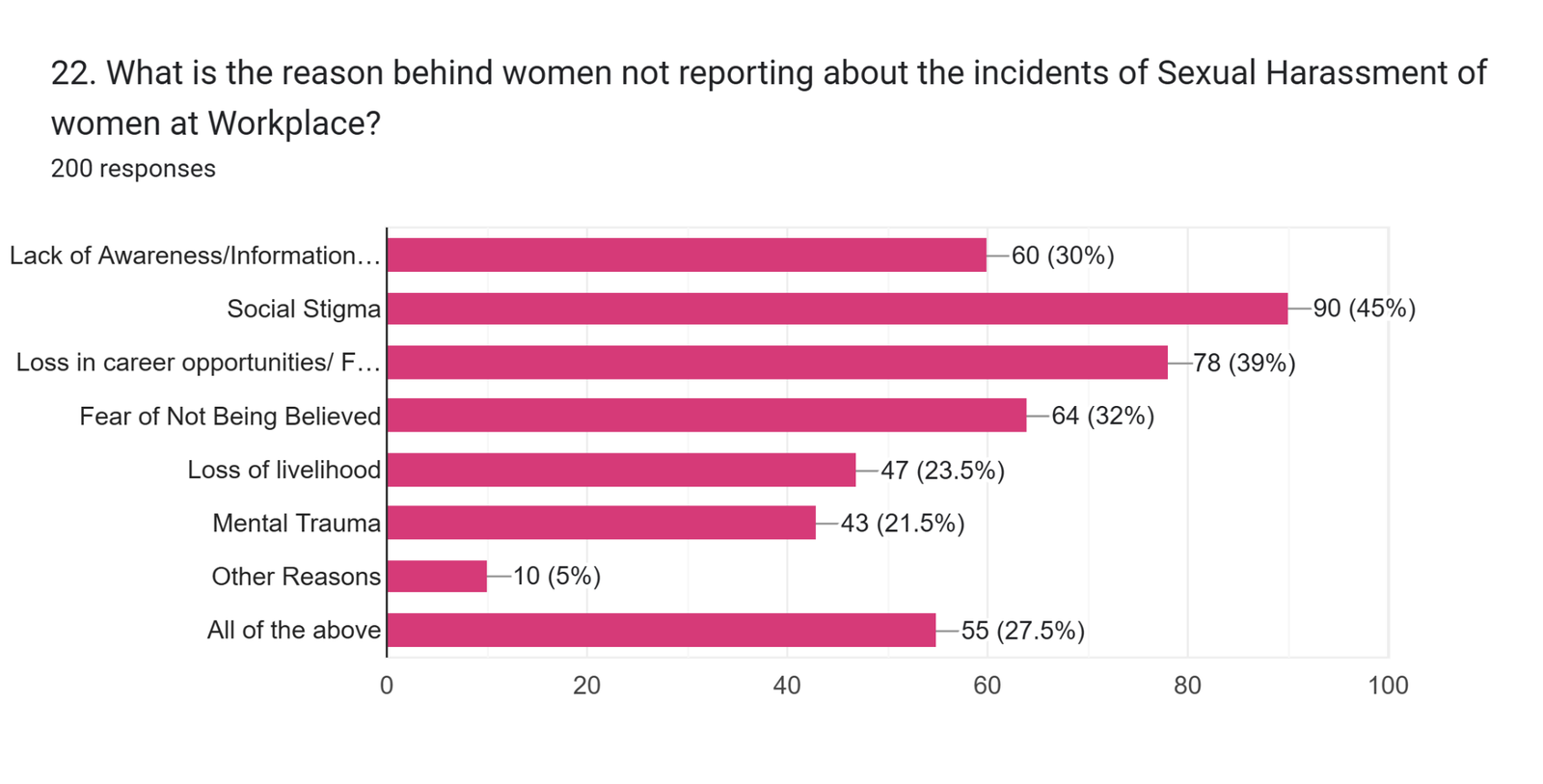 9 These results strongly correlate with patterns identified in secondary literature and point to a significant gap between legal provision and practical enforcement.
D. Limitations: While the empirical data enhances the reliability of the study, the findings are geographically limited to Delhi and adjacent areas. Additionally, because the survey depended on self-reporting, responses could be influenced by hesitancy in disclosing sensitive experiences. Despite these limitations, the research provides a strong basis for analyzing the disconnect between policy and real world implementation.
EMPIRICAL OVERVIEW AND SURVEY FINDINGS
To develop a nuanced understanding of the reasons behind the underreporting of workplace sexual harassment, this study analyzed responses collected from 200 working professionals employed across both organized and unorganized sectors.
A. Awareness Levels of POSH Act: Approximately 64.5% of the respondents were aware of the existence of the POSH Act, 2013, while the remaining 35.5% admitted they had limited or no knowledge of the law. Within the unorganized sector, awareness dropped significantly, with respondents either unaware of the Act or confusing it with internal HR policies.
B. Functionality of ICCs: Out of the participants from the organized sector, 63% reported that their workplace had established an ICC. However, less than 20% of the total sample had ever attended a workplace training or orientation related to the POSH Act, indicating a serious lack of sensitization efforts by employers.
C. Reporting Behavior: Only 44% of respondents who had witnessed or experienced sexual harassment stated that they had filed a formal complaint. The majority, over 10.5%, either ignored the incident and 12.5% chose informal routes such as speaking to a colleague or supervisor. These findings reflect a disturbing trend: while the law exists, its implementation and social acceptance remain insufficient to encourage survivors to come forward.
RTI DATA ANALYSIS
To objectively assess institutional compliance with the POSH Act, a series of RTI applications were filed under the name of Author Swati Menon to various Central and Delhi state government departments, schools, public sector undertakings and municipal bodies.10
A. Status of ICC Formation: Out of the 25 institutions contacted, 20 responded. Among them, five departments admitted they had not yet constituted an Internal Complaints Committee (ICC), directly violating Section 4 of the POSH Act. Some cited “lack of complaints in the past” as the reason, indicating a reactive rather than preventive approach.
B. Training and Awareness Measures: Only six of the twenty departments had conducted POSH training or awareness workshops in the last three years. A few shared brochures or attendance sheets, but most were unable to provide substantial evidence of sensitization programs.
C. Complaint Records and Redressal: Nine institutions had received sexual harassment complaints in the past five years. However, only four shared detailed data on action taken, inquiry timelines, or outcomes. The rest either cited confidentiality or declined information under vague provisions of the RTI Act. This resistance highlights both non-compliance and a lack of transparency in dealing with such sensitive matters.
BARRIERS TO REPORTING: A GROUND-LEVEL VIEW
Combining data from the survey and RTI responses reveals several overlapping structural and psychological factors that discourage victims from reporting such instances:-
• Institutional Apathy: Many workplaces either do not have functioning ICCs or fail to actively publicize their existence. In the absence of a visible and accessible redressal system, employees tend to avoid engaging with it.11
• Social Conditioning/Social Stigma: Cultural norms often condition women to remain silent about sexual misconduct due to shame, fear of character assassination, or pressure from families or colleagues.
• Lack of Confidentiality: Respondents frequently stated concern that complaint information may not remain confidential, especially in small offices, leading to fear of social ostracization or retaliation.
• Delayed or No Action: Several survey respondents reported that even when complaints were made, inquiries were delayed, or the process was handled informally and without due seriousness.
• Absence of Legal Literacy: A lack of understanding of the law and procedural rights discourages victims from taking formal steps. This is particularly evident in lower-income groups or informal workers.
Together, these findings underscore the urgent need to bridge the gap between legal mandates and operational realities through effective implementation and cultural change.
Case Laws and Judicial Analysis Judiciary in India has played an contributory role in shaping and understanding workplace sexual harassment laws
• Vishaka v. State of Rajasthan (1997): Laid down the first legal framework for prevention of workplace harassment.
• Medha Kotwal Lele v. Union of India (2012)12: The Supreme Court emphasized mandatory compliance and penal action for failure to constitute ICCs.
• Vidya Akhave v. Union of India & Ors (2016)13: Reflected administrative failure in addressing a complaint, underscoring mistrust in redressal systems.
• Shweta Singh v. XYZ Ltd. (2024)14: the court addressed the issue of underreporting of sexual harassment at the workplace. The petitioner delayed filing her complaint due to fear of stigma and potential career repercussions. The Court held that delayed reporting does not absolve the employer of responsibility and directed the Internal Complaints Committee (ICC) to investigate the matter in good faith. The judgment emphasized that psychological, social and economic barriers often prevent timely reporting, and the POSH Act, 2013 must protect employees regardless of such delays15.
COMPARATIVE INTERNATIONAL PERSPECTIVE
Globally, countries like the United States, UK and Sweden have embedded sexual harassment protections frameworks and some conventions too.
• ILO Convention No. 19016 (2019) declares the universal right to a workplace free of harassment and violence and ILO C-190’s gender-neutral approach. While India has ratified many women-centric treaties.
• United States, UK, Sweden: Sexual harassment protections embedded in broader anti-discrimination frameworks.
• UN Women’s17 Recommendations: Emphasize multi-sectoral responses including education, legal aid and trauma-informed policies.
SUGGESTIONS AND RECOMMENDATIONS
1. Mandatory Annual Disclosure: All employers should be required to publish annual reports on POSH compliance, including the number of complaints and actions taken.
2. Government-led awareness campaigns in schools, colleges, and workplaces
3. Victim Protection Measures: Include anonymity in the complaint process and robust anti-retaliation policies. Establishment of Victim Assistance Cells for psychological and legal and trauma support and promote community-based support groups for survivors.
4. Strengthening LCCs: Provide resources, training, and enforcement powers to LCCs for outreach in unorganized sectors
5. Regular Audits: Government labor departments should conduct periodic audits of LCCs and workplace compliance to assess ICC functionality and mandatory training of ICC/LCC members with certification.18
6. Ratify ILO Convention No. 190: To align Indian law with international best practices and make it gender neutral.
7. Legal Reforms: Extend coverage to all the genders and introduce anonymous complaint systems. Extend the time period for filing complaints beyond 3 months.
CONCLUSION
Underreporting of workplace sexual harassment reflects a gap between legal ideals and ground realities. While the POSH Act has created a strong legal infrastructure, lack of awareness, implementation flaws, and societal stigma hinder its effectiveness. Empirical data from RTIs and surveys underscore the urgent need for systemic reform. Addressing the psychological, economic, and institutional dimensions of harassment through empathetic policies and accountable systems is essential for a safe and inclusive work environment for women.19 Underreporting of sexual harassment in India reflects a deep disconnect between law and lived reality. While the POSH Act provides a well-intentioned legal framework, systemic flaws in implementation, cultural conditioning, and institutional inertia continue to impede justice. Bridging this gap requires a multidimensional approach—legal reform, capacity building, and societal transformation. Only then can India hope to create workplaces that are truly safe, equitable, and empowering for all.
*****
Footnotes
1. The Sexual Harassment of Women at Workplace (Prevention, Prohibition and Redressal) Act, 2013.
2. Vishaka & Ors v. State of Rajasthan, (1997) 6 SCC 241. The Supreme Court mandated that employers must create a safe working environment by creating a complaint mechanism, and notifying and punishing offenders. Employers need to provide conducive & appropriate work conditions for women staff in the view of: work, health, hygiene & leisure. In short there mustn’t be any conditions creating a hostile environment towards working women staff and any conditions which could put women at a position of disadvantage with regards to her career compared to other male employees of the company.
3. Section 4, POSH Act, 2013 – Constitution of Internal Complaints Committee.
4. Section 6, POSH Act, 2013 – Establishment of Local Complaints Committees.
5. Section 9, POSH Act, 2013 – Filing of Complaint within Limitation Period.
6. Section 10–13, POSH Act, 2013 – Inquiry Process and Action.
7. Section 19, POSH Act, 2013 – Duties of Employer.
8. https://docs.google.com/forms/d/e/1FAIpQLSfg96NGkPF6brwgOTDU3sb9R9RmcFCYD201-tG6Iu7QnFcP5w/viewform.
9. The graph shows main reasons for non-reporting of sexual harassment of women at workplaces.
10. Right to Information (RTI) Data Filed by Author Swati Menon to Various Government Departments in 2024–25.
11. Bhattacharya, R. (2021). Sexual Harassment at Workplaces in India: Policy and Practice. Indian Journal of Gender Studies, 28(3), 412–430.
12. Medha Kotwal Lele v. Union of India & Ors (2013) 1 SCC 297.
13. Apparel Export Promotion Council v. A.K. Chopra (1999) 1 SCC 759
14. Shweta Singh v. XYZ Ltd. (Delhi High Court, 2024).
15. This case reinforces the principle that employers must maintain a safe workplace and that ICCs cannot dismiss complaints merely due to late reporting.
16. International Labour Organization, Convention No. 190, Violence and Harassment Convention, 2019.
17. UN Women, Recommendations on Addressing Workplace Harassment (2022).
18. Ministry of Women and Child Development Guidelines for POSH Compliance, Government of India, 2022
19. Report of the Parliamentary Standing Committee on Empowerment of Women, Government of India, 2023.