
INTRODUCTION
Crime is an inseparable part of the society. There is no society in the world that has not faced the issues of criminality. According to Drukheim, even a society composed of angelic qualities would not be free from violations of the norms that society1. While the interests of stakeholders of a particular crime may vary to different nature, multiple reasons, causes and impact, the effect of a crime on the society is common to any form of crime. It is due to these reasons that many philosophers consider crime as eternal, just as sickness, disease, or death. Everywhere, every time, there have been instances where conduct of some or the other member of the society has fallen outside the pattern of permissible social limits. According to the social definition of crime, it is believed to be ‘an act which the society regards as sufficiently menacing to its fundamental interests.2’
Crimes by Juvenile has witnessed a new high in the past few years. Children are born innocent, and if raised and nourished with care, they have the potential to blossom physically, mentally and become a boon for the society. On the other hand, noxious surroundings, neglect, torture, wrong company, temptations have the potential to blemish the child and are most likely the reasons for turning the child into a delinquent. Juvenile delinquency is the gradual behavioral change in a child which lately goes on to become a concern for the society.
CONCEPT OF JUVENILE DELINQUENCY
Juvenile is derived from a Latin word ‘juvenis’. According to Article 13 of the United Nations Convention on the Rights of the Child, ‘a child means every human being below the age of 18 years.’”
Criminal behaviour committed by a minor under the age of 18 is known as juvenile delinquency. Juvenile delinquency, in other words, is described as minors engaging in illegal activities. Juvenile delinquency is easier to recognize than to define. Rendering to the New Mexico definition4, ‘An aberrant child is one who is regularly unrestricted, persistently rebellious, or habitually errant because he consistently refuses to follow his parents’ or other persons of lawful authority’s fair and legalised commands..’
While sociologists define juvenile delinquency as anti-social behavior by children, the lack of preciseness in interpretation of the term ‘anti-social behavior’ could lead to difficulty in defining the term delinquent.
The legal definition of the term juvenile delinquency is more precise as it refers to any act of children up to a prescribed age which is prohibited under the law; therefore, a child found to have committed an act of juvenile delinquency by court is a juvenile delinquent. Sol Rubin in his book Crime & Juvenile Delinquency (1958) draws inference from generally prohibited acts under various American States in understanding as to what constitutes acts of juvenile delinquency in general. According to him the following list though not exhaustive covers few significant actions of juvenile delinquency5:
• Defilement of any law order
• Dissolute or indecent manner
• Dissolute conduct around school
• Engaging in illegal occupation
• Knowingly associating with vicious or immoral persons
• Growing up in idleness or crime
• Knowingly entering or visiting houses of ill repute
• Patronizing, visiting policy shop6 or gaming place or liquor shop
• Routinely using dreadful, indecent or vulgar language
• Indulging in consumption of drugs or smoking cigarettes
• Absenting oneself from home without permission
• Incorrigible
This list on the understanding of the concept of juvenile delinquency was believed to be very vague in nature and drew extensive criticism on the ground that it was not required to use police and courts in petty matters or ‘private matters’ which can better be resolved by the family themselves. Later in the Second United Nations Congress on Prevention of Crime and the Treatment of Offenders held in August 1960, London, among various other recommendations the Congress adopted that the meaning of the term juvenile delinquency should be restricted as far as possible to the violations of criminal law. In India, the notion of juvenile felony is limited to defilement of normal penal law, so far as the jurisdiction of juvenile court is concerned.
HISTORY OF JUVENILE DELINQUENCY
Juvenile Delinquency is not a thing of recent origin. People belonging to all age groups have forever been victims and offenders of criminal laws. The chapter employs a historical approach to demonstrate the concept of juvenile delinquency and present-day perceptions regarding juvenile and their participation in crimes.
Many people used to be thinking of the categories of age as secure and ordinary and have since ages attached behavioral aspects to each category, and there is a transcending stereotypical notion that persons belonging to the particular age group should behave within the said age boundaries. A staunch denial to act in a particular manner as per the age is most likely to be interpreted as ‘anti-social’. Though expectation attached to age is culturally produced its continuous overreach significantly has potential to constitute a crime. Sheila Brown in her book, ‘Understanding Youth &Crime’7, states that “Children acting ‘like adults’ pose, somehow, a threat; similarly, perhaps some of us do not like to see ‘mutton dressed as lamb”.
Children are generally presumed to be innocent. However, the notion and urge of adapting to adulthood tend to create a lot of trouble and also violence in many cases. This can be well understood through the horrific Bulger case. The case that took the whole world with shock and surprise was a significant in understanding the psyche of two young children. As per The Guardian reports8, on February 12, 1993, two children namely Robert Thompson and Jon Venables, both aged ten, took two years old James Bulger by hand and then took him two and half miles away to railway line, where they killed James Bulger. The killing could no longer be considered a mere commission of crime, but it was abrogation of childhood. The deliberate and violent killing of the child raised substantial question in the mind of many who portrayed children as humans with angelic values.
Rousseau once said9,‘childhoods’ is a sleep of reason’; a time of innocence, simplicity, irrationality; we should ‘hold childhood in reverence’. Both the accused who went on to become the youngest pair to be held guilty for murder in English historywere sent to a Juvenile Institute until they attained the age of 18.However, there was a serious resentment among many groups of people; feeling of dystopia had started to appear in the society, which could not accept children fulfilling the negative stereotypes of aberrancy, disruption and wickedness prevailing about them. The sensation of adulthood, as earlier stated starts to bring in more serious issues for the child. In 2008, seven years after the release of both convicts of the Bulger case, one of them was rearrested on the charges of drug use the child continued his behavior and was again arrested in 2013. The commission of crimes and delinquency leaves a long-term impact on the behavior of the child, and he or she is most likely to commit similar or graver offence in later stages of his life.
Considering the wide range of delinquent activities, UN for example identified ten areas of greatest priority for the governments in its World Programme of Action for Youth to the Year 2000. It included10education, engagement, famine and lack, health,environment, drug abuse, juvenile felony, relaxation time activities, girls and young women, and full and effective participation of youth in the life of society and in decision-making. Each of the issues appear to be complimentary to each other and it is impractical to suppose that of two or more issues shall not co-exist in the multi diverse society we live in so as to result in exploitation of children.
TYPE OF JUVENILE DELINQUENCIES’”
Type of Juvenile Delinquencies’ can be divided in various categories. The paper covers one significant perspective related to the type of juvenile delinquency: the concept of labeling theory. Howard Becker11 has the distinction of propounding the idea of labeling perspective. He classifies delinquencies into four categories:
i. Individual Delinquency
This type involves delinquent behavior or commission of crime by an individual, whose cause is located within the delinquent individual. There is a belief that this type of delinquency occurs due to psychological problems arising out of rejection, jealous attitude with siblings and many other family issues. The involvement of juveniles into this form of delinquency is primarily with the intent to resolve these issues. Unhappy home lives and discontentment at life situations caused these issues to arise and contribute towards delinquent behavior of the child.
ii. Group Supported Delinquency
In this scenario, delinquency is committed in the society of his peers. The cause of this kind is found not in the man, but in the natural and social environment in which he lives. Young children are frequently exposed to delinquent adults and have a proclivity to adapt their behaviour. Prominent philosopher Sutherland later clearly defined this behavior as Differential Association Theory, according to the behavior of an individual is based on the behavior of the association of his companionship.
iii. Organized Delinquency
As the term itself suggests, this form of delinquency involves delinquent behavior by formal organized groups. The ideadenotes to the set of standards that directs the behavior of group members who stimulate the commission of such felonies, reward them with status on the basis of commission such acts and define typical relationships to individuals who fall outside the group and are yet governed by group norms.
iv. Situational Delinquency
This type of delinquency refers to a system where the individual is not guided by any outside factors but his/her delinquent action is based on a particular situation. Unlike other forms of delinquency, situational delinquency has a completely different perspective and reason for commission of an action is highly attributed to situation. A child is believed in indulging in delinquent activities without having a commitment towards it and rather based on his/her impulse.
The basis of classification of juvenile delinquents, according to Schafer12, is psychological typologies and psychological dynamics of personality. He has envisioned the types listed below:
Mentally Defective –It refers to a person who has an organic problem and is unable to control himself as a result of it. Mentally retarded children are also included in this category.
Situational Offenders –These are similar to accidental offenders, but there are more contributing factors in these cases. A crisis or some external event that they are unable to handle triggers their delinquency.To put it another way, they do not go out looking for trouble, but they don’t use good judgement due to the circumstances.
Offenders with Psychotic Disorder – Only a small proportion of children are not exposed to the realities of life. They could be diagnosed with schizophrenia or another psychiatric disorder. As a result of their dysfunctional thought patterns, they may hallucinate, have delusions, or “hear voices” encouraging them to engage in specific kinds of delinquent behaviour. Psychotic focused delinquency is uncommon compared to other types of delinquency.
Cultural Offenders – This group of teenagers may have copied a faculty identification model or dwell in a financially and socially disadvantaged setting. In their own communities, cultural offenders are regarded as typical members of a deviant subculture, and their patterns of behaviour are generally accepted and referred to as normative.
CAUSES OF JUVENILE DELINQUENCY
The social, economic, and cultural conditions that exist in a country influence the intensity and severity of juvenile offences. The sociological approach aims to explain the prodigy of criminal behaviour by looking at factors other than the delinquent’s personality. A combination of psychological, social, and economic factors contribute to delinquent behaviour, as well as crime in general.
Juveniles’ decision to pursue delinquent careers, as well as the continuation of delinquency, is influenced by a number of factors, the most important of which are listed below:
a. Mass Communication, Media & Crime
The cinema, the press, and television have all become immensely essential mediums of mass communication in today’s globe. In addition to achieving desirable outcomes, these tools have the potential to produce major social problems.
Basic standards represented and showcased by media, which is accessible to all, are far beyond the reach of many families in many developing and developed countries. However, for many people, these unrealistic things become a virtual dream, and many of them engage in and go to any length to realise their so-called dreams. The United Nations reports that13, ‘Excessive attention on stated goals (getting success) combined with insufficient resources to fulfill them is thus one of the causes of delinquent behaviour.’ Not only do televisions have the ability to hinder the growth but also may sometimes result in causing negative assumptions in the minds of children.
Though the scope and severity of the problem in India differs from that in Western countries, young people are found highly ‘appreciative’ of the movies depicting violence and sexual behavior. The unprecedented success of movies depicting violence, rash driving, sex, drug abuse etc is the evidence how these audio visual mode has now gained the authority to rule the young minds. The excitement for ‘violent and stunt’ scenes of some movies and the tendency to imitate the same, have on numerous occasions led to accidents and caused injury to oneself and others. Many movies have portrayed toxic obsession with fairness hence becoming a leading giving rise to leading issues such as racism. Consumption of drug and liquor too has been normalized in movies which have detrimental effect on the lives of children. A lot of situations have been documented in which young children attempted to imitate a celebrity and ended up delinquent.
In one of the episodes of famous TV show Shaktiman, who was potrayed as a superhero, there were as many as 17 acts of violence in the span of 20 minutes which included, assault, slapping, punching, shooting, strangling, burning, pushing, stabbing, bodily transformations and supernatural occurrences. All of these had long lasting impact on children as many tried to imitate and practice all of these in their real lives.14
There are hundreds of shocking incidents, commission of which has largely been inspired by the television. In one of the horrific incidents reported by the Hindustan Times on October, 29, 2000 (New Delhi Edition)15, On his way to his aunt’s house, Badal, an 11-year-old boy, came upon a young boy clutching his six-month-old baby sister. Badal kidnapped the baby, dragged her down a drain, and drowned her. ‘I used to pass this infant every day on my route and would wonder what it would be like to see her drown,’ the kid is believed to have remarked. He admitted to choking two more youngsters he had tempted with banana. Badal claims that he killed them because he enjoyed seeing the bubbles in the water and the youngsters struggle whilst he drowned them, and that the thought came to him after watching a television show called “Captain House.”
b. Social Factors
Ascertaining the causes of adolescence instability requires considerations of various factors. Delinquent behaviour is prevalent in human environments wherein acceptable behaviour norms have degraded.16 Many of the core tenets that restrict offender from committing socially unacceptable behaviour may lose their relevancy for some members of society in such circumstances. Children respond to changes in reality by acting in deviance and even commission and involvement in criminal activities.
The term anomie has widely used in the field of criminology in understanding the role of society in commission of crime. Concept of anomie as an analytical tool was suggested first by the French sociologist Émile Durkheim who through his seminal works of sociological theory and method, studied how extreme social conditions can influence deviant behavior and crime. For example, in India, the theory is reflected well in one of the important area of contemporary concern for the juveniles, use of unfair means. Examination is treated as one prime indicator of success and hence the urge to qualify and secure high marks drives most children towards indulgence in unfair means. Deviance and delinquency becomes the most obvious outcomes of such desires. Examples of children hurting their teachers, invigilators, destruction of properties are very much common throughout. The imaginary belief amongst the children about the societal pressure is significant factor in many cases.
It is paradoxical though true that sometimes the very norms laid down by the society tend to produce opposite results in the form of criminal behavior. According to Merton17, what is encouraged in the society is ‘successes and so goals are more important than the means to achieve those goals. Consequently, these delinquents feel justified in seeking and resorting to shortcuts irrespective of the nature involved in adopting such shortcuts. Various other social factors such as poverty, migration, slim life, delinquent gangs, social and occupational success etc have largely contributed towards social factors responsible for juvenile delinquency.
c. Associational Impact
According to Prof. M.J. Sethnaopine18, the development of juvenile delinquency is influenced by a variety of environmental influences. The influence of associations on a child’s life is an essential issue. According to Gabriel de Tarde, a French jurist and social psychologist, criminal behaviour is the result of a learning process, and a person learns it just like any other trade he learns as a child.‘Themajority of murderers and notorious thieves began as children,’ he claims… and the true seminary of crime must be sought in each public square or crossroads of our towns…in those flocks of pillaging street urchins who, like a band of sparrows, banded together, at first for marauding, then for theft…without any natural predisposition on their part, their fate is frequently decided by the influence of their comrades.’
Sutherland believed that an offender’s deviant behaviour is learned through a process. Sutherland’s theory is based on the following key principles19:
• Deviant behaviour is something that can be learnt.
• Deviant activities are picked up through human engagement in a communicative process.
• Deviant attitudes are quite often fostered within close friends. Learning deviant tactics, motivations, and tastes are all part of learning antisocial behaviour.
• Learning deviant tactics, motivations, and desires are all part of learning deviant behaviour.
Sutherland’s idea is made up of two major components. The first is based on the idea that deviant conduct, including criminal tactics, may be learned. The second section discusses the method by which a person learns aberrant behaviour. According to his theory, such behaviors are inculcated through communicative process involving people generally associated with the criminal behavior.
The likelihood of a child being delinquent if he falls under bad companionship is high as the child within no time starts to behave like a member of the group. The damage is irreparable and prolonged association even tends to make the child criminal in many cases. Several instances of juveniles being caught in delinquent habits such as consumption of drugs, alcohol and sexual indulgence have been reported. Indulgences in these habits have the potential to induce the child into commission of serious crimes of theft, murder, rape, acid attacks etc.
d. Family Influence
Across countries, the factors that contribute to teenage delinquency and crime are rather similar. Family adversity, according to worldwide data, leads to educational disadvantage, which leads to underachievement, economic marginalization, and social exclusion. Family is thought to be one of the most important social institutions in shaping an individual’s behaviour. It is not only an individual’s first social contact, but it also determines their behaviour in relation to the rest of the world. Upbringing, social environment, child treatment, nutrition, emotional values, and a variety of other factors all play a role in shaping an individual’s perception of society. According to psychologists, a child’s basic personality is formed in the first 10-12 years of his life, and it is highly likely that the child is cared for by his family during this time.
Lack of care and affection, or in some cases, excessive benevolence, is frequently perceived as a major contributor to a child’s anti-social behaviour. A child’s physical and social needs are largely met by his parents and family, and as a result of this dependence, the child becomes ingrained in family behaviour, which has a significant impact on his individual progress. Juvenile delinquency is directly linked to dysfunctional family contexts defined by conflict, lack of parental authority, inadequate internal links, and integration.
A family may either be structurally normal or a broken family. A structurally normal family is the one in which both parents are alive and live together with the child. However, broken family would mean where the child does not stay with the family, due to various reasons such as death of one of the parent or due to divorce or separation. Strained family relations coupled with broken homes result in causing serious mental impact on the child and many studies have established direct links between these mental issues and juvenile delinquency.
Although the family remains the most essential agent of socialisation for children, the reality that some groups of people outside the family have a significant impact cannot be overlooked. Teachers and peers begin to play a larger part in the lives of the kid, acting as reinforcers and models for the imitation of new and diverse reactions.20 Treatment of child with inadequate care, negligence, physical abuse at both family and school level can prove to have catastrophic results in long run.
e. Economic Factors
Negative consequences of socio-economic development and weakening of major institutions have a key role to play in its contribution towards poverty and unemployment. Unquestionably, poverty, illiteracy and unemployment have direct nexus with the rise or growth in crime. Economic factors driven due to discontentment contribute largely towards delinquency and commission of crime. Identification and analysis of various data pertaining to rise in delinquent juveniles show that children and families suffering from poverty have the maximum participation. The fact that poverty and economic suffering is the key reason for crime in urban and rural areas is not a mere hypothesis. In many developing countries, large scale industrial growth and rapid urbanization have led to the drastic increase of slums in those areas which later become breeding grounds for juvenile delinquents.
William Adrian Bonger, explained the phenomenon of capitalists induced crimes through application of Marxist approach in his book An Introduction to Criminology, wherein he established that criminal is a product of capitalist system. According to him, ‘The oppressed turn to methods that they would normally condemn…reciprocity is the foundation of social feeling.’ He considered key issues such as child labour, long working hours, inadequate wages, torture and treatment of disdain as driving factors of juvenile delinquency.
STATISTICAL STUDY OF CRIME BY JUVENILES
Juvenile offenders receive separate treatment in the criminal legal systems of most of societies in comparison to adult or any grown up offenders. It is a well-established social thought and legal principle that persons belonging to young age do not pose sufficient maturity to understand the nature and consequences of their acts in comparison to adults. Based on these principles and thoughts, various legislations pertaining to the protection of juveniles from being accustomed to criminal legal system have been formulated. These legislations have gained good acceptance because of its reformative method. However, the fact that many of the protections provided under these laws have been misused is not completely undeniable.
In this chapter, the researcher aims at studying various statistical data pertaining to crimes committed by juveniles and identifying and analyzing the most common reasons for the commission of the said crimes. Towards the end of the study, it would also be easy to understand whether the common belief that number of crimes committed by juveniles have seen a spike in the last few years is just a mere hypothesis or is in fact a well-established fact. The areas of the study would include identifying the most common types of crime committed by the Juveniles.
A. Source of Data
The primary source, from which relevant data have been extracted in order to make a comparative study of causes, numbers and nature of offences committed by juvenile, is from the annual statistical publication of ‘Crime in India’ magazine published by the National Crime Records Bureau (hereinafter referred as NCRB). The magazine is the oldest publication by the body that was established in 1986, based on the recommendations of the National Police Commission, 1977 by the Ministry of Home Affairs, Government of India.
The researcher has made a study of the ‘Crime in India’ magazine of the last three publications available on its official website.
B. Number of Crime Committed by Juveniles
Chart A
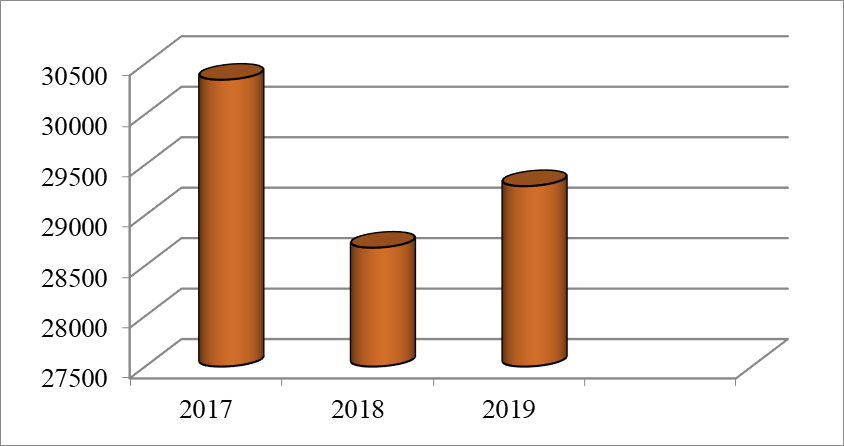
Table 6A
| Years | Total Number of Crimes |
|---|---|
| 2017 | 30341 |
| 2018 | 28677 |
| 2019 | 29287 |
Contrary to the common belief that crimes committed by juveniles have seen a significant rise in the last few years, the commission of crimes by the people belonging to the age group has seen a decline. However, it is pertinent to mention that despite witnessing a substantial decline in rate of commission from 2017 to 2018, the number increased slightly in the year 2019.
Chart B: Crime Committed by Juveniles-State Wise Studies for the year 2019
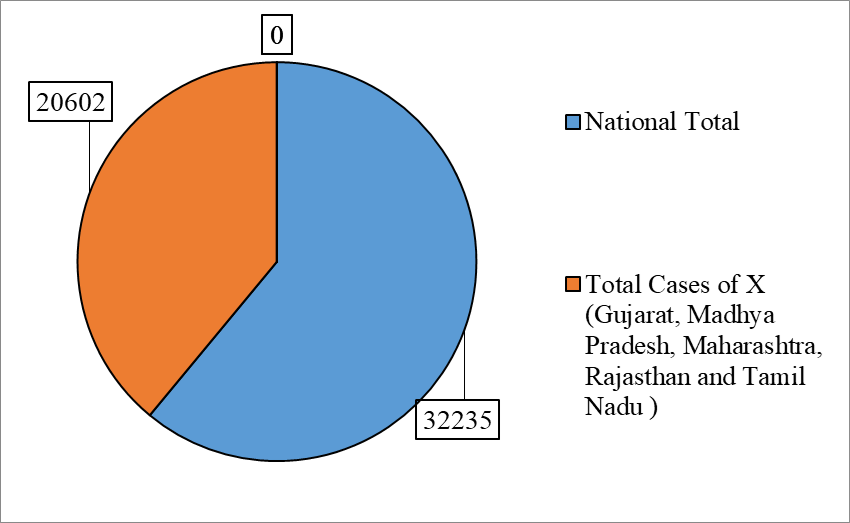
Further study of the data shows that densely populous and comparatively developed states such as Gujarat, Madhya Pradesh, Maharashtra, Rajasthan and Tamil Nadu (hereinafter collectively called X) collectively have shown figures above two thousand per year accounting to more than 50% of the national total. Surprisingly the most populous state of Uttar Pradesh has been reporting only around one thousand cases per year.
C. Education & Family Background
Chapter I of the research paper identifies various causes and reasons for juvenile delinquency of which illiteracy is attributed with one of the most common reasons for delinquency. The following study is aimed at identifying and analyzing whether education or illiteracy has any role to play in juvenile delinquency.
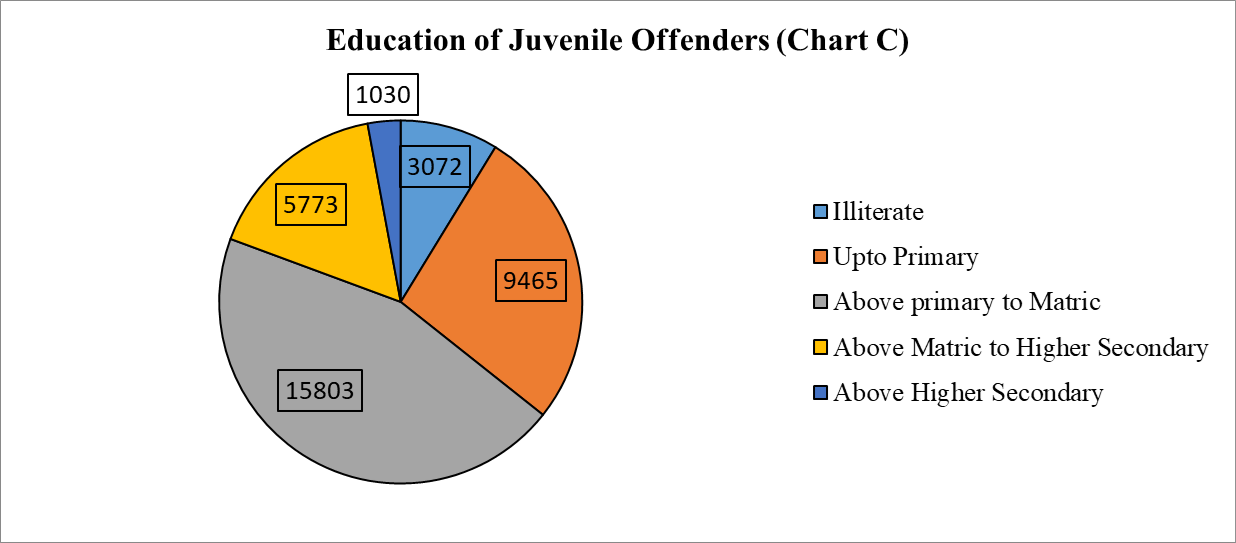
According to the data available on the NCRB’s website for the year 2019, the education of the delinquent offenders have been classified into five categories, namely, Illiterate, up to primary, above primary to matric, above matric to higher secondary and above higher secondary. Careful analysis of the said data reveals that despite illiteracy being blamed as one of the prime reasons for delinquent activity of children, the substantial fact and figures do not support the same.
While the number of illiterate juveniles committing crimes remain at 3072 out of the total figure of 35143 (which is around 8.74% of total figure), the number of juveniles apprehended for commission of crime belonging to the category ‘above primary to matric’ remains the most prevalent, amounting to 15803(which is 44.96%) followed by juveniles having primary education and above matric to higher secondary education.
Table 6B
| Year | Illiterate | Upto Primary | Above primary to Matric | Above Matric to Higher Secondary | Above Higher Secondary |
|---|---|---|---|---|---|
| 2017 | 3054 | 9493 | 15986 | 5986 | 1422 |
| 2018 | 2918 | 9406 | 15625 | 5637 | 1001 |
| 2019 | 3072 | 9465 | 15803 | 5773 | 1030 |
An analysis is shown above (Table 3B) of the records available on the website for the previous 03 (three) years for the same category which identifies one of the main causes of delinquency. The data clearly shows the contribution of juveniles belonging to above primary to matric category involved mostly in crimes by juveniles.
It is pertinent to mention that, in most cases juveniles belonging to the said category are aged between 05 (Five) to 15 (Fifteen) years of age, which signifies large scale immunity being provided to them under juvenile legislations. The board shall decide on children under the age of sixteen on the day of the commission of an offence under Section 14(5)21, of the JJ (Care and Protection) Act, 2015. Additionally, Section 18(1) of the Act specifies how the board will proceed with the matter and what orders the board may make. The board may:
• enable the child to return home after receiving suitable advise or admonition, as well as proper inquiry and counselling for the youngster and his parents or guardians;;
• encourage the youngster to participate in group counselling and other activities of a similar nature.;
• order the child to undertake community work under the guidance of an organizational system, or of a particular individual, persons, or group of people identified by the Board;
• levy a fine on the child, his or her parents, or the child’s guardian
D. Classification of Nature of Offences
In this part of the chapter, the researcher shall study the various types of crimes committed by the juveniles. The types of crimes under the Indian Penal Code, 1860 (hereinafter IPC) are classified into two broad categories, namely offences affecting the human body and offences against property.
Consequently, offences against the human body encompass Murder (Section 302, IPC), Attempt to Commit Murder (Section 307, IPC), Hurt & Grievous Hurt, Assault on Women with Intent to Outrage her Modesty (Section 354, IPC), Rape (Section 376, IPC), and so forth, while offences against property include theft, robbery, burglary, and so on.
While the other categories such as offences against public tranquility, state and other IPC Crimes have a mild contribution towards the total number of crime committed by juveniles, the number of cases falling under the categories of offences affecting human body and offences against property has a major contribution. Further analysis shows that the numbers of offences against human body and offences against property have a slight difference of 300 cases.
Table 6C
| Nature of Offence | Number of Cases (for the year 2019) |
|---|---|
| Offences Against Human Body | 1217 |
| Offences Against Property | 11873 |
The researcher has further classified the offences and identified major crimes under each of the above category that have been committed by the juveniles. For the convenience of presenting the data, heinous crimes such as murder, attempt to murder, hurt & grievous hurt, crime against woman (including attempting to outrage the modesty, rape, attempt to commit rape) have been taken for the study. It is important to note that highly contribute to the total figures have been mentioned.
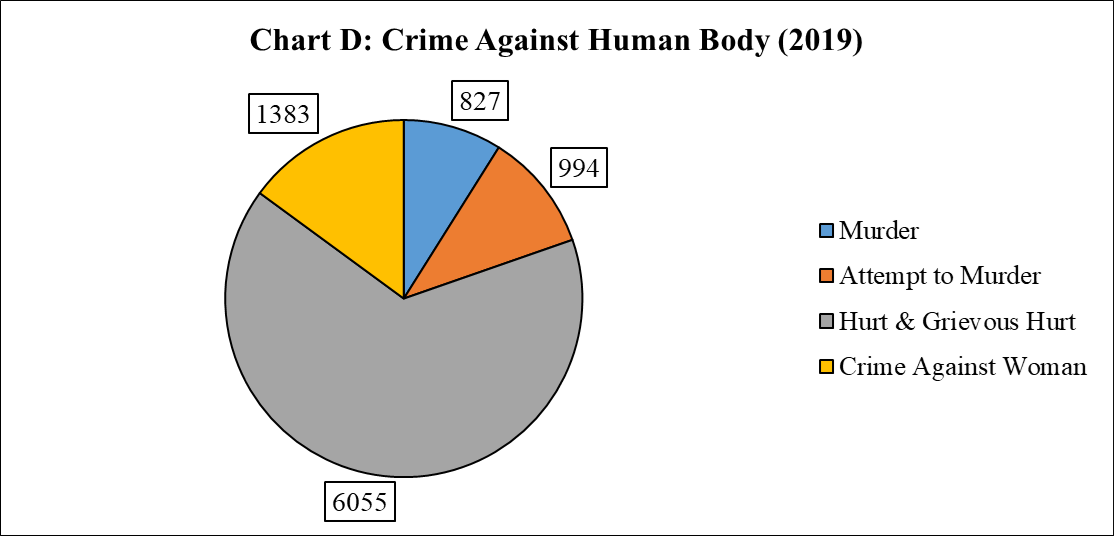
The chart clearly shows that hurt and grievous hurt contribute the most towards the total number of cases. Hurt and grievous hurt constitute 49.74% of the total number of cases affecting human body, followed by crime against woman which contributes around 11.36%.
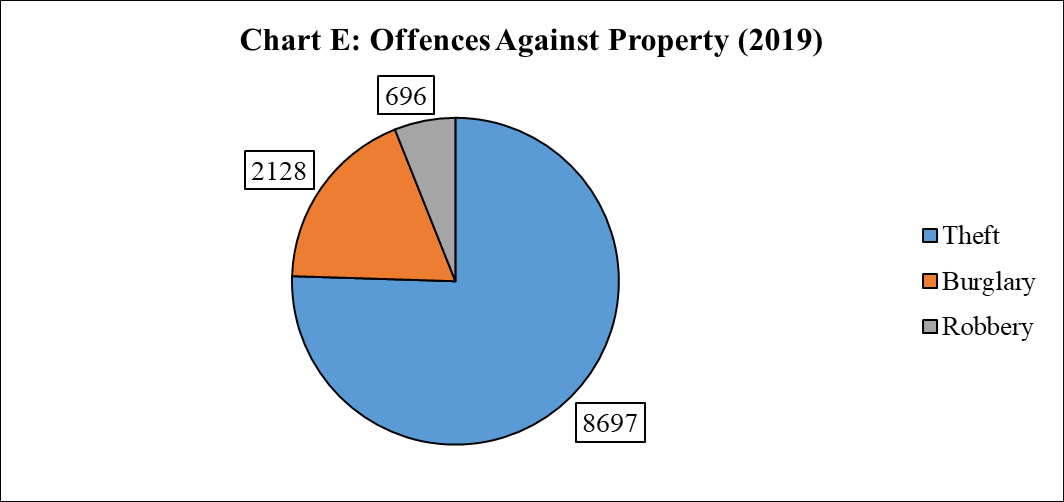
The study shows that theft is amongst the most dreaded contributory of the offences against the property with around 73.25% contribution to the total number of offences against property. The number of juveniles committing theft is higher than number of juveniles involved engaged in commission of offence of hurt/grievous hurt or crime against women.
Another significant area where juveniles are actively involved in commission of an offence is rash driving on public place.
Table 4D (Figures for Rash Driving on Public Road, 2019)
| Year | Number of Juveniles Involved |
|---|---|
| 2017 | 1239 |
| 2018 | 1174 |
| 2019 | 1233 |
Though the figures for the last three years are not sufficient for the same to be classified under the head of heinous offence, but it must be significantly noted that this rise could have worrisome effect in the long run. It is observed that more and more juveniles are being familiarized with motor vehicles and lack of understanding of the safety equipment poses massive threat not only upon the life of the juvenile but also endangers the life and safety of other people on the roads.
CONCLUSION
The researcher defines juvenile delinquency as an unwelcomed behaviour of a child that is socially not tolerated in society. “A child acting like an adult” is what a juvenile delinquent is defined as. The child’s behaviour may appear to be foolish, but it is actually a cause for concern. Delinquency is thought to be considered only when a child’s behaviour is harmful. A list of actions or circumstances that are included in the classification of delinquency was proposed by the researcher, including “violation of any law or ordinance, habitual absence, alliance with thieves, brutal or immoral persons, and beastly beyond parental or guardian authority.”
In the fight against delinquency, our schools have the potential to be one of our most powerful weapons. For children, schools are like a second home, and they play a significant role in shaping their overall behaviour. Teachers and administrators who are aware of these challenges and take appropriate measures to prevent a child from going down the wrong path become extremely important. Every school should appoint a teacher with specialised knowledge of psychology and student-related issues, and the parents-teachers’ squad should be vigilant to uproot this evil before it spreads too far for children.
Everyone can see the growing influence of media and social media on today’s generation. Headlines about juvenile delinquency abound in our newspapers, television shows, and social media sites. Our children understandably believe that they must live up to the expectations of the media. Certain films and content must be kept out of the hands of children. Censorship should be strictly enforced. Instead of emphasizing the sensational aspects, scandals, and a false heroism in delinquent behaviour, newspapers, magazines, radio, television, and motion pictures should interpret juvenile delinquency in terms of honest reports about causes and protection of youth.
*****
Footnotes
1. S.M. Afzal Qadri, Ahmad Siddique’s Criminology, Penology and Victimology 4 (7th edn., Eastern Book Company, 2016).
2. Ibid.
3. Convention on the Rights of the Child, adopted by General Assembly Resolution 44/25 of 20 November 1989, available at: https://www.ohchr.org/en/professionalinterest/pages/crc.aspx (last visited on April 3, 2025 at 01:23 PM).
4. Supra Note 3 at 377.
5. Supra.
6. Policy Shop is a place where illegal gambling takes place.
7. Sheila Brown, Understanding Youth and Crime 3 (2nd edn., Open University Press, 2005).
8. The Bulger Case: Chronology, The Guardian, December 16, 1999, available at: https://www.theguardian.com/uk/1999/dec/16/bulger2 (last visited on March 2, 2026 at 07:28 PM).
9. Understanding Youth & Crime, Sheila Brown, Open University Press, Second Edition, 2005, page 5.
10. United Nations, World Programme of Action for Youth to the Year 2000 13, available at: https://www.un.org/esa/socdev/unyin/documents/wpay2010.pdf (last visited on April 2, 2021 at 03:21 PM).
11. C. Venkatachalam & S. Aravindan, “Juvenile Delinquency as a Result of Broken Homes,” Journal of International Academic Research, Vol. 2, Issue 8 (September 2014).
12. Stephan Schafer, Juvenile Delinquency: An Introduction (1st edn., 1970).
13. Ibid.
14. K.D. Gaur, Textbook on Indian Penal Code 132 (5th edn., Universal Law Publications).
15. Ibid.
16. Ibid.
17. S.M. Afzal Qadri, Ahmad Siddique’s Criminology, Penology and Victimology 55 (7th edn., Eastern Book Company, 2016).
18. Ali Ayar, Yaser Lotfia & Elias Nooraee, “The Effects of Social Factors on Committing Crimes: A Case Study of Darehshahr Prison, Iran,” Asia Pacific International Conference on Environment-Behaviour Studies (2011), available at www.sciencedirect.com at 4.
19. Mohd. Wasim Ali, Juvenile Delinquency in India: A Socio-Legal Study 4 (SCC Online Web Edition, 2021).
20. K.C. Panda, Elements of Child Development (A Basic Text for Students in Development) 235 (Kalyani Publications, Reprint 2001).
21. Section 14(5)(f)(i), The Juvenile Justice (Care and Protection of Children) Act, 2015.