
INTRODUCTION
India has become the fastest growing startups industrial sector in the world which reflects the dynamic changes in the economy. Startups plays major part in re-establishing the structure of the traditional businesses through innovation and technologies. By large youth generation, it develops the digital penetration and supportive environment. These startups are not ended within the metropolitan cities which also spread all II tier AND III tier cities. It focuses only on the productivity, competitiveness and modernization of sectors. By establishing self-employment and entrepreneurship, it decreases dependency on government and private jobs. It creates the jobs in healthcare, technology, manufacturing education and services. This makes India as the strongest human capital and workforce adaptability.
Innovation is the core idea of the startups in India which enables to address the marketing challenges. The real world problems in the fields like financial inclusion, digitalized payments, renewable energy and rural development are being solved by many startups in India. This innovating idea approach led to supports inclusive growth and good quality of life. Consequently, it the instrument for economic and social development. The Indian startups company’s role in attracting domestic and foreign investments plays a major part. Venture capital, private equity, and foreign direct investment flow into startup ventures, boosting economic activity in India.
There are many government initiatives like startup India, Make in India, and Digital India have further more increased confidence of the investors. Now India has become one of the most important global hub in entrepreneurship and innovation. In India, the economic development and global competitiveness makes the startups to be considered as an essential pillar. They promote economic diversification by reducing reliance on traditional sectors like agriculture and manufacturing. By collaborating the technology in manufacturing it increases the productivity and efficiency in all industries. Thus, the future of India’s economic development is mostly dependent on startups.
Statement of the Problem
Despite India’s rapid economic growth and emergence as one of the world’s largest startups ecosystem, the actual contribution of startups to economic development remains uneven and insufficiently examined. The startups are mostly generating many employment opportunities, promote innovation, enhance productivity and inclusive growth yet it is facing many structural and regulating challenges. The startups are mostly concentrating on urban and metropolitan cities by not focusing on rural area which raises concern on regional imbalance which affects economic development in India. while the government initiatives for the startups are aims to concentrate on entrepreneurial growth which varies sectors and regions mostly. Thus, the problem of the startups in India understand based on how these startups will be contribute to the economic development in the future.
Review of Literature: Arshe Azam (2021), 1A startup is a young entrepreneurial, protractible business model built on innovations & technology wherein the founders develop a product or service for which they anticipate the demand through interruption of existing or by creating entirely brand new markets… So, Indian Government in the leadership of Narendra Modi has decided to offer a gift as a nation wise programme-” Startup India”.” Startup India is a revolutionary scheme that has been started to help the people who wish to start their own business. These people have ideas & capabilities, so the Government will give them support to make sure they can implement their ideas and grow.
Joanna Szarek (2018)2, The aim of this article is to determine the impact of startup businesses on the innovation of the economy. The article attempts to define the concept of startup as a business, based on an innovative idea or pioneering business. As a result, they are companies that create a completely new product or service, not based on replicated offers from other market players, and do not replicate existing ones. The development of new businesses is an opportunity to improve the condition of national economies and the situation of society.
Vladimir Menshikov (2025)3, In today’s world, startups play a key role in driving innovation by facilitating the development of new technologies, products and business models. Thanks to their flexibility, high adaptability and focus on cutting-edge solutions, startups drive sustainable economic growth and accelerate technological change in various industries. They introduce breakthrough technologies that can change the market, creating new opportunities for business and society.
Valbona Mehmati (2024)4, This paper examines the importance and the role that start-ups play in securing the future economic growth and development of a society, thereby concluding that Albania must do a lot more to afford start-ups the right and favorable environment for their flourishment. Start-ups are a relatively late comer to the Albania’s innovation and business scene, and this definitely has a bearing on its development endeavors. As of today, Albania has about 88 start-ups per 1 million inhabitants, whereas the European Union average is of 250 start-ups per 1 million inhabitants.
Natalia Kriuchkova (2025)5, Understanding how economic factors affect a business is essential to making smart decisions and leading a business. However, this starts with understanding the role of internal and external factors and how they play out in a business. For the successful implementation of a new project, a certain amount of start-up capital is required. A start-up is no exception, although it is hard to call it a full-fledged business; a start-up is a project of any kind that is just starting to develop in the market.
Research Gap of the Study
Despite the growing literature on startups and economic development in India, several important research gaps remain as undisturbed. Most of the studies which are existed today are neglecting the startups in Rural areas, semi urban and under developed districts. Beyond the technology, there are many sectors like agriculture, healthcare, education and manufacturing are still remained as unexplored. There is a minimal scholarship attention for the gender led societal based startups. There is no systematic analysis in formalization informal economy. Existing research largely relies on secondary data, with insufficient field-based or firm-level analysis. For the contribution of India’s economic development, the research gap in the paper are highlighting the need for the holistic, regionally based and data-driven evaluation of the role of startups in India.
Objective of the Study
This research is based on the study of the role of the startups in economic development in India.
• To find out the growth pattern and current status of startups in India and their contribution to economic generators like employment, innovation and GDP growth.
• To analyze the role of startups in promoting the entrepreneurship, technology, and competitiveness in different sectors of the Indian economy.
• To evaluate the effectiveness of the government policies and initiatives in fostering the startup growth and their contribution to economic development.
• To examine the impact of startups on economic development, especially in regional development, skill development and to support non-traditional markets.
• To understand the challenge faced by the startups in India including access to finance, regulatory barriers, infrastructural limitations and market uncertainties.
• To suggest the suitable measures and policy recommendations to strengthen the startups ecosystem and maximize in achieving sustainable economic development in India.
Research Methodology
This research is based on both doctrinal and non- doctrinal research the source of data collected from different new papers, journals, magazines, all Indian report and e-resource. This research is used stratified random sampling. These are 118 sample size of the responded used. In this research adopted some of the statistical tools are percentage method and average method. The duration of the research is three months. This research is based on both doctrinal and non-doctrinal research the source of data collected from different new papers, journals, magazines, all Indian report and e-resource.
Significance of the Study
This study helps the government understand how startups contribute to economic growth, employment generation, and innovation. It provides insights into the effectiveness of existing startups policies like startup India and Make in India. The findings assist policymakers in identifying gaps in funding, infrastructure, and regulatory support. The study supports evidence-based decision-making for framing startup-friendly laws. It highlights the role of startups in regional and rural development. The research helps in designing targeted incentives for emerging sectors. It aids in improving ease of doing business for new ventures. The study also supports long-terms economic planning. It encourages public-private partnerships. Overall, it strengthens the government’s role in building a robust startups ecosystem.
This study help researchers gain a deeper understanding of the economic role of startups in India. It provides a strong theoretical and empirical base for future studies. Students benefit by understanding real-world applications of economic development concepts. The study enhances academic knowledge on entrepreneurship and innovation. It helps entrepreneurs identify opportunities and challenges in the startup ecosystem. The findings guide startups in strategic planning and growth decisions. It increases awareness of government schemes and support systems. The study helps in skill development and innovation thinking. It supports informed career and business choices. Overall, it bridges the gap between theory and practice.
Hypothesis of the Study
This research is based on the following hypothesis:
• Financial constraints and limited access to funding which significantly affect the ability of startups to contribute to economic growth.
• Startups on which it contributes significantly more to any single area of economic development such as employment generation, innovation or GDP growth.
Limitation of the Study
The present study on the role of startups in economic development has several limitations that must be acknowledged for a balanced interpretations of findings. The study is largely dependent on secondary data sources, which may contain reporting biases, outdated information or inconsistencies across databases. The availability and reliability of startup-related data in developing economies, especially in informal sectors, remain limited, affecting accuracy. The dynamic and rapidly evolving nature of startups environment makes it difficult to capture long-term impacts within a short study period. The study does not deeply examine sector-wise variations such as differences between technology- based and traditional startups. The study does not sufficiently address external global factors such as international market volatility and geopolitical influences.
RESULT AND DISCUSSIONS
A. Role of startups in the economy
The results of the study reveal that startups play a significant and growing role in India’s economy. They contribute actively to GDP growth by introducing new products, services, and business models across sectors such as technology, healthcare, education, fin-tech, agriculture, and manufacturing. Startups generate employment opportunities particularly for youth and skilled professionals, thereby reducing unemployment and under employment. The findings also show that startups encourage domestic innovation and reduce dependency on foreign technologies strengthening economy by increasing productivity, competition and efficiency in the market.
Further, startups help in reducing regional economic imbalances by establishing operations in tier-II and tier-III cities. This decentralization of economic activity supports inclusive growth. The findings show that startups also enhance India’s global economic presence by attracting foreign investment and encouraging exports, thereby integrating the Indian economy with global markets.
B. Concept of startups in economic development
This concept is closely linked with innovation, risk taking and entrepreneurship. The study indicates that startups are not merely small businesses but innovation driven enterprises that focus on scalable and sustainable. They promote economic development by transforming traditional industries through digitalization and modern business practices. Government initiatives such as Startups India, Make in India and Digital India have strengthens this concept by providing policy support, funding access and infrastructure. Thus, startups are viewed as catalyst that bridge economic gaps and promote development.
Additionally, government initiatives such as Startup India and Atmanirbhar Bharat have strengthened this concept by offering policy support, funding opportunities, and incubation facilities. These initiatives have helped startups become key instruments for achieving sustainable and inclusive economic development in India.
C. Merits and Demerits of Startups
a) Merits
The findings highlight several merits of startups including innovation, job creation, efficient resource utilization and regional development. Startups encourage a culture of creativity and problem solving, which leads to technologies advancement. However, the study also identifies certain demerits. High failure rates, lack of long-term financial stability, limited access to capital, and regulatory challenges remain major concerns. Market uncertainty and intense competition further increase risks. Despite these limitations, the overall benefits of startups are their drawbacks when supported by effective policies and institutional backing.
Another important merit is boosting entrepreneurship and self-reliance. Startups encourage risk-taking and entrepreneurial culture among young Indians, reducing dependence on traditional employment. This aligns with the vision of Atmanirbhar Bharat by promoting indigenous innovation and local solutions. Startups contribute to economic growth and GDP enhancement by attracting domestic and foreign investment. Venture capital inflows and foreign direct investment into startups strengthen capital formation and improve India’s global economic standing.
b) Demerits
However, the study also identifies notable demerits. High failure rates, financial instability, lack of managerial experience and regulatory challenges pose serious obstacles. Market uncertainty and limited access to long-term funding further affect startups sustainability, particularly in the early stages. Another challenge is limited access to finance, particularly for early stages startups and those in rural or non-tech sectors. Although funding opportunities have increased, many startups struggle to secure long-term and affordable capital.
There is also concern regarding uneven development. Most startups are concentrated in metropolitan cities like Bengaluru, Delhi, and Mumbai leading to regional inequality and limited benefits for rural and backward class.
Startups often face regulatory and compliance issues. Complex taxation policies, legal formalities and bureaucratic hurdles increase operational costs and discourage small entrepreneurs, especially in traditional and manufacturing sectors. Startups also face several limitations. One major demerits are the high failure rate. A large number of Indian startups fail due to lack of funding, poor management, intense competition and inadequate market research. This results in financial losses and job insecurity.
D. Importance of startups in the Economy
The study results emphasize that startups are vital for India’s long-term economic growth. They promote entrepreneurship among youth and contribute to skill development. Startups also support micro, small, and medium enterprises by creating supply chain linkages and boosting local economies. Their role in promoting digital inclusion and financial accessibility is particularly important in a developing country like India. By attracting domestic and foreign investment, startups strengthen capital formation and enhance India’s global economic position.
Moreover, startups strengthen the MSME sector by forming supply-chain linkages and promoting local industries. They also play a crucial role in digital and financial inclusion, making economic participation easier for rural and underserved populations. Startups also play a crucial role in innovation and technological advancement. They introduce new products, services and business models that improve efficiency and competitiveness. Indian startups in various sectors have brought innovation enhances productivity, improves services delivery, and accelerates economic growth.6
E. Impacts of startups on Economic Development
The impact analysis shoes that startups have both direct and indirect effects on economic development. Directly, they generate employment, income, and tax revenue. Indirectly, they stimulate innovation enhance competitiveness and promote technological diffusion across industries. Startups have also contributed to social and environmental development by offering solutions in areas as clean energy, education, healthcare and rural development. These impacts indicate that startups support not only economic growth but also sustainable and inclusive development.
In addition, startups contribute to social and environmental development by addressing issues such as healthcare, accessibility, clean energy, education and rural development. These impacts highlight the broader development role of startups beyond mere economic gains. They provide employment to youth, skilled professionals and even semi-skilled workers, thereby reducing unemployment and underemployment. Startups also encourage self-employment and entrepreneurship, especially among young graduates.
Startups have a profound impact on India’s economic development by generating employment, fostering, innovation, promoting inclusive growth and strengthening global competitiveness. While challenges such as funding constraints and regulatory issue remain, startups continue to be a vital pillar in shaping India’s sustainable and dynamic economic future.
F. Scope of role of startups in Economic Development
The scope of startups in India’s economic development is broad, dynamic and increasingly significant in the context of globalization, digital transformation and inclusive growth. Startups act as a key drivers of innovation, employment generation, industrial diversification and regional development thereby contributing substantially to the country’s overall economic progress.
One of the major areas of scope lies in employment generation. Indian startups, especially in technology, e-commerce, fin-tech, healthcare and agri-tech create a large scale direct and indirect employment opportunities. They absorb skilled and semi-skilled labors, reduce unemployment among the youths and promote entrepreneurship aa a viable career option. This is particularly important for India, given its large demographic dividend.
Startups also play a vital role in innovation and technological advancement. By adopting advanced technologies such as artificial intelligence, block chain, data analytics, and automation startups enhance productivity and efficiency across sectors. Their innovation business models help modernize traditional industries like agriculture, manufacturing, education, and healthcare, thus strengthening India’s competitive position in the global market.
Another significant scope is in inclusive and balanced regional development. Startups are no longer concentrated only in metropolitan cities, they are expanding into tier-II and Tier-III cities. This decentralization promotes local economic development, improves infrastructure and reduces regional disparities by creating opportunities beyond urban centers.
The contribution of startups to GDP growth and capital formation is also noteworthy. Startups attract domestic and foreign investments, boost exports through global market access, and encourage the development of new industries. Government initiatives such as Startups India, Make in India, and Digital India have further widened the scope by providing policy support, funding, and incubation facilities.7
G. Discussions
Based on the results it can be discussed that startups have emerged as a powerful force in India’s economic transformation. While challenges such as funding gaps, regulatory hurdles, and market volatility persists, supportive government policies and a growing entrepreneurial ecosystem have improved startup survival and success rates. The discussion concludes that startups are essential for fostering innovation led growth, employment generation, and global competitiveness. Strengthening infrastructure, easing regulations, and enhancing access to finance can further maximize the contribution of startups to India’s economic development.
The findings of this study highlight that startups play a crucial and multifaceted role in India’s economic development. The rapid growth of the startup ecosystem in India has contributed substantially to employment generation, innovation and inclusive economic growth. One of the most important contribution of startups is job creation, particularly for youth and skilled professionals. Unlike traditional industries that often require high capital and long gestation periods, startups are agile and capable of generating employment at a faster pace. The study indicates that startups have reduced dependence on public sector employment by offering opportunities in technology, services, manufacturing and social entrepreneurship. This shift has positively influenced labor market dynamics and helped absorb India’s growing workforce. Overall, the study concludes that startups are essential for achieving innovation-led, sustainable and inclusive growth. Strengthening infrastructure, easing regulations and improving access to finance can further enhance the contribution of startups to India’s economic development.8
Relevant Case Laws
a) Kanungo & Co. vs. Union of India (2020)9
This case did not directly deal with startup policy. It stemmed from a dispute over regulatory and commercial compliance obligations under various laws. The petitioner challenged how these regulatory requirements were enforced, claiming that strict procedures created operational difficulties. Judgment: The Supreme Court noted that regulatory compliance is important. However, procedural mechanisms should not be overly burdensome or impractical. The Court pointed out that governance systems must balance enforcement with economic reality. It highlighted that too much strictness in procedures can negatively impact smaller or emerging businesses. The Court did not establish a specific doctrine for startups but reaffirmed that regulation should be reasonable, fair, and proportionate.
b) Reliance Industries Ltd. Vs. State of Gujarat (2021)10
This case concerned state taxation and industrial policy matters that impacted Reliance Industries. The matter related to the interpretation of state taxation policies and their applicability to major industrial projects. The Supreme Court held that state policies have to remain within constitutional and statutory parameters, especially in matters of trade and industry. It was emphasized that economic regulation cannot be arbitrary or discriminatory. Although not directly related to startups, the judgment represents the general judicial mindset that a stable and predictable policy framework is necessary for economic development.
c) Vodafone Idea Ltd. Vs. Union of India (202011)
The background of this case is related to the Adjusted Gross Revenue (AGR) dispute between telecom firms (such as Vodafone Idea) and the Government of India. Telecom firms disputed the government’s definition of AGR, which raised their license fee and spectrum use charges. The Supreme Court affirmed the government’s definition of AGR and ordered telecom firms to pay their dues. But the Court also recognized the financial stress in the telecom industry and later permitted firms to pay their dues in installments. This case highlights the importance of regulatory and financial stability in highly regulated sectors, although the Court did not strike down retrospective claims in this matter.
NON-DOCTORINAL RESEARCH
A survey was conducted through Google form and data is collected. The survey results are presented through pie-charts and tables and percentage method is used in tables. The total number of sample respondents is 118. Below are the data collected through Google form and percentage method is used in each tables. It also includes pie charts.
Table No:1 Startups contribute to the most to economic development in job creation and innovation.
| Particulars | Male | Female | Transgender | Total |
|---|---|---|---|---|
| Employee creation | 28 (23.73) | 15 (12.71) | 0 (0.00) | 43 (36.44) |
| Innovation and Technology | 17 (14.41) | 24 (20.34) | 0 (0.00) | 41 (34.75) |
| Wealth generation | 06 (5.08) | 16 (13.56) | 0 (0.00) | 22 (18.64) |
| Regional Development | 01 (0.85) | 11 (9.32) | 0 (0.00) | 12 (10.17) |
| Total | 52 (44.07) | 66 (55.93) | 0 (0.00) | 118 (100.00) |
Source: Primary Data
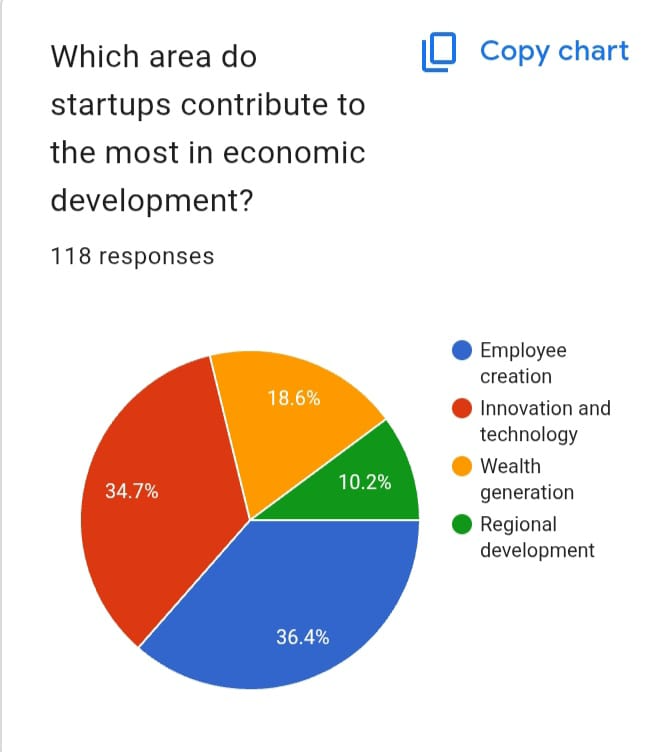
The chart shows that startups contribute most to employment creation 36.4 percentage, followed closely by innovation and technology 34.7 percentage, wealth generation accounts for 18.6 percentage, while regional development has the least contribution at 10.2 percentage. Overall, the results indicate that startups play a major role in job creation and innovation in economic development.
Table No:2 The biggest challenge faced by startups in contributing to economic growth is the lack of adequate financial support and access to resources.
| Particulars | Male | Female | Transgender | Total |
|---|---|---|---|---|
| Lack of funding | 34 (28.81) | 28 (23.73) | 0 (0.00) | 62 (52.54) |
| Regulating barriers | 05 (4.24) | 15 (12.71) | 0 (0.00) | 20 (16.95) |
| Skilled workforce shortage | 08 (6.80) | 10 (8.47) | 0 (0.00) | 18 (15.25) |
| Market competition | 05 (4.24) | 13 (11.02) | 0 (0.00) | 18 (15.25) |
| Total | 52 (44.07) | 66 (55.93) | 0 (0.00) | 188 (100.00) |
Source: Primary Data
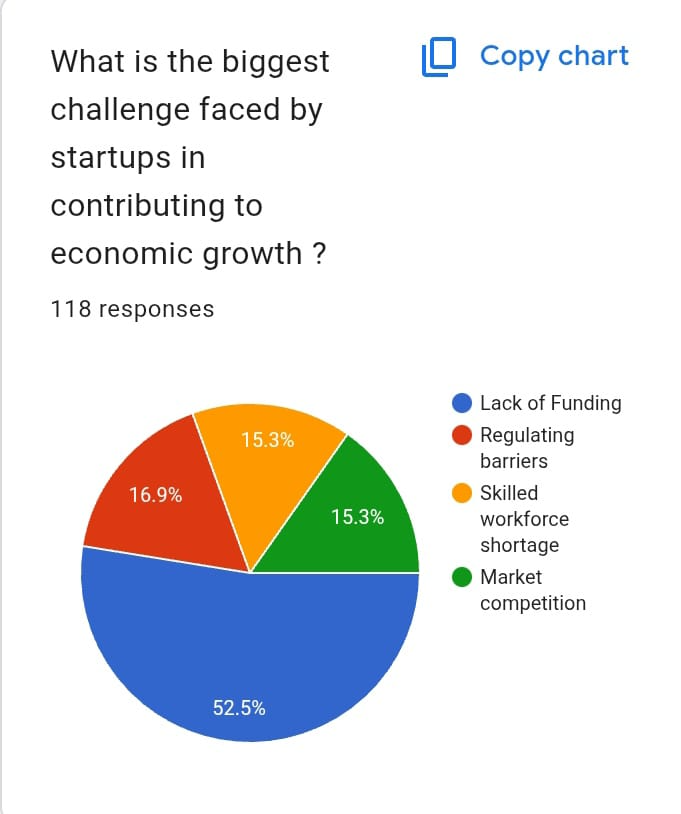
The chart shows that lack of funding is the biggest challenge faced by startups in contributing to economic growth, reported by 52.5 percentage of respondents. This is followed by regulatory barriers 16.9 percentage, while skilled workforce shortage 15.3 percentage and market competition 15.3 are perceived as comparatively lesser challenges.
Table No:3 – The startups influence the startups in economic development.
| Particulars | Male | Female | Transgender | Total |
|---|---|---|---|---|
| By increasing GDP | 25 (21.19) | 12 (10.20) | 0 (0.00) | 37 (31.36) |
| By encouraging innovation | 10 (8.47) | 15 (12.71) | 0 (0.00) | 25 (21.19) |
| By creating new markets | 07 (5.93) | 18 (15.25) | 0 (0.00) | 25 (21.19) |
| All of the above | 10 (8.47) | 21 (17.80) | 0 (0.00) | 31 (26.27) |
| Total | 52 (44.07) | 66 (55.93) | 0 (0.00) | 118 (100.00) |
Source: Primary Data
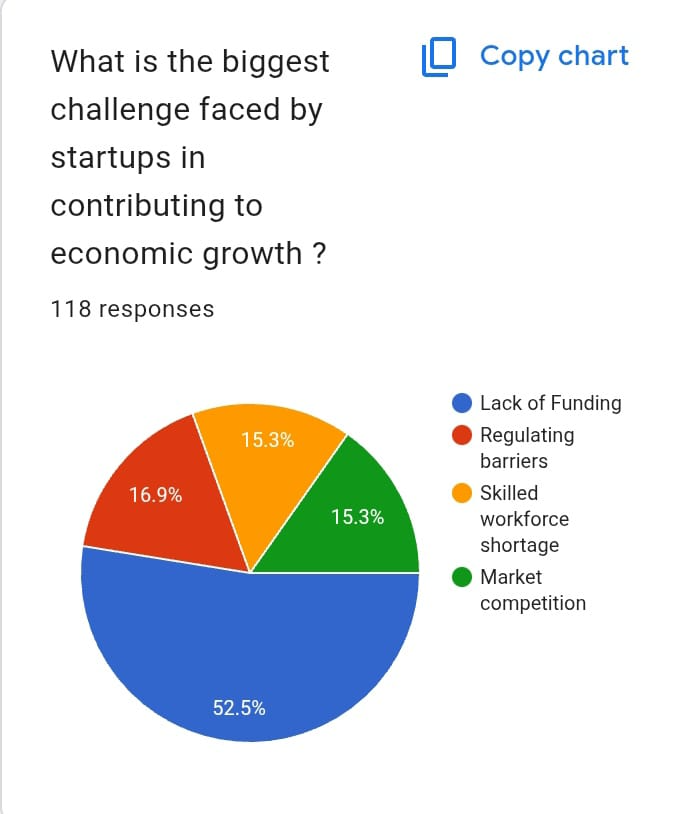
The chart shows that lack of funding is the biggest challenge faced by startups, reported by 52.5 percentage of respondents. This is followed by regulatory barriers 16.9 percentage, while market competition and skilled workforce shortage are equally cited at 15.3 percentage each, indicating secondary but significant constraints on startups contribution to economic growth.
TESTING OF HYPOTHESIS
Hypothesis:1 Financial constraints and limited access to funding which significantly affect the ability of startups to contribute to economic growth.
From the empirical evidence, Table No:2 shows that the majority of the respondents agreed (36.44) that the lack of funding affect the ability of startups to contribute to economic growth. Therefore, this hypothesis is accepted. It is called as null hypothesis (Ho).
Hypothesis:2 Startups on which it contributes significantly more to any single area of economic development such as employment generation, innovation or GDP growth.
From the empirical evidence, Table No:1 shows that the majority of the respondents agreed (36.44) that the startups contributes more to employee creation to the most in the economic development. Therefore, this hypothesis is accepted. It is called as null hypothesis (Ho).
CONCLUSION
Startups play a crucial role in economic development by driving innovation, creating employment opportunities and enhancing productivity across sectors. They contribute significantly to GDP growth by introducing new products, services and business models. Startups promote entrepreneurship and encourage a culture of risk-taking and creativity, especially among youth. By fostering competition, they improve efficiency and reduce market monopolies. Startups also support regional development by generating jobs in both urban and semi-urban areas. Their adoption of technology accelerates digital transformation and foreign investments, strengthening capital formation. Despite challenges such as funding constraints and regulatory barriers, startups continue to emerge as key engines of sustainable and inclusive economic growth.
SUGGESTIONS
• Improve access to finance for startups by expanding government-backed funding schemes, low-interest loans, credit guarantees, and venture capital support, especially for early-stage, rural and non-tech startups.
• Simplify regulatory and compliance procedures by reducing bureaucratic hurdles, streamlining taxation policies, and providing single-window clearance systems to ease the operational burden on startups.
• Promote startups in rural, semi-rural, and tier-II/tier-III regions through region-specific incentives, infrastructure development, and incubation centers to reduce regionals imbalanced in economic development.
• Strengthens skill development and entrepreneurship education by enhancing industry-academic collaboration, startup training programs and mentorship initiatives to address the shortage of skilled man power.
• Encourage innovation and technology adoption by providing research grants, innovation hub, and intellectual property support, particularly in sectors like agriculture, healthcare, education and renewable energy.
• Provide targeted support for inclusive startups by encouraging women-led, social and sustainable startups through special funding schemes, mentorship networks and policy incentives and long-term economic growth.
*****
Footnotes
1. Arshe Azam, GIS Science Journal, (2021)
2. 2 Joanna Szarek, International Entrepreneurship Review 4 (3), 389, (2018)
3. Vladimir Menshikov, European Journal of sustainable Development 14 (2), 26-26, (2025)
4. Valbona Mehmeti, Interdisciplinary Journal of Research and Development 11(2), 60-60, (2024)
5. Natalia Kriuchkova, FEB Research Report MSI_2501, 1-13, (2025)
6. Sharma, l., & Madan, P. (2019). Role of startups in Economic Development of India. International Journal of Management Studies, 6 (3), 12-20
7. Ministry of Commerce and Industry, Government of India (2023). Startup India: Action Plan and Progress Report. New Delhi: DPIIT
8. Planning Commission / NITI Aayog. (2018). Strategy for New India @ 75. Government of India
9. Kanungo and Co. 1983 (13) ELT 1456
10. [2013] 58 VST 376 (Gujarat): Reliance Industries Ltd. Vs State of Gujarat.
11. Vodafone Idea Ltd. Vs. Union of India (2024: AHC:57456)