
INTRODUCTION
Pattachitra Come from the Sanskrit Words Patta (Cloth)And Chitra (Picture)- Is One of The Most Rich and Traditional Painting Style of Odisha. It Known For Its Bright Colour, Bold Lines, Mythological Themes and detailed decorative borders, Which Is Connected to Lord Jagannath and Indian Epics.
Raghurajanpur is heritage craft village where almost every family belongs to the Chitrakara community it is located about sixteen kilometres from Puri in Orissa the artist work in different types of Pattachitra like khadichita, Talapatra, and Tikuli. The art tradition is pass down from one generation to another.
The study visual imaginary and traditional art form with a fixed rule and changing practice that is shaped to divide tourism, commercialization and modern cultural change in Raghurajpur today. Das (2023), Kumar (2021)
Objectives of the Study
• To study the visual imagery of the Pattachitra paintings of Raghurajpur through the
stories, symbols, and styles used in the paintings. This includes the depiction of the culture related to the worship of Jagannath.
• To study the ways in which Pattachitra is being continued as a living art form through the combination of traditional processes, natural colors, and styles with the culture and beliefs of the people.
Research Methodology
The qualitative approach was adopted, and for that, the photographic documentation of the individual Pattachitra works, along with the ethnographic study, observation, and interviews conducted with the active Chitrakaras in the region of Raghurajanpur, was included.
Secondary data on the history of Odishan art history was collected for the purpose of providing a comprehensive historical and cultural context.
The individual works included the contextual interpretation based on the religious, social, and cultural context in which they were created, along with the iconographic study, where the works’ lines, colors, composition, and narratives were examined.
HISTORICAL AND CULTURAL FOUNDATIONS OF PATTACHITRA
Pattachitra is one of the oldest surviving painting traditions in India, which dates back to the twelfth century with regard to the foundation of the Jagannath temple in Puri in Odisha. It is an integral part of the ritualistic tradition of the Jagannath temple in Odisha, where paintings in the style of Pattachitra were used as sacred substitutes for God in the periodic reclusion of Lord Jagannath, Balabhadra, and Subhadra. This led to the iconographic theme of Pattachitra paintings in the stylized representation of the Jagannath Trinity, Puranas in relation to the Ramayana, Mahabharata, Bhagavata Purana, and the decorative borders used in all paintings in a sacred space. It is an evolving tradition from a specific tradition related to the Jagannath temple to a more general tradition of Odisha art, which is related to Odisha sculpture, manuscript paintings, and the storytelling tradition of the Odisha-speaking population known as Chitrakar artists while maintaining its essentially ritualistic and devotional nature. J.P(1982), Tripathy (1998), Mishra (2017)
The Chitrakara are traditional painter community in Orissa who have been practicing Pattachitra art for generations. They learn the skill style and religious story from their family elders. Earlier they got support from Jagannath temple and kings who gave them work and financial stability. This helped them continue there are long time. After independence Royal support decrease and the artists is become more commercial. Today Chitrakaras specially in Raghurajpur works as recognise artist sell their art in National and international market with helps of Government and organisation. Das (2013), Singh Rao (2019), Zanatta (2021).
VISUAL LANGUAGE AND ICONOGRAPHIC ELEMENTS IN PATTACHITRA
Patachitra painting is deeply rooted in its traditional materials and techniques, which is form the base of the visual identity. The base call Butter is made by the coating cloth and chalk and natural glow to make its smooth and strong. Artist uses natural pigment derived from mineral, plans and organic source, such as hingula (red), haritala (yellow), indigo, and lamp black. Brushes are typically handmade using animal hair, allowing for fine detailing and precision. These natural materials make the colour look brighter but earthy and also help the painting last long. Using this traditional method show respect for nature and keep old artist knowledge alive. Rincy(2024), Das (2023)
Pattachitra painting mehndi show stories from Hindu shastras. They often focus on God like lord Jagannath Krishna Ram and various episode from text such as Ramayan and Mahabharat. Artist follows fixed rule while painting each God has specific symbol hand gesture (mudras) and posters so people can easily recognise them. Narrator composition is often arranged in sequential panel or continuous storytelling formats, enabling viewer to engage with complex Shastra episode. So, Pattachitra is not just a decorate in it is also help people understanding religious stories and feel a sense of devotion. Das (2024), Chatterjee (2023).
Patachitra paintings are known for their rich and detailed decoration. Intricate border, floral motif, geometrical pattern and stylized foliage frame the central imagery, enhancing visual harmony and rhythm. The paintings are flat and focus more on clear storytelling and symbols rather than realism. The figure is stylized with e elongated eyes, shape features, graceful positions. There are different types of patachitra such as scroll painting (pata), single panel deity representations and story-based theme like Krishna Leela and Dashavatara. All this refers together and create a unique style of art. Irwin (1971).
TRANSFORMATION OF VISUAL IMAGERY: TRADITION, MODERNITY, AND MARKET FORCES
Patachitra painting was originally a religious art connected to the temple worship, especially the worship of lord Jagannath in Puri. Artist follows strict rules and maintains painted shastra stories. However, things have changed because tourisms and global exposure, artists now create a new theme, not just religious ones. They also make different item like wall hanging etc. even with the changes, they maintain the stylistic essence such as bold line flat colour palette and detailed design the traditional demonstrate flexibility and innovation. So patachitra is not a fixed art form it grows and change while keeping the traditional alive. Rincy (2024)
Patachitra art is supported by the government and different organisation today world. They have art is by giving money, training and opportunities to sell their work. Place like Raghurajpur are also promoted as Heritage Village, which attracts tourists and helps preserve this traditional art. Simultaneously digital media through an E-commerce platform, social media and virtual exhibition has expand the research of buttercup beyond religious and national boundaries. Artist is now engaging with global audiences, enabling economic sustainability and cross culture dialogues. However, there are still some problems, like much focus on selling which can affect originally and young generation not always continue the traditional even with both support system and digital tool but still alive and growing while keeping it traditions. Das (2023)
DISCUSSION
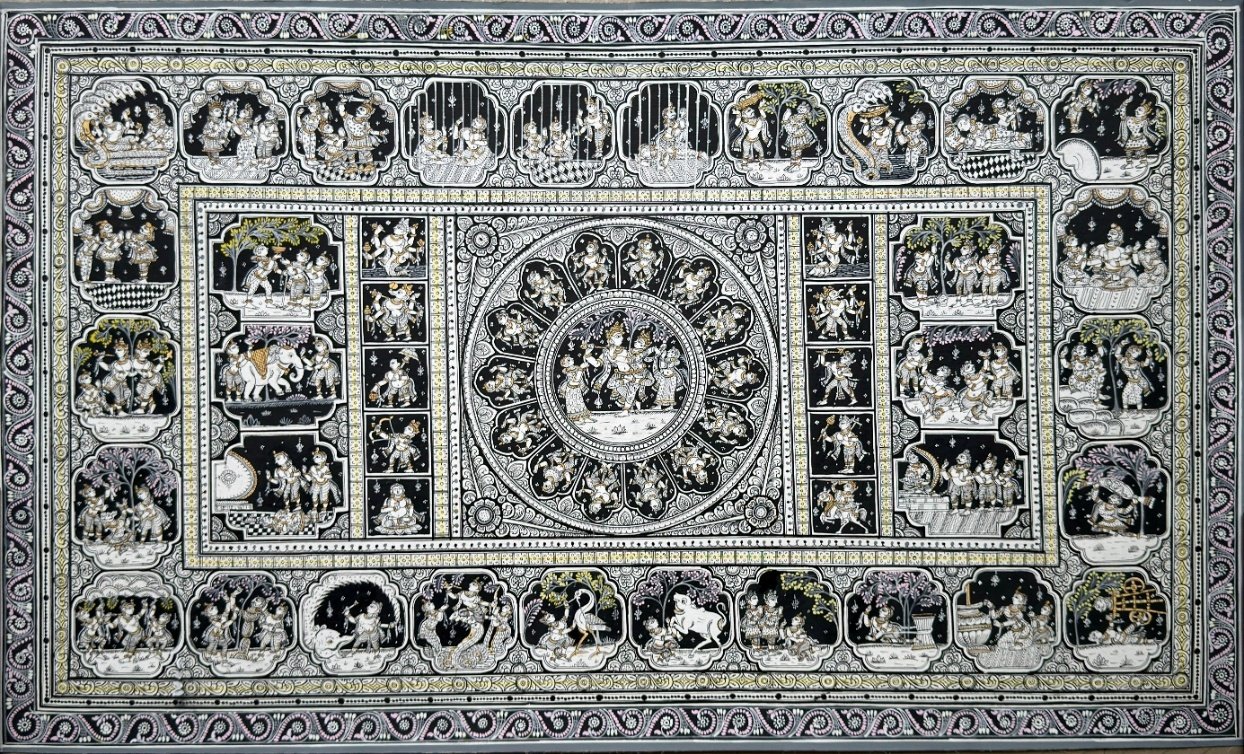
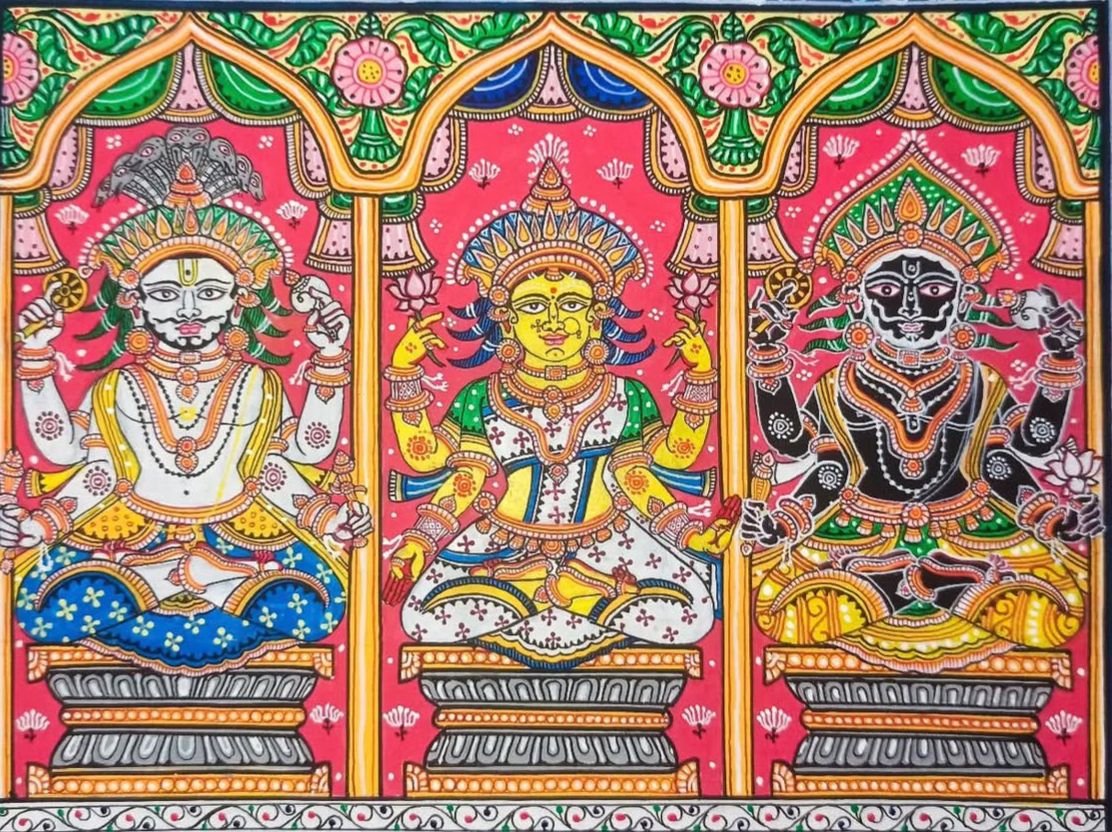
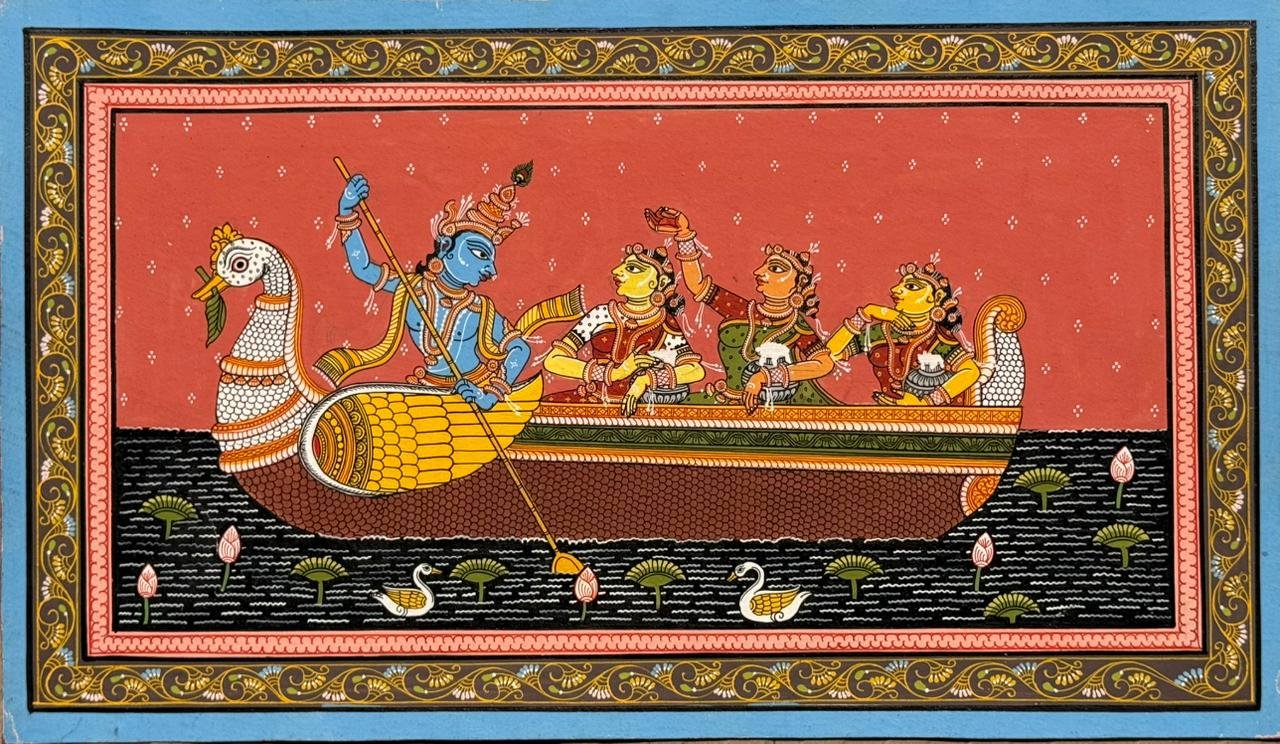
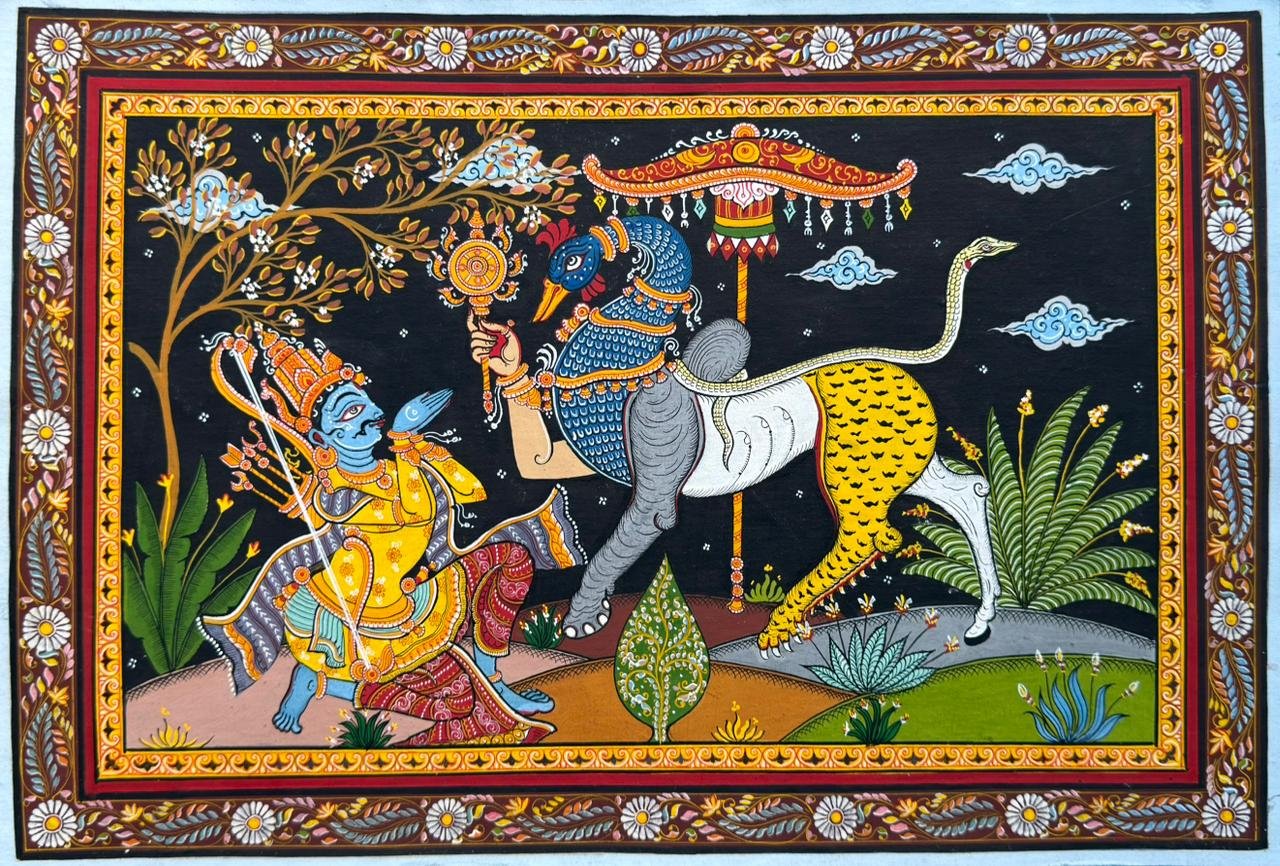
“Krishna Leela” the painting central circular designs a mandala, surrounded by numerous framed rectangular panels narrating from scriptures (plates1), “Anavasara Patti” (or Anasara Patti) are sacred Pattachitra paintings of Lord Jagannath, Balabhadra, and Subhadra worshipped during the 15-day Anasara period when the main deities rest in seclusion after the Snana Purnima bath. These paintings, serving as substitutes during this illness period, show Lord Jagannath as Narayana, Balabhadra as Basudev, and Subhadra as Bhubaneshwar( Plates 2), “Nauka Vihar” patachitra is a tradition painting depicting lord Krishna’s divine boat ride with Radha and the Gopi’s on the Yamuna River (plates 3), “Nabakunja” patachitra from Odisha is a traditional painting depicting a creature composed of nine different animals, symbolizing a divine form of lord Krishna from the Mahabharata (Plates 4), “Nava Nari Kunjar” patachitra the central subject of the painting is lord Krishna riding an elephant that is uniquely composed of figures of nine Gopi’s (Plates 5). “Krishna Raas” patachitra depicting the divine love story of Krishna, Radha and the Gopi’s dancing in Vrindavan (Plates6).
CONCLUSION
The study of patachitra from Raghurajpur is traditional art that rooted in the culture and devotional practice of Orissa especially associate with lord Jagannath. It uses unique style with natural materials and shows detailed, decorative story in unique style. Even though modern change has influenced the item and design. But the art remained the same. So patachitra continue exist as a living tradition that balance Heritage with innovation, presenting its cultural significance in the modern world.
Plates
Plates 1 Krishna Leela
Painting by Swain Purusottam
Plates 2 Anavasara Patti
Painting by Swain Purusottam
Plates 3 NAUKA VIHAR
Painting by Swain Purusottam
Plates 4 NABAKUNJA
Painting by Swain Purusottam
Plates 5 Nava Nari Kunjar
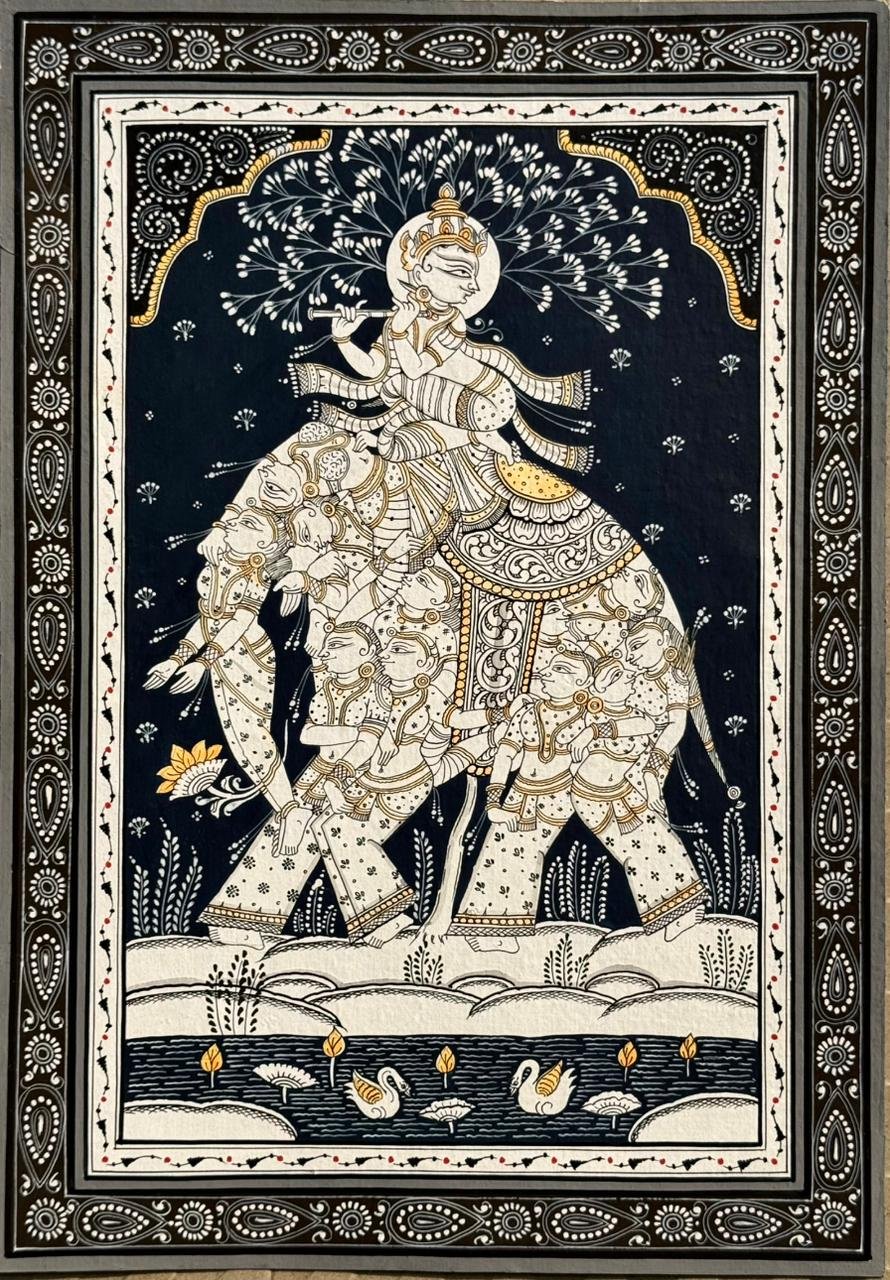
Painting by Swain Purusottam
Plates 6 KRISHNA RAAS
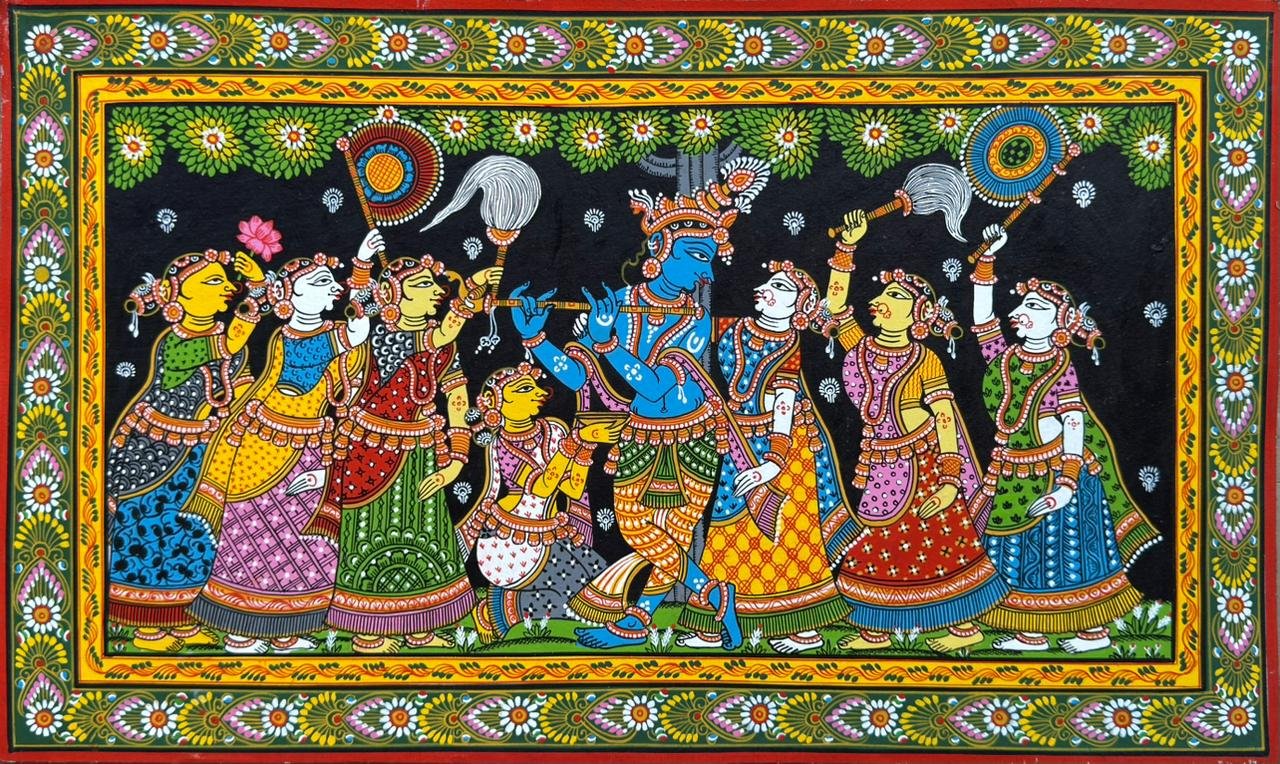
Painting by Swain Purusottam