
Introduction
The centenary of India’s independence in 2047 provides a significant horizon for reflecting on the country’s development priorities. The expression Viksit Bharat @ 2047 represents an aspiration for a prosperous, inclusive, technologically capable, environmentally sustainable, and globally influential India. It is not adequately understood as a target of higher national income alone. A developed society also requires productive employment, capable public institutions, accessible education and health services, social mobility, ecological security, and the ability to respond to external shocks.
India’s development ambitions are being pursued in a changing international environment. Geopolitical tensions, strategic competition, trade restrictions, volatile energy markets, disruptions in logistics, and uncertainty in global finance have exposed the risks associated with concentrated supply chains and excessive dependence on a limited number of external suppliers.1 At the same time, the global economy is being reshaped by artificial intelligence (AI), robotics, advanced materials, biotechnology, quantum technologies, cloud computing, and semiconductor innovation. These technologies can increase productivity and create new industries, but they can also displace tasks, intensify inequalities, and raise concerns about privacy, cyber security, and the concentration of economic power.
The idea of Atmanirbharta has consequently acquired strategic importance. In this paper, self-reliance is treated as the development of domestic capabilities, not as withdrawal from international trade or technological exchange. A country can become more resilient by strengthening its research base, diversifying suppliers, developing skilled workers, improving infrastructure, and participating in global value chains from a position of greater capability. NITI Aayog’s working paper on the strategic imperatives of Viksit Bharat similarly links the 2047 vision with economic competitiveness, national security, global partnerships, and legal reform and good governance.2
The central argument of this paper is that India’s transition towards developed-country status will depend on the quality and distribution of its productive capabilities. Economic growth, technological innovation, human development, and institutional reform must reinforce one another. The paper therefore examines global economic pressures, technological disruption, the meaning of Atmanirbharta, and the contribution of higher education and educators. It concludes with a policy roadmap that connects long-term aspirations with practical institutional priorities.
The study is qualitative and descriptive-analytical. It relies on secondary sources, including government policy documents, official statistical releases, reports of national institutions, and selected academic literature, and it organises the material thematically. Official indicators are used to establish context rather than to claim causal relationships, and where a figure represents a policy aspiration or a future scenario rather than an observed outcome, the study identifies it as such. The study has three limitations. First, it does not collect primary data from firms, workers, universities, or households. Second, it uses published secondary material whose definitions and reference periods may differ. Third, projections to 2047 are inherently uncertain and depend on policy implementation, global conditions, technological change, and environmental constraints.
Review of literature
India’s development trajectory has been examined by scholars, economists, policymakers, and government institutions from diverse perspectives, including economic growth, human development, technological transformation, industrialisation, globalisation, and self-reliance. The literature suggests that India’s aspiration to become a developed nation by 2047 cannot be achieved solely through economic expansion. Rather, it requires a comprehensive approach encompassing social inclusion, human capital development, technological innovation, educational advancement, environmental sustainability, and economic self-reliance. The major scholarly contributions and institutional perspectives are reviewed below.
A. Amartya Sen’s capability approach and human development
Amartya Sen, in Development as Freedom (1999), conceptualises development beyond conventional economic indicators such as national income and gross domestic product (GDP).3 He argues that development should be assessed in terms of the expansion of human capabilities and individual freedoms. For Sen, education, healthcare, economic opportunities, social participation, and political freedom are essential dimensions of human development, and development should enable individuals to lead lives they have reason to value. This perspective is particularly relevant to the vision of Viksit Bharat @ 2047, as India’s transformation into a developed nation requires not only economic prosperity but also improved quality of life, equal opportunities, and inclusive human development.
B. Joseph E. Stiglitz on globalisation and economic policy
Joseph E. Stiglitz, in Globalization and Its Discontents (2002), examines the complexities of globalisation, the role of international economic institutions, and the challenges faced by developing economies.4 His analysis acknowledges that integration with global markets can create opportunities for international trade, foreign investment, technology transfer, and economic growth. He also emphasises the importance of appropriate domestic institutions, effective economic policies, and regulatory mechanisms to manage the risks associated with globalisation, and argues that global economic integration must take account of the specific economic conditions and developmental priorities of individual countries. In the context of India’s development trajectory, his perspective highlights the need to balance global economic engagement with the protection of national economic interests and policy autonomy.
C. The Atmanirbhar Bharat Abhiyaan
The Government of India’s Atmanirbhar Bharat Abhiyaan is a policy initiative aimed at strengthening domestic economic and industrial capabilities. It focuses on promoting domestic manufacturing, enhancing industrial competitiveness, encouraging investment, strengthening supply chains, and improving India’s participation in global value chains, with particular emphasis on micro, small and medium enterprises (MSMEs), manufacturing, entrepreneurship, innovation, and indigenous production capabilities. The concept of self-reliance does not imply isolation from international trade and cooperation; rather, it seeks to strengthen domestic productive capacities while enabling India to participate more effectively in the global economy.5 In this regard, Atmanirbhar Bharat is an important strategic component of the broader vision of Viksit Bharat @ 2047.
D. The National Education Policy 2020 and human resource development
The National Education Policy (NEP) 2020 is a significant policy framework for transforming the country’s educational system. It places considerable emphasis on multidisciplinary education, research, innovation, skill development, digital technology, and employability, and aims to create an inclusive, flexible, practical, and knowledge-oriented educational framework that encourages critical thinking, creativity, problem-solving, and entrepreneurial skills.6 In the context of Viksit Bharat @ 2047, NEP 2020 assumes particular significance because the long-term developmental capacity of a nation depends substantially on the quality, skills, knowledge, and productivity of its human resources. Education is thus recognised not merely as an instrument of individual advancement but also as a pillar of national development and economic self-reliance.
E. NITI Aayog’s perspective on India’s development trajectory
NITI Aayog, through its policy documents and development reports, has identified several strategic priorities for India’s long-term economic and social transformation. These include structural economic reforms, infrastructure development, technological advancement, human capital formation, sustainable development, institutional strengthening, and improvements in public service delivery. Its framework emphasises increasing economic productivity while addressing regional disparities, strengthening social-sector investment, and ensuring that the benefits of development reach different sections of society. These perspectives indicate that India’s aspiration to become a developed nation by 2047 requires coordinated transformation across economic, social, technological, and institutional sectors. NITI Aayog’s Strategy for New India @ 75 (2018) provides an important policy framework for understanding these developmental priorities.7
F. Integrated development and the vision of Viksit Bharat @ 2047
Taken together, these contributions indicate that India’s aspiration to become a developed nation cannot be evaluated solely through GDP growth or industrial expansion. It requires a comprehensive development strategy integrating economic transformation, technological capabilities, quality education, social justice, inclusive growth, environmental sustainability, institutional efficiency, and strategic autonomy. While Sen’s capability approach highlights the human and social dimensions of development, Stiglitz’s analysis of globalisation underlines the importance of balancing international economic integration with domestic institutional capabilities. The Atmanirbhar Bharat initiative, the National Education Policy 2020, and NITI Aayog’s developmental priorities provide further insight into India’s economic, educational, and institutional transformation. Collectively, these perspectives establish the multidimensional foundation of the Viksit Bharat @ 2047 vision.
Global economic headwinds and India’s development trajectory
The international economy presents a combination of risks and opportunities for India. Geopolitical conflicts and strategic competition can affect energy prices, shipping routes, access to critical minerals, technology transfers, and investment decisions. Export controls and industrial subsidies adopted by major economies may alter the location of production and the terms of market access.8 For India, the policy challenge is not simply to replace imports but to identify strategic vulnerabilities, diversify sources, and build competitive domestic capacity where it is economically and strategically justified.
Supply-chain resilience has become particularly important in sectors such as semiconductors, electronics, pharmaceuticals, telecommunications, defence equipment, and clean-energy technologies. The pandemic and subsequent disruptions demonstrated that concentrated production networks can transmit shocks across borders.9 Diversification, strategic inventories, trusted partnerships, logistics infrastructure, and domestic supplier development can reduce exposure. However, resilience should not be confused with complete domestic production of every input. The costs of localisation, the availability of skills, economies of scale, and access to global knowledge must be considered.
Energy security links economic resilience with environmental sustainability. India’s development requires reliable and affordable energy, while dependence on imported fossil fuels can expose the economy to price volatility and geopolitical risks.10 Renewable energy, storage, grid modernisation, green hydrogen, battery technology, electric mobility, energy efficiency, and diversified supply arrangements can reduce vulnerabilities. The transition must nevertheless account for the cost of technology, mineral supply chains, land use, grid stability, and the livelihood implications for workers and regions dependent on conventional energy.
Global integration remains essential. Export markets, foreign investment, research partnerships, and technology collaboration can support industrial upgrading. The strategic objective should therefore be to participate more effectively in global value chains, move towards higher-value activities, and develop domestic firms capable of meeting international standards. A resilient economy is not one that avoids interdependence; it is one that manages interdependence through diversification, competitiveness, and strong institutions. Table 1 sets out the principal quantitative indicators associated with the 2047 vision, distinguishing the present position from the 2047 value, and Figure 1 shows the distance between the 2025 GDP baseline and the 2047 aspiration.
| No. | Indicator11 | Current / baseline position | 2047 value and its status | Analytical significance |
|---|---|---|---|---|
| 1 | Gross domestic product (GDP) | 2025: about US$4.18 trillion | About US$30 trillion (Viksit Bharat aspiration, NITI Aayog) | Around 7% long-term real growth would be required |
| 2 | Urbanisation | 37% (2023) | 51% (NITI Aayog scenario) | Greater pressure on urban infrastructure, housing, transport and employment |
| 3 | Investment rate | Gross fixed capital formation: 33.7% of GDP at constant (2011–12) prices, 2024–25 (provisional) | Around 34% of GDP (NITI Aayog reform scenario) | Long-term capital formation will be decisive |
| 4 | Female labour-force participation | 41.7% (2023–24, persons aged 15 and above, usual status) | 70% (stated Viksit Bharat aim, Ministry of Labour and Employment) | A major indicator of human-capital development and inclusive growth |
| 5 | Manufacturing contribution to GDP | About 17%, broadly stable for two decades | At least 25% (stated by the CEO of NITI Aayog, 2025) | Important for employment, exports and self-reliance |
| 6 | India’s share of global manufacturing value added | About 3.2% (2023) | Around 10% (authors’ scenario) | India must move upward in high-value global value chains |
| 7 | Share in global merchandise exports | About 1.8% (2024) | Around 10% (Viksit Bharat aim, as recorded by the WTO Secretariat) | Competitive manufacturing and trade policy will be essential |
Table 1: Major quantitative indicators for Viksit Bharat @ 2047. Compiled by the authors; the status of each 2047 value is stated in the table.
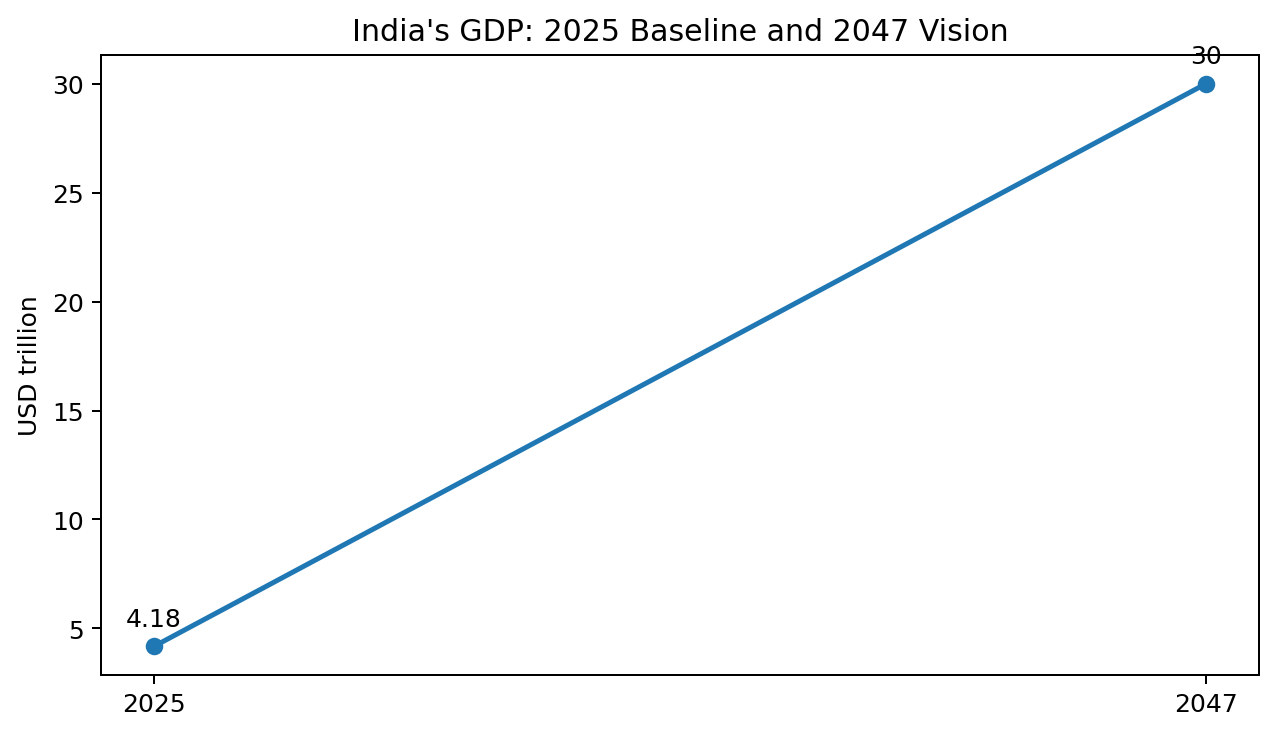
Figure 1: India’s GDP, 2025 baseline and 2047 aspiration (US$ trillion). The line joins the two values only and is not a projected growth path. Source: as for Table 1.
Macroeconomic stability is another precondition for long-term development. Inflation, exchange-rate movements, interest rates, fiscal pressures, and shifts in international capital flows and financial conditions influence investment, household welfare, and India’s growth prospects. The Economic Survey 2025–26 describes the outlook as one of steady growth amid global uncertainty and projects real GDP growth of 6.8–7.2 per cent for FY 2026–27.12 Such projections provide a useful near-term reference, but they do not guarantee a particular income level by 2047. Sustained productivity growth, investment quality, employment creation, and institutional capacity will determine whether current momentum can be maintained. Table 2 sets out a framework for assessing how far a sector has progressed towards self-reliance.
| Criterion | Weak position | Moderate position | Strong position |
|---|---|---|---|
| Technological capability | Import-dependent | Some domestic capability | Indigenous R&D and global leadership |
| Manufacturing | Low value addition | Medium value addition | Advanced/high-technology manufacturing |
| Human capital | Skill gap | Regional skill improvement | Future skills and lifelong learning |
| Global trade | Low GVC participation | Selective GVC participation | High-value GVC leadership |
| Innovation | Low R&D | Emerging innovation | World-class innovation ecosystem |
Table 2: Atmanirbharta assessment framework (constructed by the authors; GVC = global value chain)
Technological disruption: opportunities and risks
Technological change is transforming the organisation of production, services, public administration, and everyday life. The Government has identified quantum technologies, artificial intelligence, robotics, biotechnology, and semiconductors among the new and emerging areas of science and technology it is advancing through policy support, institutional mechanisms, mission-mode programmes, and research funding.13 AI can support predictive maintenance, medical diagnosis, agricultural advisory services, logistics, financial services, language technologies, and personalised learning. Robotics and automation can improve precision, consistency, and productivity in manufacturing. Biotechnology can contribute to healthcare, pharmaceuticals, agriculture, and environmental management. Quantum technologies may create new capabilities in computing, sensing, and secure communication, although many applications remain at different stages of research and development.
The economic benefits of these technologies depend on more than adoption. Firms need reliable infrastructure, skilled personnel, access to finance, data governance, and the capacity to reorganise work processes. Smaller enterprises may face barriers because advanced systems require capital, technical expertise, and complementary organisational changes. Public policy should therefore support the diffusion of appropriate technologies across firms and regions rather than concentrating benefits in a small number of large enterprises.
AI raises a distinct set of questions. Automated systems can perform or assist with routine cognitive tasks, potentially changing occupations in administration, customer service, finance, education, manufacturing, and professional services.14 The impact is unlikely to be uniform: some jobs may be displaced, others redesigned, and new occupations created. Policy should focus on tasks and transitions rather than assuming that entire occupations will disappear at the same rate. Workers need opportunities for reskilling, portable credentials, career guidance, and social protection during transitions. Employers and educational institutions should also communicate how AI systems are used and remain accountable for consequential decisions.
Semiconductors are foundational to modern electronics, telecommunications, transport, defence, medical equipment, and AI infrastructure. Building a domestic semiconductor ecosystem requires long-term investment, reliable utilities, specialised skills, intellectual property, supplier networks, and sustained research; the India Semiconductor Mission, with a budget outlay of ₹76,000 crore, is the Government’s national mission for this purpose.15 It is not sufficient to announce manufacturing capacity; the ecosystem must also develop chip design, materials, equipment services, packaging, testing, and downstream applications. International collaboration will remain important because semiconductor supply chains are highly specialised and geographically distributed. Table 3 compares the risks, opportunities, and direction of self-reliance across the main sectors.
| Sector | Global economic / technological risk | Opportunity for India | Direction of Atmanirbharta |
|---|---|---|---|
| Semiconductors | Import dependence and supply-chain risks | Electronics and AI hardware | Domestic design, manufacturing and packaging capabilities |
| Artificial intelligence | Skill inequality and employment transformation | Higher productivity and new services | Indigenous AI models, data and computing capacity |
| Energy | Price volatility and geopolitical risks | Renewable energy and green hydrogen | Diversification of energy sources |
| Pharmaceuticals | Risk related to raw materials and critical inputs | Access to global health markets | Critical APIs and medical technologies |
| Defence | Global supply constraints | Domestic defence industry | Indigenous design, research and production |
| Digital infrastructure | Cyber attacks and data-related risks | Inclusive development based on digital public infrastructure | Secure digital public infrastructure |
Table 3: Comparative analysis of technological disruption and self-reliance (compiled by the authors; API = active pharmaceutical ingredient)
Cyber security and data governance are cross-cutting concerns. As digital systems become central to finance, health, education, transport, and public services, cyber incidents can disrupt essential services and undermine trust. Strong security standards, incident reporting, privacy safeguards, independent oversight, and digital literacy are necessary. Indigenous capability should include the ability to audit, secure, maintain, and improve systems, not merely to own or host them.
The policy challenge is to ensure that technological progress expands human capabilities. Technology should complement workers where possible, improve the quality and reach of public services, and create opportunities for innovation. Its benefits must be assessed through productivity, job quality, accessibility, affordability, privacy, and distributional effects, not only through the number of systems deployed.
Atmanirbharta as strategic capability-building
Atmanirbharta is most useful when understood as a strategy for strengthening the ability to make informed choices under conditions of interdependence. It includes productive capacity, technological knowledge, resilient infrastructure, skilled human resources, institutional competence, and the ability to negotiate and compete internationally. It does not require autarky or the rejection of foreign investment and knowledge.16
In manufacturing, the objective should be to increase productivity, quality, domestic value addition, and export competitiveness. Industrial policy can support emerging sectors, but incentives need transparent criteria, time-bound evaluation, and performance measures. Support should encourage learning, innovation, and scale rather than permanent protection for inefficient producers. Micro, small, and medium enterprises require access to affordable credit, technology extension, standards certification, logistics, digital platforms, and skilled workers. Their integration into larger supply chains can broaden the benefits of industrial growth.
Strategic autonomy also has an energy and health dimension. Domestic capabilities in renewable-energy equipment, storage, essential medicines, active pharmaceutical ingredients, medical devices, and public-health research can reduce exposure to external shocks. Agricultural resilience requires investment in irrigation efficiency, storage, climate-adapted practices, extension services, and market access. Defence self-reliance requires indigenous design and testing capabilities, dependable supply chains, and carefully structured international partnerships.17
A balanced strategy must recognise trade-offs. Local production may be desirable in strategically sensitive areas, but it can be costly where domestic scale or expertise is limited. Imports can provide access to advanced inputs and lower prices, while exports expose firms to competition and encourage productivity. The appropriate policy mix should therefore be sector-specific, evidence-based, and periodically reviewed. The measure of success is not the lowest possible import share; it is the ability to secure critical supplies, innovate domestically, compete globally, and protect public welfare.
Role of higher education, educators and human capital
Higher education is central to the 2047 vision because economic transformation depends on the quality of knowledge, skills, research, and civic capabilities. Universities and colleges should function not only as providers of degrees but also as institutions for knowledge creation, problem-solving, innovation, entrepreneurship, and social development. The National Education Policy 2020 provides a framework for multidisciplinary education, research, flexibility, and skill development,18 and the University Grants Commission has linked the establishment of research and development cells in higher education institutions to the goals of Atma-Nirbhar Bharat.19 Their impact, however, depends on institutional capacity, faculty support, adequate funding, and effective implementation.
The relationship between education and employment requires particular attention. Curricula should combine disciplinary foundations with communication, quantitative reasoning, digital literacy, critical thinking, teamwork, and ethical judgement. Vocational and higher education pathways should be connected through flexible credit systems and recognition of prior learning. Industry partnerships can improve practical exposure, but universities must preserve academic independence and avoid reducing education to short-term employer requirements. Lifelong learning is increasingly important because technological change makes skills perishable.
Research and development is a major constraint. According to the Department of Science and Technology, India’s gross expenditure on R&D reached ₹2,44,767.81 crore in 2023–24, equivalent to 0.84 per cent of GDP.20 The amount has increased, but the ratio indicates that strengthening research intensity remains a significant task. Public funding, private investment, university research, and industry collaboration need to reinforce one another. Research assessment should value quality, reproducibility, societal relevance, and responsible innovation rather than relying only on publication counts.
Educators have a wider responsibility in preparing students for technological and democratic change, because the transition towards Viksit Bharat is not merely an economic or technological process but also a political and social transformation. Teachers need continuing professional development in digital pedagogy, AI literacy, research methods, and inclusive teaching. They should help students evaluate information, identify algorithmic bias, understand privacy, and use digital tools responsibly. Through teaching and research on democratic governance, public policy, constitutional values, digital governance, global politics and international relations, public administration, social justice, sustainable development, inequality, environmental justice, and democratic accountability, educators in political science, the social sciences, and the humanities can strengthen students’ understanding of institutions and citizenship and help ensure that technological and economic change remains socially grounded. Higher education and educators can thus play a transformative role in building informed, responsible, innovative, ethical, and democratic citizens who can contribute meaningfully to India’s development vision for 2047.
Women’s participation in the labour force is also relevant to human-capital development. The Periodic Labour Force Survey reports a female labour-force participation rate of 41.7 per cent in 2023–24 for persons aged fifteen and above in usual status, compared with 37.0 per cent in 2022–23.21 The increase is important, but participation alone does not reveal whether work is adequately paid, secure, formal, or compatible with care responsibilities. Policies must address safe transport, childcare, equal opportunity, skills, workplace protections, and access to productive assets. Regional, social, and rural–urban differences also require attention.
Universities can contribute through local problem-solving partnerships with industry, schools, local governments, civil society, and communities. Research on agriculture, public health, urban planning, climate adaptation, digital inclusion, and local governance can connect national aspirations with local needs. A developed India will require not only advanced laboratories but also institutions that make knowledge accessible and useful across society.
Key challenges
Several interconnected challenges may constrain progress towards 2047. First, the skills mismatch between education and changing labour demand can limit employability and productivity. Second, technological dependence in critical sectors can expose the economy to external disruption. Third, regional inequalities in infrastructure, education, health, investment, and digital connectivity may produce uneven development. Fourth, the benefits of AI and automation may be concentrated unless workers and smaller firms can access training and technology.
Fifth, research capacity requires sustained investment, institutional autonomy, high-quality infrastructure, and stronger university–industry collaboration. Sixth, climate change threatens agriculture, water resources, biodiversity, infrastructure, and public health. Seventh, rapid urbanisation creates pressure on housing, transport, sanitation, energy, and municipal finance. Finally, cyber risks, misinformation, privacy concerns, and the concentration of digital power can weaken trust in institutions. These challenges cannot be addressed through isolated schemes. They require coordinated policy, transparent implementation, credible data, and public accountability.
Policy recommendations and roadmap towards 2047
A practical roadmap should connect national goals with measurable milestones, and Table 4 sets out the phases proposed here. During 2026–2030, priority should be given to foundational capacity: strengthening school and higher education quality, expanding vocational pathways, improving digital and physical infrastructure, supporting applied research, and identifying critical supply-chain vulnerabilities. Public programmes should publish baseline indicators and evaluation criteria so that progress can be assessed.
| Phase | Period | Major priorities | Measurable outcome |
|---|---|---|---|
| Phase I | 2026–2030 | Skills, infrastructure, R&D, semiconductors and AI | Capacity building |
| Phase II | 2030–2035 | Advanced manufacturing, exports and global value chains | Competitiveness |
| Phase III | 2035–2040 | High technology, green industry and innovation | Higher productivity |
| Phase IV | 2040–2047 | Global leadership and inclusive development | Transition towards a developed economy |
Table 4: Phased roadmap towards 2047 (proposed by the authors)
During 2030–2035, policy should focus on industrial upgrading and wider diffusion of technology. This includes support for MSMEs, quality infrastructure, standards, export readiness, logistics, and supplier development. Universities and firms should develop joint research programmes, apprenticeships, and technology-transfer mechanisms. Regional industrial strategies should be linked to local skills and infrastructure rather than replicated uniformly across states.
During 2035–2040, the emphasis should shift towards advanced manufacturing, high-value services, clean technologies, and globally competitive research. Investment in fundamental science, AI safety and governance, biotechnology, semiconductor design, energy storage, and climate adaptation should be sustained. Public procurement can encourage innovation where transparent standards and competitive processes are maintained.
During 2040–2047, the priority should be to consolidate inclusive development and institutional resilience. Progress should be assessed not only through GDP but also through productivity, job quality, women’s economic participation, educational outcomes, health, regional convergence, research performance, energy security, and environmental indicators.
Across all phases, six policy principles are essential. First, industrial support should be transparent, time-bound, and linked to measurable productivity and innovation outcomes. Second, skills policy should be employer-informed but worker-centred, with accessible lifelong learning. Third, research funding should support universities, public laboratories, and private innovation while protecting academic freedom and research integrity. Fourth, digital governance should include privacy, cyber security, accessibility, transparency, and accountability. Fifth, women’s participation and social inclusion should be integrated into infrastructure, employment, and education policy. Sixth, international cooperation should be treated as a source of knowledge, investment, standards, and market access, while strategic risks are managed through diversification and domestic capability.
A monitoring framework should identify responsible institutions, baseline values, target dates, data sources, and independent evaluation arrangements. Targets should be clearly labelled as official commitments, analytical scenarios, or proposed benchmarks. This distinction is necessary to avoid presenting aspirational numbers as established government targets. The 2047 vision will be credible only when long-term ambition is connected to transparent measurement and periodic policy correction.
Conclusion
Viksit Bharat @ 2047 is a broad developmental aspiration whose achievement will depend on the interaction of economic resilience, technological capability, human development, institutional quality, and environmental sustainability. Global economic uncertainty and technological disruption create risks, but they also provide opportunities for India to strengthen its productive base and improve its position in international markets. Atmanirbharta can contribute to this process when understood as capability-building within an open and cooperative global economy. Table 5 summarises the sector-wise policy priorities that follow from this analysis.
| Sector | High-priority policy | Expected outcome by 2047 |
|---|---|---|
| Advanced manufacturing | Expansion towards a 25% GDP share | Employment, exports and technological capability |
| R&D | Government–industry–university partnerships | Patents, innovation and indigenous technologies |
| Skills | AI, robotics, semiconductors, quantum and green skills | Employability and productivity |
| Higher education | Research-based and multidisciplinary education | Knowledge-based economy |
| Digital public infrastructure | Next-generation digital public infrastructure (DPI 2.0 and DPI 3.0)22 | Inclusive and low-cost digital services |
| Green development | Renewable energy, efficiency and circular economy | Low-carbon development |
Table 5: Sector-wise policy priorities (compiled by the authors).
The evidence considered in this paper points to both progress and unfinished tasks. The near-term growth outlook is positive, yet long-term development requires productivity and quality employment. Female labour-force participation has improved in the PLFS estimates, but the quality and security of work remain important concerns. R&D expenditure has increased in absolute terms, while its share of GDP indicates the need for stronger research investment and collaboration. These indicators reinforce the argument that national development cannot be measured by output alone.
The central policy requirement is balance: domestic capacity with global engagement; automation with worker transition; industrial competitiveness with environmental responsibility; and economic growth with social inclusion. Higher education institutions and educators must be active partners in this transformation by advancing research, critical thinking, digital literacy, ethical reasoning, and locally relevant innovation. Ultimately, a developed India in 2047 will be defined not merely by its economic size or technological achievements, but by the opportunities, freedoms, security, and quality of life available to its people.
*****
Footnotes
1. Ministry of Finance, Economic Survey 2025–26 ch. 1, at 1 (2026), https://www.indiabudget.gov.in/economicsurvey/doc/eschapter/echap01.pdf (describing a global environment “shaped by geopolitical tensions, trade disruptions” and “fragmented supply chains”).
2. NITI Aayog, India’s Path to Global Leadership: Strategic Imperatives for Viksit Bharat @2047 3 (Working Paper, Apr. 2025), https://www.niti.gov.in/node/1630 (identifying four pillars: economic competitiveness and growth, national security and stability, global partnerships and strategic influence, and legal reforms and good governance).
3. Amartya Sen, Development as Freedom (1999).
4. Joseph E. Stiglitz, Globalization and Its Discontents (2002).
5. Press Release, Prime Minister’s Office, PM Gives a Clarion Call for Atmanirbhar Bharat (May 12, 2020), https://www.pib.gov.in/PressReleasePage.aspx?PRID=1623391 (announcing the Atmanirbhar Bharat package and stating that self-reliance in a globalised world “is different from being self-centered”).
6. Ministry of Human Resource Development, National Education Policy 2020 chs. 9, 11, 16–17 (2020), https://www.education.gov.in/nep/about-nep.
7. NITI Aayog, Strategy for New India @ 75 (2018), https://www.niti.gov.in/sites/default/files/2019-01/Strategy_for_New_India_2.pdf.
8. See NITI Aayog, supra note 2, at 18 (protectionist policies, trade restrictions and sanctions, and restricted access to critical technologies); Ministry of Finance, supra note 1, at 1 (increased reliance on economic policy instruments for strategic purposes).
9. See NITI Aayog, supra note 2, at 23 (geopolitical tensions and global supply-chain crises).
10. NITI Aayog, supra note 2, at 12.
11. Row 1: Backgrounder, Press Information Bureau, 2025: A Defining Year for India’s Growth 1 (Dec. 29, 2025), https://static.pib.gov.in/WriteReadData/specificdocs/documents/2025/dec/doc20251229746901.pdf; NITI Aayog & Crisil, Key Sectors to Position India as a Global Manufacturing Hub vol. I, at 11 (2026), https://www.niti.gov.in/sites/default/files/2026-08/Key-Sectors-to-Position-India-as-a-Global-Manufacturing-Hub.pdf. Row 2: NITI Aayog, A Study Report on Scenarios Towards Viksit Bharat and Net Zero: An Overview vol. 1, at xxvi tbl. E1 (2026), https://niti.gov.in/sites/default/files/2026-02/Scenarios-Towards-Viksit-Bharat-and-Net-Zero-%20An-Overview-Vol1.pdf. Row 3: NITI Aayog, Scenarios Towards Viksit Bharat and Net Zero: Macroeconomic Implications vol. 2, at 23 n.4 (2026), https://niti.gov.in/sites/default/files/2026-02/Scenarios-Towards-Viksit-Bharat-and-Net-Zero-Macroeconomic-Implications-Vol2.pdf; Press Note, National Statistics Office, Ministry of Statistics & Programme Implementation, Provisional Estimates of Annual Gross Domestic Product for 2024-25, stmt. 1 (May 30, 2025), https://www.mospi.gov.in/sites/default/files/press_release/NAD_PR_30may2025.pdf. Row 4: Press Note, National Sample Survey Office, Ministry of Statistics & Programme Implementation, Periodic Labour Force Survey (PLFS) Annual Report [July 2023 – June 2024], at 2 (Sept. 23, 2024), https://mospi.gov.in/sites/default/files/press_release/Press_note_AR_PLFS_2023_24_22092024.pdf; Press Release, Ministry of Labour & Employment, Nari Shakti se Viksit Bharat: Women Leading India’s Economic Transformation Story (Aug. 25, 2025), https://www.pib.gov.in/PressReleasePage.aspx?PRID=2160547. Row 5: Manufacturing Sector Must Grow 15% to Contribute 25% of GDP by 2047: Niti Aayog Chief, Times of Oman (May 30, 2025), https://timesofoman.com/article/158713-manufacturing-sector-must-grow-15-to-contribute-25-of-gdp-by-2047-niti-aayog-chief; NITI Aayog & Crisil, supra, at 3. Row 6: NITI Aayog & Crisil, supra, at 3, 21. Row 7: World Trade Organization, Trade Policy Review: India, Report by the Secretariat, WT/TPR/S/488, ¶ 14 (May 26, 2026), https://www.wto.org/english/news_e/news_docs/S488_sum_e.pdf.
12. Ministry of Finance, supra note 1, ¶ 1.46, at 31.
13. Press Release, Ministry of Science & Technology, Parliament Question: Policies Formulated Relating to Science and Technology (Mar. 18, 2026), https://www.pib.gov.in/PressReleasePage.aspx?PRID=2241764 (naming the National Quantum Mission, the National Mission on Interdisciplinary Cyber-Physical Systems and the IndiaAI Mission).
14. See NASSCOM, The Technology Sector in India: Strategic Review 2020 v (2020), https://static.investindia.gov.in/s3fs-public/2020-04/Techade.pdf (“Work will be disrupted due to automation and machines working in cohesion with humans”).
15. Press Release, Ministry of Science & Technology, Parliament Question: Research and Development Expenditure (July 29, 2026), https://www.pib.gov.in/PressReleasePage.aspx?PRID=2291139.
16. See Press Release, Prime Minister’s Office, supra note 5.
17. See NITI Aayog, supra note 2, at 5 (calling for reduced dependence on foreign military imports and for indigenous defence production).
18. Ministry of Human Resource Development, supra note 6, chs. 11, 17.
19. University Grants Commission, Research Development Cells, https://www.ugc.gov.in/KeyInitiative?ID=Ox9NUJ%2F7LE8xivPCZ476jg== (last visited Nov. 21, 2026).
20. Press Release, Ministry of Science & Technology, supra note 15 (citing Department of Science and Technology, Research & Development Statistics 2025-26).
21. Press Note, National Sample Survey Office, supra note 11, at 2.
22. On digital public infrastructure, see NITI Frontier Tech Hub, NITI Aayog, DPI@2047 for Viksit Bharat: A Strategic Roadmap to Enable Non-linear Inclusive Socio-economic Growth 16 (2026), https://www.niti.gov.in/sites/default/files/2026-04/DPI-2047-for-Viksit-Bharat-A-Strategic-Roadmap-to-Enable-Non-linear-Inclusive-Socio-economic-Growth.pdf.