
Introduction
The intersection of public health and national security has become increasingly significant in recent years, primarily as a result of global health crises like the COVID-19 pandemic. The catastrophes underscore the importance of robust public health systems for national stability and security, yet there is a significant issue of insufficient integration of public health within national security frameworks, leading to fragmented responses to health emergencies.3 This study aims to thoroughly investigate the role of public health in national security, encompassing theoretical and practical aspects. The research aims to examine the integration of public health policies into national security objectives, evaluate the efficacy of current legal frameworks, identify obstacles and prospects, and suggest policy suggestions for improving health security. Using a doctrinal research method, this study examines current literature, legal documents, regulations, and case studies to provide insights into the integration process. The importance of this study resides in its capacity to impact policy and practice through a comprehensive understanding of the overlap between public health and national security. The research seeks to enhance the establishment of more efficient and cohesive security frameworks by emphasizing the significance of robust public health systems. Consequently, this can result in heightened readiness for pandemics, strengthened measures to avoid bioterrorism, and increased general stability at a national level. This study aims to provide policymakers and stakeholders with valuable information and suggestions, with the ultimate goal of enhancing national security by improving public health practices.
Theoretical Analysis
Many theoretical approaches emphasize the link between health and security, supporting public health in national security frameworks. The securitization hypothesis is a well-known idea that problems might be posed as security risks to encourage rapid action and resource allocation. Due to pandemics, bioterrorism, and antibiotic resistance, public health, historically connected with social policy, has focused increasingly on security.4 This theoretical framework highlights the need to treat health crises as important national security threats and allocate significant resources. The human security paradigm, which goes beyond military security to include health, is another relevant theoretical framework. Human security prioritizes protecting people from threats to their health and survival, aligning with public health aims. 5This stance advocates for a comprehensive national security strategy that includes public health activities to protect populations. Additionally, resilience provides a useful viewpoint for examining public health's role in national security. Resilience theory examines how systems and civilizations may adapt and recover from setbacks.6 National security depends on a strong public health system, which minimizes health emergencies, ensures service continuity, and maintains social stability.7 This approach supports the idea that public health infrastructure and readiness are both health and strategic security priorities. Global health security means states must cooperate to address global health issues. 8This theoretical framework highlights the importance of public health in national and international security policies and the need for international coordination and synchronized efforts to manage global health dangers. To conclude, these theoretical perspectives stress the importance of public health in national security contexts. Acknowledging health crises as security risks, prioritizing human well-being, building resilient institutions, and promoting international collaboration provide a solid foundation for understanding and improving public health's role in national security.
Policy Integration
Public health programmes in national security strategies vary per country, reflecting various methods and goals. Many countries consider public health an essential part of national security, resulting in comprehensive programmes to address health emergencies as security issues. To prevent, respond to, and recover from health crises, the US created the National Health Security Strategy (NHSS). To increase the nation's resilience, this approach prioritizes coordinated efforts by public health groups, healthcare providers, and security personnel.9 However, some governments may choose a more fragmented policy that separates public health and national security with little coordination. Lack of integration may hinder health emergency responses. The public health systems of many developing nations may lack the resources and infrastructure to work with security services. This delays responses and amplifies health crises' national security implications.10 Strong public health systems are integrated into national security strategies in Germany and Australia.11 The German Federal Office of Civil Protection and Disaster Assistance (BBK) is vital to health security coordination. It efficiently integrates public health measures with security planning. The federal, state, and territory governments of Australia work together to address health hazards in the context of national security under the National Health Security Agreement.12 These strategies highlight the importance of personalised solutions that take into account each country's unique conditions and capabilities. Understanding the links between public health and national security is essential for policy integration.13 To ensure smooth integration of public health programs with national security initiatives, clear communication and cooperation protocols are needed. This research analyses practices to find ideal methods and frameworks to improve public health-national security integration. Creating more robust and secure nations is the ultimate goal.
Table: Comparative Analysis of National Health Security Strategies
| Country | Health Security Strategy | Key Components | Strengths | Challenges |
|---|---|---|---|---|
| United States | National Health Security Strategy (NHSS) | Surveillance, preparedness, response, recovery | Comprehensive approach, strong interagency coordination | Resource allocation, bureaucratic complexity |
| Germany | Federal Office of Civil Protection and Disaster Assistance (BBK) | Health-security integration, disaster response | Efficient coordination, robust infrastructure | Balancing regional and national interests |
| Australia | National Health Security Agreement | Federal-state cooperation, emergency preparedness | Strong federal-state collaboration, clear roles and responsibilities | Variability in state-level resource availability |
| South Korea | Disease Control and Prevention System | Early detection, rapid response, public communication | Effective early response, strong public compliance | Maintaining readiness during non-crisis periods |
| New Zealand | Pandemic Plan and National Health Emergency Plan | Surveillance, vaccination, public information campaigns | High public trust, proactive health measures | Geographic isolation affecting resource mobilization |
| India | Integrated Disease Surveillance Programme (IDSP) | Disease surveillance, rapid response, health education | Large surveillance network, community engagement | Infrastructure limitations, inter-state coordination challenges |
The above table compares national health security strategies across six countries: the United States, Germany, Australia, South Korea, New Zealand, and India. Each country focuses on integrating public health within its national security framework, with the US employing the National Health Security Strategy (NHSS), Germany's Federal Office of Civil Protection and Disaster Assistance (BBK), Australia's National Health Security Agreement, South Korea's Disease Control and Prevention System, New Zealand's Pandemic Plan and National Health Emergency Plan, and India's Integrated Disease Surveillance Programme. Each strategy faces unique challenges, such as resource allocation, coordination complexities, and infrastructure limitations, highlighting the diverse landscape of global health security efforts.
Pandemic Preparedness: Analyzing the Role of Public Health Systems
Public health systems are essential for pandemic preparedness and response, ensuring national security and human welfare. The main defense against infectious diseases is public health systems, which provide disease monitoring, immunization, and awareness.14 A pandemic strategy must incorporate early detection, fast intervention, and continuing health emergency control. Establishing good disease surveillance systems to detect outbreaks early is crucial to pandemic preparation. These systems detect health concerns via comprehensive data collection, fast reporting, and advanced analytics. Public health officials can contain outbreaks early to reduce transmission.15 Technology like electronic health records and predictive modelling helps surveillance systems track and anticipate sickness patterns. Pandemic preparedness requires vaccination programs. Public health systems produce, distribute, and administer vaccines. These programs reduce disease and death rates during pandemics and build herd immunity to protect vulnerable populations.16 To ensure fair access and high coverage, the government, healthcare providers, and the community must work together on immunization programs. Pandemic preparedness requires public health education to spread preventive information and improve health literacy. Public health officials must deliver accurate and timely information to build trust and promote health guidelines. In a pandemic, effective communication is needed to rebut misinformation and promote virus-prevention behaviours including social distancing, masks, and basic cleanliness. Public health institutions must plan for and respond to pandemics. Comprehensive disease surveillance, effective immunization programs, and strong public health education strengthen a nation's health crisis response. These systems must be improved to ensure national security and public health during pandemics.17
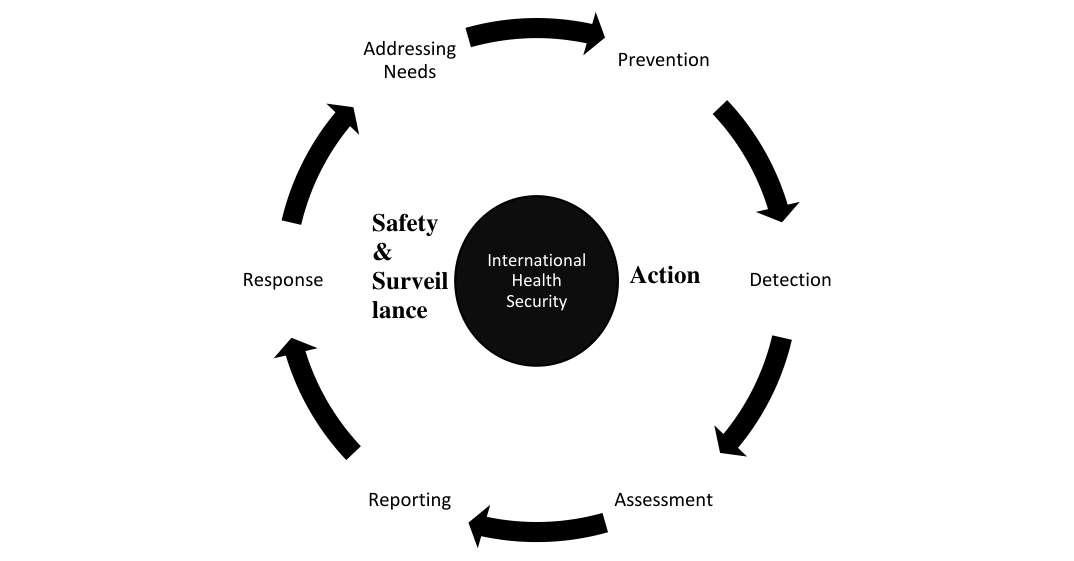
Figure: The cycle of international health security highlighting key stages such as prevention, detection, assessment, reporting, response, addressing needs, and action.
This diagram shows the key components of International Health Security and how they work together to protect public health worldwide. Prevention, detection, assessment, reporting, response, and needs-addressing make up the outer ring of health security. The inner ring emphasizes Safety and Surveillance, essential for health threat monitoring and management. The framework's main goal, Action, emphasizes proactive and reactive measures to ensure international health security. This holistic approach emphasizes the importance of each component working together to protect and promote public health and national and global security.
Bioterrorism Prevention
Bioterrorism, the purposeful spread of harmful organisms to cause illness or death, threatens national security. Bioterrorism can spread disease and death, strain healthcare systems, instill fear, and undermine economies and governments. Bioterrorism attacks are unpredictable and can be large, thus a solid preventative and response strategy is essential.18 National security frameworks must include public health efforts to mitigate bioterrorism risks. These precautions include surveillance, early detection, rapid reaction, and biomedical research and development. Surveillance systems quickly identify anomalous disease trends that may indicate bioterrorism. 19Advanced diagnostic tools and real-time data transmission at the local, national, and global levels help identify and mitigate such dangers. Medical countermeasures such as vaccines, antibiotics, and antivirals must also be prepared. 20The public health infrastructure must quickly provide these interventions to affected people. Healthcare providers and emergency responders need regular training and simulations to coordinate their response. Public health education about bioterrorism dangers and activities can reduce panic and improve adherence to public health directives in the event of an incident. Additionally, agency coordination is essential. Bioterrorism prevention and response need collaboration between public health, law enforcement, intelligence, and military authorities. Bioterrorism transcends borders, making international cooperation crucial. Global bioterrorism prevention can benefit from collaborative intelligence, coordinated drills, and uniform regulation. Public health measures must be integrated into national security programs to prevent bioterrorism. Countries may improve surveillance, preparedness, and response to protect their citizens against bioterrorism and maintain national security.
Challenges and Opportunities
Public health under national security settings has many challenges. Resource allocation matters. Governments sometimes have competing requests for scarce resources, thus public health programs may not receive the same funding and support as conventional security measures. Due to this difference, public health systems may be underfunded and unable to handle health emergencies. 21Interagency cooperation is difficult. Public health authorities, security agencies, and others must work together for effective integration. However, bureaucratic barriers, different organizational cultures, and poor communication can hinder coordination, leading to fragmented and ineffective health crisis responses. Additionally, legal hurdles are high. National security and public health laws are separate and may conflict, creating regulatory gaps and uncertainty. Legislative inconsistencies can delay crucial decisions, making public health integration into national security harder.22 Despite these challenges, public health and national security can be improved. Technology can greatly improve health security. Data analytics, AI, and biotechnology can improve disease surveillance, early warning, and response. These technologies can improve public health systems' efficiency and effectiveness. International partnership is another important possibility. Health security is a global issue that requires international cooperation. Global health security and pandemic mitigation can be improved by building international ties, sharing best practices, and coordinating health risk responses. These challenges and opportunities can be overcome to create a more coherent and effective public health and national security policy that improves outcomes for both.
Findings & Recommendations
The research uncovers multiple significant discoveries, emphasizing the crucial importance of strong public health systems in preserving national stability. A robust public health infrastructure is crucial for ensuring efficient readiness for pandemics, preventing bioterrorism, and swiftly responding to health emergencies. Incorporating public health policies within national security frameworks greatly improves a country's capacity to handle and reduce the consequences of health emergencies, therefore protecting national security. An exemplary instance is the reaction to the COVID-19 epidemic. Countries with robust public health systems, like South Korea and New Zealand, exhibited exemplary crisis management and containment tactics, leading to reduced fatality rates and minimal economic damage. These stories exemplify the immediate impact of public health interventions on national security outcomes. In contrast, countries with less robust healthcare systems saw significant difficulties, such as overcrowded medical facilities, increased mortality rates, and heightened socio-economic instability. Furthermore, the study highlights deficiencies in existing legal structures and emphasizes the necessity for all-encompassing policies that incorporate both public health and national security. The results strongly suggest the need for more funding for public health infrastructure, improved coordination between different agencies, and the creation of legal frameworks to ensure quick and efficient responses to health hazards. These actions are crucial for strengthening national security and guaranteeing the ability to withstand future health crises.
To bolster health security, this report proposes several specific policy initiatives. Legislative measures must be enacted to guarantee a more cohesive approach to public health and national security. Enhancing collaboration between public health and security organizations is crucial, requiring the creation of interagency task groups and efficient communication channels. Furthermore, it is essential to allocate more resources to enhance public health infrastructure, such as providing financial support for state-of-the-art healthcare facilities, research initiatives, and training programs. These actions will enhance the country's ability to address health emergencies, reduce the risks of bioterrorism, and guarantee overall national stability and security.
Conclusion
This research paper has analyzed the crucial overlap between public health and national security, highlighting the increasing significance of incorporating public health policies within national security frameworks. The study emphasized the importance of strong public health systems in maintaining national stability, particularly pandemic preparedness and prevention of bioterrorism. This was achieved by conducting a thorough examination of current literature, legal texts, and case studies. The main findings indicate that the integration process has significant obstacles, such as allocating resources and coordinating between different agencies. However, there are also huge possibilities for development through legislative changes and more international cooperation. Further investigation should focus on the precise processes of policy integration, exploring how other nations effectively integrate public health into their national security policies. Conducting comparative studies to assess the efficacy of different legislative frameworks and their influence on national security outcomes would yield significant information. Furthermore, investigating the influence of technical progress on public health monitoring and response, as well as the effects of socio-economic factors on health security, will enhance our comprehension of this crucial connection. To build comprehensive strategies that improve global health security and national resilience, scholars must continue focusing on the connection between public health and national security.
*****
Footnotes
3. A National Security Case for Public Health Infrastructure and Universal Healthcare | School of Public Health | University of Illinois Chicago, School of Public Health | University of Illinois Chicago, https://publichealth.uic.edu/news-stories/a-national-security-case-for-public-health-infrastructure-and-universal-healthcare/ (last visited June 15, 2024). ↑
4. Adam Kamradt-Scott & Colin McInnes, The securitisation of pandemic influenza: Framing, security and public policy, 7 Glob. Pub. Health S95, (2012), https://doi.org/10.1080/17441692.2012.725752. ↑
5. Alexander Lautensach & Sabina Lautensach, Eds., Threats to Human Security, BCcampus Open Publishing – Open Textbooks Adapted and Created by BC Faculty (Sept. 8, 2020), https://opentextbc.ca/humansecurity/chapter/threats-human-security/. ↑
6. Xueming Liu et al., Network resilience, 971 Physics Reps. 1, (2022), https://doi.org/10.1016/j.physrep.2022.04.002. ↑
7. Resham B. Khatri et al., Preparedness, impacts, and responses of public health emergencies towards health security: qualitative synthesis of evidence, 81 Archives Pub. Health, (2023), https://doi.org/10.1186/s13690-023-01223-y. ↑
8. W. Aldis, Health security as a public health concept: a critical analysis, 23 Health Pol'y & Plan. 369, (2008), https://doi.org/10.1093/heapol/czn030. ↑
9. https://aspr.hhs.gov/NHSS/Pages/default.aspx (last visited June 17, 2024). ↑
10. Security and Public Health: How and Why do Public Health Emergencies Affect the Security of a Country? The Nuclear Threat Initiative, https://www.nti.org/analysis/articles/public-health-emergencies-security/ (last visited June 18, 2024). ↑
11. Benjamin Scharte, Resilience Misunderstood? Commenting on Germany’s National Security Strategy, 2023 Eur. J. for Sec. Rsch., https://doi.org/10.1007/s41125-023-00095-1. ↑
12. Fed. Ministry of the Interior & Cmty., The Federal Office of Civil Protection and Disaster Assistance (BBK), Federal Ministry of the Interior and Community (Nov. 2, 2023), https://www.bmi.bund.de/EN/topics/civil-protection/bbk/bbk-node.html. ↑
13. Global health security is integral to foreign policy, World Health Organization - Regional Office for the Eastern Mediterranean, https://www.emro.who.int/health-topics/health-diplomacy/foreign-policy.html (last visited June 21, 2024). ↑
14. Strengthening Public Health as the Foundation of the Health System and First Line of Defense - The Neglected Dimension of Global Security - NCBI Bookshelf, National Center for Biotechnology Information, https://www.ncbi.nlm.nih.gov/books/NBK368392/ (last visited June 25, 2024). ↑
15. Thushara Kamalrathne et al., Need for effective detection and early warnings for epidemic and pandemic preparedness planning in the context of multi-hazards: Lessons from the COVID-19 pandemic, 2023 Int'l J. Disaster Risk Reduction 103724, https://doi.org/10.1016/j.ijdrr.2023.103724. ↑
16. Yashpal Singh Malik et al., How artificial intelligence may help the Covid‐19 pandemic: Pitfalls and lessons for the future, 2020 Revs. Med. Virology, https://doi.org/10.1002/rmv.2205. ↑
17. Suneja, N., Bose, K. (2022). Communicating COVID: Learnings and Way Forward. In: Pachauri, S., Pachauri, A. (eds) Health Dimensions of COVID-19 in India and Beyond. Springer, Singapore. https://doi.org/10.1007/978-981-16-7385-6_16 ↑
18. Comprehensive Review of Bioterrorism - StatPearls - NCBI Bookshelf, National Center for Biotechnology Information, https://www.ncbi.nlm.nih.gov/books/NBK570614/ (last visited June 29, 2024). ↑
19. Detecting Biological Threats Through the Public Health and Health Care Systems: Current Status - Biowatch and Public Health Surveillance - NCBI Bookshelf, National Center for Biotechnology Information, https://www.ncbi.nlm.nih.gov/books/NBK219707/ (last visited June 27, 2024). ↑
20. Who Should Get Antivirals and Where? - Antivirals for Pandemic Influenza - NCBI Bookshelf, National Center for Biotechnology Information, https://www.ncbi.nlm.nih.gov/books/NBK214511/ (last visited June 28, 2024). ↑
21. Public Health as a Problem-Solving Activity: Barriers to Effective Action - The Future of Public Health - NCBI Bookshelf, National Center for Biotechnology Information, https://www.ncbi.nlm.nih.gov/books/NBK218227/ (last visited July 10, 2024). ↑
22. https://www.gov.uk/government/publications/ai-regulation-a-pro-innovation-approach/white-paper ↑