
INTRODUCTION
During the World War II, atrocities such as mass genocide, night raids, forced deportations, slave labour and mass extermination had been committed by Germany. The Allied Power had a challenging question to answer, what do you do to the acts so evil? Since it was necessary to do something more than the conventional method, which was carried out during the war time. They had three responses-do nothing, death by the hands of the executions but they were rejected by Roosevelt and Churchill, justice by prosecution. As it was resolved the perpetrators of the second world war and the holocaust would receive justice and fairness as they themselves had wrought havoc in Germany. It served as a legal response to tyranny. The Allied powers acknowledged the need to hold Nazi leaders responsible not through revenge but by law. This was not just a response to the evil which the Nazi’s did but a transformation which shaped modern international law. The decision to do the trials was not just fairness but a way to show that law and justice prevailed even after war.
HISTORICAL BACKGROUND
1. Failure of Treaty of Versailles
The Nuremberg Trials began their history during World War I. This was not the initial occasion when punishment of the criminals was given after war. To hold the Germans responsible of genocide and the atrocities of the Nazi regime was a treaty that was proposed but was unable to do so due to economic shocks, huge compensation and extreme fines under the Versailles treaty. Before Nuremberg, there were treaties like The Kellogg-Briand Pact (1928) and The Hague Conventions (1899, 1907), but they were only symbolic, and there was no mechanism to enforce them. After World War I, the Leipzig Trials took place to prosecute the German leaders but were not successful (Holmes, 2022).
2. The Rise of The Nazi Regime
During the 1930s under Adolf Hitler the totalitarian governments were developed in Europe. Adolf Hitler and the National Socialist German Workers Party (Nazi Party) were clinging to the issues of national humiliation, resurrection of their nation and unity. People were manipulated through this propaganda. The only power that struck the democracy and instituted dictatorship was Hitler in 1933. The opposition to the Nazi politics was heightened as the Nazism ideology replaced laws prohibiting Jews, political opposition, Roma, and the disabled. State-approved propaganda, racial legislation and cruel methods of the Gestapo (Geheime Staatspolizei or Secret State Police) and SS ( Schutzstaffel or Protection Squads ) all led to the creation of a totalitarian state in Germany. Germany pulled out of the League of Nations in 1933 and this was a demonstration that they did not embrace the international laws (Galofré-Vilà et al., 2021).
3. Nature of Nazi Crime and Call for Justice
The German forces expanded across Europe after the outbreak of war in 1939. They did massacre, forces deportation, mass genocide and made extermination centers . Six million Jews were systematically murdered during the Holocaust, which was a key component of Nazi policy. There were also millions of people killed, among which were disabled people, Polish citizens, political dissidents and Soviet prisoners of war. This kind of atrocities and bureaucracy was incomparable to the rest of the world. The Allied Powers did not want to create the same mistakes that they made in World War I. They recognized that typical military tribunals could not handle the systemic foundation of Nazi crimes. A new type of justice was required, one that emphasized moral responsibility over battlefield conduct. By 1943, the Allied forces realized that simply defeating Germany would not be enough. There must be a legal resolution (Galofré-Vilà et al., 2021).
FORMATION OF IMT
The main question posed was to punish people who performed actions in a sovereign state in case those actions were not considered illegal in the domestic law of this state. The solution to this dilemma was to develop the International Military Tribunal (IMT). The IMT had its legal foundation when on 8 August 1945 the Allied Powers, the United States, the United Kingdom, France and the Soviet Union signed the London Charter. This Charter established a special set of judicial courts that involved the laws of the four Allied nations into a single international court.
The four countries had one judge, one alternate judge as well as its own prosecution team.
• Judges:
The United States: Francis Biddle, former U.S. Attorney General, who served as President of the Tribunal.
United Kingdom: Lord Justice Geoffrey Lawrence.
France: Henri Donnedieu de Vabres.
Soviet Union: Major General I. T. Nikitchenko
• Alternate Judges:
The United States: John J. Parker.
United Kingdom: Norman Birkett.
France: Robert Falco.
Soviet Union: Lieutenant Colonel Alexander Volchkov
• Chief Prosecutors:
The United States: Justice Robert H. Jackson.
United Kingdom: Sir Hartley Shawcross.
France: François de Menthon and Auguste Champetier de Ribes.
Soviet Union: Lieutenant General Roman Andreyevich Rudenko
“We must never forget that the record on which we judge these defendants today is the record on which history will judge us tomorrow. We must summon such detachment and intellectual integrity to our task that this Trial will commend itself to posterity as fulfilling humanity’s aspirations to do justice.”—US chief prosecutor, Robert H. Jackson
Objectives
1. Accountability: The might of the Allies was eager to see the Nazi leaders stand trial as a way of repaying them due to the holocaust, genocide and extermination.
2. Establish legal record: There were open trials that ensured transparency of evidence, documents and testimonies that could not be questioned in the future.
3. Individual Responsibility: The leaders simply could not use defence of I was only doing what was ordered or Befehl ist Befehl (an order is an order). The prosecution dismantled that argument where men who commit crimes cannot plea as a defence that they do so in uniform. Military men are not on top and out of the ethical and legal demands that are applicable to other persons. The fact that moral judgments cannot be made is inherent in the person. They used the example of: Erwin Rommel who had been instructed to execute any commandoes that he had or would get hold of but he incinerated the order demonstrating that even a general high-ranking could make moral judgement and override immoral command.
4. Defined New Crimes
Crimes against peace: These are the planning, the starting and entering wars of aggression or wars against international conventions.
Crimes against humanity: This encompassed exterminations, forced deportation, concentration camps, genocide, murder, forced labour or subjecting people based on race, religion or political beliefs.
War Crimes: This implied contravention of regulations of wars established before the World War II such as attacks on civilians, illegal destruction of property and murder of prisoners.
Conspiracy: This means that even participating in the agreement for the above crimes will also be punished.
5. Prevention from future atrocities: By punishing the leaders, the trials aimed that seeing that the leaders are getting punished people will be sacred to commit similar crimes.
WHY NUREMBERG?
Nuremberg Trials took place in Nuremberg, Germany because the Nazi Party had rallied in Nuremberg and because Nuremberg Laws that disenfranchised the Jews were enacted and thus when it was decided where to prosecute the leaders, the message was clear. The war demolished and ruined the other cities, but The Palace of Justice in Nuremberg remained intact and contained enough room to house a courtroom and a secure jail. It was also within the American zone of occupation, which was giving the US security, resources and administrative support that were needed to carry out the trials. It also possessed good history that linked law and governance (Ginsburgs and Kudriavtsev, 2024). There were over 400 visitors each day.
THE CONDUCT OF THE TRIALS
The trial of Nuremberg began on 20th November 1945 in the Place of Justice, Nuremberg. The Trial took approximately 316 days of which 218 days were the court sessions and other 98 days were preparation, documentation and judicial introspection days. The IMT constituted under London Charter of 1945 had the structure of the trials; the defendants had the right to be provided with a copy of the indictments brought against them and was allowed to engage a lawyer of his choice and provide evidence and cross examine since it was a paramount right to a fair trial. At the time the trials were initiated, the prosecution feared that it would not find anything against the men who had committed the atrocities that occurred during the war. They did not remember that the Germans take notes on everything. They exhibited more than 1,000,000 documents and carded them into 2000 binders, they also had 25 movie reels and numerous photographs. The Nazi documents that the Germans wrote to themselves worked against them since they were presented as their defence. The prosecution did not directly target the great atrocities of World War II just brought to bear the mechanism of conspiracy that gradually resulted into World War II and the atrocities of World War II. They wanted to demonstrate that these men were the ones who designed the system, which would result in these atrocities. Out of the alleged necessity of breathing rooms that were the gas chamber where human beings were killed. They dubbed it the breathing room as a way of deceiving the people. The defendants were permitted to contest the evidence but could not question the authorities.
There was one more problem to overcome which was language. International Business Machines a US company used the technique to ‘simultaneous interpretation’. There were five translation channels. The first channel contained the exact words spoken of the speaker. While the others translated it into English, French, Russian and German. There were three teams of interpreters, the first two teams would alternately shift courtrooms while the third teams would be on standby. Because of all this the trial could not be fast. The trials set a historical standard for international criminal justice with their precise and unbiased conduct.
CRITICISM OF THE NUREMBERG TRIALS
1. Victor’s Justice
This is centred around the idea that the Allied Powers were the ones making the laws. Just because Germany was defeated, they did not had influence over the trials. The Allies were excuses of the same crime for which the Germans were punish (Kim, 2019).
For example: Atomic Bombing on Japan.
2. Ex Post Facto
The laws applied were not codified when the acts occurred. “nullum crimen sine lege” means no crime without prior law.
For example: Crime against humanity was not there as codified international law before 1945.
3. Sovient Participation despite their own war crimes
Whether the Soviet Union would be considered as a judge was another controversial issue since the same crimes that the Germans were under prosecution, were also perpetrated by the Union of Soviet Socialist Republics (USSR) but were the judges. The Soviet NKVD executed thousands of Polish Officers in the Katyn Massacre that they attempted to place on the Germans.
4. Limited Resources and rights
The defendants were given restricted access to the documents and less time to prepare than the prosecution. The prosecution had full access to all the documents and Nazi records.
5. No Right to Appeal
There was no appellate body, the tribunal was the first and last authority to review the judgements. This was against their principle of fair judgement (Kim, 2019).
LEGAL IMPACT OF THE NUREMBERG TRIALS
The spirit of the Nuremberg Trials affected the format of the current international criminal law. It provided that even the military personnel and the government officials will be subject to international crimes as well as the individual including the head of state. It destroyed the state immunity through which a person cannot be defended against atrocities by sovereignty. It clarified that the following crimes may be punishable; crime of genocide, crime against humanity or aggression of war, it does not matter whether law or not these are codified. The universal human rights principle was based on this. The principles had introduced a substantive global standard, which was opposed to dominant orders and did not defend criminal atrocities (Shestak and Ulyanova, 2020). The resurgence of international criminal justice was also marked by an International Criminal Tribunal of the Former Yugoslavia(ICTY) and International Criminal Tribunal of Rwanda(ICTR) that established a conceptual foundation of sustainability through the principle of accountability of individual and no superior order that was introduced by Nurenberg. These precepts were legal grounds on which the Rome Statute (1998) was put in place, it constituted International Criminal Court.
KEY DEFENDANTS
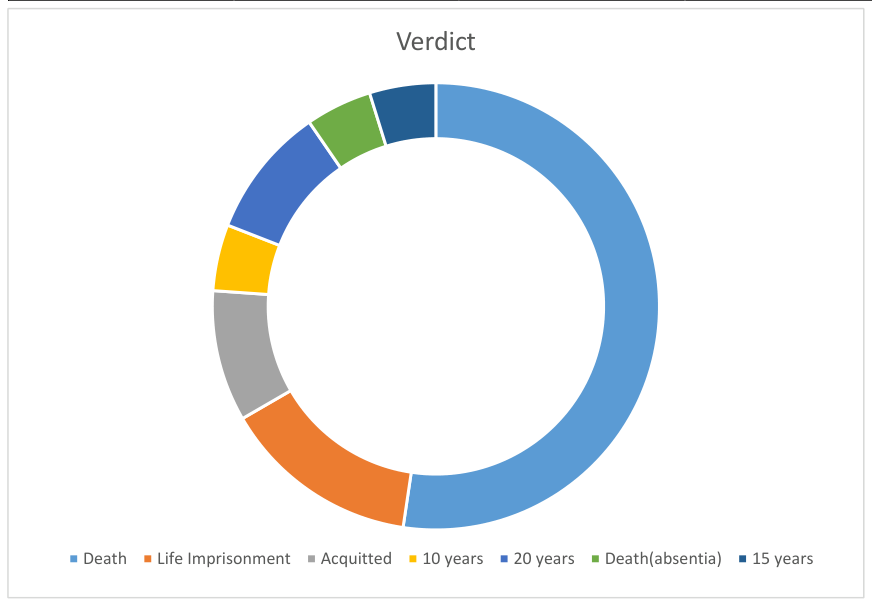
| Defendants | Position | Charges | Verdict |
|---|---|---|---|
| Hermann Göring | 2nd most powerful Nazi leader | Conspiracy, Crimes Against Peace, War Crimes, Crimes Against Humanity | Suicide before execution |
| Joachim von Ribbentrop | Foreign Minister of Nazi Germany | Conspiracy, Crimes Against Peace, War Crimes, Crimes Against Humanity | Death |
| Rudolf Hess | Deputy Führer | Conspiracy, Crimes Against Peace | Life imprisonment |
| Ernst Kaltenbrunner | Head of the Reich Main Security Office (RSHA), senior SS leader | War Crimes, Crimes Against Humanity | Death |
| Wilhelm Keitel | Head of the Armed Forces High Command (OKW) | All four charges | Death |
| Alfred Rosenberg | Chief Nazi ideologue | All four charges | Death |
| Wilhelm Frick | Interior Minister | All four charges | Death |
| Hans Frank | Governor-General of Occupied Poland | War Crimes, Crimes Against Humanity | Death |
| Julius Streicher | Publisher of antisemitic newspaper Der Stürmer | Crimes Against Humanity | Death |
| Karl Dönitz | Commander of German Navy; briefly succeeded Hitler | Crimes Against Peace, War Crimes | 10 years imprisonment |
| Walter Funk | Minister of Economics | Conspiracy, War Crimes, Crimes Against Humanity | Life imprisonment |
| Franz von Papen | Former Chancellor of Germany | Conspiracy | Acquitted |
| Konstantin von Neurath | Former Foreign Minister | All four charges | 15 years imprisonment |
| Baldur von Schirach | Hitler Youth Leader | Crimes Against Humanity | 20 years imprisonment |
| Hans Fritzsche | Senior official in Ministry of Propaganda | Crimes Against Humanity | Acquitted |
| Hjalmar Schacht | Reichsbank President | Conspiracy | Acquitted |
| Martin Bormann | Hitler’s private secretary (tried in absentia) | All four charges | Death (in absentia) |
CASE ANALYSIS (ADMIRAL KARL DÖNITZ)
1. Title
United States, United Kingdon, France and USSR v. Admiral Karl Dönitz
(International Military Tribunal, Nuremberg, 1945–46)
2. Charges
• Conspiracy to commit crimes
• Crimes against peace
• War Crimes
3. Facts of the Case
The Laconia Order which commanded the U-boat commanders not to help the survivors. The U-boat was built and commanded by Admiral Karl Dönitz was responsible for submarine warfare during the World War II. The Allies also participated in the submarine warfare but still only Karl was prosecuted.
4. Issue
Issue 1: Was Dönitz criminally responsible for participating in planning and waging aggressive war?
Issue 2: Did his conduct constitute war crimes based on unrestricted submarine warfare?
Issue 3: Was the Laconia Order a violation of international maritime law and humanitarian principles?
5. Judgement
• Conspiracy: Not guilty
The tribunal held that naval command alone did not prove involvement in Nazi political conspiracies.
• Crime Against Peace: Guilty
The court found he actively supported aggressive naval warfare and contributed to Nazi expansion.
• War Crimes: Guilty
The tribunal concluded that the Laconia Order violated international law.
Nevertheless, the tribunal also realized that the U.S. Navy itself engaged in similar submarine warfare and as such did not simply sentence Dönitz to unrestricted warfare
6. Punishment
He served in the Spandau Prison for 10 years.
CONCLUSION
The Nuremberg Trials showed that even in the difficult times of war the law must win over revenge. It reframed the justice in the 20th century. Despite flaws and political influences, the trials shaped the international laws regarding human rights and worldwide moral rules. The main aim was to punish the people who tortured people because of their race and vandalised the properties.