
Introduction
The grievance cannot be treated as a mere monetary claim of a routine nature. Subsistence allowance is intended to preserve the suspended employee’s minimum means of survival and to enable her to effectively defend herself in the disciplinary proceedings.
– Supreme Court of India, Surekha Domaji Bele v. Executive Engineer, Testing Division, MSEDCL (2026)1
Suspension is one of the most consequential interim measures available to an employer during disciplinary or criminal proceedings. Though suspension is formally conceived as an interim measure that neither determines guilt nor ordinarily extinguishes the underlying service relationship, its practical consequences may be far from neutral: it removes the employee from active service, restricts access to the workplace, affects professional standing and reputation, and may profoundly disrupt the employee’s financial security. Suspension thus presents an inherent jurisprudential tension between its ostensibly non-punitive legal character and its potentially punitive practical consequences. The tension is especially acute in the teaching profession, where suspension may continue while an enquiry, criminal investigation or trial remains pending for a substantial period. The law of subsistence allowance therefore operates at the intersection of service law, natural justice, livelihood, institutional accountability and constitutional fairness.
The problem acquires a distinctive character in Maharashtra’s higher-education system. A teacher working in a non-government aided affiliated college is ordinarily appointed by the management rather than directly by the State. Yet the institution may receive substantial salary grants; appointments and service conditions are regulated by statutory norms; pay structures are shaped by State acceptance of University Grants Commission recommendations; disciplinary processes are subject to university legislation and statutes; and public authorities exercise regulatory and financial control. Teachers directly serving in public university departments occupy a different institutional position, but their conditions of service are likewise statutory rather than purely contractual. Treating these categories simply as “government servants” is legally imprecise; treating them as ordinary private employees is equally misleading.
This hybrid regulatory status makes subsistence allowance a valuable subject of legal research. The principal questions are not confined to the rate payable during suspension. They include the source of the entitlement, the authority competent to suspend, the relationship between suspension and disciplinary enquiry, the consequences of delay, the responsibility of management and Government in aided institutions, the effect of non-payment on natural justice, and the constitutional limits on reducing an employee to financial helplessness while simultaneously requiring him or her to defend serious charges.
The Supreme Court has repeatedly described subsistence allowance as connected with minimum livelihood and fair opportunity. In O.P. Gupta v. Union of India2 the Court emphasised that suspension does not terminate service and observed that prolonged suspension injuriously affects the employee. In State of Maharashtra v. Chandrabhan Tale,3 the Court invalidated a rule reducing subsistence allowance to a nominal one rupee per month after conviction pending appeal, holding the provision inconsistent with constitutional guarantees. More recently, the Supreme Court reiterated that a grievance concerning unpaid subsistence allowance cannot be dismissed as a routine monetary claim, because the allowance preserves the minimum means of survival and enables effective defence in disciplinary proceedings.4
Against this background, this paper critically examines the Maharashtra framework governing teachers of public universities and non-government aided colleges. It argues that subsistence allowance should be understood not merely as a service benefit but as an institutional safeguard against punitive suspension without adjudication.
A. Research problem
The central research problem is therefore not merely whether a suspended teacher possesses an entitlement to subsistence allowance, but whether the regulatory structure ensures actual and uninterrupted payment where disciplinary authority and financial responsibility are institutionally separated. In aided colleges, the management may order suspension while salary expenditure operates through the grant-in-aid structure. Disagreement may consequently arise over whether the management must initially bear the amount or whether Government must sanction or reimburse it. Judicial experience demonstrates that such disagreements can result in employees approaching constitutional courts merely to secure payment during suspension. The resulting problem is one of enforcement design: the employee’s immediate statutory entitlement must be insulated from the subsequent institutional question of reimbursement, adjustment or recovery.
B. Research questions
The study addresses the following questions:
1. What is the legal source and character of a teacher’s entitlement to subsistence allowance in Maharashtra’s public universities and aided affiliated colleges?
2. In the case of teachers of aided affiliated colleges, how do the Uniform Statutes allocate the immediate obligation to pay subsistence allowance between management and public authorities, and to what extent does the Government payment-and-recovery mechanism prevent disputes concerning sanction, reimbursement or ultimate financial liability from resulting in non-payment to the suspended teacher?
3. What constitutional and natural-justice principles govern non-payment or inadequate payment?
4. What is the legal significance of prolonged suspension?
5. What reforms can make the statutory protection effective in practice?
C. Hypothesis
The study proceeds on the hypothesis that Maharashtra’s statutory framework recognises comparatively strong financial protection during suspension, but that its practical effectiveness in aided affiliated colleges depends upon a clear distinction between the employee’s immediate entitlement to payment and the ultimate allocation of financial liability between management and Government. Where management default, grant sanction, reimbursement or inter-institutional disagreement delays actual payment, a formally protected entitlement may become practically ineffective and compel the suspended teacher to resort to litigation. The hypothesis further proceeds on the premise that an effective framework must ensure payment first and permit reimbursement, grant adjustment or recovery between institutions thereafter.
D. Methodology and scope
The research adopts a doctrinal and analytical method. Primary materials include the Constitution of India, the Maharashtra Public Universities Act, 2016, the Uniform Statutes governing teachers, and judicial decisions of the Supreme Court and the Bombay High Court. Secondary institutional materials are used to clarify the regulatory setting. The paper focuses on teachers working in public universities covered by the Maharashtra Public Universities Act and teachers of non-government affiliated or aided colleges governed by the relevant Uniform Statutes. School teachers governed by the Maharashtra Employees of Private Schools framework are outside the principal scope, except where a judicial principle has wider conceptual relevance.
Regulatory framework governing service and disciplinary matters of university teachers in Maharashtra
The service conditions of teaching staff in public universities and affiliated colleges in Maharashtra operate within a multi-layered statutory and regulatory framework. Unlike members of the State civil service, university and college teachers do not derive their service conditions from a single body of service rules. Their rights, duties, pay structure, academic obligations, standards of conduct and disciplinary accountability emerge from the interaction of the Maharashtra Public Universities Act, 2016; the Statutes, Standard Code, Ordinances and other statutory instruments framed or continued thereunder; the University Grants Commission Act, 1956 and applicable UGC Regulations; Central and State Pay Commission and UGC pay revision schemes as adopted by the State Government; and relevant Government Resolutions and directions. The precise applicability of each instrument necessarily depends upon the subject matter which it regulates.
A. Maharashtra Public Universities Act, 2016 as the primary statutory framework
For public universities falling within its scope, the Maharashtra Public Universities Act, 2016 constitutes the principal State legislation governing university administration and the service framework of university teachers. Section 71 of the Act contemplates the framing of Statutes concerning the service conditions of teachers, officers and other employees. The statutory framework specifically permits regulation of disciplinary action against defaulting teachers and employees and also encompasses matters relating to their qualifications, recruitment, code of conduct, duties, conditions of service, retirement benefits and termination.5 Consequently, the substantive authority for initiating disciplinary proceedings against an erring member of the teaching staff must ordinarily be traced to the Act and to the applicable Statutes or other statutory service instruments made or continued thereunder.
The Act simultaneously confers an important regulatory power upon the State Government. Section 8(3) empowers the State Government to prescribe a Standard Code dealing, inter alia, with appointment, duties, workload, pay, allowances, post-retirement benefits, conduct, disciplinary matters and other conditions of service of university teachers, officers and employees. Where such a Standard Code has been validly prescribed and made applicable, its provisions assume overriding significance and prevail over inconsistent provisions contained in subordinate university instruments to the extent contemplated by the Act.6
Thus, for disciplinary and service matters, the governing framework has to be identified by examining the Act, the applicable Standard Code and Statutes, together with validly continuing pre-existing statutory instruments and other subordinate provisions.
B. Continuing operation of earlier statutes, ordinances and service instruments
The enactment of the Maharashtra Public Universities Act, 2016 did not necessarily produce a regulatory vacuum by extinguishing every service provision operating under the earlier university legislation. To the extent recognised by the saving and transitional framework of the 2016 Act, pre-existing Statutes, Ordinances, Regulations and other statutory instruments may continue to operate until they are lawfully replaced, modified or superseded, provided that they are not inconsistent with the provisions of the 2016 Act or a superior statutory instrument subsequently brought into force.
Consequently, where a comprehensive Standard Code or subsequently enacted uniform statutory provision does not govern a particular disciplinary issue, disciplinary proceedings against university or college teachers may continue to draw their substantive and procedural authority from the applicable pre-existing Statutes, Ordinances or service regulations, subject always to their continued legal validity under the 2016 Act.
C. UGC Regulations and Pay Commission framework: an additional regulatory layer
The position of university teachers is further distinguished from that of ordinary State civil servants by the operation of the University Grants Commission Act, 1956 and the Regulations framed by the UGC, together with the UGC and Pay Commission schemes adopted and implemented by the Central and State Governments.
The UGC regulatory framework has particular significance in relation to minimum qualifications for appointment, recruitment and selection procedures, academic standards, career advancement, promotion, workload, teaching and research responsibilities, academic performance and other professional standards applicable to the teaching community. Where valid UGC Regulations operate within the field entrusted to the UGC and are legally applicable to the institution concerned, the University and the State regulatory framework have to be understood consistently with those requirements.
This regulatory relationship becomes particularly visible in the matter of pay revision. Successive UGC and Pay Commission recommendations concerning university and college teachers have been adopted and implemented in Maharashtra through appropriate Government Resolutions and consequential university action. The pay structure, academic levels, increments, Career Advancement Scheme and related financial and professional benefits of eligible teaching staff may therefore derive from the UGC and Pay Commission framework as adopted by the State Government.
Accordingly, the legal status of a university teacher cannot be equated simpliciter with that of a State Government servant. The teaching community possesses a distinct statutory and professional service framework in which State university legislation and Statutes operate alongside applicable UGC norms and State-adopted UGC and Pay Commission schemes.
At the same time, the applicability of UGC Regulations or UGC-based pay scales does not, by itself, mean that every aspect of disciplinary control is governed by UGC Regulations. The source governing a particular question must be identified according to its subject matter. Thus, academic qualifications, recruitment standards, promotion and academic obligations may substantially engage the UGC regulatory framework, while disciplinary jurisdiction, penalties, inquiry procedure, suspension and allied service matters must principally be traced to the University Act, Standard Code, applicable Statutes and other legally operative service instruments, unless a UGC provision specifically governs the issue concerned.
D. Position of the Maharashtra Civil Services Rules
Within this composite framework, the status of the Maharashtra Civil Services Rules (MCS Rules) requires particular care. A teacher appointed by a statutory public university does not become a member of the Maharashtra State civil service merely because the University has been established by State legislation, receives substantial governmental financial assistance, or because the State Government implements UGC and Pay Commission pay scales for its teachers. Consequently, the MCS Rules do not automatically constitute the primary source governing the service conditions or disciplinary proceedings of university or college teachers.7 Their binding applicability must ordinarily be traced to an express adoption, incorporation or reference in the governing Act, Standard Code, Statutes, service regulations, Government Resolution having the necessary legal authority, or another competent statutory instrument.8 Where the MCS Rules, or specified provisions thereof, have been validly incorporated into the university service framework, those provisions may operate with binding force to the extent of their adoption.
A different situation arises where the governing University Act, Statutes, Ordinances or service regulations confer disciplinary authority but remain silent or incomplete on a particular procedural question. In such cases, corresponding provisions of the MCS Rules may legitimately provide persuasive or supplementary procedural guidance, particularly where they embody established principles of fair disciplinary administration, their application is not inconsistent with the governing statutory framework, and they cause no prejudice to the delinquent.
The distinction is therefore between substantive governance and procedural supplementation. MCS Rules may assist in filling a genuine procedural interstice; they cannot ordinarily be invoked merely by analogy to create a substantive power of suspension, impose a penalty, alter a statutory condition of service or displace an express provision contained in the University Act, Standard Code, Statutes or another superior statutory instrument.
The appropriate principle may consequently be described as “supplementation without substitution.” Where expressly incorporated, MCS provisions may be binding; where the governing university framework is procedurally silent, they may provide persuasive guidance; but where they conflict with the applicable statutory university regime, the latter must prevail.
E. Harmonised position
The service and disciplinary regime applicable to university teachers in Maharashtra should therefore be understood not through a single set of rules but through a harmonised and subject-specific regulatory structure. This can be represented as follows:
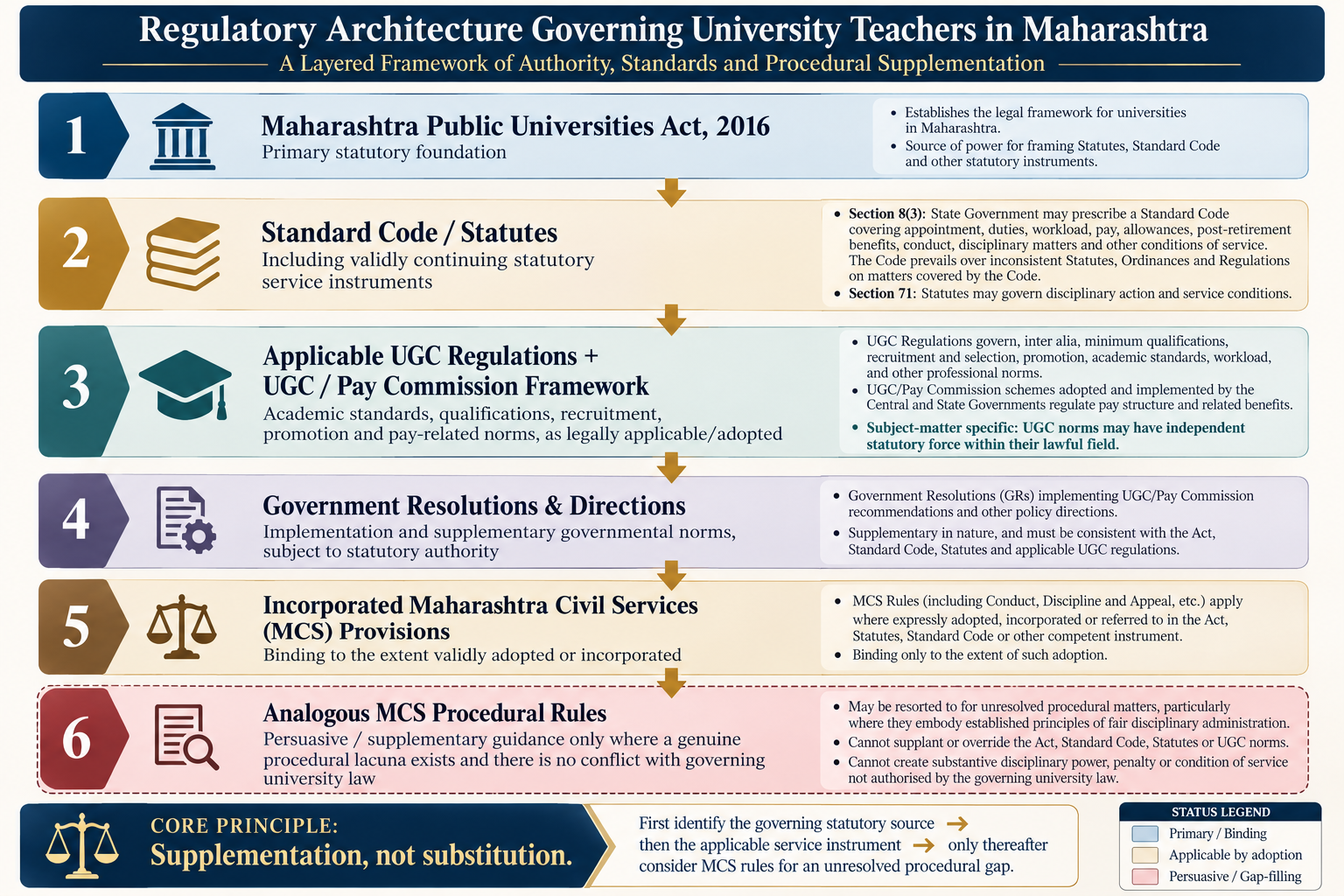
Figure 1: Regulatory Architecture Governing University Teachers in Maharashtra: A Layered Framework of Authority, Standards and Procedural Supplementation
This sequence, however, should not be understood as an inflexible hierarchy for every issue. The controlling instrument depends upon the nature of the question involved. UGC Regulations assume particular importance in matters falling within academic standards, qualifications, recruitment, promotion and related professional norms; the University Act and statutory service instruments principally govern institutional service and disciplinary matters; while Government Resolutions implementing UGC and Pay Commission recommendations regulate the corresponding financial and service benefits to the extent of their lawful adoption.
Thus, university teachers in Maharashtra occupy a distinct statutory-academic service category. They are neither ordinary State civil servants governed wholesale by the Maharashtra Civil Services Rules nor employees whose service conditions are determined exclusively by autonomous university regulations. Their legal position is produced by the combined operation of the Maharashtra Public Universities Act, applicable Statutes and Standard Code, validly continuing service instruments, UGC Regulations, State-adopted UGC and Pay Commission schemes and Government directions, with the Maharashtra Civil Services Rules operating directly where validly incorporated and, in appropriate procedural matters, supplementarily or persuasively where the governing university framework contains a genuine lacuna.
Accordingly, in disciplinary proceedings against an erring university teacher, the first inquiry must always be directed towards identifying the specific statutory source of disciplinary authority and the applicable university service provisions. Only thereafter should resort be made to the Maharashtra Civil Services Rules for an unresolved procedural issue. Such resort can supplement the statutory framework but cannot supplant it. This approach simultaneously preserves university autonomy, respects the special statutory and academic status of the teaching profession, recognises the binding force of applicable UGC norms and State-adopted pay schemes, and ensures procedural fairness where the university regulatory framework is incomplete.
Jurisprudential and constitutional foundations of suspension and subsistence allowance
Suspension creates a peculiar juridical paradox: the employee remains within the discipline of employment while being temporarily excluded from its ordinary functions and some of its benefits. It does not, by itself, adjudicate guilt, nor does it ordinarily dissolve the underlying service relationship. Rather, suspension places certain incidents of that relationship (principally the performance of duties and the entitlement to ordinary remuneration) in temporary abeyance pending disciplinary or other legally recognised proceedings.9 The Supreme Court, in Balvantray Ratilal Patel v. State of Maharashtra, distinguished suspension as a penalty from interim suspension pending an enquiry, and explained that where the power to suspend exists, an order forbidding the servant to work suspends the reciprocal obligations of the relationship: the servant is not bound to render service and the master is not bound to pay, save as the governing rules provide.10 The position was expressed even more directly in O.P. Gupta v. Union of India, where the Court observed that an order of suspension does not put an end to service and that the employee continues to remain a member of the service despite being prevented from working.11
This distinction is fundamental. Suspension is preventive or interim in legal character; punishment is adjudicatory in character. The former preserves the employer’s ability to conduct an effective inquiry or protect legitimate institutional interests while allegations remain unresolved; the latter follows a determination of responsibility in accordance with law. In Ajay Kumar Choudhary v. Union of India, the Supreme Court described suspension preceding the formulation of charges as “essentially transitory or temporary in nature” and cautioned against its indefinite continuation.12 The legitimacy of suspension therefore derives substantially from its provisional character. When an interim measure is continued mechanically, accompanied by unjustified financial deprivation, or allowed to impose consequences disproportionate to its temporary purpose, the distinction between precaution and penalty begins to erode.
The expression “subsistence allowance” must be understood against this jurisprudential background. It represents a legal compromise or, more accurately, a juridical equilibrium between the employer’s power to temporarily withhold work and the employee’s continuing right to survive the period during which that power is exercised. During a valid suspension, the employee is ordinarily prohibited from discharging normal duties but remains subject to the discipline of the employment relationship. The employee may also be prohibited or restricted from accepting alternative employment. Complete deprivation of financial support in such circumstances would create an obvious asymmetry: the employer would retain the disciplinary incidents of employment while disclaiming the economic consequences of maintaining that relationship.
The jurisprudential sequence may therefore be expressed as follows:
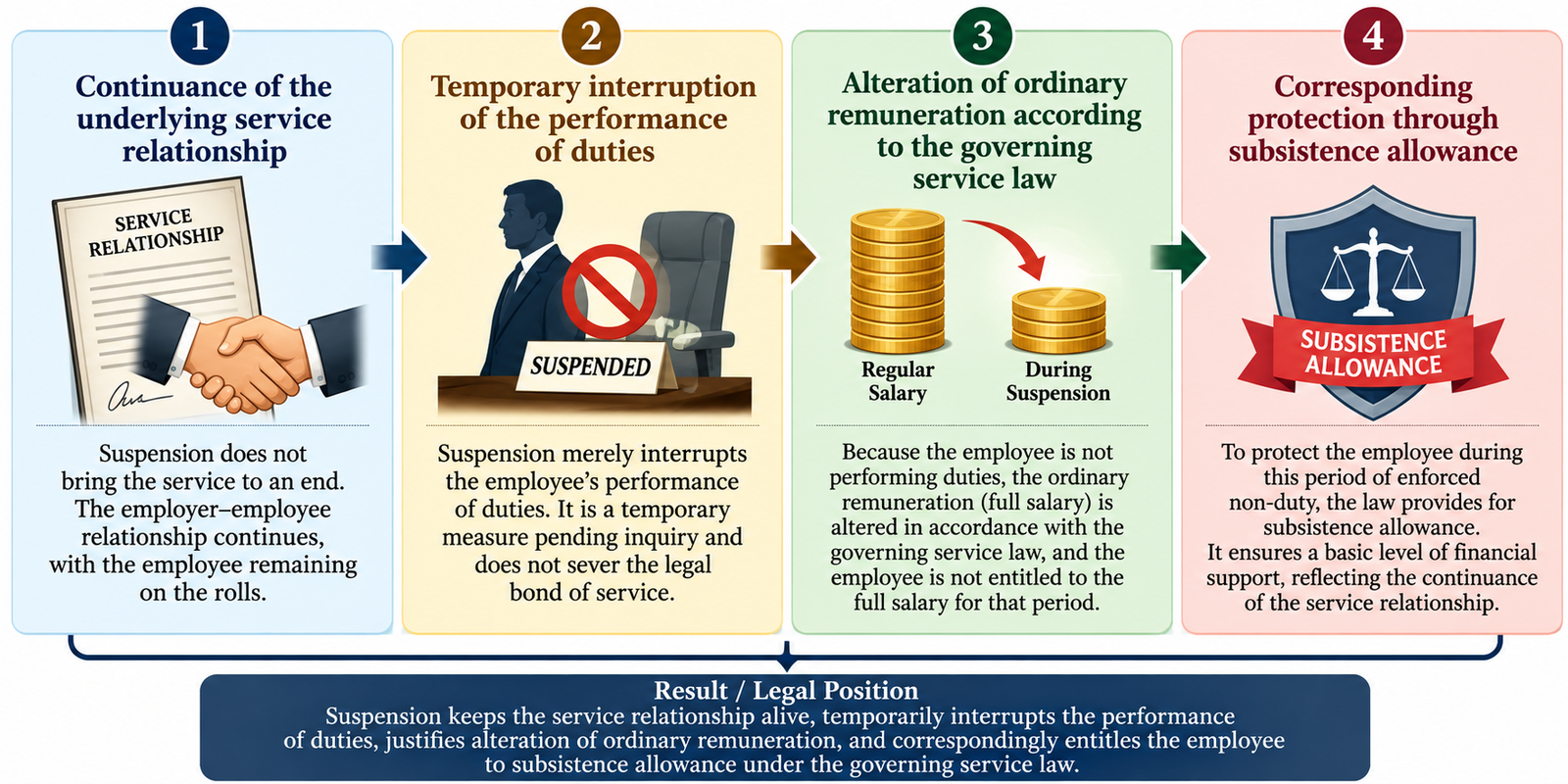
Figure 2: The Legal Architecture of Suspension: Continuity of Service, Interruption of Duties, Adjustment of Remuneration and Subsistence Protection
Subsistence allowance is consequently not an accidental monetary benefit associated with suspension. Nor is it charity, bounty or an act of institutional generosity. It is a legal consequence of an employment relationship that continues in an altered form while the employee is prevented from earning ordinary remuneration through the performance of normal duties. As the Supreme Court explained in O.P. Gupta, the suspended employee remains in service but is not permitted to work and receives the allowance prescribed for the period of suspension instead of ordinary pay and allowances.13
This produces an important conceptual limitation upon the employer’s power: an employer cannot coherently treat a suspended person as an employee for the purposes of discipline, obedience and restrictions, but as a stranger to employment when the question of subsistence arises. If suspension does not determine guilt, if the underlying service relationship survives, and if the employee is prevented by the employer from performing normal duties, legally protected subsistence becomes an integral incident of that altered relationship. Its unjustified denial risks transforming an ostensibly interim administrative measure into economic punishment before adjudication.
The constitutional significance of subsistence allowance was powerfully demonstrated in State of Maharashtra v. Chandrabhan Tale.14 The Supreme Court considered a service rule in force in Maharashtra, the second proviso to rule 151(1)(ii)(b) of the Bombay Civil Services Rules, 1959, under which subsistence allowance stood reduced to the nominal amount of one rupee per month after conviction while the employee’s appeal remained pending. The Court rejected such an arrangement as constitutionally unacceptable and held the impugned provision violative of Articles 14, 16 and 21 of the Constitution.15 The significance of Chandrabhan Tale extends beyond the particular service rule under challenge. It establishes that the law cannot formally recognise a right to subsistence while fixing its content at a level incapable of performing the very function for which that right exists. Subsistence must be real rather than illusory.
The reasoning also reveals an important relationship between Article 21 and service jurisprudence. Subsistence allowance cannot be understood exclusively through the arithmetic of salary. Its ultimate subject is the human being who must continue to maintain himself or herself, and ordinarily a dependent family, during a period in which normal earning through the employment has been legally interrupted. The constitutional concern is therefore not simply whether some amount has technically been sanctioned, but whether the statutory arrangement remains compatible with dignity, livelihood and fair procedure.16
The jurisprudence becomes still more compelling when subsistence is connected with the employee’s ability to defend disciplinary proceedings. In Fakirbhai Fulabhai Solanki v. Presiding Officer, the Supreme Court recognised the necessity of providing a suspended employee sufficient subsistence to maintain himself and his family and to meet the expenses involved in defending the proceedings.17 The Court connected financial deprivation with denial of a reasonable opportunity of defence and, consequently, with the principles of natural justice.18
This connection transforms the conceptual character of subsistence allowance. It performs not merely a survival function, but also a defence function. A disciplinary system may formally provide notice of charges, access to documents, representation, production of evidence and participation in hearings; yet those procedural guarantees can become substantially ineffective if the employee is deprived of the minimum economic capacity necessary to exercise them. Travel to inquiry proceedings, obtaining documents, preparing written explanations, seeking professional assistance and participating in repeated hearings all carry material costs. Procedural rights cannot be evaluated entirely in abstraction from the practical capacity to exercise them.
The broader jurisprudential foundation for this approach can also be traced to Madhav Hayawadanrao Hoskot v. State of Maharashtra.19 Hoskot did not concern suspension or subsistence allowance and should not be treated as a direct authority on either subject. Its relevance lies instead in Krishna Iyer J.’s broader conception of substantive procedural fairness: a legal right must be capable of meaningful exercise rather than existing merely on paper. Significantly, the Supreme Court itself subsequently invoked the reasoning of Hoskot in Chandrabhan Tale while considering the relationship between subsistence allowance and the effective exercise of the employee’s legal remedies.20 Read together, the two decisions support a wider constitutional proposition: where law confers a procedural right, State action should not deprive the individual of the minimum material conditions necessary to make that right effective.
This principle assumes special importance during suspension. The suspended employee occupies an inherently vulnerable legal position: normal work is prohibited, ordinary remuneration is interrupted or altered, service discipline continues, and allegations remain to be adjudicated. To provide a formal opportunity of defence while simultaneously depriving the employee of the means reasonably necessary to exercise that opportunity would reduce natural justice to a procedural abstraction. Subsistence allowance thus becomes one of the material conditions through which the audi alteram partem principle acquires practical content.
The same jurisprudence imposes limits upon conditions that an employer may attach to payment. A statutory entitlement cannot ordinarily be defeated by superimposing burdensome conditions having no foundation in the governing legal regime. The Bombay High Court’s decision in Hindustan Lever Employees Union v. Hindustan Unilever Limited illustrates this principle in the industrial-employment context.21 Although the case arose under Section 10A of the Industrial Employment (Standing Orders) Act, 1946 and therefore does not directly govern teachers of universities or aided colleges, its reasoning is jurisprudentially instructive. The Court rejected compulsory daily attendance as a condition for receiving subsistence allowance where such a requirement lacked statutory foundation.22 The case illustrates an important distinction between a statutory condition regulating entitlement and an extra-statutory condition obstructing entitlement. The former derives legitimacy from law; the latter requires close scrutiny where it has the effect of frustrating the substantive right.
The emerging jurisprudence therefore suggests that subsistence allowance should no longer be conceptualised merely as a reduced substitute for salary. It performs at least three interrelated legal functions.
First, it performs a livelihood function: it protects the suspended employee and dependent family against destitution during an employer-imposed interruption of ordinary work. This dimension finds its strongest constitutional expression in Chandrabhan Tale.23
Second, it performs a procedural or defence function: it preserves the employee’s practical capacity to participate meaningfully in disciplinary proceedings and to exercise available legal remedies. Fakirbhai Fulabhai Solanki provides direct judicial support for this dimension, while Hoskot and Chandrabhan Tale locate it within the broader jurisprudence of effective procedural rights.24
Third, it performs a rule-of-law function: it helps preserve the distinction between suspension and punishment. By ensuring minimum economic protection while allegations remain unresolved, subsistence allowance reduces the possibility that suspension itself will operate as an informal penalty imposed before lawful adjudication. This concern resonates particularly with the Supreme Court’s warning against prolonged and mechanically continued suspension in Ajay Kumar Choudhary.25
These three functions of livelihood, defence and rule of law are ultimately interconnected. Livelihood makes defence materially possible; effective defence makes adjudication fair; and fair adjudication preserves the distinction between interim suspension and final punishment. Subsistence allowance can therefore be understood as a financial guarantee of procedural fairness during suspension.
The jurisprudential position may ultimately be reduced to a simple but consequential proposition: suspension may temporarily take away the employee’s work; it cannot legitimately be administered so as to take away the means to survive the suspension, the practical capacity to defend the allegations that produced it, or the dignity with which that defence must be made. Viewed from this perspective, subsistence allowance is not peripheral to the law of suspension. It is one of the principal legal mechanisms through which the coercive consequences of suspension are reconciled with continuing employment, natural justice and constitutional fairness.
A. From formal suspension to substantive fairness
The constitutional jurisprudence of subsistence allowance may also be understood through the broader conception of substantive procedural fairness developed under Article 21 in Madhav Hayawadanrao Hoskot v. State of Maharashtra.26 The relevance of this principle to subsistence allowance is not merely inferential. In State of Maharashtra v. Chandrabhan Tale,27 the Supreme Court itself invoked Hoskot while considering the constitutional validity of drastically reducing the subsistence allowance of a suspended employee. The Court connected economic capacity with the meaningful exercise of the right of appeal and rejected an arrangement under which the purported subsistence allowance was reduced to an amount incapable of sustaining the employee.
Read together, Hoskot and Chandrabhan Tale reveal an important constitutional principle: law must protect not merely the formal existence of a right but also the minimum conditions necessary for its meaningful exercise. Applied to disciplinary proceedings, an employee who possesses on paper the right to notice, representation, production of evidence and defence cannot be economically incapacitated by the very suspension that necessitates the exercise of those rights.
In this sense, suspension and subsistence are jurisprudentially interconnected. Suspension may temporarily withdraw the employee from active duty, but it cannot legitimately reduce the employee to such economic vulnerability that the opportunity of defence becomes illusory. Subsistence allowance is therefore better understood not merely as a monetary incident of suspension, but as one of the material conditions through which procedural fairness is made effective.
B. Limits on employer-imposed conditions for release of subsistence allowance
An important dimension of the jurisprudence of subsistence allowance concerns the extent to which an employer may impose additional conditions before releasing the amount otherwise payable under law. Although arising in the context of industrial employment, the decision of the Bombay High Court in Hindustan Lever Employees Union v. Hindustan Unilever Limited28 provides a useful jurisprudential principle for understanding the limits of managerial discretion.
The significance of the decision extends beyond the particular industrial setting in which it arose. It would be inappropriate to apply Section 10A of the Industrial Employment (Standing Orders) Act directly to university or aided-college teachers where their service conditions are governed by a different statutory regime. Nevertheless, the underlying jurisprudential proposition is relevant: once the governing law creates an entitlement to subsistence allowance and prescribes the conditions governing its payment, an employer should not be permitted to defeat that entitlement by superimposing additional, burdensome or extra-statutory conditions.
This principle assumes particular significance in the context of teachers working in non-government aided colleges in Maharashtra. Their entitlement must principally be determined by the Maharashtra Public Universities Act, 2016 and the applicable Uniform Statutes. Where those Statutes themselves prescribe a legitimate condition, for example requiring the suspended teacher to furnish a declaration concerning engagement in private employment, trade or business, the condition forms part of the statutory arrangement and must ordinarily be complied with. Such a requirement is conceptually different from an employer unilaterally creating an additional condition having no foundation in the governing Statutes.
The distinction may therefore be expressed as one between a statutory condition regulating entitlement and an extra-statutory condition obstructing entitlement. The former derives legitimacy from the governing service law; the latter requires much closer judicial scrutiny, particularly where non-compliance results in complete deprivation of the means of subsistence. The purpose of subsistence allowance would be substantially defeated if an employer could achieve indirectly, through administrative conditions, what the statutory framework does not permit directly.
The Hindustan Lever Employees Union29 decision thus contributes to a broader jurisprudence in which subsistence allowance is understood not as a matter of managerial generosity but as a legally protected incident of suspension. Read alongside State of Maharashtra v. Chandrabhan Tale,30 Fakirbhai Fulabhai Solanki v. Presiding Officer31 and O.P. Gupta v. Union of India,32 the judgment strengthens the proposition that conditions governing subsistence allowance must be interpreted consistently with its underlying purposes: preservation of minimum economic security, maintenance of the employee and family, and preservation of a meaningful capacity to defend disciplinary proceedings.
The distinctive status of university and aided-college teachers in Maharashtra
The Maharashtra Public Universities Act, 2016 regulates non-agricultural and non-medical public universities in the State and establishes a statutory framework for university governance, affiliation, appointments and conditions of service. Section 71 contemplates Statutes dealing with qualifications, recruitment, code of conduct, duties and conditions of service of teachers, officers and other employees of universities and affiliated colleges, subject to State policy.33 The resulting service relationship is therefore embedded in public regulation rather than left solely to private contract.
For aided affiliated colleges, the institutional arrangement is triangular. The management is the immediate employer and disciplinary authority in important respects; the university supplies the academic and statutory framework; and the State, acting through the Higher and Technical Education Department and the Directorate and Joint Director machinery, exercises financial and regulatory control. Grant-in-aid makes the State a material participant in the economic structure of the institution even though the teacher is not thereby converted into a civil servant.
This distinction is central to the present study. The legal justification for subsistence allowance need not depend upon proving that an aided-college teacher is a government servant. The entitlement can arise directly from the statutory service conditions governing the institution. Constitutional principles then operate as interpretative and supervisory standards because the regulatory regime itself is created and enforced through public law.
Teachers employed directly in university schools, departments, conducted colleges and university institutions are governed by one set of Uniform Statutes, while teachers in affiliated colleges, recognised institutions and specified autonomous institutions are governed by the corresponding Uniform Statutes applicable to those institutions. The existence of differentiated institutional categories does not diminish the common normative premise: suspension is temporary, service continues, and the teacher cannot be deprived of the financial protection prescribed by the governing statutes.
Maharashtra Public Universities Act, 2016 and the Uniform Statutes
The Maharashtra Public Universities Act, 2016 authorises the framing of statutes concerning the conditions of service of teachers. Section 71(20), read with the statute-making provisions of Section 72, including the power of the State Government under Section 72(10) to prescribe uniform Statutes, provides the legislative foundation for detailed service conditions.34 The Uniform Statutes consequently occupy a central position in determining the rights and obligations of teachers during suspension.
The Uniform Statutes define “subsistence allowance” as the monthly grant paid to a teacher who is not in receipt of pay or leave salary during suspension. More importantly, the suspension provisions prescribe the financial consequence of a pending regular enquiry. The Statutes provide that during suspension a teacher shall be paid subsistence allowance equal to full pay and admissible allowances pending regular enquiry.35 This is materially more protective than the conventional model in which an employee begins with approximately half salary.36
The Statutes also recognise that responsibility for prolongation matters. Where suspension extends beyond three months for reasons directly attributable to the teacher, and reasons are recorded in writing, the competent authority may reduce the amount by a suitable sum not exceeding fifty per cent of the pay component, excluding allowances.37 The requirement of recorded reasons is important. It prevents reduction from operating automatically merely because three months have elapsed. The statutory design therefore links financial reduction to attributable delay rather than to the mere passage of time.
A teacher must furnish a declaration that he or she will not engage in private employment, trade or business during suspension. This requirement reflects the reciprocal nature of the arrangement: the employer continues financial support because the suspended teacher remains bound to the service relationship and is not expected to replace that relationship with another gainful occupation. If the declaration is suspected to be false, verification is contemplated, and a false declaration may itself amount to misconduct.38
The Statutes further address criminal proceedings, superannuation, exoneration and reinstatement.39 These provisions attempt to connect the interim financial arrangement with the eventual outcome of the proceedings. The broader principle is that the final treatment of the suspension period must follow a reasoned decision after the disciplinary or judicial process rather than being presumed at the beginning.
Who must pay? The special problem of aided colleges
The most significant feature of the Maharashtra framework for affiliated colleges is the express mechanism dealing with management default. The Uniform Statutes provide that if a college or recognised institution fails to pay the subsistence allowance determined under the Statutes, the Government, through the office of the Joint Director, shall pay the teacher and deduct the amount from grants payable to the college or institution.40
This mechanism is normatively important for three reasons. First, it recognises that the teacher should not bear the consequences of a financial or administrative dispute between the management and Government. Second, it uses the grant-in-aid relationship as an enforcement device. Third, it transforms the State’s role from that of a distant regulator into a statutory backstop where the aided institution defaults.
The provision also answers a recurring practical objection: a management cannot ordinarily justify non-payment merely by asserting financial inability while continuing to enjoy grant-in-aid status. The statutory solution is not to leave the suspended teacher without support; it is to facilitate payment and adjust the amount against grants. This structure is especially appropriate because suspension is normally the result of an institutional decision, not an employee’s voluntary withdrawal from work.
The practical significance of separating immediate payment from ultimate financial liability is illustrated by Gajanan S/o Bhaskar Jadhav v. Joint Director of Higher Education.41 The petitioner, who was serving as Principal of the college concerned, complained of non-payment of the amount claimed during suspension. The management indicated that the relevant pay bills would be forwarded to the Government authority for sanction. Significantly, the Court did not permit the pendency of governmental sanction to postpone the employee’s immediate financial protection. It directed the management to pay the petitioner the subsistence allowance or amount payable in accordance with the applicable rules and expressly permitted the management, after making such payment, to submit the pay bills and seek reimbursement from the Government authorities in accordance with law. The decision therefore demonstrates an important distinction between the employee’s immediate entitlement and the ultimate inter-institutional allocation of financial liability.
This distinction lies at the heart of the present study. A dispute between management and Government concerning sanction, reimbursement or ultimate financial responsibility should not be allowed to migrate downward and become a period of involuntary non-payment for the suspended teacher.
The Uniform Statutes carry this protective logic further. They expressly contemplate that where the College or Recognized Institution fails to pay the prescribed subsistence allowance, Government, acting through the office of the Joint Director, shall make payment to the suspended teacher and deduct the corresponding amount from grants payable to the institution. The provision is significant because it prevents the question of ultimate financial incidence from defeating the immediate statutory protection of the employee. In structural terms, the management remains the primary institutional actor, while the Joint Director mechanism functions as a statutory safety valve against management default.
The problem is not merely hypothetical. In Wainganga Bahu-Uddeshiya Vikas Sanstha v. Diwakar S/o Maloji Kamble,42 the Bombay High Court dealt with litigation involving college teachers in which grievances concerning non-payment of salary and subsistence allowance formed part of the disciplinary controversy. The Division Bench directed payment of arrears of subsistence allowance within the stipulated period, required regular subsistence allowance to be paid on due dates and, significantly, required clearance of arrears before the de novo enquiry proceeded. The case illustrates how non-payment may cease to be a collateral financial dispute and directly affect the fairness and practical conduct of disciplinary proceedings. Vatsala Premchand Sarmal v. Raghunath Damodar Krachale43 is another instance from the same sector, although there the Court held that the non-payment of subsistence allowance to a college employee did not by itself vitiate the enquiry in the absence of pleaded and established prejudice. The recurring appearance of subsistence-allowance disputes in educational service litigation thus demonstrates that formal recognition of entitlement does not necessarily ensure its timely realisation.
Older Bombay High Court jurisprudence under the Standard Code, though often concerning non-teaching employees, remains instructive on enforcement logic. In President, Panchasheel Teachers’ Education Society v. Bhaskar Najukrao Wankhade,44 the Bombay High Court dealt with Rule 24 of the Standard Code and the employee’s obligation to furnish a certificate of non-employment during suspension. The decision reinforces the proposition that entitlement and conditions must be located in the governing statutory framework rather than invented administratively.
For teachers governed by the present Uniform Statutes, the statutory text should therefore be applied purposively: the payment obligation is immediate, while disputes about ultimate liability between management and Government should be resolved without interrupting the teacher’s subsistence.
Subsistence allowance as a component of natural justice
Natural justice is often discussed through notice, disclosure of charges, opportunity to lead evidence, cross-examination and an unbiased decision-maker. Financial capacity to exercise those rights receives less attention. Yet a procedural opportunity can become illusory where the employee lacks the minimum resources required to participate.
Fakirbhai Fulabhai Solanki45 makes the connection explicit. The Supreme Court reasoned that an employee kept under suspension requires an amount sufficient not only for maintenance but also to meet the expenses of defending proceedings. The principle is particularly compelling for teachers who may be required to travel to enquiry venues, secure documents, consult legal or service-law advisers, prepare detailed responses and remain available over an extended period.
The proposition does not necessarily mean that every short delay in payment automatically nullifies every disciplinary proceeding. Courts ordinarily examine the governing rule, the duration and magnitude of default, the employee’s conduct, prejudice and the relationship between non-payment and inability to defend. Nevertheless, prolonged or deliberate non-payment strikes at the fairness of a proceeding when the employee is simultaneously prevented from earning normal salary through the employer’s suspension order.
A recent judgment of the Supreme Court, Surekha Domaji Bele v. Executive Engineer, Testing Division, MSEDCL, decided in June 2026, gives renewed force to this understanding. The Court observed that a claim concerning subsistence allowance during a suspension lasting nearly eleven years could not be treated as a routine monetary demand and emphasised its role in preserving survival and enabling effective defence.46 This contemporary restatement is especially relevant to higher-education disciplinary systems, where enquiries can become prolonged because of institutional changes, litigation, criminal proceedings or repeated procedural challenges.
Prolonged suspension: when an interim measure becomes punitive
Suspension is justified principally as a protective measure: to prevent interference with records or witnesses, preserve institutional discipline, or facilitate an impartial enquiry. Its legitimacy weakens when the enquiry is not pursued with reasonable diligence. The longer a teacher remains outside the classroom and academic community without adjudication, the greater the professional and reputational consequences.
In Ajay Kumar Choudhary v. Union of India,47 the Supreme Court expressed serious concern about protracted suspension and emphasised that suspension should not continue mechanically for an indefinite period. Although the case concerned government service, its reasoning is valuable in the university context because the underlying concern is procedural proportionality: an interim restriction must remain connected to a legitimate pending process.
The Bombay High Court has likewise confronted prolonged suspension in the educational setting. In litigation involving Panchasheel Teachers’ Education Society, the Court considered complaints arising from employees being kept under suspension for long periods while enquiries remained pending.48 The factual setting demonstrates how financial protection and timely disciplinary adjudication are inseparable aspects of fair administration.
The Uniform Statutes’ three-month threshold for considering reduction where delay is attributable to the teacher implicitly recognises that the duration of suspension requires scrutiny. Yet the framework would be stronger if it expressly required periodic review of the necessity of suspension itself. Payment of full or substantial subsistence allowance protects livelihood, but it does not completely remedy the academic, reputational and professional harm caused by unnecessary exclusion from service.
Constitutional foundations: Articles 14, 16 and 21
The constitutional significance of subsistence allowance is clearest in Chandrabhan Tale.49 By invalidating a nominal one-rupee allowance, the Supreme Court rejected a purely formal understanding of subsistence. A statutory label cannot save a regime that is substantively incapable of sustaining the employee.
Article 14 supplies the principle against arbitrariness. A teacher cannot rationally be prohibited from working, restrained from alternative employment and simultaneously deprived of the amount prescribed for subsistence without lawful justification. Article 21 contributes the values of dignity and livelihood. While service benefits are ordinarily governed by statute and contract, the State-created regulatory framework must operate consistently with fair, just and reasonable procedure.
Article 16 is directly engaged in public employment and informed the decision in Chandrabhan Tale. Its application to an aided-college teacher depends upon the precise institutional and legal setting; such teachers should not automatically be equated with civil servants. Nevertheless, equality principles remain relevant to State regulation, grant administration and statutory enforcement. The stronger analytical route for aided colleges is therefore not to fictionalise the teacher as a government servant, but to insist that statutory service protections within a publicly financed and regulated system must be administered non-arbitrarily.
This distinction preserves doctrinal accuracy. Public funding does not by itself convert every aided institution into a department of Government, but neither does private management erase the public-law content of statutory service conditions. Subsistence allowance illustrates the point particularly well because the Uniform Statutes themselves integrate the management’s primary obligation with a Government-backed grant-recovery mechanism.
Critical issues in the existing Maharashtra framework
The Maharashtra Uniform Statutes provide a comparatively protective textual regime, but several implementation issues deserve attention. The first is awareness and consistency. Managements, university authorities and Joint Director offices must apply the current teacher-specific Statutes rather than mechanically importing rules applicable to government servants, school employees or non-teaching staff.
Second, the expression “full pay and allowances” during suspension pending regular enquiry is unusually significant and should be administered with clarity. Any reduction after the prescribed period requires reasons and attribution of delay to the teacher. A routine office order stating that suspension has exceeded three months should not satisfy this standard.
Third, the grant-adjustment mechanism requires operational timelines. A right that depends on repeated representations to the management, university and Joint Director can become practically ineffective. The statute’s purpose would be better served by a defined period after which Government payment is triggered upon proof of default.
Fourth, the framework should distinguish clearly between suspension pending departmental enquiry, deemed suspension connected with detention or conviction, and the financial consequences after superannuation. Each involves different considerations. Mechanical application of one category to another risks both overpayment and unlawful deprivation.
Fifth, there is a need to integrate subsistence payment with the timeline of disciplinary proceedings. Financial protection should not become an institutional substitute for deciding the case. An employer should not be able to say, in effect, that indefinite suspension is acceptable because subsistence allowance is being paid. Fairness requires both economic protection and timely adjudication.
Finally, digital administration offers a practical opportunity. Salary grants in aided higher education already depend upon structured governmental processes. A suspension-payment module could record the date of suspension, statutory rate, certificate of non-employment, dates of enquiry, responsibility for adjournments, reductions with reasons, management defaults and Government recovery. Such a system would convert an often opaque dispute into an auditable administrative process.
The enforcement gap: entitlement without immediate payment
A significant gap may arise between statutory entitlement and administrative realisation. The Uniform Statutes contemplate Government intervention through the Joint Director where the institution fails to pay, but the effectiveness of this safeguard depends upon the speed and certainty with which it is activated. If management waits for Government sanction before making payment, while Government maintains that the immediate liability rests upon management, the statutory right may become trapped in an institutional loop. The suspended teacher then bears the economic consequences of a disagreement for which he or she is not responsible.
The decision in Gajanan S/o Bhaskar Jadhav v. Joint Director of Higher Education50 provides an instructive response: payment to the employee and reimbursement to the management were treated as sequential rather than mutually dependent questions. The management was required to pay, while remaining free thereafter to seek reimbursement from Government authorities in accordance with law. Read together with the Uniform Statutes’ mechanism permitting Government payment followed by deduction from grants upon management default, a coherent principle emerges: inter-institutional accounting should follow, rather than precede, protection of the suspended employee.
A rights-oriented model for Maharashtra
A coherent model should begin with the presumption that suspension is exceptional and temporary. The suspension order should identify the statutory authority, reasons, effective date, financial entitlement and the officer responsible for processing payment. The teacher should simultaneously receive the prescribed declaration concerning private employment so that payment is not delayed for avoidable procedural reasons.
Second, payment should be automatic and monthly. Subsistence allowance loses its character if arrears accumulate for months and are eventually released only after litigation. Where an aided management defaults, the Joint Director mechanism should activate within a specified period, followed by adjustment against grants.
Third, every continuation of suspension beyond three months should involve two separate determinations: whether suspension remains necessary, and whether any prolongation of the proceeding is directly attributable to the teacher. These questions should not be conflated. Even where delay is attributable to the employee for purposes of financial reduction, continued exclusion from service must still satisfy proportionality and institutional necessity.
Fourth, reasons for reduction should be speaking reasons. They should identify the specific conduct that prolonged proceedings, the period of delay attributable to that conduct, and the basis for selecting the percentage of reduction. This would facilitate meaningful administrative and judicial review.
Fifth, default in payment should carry financial consequences. Interest for unjustified delay would recognise that late payment does not fully cure deprivation during the period when money was required for survival and defence. In appropriate cases, responsibility for avoidable loss to public grants should be fixed upon the defaulting institution or authority.
Sixth, disciplinary enquiries against teachers should ordinarily follow a defined calendar. Adjournments, stays, criminal proceedings and employee-caused delays may justify extension, but the record should disclose why the enquiry remains pending. This would align service administration with the Supreme Court’s concern regarding prolonged suspension.51
Findings
The doctrinal and comparative analysis of the applicable statutory provisions, service regulations and judicial authorities produces six principal findings concerning suspension and subsistence allowance of teaching personnel in Maharashtra’s higher-education sector. Read collectively, these findings reveal that the applicable legal regime is neither uniform nor reducible to ordinary government-service principles; rather, it operates through an interconnected framework of university legislation, teacher-specific Statutes, governmental regulation and constitutional safeguards developed through judicial interpretation.
1. Distinct statutory character of university teaching service. Teachers serving in Maharashtra public universities and aided affiliated colleges cannot appropriately be classified through a simplistic binary of government employment versus private employment. Their service relationship is situated within a statutorily regulated higher-education framework, in which appointment, qualifications, pay, academic responsibilities, disciplinary control and other service conditions are shaped by the Maharashtra Public Universities Act, 2016, applicable Statutes, UGC norms, State-adopted pay structures and other legally operative instruments. The legal character of the employment relationship must therefore be determined from this composite regulatory framework rather than merely from the identity of the appointing authority.
2. The MPU Act and teacher-specific Statutes constitute the immediate regulatory framework. For the purposes of suspension and subsistence allowance, the Maharashtra Public Universities Act, 2016 and the applicable teacher-specific Statutes constitute the immediate point of legal inquiry. This framework must be carefully distinguished from the Maharashtra Employees of Private Schools (Conditions of Service) Regulation Act, 1977 and the Rules framed thereunder, which operate within the school-education sector, as well as from Standard Code provisions historically associated with other categories of university and college employees. Conflation of these distinct regulatory regimes can lead to an incorrect identification of the applicable rule governing suspension and remuneration during the suspension period.
3. Full pay during the initial period of suspension represents a significant statutory safeguard. The applicable Uniform Statutes provide an unusually strong financial safeguard by contemplating full pay and admissible allowances during suspension pending regular enquiry, rather than treating suspension as automatically resulting in a substantial reduction of remuneration from its commencement. The power to reduce such payment after the prescribed period is not unrestricted: where reduction is contemplated after three months, the prolongation must be attributable to the teacher and the decision must satisfy the requirement of recorded reasons. The three-month threshold therefore operates as an identifiable statutory checkpoint rather than as an automatic point for diminution of remuneration.
4. The payment-and-recovery mechanism: enforceability in affiliated institutions. The study finds that the statutory framework contains a significant safeguard against management default, but practical difficulty can arise where the management and Government authorities approach financial responsibility from different institutional perspectives. The management may look to the grant-in-aid mechanism, whereas Government authorities may distinguish the management’s disciplinary liability from ordinary salary expenditure. The resulting disagreement must not be permitted to postpone payment to the employee. Gajanan S/o Bhaskar Jadhav demonstrates a judicially workable model: the management makes immediate payment and may thereafter seek reimbursement according to law. The Uniform Statutes provide an additional safety mechanism by requiring Government, through the Joint Director, to pay where the institution defaults and to recover the amount through adjustment of grants. The employee’s entitlement should therefore be treated as primary and immediate; allocation of ultimate financial incidence between institutions is secondary.
5. Supreme Court jurisprudence transforms subsistence allowance from a financial concession into a rights-based protection. The judicial authorities examined in the study demonstrate a consistent movement away from viewing subsistence allowance as a matter of administrative generosity. The Supreme Court’s jurisprudence connects adequate payment during suspension with livelihood, human dignity, meaningful opportunity to defend disciplinary proceedings and procedural fairness. Decisions including State of Maharashtra v. Chandrabhan Tale52 and O.P. Gupta v. Union of India53 reinforce the proposition that subsistence allowance is not a bounty but a legal safeguard operating during the continued subsistence of the employment relationship. The financial dimension of suspension must consequently be evaluated alongside its constitutional and procedural consequences.
6. Regular payment does not, by itself, validate prolonged or indefinite suspension. The analysis demonstrates that financial compliance and procedural legitimacy are separate requirements. Timely payment of salary or subsistence allowance may satisfy one dimension of the employer’s obligation, but it cannot by itself justify keeping a teacher under suspension for an indeterminate period. A legally sustainable suspension regime must therefore combine at least five interrelated safeguards: timely payment, periodic review of the necessity of suspension, recorded reasons for its continuation, expeditious completion of disciplinary proceedings, and access to an effective remedy against arbitrary or disproportionately prolonged suspension. Duration thus becomes an independent variable in assessing the fairness and proportionality of continued suspension.
Taken together, these six findings reveal a dual-protection structure: financial protection during the currency of suspension and procedural protection against its arbitrary or excessive continuation. The governing legal framework therefore requires suspension to be understood not merely as an interim managerial measure, but as a continuing statutory relationship in which payment, duration, justification, review and procedural fairness must operate cumulatively.
The central finding of the study is consequently that subsistence allowance cannot be examined in isolation from the legality of suspension itself. A sound regulatory model must protect the teacher from financial deprivation without insulating prolonged suspension from scrutiny; conversely, protection against arbitrary suspension becomes ineffective if the teacher is deprived of the economic means necessary to sustain livelihood and meaningfully participate in the disciplinary process.
Recommendations
The Government of Maharashtra and public universities should issue a consolidated implementation circular explaining the teacher-specific Uniform Statutes governing suspension and subsistence allowance, with separate guidance for university teachers and teachers of affiliated colleges and recognised institutions. Such guidance should clearly identify the competent authority, the authority bearing the immediate responsibility for payment, documentary requirements, the payment workflow, the role of the Joint Director, and the procedure for reimbursement, adjustment or recovery. Particular care should be taken to distinguish the teacher’s immediate entitlement to receive payment from the separate question of which institution must ultimately bear its financial incidence.
A. The “pay first, adjust later” principle
The Government should operationalise a “pay first, adjust later” principle for aided higher-education institutions. The object of this principle should be to ensure that a suspended teacher does not become the financial casualty of an institutional dispute between the management and Government. Upon suspension, responsibility for making immediate payment should be unambiguously identified. Where the management bears the initial responsibility, the pendency of a proposal for Government sanction, grant admissibility or reimbursement should not postpone payment to the teacher.
Where the management fails to make payment within a short prescribed period, the mechanism contemplated under the Uniform Statutes should operate automatically through the office of the Joint Director. Government should make the payment to the teacher and thereafter recover, deduct or adjust the amount from grants payable to the college or recognised institution concerned in accordance with the governing statutory framework. Questions concerning grant admissibility, reimbursement, recovery or the ultimate financial incidence of the payment may thereafter be resolved between the management and Government without interrupting the teacher’s subsistence.
This approach requires a clear conceptual distinction between the immediate obligation to ensure payment and the ultimate allocation of financial liability. The former concerns protection of the suspended teacher and must operate promptly; the latter concerns the financial relationship between management and Government and may appropriately be determined subsequently. An inter-institutional disagreement over the latter should not defeat or postpone the former.
A suspended teacher should therefore not be compelled to institute a writ petition merely to activate a payment-and-recovery mechanism already contemplated by the statutory framework. Judicial proceedings should remain a remedy against exceptional illegality or failure of administration rather than becoming the ordinary means through which a teacher secures subsistence during suspension.
B. Time-bound payment and automatic intervention
A statutory or administrative timeline should prescribe uninterrupted monthly payment and specify the period within which management must discharge its payment obligation. Upon expiry of that period without payment, intervention by the Joint Director should follow automatically rather than depend upon repeated representations by the teacher. The payment-and-recovery mechanism should thus function as an administrative safeguard rather than as a remedy available only after prolonged correspondence or litigation.
C. Periodic review of suspension
Continuation of suspension beyond three months should require a written review of its necessity and proportionality. The mere fact that subsistence allowance is being paid should not justify indefinite continuation of suspension. Any reduction in the financial entitlement of the teacher should be supported by a separate speaking order specifically demonstrating how and to what extent the prolongation of proceedings is directly attributable to the teacher. Delay caused by the management, Enquiry Officer, university, Government authority or other institutional process should not be attributed to the employee by default.
D. Digital suspension and payment monitoring
The State should establish a digital suspension register for aided higher-education institutions. It should record the date and authority of suspension, applicable financial entitlement, dates and amounts of monthly payments, status of disciplinary enquiry, responsibility for adjournments, reasons for continuation of suspension, any order reducing the amount payable, management default, Joint Director intervention, and subsequent grant adjustment or recovery. Aggregated and anonymised data from such a system could additionally assist universities and Government in identifying recurrent delays and evaluating the effectiveness of the statutory framework.
E. Consequences of unjustified non-payment
Where payment is unlawfully withheld or substantially delayed, interest should ordinarily follow unless exceptional reasons are recorded. Repeated institutional default should have consequences for grant administration and, where appropriate, accountability of the responsible authorities. A statutory entitlement loses much of its protective value if compliance becomes economically advantageous only after the employee successfully litigates for it.
F. Financial protection and speedy enquiry as complementary obligations
Finally, universities, managements and Government authorities should treat financial protection during suspension and timely completion of disciplinary proceedings as complementary rather than alternative obligations. Subsistence allowance protects the teacher against financial deprivation while allegations remain undecided; periodic review and expeditious enquiry protect against suspension itself becoming a de facto punishment. The objective of the regulatory framework should therefore not merely be to finance suspension, but to ensure that suspension remains temporary, justified, financially protected and procedurally fair.
Taken together, these recommendations seek to transform subsistence allowance from a formally recognised entitlement into an effective and continuously enforceable protection during suspension. The governing principle should remain clear: institutional disputes concerning reimbursement or ultimate financial liability may be resolved subsequently, but the teacher’s subsistence cannot be deferred. Payment must come first and adjustment later.
Conclusion
Subsistence allowance is often treated as a narrow subject of service-law arithmetic. In the context of Maharashtra’s universities and aided colleges, that approach is inadequate. The issue reveals a deeper constitutional and institutional question: what obligations arise when a publicly regulated educational system removes a teacher from active service before guilt has been finally determined?
The answer emerging from statute and precedent is that suspension cannot place the teacher outside the protection of law. The employment relationship continues; the disciplinary process must remain fair; and the employee must possess sufficient financial security to survive and defend the proceeding. Supreme Court jurisprudence from Chandrabhan Tale to the Court’s 2026 restatement in Surekha Domaji Bele demonstrates that subsistence allowance is connected with dignity and effective defence, while Ajay Kumar Choudhary underscores the dangers of prolonged suspension.
Maharashtra’s Uniform Statutes provide an important foundation for a rights-oriented regime. Their provision for full pay and admissible allowances pending regular enquiry, controlled reduction where delay is attributable to the teacher, and Government payment with recovery from grants in case of institutional default are significant safeguards. The principal challenge is implementation.
The broader lesson is that the hybrid status of aided-college teachers should not become a source of legal vulnerability. They need not be artificially classified as government servants in order to receive the statutory protection expressly created for them. What is required is faithful application of the Maharashtra Public Universities Act and Uniform Statutes, informed by constitutional fairness. A system that suspends first but pays late, reviews rarely and enquires indefinitely converts an interim administrative device into de facto punishment. A system that pays promptly, reviews periodically and decides expeditiously preserves both institutional discipline and the dignity of the teacher.
The study ultimately reveals that the most serious weakness may arise not from absence of entitlement but from the distance between entitlement and payment. In aided higher education, disciplinary power, employer responsibility and public financial support are distributed among different institutional actors. That triangular structure cannot be permitted to transfer the consequences of institutional disagreement to the suspended teacher.
The answer emerging from the statutory framework and the Bombay High Court’s approach is that two questions must be kept analytically distinct: who must ensure that the employee is paid during suspension, and who must ultimately bear the financial incidence of that payment? The former requires immediacy; the latter may involve subsequent sanction, reimbursement, recovery or grant adjustment. Conflating the two converts an institutional accounting dispute into deprivation of an individual’s livelihood.
Accordingly, the effectiveness of the right to subsistence allowance should be measured not merely by whether the law declares an entitlement, but by whether the employee receives it when subsistence is actually required. A right to subsistence should not become merely a right to litigate for subsistence.
*****
Footnotes
1. Surekha Domaji Bele v. Executive Engineer, Testing Division, MSEDCL, 2026 INSC 639, ¶ 58 (India) (decided June 11, 2026).
2. O.P. Gupta v. Union of India, (1987) 4 SCC 328, AIR 1987 SC 2257 (India).
3. State of Maharashtra v. Chandrabhan Tale, (1983) 3 SCC 387, AIR 1983 SC 803 (India).
4. Surekha Domaji Bele, supra note 1, ¶ 58.
5. Maharashtra Public Universities Act, No. 6 of 2017, India Code (2017), § 71(9), (20).
6. Id. § 8(3).
7. Dr. Suhail Ahmed Khan v. State of Maharashtra, Writ Petition No. 5295 of 2014 (Bom. HC, Aurangabad Bench Dec. 20, 2014) (India) (holding that the Principal of a grant-in-aid private college is not a “Government servant”, so that the Maharashtra Civil Services (Conduct) Rules, 1979 did not empower the Joint Director of Higher Education to impose a penalty on him); cf. Association of College and University Superannuated Teachers (Maharashtra) v. Union of India, 2024:BHC-AUG:2226-DB (Bom. HC, Aurangabad Bench) (India) (holding that the pension of retired university and college teachers governed by the Maharashtra Civil Services (Pension) Rules, 1982 could not be curtailed by Government Resolutions issued as executive instructions under Article 162), https://www.verdictum.in/court-updates/high-courts/bombay-aurangabad-association-of-college-and-university-superannuated-teachers-v-union-of-india-2024-bhc-aug-2226-db-1518992.
8. See Khandesh College Education Society v. Arjun Hari Narkhede, [2011] 7 S.C.R. 175 (India) (holding that r. 54 of the Maharashtra Civil Services (Leave) Rules, 1981, which applies only to “a Government servant”, could not be applied to lecturers of a privately managed, State-aided college, who are not Government servants, and that their leave entitlement was governed by the continuing university Statutes); see also State of Maharashtra v. Nowrosjee Wadia College, [2013] 4 S.C.R. 303, 2013 INSC 63 (India) (Civil Appeal Nos. 531–532 of 2013) (agreeing with Khandesh College that the 1981 Rules do not apply to university teachers and teachers of affiliated colleges because they are not Government servants, while holding that this gives the colleges no right to reimbursement from the State of leave encashment paid under university Statutes).
9. O.P. Gupta, supra note 2; Balvantray Ratilal Patel v. State of Maharashtra, AIR 1968 SC 800, (1968) 2 SCR 577 (India).
10. Balvantray Ratilal Patel, supra note 9.
11. O.P. Gupta, supra note 2 (“An order of suspension of a government servant does not put an end to his service under the Government.”).
12. Ajay Kumar Choudhary v. Union of India, (2015) 7 SCC 291 (India) (Civil Appeal No. 1912 of 2015, decided Feb. 16, 2015).
13. O.P. Gupta, supra note 2.
14. Chandrabhan Tale, supra note 3.
15. Id.
16. Chandrabhan Tale, supra note 3; see also O.P. Gupta, supra note 2.
17. Fakirbhai Fulabhai Solanki v. Presiding Officer, (1986) 3 SCC 131, AIR 1986 SC 1168 (India).
18. Id.
19. Madhav Hayawadanrao Hoskot v. State of Maharashtra, (1978) 3 SCC 544, AIR 1978 SC 1548 (India).
20. Chandrabhan Tale, supra note 3 (relying on Hoskot, supra note 19).
21. Hindustan Lever Employees Union v. Hindustan Unilever Ltd., Writ Petition No. 8562 of 2015, 2024:BHC-AS:282 (Bom. HC Jan. 3, 2024) (India).
22. Id.
23. Chandrabhan Tale, supra note 3.
24. Fakirbhai Fulabhai Solanki, supra note 17; Hoskot, supra note 19; Chandrabhan Tale, supra note 3.
25. Ajay Kumar Choudhary, supra note 12.
26. Although Madhav Hayawadanrao Hoskot v. State of Maharashtra, (1978) 3 SCC 544, [1979] 1 S.C.R. 192 (India), did not concern suspension from employment or subsistence allowance, its jurisprudential significance lies in the Supreme Court’s insistence that a legally conferred right must be capable of effective exercise and cannot remain merely formal. Krishna Iyer J. memorably observed that “every step that makes the right of appeal fruitful is obligatory and every action or inaction which stultifies it is unfair and, ergo, unconstitutional.” Id. at 203 (S.C.R.).
27. Chandrabhan Tale, supra note 3.
28. Hindustan Lever Employees Union, supra note 21. In that case, a suspended employee was directed to report at the factory gate every day at 11:00 a.m. and mark his attendance in a register. Failure to mark such attendance resulted in denial of subsistence allowance for the day concerned. The employer sought to justify the requirement, inter alia, as a mechanism for ensuring that the suspended employee was not gainfully employed elsewhere. The Bombay High Court rejected the denial of subsistence allowance based upon this condition. The Court examined Section 10A of the Industrial Employment (Standing Orders) Act, 1946 and concluded that a statutory entitlement could not be curtailed through an additional attendance requirement unsupported by the governing statutory scheme. The Court consequently directed payment of the subsistence allowance together with interest. Id.
29. Hindustan Lever Employees Union, supra note 21.
30. Chandrabhan Tale, supra note 3.
31. Fakirbhai Fulabhai Solanki, supra note 17.
32. O.P. Gupta, supra note 2.
33. Maharashtra Public Universities Act § 71(20).
34. Maharashtra Public Universities Act §§ 71(20), 72(10).
35. Uniform Statutes Governing the Terms and Conditions of Service of the Teachers Working in the Affiliated Colleges, Recognized Institutions, Autonomous Colleges, Community Colleges, Empowered Autonomous Colleges, Empowered Autonomous Cluster Institutions, Empowered Autonomous Skill Development Colleges in Maharashtra (framed under the Maharashtra Public Universities Act, 2016, § 72(10) read with §§ 71(20), 105(10)) [hereinafter Uniform Statutes (Colleges)], S. 152(45), S. 211(2).
36. Cf. Maharashtra Civil Services (Joining Time, Foreign Service and Payments during Suspension, Dismissal and Removal) Rules, 1981, r. 68(1)(a) (subsistence allowance equal to the leave salary admissible on leave on half pay, with dearness allowance on that amount, variable by up to fifty per cent after the initial period of suspension).
37. Uniform Statutes (Colleges), supra note 35, S. 211(2)(a).
38. Id. S. 211(3).
39. Id. S. 211(4)–(7).
40. Uniform Statutes (Colleges), supra note 35, S. 211(9).
41. Gajanan S/o Bhaskar Jadhav v. Joint Director of Higher Education, Writ Petition No. 3005 of 2021 (Bom. HC, Nagpur Bench Sept. 28, 2022) (India).
42. Wainganga Bahu-Uddeshiya Vikas Sanstha v. Diwakar S/o Maloji Kamble, 2013 (2) Mh. L.J. 804 (Bom. HC, Nagpur Bench) (India) (Letters Patent Appeal No. 560 of 2011 and connected appeals, decided Sept. 26, 2012).
43. Vatsala Premchand Sarmal v. Raghunath Damodar Krachale, 2007 (1) Mh. L.J. 705 (Bom. HC Nov. 29, 2006) (India) (subsistence allowance of a college accountant unpaid until the High Court ordered payment; non-payment held not to vitiate the enquiry in the absence of pleaded and established prejudice).
44. President, Panchasheel Teachers’ Education Society v. Bhaskar Najukrao Wankhade, Writ Petition No. 7851 of 2018 (Bom. HC, Nagpur Bench Aug. 30, 2019) (India).
45. Fakirbhai Fulabhai Solanki, supra note 17.
46. Surekha Domaji Bele, supra note 1, ¶¶ 58, 70.
47. Ajay Kumar Choudhary, supra note 12.
48. Panchasheel Teachers’ Education Society, supra note 44.
49. Chandrabhan Tale, supra note 3.
50. Gajanan S/o Bhaskar Jadhav, supra note 41.
51. See Ajay Kumar Choudhary, supra note 12.
52. Chandrabhan Tale, supra note 3.
53. O.P. Gupta, supra note 2.