
Introduction
A. The problem
American universities admit doctoral students through some of the most selective processes in higher education, and then lose a large share of them. The most detailed multi-institution evidence available, from the Council of Graduate Schools’ Ph.D. Completion Project, found that only 57 percent of students who entered doctoral programs in the early 1990s had finished within ten years.1 The rest had left, or were still enrolled a decade after they began. The problem is not new. When William Bowen and Neil Rudenstine studied more than 35,000 entrants to six arts-and-sciences fields at ten leading universities, they found completion rates that varied sharply by field and by program size, and concluded that money mattered too.2 More than three decades later, a basic question remains unsettled: when a doctoral student leaves without the degree, whose problem is that?
The usual answer has been that it is the student’s. Departure tends to be read as a private failure of ability, stamina or commitment. A substantial body of research now points the other way. Barbara Lovitts, who studied 816 students across nine departments at two universities, concluded that the reasons for leaving lay mostly in how programs were organized and how isolated students were within them, rather than in the students themselves.3 If that is right, attrition is at least partly an institutional outcome, and institutional outcomes raise legal questions. What do universities promise doctoral students? Which of those promises will courts enforce? And what does federal law require of the programs it helps to fund?
B. Why it matters
The costs fall on several parties at once. For students, the doctorate is a long commitment. In 2024 the median recipient of a research doctorate had spent 7.3 years in graduate school, 5.7 of them in the doctoral program itself.4 A student who leaves late has given up much of that time, and the earnings that went with it, with no credential to show for it. The degree also carries a large labor-market premium. In 2025, doctoral-degree holders aged twenty-five and over had median weekly earnings of $2,307 and an unemployment rate of 1.8 percent, against $1,268 and 3.4 percent for all workers.5 Not all of that gap is caused by the degree, since people who earn doctorates differ from others in many ways. It nonetheless gives a sense of what a non-completer forgoes.
The stakes have recently risen. For periods of instruction beginning on or after July 1, 2026, graduate students can no longer borrow through the Grad PLUS program, and federal borrowing by non-professional graduate students, the category into which most PhD students fall, is capped at $20,500 a year and $100,000 in total.6 Students whose funding falls short will lean more heavily on institutional support, private credit or paid work, and so will be more exposed to the financial pressures that the literature already ties to departure. Universities and federal agencies also lose what they have invested in students who do not finish, although that cost is rarely counted.
C. Aim and scope
Researchers in higher education and psychology have studied doctoral attrition closely and mapped its causes in detail.7 Legal scholarship has followed a separate track. Writing on the relationship between students and universities has concentrated on discipline, sexual-misconduct proceedings and the enforceability of student handbooks,8 while the courts have built a strong doctrine of deference to academic judgment.9 Comparatively little work appears to bring these two literatures together to ask how far existing law reaches the particular institutional causes of doctoral non-completion. This paper attempts that connection.
This paper asks how many US doctoral students leave and why, what legal duties US law places on universities with respect to the main causes of attrition, namely supervision, program structure, funding and student well-being, and what legal or policy reforms would close the gaps. It reads federal statutes, regulations and case law alongside published national data from the Council of Graduate Schools, the National Center for Science and Engineering Statistics and the Bureau of Labor Statistics, and alongside the empirical literature on doctoral persistence. It reports no new survey data; a survey of current and former doctoral students is proposed in Part VI as a direction for further work. The scope is research doctorates, meaning the PhD and its equivalents, in the United States. Professional doctorates such as the JD and the MD are excluded because their structure, funding and attrition patterns differ.
Part II sets out what the evidence shows about the scale of attrition and the length of doctoral study. Part III reviews why students leave, separating institutional from personal factors. Part IV examines the legal relationship between a doctoral student and a university, with a focus on contract and academic deference. Part V considers the federal levers that bear on attrition: student aid, civil rights law, labor law and disclosure rules. Part VI identifies gaps and proposes reforms, and Part VII concludes.
The scale of doctoral attrition
A. What the completion data show
Measuring doctoral attrition is harder than it sounds. Students leave at different stages, some return after long breaks, and many programs have no fixed end point. A single “dropout rate” says little unless it is tied to a defined cohort and a defined period. The most careful attempt to do this in the United States is still the Ph.D. Completion Project, coordinated by the Council of Graduate Schools. Its baseline demographic analysis drew on 24 participating institutions and 41,017 students who entered between 1992–93 and 2003–04, and it calculated ten-year cumulative completion rates for the 9,683 of them who entered between 1992–93 and 1994–95.10
Table 1 summarizes the results. Overall, 57 percent of entrants had earned the doctorate within ten years.11 Completion varied by field, and the humanities had the lowest rates: 52 percent of women and 47 percent of men in those fields had finished.12 Men completed at higher rates than women in engineering, the life sciences and the mathematical and physical sciences, while the pattern reversed in the social sciences and the humanities. International students completed at higher rates than domestic students in every broad field.13
| Broad field | Women | Men | Domestic | International |
|---|---|---|---|---|
| Engineering | 56 | 65 | 58 | 70 |
| Life sciences | 56 | 64 | 58 | 66 |
| Mathematics and physical sciences | 52 | 59 | 51 | 68 |
| Social sciences | 57 | 53 | 56 | 63 |
| Humanities | 52 | 47 | 50 | 52 |
| All fields | 55 | 58 | 54 | 67 |
Table 1: Ten-year cumulative completion rates by broad field, sex and citizenship, students entering 1992–93 to 1994–95 (%)
Note: Overall ten-year completion, all fields and both sexes, was 57 percent. Sex data cover 24 institutions; citizenship data cover 23. Source: compiled by the author from Sowell et al., supra note 1, at 18, 22, 28, 32.
Two cautions apply. The study reports completion, not departure, so the remaining 43 percent includes some students who were still enrolled after ten years. And the students it followed entered graduate school more than thirty years ago. That the best available figures are this old is itself a finding, and one to which Part V returns.
B. How long the doctorate takes
Length matters because every additional year is another year in which money, family obligations, health or a job offer can draw a student away. According to the Survey of Earned Doctorates, US institutions awarded 58,131 research doctorates in 2024, up from 53,986 in 2014.14 The median recipient had spent 7.3 years in graduate school and 5.7 years in the doctoral program.15 As Figure 1 shows, the spread across fields is wide. Measured from entry to graduate school, the median ran from about six years in the physical sciences and mathematics to 9.7 years in the humanities and arts and 12.3 years in education.16 Time inside the doctoral program varied much less, from 5.0 to 6.8 years. The gap between the two measures points to time spent before formal doctoral study, such as master’s study or periods away from enrollment, although the published tables do not break it down further.
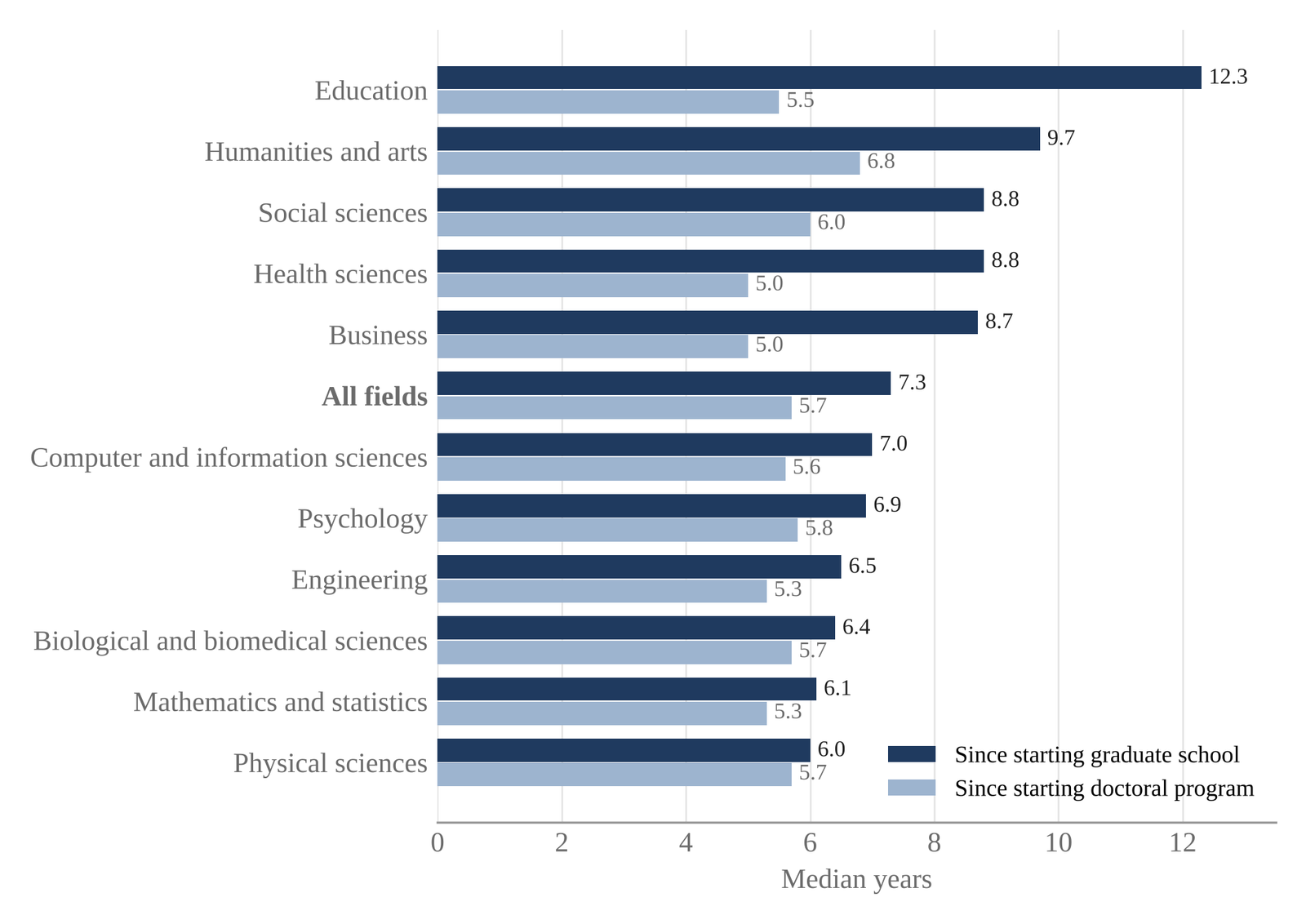
Figure 1: Median years to research doctorate by broad field, 2024
Source: prepared by the author from National Center for Science and Engineering Statistics, supra note 4, tbl. 1-12. Field-of-doctorate data before 2021 may not be comparable because of a change in the field taxonomy.
The fields in which the doctorate takes longest overlap with those in which completion is lowest; the humanities show both features. This does not prove that length causes departure. It is, however, consistent with the view that longer and less structured programs expose students to more of the risks described in Part III.
C. What non-completion costs
Figure 2 sets out what the degree is worth in the labor market. In 2025 the median weekly earnings of doctoral-degree holders were $2,307, slightly above those of professional-degree holders at $2,294 and well above master’s ($1,876) and bachelor’s ($1,578) degree holders.17 Doctoral-degree holders also had the lowest unemployment rate of any group, at 1.8 percent. The 2025 figures carry one irregularity: the Bureau of Labor Statistics could not collect data for October 2025 because of the federal government shutdown, so the annual estimates are eleven-month averages and are not strictly comparable with earlier years.18
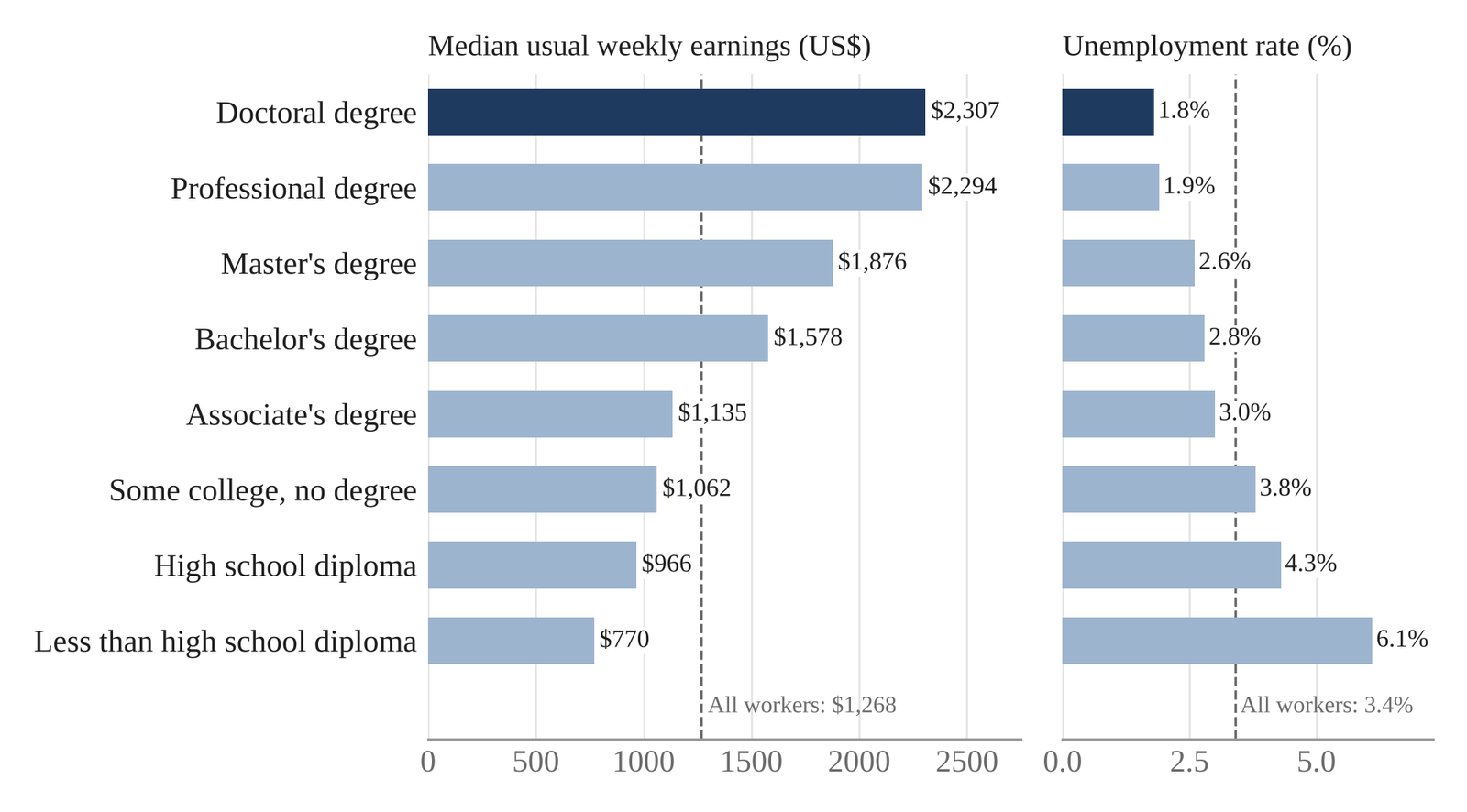
Figure 2: Median weekly earnings and unemployment rate by educational attainment, persons aged 25 and over, 2025
Note: Earnings are for full-time wage and salary workers. Annual figures are eleven-month averages excluding October 2025. Source: prepared by the author from U.S. Bureau of Labor Statistics, supra note 5.
These numbers need careful reading. They describe people who finished, and those people may differ from non-completers in ability, field and opportunity. Even so, a student who leaves after several years of doctoral study has usually given up years of earnings, and may have taken on debt, without gaining the credential the labor market rewards. Bowen and Rudenstine’s finding that completion depends in part on financial support suggests that some of this loss is avoidable.19
D. Limits of the evidence
Three limits shape the rest of the analysis. First, there is no current national measure of doctoral completion. The Council of Graduate Schools figures are old, and the federal rules that require institutions to disclose completion rates apply to full-time undergraduates, not to doctoral students.20 Second, most of the available data describe people who finished. The Survey of Earned Doctorates counts those who receive degrees; it does not follow those who leave. Third, aggregate rates hide differences between programs, and it is at the program level that the institutional causes of attrition operate. These limits are not only methodological. As Part V argues, they also reflect a regulatory choice about what universities must disclose.
Why doctoral students leave
A. Theoretical frame
The modern study of student departure owes much to Vincent Tinto, whose model treats persistence as a product of a student’s academic and social integration into an institution.21 In the second edition of his book, Tinto added an appendix setting out a theory of doctoral persistence.22 Lovitts took the argument in a different direction. Instead of asking what was wrong with the students who left, she asked what was wrong with the programs they left, and she located much of the answer in isolation and weak academic community.23
A review by Anna Sverdlik and colleagues of 163 empirical studies offers a useful way to organize the evidence. It sorts the influences on completion and well-being into external factors, such as supervision, personal and social life, departmental socialization and financial support, and internal factors, such as motivation, writing skills, self-regulation and academic identity.24 This section uses a similar division between institutional and personal factors, and gives most attention to those that law and policy can plausibly reach.
B. Institutional factors
i. The department and its culture
Doctoral students live their academic lives in departments more than in universities, and departmental practices vary widely even within a single institution. Chris Golde’s study of attrition in four departments drew attention to the role of the department and of the discipline in whether students stay.25 Later work has treated departmental culture as a particularly important influence on how doctoral students are socialized and whether they are retained.26 Faculty may not see it that way. In interviews with thirty-eight science, engineering and mathematics faculty advisers at a research-extensive university, Gilmore and colleagues found that faculty rarely described how their programs or departments could support students’ motivation, a result the authors call consistent with earlier studies showing that faculty rarely discuss the department’s contribution to attrition. That blind spot fits Lovitts’s broader argument that departure is shaped by the structure of the program and not only by the student.27
Admissions practices may also play a part, for example where programs look closely at past academic records but less closely at the fit between a student’s goals and what the program demands. The evidence on this point is thinner than for the factors discussed below, and the paper treats it as a question for further research rather than an established finding.
ii. Supervision
If one institutional factor recurs across the literature, it is the relationship with the supervisor. In a survey of more than 9,000 doctoral students at twenty-one leading US institutions, Michael Nettles and Catherine Millett identified engaged and accessible faculty mentors, together with adequate funding, as critical to students’ progress.28 David Litalien and Frédéric Guay, who studied 422 completers and non-completers and then 1,060 enrolled students, found that support from advisers and faculty reduced intentions to drop out. The effect was indirect: support worked by strengthening students’ sense of their own competence and their motivation.29 Supervision bears on mental health as well. In a large study of PhD students in Flanders, Katia Levecque and colleagues found that an inspirational leadership style in the supervisor was associated with lower odds of psychological distress.30
Failures of supervision can be stark. In Soueidan v. St. Louis University, a doctoral engineering student alleged that he went without an assigned adviser for his first three semesters, that the professor who eventually agreed to advise him was unsure of the qualifying-examination procedures, and that the department chair and several professors left during his studies; he did not pass the examination and left the program.31 Part IV discusses what the case shows about the law. Here it illustrates how a basic institutional failure, the absence of a supervisor, can sit at the start of a path to non-completion.
iii. Online programs
Online doctoral programs change the way students relate to faculty and to one another, since most contact takes place at a distance. In archival data on 148 online doctoral candidates, Amanda Rockinson-Szapkiw and colleagues found that support services, the quality of the program and its instruction, academic integration, social integration with faculty and integration with family each contributed to predicting persistence.32 The pattern echoes the residential literature. What matters is not only what the student brings, but what the program provides.
C. Personal factors
i. Money
Financial pressure runs through the literature as both a direct and an indirect cause of departure. Bowen and Rudenstine found that completion and time to degree varied with the type of financial support students received, although those differences appeared smaller than had commonly been supposed.33 Nettles and Millett placed adequate institutional funding alongside mentoring as a condition of progress,34 and the Sverdlik review lists financial support among the main external influences on completion.35 The 2026 federal loan limits give these findings new relevance, since students whose funding packages fall short now have a smaller federal backstop.36
ii. Family and work–life balance
Doctoral students are adults, and many carry responsibilities to partners, children and parents. In the Levecque study, conflict between work and family was the strongest single predictor of psychological distress among PhD students.37 Teresa Evans and colleagues found that, among graduate students with moderate-to-severe anxiety, a majority did not agree that they had a good work–life balance.38 These findings matter for law and policy because the structures that produce such conflict, including expectations about working hours, the scheduling of teaching duties and the availability of leave, are set by institutions.
iii. Mental health
The evidence on mental health has become difficult to set aside. Levecque and colleagues found that 32 percent of PhD students in their Flemish sample were at risk of having or developing a common psychiatric disorder, 2.43 times the rate among highly educated members of the general population.39 In a survey of 2,279 graduate students across twenty-six countries, about 90 percent of them doctoral students, Evans and colleagues found that 41 percent scored in the moderate-to-severe range for anxiety and 39 percent for depression, compared with roughly 6 percent in the general population.40 Neither study is a national sample of US doctoral students, and neither measures attrition directly. The review literature, however, repeatedly reports mental-health concerns alongside high attrition among doctoral students,41 and these conditions bring into play the disability law discussed in Part V.
iv. Leaving late
Not all attrition happens early. Brad Willis and Karla Carmichael interviewed six students who had left counselor-education doctoral programs at a late stage. Five described their departure as a negative experience of meeting barriers that worked against their own wish to finish.42 Late departure is the most costly kind, because the student has invested the most time by then.
D. From causes to legal questions
Read together, the evidence points to a set of causes that lie, to a significant degree, within institutional control: whether students have supervision and how good it is, how programs are structured, whether funding is adequate, and the conditions that affect students’ health. Each corresponds to a legal question. Does a university’s promise of supervision bind it? How far will courts defer when a student challenges an academic decision? How does federal student-aid policy shift financial risk between students and institutions? What do civil rights and disability law require when harassment or illness threatens a student’s progress? And should universities have to disclose how many of their doctoral students finish? Parts IV and V take up these questions.
The legal relationship between the doctoral student and the university
No single statute governs the relationship between a doctoral student and the university that admits her. At private institutions, courts treat it mainly as a matter of contract. At public institutions, the Due Process Clause of the Fourteenth Amendment also applies. Both routes run into the same obstacle: a long-standing reluctance to second-guess academic judgment. This section asks how far these doctrines reach the institutional causes of attrition identified in Part III, and finds that they reach them only at the edges.
A. Handbooks as contracts
The starting point is that the basic legal relationship between a student and a private university is contractual, and that its terms are found in the institution’s catalogues, bulletins and regulations.43 That sounds promising for a student who has been let down. In practice, the contract is narrow. In Ross v. Creighton University the Seventh Circuit held that a student must point to an “identifiable contractual promise” that the university failed to honor; a complaint that the education was simply inadequate will not do.44 The same court refused to recognize a tort of educational malpractice, citing four concerns: the lack of a workable standard of care for educators, uncertainty about causation and damages, the risk of a flood of litigation, and the danger of drawing courts into the day-to-day running of schools.45
Soueidan v. St. Louis University shows how these rules play out for a doctoral student. According to his complaint, Ahmed Soueidan entered a PhD program in engineering and went three semesters without an adviser.46 He relied on the graduate student handbook, which said, “[y]ou should have an advisor assigned within the first few weeks of classes starting.” The Eighth Circuit read the word closely. The handbook used “should,” not “must” or “shall,” and the court treated the statement as aspirational rather than as a binding promise.47 It added, quoting Missouri authority, that universities “must be allowed the flexibility to manage themselves and correct their own mistakes,”48 and it affirmed the dismissal of his claims under Missouri’s educational malpractice doctrine.49
The result is a strange incentive. The failure Soueidan described, the absence of a supervisor at the start of doctoral study, is exactly the kind of institutional failure that Part III links to departure. Yet whether a student can sue over it depends on the drafting of the handbook, and the safest drafting for a university is the vaguest. Max Schanzenbach and Kimberly Yuracko have argued that courts should enforce handbook terms that are definite enough to be read as promises, should not let blanket disclaimers wipe out every obligation, and should leave universities good-faith discretion over academic standards.50 Their approach would not turn courts into examiners of dissertations. It would make universities answer for the specific commitments they choose to make. Another commentator has shown how unsettled the courts’ treatment of handbooks remains, particularly in the different treatment of public and private institutions.51
B. Academic deference and due process
Students at public universities have a further protection, but it too is modest. In Board of Curators of the University of Missouri v. Horowitz, a medical student dismissed on academic grounds argued that she was entitled to a hearing. The Supreme Court held that she had received at least as much process as the Constitution requires, and that a formal hearing is not required for an academic dismissal.52 The Court explained that academic decisions call for an “expert evaluation of cumulative information” that is not well suited to the procedures of courts or administrative hearings.53 Seven years later, in Regents of the University of Michigan v. Ewing, the Court addressed substantive review. A court may override a genuinely academic decision only if it is such a “substantial departure from accepted academic norms” that the decision-makers cannot have exercised professional judgment.54
For doctoral students, this standard covers most of the decisions that end a doctorate: qualifying examinations, assessments of progress, the composition of committees and dismissal for unsatisfactory work. There are good reasons for deference. Courts are poorly placed to grade a dissertation, and academic freedom depends on scholars judging scholarship. The difficulty is that deference is not limited to judgments of quality. As Soueidan shows, the language of institutional flexibility also protects administrative failures, such as not assigning a supervisor at all, that involve no academic judgment. The distinction between academic judgment and administrative performance is the one on which the reforms in Part VI rely.
C. Misrepresentation and federal program integrity rules
A different set of rules governs what universities tell students before they enroll. Institutions that take part in federal student aid programs may not engage in misrepresentation. The Department of Education’s regulations define a misrepresentation as a false, erroneous or misleading statement, including one that misleads by omission, and treat it as substantial when the person to whom it was made “could reasonably be expected to rely, or has reasonably relied,” on it to that person’s detriment.55 The covered subjects include the requirements for completing a program, the number and qualifications of faculty, tutoring, counseling and other supplementary support, and the time it takes to complete a program compared with its stated length.56
These rules come closer than contract law to the causes of attrition. A program that advertises close mentoring it does not provide, or a stated length that bears little relation to how long students actually take, falls within their terms. Two limits remain. The listed remedies belong to the Secretary of Education, who may restrict or end an institution’s participation in federal aid programs or begin enforcement proceedings; the regulation does not itself give the student a remedy.57 And the rules police statements, not performance. A university that promises nothing specific about supervision makes no misrepresentation when it provides none.
Federal policy levers
If the law of the student–university relationship offers students little, federal policy might be expected to fill the gap. This section considers four levers that bear on the causes of attrition: student aid, civil rights and disability law, labor law and disclosure rules.
A. Student aid after July 2026
Until recently, a graduate student whose funding fell short could borrow federally through the Grad PLUS program up to the cost of attendance, minus other aid.58 The 2025 budget reconciliation act ended that option. For periods of instruction beginning on or after July 1, 2026, graduate and professional students may not receive Grad PLUS loans. A graduate student who is not in a professional program may borrow up to $20,500 a year in unsubsidized loans, with an aggregate limit of $100,000; professional students may borrow $50,000 a year, up to $200,000.59 Most PhD students fall into the first category.60 Students who, as of June 30, 2026, were enrolled in a program and had received a federal loan for it may keep the earlier terms for up to three academic years or the expected time to complete their program, whichever is shorter.61 Table 2 summarizes the change.
| Feature | Before July 1, 2026 | From July 1, 2026 |
|---|---|---|
| Grad PLUS loans | Available up to cost of attendance minus other aid | Not available for new periods of instruction |
| Unsubsidized loans, non-professional graduate students (most PhD students) | Supplemented by Grad PLUS | $20,500 a year; $100,000 aggregate |
| Unsubsidized loans, professional students | Supplemented by Grad PLUS | $50,000 a year; $200,000 aggregate |
| Students enrolled and borrowing as of June 30, 2026 | Not applicable | Earlier terms for up to three academic years or the expected time to completion, whichever is shorter |
Table 2: Federal loans for doctoral students before and after July 1, 2026
Source: compiled by the author from Pub. L. No. 119-21, § 81001, 139 Stat. at 334–37; Council of Graduate Schools, supra note 6; and Federal Direct Graduate PLUS, supra note 58.
The arithmetic matters. A median doctorate takes 7.3 years from entry to graduate school, and far longer in some fields. A student without full institutional funding who reaches the $100,000 limit before finishing must turn to private credit, paid work or departure. Part III showed that financial pressure and competing work demands are already among the reasons students leave. The new limits change the federal backstop without placing any corresponding duty on institutions to fund the students they admit. The effect on completion cannot yet be measured, but the direction of the change is clear: more of the financial risk of a long doctorate now falls on the student.
B. Civil rights and disability law
Two federal statutes speak directly to conditions that can push students out. Title IX prohibits sex discrimination in federally funded education programs, and it is the basis for claims arising from harassment in advising relationships, where the adviser’s control over a student’s funding, research and future is considerable.62 The threshold for damages, however, is high. Under Gebser v. Lago Vista Independent School District, a recipient of federal funds is liable for harassment by an employee only if an official with authority to take corrective action had actual knowledge of it and responded with deliberate indifference.63 Gebser arose in a school district, but it remains the Supreme Court’s leading statement of that standard.
Section 504 of the Rehabilitation Act prohibits disability discrimination in federally funded programs and expressly covers colleges and universities.64 Where a student’s mental-health condition meets the statutory definition of disability, the university may be required to make reasonable accommodations. Here, too, deference shapes the outcome. In Wynne v. Tufts University School of Medicine, the First Circuit, sitting en banc, applied the principle of respect for academic decision-making drawn from Ewing, subject to two qualifications, and held that an institution can meet its obligation by showing on undisputed facts that its officials considered alternatives and came to a “rationally justifiable conclusion” that they would lower academic standards or require substantial program alteration.65 Katherine Macfarlane has argued that Wynne imported a deference standard from an unrelated body of law, and that abandoning it would allow more disabled students to stay in school and graduate.66 Given the mental-health findings reviewed in Part III, her critique bears directly on doctoral attrition.
C. Labor law and graduate assistants
Many doctoral students are also employed by their universities as teaching or research assistants. Whether they are “employees” under the National Labor Relations Act, and so entitled to bargain collectively, depends on the statutory definition of the term.67 The National Labor Relations Board has changed its answer several times. It recognized graduate assistants as employees in 2000, reversed itself in 2004, and reversed itself again in 2016.68 Under Columbia University, the current precedent, student assistants who have a common-law employment relationship with a private university are statutory employees.69 The Board proposed a rule in 2019 that would have excluded them, but withdrew it in 2021.70
As of October 2026, Columbia University remains in force, but it is under renewed challenge. A Cornell doctoral candidate filed an appeal in February 2026, addressed to the NLRB General Counsel, seeking to overturn it, and in September 2026 Stanford, in a motion to stay a Board election, previewed the argument that it was wrongly decided and should be overruled.71 The stakes for attrition are practical. Where graduate assistants can bargain, the law requires bargaining over wages, hours and other terms and conditions of employment,72 which include stipends and workloads, two of the pressures Part III associates with departure. Even so, this lever is partial. The Act does not apply to state employers, so assistants at public universities fall outside it,73 and its protection at private universities depends on a position that the Board has already reversed twice.
D. Disclosure
The weakest lever is information. Federal law requires institutions to disclose completion or graduation rates only for certificate- or degree-seeking, full-time undergraduate students.74 There is no equivalent requirement for doctoral programs. A prospective PhD student can therefore choose a program without knowing how many of its entrants finish, or how long they take. The gap also limits the misrepresentation rules discussed in Part IV.C: those rules treat misstatements about matters that must be disclosed as misrepresentations,75 but doctoral completion is not among them. It is telling that the most careful national study of doctoral completion still rests on students who entered graduate school in the early 1990s.76
E. Summary
Table 3 brings together the causes of attrition identified in Part III and the legal tools examined in Parts IV and V. The pattern is consistent. Each tool reaches part of the problem, but each is limited by deference, by narrow drafting, by the identity of the person entitled to enforce it, or by the instability of the rule itself. Part VI considers how those limits might be addressed.
| Cause of attrition | Legal tool | What it reaches | Gap |
|---|---|---|---|
| Absent or poor supervision | Contract (Ross; Soueidan) | Breach of specific, identifiable promises | Promises framed as aspirations are unenforceable |
| Examinations, progress decisions, dismissal | Due process and academic deference (Horowitz; Ewing) | Minimal procedure; review for substantial departure from academic norms | Administrative failures can shelter behind academic deference |
| Misleading descriptions of programs | Federal misrepresentation rules (34 C.F.R. §§ 668.71–.72) | Statements about completion requirements, faculty, support and time to complete | Enforced by the Secretary; addresses statements, not performance |
| Funding shortfalls | Federal student aid (Pub. L. No. 119-21, § 81001) | Sets federal borrowing limits from July 2026 | No duty on institutions to fund admitted students |
| Harassment by advisers | Title IX (Gebser) | Damages for harassment by employees | Requires actual knowledge and deliberate indifference |
| Mental-health conditions | Section 504 (Wynne) | Reasonable accommodation | Deference to the institution’s judgment on what would alter the program |
| Stipends and workload | NLRA (Columbia University) | Bargaining for assistants at private universities | Excludes public universities; precedent unstable |
| Information about completion | HEA disclosure (20 U.S.C. § 1092(a)(1)(L)) | Completion rates for full-time undergraduates | No doctoral completion disclosure |
Table 3: Causes of doctoral attrition, the legal tools that reach them, and the gaps they leave
Source: compiled by the author from the authorities discussed in Parts IV and V.
Gaps and recommendations
The analysis so far suggests that the main problem is not an absence of law but a mismatch. The causes of attrition are largely administrative and structural, while the legal doctrines that might reach them are built around the protection of academic judgment. The reforms proposed here try to correct that mismatch without asking courts to evaluate scholarship. Each leaves academic decisions where they belong and asks institutions to answer for the commitments they make and the information they hold.
A. Supervision commitments that can be enforced
Universities should state their basic supervisory commitments in mandatory terms: that every doctoral student will have an assigned adviser from the start of the program, that there is a published procedure for changing supervisors, and that progress will be reviewed at stated intervals. Under existing law, a specific promise of this kind can support a contract claim when it is broken.77 Soueidan turned in part on the difference between “should” and “must”;78 universities that intend to provide supervision lose nothing by saying so plainly. Courts, for their part, should follow the approach Schanzenbach and Yuracko propose and enforce handbook terms that are definite enough to be promises, while leaving universities good-faith discretion over academic standards.79 Deference under Ewing would remain fully in place for genuine academic judgments.80 It would simply not extend to a failure to assign a supervisor, which is an administrative act rather than an academic one. The evidence that supervisory support works through students’ sense of their own competence suggests that such commitments would matter in practice, not only on paper.81
B. Program-level completion disclosure
Congress or the Department of Education should extend the existing completion-rate disclosure, which now covers only full-time undergraduates,82 to doctoral programs. Each program would publish cohort completion rates over a fixed period and the median time to degree. The Ph.D. Completion Project showed that cohort-based completion rates can be calculated across many institutions,83 and federal time-to-degree data are already collected by field.84 Disclosure would allow prospective students to compare programs, would give institutions a reason to monitor their own attrition, and would bring doctoral completion within the misrepresentation rules, which already treat misstatements about required disclosures as misrepresentations.85
C. Funding transparency
The 2026 loan limits make the length and amount of institutional funding far more important to doctoral students than before.86 Programs should state at the point of admission how many years of funding they guarantee, what the funding covers and the conditions on which it can be withdrawn. Stated in definite terms, such commitments would be enforceable as promises in the way Part VI.A describes. They would also give students the information they need to judge whether a program’s likely time to degree fits within the funding offered and the new federal limits.
D. Health, leave and accommodation
Courts should reconsider the strong deference that Wynne gives universities on questions of disability accommodation, for the reasons Macfarlane sets out.87 Universities need not wait for that. Leave policies that preserve a student’s place, funding and visa or employment status during a health-related absence, and clear routes to request accommodation, respond directly to the evidence on psychological distress and work–family conflict among doctoral students.88 These are measures that institutions control and that do not touch academic judgment at all.
E. Independent channels for concerns
Doctoral students depend heavily on a single supervisor, which makes it hard to raise a problem with that supervisor through ordinary channels. Universities should provide routes for raising concerns that sit outside the supervisory relationship, such as an ombudsperson or a graduate school officer with authority to act. Under Gebser, a recipient’s liability for harassment turns on whether an official with authority to act knew of it.89 Independent channels help ensure that such officials learn of problems early enough to deal with them, which serves both students and institutions.
F. Directions for further research
This paper has relied on published data and existing studies. Three lines of empirical work would strengthen the case for reform. First, a survey of current and former doctoral students in the United States, asking why those who left did so and what institutional support they received, would test the causes reviewed in Part III against present conditions. Second, program-level data on completion and time to degree, of the kind Part VI.B proposes, would show where attrition is concentrated. Third, the effect of the 2026 loan limits on enrollment, borrowing and completion should be tracked as data become available.
Conclusion
This paper asked three questions. The first was how many US doctoral students leave, and why. The most careful national study found that only 57 percent of entrants finished within ten years, and the median doctorate now takes more than seven years from entry to graduate school. The research on causes points again and again to factors within institutional control: the presence and quality of supervision, the culture of departments, the adequacy of funding and the conditions that affect students’ health.
The second question was what duties US law places on universities in respect of those causes. The answer is that it places few. Contract law enforces only specific promises, and universities can avoid making them. Courts defer to academic judgment, and that deference reaches administrative failures as well. Federal misrepresentation rules address what universities say rather than what they do, and they are enforced by the Secretary of Education rather than by students. Civil rights and disability law set high thresholds or defer to institutional judgment. Labor law reaches only some students, on unstable terms. Federal completion-rate disclosure does not reach doctoral programs at all. Meanwhile, the 2026 loan limits have moved more of the financial risk of a long doctorate onto students.
The third question was what would close these gaps. The reforms proposed here share a single principle: academic judgment should stay with academics, but administrative commitments and information about outcomes should carry legal weight. A university that promises supervision should provide it, a program should say how many of its students finish, and a funding offer should mean what it says. Doctoral attrition will never fall to zero, and some departures are the right choice for the student. But when a student leaves because the institution did not do what it undertook to do, the cost of that failure should not rest on the student alone.
*****
Footnotes
1. Robert Sowell et al., Council of Graduate Schs., Ph.D. Completion and Attrition: Analysis of Baseline Demographic Data from the Ph.D. Completion Project 18 (2008).
2. See generally William G. Bowen & Neil L. Rudenstine, In Pursuit of the PhD (1992) (analyzing the records of more than 35,000 students who entered six arts-and-sciences fields at ten leading universities between 1962 and 1986).
3. See generally Barbara E. Lovitts, Leaving the Ivory Tower: The Causes and Consequences of Departure from Doctoral Study (2001) (studying 816 students who entered nine departments at two universities).
4. Nat’l Ctr. for Sci. & Eng’g Stat., Nat’l Sci. Found., Doctorate Recipients from U.S. Universities: 2024 Data Tables tbl. 1-12 (NSF 25-349, 2025), https://ncses.nsf.gov/pubs/nsf25349.
5. U.S. Bureau of Lab. Stat., Education Pays, 2025, Career Outlook (Sept. 2026), https://www.bls.gov/careeroutlook/2026/data-on-display/education-pays.htm.
6. Act of July 4, 2025, Pub. L. No. 119-21, § 81001, 139 Stat. 72, 334–35 (commonly known as the One Big Beautiful Bill Act); see also Council of Graduate Schs., Know Before You Go: Navigating Grad School Finances After July 1, 2026 (2026), https://cgsnet.org/wp-content/uploads/2026/06/Know-Before-You-Go_Navigating-Grad-School-Finances-After-July-1-2026.pdf (listing the professional degree fields eligible for the higher limit, among which the only PhD is in clinical psychology).
7. See generally Anna Sverdlik et al., The PhD Experience: A Review of the Factors Influencing Doctoral Students’ Completion, Achievement, and Well-Being, 13 Int’l J. Doctoral Stud. 361 (2018), https://doi.org/10.28945/4113 (reviewing 163 empirical studies).
8. See, e.g., Max M. Schanzenbach & Kimberly Yuracko, What Is the University–Student Contract?, 65 Ariz. L. Rev. 965, 983 (2023); Bryce Freeman, Comment, The Title IX Contract Quagmire, 118 Mich. L. Rev. 909 (2020), https://doi.org/10.36644/mlr.118.5.title.
9. See Regents of Univ. of Mich. v. Ewing, 474 U.S. 214, 225 (1985); Bd. of Curators of Univ. of Mo. v. Horowitz, 435 U.S. 78, 90 (1978).
10. Sowell et al., supra note 1, at 13–14.
11. Id. at 18.
12. Id. at 22.
13. Id. at 28, 32.
14. Nat’l Ctr. for Sci. & Eng’g Stat., supra note 4, tbl. 1-1.
15. Id. tbl. 1-12.
16. Id.
17. U.S. Bureau of Lab. Stat., supra note 5.
18. Id.
19. See generally Bowen & Rudenstine, supra note 2.
20. 20 U.S.C. § 1092(a)(1)(L); 34 C.F.R. § 668.45(a)(1) (2025).
21. See generally Vincent Tinto, Leaving College: Rethinking the Causes and Cures of Student Attrition (2d ed. 1993).
22. Id. app. B, at 230.
23. See generally Lovitts, supra note 3.
24. Sverdlik et al., supra note 7, at 361.
25. See generally Chris M. Golde, The Role of the Department and Discipline in Doctoral Student Attrition: Lessons from Four Departments, 76 J. Higher Educ. 669 (2005), https://doi.org/10.1080/00221546.2005.11772304.
26. Joanna Gilmore et al., The Flip Side of the Attrition Coin: Faculty Perceptions of Factors Supporting Graduate Student Success, 11 Int’l J. Doctoral Stud. 419, 421 (2016), https://doi.org/10.28945/3618.
27. Id. at 424–25, 433; see generally Lovitts, supra note 3.
28. See generally Michael T. Nettles & Catherine M. Millett, Three Magic Letters: Getting to Ph.D. (2006) (surveying more than 9,000 doctoral students at twenty-one institutions).
29. David Litalien & Frédéric Guay, Dropout Intentions in PhD Studies: A Comprehensive Model Based on Interpersonal Relationships and Motivational Resources, 41 Contemp. Educ. Psych. 218, 218 (2015), https://doi.org/10.1016/j.cedpsych.2015.03.004.
30. Katia Levecque et al., Work Organization and Mental Health Problems in PhD Students, 46 Rsch. Pol’y 868, 875–76 (2017), https://doi.org/10.1016/j.respol.2017.02.008.
31. Soueidan v. St. Louis Univ., 926 F.3d 1029, 1031–32 (8th Cir. 2019).
32. Amanda J. Rockinson-Szapkiw et al., Identifying Significant Integration and Institutional Factors That Predict Online Doctoral Persistence, 31 Internet & Higher Educ. 101, 101 (2016), https://doi.org/10.1016/j.iheduc.2016.07.003.
33. See generally Bowen & Rudenstine, supra note 2.
34. See generally Nettles & Millett, supra note 28.
35. Sverdlik et al., supra note 7, at 375–76.
36. Pub. L. No. 119-21, § 81001, 139 Stat. at 334–35.
37. Levecque et al., supra note 30, at 876.
38. Teresa M. Evans et al., Evidence for a Mental Health Crisis in Graduate Education, 36 Nature Biotech. 282, 282 (2018), https://doi.org/10.1038/nbt.4089.
39. Levecque et al., supra note 30, at 868, 875.
40. Evans et al., supra note 38, at 282.
41. Sverdlik et al., supra note 7, at 362–63.
42. Brad Willis & Karla D. Carmichael, The Lived Experience of Late-Stage Doctoral Student Attrition in Counselor Education, 16 Qualitative Rep. 192, 192 (2011), https://doi.org/10.46743/2160-3715/2011.1046.
43. Ross v. Creighton Univ., 957 F.2d 410, 416 (7th Cir. 1992).
44. Id. at 416–17.
45. Id. at 414–15.
46. Soueidan, 926 F.3d at 1031–32.
47. Id. at 1035.
48. Id. at 1034.
49. Id. at 1036.
50. Schanzenbach & Yuracko, supra note 8, at 985–89.
51. See generally Freeman, supra note 8 (examining how courts treat handbooks as the source of contractual terms in student discipline, and the divergence between public and private institutions).
52. Horowitz, 435 U.S. at 84–85, 86 n.3.
53. Id. at 90.
54. Ewing, 474 U.S. at 225.
55. 34 C.F.R. § 668.71(c) (2025).
56. Id. § 668.72(d), (h), (i), (r).
57. Id. § 668.71(a).
58. Federal Direct Graduate PLUS, Univ. of Fla. Off. of Student Fin. Aid & Scholarships, https://www.sfa.ufl.edu/types-of-aid/loans/graduate-plus/ (last visited Oct. 26, 2026); see also Council of Graduate Schs., supra note 6 (describing roughly two decades of borrowing through Grad PLUS without a fixed limit).
59. Pub. L. No. 119-21, § 81001, 139 Stat. at 334–35.
60. Council of Graduate Schs., supra note 6.
61. Pub. L. No. 119-21, § 81001, 139 Stat. at 336–37; see also Council of Graduate Schs., supra note 6.
62. 20 U.S.C. § 1681(a).
63. Gebser v. Lago Vista Indep. Sch. Dist., 524 U.S. 274, 290 (1998).
64. Rehabilitation Act of 1973 § 504, 29 U.S.C. § 794(a), (b)(2)(A).
65. Wynne v. Tufts Univ. Sch. of Med., 932 F.2d 19, 25–26 (1st Cir. 1991) (en banc).
66. Katherine Macfarlane, The Higher Education Accommodation Mistake, 114 Geo. L.J. 219, 219, 223–24, 235–37, 277 (2025).
67. National Labor Relations Act § 2(3), 29 U.S.C. § 152(3).
68. N.Y. Univ., 332 N.L.R.B. 1205 (2000), overruled by Brown Univ., 342 N.L.R.B. 483 (2004), overruled by Columbia Univ., 364 N.L.R.B. No. 90 (Aug. 23, 2016).
69. Columbia Univ., 364 N.L.R.B. No. 90 (Aug. 23, 2016) (holding that student assistants, including graduate teaching and research assistants, who have a common-law employment relationship with a private university are statutory employees).
70. Jurisdiction: Nonemployee Status of University and College Students Working in Connection With Their Studies, 84 Fed. Reg. 49,691 (proposed Sept. 23, 2019); Jurisdiction: Nonemployee Status of University and College Students Working in Connection With Their Studies, 86 Fed. Reg. 14,297 (Mar. 15, 2021) (withdrawing the proposed rule).
71. Rajorshi Chatterjee, Graduate Student Asks NLRB to Question Graduate Student Union’s Legality, Cornell Daily Sun (Mar. 4, 2026), https://www.cornellsun.com/article/2026/03/graduate-student-asks-nlrb-to-question-graduate-student-union-s-legality; Paul Salvatore et al., The Fight Over Columbia Heads West: Stanford Moves to Stay NLRB Election for Undergraduate RA’s, Nat’l L. Rev. (Oct. 5, 2026), https://natlawreview.com/article/fight-over-columbia-heads-west-stanford-moves-stay-nlrb-election-undergraduate-ras.
72. 29 U.S.C. § 158(d).
73. Id. § 152(2).
74. 20 U.S.C. § 1092(a)(1)(L); 34 C.F.R. § 668.45(a)(1) (2025).
75. 34 C.F.R. § 668.72(s) (2025).
76. Sowell et al., supra note 1, at 13–14.
77. Ross, 957 F.2d at 417.
78. Soueidan, 926 F.3d at 1035.
79. Schanzenbach & Yuracko, supra note 8, at 985–89.
80. Ewing, 474 U.S. at 225.
81. Litalien & Guay, supra note 29, at 218.
82. 20 U.S.C. § 1092(a)(1)(L).
83. Sowell et al., supra note 1, at 13–14.
84. Nat’l Ctr. for Sci. & Eng’g Stat., supra note 4, tbl. 1-12.
85. 34 C.F.R. § 668.72(s) (2025).
86. Pub. L. No. 119-21, § 81001, 139 Stat. at 334–35.
87. Macfarlane, supra note 66, at 223, 235–37.
88. Levecque et al., supra note 30, at 875–76.
89. Gebser, 524 U.S. at 290.