
Introduction
Amid globalization and the Fourth Industrial Revolution, the semiconductor industry has become a cornerstone of economic and technological progress, shaping the trajectories of nations worldwide. Vietnam, endowed with substantial potential and competitive advantages in information technology and electronics, is actively pursuing the development of its semiconductor industry to enhance the value of its products and services and promote sustainable economic growth. However, one of the most formidable challenges lies in cultivating a highly skilled workforce capable of meeting the rapidly evolving and exacting demands of this dynamic sector.
Semiconductor Industry and the Imperative of Developing Policies for Semiconductor Workforce in Vietnam
(A) The Semiconductor Industry and Development Policies in Vietnam
Semiconductors, commonly referred to as chips or integrated circuits, are the backbone of today’s digital and interconnected world. As foundational components for information processing, data storage, numerical computation, and logical operations, chips are regarded as the “brains” of modern electronic devices, powering a wide range of technologies from smartphones and electric vehicles to satellites and defense systems 3. Their indispensable role has positioned the semiconductor industry as a cornerstone of technological advancement and global economic growth.
The industry’s rapid evolution has been fueled by breakthroughs in artificial intelligence (AI), the Internet of Things (IoT), 5G communication, cloud computing, electric vehicles, and autonomous driving 4. These innovations have propelled global semiconductor sales to record heights, with revenues of 574.1 billion USD in 2022 and 526.9 billion USD in 2023. Projections further suggest the industry will surpass a trillion-dollar valuation by 2030, solidifying its status as a linchpin of the global economy5.
The global semiconductor supply chain comprises seven essential segments: (1) research and development (R&D); (2) design; (3) front-end manufacturing (wafer fabrication); (4) back-end manufacturing (assembly, packaging, and testing); (5) electronic design automation (EDA) and core intellectual property; (6) equipment and tools; and (7) materials. Due to the highly specialized technical knowledge and large-scale production required, the semiconductor supply chain is extraordinarily complex and spans multiple countries. The United States leads in chip design and R&D-intensive semiconductor equipment; Taiwan is home to the world’s most advanced chip fabrication facilities and dominates the assembly, packaging, and testing stages; while the Netherlands is home to the only company globally capable of producing advanced extreme ultraviolet (EUV) lithography machines, which are critical for manufacturing cutting-edge semiconductors 6.
In Vietnam, according to a report by Research and Markets 7, the semiconductor market was valued at 18.6 billion USD in 2023 and is expected to experience substantial growth, projected to reach 28.8 billion USD by 2029. This growth is largely driven by major international companies selecting Vietnam as a manufacturing hub, bolstered by a skilled workforce and favorable policies that promote foreign trade and investment. Leading multinational corporations in the semiconductor sector, such as Intel (USA), Samsung, Hanmi Semiconductor (South Korea), and Infineon Technologies AG (Germany), have already invested hundreds of millions of USD in Vietnam’s semiconductor industry8.
In response to these emerging opportunities, the Vietnamese government has introduced a series of strategic policies aimed at fostering the growth and development of the semiconductor sector. Recent Party and State resolutions have outlined key directions and strategies for strengthening the institutional framework. These efforts signal the government’s commitment to positioning Vietnam as a competitive player in the global semiconductor industry. Specifically, the Vietnamese government is focused on improving infrastructure, expanding R&D capabilities, and ensuring the cultivation of a highly skilled workforce to meet the growing demands of the industry.
• Resolution No. 52-NQ/TW dated September 27, 2019 of the Vietnam Politburo on “A number of policies to proactively participate in the Fourth Industrial Revolution”9, emphasizes the need to focus on developing priority industries with high levels of readiness, such as information technology, electronics, and telecommunications. Additionally, the resolution calls for the allocation of resources to support the implementation of national key research programs in priority technologies, with a specific emphasis on information and communication technology;
• Resolution No. 29-NQ/TW dated November 17, 2022, of the Central Executive Committee of the XIII Vietnam Party Congress on “Continuing to Promote Industrialization and Modernization of the Country by 2030, with a Vision Towards 2045”. This resolution highlights the prioritization of resources and the establishment of comprehensive policies and mechanisms to foster the development of critical sectors, including semiconductor chip design and manufacturing, to position Vietnam as a leader in these industries 10;
• The 10-Year Socio-Economic Development Strategy (2021-2030 period), outlined in the Document of the XIII Vietnam National Congress of the Party, provides key orientations and tasks for national development. It prioritizes the advancement of high-tech, spearhead industries, such as information and communication technology, electronics, and telecommunications, as central to the nation’s economic development;
• Resolution No. 31/2021/QH15, dated November 12, 2021 of the Vietnam National Assembly on the Economic Restructuring Plan for the 2021-2025 Period, identifies one of the key tasks of economic restructuring as modernizing industries, promoting green and sustainable growth, and optimizing the country’s potential and advantages. A central solution within the plan is to promote the restructuring of service sectors based on modern and digital technologies;
• Resolution No. 81/2023/QH15, dated January 9, 2023 of the Vietnam National Assembly on the National Master Plan for the 2021-2030 Period, with a Vision to 2050, focuses on the development of the information technology sector, as well as the processing and manufacturing industries that serve agriculture. The resolution also calls for the construction of large-scale information technology parks and the formation of industrial clusters in information technology, with an emphasis on attracting investment in the production of electrical and electronic products, the Internet of Things (IoT), and artificial intelligence.
To implement the Party’s guidelines, the National Assembly’s resolutions, and the Government’s strategies, semiconductor products have been designated as part of Vietnam’s national product portfolio11. They are recognized as a vital avenue for transforming scientific and technological innovations into high-value-added commercial goods, fostering economic growth and technological self-reliance.
Resolution No. 01/NQ-CP, dated January 5, 2024 of the Vietnam Government outlines key tasks and solutions for implementing the socio-economic development plan and the state budget estimate for 2024. The resolution highlights the imperative to: “Vigorously promote industrial restructuring; prioritize the recovery and development of strategic industries, particularly the processing and manufacturing sectors, as well as semiconductor chip production, to establish these sectors as primary drivers of economic growth. Expedite research and propose to competent authorities the introduction of breakthrough mechanisms and policies aimed at promptly resolving challenges in attracting investment to develop key industries, foundational sectors, and emerging technologies, including semiconductors.”
Prime Minister’s Decision No. 1018/QĐ-TTg, dated September 21, 2024, further reinforces the Government’s commitment by issuing the Vietnam Semiconductor Industry Development Strategy to 2030 with a Vision to 2050. This landmark strategy sets ambitious objectives, including: i) By 2040: Establish Vietnam as one of the global centers for the semiconductor and electronics industries. This includes fostering a synergistic development model that combines self-reliance in domestic capabilities with active foreign direct investment (FDI) partnerships to strengthen competitiveness and innovation; ii) By 2050: Position Vietnam among the world’s leading nations in the semiconductor and electronics industries. This goal entails achieving mastery in research, development, and production across the semiconductor value chain, thereby ensuring sustainable growth and technological leadership.
The strategy underscores the importance of building an advanced semiconductor ecosystem that integrates global expertise while enhancing domestic capabilities. It highlights Vietnam’s commitment to leveraging its strategic position, skilled workforce, and supportive policy framework to attract significant investments in the semiconductor and electronics sectors, paving the way for long-term economic transformation and global competitiveness
(B) The Imperative of Developing Policies for Semiconductor Workforce in Vietnam
The advent of the Fourth Industrial Revolution has underscored the transformative role of the semiconductor industry, prompting nations worldwide to commit billions of dollars to domestic chip production and the construction of advanced manufacturing facilities. This global momentum has catalyzed an unprecedented demand for skilled workers specializing in semiconductor design, manufacturing, and testing. According to Deloitte’s “Semiconductor Industry Outlook 2023” 12, the global semiconductor workforce exceeded two million direct employees in 2021. By 2030, the industry is projected to require an additional one million skilled professionals, equating to over 100,000 new hires annually.
In Vietnam, human resources have been identified as one of the four cornerstone factors for the growth and sustainability of its semiconductor industry, as articulated in Decision No. 1018/QĐ-TTg, which outlines Vietnam’s semiconductor development strategy through 2030, with a vision extending to 2050. This strategic framework is encapsulated in the formula:
C = SET + 1
Where:
C: Chip (Semiconductor Chips)
S: Specialized (Specialized Semiconductor Applications)
E: Electronics (The Electronics Industry)
T: Talent (Skilled Human Resources)
+1: Vietnam (Vietnam as the new and safe destination for the global semiconductor supply chain).
This formula emphasizes the critical role of a highly skilled workforce in achieving Vietnam’s aspirations to become a key player in the global semiconductor ecosystem. By prioritizing human resource development, Vietnam aims to bridge the skills gap, foster innovation, and establish itself as a secure and competitive destination for investments in semiconductor manufacturing and research.
The integration of talent development within the larger framework of semiconductor industry growth not only aligns with Vietnam’s long-term economic goals but also positions the country as a vital link in the global semiconductor value chain. This commitment to cultivating a robust and capable workforce underscores Vietnam’s readiness to leverage its comparative advantages in attracting foreign direct investment, advancing technological capabilities, and contributing to global supply chain resilience in this critical industry.
Policymakers recognize Vietnam as one of the 16 most populous nations globally, with a young and dynamic population and a workforce well-equipped in STEM (Science, Technology, Engineering, and Mathematics) disciplines. These attributes position Vietnam as a country capable of rapidly meeting the growing human resource demands of the semiconductor industry. Under Decision No. 1018/QĐ-TTg, Vietnam has outlined ambitious goals for its semiconductor workforce. By 2030, the industry is expected to employ over 50,000 engineers and bachelor’s degree holders, structured to meet the needs of industry development. By 2040, this figure is projected to double, with 100,000 highly qualified professionals contributing to the sector. To achieve these targets, the Ministry of Planning and Investment is actively implementing the “Development of Human Resources for the Semiconductor Industry to 2030, with a Vision to 2045” 13 initiative, aimed at bolstering workforce readiness and capability.
However, despite its advantages, Vietnam’s semiconductor industry faces significant challenges. Chief among these is a critical shortage of highly skilled labor and an increasing skills gap when compared to more developed markets. While Vietnam’s young and energetic workforce is a considerable asset, there is a noticeable lack of professionals with specialized expertise across the semiconductor supply chain. The semiconductor industry demands a workforce proficient in fields such as electrical engineering, materials science, semiconductor physics, and automation. Unfortunately, many domestic educational institutions lack the specialized programs and resources needed to adequately train students in these areas. This imbalance between the industry’s needs and the available talent pool exacerbates the shortage of skilled labor.
Moreover, the rapid pace of technological advancement in the semiconductor sector necessitates continuous upskilling and reskilling of the workforce to stay aligned with emerging technologies and global market trends. Addressing these challenges requires concerted efforts from multiple stakeholders, including government agencies, educational institutions, and industry leaders.
A skilled and well-prepared workforce is essential for driving innovation, accelerating the growth of Vietnam’s semiconductor industry, and enhancing its global competitiveness. By fostering collaboration, investing in education and training infrastructure, and aligning policies to support workforce development, Vietnam can position itself as a vital link in the global semiconductor value chain. Such efforts will not only ensure the sustainability and success of this critical industry but also secure Vietnam’s place as a leader in the rapidly evolving global semiconductor market.
The Triple Helix Model in Semiconductor Workforce Development and Experiences from Other Jurisdictions
(A) The Triple Helix Model in Semiconductor Workforce Development
In an increasingly interconnected and rapidly changing economy, collaboration among stakeholders is key to addressing common challenges and creating sustainable value. In the context of the semiconductor workforce development orientation outlined in Decision No. 1018/QD-TTg, which emphasizes the need for workforce preparation based on long-term forecasts and vision while closely aligning with market demands, the challenge in semiconductor workforce development is how to adapt and prepare a workforce that can meet the future challenges of this high-tech industry. The quality of semiconductor workforce training cannot rely solely on educational institutions; it requires close cooperation from both businesses and the government. In this context, the creation of a high-quality workforce is not only the responsibility of universities but also the result of close cooperation with the needs of the semiconductor industry. The Triple Helix model is a suitable theoretical framework to understand how to develop a high-quality workforce in the semiconductor industry through collaboration among universities, semiconductor industry businesses, and the government.
The Triple Helix model originated in the 1990s as a framework for understanding the dynamic relationships between universities, industries, and governments. This model asserts that integrating innovative elements from academia, industry, and government fosters transformative changes in the production, transfer, and application of knowledge, thereby unlocking significant opportunities for economic growth and development 14. Among the various iterations of the Triple Helix model 15, the most widely adopted today is the Hybrid Triple Helix model (Figure 1) 16. This version highlights the central role of universities in driving education, research, and innovation. Within this model: i) Universities serve as providers of skilled human resources and applied research; ii) Industries implement these research outcomes into production processes and market applications, and; iii) Governments create a supportive environment through policies, funding, and infrastructure that facilitate collaboration.
This synergistic collaboration leads to the establishment of intermediary organizations that bridge gaps among stakeholders, optimize resource utilization, and foster the creation of new social models for the production, dissemination, and application of knowledge. By emphasizing the interconnected roles of innovation, policy, and industry, the Triple Helix model provides a robust framework for addressing contemporary challenges and driving sustainable development within a knowledge-based economy.
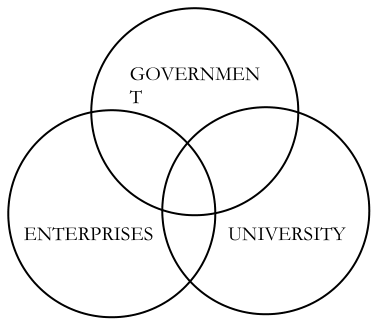
Figure 1. Hybrid Triple Helix model
Source: Etzkowitz, H. and Klofsten, M. (2005)
Firstly, University: A Pillar in Semiconductor Workforce Development
Education plays a pivotal role in developing a highly skilled workforce for the semiconductor industry, especially in the context of the Fourth Industrial Revolution, which is marked by widespread automation and rapid technological advancements. This high-tech sector demands a workforce with advanced, specialized, and diverse skill sets capable of meeting complex and ever-evolving job requirements.
To meet these demands, the education system must adapt to the dynamic labor market, empowering learners with cutting-edge technical expertise and the flexibility to embrace emerging technologies. The semiconductor industry relies heavily on deep technical knowledge - skills that many current workers lack. As such, universities and training institutions have a critical responsibility to modernize their curricula. This entails aligning educational programs with industry needs and cultivating a pipeline of highly qualified professionals to drive innovation and growth.
Investment in education is directly linked to the development of a robust, high-quality workforce for the semiconductor sector. Such investment not only enhances national competitiveness but also fosters sustainable economic growth. Research consistently underscores the importance of educational funding in strengthening a country’s position in advanced technology industries like semiconductors 17. By prioritizing quality education and targeted training, nations can elevate workforce capabilities, effectively addressing the growing and sophisticated demands of semiconductor businesses. This strategic focus ensures that countries remain competitive and thrive in the global technology landscape.
Secondly, The Role of Enterprises in the Semiconductor Industry
Enterprises in the semiconductor industry are transitioning from traditional employers to becoming essential partners in developing a high-quality workforce training system. This evolution ensures a sustainable pipeline of skilled talent to meet the rapidly advancing technological demands of this high-tech sector.
As central players, enterprises are uniquely equipped to identify the specific skills and competencies required in the semiconductor industry. By engaging in continuous innovation and technological development, they provide critical insights to educational institutions, guiding the design of curricula and training programs to align with market needs.
Semiconductor enterprises often maintain robust R&D divisions, which serve as hubs of innovation and knowledge creation. These R&D environments offer invaluable opportunities for engineers and professionals to engage in practical, hands-on learning, foster creativity, and refine their ability to apply theoretical knowledge to real-world challenges 18. Through such initiatives, businesses not only drive technological advancements but also create dynamic training ecosystems where employees develop research skills, innovative thinking, and problem-solving abilities.
Equally important is the collaboration between enterprises and educational institutions in co-developing targeted training programs. This partnership ensures that students and trainees gain the specialized knowledge and practical expertise necessary for success in the semiconductor industry. By bridging the gap between theoretical education and practical application, this synergy cultivates a workforce that is not only technically proficient but also adaptable to the evolving demands of the industry, driving innovation, sustaining competitiveness, and ensuring long-term growth.
Thirdly, The Role of Government in Developing the Semiconductor Workforce
The government plays a pivotal role as a policymaker and architect, ensuring that education and technical training systems align with the workforce development needs of the semiconductor industry. This role encompasses implementing supportive policies in education, R&D, and infrastructure, all of which are essential for fostering a highly skilled and competitive workforce. Central to the government’s responsibilities is the promotion of public-private partnerships, facilitating collaboration between academia and industry while creating an environment conducive to the growth of semiconductor businesses. By providing funding for R&D to both industry and educational institutions, the government helps establish a steady pipeline of innovation and talent development.
Strategic policies enable the government to create a robust educational and employment ecosystem tailored to the semiconductor sector. Such an ecosystem not only expands job opportunities but also cultivates a workforce equipped with the specialized skills necessary to excel in this high-tech and fast-paced industry 19. Close cooperation among universities, the semiconductor industry, and government agencies is essential for building a world-class workforce that meets the demands of global competition. This collaboration fosters dynamic and responsive educational frameworks, ensuring they are attuned to the technical and labor market needs of the semiconductor industry.
Through effective tripartite cooperation, a flexible and adaptive ecosystem emerges, capable of addressing the rapidly evolving requirements of the semiconductor sector. This ecosystem provides a skilled and globally competitive workforce, ensuring the industry’s sustained growth and its ability to thrive in the increasingly sophisticated global technology landscape.
(B) Experiences of Other Jurisdictions
1. Taiwan
Many countries have explored policy initiatives aimed at developing a skilled semiconductor workforce through the Triple Helix model, with Taiwan standing out as a prominent example. Taiwan is home to the world’s largest semiconductor foundry, holding 63.8% of the global market share. It also leads in the packaging and testing sectors, with a 58.6% share of the global market, and ranks second in integrated circuit design, contributing 20.1% of the global market20. These achievements have firmly established Taiwan as one of the foremost global semiconductor industry hubs, second only to the United States. The Taiwanese government has enacted strategic policies to encourage and facilitate investment in the domestic semiconductor industry, ensuring its continued advancement. Strong collaboration exists between academic institutions, technology research organizations, and industry partners within the semiconductor value chain. This partnership fosters innovation and growth, with the government fully committed to cultivating talent in the semiconductor sector, ensuring a highly skilled and sustainable workforce to support the industry’s long-term success.
To address the shortage of high-quality talent, Taiwan enacted the National Key Fields Industry-University Cooperation and Skilled Personnel Training Act in 202121. This law allows companies and national universities to collaborate in developing talent in critical sectors. Four leading national universities, including National Taiwan University, National Tsing Hua University, National Yang Ming Chiao Tung University, and National Cheng Kung University, established dedicated semiconductor schools in 2022, each with a quota of approximately 100 master’s and doctoral students 22. Currently, 13 universities in Taiwan have departments or schools dedicated to semiconductor studies, fostering close cooperation between higher education institutions and businesses through integrated training programs. The Taiwanese government has established the International Academic-Industry Exchange Alliance to accurately match industry talent needs with academic resources. This not only ensures that educational programs are aligned with industry practices but also creates a workforce ready to meet the demands of the growing semiconductor industry.
Additionally, the government supports scholarship programs and international collaborations, providing opportunities for foreign students to study at Taiwan’s leading semiconductor institutes. This policy aims to attract international talent at the training stage, preparing them for the semiconductor job market. Moreover, the Taiwanese government has adjusted its foreign labor-related laws, particularly in the semiconductor sector. The Act for the Recruitment and Employment of Foreign Professionals23 was amended in 2021 to create favorable conditions for long-term residency, social insurance, and tax benefits, ensuring that highly skilled professionals in the semiconductor field can work and live stably in Taiwan.
2. South Korea
South Korea’s semiconductor industry, accounting for nearly 20% of the nation’s Gross Domestic Product (GDP), serves as a cornerstone of its economy. Dominating the global memory semiconductor market with a 56.9% share 24, South Korea excels not only in memory chip production but also in cutting-edge research on AI semiconductors and a highly advanced talent development system. Universities across the country are actively expanding their research into next-generation chips and semiconductor technologies, further solidifying South Korea’s position as a global leader in the field.
A notable initiative began in 2006 when Sungkyunkwan University, with support from Samsung Electronics, established a dedicated semiconductor department under a contractual agreement. This model was later adopted by Yonsei University in 2019 and Korea University in 2021, in partnership with Samsung and SK Hynix. These contract-based semiconductor departments offer specialized curricula focused on critical semiconductor technologies, ranging from foundational devices to system design and integration. Students engage in real-world projects and receive mentorship from industry experts, ensuring they are workforce-ready upon graduation. Notably, graduates are guaranteed employment with the partnering companies, creating a steady pipeline of skilled professionals for South Korea’s domestic semiconductor industry. Currently, seven major universities in South Korea have established similar partnerships with leading enterprises to create semiconductor-focused departments 25.
The South Korean government plays a pivotal role in fostering collaboration between universities and semiconductor enterprises to develop both talent and technology. Under its ambitious plan to train 3,400 semiconductor specialists by 2030, the government has supported the creation of specialized training programs at leading universities 26. Additionally, the government has championed the establishment of advanced research centers, such as the AI Semiconductor System Research Center and the Korea Advanced Institute of Science and Technology (KAIST) 27, to drive innovation in next-generation semiconductor technologies. Through strategic policies, including tax incentives, substantial funding for R&D, and robust support for education, the government has strengthened South Korea’s semiconductor research and training ecosystem. These initiatives have laid a solid foundation for the nation to sustain its leadership in the global semiconductor market, ensuring continued competitiveness in this high-tech and rapidly evolving sector.
Recommendations for Strengthening Human Resource Development Policies in the Semiconductor Industry Using the Triple Helix Model
Vietnam needs a comprehensive strategy rooted in the Triple Helix model to cultivate a skilled workforce for its burgeoning semiconductor industry. Effective collaboration among the government, businesses, and educational institutions is vital to meeting the demand for high-quality talent and enhancing Vietnam’s position in the global high-tech sector.
Firstly, promoting collaboration between businesses, universities, and the government as a strategic policy lever.
The government must play a central role by formulating and implementing policies that incentivize cooperation, provide financial support, and create favorable conditions for businesses to invest in training and R&D. Businesses should articulate real-world market needs, offer internship opportunities for students, and commit to guaranteed employment for graduates. Simultaneously, universities should design curricula that are closely aligned with industry demands, integrating theoretical knowledge with practical training to enable students to adapt quickly to new technologies.
Key policy measures such as tax incentives, financial subsidies, and infrastructure investments are essential to fostering this collaboration. Establishing specialized semiconductor research centers and training institutes - drawing inspiration from successful models in South Korea and Taiwan - will be pivotal. These institutions can bridge academic research and industrial practice, ensuring that the workforce is equipped with cutting-edge skills while fostering innovation.
Secondly, investing in education and advancing curricula.
To address the advanced technological demands of the semiconductor industry, universities and training institutions must regularly update their academic programs. Particular focus should be placed on areas such as microchip design, system integration, and artificial intelligence (AI). Investments in modern equipment and state-of-the-art laboratories are equally important to provide students with practical exposure to emerging technologies.
Such initiatives will not only equip students with industry-relevant competencies but also position them competitively in the global labor market. A blend of enhanced educational programs and strategic public-private collaboration will enable Vietnam to develop a resilient, skilled workforce capable of driving growth and innovation in the semiconductor sector.
Thirdly, recruitment commitments from enterprises.
Enterprises in the semiconductor industry should commit to hiring graduates from specialized training programs. These commitments not only motivate students to excel in their studies but also ensure that training programs remain closely aligned with industry needs. By guaranteeing employment for graduates, businesses are incentivized to actively participate in the training process, fostering a collaborative ecosystem that produces a workforce well-equipped to meet practical job requirements.
Fourth, adopting best practices from leading semiconductor nations.
Vietnam can gain valuable insights by studying the approaches of countries with advanced semiconductor industries, such as Taiwan and South Korea. These nations have achieved notable success through strong collaboration among the government, businesses, and academic institutions. They have also established robust legal frameworks, implemented progressive educational policies, provided financial incentives, and promoted international cooperation to ensure the sustainable development of their talent pools.
Vietnam should consider adopting similar models, particularly in the formulation of supportive legislation for its semiconductor industry. Such measures might include policies that incentivize R&D, enhance workforce training, and attract foreign investment. By doing so, Vietnam can establish a solid foundation for the long-term growth and global competitiveness of its semiconductor sector.
Conclusion
The growth and competitiveness of Vietnam’s semiconductor industry depend on the implementation of a robust, forward-thinking human resource development strategy. The Triple Helix Model, emphasizing the synergistic collaboration among government, industry, and academia, offers a comprehensive approach to addressing the critical workforce needs of this high-tech sector.
Government-led initiatives must play a pivotal role in formulating policies that incentivize business involvement, provide financial support, and create an enabling environment for R&D. Enterprises should commit to employing graduates from industry-aligned programs while actively contributing to the training process, ensuring a steady supply of job-ready professionals. Simultaneously, educational institutions must enhance their capacity by modernizing curricula, integrating theoretical knowledge with practical training, and fostering innovation through state-of-the-art facilities. Vietnam can also benefit significantly by adopting best practices from established semiconductor leaders like Taiwan and South Korea. These nations have demonstrated the success of leveraging strong collaboration among stakeholders, implementing comprehensive legal frameworks, offering financial incentives, and fostering international partnerships to sustain talent development and technological advancement.
By strategically integrating these elements within the Triple Helix framework, Vietnam can address existing gaps in its semiconductor workforce and build a foundation for long-term success. This approach not only positions Vietnam as a competitive player in the global semiconductor market but also drives broader economic growth and technological innovation, solidifying its role in the global high-tech ecosystem.
*****
Footnotes
3. Sengottaiyan D. (2024), The role of semiconductors in electronics, https://www.linkedin.com/pulse/role-semiconductors-electronics-sengottaiyan-d-wecmc/ (last visited Dec 30, 2024)
4. Taj, I., & Zaman, N. (2022). Towards industrial revolution 5.0 and explainable artificial intelligence: Challenges and opportunities. International Journal of Computing and Digital Systems, 12(1), 295-320
5. Semiconductor Industry Association (2024), AI, Auto, Industrial Markets Spurred Rebound in Chip Demand During Second Half of 2023, https://www.semiconductors.org/ai-auto-industrial-markets-spurred-rebound-in-chip-demand-during-second-half-of-2023/ (last visited Dec 30, 2024)
6. Chen-Yuan Tung (2023), Taiwan and the global semiconductor supply chain, https://www.roc-taiwan.org/uploads/sites/86/2023/08/20230824-TAIWAN-AND-THE-GLOBAL-SEMICONDUCTOR-SUPPLY-CHAIN.pdf (last visited Dec 30, 2024)
7. Research and Markets (2023), Vietnam Semiconductor Market Competition Forecast & Opportunities, 2028 https://www.researchandmarkets.com/reports/5891997/vietnam-semiconductor-market-competition (last visited Dec 30, 2024)
8. Do Phong (2023), Billions of dollars pour into Vietnam’s semiconductor projects, https://vneconomy.vn/hang-ty-usd-do-vao-cac-du-an-ban-dan-viet-nam.htm (last visited Dec 30, 2024)
9. Pham Thanh Ha (2021), Renovating Vietnam’s monetary policy framework in the digital economy context, https://www.tapchicongsan.org.vn/web/english/economy/detail/-/asset_publisher/mqd1ARxqSObP/content/renovating-vietnam-s-monetary-policy-framework-in-the-digital-economy-context (last visited Dec 30, 2024)
10. Phuong Huu Tung (2023), Policy for high quality human resources in the public sector in the trend of administrative integration and service in Vietnam, https://ojs.revistagesec.org.br/secretariado/article/view/2286 (last visited Dec 30, 2024)
11. According to Decision No. 2441/QD-TTg dated December 31, 2012, of the Prime Minister on the Approval of the National Product Development Program to 2020
12. Deloitte (2023), 2023 Semiconductor Outlook, https://www2.deloitte.com/th/en/pages/about-deloitte/articles/2023-semiconductor-outlook-en.html (last visited Dec 30, 2024)
13. HA.NV (2024), Vietnam is ready for the semiconductor industry, https://dangcongsan.vn/kinh-te/viet-nam-da-san-sang-cho-nganh-cong-nghiep-ban-dan-664816.html (last visited Dec 30, 2024)
14. Etzkowitz, H. and Leydesdorff, L. (1995), The Triple Helix – University–Industry– Government Relations: A Laboratory for Knowledge Based Economic Development, https://papers.ssrn.com/sol3/papers.cfm ?abstract_id=2480085 (last visited Dec 30, 2024)
15. Etzkowitz, H., Leydesdorff, L. (2000), The dynamics of innovation: from national system and mode 2 to a triple helix of university-industry-government relations, Research Policy, Volume 29, Issue 2, https://www.sciencedirect.com/science/article/abs/pii/S0048733399000554 (last visited Dec 30, 2024)
16. Etzkowitz, H. and Klofsten, M. (2005), The innovating region: toward a theory of knowledge-based regional development, R&D Management, Vol. 35, pp.243–255, https://www.researchgate.net/publication/22750517 4_The_Innovating_Region_Toward_a_Theory_of_Knowledge-Based_Regional_Development (last visited Dec 30, 2024)
17. Ershova I., Belyaeva O., & Obukhova A. (2019), Investment in human capital education under the digital economy, Економiчний часопис-XXI, 180(11-12), 69
18. Shin, N., Kraemer, K. L., & Dedrick, J. (2016). R&D and firm performance in the semiconductor industry. Industry and Innovation, 24(3), 280–297, https://www.tandfonline.com/doi/full/10.1080/13662716.2016.1224708 (last visited Dec 30, 2024)
19. Chang, MF., Lin, C., Shen, C.H. et al. The role of government policy in the building of a global semiconductor industry. Nat Electron 4, 230–233 (2021), https://www.nature.com/articles/s41928-021-00575-z (last visited Dec 30, 2024)
20. Chen-Yuan Tung (2023), Taiwan and the global semiconductor supply chain, https://www.roc-taiwan.org/uploads/sites/86/2023/08/20230824-TAIWAN-AND-THE-GLOBAL-SEMICONDUCTOR-SUPPLY-CHAIN.pdf (last visited Dec 30, 2024)
21. National Key Fields Industry-University Cooperation and Skilled Personnel Training Act, https://www.semi.org/en/blogs/semi-news/semi-taiwan-talent-pipeline-and-public-policy-initiatives-one-key-to-industry-growth (last visited Dec 30, 2024)
22. Ministry of Education, R.O.C. (Taiwan) – Semiconductor Research Department Introduction
23. Act for the Recruitment and Employment of Foreign Professionals https://law.moj.gov.tw/ENG/LawClass/LawAll.aspx?pcode=A0030295 (last visited Dec 30, 2024)
24. Naphakhawat Wanchai (2024), Economic Strategy of the Republic of Korea: A Case Study of the Semiconductor Industry, https://so02.tci-thaijo.org/index.php/easttu/article/view/265403 (last visited Dec 30, 2024)
25. Ji-Hoon Kim, Sungyeob Yoo, and Joo-Young Kim (2023), South Korea’s Nationwide Effort for AI Semiconductor Industry, https://cacm.acm.org/research/south-koreas-nationwide-effort-for-ai-semiconductor-industry/ (last visited Dec 30, 2024)
26. Yojana Sharma (2021), Asian universities step up semiconductor programmes, https://www.universityworldnews.com/post.php?story=20211021144726611 (last visited Dec 30, 2024)
27. Korea Advanced Institute of Science and Technology, https://www.kaist.ac.kr/en/ (last visited Dec 30, 2024)