
Legislative History of PLIA and the Concept of No-Fault Liability
The concept of liability was brought into the area of environmental and industrial accidents by the English landmark decision, Rylands v. Fletcher, in which the principle of strict liability was enunciated.2 As per the principle of strict liability, in case a person has a potentially hazardous substance in his land, which amounts to a “non-natural use” of such land, and if such a substance escapes, then the owner of the land shall be held liable for the injury and damage caused as a result of such an escape.3 This principle was also applied by the Indian courts in a plethora of cases, and with such application, various exceptions were also evolved for the application of the principle. These exceptions included showing fault on part of the Plaintiff leading to the escape of the hazardous substance, vis major, escape being the fault of a third party, act being done with the consent of or for the common benefit of the Plaintiff, as well as an act performed in discharge of public duty authorized by law.4 By giving way to these many exceptions, the very strictness of the principle of strict liability was diluted. With time, this principle became obsolete and was eventually disapproved of by the courts.5
In 1984, the Bhopal Gas Tragedy shook the core of Indian legal system. The catastrophic injury and damage caused was immeasurable and the Indian legal system lacked the framework to handle such an apocalyptic accident. As the country and the legal system still struggled to provide adequate reliefs to the victim’s families as well as to the survivors of the Bhopal Gas Tragedy, the Oleum Gas Leak case came forth. The memories of the tragic accident in Bhopal, coupled with the hue and cry of the Oleum Gas Leak from every corner of the country, finally made the Government as well as the judiciary to take note and make apt provisions. The Hon’ble Supreme Court while deciding not only the fate of the victims of Oleum Gas Leak, but also that of the Indian legal system, propounded the rule of “absolute liability”.6 In this landmark judgment of M.C. Mehta v. Union of India, the Supreme Court discarded the rule of strict liability, as propounded in Rylands v. Fletcher by stating how the advancements in industrial processes involving ultra-hazardous substances, need to be considered and a parallel development in the legal framework ought to be made.7 It was held that since the enterprise or the industry alone has the capacity, opportunity and resources discover and mitigate potential hazards, there lies an absolute and non-delegable duty upon them, which cannot be escaped simply by showing that all necessary statutory precautions had been taken. This rule of absolute liability, in simple words, made the enterprises or industries holding hazardous substances absolutely liable for the damage and injury caused due to escape of those substances. Essentially, it extended the strictness of the strict liability principle by doing away with all the exceptions, as well as, all the defences that could be claimed by the Defendants. This principle was reiterated by the Supreme Court in the case of Indian Council for Enviro-Legal Action v. Union of India.8
In 1991, as a legislative sequel to the judgement of the Supreme Court in M.C. Mehta v. Union of India, as well as an answer to the Bhopal Gas Tragedy and the Oleum Gas Leak case, the parliament enacted the Public Liability Insurance Act, 1991 (hereinafter referred to as “PLIA” or “the Act”). The purpose of this Act is to provide immediate relief to the victims of industrial accidents and incidents occurring as a result of handling hazardous substances.9 This Act casts a statutory mandate upon every owner to take out insurance policies before dealing with and handling any sort of hazardous substances in their enterprise.10 The rationale here is to have monetary coverage against any potential liability that may arise due to an accident involving these hazardous substances.
Section 3 of PLIA embodies the concept of “no-fault” liability by stating that:
“3.Liability to give relief in certain cases on principle of no fault.—(1) Where death or injury to any person (other than a workman) or damage to any property has resulted from an accident, the owner shall be liable to give such relief as is specified in the Schedule for such death, injury or damage.
(2) In any claim for relief under sub-section (1) (hereinafter referred to in this Act as claim for relief), the claimant shall not be required to plead and establish that the death, injury or damage in respect of which the claim has been made was due to any wrongful act, neglect or default of any person.
Explanation. —For the purposes of this section, —
(i) “workman” has the meaning assigned to it in the Workmen’s Compensation Act, 1923 (8 of 1923);
(ii) “injury” includes permanent total or permanent partial disability or sickness resulting out of an accident.”11
On a bare reading of the aforementioned provision, it is clear that the legislature has left no leeway for the enterprise to raise any defence or to avail any exception so as to not pay the requisite relief. The provision uses the term “shall”, thereby making the payment of relief a statutory mandate.
The traditional law of torts is based on the concept of ‘fault liability’. It has two principle objectives; firstly, to compensate the injured party and secondly, to provide potential loss-causers with incentives to avoid the acts that have injured others by making them liable to pay compensation to those who have been injured by their acts.12 In other words, it aims to create a deterrence effect by inducing individuals to internalise the negative externality of careless behaviour by making them liable for the losses they cause.13 Hence, it basically forces people to not make faults which injure others.
However, principles like strict liability and absolute liability take away this element of “fault”. This is all the truer for “no-fault” principle, which can be said to be the umbrella concept encompassing the concepts of strict liability and absolute liability. No-fault liability is a means of reforming and amending the traditional law of torts by doing away with the need to prove cause or fault on part of the person who is made liable to compensate.
The morality of the “no-fault” principle is disputable as not only the one who has no fault, who isn’t the actual wrongdoer is made to compensate; but the injury caused might just be the fault of the victim himself, thereby enabling one to take advantage of one’s own wrong.14 However, exploring the morality of “no-fault” principle is not the purpose of this paper, therefore, further discussion on the same is dispensed with.
Salient Features of the Public Liability Insurance Act, 1991
The salient features of the PLIA can be summarized as follows-
(A) Structure of the Act and Preamble
The Public Liability Insurance Act consists of 23 sections and one Schedule to the Act. The Preamble states the object and purpose of the Act. As per the same, the Act is purported to provide immediate relief to the persons who are affected by an accident while handling hazardous substances of any kind. The preamble ends with the phrase “and for matters connected therewith and incidental thereto”, which extends the scope of the Act to dealing with matters that might not directly be connected but incidental to providing immediate relief to the aforementioned class of victims.
(B) Definition of “hazardous substance”
The definition clause of the Act is embodied in Section 2. Sub-section (d) of Section 2 defines “hazardous substance”. This is one of the key definitions under the Act. As per the definition, the meaning of hazardous substance is adopted from the Environment Protection Act, 1986, which is a pari materia statute in his regard. As per the definition mentioned therein, “hazardous substance means any substance or preparation which, by reason of its chemical or physio-chemical properties or handling, is liable to cause harm to human beings, other living creatures, plants, micro-organisms, property, or the environment.”15 PLIA subjects the definition under EPA to an additional qualification to come under the purview of “hazardous substance” as defined in Section 2(d) of PLIA. A hazardous substance as defined under EPA comes under the meaning of the term in PLIA only if it is in such exceeding quantity as the Central Government specifies by notification. This implies that despite a substance causing detriment to life and limb, in the absence of the necessary government notification, the beneficial features of the PLIA are not available to the victims of un-notified hazardous substances.16 However, in various cases, a contrary view has been taken by the courts. In U.P. State Electricity Board v. District Magistrate, Dehradun17, the Allahabad High Court, while holding that electricity comes under the purview of “hazardous substance” under PLIA stated that:
“ 'hazardous substance' as defined in Section 2 (d) of the 1991 Act is not to be confined to a substance specified in the notification issued by the Central Government, but it includes all substances which come under the definition of 'hazardous substance' under the Environment (Protection) Act, 1986, with this exception that if any such substance is also notified by the Central Government under Section 2 (d) of the 1991 Act then it will be a 'hazardous substance' only if it exceeds the quantity specified in the said notification”18
Relying on this view of the Allahabad High Court, the Madhya Pradesh High Court also held that electricity is a hazardous substance despite of it not being notified by the Central Govt. The Court also went on to state that on construing the definitions under EPA and PLIA harmoniously, it would be wrong to conclude that the substance which is not notified under Section 2(d) of PLIA cannot be regarded as a ‘hazardous substance’. The definition under PLIA is of wide amplitude and immense magnitude, and should not be understood in a narrow, restricted or confined manner.19 Furthermore, the Court also stated that:
“A thing which is known as intensely hazardous has to be treated as hazardous substance so as to effectuate the purposes for the enactment of the Act of 1991. Whatever irrespective of proportion is hazardous has to be treated as hazardous one.”20
(C) Definition of “accident”
Another important definition contained in Section 2(a) is that of “accident”. This definition has a very wide scope has it covers accidents happening by chance, rather than intention (“fortuitous”), those which happen suddenly as well as unintended occurrences while handling hazardous substances. Such an accident may result in continuous or sporadic or repeated exposure to death of, or injury to, any person or damage to any property.21 However, this definition excludes accidents by reason only of war or radio-activity. This is probably due to the fact that atomic energy is largely within the purview of the state.22 What is pertinent to note herein is that this exclusion of accidents occurring due to radio-activity is in contravention to the judgement of the Supreme Court mandating insurance coverage for workmen engaged in radio-active areas to cover the possible hazards.23
(D) Definition of “handling”
The definition of “handling” in PLIA is also an important one. It is defined as the manufacture, processing, treatment, package, storage, transportation by vehicle, use, collection, destruction, conversion, offering for sale, transfer or the like of any hazardous substance.24 This definition is wide enough to encompass all the activities related to handling of hazardous substances. This definition is almost exactly same as the definition of the term under EPA in Section 2(d) therein. The only point of slight difference that can be made out is that while PLIA uses the phrase “transportation by vehicle”, EPA simply uses the term “transportation” in place of the aforementioned phrase. In PLIA, “vehicle” is used as a qualifying expression for “transportation”. Hence, it can be concluded that although the definition of “handling” in PLIA is broad, but it is a little narrower as compared to the definition in EPA. Further, the term “vehicle” itself has also been defined in PLIA under Section 2(j) as meaning any mode of surface transport other than railways.25 The term “handling” therefore excludes from its ambit transportation of hazardous substances by air, sea or railways. The rationale behind this exclusion is not clear, as transportation of hazardous substances by any mode of transportation is equally dangerous and involves an equal risk of unfortunate accidents.
(E) No-fault principle under Section 3
Section 3 of PLIA embodies the no-fault principle and makes the owner of establishments handing hazardous substances to indemnify victims of accidents involving such hazardous substances. The Section provides that where any person has died or has been injured or any property has been damaged as a result of an accident involving handling of hazardous substance, the owner of the concerned establishment is mandatorily liable to pay relief as specified in the Schedule of PLIA for such death, injury or damage. To claim this relief, the claimant is not required to establish that the death, injury or damage in respect of which the claim has been made was due to any wrongful act, neglect or default of any person. The relief awarded under this Section is in addition to any other right to claim compensation for the accident under any law for time being in force; if the additional claim is also recoverable from the owner himself and he has discharged his liability under PLIA, then the amount awarded under PLIA shall be deducted from the additional compensation payable.26 This Section, however, disentitles workmen [as defined in the Workmen Compensation Act] to claim relief as a claimant. This is done because they are already entitled to recover adequate compensation under the Workmen Compensation Act, and hence, duality of liability upon the owner is prevented by this exclusion. Further, in the explanation appended to this Section, “injury” has been defined as inclusive of permanent total or permanent partial disability or sickness because of the accident. In other words, temporary disability does not give rise to right to claim under PLIA. 27 It is pertinent to note herein that the deployment of the “no-fault” principle is balanced against the limiting, and pre-determined, categorisation of compensation which is detailed out in the Schedule appended to the Act
(F) Compulsory, statutory insurance under Section 4
Section 4 of the Act imposes statutory duty upon the owners of enterprises handling hazardous substances to take out insurance policies to cover the claims arising with respect to Section 3(1) of the Act. Such a policy has to be renewed from time to time and should not expire during the period the handling of hazardous substance continues. The value of such a policy cannot be less than the paid-up capital of the enterprise, or in case the enterprise is not in the form of a company, then the market value of all assets and stocks on the date of contract of insurance shall be the relevant minimum amount. Further, the owner also has to pay to the insurer the relevant amount for the Relief Fund28 along with the premium of the policy and the insurer has the duty to pay to the concerned authorities the amount paid by the owner towards the Relief Fund in due time and prescribed manner. However, the Central Government is empowered to exempt any enterprise owned by the Central Government, State Government, any corporation owned or controlled by the Central or State Government or any local authority from the statutory mandate of taking out insurance policy. The only pre-requisite to grant such an exemption is that such enterprise should have a fund established and maintained for meeting claims under Section 3. 29
It is crucial to take note of the various criticisms that have arisen of this compulsory, statutory insurance adopted by the Act. It is said that the “loss-spreading that insurance effects, and the intermediate distance that it places between the alleged tortfeasor- the “owner” in the PLIA- and the victim, converts the nature of the hazardous event: from a position of responsibility and answerability for having caused the death, injury and sickness to masses of people, it becomes a unidimensional concern about the determination and payment of compensation.”30 Whether the “accident” was carried out with a criminal intent on part of the owner remains under the ambit of general criminal law, which owing to its nature is an uncharted territory for the law of crimes.
(G) Environmental Relief Fund under Section 7A
Under Section 7A of the Act, the Central Government has established an “Environmental Relief Fund” based on the American model of the Super Fund for environmental protection in extension of the polluter-pays principle.31 The owner is liable to pay an amount in addition to the premium paid to insurance company which is ultimately deposited in this Fund. This Fund is utilised to pay awards under Section 7(2)(b) of the Act. 32
The procedure laid down by the Act for award of compensation, the structure of compensation and related procedural aspects are separately dealt with in the subsequent chapter.
Compensation Mechanism and Structure
The procedure laid down in the Act for award of compensation and the compensation as well as the compensation structure forms the key aspects of this Act, as the very purpose of this Act is to compensate victims.
Compensation Mechanism
The procedure under the Act comes into full swing with the Collector taking notice of the accident which has happened in his jurisdiction and verifying the occurrence of the same. After verifying such occurrence, he publishes the accident to invite applications for claim of relief under Section 6 (1).33
An application to the Collector for claim of relief under Section 6(1) of the Act, may be made by any one of the following categories of privies:
1. By the victim who has sustained injuries,
2. Where property has been damaged, by the owner of such property;
3. Where the victim has died, any or all of his or her legal representatives. In case all the legal representatives of the deceased have not joined the application of relief, the application shall be made on behalf of or for the benefit of all the legal representatives of the deceased and the legal representatives who have not so joined shall be impleaded as respondents to the application.34
4. By an agent duly authorised to apply for claim by any of the abovementioned category of claimants.
The limitation period of filing an application under Section 6(1) is five years from the date of occurrence of the accident.
After receipt of the application, the Collector sends a notice regarding the same to the owner of the establishment. Then both the parties are given an opportunity of being heard in consonance with the principles of natural justice, after which an inquiry is held into the claims and award is determined with respect to the amount of relief justly payable to the victim.35 A copy of this award is delivered to the parties within 15 days from the date of the award.36
When an award is made, the insurer is liable to pay the amount in terms of the award within 30 days from the date of the award and deposit the same in the manner directed by the Collector.37 If the insurer or the owner fails to deposit the amount within the prescribed time, the amount shall be recoverable from them or either of them, as the case maybe, as arrears of land revenue or of public demand. 38Further, the Collector also has to arrange payment from the Relief Fund as per the terms of the award and the scheme of Section 7A of this Act.39 The Collector has to make all possible efforts to settle the claim within 3 months from the date of application.40
In dealing with this entire matter, the Collector is deemed to be acting as a Civil Court and has the same powers as those held by the Civil Court for purpose of recording evidence, statements of witnesses, compelling attendance of witnesses and production of documents etc.41
The amount of claim payable under Section 7 is in addition to any other claim payable to the victim under any other law for the time being in force. However, where both these claims are recoverable from the owner, the claim under PLIA shall be deducted from the claim payable under the other enactment.42
The PLIA has in effect has created a three-level compensation scheme. Firstly, the insurance company is made liable to discharge its extent of the liability as expressed in the insurance contract and the rules under PLIA. Remaining compensation is then drawn from the Environmental Relief Fund and in case the resources in the Fund do not suffice either, the owner of the establishment is required to discharge the remaining compensation.
Compensation Structure43
The compensation structure of the Act is laid down in the Schedule to the Act. It can be summarised in a tabular form as follows:
| Head of Compensation | Relief to be awarded |
|---|---|
| 1. Reimbursement of medical expenses | Rs. 12,500 in each case (upper limit) |
| 2. Fatal Accidents | a. Rs. 25,0000 per person, and b. Reimbursement of medical expenses up to Rs. 12,500 per person |
| 3. Permanent total or permanent partial disability or other injury or sickness | a. Reimbursement of medical expenses up to Rs. 12,500 per person, and b. Cash relief on the basis of percentage of disablement. If the disability is total and permanent, then relief will be Rs. 25,000. |
| 4. Loss of wage due to temporary partial disability | Rs. 1000 per month (upper limit) up to a maximum of 3 months [This relief is awarded only when victim has been hospitalised for a period exceeding 3 days and is above 16 years of age] |
| 5. Damage to private property | Rs. 6000 depending on actual damage (upper limit)44 |
Adequacy of Compensation in the Present Day
The Public Liability Insurance Act was enacted in 1991 and was amended in 1992 to add the provisions regarding Environmental Relief Fund. The compensation structure under the Act was also devised in 1991 and has not been amended even once in 29 years of the Act being in force.
As per the compensation structure, in case of fatal accidents, the maximum sum awardable is Rs. 37,500, inclusive of medical expenses of up to Rs. 12,500 per person. While no monetary value can be placed on a human life, but the death of a person caused due to an accident in which he did not partake any role whatsoever, is definitely a lot more than what the Act provides for. If the sole bread winner of a family dies in an accident falling within the ambit of PLIA, and only such a meagre sum of money is awarded to the entire family, one cannot refrain from imagining the sheer worthlessness of that monetary relief.
While it is agreed that in India, we do not follow the principle of pure “no-fault”, but that of “no-fault” liability coupled with other civil liabilities, yet the years and years of pendency of cases in civil courts cannot be ignored. Till the time the case is disposed off in the civil court and the compensation awarded by them is disbursed, years and possibly decades pass by.
Coming to those victims who survive the accident but need medical care, the maximum compensation of Rs. 12,500 is grossly inadequate. In the absence of any empirical study solely on the victims of accidents which come under the purview of PLIA, a general report of the NSSO regarding healthcare in India and various statistics related to it is being referred here.45
The following table extracted from the aforementioned report shows the percentage of hospitalised cases with respect to broad ailment categories:
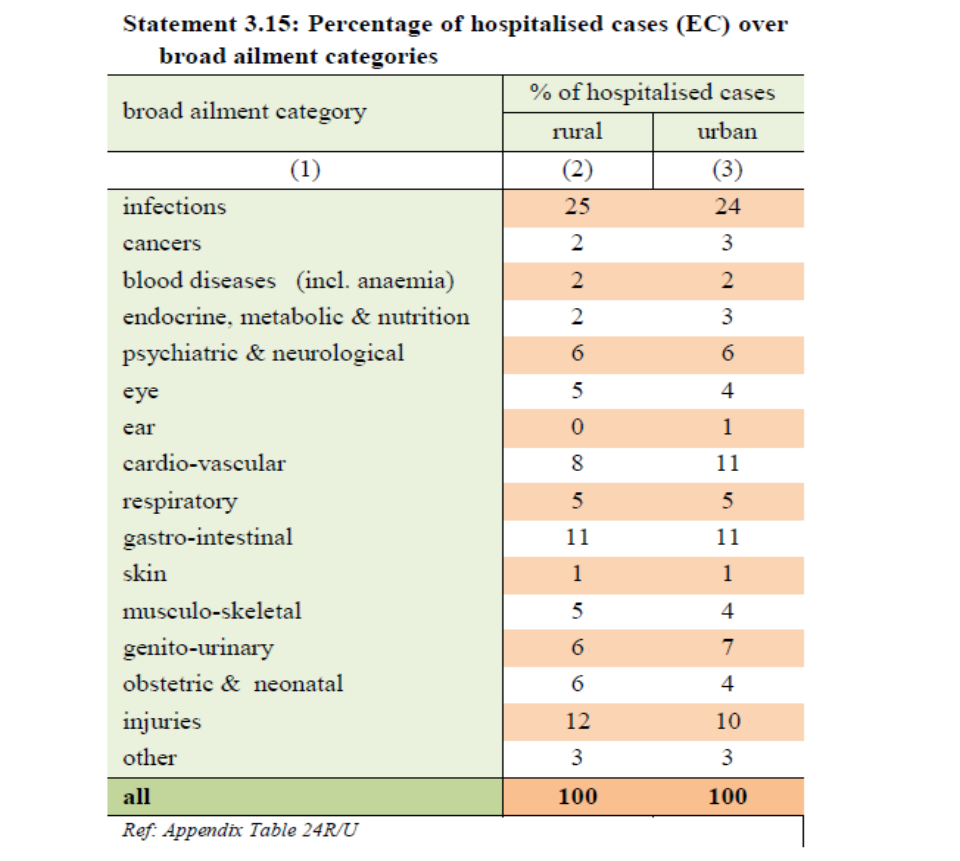
As is evident, 10% to 12% of all hospitalised cases were related to injuries, such as cuts, wounds, haemorrhage, fractures and burns caused by an accident, including bites to any part of the body.47
It is also important to take note of the percentage of cases which were hospitalised in public hospitals and private hospitals separately, since the cost of treatment varies greatly between the two:
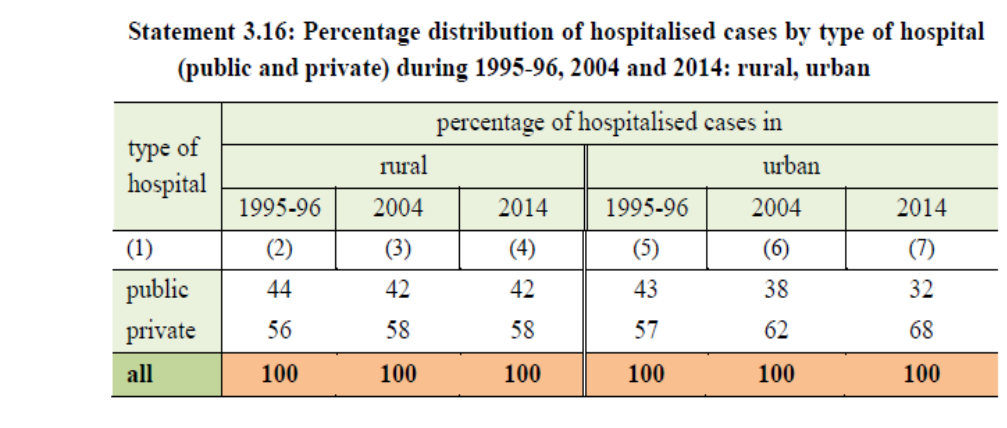
Hence, it is clear that private hospitals are preferred over government hospitals by an over-whelming majority of people. This implies that the cost of treatment is also higher, since private hospitals are more expensive as compared to their public counterparts.
The report has classified the population into five classes of UMPCE (Usual Monthly Per Capital Expenditure) based on the monthly per capita expenditure incurred by them.
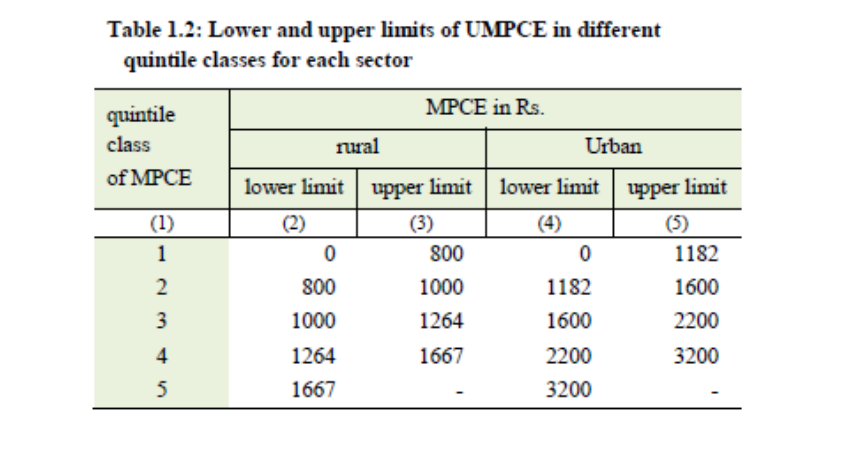
The people coming under class 1 incur least monthly per capita expenditure and belong to the poorest section of the society. The expenditure as well as financial stability rises as we move from one class to the other.
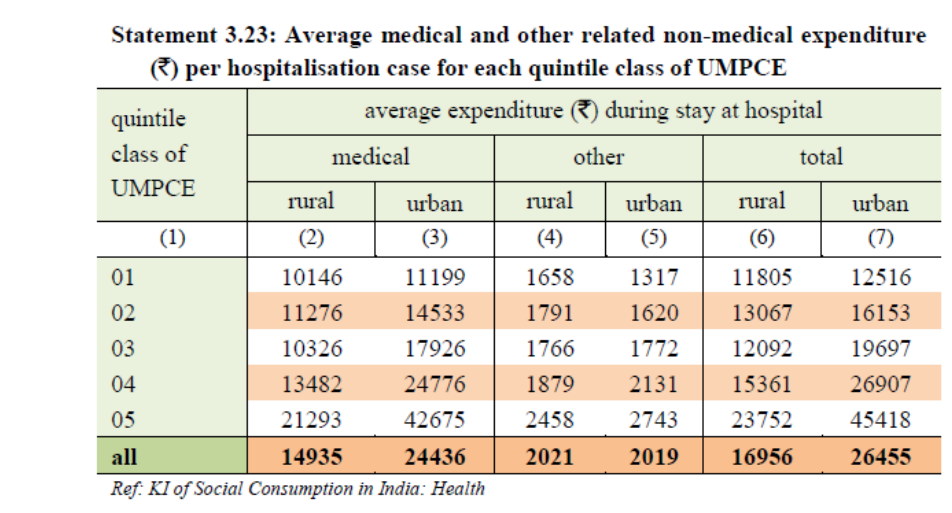
The table below shows the average medical and related expenses for each quintile class of UMPCE.
Furthermore, a vast majority of the population has no health coverage of any sort.
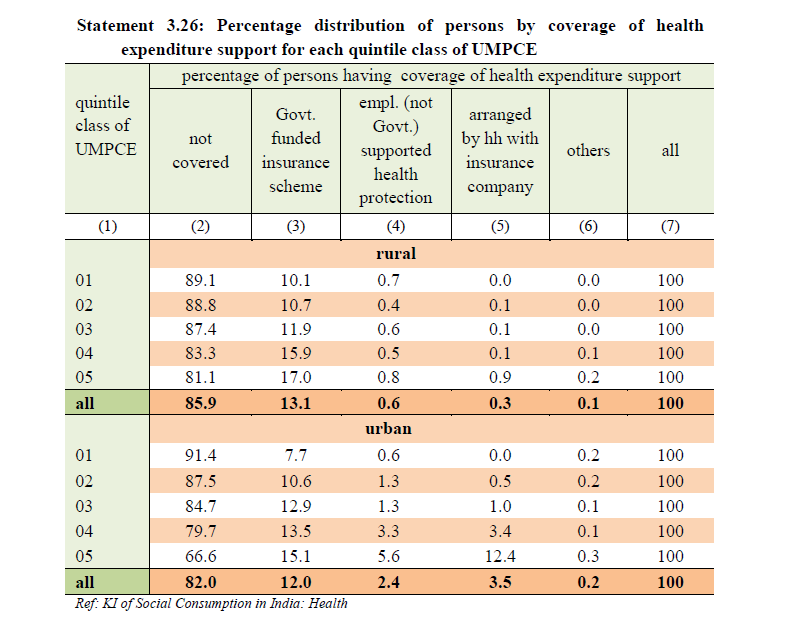
Based on all the statements of statistics mentioned above, few straight and simple conclusions can be drawn-
• 82% to 85.9% of the people who were hospitalised had no insurance coverage of any kind.
• The two poorest sections of the society with little to no income had spent Rs.11805 to Rs. 16153 on medical and related expenses while they were hospitalised. This figure does not cover the expenses which were incurred as part of after-care after being discharged from the hospital. This survey does not cover the cost of surgeries which need to be performed in cases of severe accidents.
• 10% to 12% of those hospitalised were on the pretext of injuries, and 58% to 68% of them were hospitalised in private hospitals, where the cost of treatment is significantly higher.
Taking into consideration all the aforementioned statistics and the aforesaid conclusions based on the various data referred, it is not an over-statement to say that the relief provided by PLIA of a maximum of Rs. 12,500 for medical expenses is grossly inadequate. Same is the case with every other relief under the other categories mentioned in the Schedule of PLIA. There is no doubt regarding the fact that the twenty-nine-year-old compensation structure under the Act needs to be revised in tandem with the needs of the present day.
Suggestions and Conclusion
Based on the foregoing discussion, the hypothesis for this research paper that “the principle of no-fault liability is efficiently and expediently implemented through the Public Liability Insurance Act, 1991, but the compensation structure provided in the same stands inadequate in the present day and hence needs to be amended” stands partly disproved and partly proved. After taking a deeper look into the mechanism for implementation of PLIA, one cannot help but discover the various loopholes imminent within this Act.
Firstly, the definition of “hazardous substances” is ambiguous and the judiciary has tried to cover up the failure of the legislature and drafters by stating that notification by the Central Government is not a pre-requisite to including a substance in the ambit of hazardous substances within the Act.
Secondly, “accidents” relating to transportation of hazardous substances recognise only those accidents which take place while transporting the hazardous substance by road, excluding even railways. The rationale behind this is unclear and disentitles a lot of potential victims from seeking claim under the Act.
Thirdly, the limitation period of 5 years for seeking relief under the Act leads to the failure of the very purpose of the Act to an extent. In various cases of accidents, the effect of the accident takes time to develop and may not even be visible for years altogether. Take, for example, the Bhopal Gas Tragedy, effects of which have flowed across generations altogether in the form of genetic mutations, gradual but steady decline in the function of organs and ever-lasting environmental ramifications.
Lastly, the sheer inadequacy of the compensation structure of the Act, which is nearly three decades old, is baffling. The Act has failed drastically to take into account the rising inflation and soaring medical expenses. The method for determining the compensation payable is also not fair and just. The method for calculation of compensation, as well as the structure of compensation, both need to be revised. The method for calculation of compensation should be made like that in Motor Vehicles Act, which takes into account various other factors and determinants apart from the extent of injury caused.
With such loopholes present all throughout the Act, the purpose of the Act is diluted and unless these loopholes are taken care of, the Act would continue to remain a mere statute with no real purpose or benefit.
*****
Footnotes
2. Rylands v. Fletcher, (1868) I.R.H.L. 330. ↑
3. Id. Also see, Rickards v. Lothian (1913) A.C. 263 (PC). ↑
4. See, Narayanan Bhattathripad v. Government of Trancancore-Cochin, 56 I.L.R. 639 (1956). Madras Railway Co. v. Zamindar of Carverangarum, 1 I.A. 364 (1874). S. Vendantacharya v. Highways Department of South Arcot, (1987) 3 SCC 400. ↑
5. Sullivan v. Dunham, 161 N.Y. 290, 55 N.E. 923 (1900). ↑
6. M.C. Mehta v. Union of India, A.I.R. 1987 S.C. 1086. ↑
8. Indian Council for Enviro-Legal Action v. Union of India, (1996) 3 SCC 212. ↑
9. Vikram Raghavan, Public Liability Insurance Act: Breaking New Ground for Indian Environmental Law, 39 Journal of the Indian Law Institute 96 (1997), available at https://www.jstor.org/stable/43951681?read-now=1&seq=1#page_scan_tab_contents. ↑
10. The Public Liability Insurance Act, 1991, No. 18, Acts of Parliament, §4. ↑
12. Bronwyn Howell, Judy Kavangh et. al., No-Fault Public Liability Insurance: Evidence from New Zealand, 9 Agenda Australian National University 135 (2002), available at http://press-files.anu.edu.au/downloads/press/p89791/pdf/9-2-A-4.pdf. ↑
14. For literature on morality of “no-fault” principle, refer: Bronwyn Howell, Judy Kavangh et. al., No-Fault Public Liability Insurance: Evidence from New Zealand, 9 Agenda Australian National University 135 (2002), available at http://press-files.anu.edu.au/downloads/press/p89791/pdf/9-2-A-4.pdf. C.L. Gaylord, Fault, No Fault or Strict Liability, 58 American Bar Association Journal 589 (1972), available at https://www.jstor.org/stable/25725872?read-now=1&refreqid=excelsior%3A3cdd90790c77edb549b8b745d1548f84&seq=3#page_scan_tab_contents. Jules L. Coleman, The Morality of Strict Tort Liability, 18 Wm. & Mary L. Rev. 259 (1976-1977), available at https://digitalcommons.law.yale.edu/cgi/viewcontent.cgi?referer=https://www.google.com/&httpsredir=1&article=5206&context=fss_papers. Professor S. Fredericg, Alternatives to the fault system, such as “no fault”, their pros. and cons, UNCTAD, available at https://unctad.org/en/PublicationsLibrary/unctadinsd56_en.pdf ↑
15. Supra, note 9 at § 2(e). ↑
16. Supra, note 8 at page 108. ↑
17. U.P. State Electricity Board v. District Magistrate, Dehradun , 1997 UPLBEC (2) 1344 ↑
19. M.P. State Electricity Board, Jabalpur vs. Collector Mandla, 2003 AIR (MP)-0-156 ↑
22. Supra, note 8 at page 108. ↑
23. M.K. Sharma v Bharat Electronics 1987, (1) SCALE 1049. ↑
30. Usha Ramanathan, Statute Law, Injury and Compensation, Journal of the Indian Law Institute 158, 188 (2005), available at http://14.139.60.114:8080/jspui/bitstream/123456789/12722/1/007_Statute%20Law,%20Injury%20and%20Compensation%20(158-198).pdf. ↑
31. Supra, note 8 at page110. ↑
34. Supra, note 9 at §6(1) proviso. ↑
37. Supra, note 9 at §7(3)(a). ↑
39. Supra, note 9 at §7(3)(b). ↑
43. Supra, note 9 at Schedule. ↑
45. National Sample Survey Organisation, Health in India (2014), available at http://mospi.nic.in/sites/default/files/publication_reports/nss_rep574.pdf. ↑