
Introduction
Age verification is an important aspect of competitive sport. It ensures that athletes participate in the appropriate age category and that competitions remain fair. In India, disputes relating to age verification are common, particularly in school-level, collegiate and youth national sporting events. Allegations of age fraud often arise from discrepancies in birth records or from the results of medical age determination tests. These disputes frequently result in exclusion from competition and raise concerns about fairness in selection and participation.1
Indian courts have increasingly been required to address disputes arising from age verification practices. In Chirag Sen v. State of Karnataka, the Supreme Court quashed criminal proceedings alleging falsification of birth records against two established badminton players, their parents and their coach. It held that the allegations rested on conjecture and that continuing the prosecution would be an abuse of process, since the age question had already been examined and closed by the Sports Authority of India after ossification and dental tests at government hospitals, including AIIMS, Delhi.2 Similarly, in Deepak Jain v. Basketball Federation of India, the Delhi High Court set aside a federation rule that accepted only birth certificates issued within five years of birth, holding that players who lacked such documents because of socio-economic disadvantage could not be denied the opportunity to compete on that ground alone.3 These cases show that the issue of age fraud in youth sport is not only about cheating but also about how fair and just the system is.
Scientific research shows that chronological age, as recorded in official documents, does not always reflect biological maturity.4 Biological age is influenced by factors such as eating habits, lifestyle, genetics, socio-economic conditions and overall health.5 Empirical studies conducted in Western Maharashtra have found that biological age, as estimated from body-composition measures, can diverge from recorded age.6 Medical research has also shown that individuals mature at different rates, suggesting that reliance on documentary proof or traditional medical tests alone may not always lead to fair outcomes in age verification.7
In response to concerns regarding age fraud, the Government of India introduced the National Code Against Age Fraud in Sports in 2010.8 The Code mandates medical age determination tests for athletes in age-restricted competitions and seeks to standardise practice across sports bodies. However, it relies largely on radiological (ossification) and dental tests, despite their known margins of error. In March 2025, the Ministry of Youth Affairs and Sports released a Draft National Code Against Age Fraud in Sports for public consultation, the first revision of the framework in some fifteen years.9 The Draft proposes bone-age assessment by the TW3 method, together with physical and dental examination. It does not, however, address how biological growth patterns, which vary across regions with differences in nutrition, climate and training conditions, should bear on a single uniform method of age determination, a method that may not operate fairly in a country as diverse as India.
Age verification practices also raise constitutional concerns. Article 14 of the Constitution guarantees equality before the law and the equal protection of the laws. Applying uniform age tests without accounting for biological differences risks treating unequal athletes as equals, which may undermine substantive equality.10 Article 21 protects the right to life and personal liberty, which includes bodily autonomy and the right to privacy.11 Compulsory medical examinations conducted without informed consent raise serious concerns, particularly when minors are involved, in the light of the Supreme Court’s recognition in K.S. Puttaswamy v. Union of India that privacy and bodily integrity form part of Article 21.12 Further, Article 39(f), among the Directive Principles, requires the State to ensure that childhood and youth are protected against exploitation and against moral and material abandonment.13 Incorrect age classification and exclusion from competition can have lasting physical and psychological effects on young athletes, thereby engaging the State’s constitutional responsibility.
At the international level, sports governing bodies have adopted approaches that seek to balance accuracy with athlete welfare. FIFA uses MRI-based wrist testing for under-17 competitions, which avoids the ionising radiation of traditional X-ray methods.14 The International Olympic Committee, in its framework on eligibility for men’s and women’s categories, asks that the well-being of athletes be prioritised and that competition be fair,15 while UNESCO’s International Charter of Physical Education and Sport (1978) affirms the right of every individual to participate in sport under fair and equal conditions.16 These practices show that scientific assessment and legal safeguards can be applied together.
In India, however, age verification continues to depend largely on documentary proof and traditional medical tests. This creates a gap between scientific understanding and legal regulation. Failure to account for biological variation may lead to unfair exclusion, affect athlete welfare and weaken confidence in sports governance. This study examines how reliance on chronological age alone influences fairness, athlete dignity and legal protection within the Indian sports system.
Age verification in sport must also be examined within the framework of international human rights and ethical governance standards. The UNESCO International Charter of Physical Education, Physical Activity and Sport recognises access to sport as a fundamental right and emphasises that participation must occur under conditions of fairness, dignity, safety and non-discrimination. UNESCO’s Universal Declaration on Bioethics and Human Rights further requires that any preventive, diagnostic or therapeutic medical intervention be carried out only with the prior, free and informed consent of the person concerned, that special protection be given to persons who lack the capacity to consent, and that the personal integrity of individuals of special vulnerability be respected. When age-determination mechanisms rely on scientifically uncertain methods and are applied uniformly without adequate procedural safeguards, they risk undermining these international commitments. Accordingly, age verification cannot be treated solely as an administrative anti-fraud tool; it must be evaluated as a rights-sensitive regulatory process governed by ethical, legal and human rights standards.17
A. Research question
How do differences between biological and chronological age influence the fairness and legal protection of athletes in Indian sports?
B. Hypothesis
Reliance solely on chronological age for age verification leads to unfair outcomes and undermines the principles of equality, dignity and fair opportunity under constitutional law and international sports ethics.
This study is based on doctrinal legal analysis, scientific literature and empirical observation. It reviews the legal and medical frameworks governing age verification and examines their limitations. The methodology section explains the mixed doctrinal and empirical approach adopted, including interviews with medical professionals and a survey of athletes from different regions of India.
Literature review
Experts in both law and sport have discussed at length how the exact age of an athlete is to be determined, and it is widely recognised that a person’s real age is often very difficult to establish by any single method. In Indian sport, the documents mainly used for age verification are birth certificates issued by the local authority and Class 10 mark sheets issued by educational boards, but these are at times inaccurate or open to manipulation. In the absence of reliable records, doctors are asked to conduct a medical examination to estimate the biological age of the athlete.
A. Scientific side of age checking
In India, age determination relies mostly on the ossification or wrist X-ray test. Doctors examine the wrist bones to see whether the growth ends of the bones have fused. As the gap at the growth plate narrows and the bones begin to join, the person is maturing in terms of biological age. The National Code Against Age Fraud in Sports (2010), however, provides for a medical examination by a panel comprising a dental surgeon, a radiologist and a physician the first time an athlete enters an age-restricted competition, and not only where documents are deficient.18 A study of the rural population of Western Maharashtra (Alate, 2022)19 found that biological age, measured with a body-composition monitor, is not the same as chronological age, and associates it with eating habits, lifestyle, genetics and socio-economic conditions. An interventional study of medical students in Western Maharashtra (Sharavanakumaran et al., 2023)20 found that individuals of the same chronological age vary in biological age, and that regular physical activity narrowed the gap between the two. Although these studies concern adults rather than the skeletal maturity of adolescents, they illustrate that people of the same recorded age may differ in physical development. This variation highlights the limitations of relying solely on chronological age when assessing physical development or eligibility in contexts such as competitive sport.
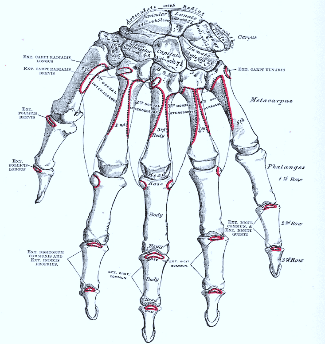
Figure 1: Bones of the wrist and hand, the region examined by X-ray in the ossification test to assess bone maturity
The figure above shows the part of the body that doctors examine during the age determination test.21,22 Doctors look at the radius, the ulna and the small bones of the wrist to assess how far the bones have grown and whether their growth ends have joined. They then compare these observations with standard age charts to estimate a person’s age. However, this method is not always exact. As Hamczyk et al. (2020) explain, chronological age and biological age are not always the same.23 Chronological age only tells how many years a person has lived, whereas biological age reflects the actual physical condition of the body. Because of this, two people who are the same age on paper may still show different levels of physical growth and health.
Mulero et al. (2025) discuss biological ageing and the different factors that influence it.24 Their research shows that biological age can change because of genetics, environment, lifestyle, diet and physical activity. The authors point out that even where two people are of the same age, their biological maturity may differ, which makes age assessment difficult in fields such as medicine, sport and public health. Other studies, such as Jylhävä et al. (2017),25 discuss several scientific methods that try to measure biological age, including markers such as DNA changes, telomere length, proteins and other biological indicators of how the body is ageing. That research also notes, however, that these methods require advanced laboratory testing and are still developing, so they are not easy to use in ordinary settings. Drewelies et al. (2022)26 observe that most biomarkers of biological age are laborious or expensive to assess, and derive a biological age from routine blood-test parameters that predicts morbidity and mortality over and above chronological age; but laboratory-based biomarker testing of this kind still requires resources, so using it regularly, especially across large populations or sports systems, is not very practical in a country like India.
The Supreme Court has long taken judicial notice that the margin of error in age ascertained by radiological examination is two years on either side,27 which means that two players with the same test report can still differ in actual age. Depending only on medical tests can therefore be unfair to young players.
B. Legal and ethical side
In The Menace of Age Fraud in Indian Sports (2021), Pooja Gautam discusses the problem of age fraud in Indian sport and explains how it affects fairness in competition.28 The article argues that age fraud gives players who falsely claim to be younger than they are an unfair advantage of physical maturity over genuinely younger athletes. It attributes the persistence of the problem to the complacency of sports governing bodies and the limited enforcement of birth registration laws, and observes that the National Code of 2010 has largely failed to act as a deterrent.
Practice has also varied between federations. In Deepak Jain, the Basketball Federation of India had laid down its own requirement that players produce birth certificates issued in the year of their birth or within five years of it, although the Union maintained that the National Code, with its mandatory medical examination, binds every national sports federation.29 The Draft National Code of 2025 allows States and Union Territories to adopt it, or to use it as a model for their own policies, “for promoting uniformity nationwide”.30
The Supreme Court’s Handbook on Child Rights and the Law (2025) records the Court’s consistent position, developed under juvenile justice law, that an ossification test is not conclusive, carries a margin of error, should be used only as a last resort where documentary evidence is unavailable, and that any benefit of the doubt must go to the child.31 UNESCO’s Universal Declaration on Bioethics and Human Rights (2005) likewise requires the prior, free and informed consent of the person concerned for any diagnostic medical intervention, and special protection for persons who lack the capacity to consent.32 These ideas connect with Article 21 of the Constitution, which protects life, personal liberty and privacy.
These studies show that science and law should work together, with fair rules and respect for privacy and consent. Indian courts have also addressed fairness in age verification. In Deepak Jain, the Delhi High Court held that athletes cannot be shut out merely because socio-economic disadvantage prevented them from obtaining a birth certificate within a set period, and directed the federation to follow the medical-examination procedure of the National Code instead.33 In Chirag Sen, the Supreme Court refused to allow a criminal prosecution to reopen an age question that the sports authorities had already examined and closed.34
Overall, both science and law indicate that current age-checking methods in India are not foolproof. There are still gaps, errors and a lack of fairness. The next part of this study explains the method used in this research, which combines a review of the law with interviews of doctors and a survey of athletes.
Methodology
This study uses both legal and practical approaches to understand the issue of age verification in Indian sports. The topic connects law, science and ethics, so a single method is not sufficient. The researcher has used a combination of doctrinal, empirical and comparative methods to obtain a full picture.
A. Doctrinal method (legal review)
The doctrinal part focuses on the existing laws, codes and cases that govern age verification in Indian sports. The main documents used are the National Code Against Age Fraud in Sports (2010)35 and the Draft National Code (2025)36 released by the Ministry of Youth Affairs and Sports. Along with these, Articles 14, 21 and 39(f) of the Constitution are studied to understand how equality, liberty and the protection of youth bear on this issue.
Court decisions such as Chirag Sen v. State of Karnataka (2025) and Deepak Jain v. Basketball Federation of India (2025) were analysed to see how courts approach fairness in age determination.37 Legal literature such as The Menace of Age Fraud in Indian Sports (Pooja Gautam, 2021)38 was also reviewed. These helped to show how the existing law works and where it is weak.
The doctrinal part also looks at child rights and ethics. The Supreme Court’s Handbook on Child Rights and the Law (2025) and UNESCO’s Universal Declaration on Bioethics and Human Rights (2005) were used to study how age determination, consent and dignity bear on compulsory medical tests of minors.39 This forms the basis of the legal analysis in the paper.
B. Empirical method (field observations and survey data)
The empirical part of this study aims to understand how athletes, coaches and doctors experience the process of age verification in sport. A short online and offline survey titled “Age Verification in Indian Sports: Legal, Ethical and Athlete Perspectives” was conducted between November and December 2025. A total of 25 athletes and three medical experts participated. The athletes were from Haryana, Delhi and Maharashtra and represented sports such as wrestling, athletics, boxing and football. The doctors were from government hospitals and one sports medicine centre. No respondent is identified in this paper.
C. Survey findings from athletes
Of the 25 athletes, 17 (68%) said that they had to submit school or birth certificates for verification, and 8 (32%) said that they had to undergo a medical age test, such as an X-ray or ossification test. Many athletes felt that the process was not always transparent. Fifteen (60%) believed that the existing system could be unfair, especially when their medical test results differed from their official documents.40
Some athletes shared that the ossification test made them uncomfortable because they were not told clearly why it was being done or how the result would be used. A few also said that the waiting period for test results affected their mental focus before tournaments. Eighteen respondents (72%) agreed that biological and chronological age should be considered together, not just one of them.
The survey also found that athletes from rural or economically weaker backgrounds had more difficulty obtaining proper birth documents. Some said that their certificates were issued late or contained spelling or date errors. Earlier research from rural Western Maharashtra has likewise linked socio-economic conditions with differences between biological and chronological age.41
D. Inputs from medical experts
Three medical professionals, a radiologist, a dentist and a physician, were interviewed for this purpose. All three regularly perform sports-related examinations. All of them stated that wrist X-rays, ossification tests and dental examinations are the common methods used for verifying the age of athletes. They explained that these tests are preferred because they are cheaper and easier to conduct, even though they are not entirely accurate. According to them, the usual margin of error ranges from one to two years and can vary with nutrition, lifestyle and regional differences. One doctor noted that a 17-year-old player may sometimes appear to be 19 in a wrist X-ray, which can result in unfair disqualification from under-18 competitions.
The doctors also mentioned that proper consent is often not obtained, and that the consent given is not fully informed, especially when the athletes are minors. In many cases, players are simply instructed to undergo these tests if they want to participate, as the tests are treated as mandatory for the competition. They also highlighted that India still lacks clear and uniform medical guidelines and an adequate review system for cases where test results do not match official documents. This verification process causes significant stress for athletes and raises concerns about privacy, consent and fairness under Article 21 of the Constitution.
E. Interpretation
The empirical data in this study largely support what earlier legal and scientific studies have pointed out: the current system of age verification in sport is not always accurate or fair. Many athletes face practical problems during the process. There is often no clear communication about how the tests are done, some players do not have proper documents, and in some cases medical tests are conducted without proper consent.
The doctors who were interviewed also said that bone-based age tests are not completely reliable. In their view, these tests can be in error, and the results may not always match the actual age of the athlete. They also pointed out that there is no clear procedure for cases in which such differences appear. This shows that the gap lies not only in the scientific method but also in the way the tests are carried out.
Read together, the survey responses and the interviews suggest that the age verification system in India needs improvement. The issue is not only scientific accuracy but also proper procedure, communication and the protection of athletes’ rights. These observations provide the basis for the discussion in the latter part of this paper.
Results and discussion
This section discusses the findings of the empirical part of the study and examines how they relate to the scientific limitations of age determination, existing legal standards and the current regulatory framework governing age verification in Indian sports.
A. Findings from the athlete survey, medical interviews and field observation
The empirical findings of this study are based on an original survey titled “Age Verification in Indian Sports: Legal, Ethical and Athlete Perspectives”, conducted between November and December 2025, together with interviews with medical professionals involved in age determination for sports competitions.42 The survey shows that documentary proof, mainly school certificates and birth records, continues to be the primary method of age verification in India. However, many athletes reported that they were required to undergo medical age tests, such as ossification or wrist X-ray examinations, when their documents were questioned or found inconsistent.
A common issue raised by athletes was the lack of clarity and communication in the age verification process. Several respondents stated that they were not properly informed why medical tests were required or how the results would be used. Some athletes also reported anxiety and stress, particularly when tests were conducted close to competition dates. For young athletes, uncertainty over age verification often affected confidence and performance.
The survey further revealed that athletes from rural areas and economically weaker backgrounds faced greater difficulty in producing accurate birth documents. Delayed birth registration, spelling mistakes and incorrect dates were frequently reported. Many athletes felt that these documentation problems led to increased scrutiny and testing, even where there was no intention to misrepresent age. These findings suggest that structural and administrative disadvantages play a significant role in age verification disputes.
In addition to the survey data, the researcher’s long-term engagement with sporting institutions provides useful context. Field observations indicate that age disputes often arise from inconsistent documentation and uneven enforcement of age rules rather than from deliberate age fraud. At district and state levels, limited awareness of procedural safeguards and reliance on informal practices were commonly observed. These observations support the survey findings and highlight the gap between formal rules and their implementation on the ground.43
B. Scientific limits of medical age determination
The findings highlight serious limitations in the scientific reliability of the medical age determination methods currently used in India. The medical professionals interviewed for this study acknowledged that ossification and dental tests are widely used because they are inexpensive and easy to administer. At the same time, all of them agreed that these tests have known margins of error and cannot determine age with certainty.
According to the doctors interviewed, medical age assessments may differ from actual biological maturity by one to two years, depending on factors such as nutrition, physical activity, climate and regional growth patterns.44 These views are consistent with regional studies conducted in Western Maharashtra, which found that biological age and chronological age do not always match, and associated the difference with lifestyle, physical activity and socio-economic conditions.45 Continued reliance on such tests as decisive proof of age therefore risks incorrect classification and the unfair exclusion of athletes.
The study also reveals gaps in procedural safeguards during medical testing. Many athletes reported that consent was assumed rather than explicitly taken, and that clear explanations were rarely provided. There were limited opportunities to review or challenge adverse test results, and athletes often lacked access to independent medical opinion. These procedural gaps increase the risk of arbitrary decision-making and weaken confidence in the age verification process.
C. Legal and constitutional concerns
The empirical findings raise important concerns under Articles 14 and 21 of the Constitution of India. Article 14 guarantees equality before the law and the equal protection of the laws. Uniform application of age verification methods without considering biological differences may result in unequal treatment of athletes who are not similarly placed. Treating athletes with different levels of biological development as equals can lead to unfair outcomes, contrary to the idea of substantive equality recognised in constitutional jurisprudence.46
Article 21 protects the right to life and personal liberty, which includes bodily autonomy and the right to privacy. The survey and interviews indicate that medical age tests are often conducted without meaningful consent or adequate explanation. Such compulsory medical procedures, particularly when imposed on minors, raise serious constitutional concerns. These concerns are significant in the light of the judicial recognition that privacy and bodily integrity form part of the protection of Article 21.47
Judicial decisions on age verification in sport have also stressed the need for fairness and proportionality. Courts have refused to let rigid documentary requirements exclude athletes who could not obtain timely birth certificates, and have declined to let settled age determinations be reopened through criminal complaints.48 The findings of this study support this judicial approach by showing that strict enforcement of age rules can produce unjust outcomes, especially for athletes from disadvantaged backgrounds.
D. Gaps in implementation of the National Code Against Age Fraud in Sports
The study also shows weaknesses in the way the National Code Against Age Fraud in Sports is actually implemented. The Code was meant to bring uniform rules to different sports bodies, but in practice its application is not the same everywhere. Different federations follow different methods. There are also gaps in areas such as consent, grievance redressal and independent review, which limit the effectiveness of the regulatory framework.
The Draft National Code Against Age Fraud in Sports (2025) proposes several changes: bone-age assessment by the TW3 method, with MRI available at the appeal stage; a mandatory consent form, countersigned by a parent or guardian for athletes under eighteen; and a two-tier appeal, first to a regional authority or a federation committee and then to a Central Appeals Committee.49 These are important steps on paper. However, the Draft does not address how differences in biological growth across regions, arising from nutrition, climate and training conditions, are to be handled in real situations. Without clear procedures for such cases, there remains a risk that players may be unfairly excluded or their rights affected.
Overall, the findings suggest that the current system often places administrative convenience ahead of scientific accuracy and athlete welfare. Reforms are needed to improve this situation. They should aim not only to prevent fraud but also to respect constitutional values, procedural fairness and the dignity of athletes.
Reform and policy suggestions
The findings discussed in the previous section show that age verification in Indian sports suffers from scientific limitations, procedural gaps and uneven enforcement. While preventing age fraud is a legitimate objective, the present framework often places a disproportionate burden on genuine athletes, particularly those from rural and economically weaker backgrounds. Reforms are therefore required to ensure that age verification processes remain fair, accurate and consistent with constitutional values.
A. Moving beyond a single-method approach
Age verification should not rely on a single method, whether documentary proof or medical testing. Birth certificates and school records should continue to be considered, but they should not be treated as conclusive in every case. Similarly, medical tests such as ossification or dental examinations should be used only as supporting tools, keeping in mind their known margin of error.
A combined approach that considers documents, medical assessment and regional growth patterns would reduce the risk of incorrect age classification. Where doubts persist, the benefit of the doubt should be given to the athlete unless there is clear evidence of intentional age misrepresentation.
B. Strengthening consent and transparency
One of the major concerns highlighted by this study is the absence of informed consent in medical age testing. Medical examinations are not mere formalities; they directly affect the bodily autonomy of athletes, particularly minors. The consent form proposed in the 2025 Draft Code is a welcome step, but it will matter only if consent is genuinely informed. Sports authorities should ensure that informed, written consent is obtained from athletes and, where required, from parents or guardians.
Athletes should also be informed of the purpose of the test, the method used and the limitations of the results. Clear communication of outcomes and of the reasons for decisions would improve transparency and reduce disputes.
C. Independent review and appeal mechanisms
Age verification decisions often have serious and irreversible consequences for an athlete’s career. At present, many sports bodies lack effective mechanisms for review or appeal. The 2025 Draft Code proposes a two-tier appeal, and the National Sports Governance Act, 2025 provides for a National Sports Tribunal, whose constitution was brought into force from 1 January 2026;50 how these mechanisms will operate in age disputes remains to be seen. Independent medical review boards should be established to reassess disputed cases. These boards should include experts from different medical disciplines and function independently of selection committees.
An internal appeal mechanism, or access to an independent sports dispute resolution body, would ensure that athletes are not excluded without an opportunity to be heard. Such safeguards would also strengthen confidence in sports governance.
D. Addressing regional and socio-economic disparities
The study shows that athletes from rural areas and economically weaker sections face greater difficulties owing to delayed or inaccurate birth records. Policy frameworks must recognise these structural disadvantages. Flexible evidentiary standards, acceptance of alternative records and contextual evaluation of documents would help prevent the unfair exclusion of athletes for administrative shortcomings beyond their control.
Such an approach would better reflect the principle of substantive equality than rigid formal equality.
E. Biological variation and fair play: lessons from international practice
Recent international sporting controversies have also drawn attention to how natural biological differences, including variations in hormonal development, can affect physical capacity and competitive outcomes. In high-level competition, concerns have been raised about whether rigid eligibility rules adequately account for biological diversity, even where no intentional wrongdoing is involved. These debates underline a broader point: when biological development varies significantly, uniform regulatory standards may produce unfair results if applied mechanically.51
Although age verification and sex-based eligibility operate within different regulatory frameworks, both raise a common concern regarding fairness, dignity and the limits of scientific categorisation. This reinforces the argument that biological growth and development should be treated as relevant considerations when designing eligibility rules aimed at ensuring fair play.
F. Aligning age verification with constitutional principles
Age verification policies must comply with Articles 14 and 21 of the Constitution. Uniform application of age tests without accounting for biological variation can lead to unequal treatment and arbitrary outcomes. Medical testing without meaningful consent raises serious concerns relating to bodily autonomy and privacy.
Reforms should therefore ensure that age determination processes are reasonable, proportionate and respectful of athletes’ dignity. Protecting young athletes from unnecessary physical and psychological harm must remain a central objective of sports regulation.
G. Towards a fair and athlete-centric framework
Age verification should not be treated only as a way of detecting fraud in sport. It is also a process that can affect the rights, dignity and future of young athletes. For many players, the result of these tests can decide whether they are allowed to continue competing. The process therefore needs to be handled with care, with scientific knowledge, fair procedures and constitutional values all taken into account when the rules are applied. A system that keeps this balance can support clean sport while also protecting athletes from unfair exclusion.
The reforms discussed in this study are not meant to weaken the fight against age fraud. Rather, they seek to ensure that the methods used to prevent fraud are themselves fair and respectful of athletes’ rights. A more balanced and transparent system can increase trust in sports authorities and, over time, help create a fairer and more responsible sports environment in India.
Conclusion
Age verification is important for maintaining fairness in competitive sport. However, this study shows that the present system in India depends mostly on chronological age and traditional medical tests. These methods do not always reflect the actual biological development of athletes, and as a result some players may be unfairly excluded from competition. The problem can be more serious for athletes from rural areas or economically weaker backgrounds, who may already face difficulties with documentation. It also raises questions about equality, bodily autonomy and procedural fairness.
The findings also suggest that age disputes in Indian sport are not always caused by intentional age fraud. In many situations the problem arises from missing or unclear documents, natural differences in biological growth, and the inconsistent way in which sports authorities apply the rules. Court decisions, scientific studies and the empirical observations in this research together indicate that a rigid and uniform approach to age verification can affect athlete welfare and may also raise concerns under constitutional protections.
From an international perspective, this study also connects with the ideas promoted by UNESCO on ethical governance in sport and the protection of athletes. UNESCO’s International Charter of Physical Education, Physical Activity and Sport requires that sport take place in a safe environment that protects the dignity, rights and health of all participants.52 When age verification relies too strictly on fixed standards without considering biological differences or fair procedures, it may conflict with these ethical principles. Ensuring fairness in sport therefore requires rules that combine scientific understanding with legal safeguards that respect dignity and non-discrimination. Aligning age verification practices with such ethical standards can improve athlete protection and increase trust in sports institutions.
This paper therefore supports a more balanced, rights-based approach to age verification, one that recognises biological diversity while maintaining fairness and integrity in sports competitions. When scientific knowledge, constitutional values and fair procedures are considered together, age verification can become fairer for athletes. A clear and humane system can also help build trust in sports governance and better protect young athletes in India.
*****
Footnotes
1. Pooja Gautam, The Menace of Age Fraud in Indian Sports: Extent and Analysis, 4 Int’l J.L. Mgmt. & Human. 1457 (2021), https://ijlmh.com/wp-content/uploads/The-Menace-of-Age-fraud-in-Indian-Sports.pdf.
2. Chirag Sen & Anr. v. State of Karnataka & Anr., Crim. Appeal Nos. 3213–3215 of 2025, 2025 INSC 903, ¶¶ 18, 21–24 (Sup. Ct. India July 28, 2025).
3. Deepak Jain & Ors. v. Basketball Fed’n of India & Ors.; Chandini v. Basketball Fed’n of India & Ors., W.P.(C) Nos. 4648/2024 & 16299/2024, ¶¶ 19–21 (Del. H.C. Jan. 27, 2025) (Sachin Datta, J.).
4. Magda R. Hamczyk et al., Biological Versus Chronological Aging: JACC Focus Seminar, 75 J. Am. Coll. Cardiology 919 (2020), https://doi.org/10.1016/j.jacc.2019.11.062.
5. Mahendra M. Alate, Study of Biological Age and Chronological Age in Rural Population of Western Maharashtra, 8 Rsch. & Revs.: J. Stat. & Mathematical Sci. 1 (2022), https://www.rroij.com/open-access/study-of-biological-age-and-chronological-age-in-rural-population-of-western-maharashtra.php?aid=91944.
6. See Alate, supra note 5; K.B. Sharavanakumaran et al., A Study to Minimize the Gap Between Biological Age and Chronological Age Among Medical Students: An Interventional Study in Western Maharashtra, 12 Eur. Chem. Bull. (S2) 538 (2023), https://kvv.edu.in/documents/4674/055.pdf.
7. Hamczyk et al., supra note 4.
8. Ministry of Youth Affairs & Sports, National Code Against Age Fraud in Sports (circulated by Letter No. 32-18/2009-SP-III, Mar. 19, 2010).
9. Press Info. Bureau, Ministry of Youth Affairs & Sports, Ministry of Youth Affairs and Sports Invites Comments on Draft National Code Against Age Fraud in Sports 2025 (NCAAFS-2025), Release ID 2111175 (Mar. 13, 2025), https://pib.gov.in/PressReleasePage.aspx?PRID=2111175; Ministry of Youth Affairs & Sports, Draft National Code Against Age Fraud in Sports (NCAAFS) 2025 cl. 7.1.1 (Mar. 12, 2025) [hereinafter Draft National Code], https://yas.gov.in/sites/default/files/Draft%20%20National%20Code%20against%20Age%20Fraud%20in%20Sports%20%28NCAAFS%29%202025.pdf.
10. E.P. Royappa v. State of Tamil Nadu, A.I.R. 1974 S.C. 555 (India).
11. Maneka Gandhi v. Union of India, A.I.R. 1978 S.C. 597 (India).
12. K.S. Puttaswamy v. Union of India, (2017) 10 S.C.C. 1 (India).
13. See M.C. Mehta v. State of Tamil Nadu, (1996) 6 S.C.C. 756 (India).
14. Mehdi Karami, Alireza Moshirfatemi & Pooya Daneshvar, Age Determination Using Ultrasonography in Young Football Players, 3 Advanced Biomed. Rsch. 174 (2014), https://doi.org/10.4103/2277-9175.139192; see also Jiri Dvorak, John George, Astrid Junge & Juerg Hodler, Age Determination by Magnetic Resonance Imaging of the Wrist in Adolescent Male Football Players, 41 Brit. J. Sports Med. 45 (2007), https://doi.org/10.1136/bjsm.2006.031021.
15. Int’l Olympic Comm., IOC Framework on Fairness, Inclusion and Non-Discrimination on the Basis of Gender Identity and Sex Variations principles 2, 4 (2021), https://stillmed.olympics.com/media/Documents/Beyond-the-Games/Human-Rights/IOC-Framework-Fairness-Inclusion-Non-discrimination-2021.pdf.
16. UNESCO, International Charter of Physical Education and Sport art. 1 (1978).
17. UNESCO, International Charter of Physical Education, Physical Activity and Sport arts. 1, 9–10 (2015) (revising the 1978 Charter); UNESCO, Universal Declaration on Bioethics and Human Rights arts. 6–8 (2005).
18. Ministry of Youth Affairs & Sports, supra note 8, cls. 5.1, 7.2.1; see Deepak Jain, supra note 3, ¶¶ 7, 15.
19. Alate, supra note 5.
20. Sharavanakumaran et al., supra note 6.
21. Illustration reproduced from Henry Gray, Anatomy of the Human Body fig. 220 (Warren H. Lewis ed., 20th ed. 1918) (public domain). On the test itself, see Ossification Test, Drishti IAS (Oct. 17, 2024), https://www.drishtiias.com/daily-updates/daily-news-analysis/ossification-test.
22. Ministry of Youth Affairs & Sports, supra note 8.
23. Hamczyk et al., supra note 4.
24. Patricia Mulero, Alba Chavarría-Miranda & Nieves Téllez, The Relevance of Chronological and Biological Aging in the Progression of Multiple Sclerosis, 13 Healthcare 2619 (2025), https://doi.org/10.3390/healthcare13202619.
25. Juulia Jylhävä, Nancy L. Pedersen & Sara Hägg, Biological Age Predictors, 21 EBioMedicine 29 (2017), https://doi.org/10.1016/j.ebiom.2017.03.046.
26. Johanna Drewelies et al., Using Blood Test Parameters to Define Biological Age Among Older Adults: Association with Morbidity and Mortality Independent of Chronological Age Validated in Two Separate Birth Cohorts, 44 GeroScience 2685 (2022), https://doi.org/10.1007/s11357-022-00662-9.
27. Jaya Mala v. Home Sec’y, Gov’t of Jammu & Kashmir, (1982) 2 S.C.C. 538, ¶ 9 (India).
28. Gautam, supra note 1.
29. Deepak Jain, supra note 3, ¶¶ 2, 15, 20.
30. Ministry of Youth Affairs & Sports, Draft National Code, supra note 9, cl. 4.2.
31. Centre for Research & Planning, Supreme Court of India, Handbook on Child Rights and the Law 34–36 (2025), https://cdnbbsr.s3waas.gov.in/s3ec0490f1f4972d133619a60c30f3559e/uploads/2025/10/2025101472.pdf.
32. UNESCO, Universal Declaration on Bioethics and Human Rights, supra note 17, arts. 6–7.
33. Deepak Jain, supra note 3, ¶¶ 17–21.
34. Chirag Sen, supra note 2, ¶¶ 21, 23.
35. Ministry of Youth Affairs & Sports, supra note 8.
36. Ministry of Youth Affairs & Sports, Draft National Code, supra note 9.
37. Chirag Sen, supra note 2; Deepak Jain, supra note 3.
38. Gautam, supra note 1.
39. Centre for Research & Planning, Supreme Court of India, supra note 31; UNESCO, Universal Declaration on Bioethics and Human Rights, supra note 17.
40. Age Verification in Indian Sports: Legal, Ethical and Athlete Perspectives (Author’s Survey Report, Nov.–Dec. 2025) (on file with author).
41. See Alate, supra note 5.
42. Age Verification in Indian Sports, supra note 40.
43. Field observations of the researcher based on long-term engagement with sports institutions (on file with author).
44. Interviews with Medical Officers, Government Hospitals & Sports Medicine Centre (Dec. 2025) (notes on file with author).
45. See Alate, supra note 5; Sharavanakumaran et al., supra note 6.
46. E.P. Royappa, supra note 10.
47. K.S. Puttaswamy, supra note 12.
48. Deepak Jain, supra note 3, ¶¶ 19–21; Chirag Sen, supra note 2, ¶¶ 21–23.
49. Ministry of Youth Affairs & Sports, Draft National Code, supra note 9, cls. 6.2–6.3, 7.1.1, 7.1.3 & annex II.
50. The National Sports Governance Act, 2025, No. 25, Acts of Parliament, 2025 (India); Press Info. Bureau, Ministry of Youth Affairs & Sports, Notification of Commencement of Select Provisions of the National Sports Governance Act, 2025, Release ID 2210321 (Dec. 31, 2025), https://www.pib.gov.in/PressReleasePage.aspx?PRID=2210321.
51. Int’l Olympic Comm., Joint Paris 2024 Boxing Unit/IOC Statement (Aug. 1, 2024), https://www.olympics.com/ioc/news/joint-paris-2024-boxing-unit-ioc-statement.
52. UNESCO, International Charter of Physical Education, Physical Activity and Sport, supra note 17, art. 9.