
Introduction
Oral testimony is common in the Indian criminal trial, but it is also among the least reliable forms of evidence. It is prone to being lost through memory lapse or hostile witnesses, and statements recorded by police officers have limited evidentiary value. To overcome these problems, the framers of the new criminal laws have placed a duty to use science at an early stage of the investigation. Under Section 176(3) of the Bharatiya Nagarik Suraksha Sanhita, 2023 (BNSS), on receipt of information about an offence punishable for seven years or more, the officer in charge of a police station must cause a forensic expert to visit the crime scene to collect forensic evidence and must cause the process to be video-recorded.1 Section 157 of the Code of Criminal Procedure, 1973 (CrPC) contained no such provision. Whether a scientific team reached the crime scene depended solely on the discretion of the Investigating Officer and the resources available in the District.2
The change answers a long-standing complaint. More than twenty years ago, the Committee on Reforms of the Criminal Justice System (Malimath Committee) recommended modernising investigation and placing forensic science at its centre.3 More forensic evidence, however, requires more examination of that evidence. Exhibits collected under Section 176(3) must be sent to a laboratory, await analysis and be reported on before they can be used in court. In December 2024, the Union Ministry of Home Affairs told Parliament that the new criminal laws were expected to bring a significant increase in the workload of forensic science laboratories.4 The same reply gives that expected demand as the reason for the National Forensic Infrastructure Enhancement Scheme (NFIES), which the Union Cabinet had approved in June 2024.5
The primary problem is one of chronology. In Hussainara Khatoon, Article 21 was interpreted as containing the right to a speedy trial, a right that applies to all stages of the criminal process, including investigation.6 The decisions of the Supreme Court also make clear that lack of financial capacity cannot excuse delay.7 If Section 176(3) increases the demand for forensic examination beyond what the current laboratories can handle, a statute meant to improve the collection of evidence will instead lead to longer pre-trial incarceration, delayed charges and acquittals based on the deterioration of exhibits or lapses in the chain of custody. The Supreme Court’s 2025 decision in Kattavellai @ Devakar, which set aside a death sentence where DNA evidence had been rendered unusable by unexplained delay and a break in the chain of custody, shows that these risks are real.8
This paper therefore asks what Section 176(3) requires, by when, and what happens when it is not followed; what the official data show about the extent and distribution of the forensic laboratory backlog in India; how constitutional courts respond to delays caused by forensic analysis; and how legal and institutional design can enhance the use of forensic evidence at trial while reducing the time trials take.
Sources and limits of the data
The study combines a doctrinal reading of the BNSS, the Bharatiya Sakshya Adhiniyam, 2023 (BSA) and the case law on speedy trial and fair investigation with descriptive analysis of published secondary data. No field work, interviews or right to information requests were undertaken.
A. Data sources
The data come from three categories of source:
Official parliamentary data. The written replies of the Ministry of Home Affairs to questions in the Lok Sabha (Unstarred Question No. 3452, December 17, 2024) and the Rajya Sabha (Unstarred Question No. 1331, February 11, 2026) give the number of laboratories, vacancies, the backlog of cases at the Central Forensic Science Laboratories (CFSLs) and the amounts approved under the schemes.9
Executive decisions and State-level reporting. The Union Cabinet’s decision on NFIES, State notifications made under Section 176(3), and official statements reported from Delhi and Bihar on pendency and capacity.
Judicial decisions. Decisions of the Supreme Court and High Courts from 2022 to 2026 in which delay in forensic processing or a gap in the chain of custody was a major factor in the outcome.
Sums, proportions and rates are derived from the reported data. Where a derived value differs from the value given in the original source, both are stated.
B. Limitations
Three limitations affect the findings. First, the Union Government does not centrally maintain data on pendency or vacancies in State Forensic Science Laboratories.10 Since most routine criminal casework passes through State laboratories, the overall national backlog cannot be quantified from publicly available information, and the CFSL data represent only a small part of the forensic laboratory system. Second, the State-level data come from press reports and official statements, and each State defines pendency in its own terms. What one State calls “critical case pendency” may not be equivalent to what another calls “pending samples”. Third, a purposive sample of reported cases shows how courts reason about forensic delay when it affects trials, but not how often forensic delay causes trial delay across the system.
Statutory framework of Section 176(3) BNSS
A. Text and scope
Four key points about this section need to be noted. Section 176(3) applies to “every information relating to the commission of an offence which is made punishable for seven years or more”. On receiving such information, the officer in charge of the police station “shall, from such date, as may be notified within a period of five years by the State Government in this regard”, cause a forensic expert to visit the crime scene to collect forensic evidence and cause videography of the process “on mobile phone or any other electronic device”.11
The first point is that the scope of the mandate depends on the maximum sentence the offence can carry, which turns on the nature of the offence itself and not on what is alleged to have occurred in the particular case. An offence that can carry up to seven years in prison therefore falls within the mandate. While the mandate includes murder and rape, it also includes many other offences, such as those relating to property, money laundering and organised crime, some of which may not even take place at a specific physical location.
The second point is that the responsibility for arranging the visit to the crime scene falls on the officer in charge, not on the forensic services. Although the law requires the police to arrange the visit, it sets no time within which a laboratory must begin testing the evidence collected at the scene, and none within which it must report its results.
The third point is that the effect of the provision is deferred. The provision does not apply in a State until that State has issued its notification, and States have up to five years after the BNSS came into force on July 1, 2024 to do so.12 States can therefore notify the provision until about mid-2029, and implementation will vary among them. Some States and Union Territories have already issued notifications; Puducherry, for example, has done so.13
The fourth point is that the proviso addresses a lack of resources. Where a forensic facility is not available in respect of an offence, the State Government must, until the facility is developed or made in the State, notify the use of such a facility of another State.14 The proviso acknowledges that there is a resource problem, but its solution relies on other States’ laboratories, which may be under the same pressure.
B. Connected provisions
Section 105 BNSS also provides for a documentary trail of evidence from the site of the offence to the exhibits, through audio-video recording at the time of search and seizure. Section 329 BNSS (which replaced Section 293 CrPC) allows reports prepared by Government scientific experts to be used as evidence without formal proof, and Section 329(4)(g) allows State and Central Governments to specify or certify other scientific experts for the same purpose.15 Section 349 BNSS empowers a Magistrate to order a person to give specimen signatures, finger impressions, handwriting or voice samples, providing another source of material for laboratory testing.16 For purposes of admissibility, forensic reports are treated as expert opinion under Section 39 BSA. Kattavellai @ Devakar shows that the weight of DNA evidence depends directly on how well it was collected and preserved.17 Procedurally, Section 187(3) BNSS maintains the right to default bail where an investigation is not completed within 60 or 90 days, and completion can depend on the timely receipt of a forensic report.18
C. Consequences of non-compliance
Nothing in the BNSS states the consequences of failing to meet the requirements of Section 176(3). Established case law holds that an error in an investigation does not invalidate the trial and becomes relevant only if it has resulted in a “miscarriage of justice”.19 Courts have also indicated that an accused person should not be acquitted merely because of deficiencies in the investigation.20 Section 176(3) is therefore unlikely to operate as a rule excluding evidence, and will probably serve as an additional factor for the court in deciding whether the prosecution has met its burden of proof. Failure to call a forensic expert in a State where Section 176(3) applies may weaken the prosecution’s case: the court may find that the quality of the investigation was poor, and the defence may argue that material evidence was lost as a result. While Section 176(3) creates higher expectations regarding evidence, it provides no remedy for deficiencies in the investigation, and it makes the meeting of those expectations depend on laboratory capacity.
The data: forensic laboratory capacity and backlogs
Official data show that there are fewer laboratories in the central tier of the network than in the State tier. The backlog in the State tier is not measured. Laboratory capacity is also arriving after the mandate, not before it.
A. The size of the network
As of December 2024, India had 7 CFSLs, 32 State Forensic Science Laboratories (SFSLs) and 97 Regional Forensic Science Laboratories (RFSLs), a total of 136 government forensic science laboratories serving a population of more than 1.4 billion.21 The presence of these laboratories varies widely among the States. Maharashtra and Uttar Pradesh each reported 12 regional laboratories, while Bihar reported one State laboratory and two regional laboratories.22 Since then, the Director General of Police of Bihar has stated that four forensic science laboratories are functioning in the State, that nine more will be made functional within one to two years, and that the State’s only DNA laboratory cannot meet the demand for DNA testing, which is now mandatory in cases under the Protection of Children from Sexual Offences Act, 2012 (POCSO).23
B. Pendency in the central laboratories
The CFSLs received 69,826 cases between 2020-21 and October 2024. As of October 2024, 3,953 cases were pending.24 Annual intake varies depending on whether the partial year is counted, but averages around 14,000 to 15,000 cases. The pending caseload in October 2024 therefore represents roughly three months of intake. CFSL Kolkata carries the largest share of the pending cases: 1,340 of the 3,953, or just over one-third (see Figure 1).
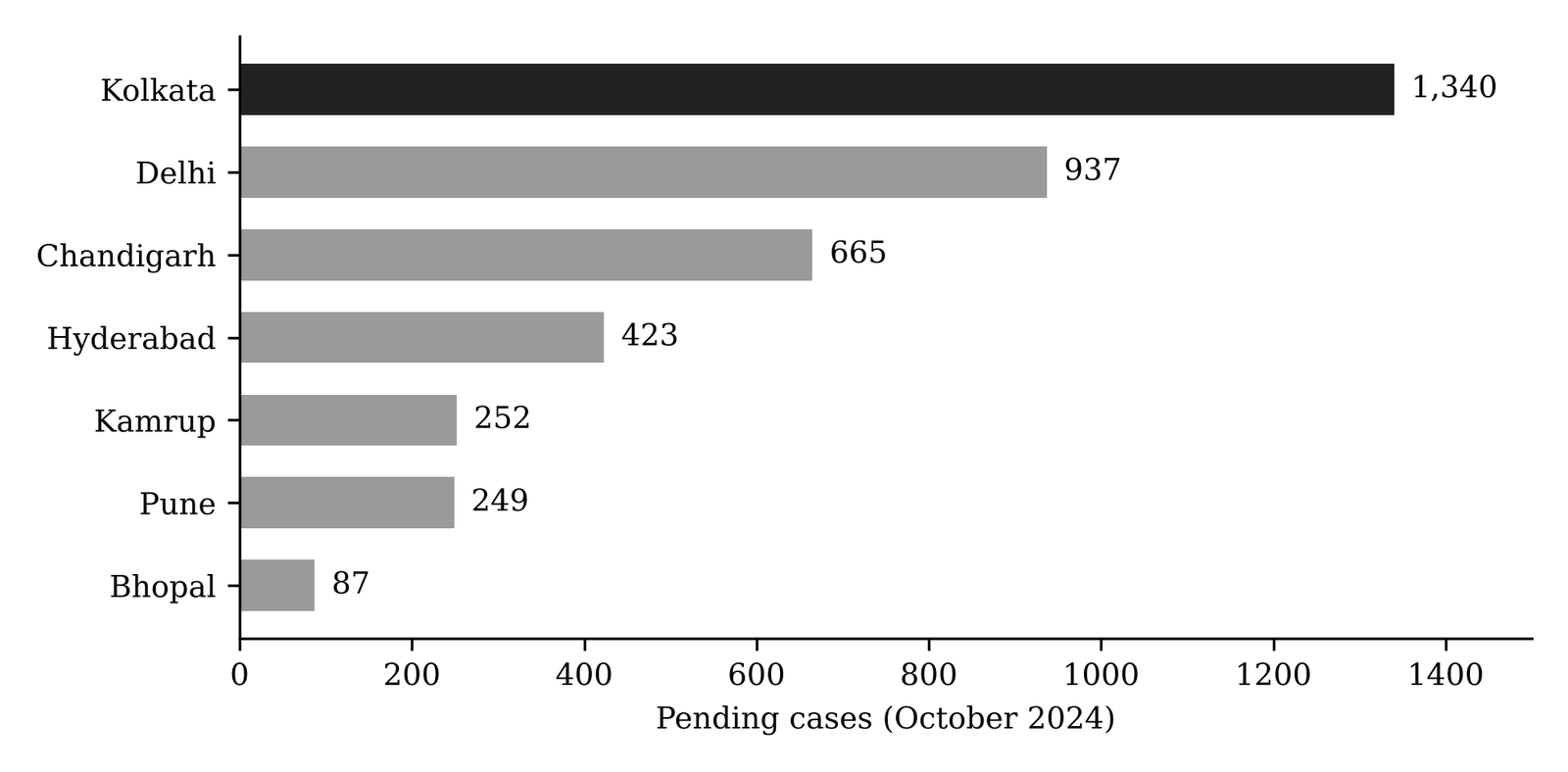
Figure 1: Pending cases in the seven Central Forensic Science Laboratories as of October 2024 (total = 3,953).
Source: compiled by the authors from Ministry of Home Affairs, Lok Sabha Unstarred Question No. 3452 (December 17, 2024), reply to part (d).
The same reply reported 123 vacancies across the seven CFSLs.25 For 2025-26, the Ministry engaged 154 forensic experts on contract in the CFSLs to ensure “zero pendency”.26 The CFSL tier is small, but the Ministry’s own response treats staffing as the means of clearing pendency, and staff shortage is also a reason given for delay in the Delhi and Kerala material discussed below.
C. The State tier: a measurement gap
The Ministry told the Lok Sabha that data on vacancies and pendency in SFSLs are not maintained centrally, and told the Rajya Sabha the same of data on contractual experts in State laboratories.27 It is the SFSLs and RFSLs that will receive the majority of the material collected under Section 176(3), since most ordinary crime is investigated by State police. The backlogs that will decide whether the mandate shortens or lengthens trials are therefore not being monitored at the national level.
D. A State-level illustration: Delhi
The Union Government told the Lok Sabha in 2016 that, as reported by Delhi Police, 9,635 cases were pending at the CFSLs and Forensic Science Laboratories (FSLs) as of October 31, 2016, of which 8,074 were at the Rohini laboratory in Delhi, and that the Delhi Government gave shortage of manpower as the main reason.28 The critical case pendency of FSL Delhi fell from 27,585 in June 2025 to 7,178 by July 31, 2026, as the laboratory recruited 247 scientific staff on contract, procured equipment, raised its examination capacity to over 3,000 cases per month and deputed experts across all six Delhi Police ranges. POCSO pendency fell from 800 in December 2025 to 77 in July 2026.29 The laboratory described this as a 72 percent decrease in critical case pendency; on the reported numbers, the decrease is 20,407 cases, or approximately 74 percent. The two data sets use different measurements and cannot be combined into a single trend. They show a substantial backlog in 2016 and a larger count of critical cases in June 2025, followed by a sharp fall once staff and equipment were brought in.
E. Capacity arriving after demand
The Union Government’s primary response is NFIES, approved on June 19, 2024 with an outlay of ₹2,254.43 crore over five years (2024-25 to 2028-29) for, among other things, nine off-campuses of the National Forensic Sciences University (NFSU) and seven new CFSLs. The outlay for the seven new CFSLs is ₹860.3 crore.30 As of February 2026, five of the nine NFSU off-campuses were functioning from transit campuses, and land had been allotted in four States. The reply does not report any of the seven new CFSLs as functioning.31 Before NFIES, the Union Government had approved the Scheme for Modernization of Forensic Capacities (₹2,080.5 crore, 2022). Under this scheme, it has approved projects totalling ₹233.32 crore for upgrading laboratories in 25 States and Union Territories, and ₹361.06 crore for mobile forensic vans in 30 States and Union Territories.32 An e-Forensics platform connects 117 laboratories.33 At the State level, Bihar added 34 mobile forensic vans in December 2025.34
These rupee allocations exist, but the timing of the investment is extremely important. Section 176(3) came into force on July 1, 2024, and binds each State once it issues its notification. NFIES, by contrast, runs through 2028-29. Laboratories created under the scheme must acquire land, construct buildings, obtain accreditation and employ qualified staff before their output can increase. Mobile forensic vans improve a State’s ability to gather evidence at the scene as Section 176(3) requires, but they will not by themselves increase its capacity to analyse that evidence. In the interim, Section 176(3) will send a larger number of exhibits through the State tier, where neither the backlog nor the number of staff available to process the exhibits is measured nationally.
Laboratory backlogs and trial delay: the judicial response
The published decisions show at least three ways in which courts treat forensic delay. Some courts have found that it can violate the right to a speedy trial. Others have used it as a factor in deciding bail. Others still have held that it may make evidence less reliable. Each of these bears directly on Section 176(3).
A. Speedy trial and the resource defence
The Supreme Court ruled in Hussainara Khatoon that the “reasonable, fair and just” procedure required by Article 21 includes a speedy trial, and that the State cannot avoid this obligation by pleading financial or administrative inability.35 In Abdul Rehman Antulay, the Court extended the principle to every stage of a criminal proceeding (investigation, inquiry, trial, appeal, revision and retrial).36 In Kadra Pehadiya, the Court expressed its disapproval of a system that keeps persons in jail for long periods without trial.37 In K.A. Najeeb, the Court held that statutory restrictions on bail do not oust the power of constitutional courts to grant bail where prolonged pre-trial incarceration violates Part III of the Constitution.38 Forensic delay engages all of these principles, because the State is responsible for it.
B. Forensic delay as a ground of judicial intervention
High Courts are now dealing with laboratory delay as a problem in its own right. In Sanjay Oraon v. State of Kerala, a person accused of murder had been in custody since October 2019. The final report had been filed in March 2020, but charges had not been framed because the Forensic Science Laboratory (FSL) had not sent its report on the material objects. When the Director of the FSL was impleaded, he stated that the delay was caused by the high volume of requisitions in 3,549 POCSO cases and from Fast Track and other courts, together with a shortage of staff. The High Court held that a dearth of staff or infrastructure could not excuse delay in the constitutional duty of speedy justice. It directed the Director to prioritise the analysis and reporting of material objects when requisitioned, directed the Sessions Court to dispose of the case within four months, and refused bail because the petitioner had no roots in the State and might flee.39
In Vinit Yadav v. State of Haryana, the Punjab and Haryana High Court described the delay in preparing and despatching FSL reports as alarming, particularly in prosecutions under the Narcotic Drugs and Psychotropic Substances Act, 1985 (NDPS Act), where the prosecution’s case hinges on the Chemical Examiner’s Report. The Court stated that being a passive observer of these delays would be a failure of its constitutional duty, and constituted a committee to identify the administrative and technical causes of delay and recommend remedies.40 In 2026, the same Court granted bail to an accused in an attempt to murder case. The case property had been sent to the laboratory more than one and a half years after the incident, the trial had reached its final stage, and the property was yet to be examined. The Court also directed the Senior Superintendent of Police, Ludhiana, to take appropriate disciplinary action against the officials at fault.41
The Supreme Court has now taken up the issue on a systemic basis. In Sunny Chauhan v. State of Haryana, while issuing directions for the prompt hearing of bail applications in the High Courts, the Court noted that bail applications in NDPS matters were not being heard because FSL reports were unavailable and that, although most States had by then established forensic laboratories, much improvement was still required. It requested the Chief Justices of the High Courts to take up the matter with their State Governments and other agencies so that FSL reports are submitted within a reasonable time.42
C. Pending reports and default bail
A pending forensic report also raises the question whether a charge sheet filed before its receipt was filed “in time” for the purpose of the statutory limit on investigation. Courts have taken different positions. The Madhya Pradesh High Court has held that where a charge sheet is filed in time, the absence of the FSL report neither vitiates it nor entitles the accused to default bail.43 The Calcutta High Court, in an NDPS prosecution where the identity of the seized substance was confirmed by a later report filed with a supplementary charge sheet, concluded that the initial charge sheet was incomplete for the purpose of default bail.44 The Supreme Court took a broader view in CBI v. Kapil Wadhawan, holding that once a charge sheet is filed in time, the accused is not entitled to default bail merely because investigation continues.45 The issue is especially pertinent where forensic evidence is the foundation of the prosecution’s case. Since Section 176(3) increases the number of samples submitted for testing, litigation on this question can be expected to increase.
D. When delay destroys the evidence
Delay does not merely lengthen the time before trial; it may also render forensic evidence unusable. In Rahul v. State (NCT of Delhi), the samples remained in the police station’s malkhana for about two weeks before being sent for testing. The Supreme Court held that the possibility of tampering could not be ruled out and treated the DNA reports as highly vulnerable.46 In Kattavellai @ Devakar, a three-judge Bench of the Supreme Court set aside a death sentence, finding the DNA evidence unusable because of a large unexplained delay, a chain of custody that could not be established, and a possibility of contamination that could not be ruled out. To create consistency nationwide, the Court issued directions for all cases involving DNA evidence: documentation of the samples at the point of collection; responsibility of the investigating officer for transporting them; and a Chain of Custody Register recording each movement of the evidence, to be appended to the trial court record. The Court also directed each State’s Director General of Police to prepare the required forms and dispatch them to all districts.47
E. Synthesis
The case law is developing along two paths at once. Courts are requiring timely action from States by holding them accountable under Article 21 for laboratory delay. They are also demanding accountability for the integrity of forensic evidence, and will not rely on evidence whose handling cannot be accounted for. Section 176(3) increases the quantity of evidence that must be both processed in time and accurately tracked. A system that generates more exhibits than it can quickly process and account for is likely to fail on both counts: trials will wait for laboratory results, and when those results arrive, their credibility may be questioned.
Critical assessment of implementation gaps
There are six structural areas in the design of the section that may result in delays.
A. An over-inclusive trigger
The seven-year threshold measures the gravity of the offence, not the need for forensic investigation. Murder and rape fall within it, and both are serious enough to justify a scene examination. But the trigger also catches offences that carry up to seven years in prison and do not typically involve physical evidence at a crime scene, such as aggravated cheating under Section 318(4) of the Bharatiya Nyaya Sanhita, 2023.48 When all such offences draw the same mandate, limited resources are spread evenly across cases with very different evidentiary needs. On that footing, expert and laboratory time needed for murder, sexual assault and child abuse cases would be spent on financial or document-based offences.
B. A duty to collect without a duty to examine
The law governs the early phases of the forensic process but gives no guidance on the later stages. No time limit exists within which a laboratory must analyse an item or produce a report. No priority is given to items relating to persons in custody. Nor are laboratories required to submit reports directly to courts. The logical outcome is that collection will increase while backlogs at laboratories continue to grow. As the Kerala FSL’s affidavit in Sanjay Oraon shows, when capacity is restricted, demand in one area (POCSO requisitions) can displace analysis in another (murder).49
C. A measurement deficit
A reform that depends on laboratory output cannot be implemented without measuring that output. There are currently no national statistics on pending cases or vacancies in SFSLs and RFSLs. Neither Parliament nor the courts will therefore know whether the mandate increases the time taken for forensic investigation. The published data from Delhi indicate that measurement is possible; the difficulty is that nothing requires it to be reported.
D. Manpower and contractualisation
Contract staff have been central to recent efforts to reduce pendency: 247 contract scientific staff in Delhi and 154 contract experts in the CFSLs.50 The Forensic Aptitude and Calibre Test (FACT), conducted by the NFSU, identifies candidates whom laboratories can then engage on contract.51 Contracting is a quick fix for shortages of personnel, but it raises concerns about retention, continuing education, and the professional standing of contract experts when their testimony is challenged in cross-examination. A permanent mandate needs a permanent staff structure.
E. Institutional independence
In some States, forensic laboratories are part of the police establishment. The State Forensic Science Laboratory in Bihar, for instance, is attached to the Criminal Investigation Department.52 Where a single agency both collects evidence and controls the body that analyses it, there is a potential conflict of interest if priorities are set by what is convenient for investigators and not by what the judicial process needs or an impartial opinion requires. Section 176(3) adds to these concerns by requiring police and forensic experts to work together at the crime scene.
F. Quality, accreditation and federal unevenness
The Directorate of Forensic Science Services has issued Quality Manuals for accreditation under NABL standards (ISO 17025) and Working Procedure Manuals in nine disciplines of forensic science, but Section 329 BNSS does not make accreditation a condition for using a Government scientific expert’s report as evidence.53 Since police and related forensic services are the responsibility of each State,54 and each State has up to five years to notify Section 176(3), implementation will be uneven. Some accused will be subject to mandatory scene investigation and videography, while others accused of the same offence in another State will not. The proviso’s cross-State arrangement also spreads the workload among laboratories instead of developing new capacity. Lastly, the requirement of videography creates digital evidence that must be archived, hashed and presented at trial with no break in the chain of custody. These requirements add to the strain on systems that, as Kattavellai @ Devakar shows, were already failing in handling physical samples.
Comparative perspectives
The United Kingdom and the United States impose no statutory duty similar to Section 176(3) of the BNSS. Both, however, have faced the problems that the section raises in India: poor quality, lack of independence and backlogs. This indicates that regulating the laboratory end is as crucial as regulating the crime scene end.
A. United Kingdom: statutory regulation of quality
In England and Wales, the regulation of forensic science rested for many years on non-statutory standards. After serious concerns about this framework, particularly in a House of Lords select committee report that described forensic science as being in a state of crisis and criticised poor leadership, inadequate funding and weak regulatory powers,55 Parliament enacted the Forensic Science Regulator Act 2021. The Act established the Regulator as a statutory body, provided for a statutory code of practice for forensic science activities, and gave the Regulator authority to investigate forensic science activities that create a substantial risk to an investigation or to the course of justice, and to serve compliance notices.56 The lesson for India is that if there is a statutory requirement to produce forensic evidence, there should also be a statutory requirement that those producing it follow published standards.
B. United States: independence and funded backlog reduction
The National Research Council’s 2009 report on forensic science in the United States found great variability in the quality of public forensic laboratories, and recommended removing them from the administrative control of law enforcement agencies, to maximise independence from or autonomy within the law enforcement community.57 The federal government also funds backlog reduction through direct grants; the Debbie Smith DNA Backlog Grant Program, created under the Justice for All Act of 2004, ties federal grant funds to the processing of backlogged DNA samples.58 At the trial level, the Supreme Court ruled in Melendez-Diaz v. Massachusetts that forensic analysts’ certificates are testimonial evidence, allowing the defendant to cross-examine the analyst.59 This ruling places additional demands on analysts’ time, which is a reminder that procedural protections and laboratory capacity need to be planned together.
C. Lessons for India
Three lessons follow:
1. Apply regulatory standards to laboratories and crime scenes alike, through binding standards and independent oversight.
2. Separate forensic services administratively from the investigative process, including in budget.
3. Fund backlog reduction on performance metrics (such as the number of cases processed), and not merely by providing facilities.
Section 329 BNSS permits the use of reports by notified Government experts without formal proof, which shows how heavily trials depend on laboratory results. That reliance needs regulatory backing.
Recommendations
The following recommendations would maintain the evidentiary value of Section 176(3) while reducing the time taken to collect and analyse evidence. They are organised by the body best placed to implement each one.
A. Legislative and rule-making measures
Statutory timelines. State rules or an amendment should set maximum times for analysis and reporting for each type of exhibit, with shorter limits where the accused is in custody or the victim is a child.
Graded notification. States should notify Section 176(3) offence group by offence group, beginning with homicide, sexual offences and crimes against children, and should extend it to other offences only when audited data on laboratory capacity show that they can handle the increased volume.
Accreditation as a condition of reliance. All laboratories and experts seeking notification under Section 329 BNSS should be accredited to ISO/IEC 17025 or an equivalent national standard.
National regulator. Legislation should establish a national forensic regulator, modelled on the United Kingdom’s Forensic Science Regulator, to set binding professional standards and review compliance in central and State laboratories.
B. Executive and administrative measures
Publication of pendency data. For each SFSL and RFSL, quarterly figures should be published for receipts, disposals, pendency by time in the system and by discipline, and vacancy rates, and compiled nationally. The e-Forensics platform that connects 117 laboratories can serve as the foundation.
Binding priority guidelines. Guidelines binding on all laboratory personnel should establish the following order of precedence: custody matters; cases of child abuse (POCSO) or sexual assault; and cases approaching a statutory time limit.
Permanent cadre. Contractual employees should be brought into a sanctioned cadre, with paths of advancement and training to retain expert witnesses.
Administrative autonomy. Forensic laboratories should be placed under a directorate within the Home Department that operates independently of the police chain of command, with a separate budget head.
Digital chain of custody. The Chain of Custody Register required by Kattavellai @ Devakar for DNA samples should be extended to all exhibits collected under Section 176(3), including video files, through digital records that are both time-stamped and hashed.
C. Judicial measures
High Court oversight. Building on the request in Sunny Chauhan, High Courts can supervise the FSL process in each State on the administrative side, and can constitute committees as the Punjab and Haryana High Court did in Vinit Yadav.
Reporting dates. A trial court can ask the laboratory for the date by which it expects to submit an outstanding report. Unexplained delay may be treated as a reason to grant bail to a person in custody.
Settling the default bail question. The Supreme Court has the opportunity to rule definitively on whether a charge sheet filed without a central forensic report is complete under Section 187(3) BNSS, which would bring consistency to the rulings of different High Courts.
Conclusion
The concept of Section 176(3) BNSS is correct, but the order in which it is being implemented is not. It was right to put forensic science first in the investigation of serious crime, as forensic science does not rely on the unreliable oral testimony of witnesses. But Section 176(3) makes the collection of physical evidence mandatory without mandating its prompt analysis or creating the capacity to carry it out.
This paper can therefore give only a partial answer to the question it asks. On the information available, the mandate as presently funded is likely to increase rather than decrease the time taken to reach a verdict in serious cases over the next few years. Three findings support this conclusion. The State-tier backlog, where most of the work will fall, is not measured nationally. While backlogs can be reduced quickly with more staff and equipment, the large capital expenditure on capacity under NFIES runs until 2028-29, after laboratories begin receiving the demand created by the mandate. And courts have shown that delay caused by laboratory backlogs will be treated as the responsibility of the State under Article 21, leading to the release of accused persons who would otherwise be held in custody and to acquittals where chains of custody are broken.
The authors do not argue for cutting back Section 176(3), but for finishing it. Finishing Section 176(3) means establishing turn-around standards, releasing pendency data publicly, using graded notification, creating an accreditation process, maintaining institutional autonomy and creating a legally enforceable chain of custody. With these components, evidence can be provided both in time and reliably. Without them, Section 176(3) will most likely result in longer trials and not in more equitable results.
*****
Footnotes
1. The Bharatiya Nagarik Suraksha Sanhita, No. 46 of 2023, India Code (2023), § 176(3).
2. The Code of Criminal Procedure, No. 2 of 1974, India Code (1974), § 157.
3. Comm. on Reforms of Crim. Just. Sys., Report, Vol. I (Ministry of Home Affs., Mar. 2003).
4. Ministry of Home Affairs, Lok Sabha Unstarred Question No. 3452, Infrastructure in Forensic Laboratories, at 2 (Dec. 17, 2024), https://sansad.in/getFile/lsapps/loksabhaquestions/annex/183/AU3452_Dh2V5W.pdf?source=lsapps.
5. Press Release, Prime Minister’s Office, Cabinet Approves Central Sector Scheme “National Forensic Infrastructure Enhancement Scheme” (N.F.I.E.S.) (June 19, 2024), https://www.pmindia.gov.in/en/news_updates/cabinet-approves-central-sector-scheme-national-forensic-infrastructure-enhancement-scheme-n-f-l-e-s/.
6. Hussainara Khatoon v. Home Sec’y, State of Bihar, (1980) 1 SCC 81; Abdul Rehman Antulay v. R.S. Nayak, (1992) 1 SCC 225.
7. Hussainara Khatoon v. Home Sec’y, State of Bihar, (1980) 1 SCC 98.
8. Kattavellai @ Devakar v. State of Tamil Nadu, 2025 INSC 845 (India July 15, 2025).
9. Lok Sabha Unstarred Question No. 3452, supra note 4; Ministry of Home Affairs, Rajya Sabha Unstarred Question No. 1331, National Forensic Infrastructure Enhancement Scheme (Feb. 11, 2026), https://sansad.in/getFile/annex/270/AU1331_5dgBIW.pdf?source=pqars.
10. Lok Sabha Unstarred Question No. 3452, supra note 4, at 3; Rajya Sabha Unstarred Question No. 1331, supra note 9, at 2.
11. The Bharatiya Nagarik Suraksha Sanhita, supra note 1, § 176(3).
12. Ministry of Home Affairs, Notification S.O. 848(E), Gazette of India, Extraordinary, pt. II, sec. 3(ii) (Feb. 23, 2024).
13. Home Dep’t, Gov’t of Puducherry, G.O. Ms. No. 75, Notification u/s 176(3) of Bharatiya Nagarik Suraksha Sanhita, 2023 (Oct. 15, 2024), Gazette of Puducherry, Extr., pt. I, No. 139 (Oct. 21, 2024).
14. The Bharatiya Nagarik Suraksha Sanhita, supra note 1, § 176(3) proviso.
15. Id. §§ 105, 329.
16. Id. § 349.
17. Kattavellai, 2025 INSC 845; The Bharatiya Sakshya Adhiniyam, No. 47 of 2023, India Code (2023), § 39.
18. The Bharatiya Nagarik Suraksha Sanhita, supra note 1, § 187(3).
19. H.N. Rishbud v. State of Delhi, AIR 1955 SC 196.
20. C. Muniappan v. State of Tamil Nadu, (2010) 9 SCC 567.
21. Lok Sabha Unstarred Question No. 3452, supra note 4, at 2–3.
22. Id. annex.
23. Lakshita Kashyap, Bihar Police to Set Up 13 Forensic Labs to Speed Up Investigations and Reduce DNA Testing Delays, Patna Press (Apr. 7, 2026), https://patnapress.com/bihar-police-13-forensic-labs-speed-up-investigation-dna-testing-delays/.
24. Lok Sabha Unstarred Question No. 3452, supra note 4, at 3.
25. Id.
26. Rajya Sabha Unstarred Question No. 1331, supra note 9, at 2.
27. Lok Sabha Unstarred Question No. 3452, supra note 4, at 3; Rajya Sabha Unstarred Question No. 1331, supra note 9, at 2.
28. Ministry of Home Affairs, Lok Sabha Unstarred Question No. 2207, Delay in Forensic Labs Test, at 1–2 (Nov. 29, 2016), https://sansad.in/getFile/lsapps/loksabhaquestions/annex/10/AU2207.pdf?source=lsapps; see also Business Standard (Nov. 29, 2016), https://www.business-standard.com/article/pti-stories/9635-cases-pending-with-cfsl-fsl-116112901212_1.html.
29. Harsh Yadav, Delhi Forensic Lab Cuts Critical Case Pendency by 72% in Year, Tribune (Aug. 9, 2026), https://www.tribuneindia.com/news/delhi/delhi-forensic-lab-cuts-critical-case-pendency-by-72-in-year/.
30. Press Release, supra note 5; Lok Sabha Unstarred Question No. 3452, supra note 4, at 1–2.
31. Rajya Sabha Unstarred Question No. 1331, supra note 9, at 1–2.
32. Lok Sabha Unstarred Question No. 3452, supra note 4, at 5; Rajya Sabha Unstarred Question No. 1331, supra note 9, at 3.
33. Lok Sabha Unstarred Question No. 3452, supra note 4, at 4.
34. Bihar CM Flags Off 34 Mobile Forensic Vans to Boost Evidence Collection and Crime Investigation, Patna Press (Dec. 18, 2025), https://patnapress.com/bihar-cm-flags-off-34-mobile-forensic-vans-crime-investigation/.
35. Hussainara Khatoon, (1980) 1 SCC 81; Hussainara Khatoon, (1980) 1 SCC 98; India Const. art. 21.
36. Antulay, (1992) 1 SCC 225.
37. Kadra Pehadiya v. State of Bihar, (1981) 3 SCC 671.
38. Union of India v. K.A. Najeeb, (2021) 3 SCC 713.
39. Sanjay Oraon v. State of Kerala, Bail Appl. No. 11291 of 2023, 2024 LiveLaw (Ker) 95; see Tellmy Jolly, FSL Can’t Delay Forensic Reports Citing Dearth of Staff or Lack of Infrastructure, High Time to Ensure Emphasis Is Maintained on Right to Speedy Trial: Kerala HC, LiveLaw (Feb. 6, 2024), https://www.livelaw.in/high-court/kerala-high-court/fsl-cant-postpone-medical-reports-due-to-lack-of-staff-infrastructure-high-time-to-ensure-emphasis-is-maintained-on-right-to-speedy-trial-kerala-hc-248682.
40. Vinit Yadav v. State of Haryana, CRM-M-41613-2023 (P&H High Ct. Feb. 29, 2024), 2024 LiveLaw (PH) 69; see also Aiman J. Chishti, “Alarming Delays in Reports from Forensic Science Labs”: High Court Forms Panel to Look into Functioning of FSL’s in Punjab & Haryana, LiveLaw (Mar. 4, 2024), https://www.livelaw.in/high-court/punjab-and-haryana-high-court/punjab-haryana-high-court-panel-look-into-functioning-fsl-in-punjab-haryana-alarming-delay-251190.
41. Surinder Singh @ Shinda v. State of Punjab, CRM-M-19758-2026 (P&H High Ct. July 21, 2026); see also Saurabh Malik, One-and-a-Half Years to Reach the Lab: HC Orders Action over FSL Delay in Attempt-to-Murder Case, Tribune (July 24, 2026), https://www.tribuneindia.com/news/news-legal/one-and-a-half-years-to-reach-the-lab-hc-orders-action-over-fsl-delay-in-attempt-to-murder-case/.
42. Sunny Chauhan v. State of Haryana, Crim. Appeal arising out of SLP (Crl.) No. 1613 of 2026 (India May 11, 2026) (order); see also Satyajeet Barik, Timely Disposal Essential to Protect Undertrial Prisoners and Personal Liberty: SC Directs High Courts to Speed Up Bail Hearings, LawChakra (May 11, 2026), https://lawchakra.in/supreme-court/disposal-undertrial-directs-speed-bail/.
43. Udaybhan Dahiya v. State of Madhya Pradesh, Crim. Rev. No. 900 of 2024 (M.P. High Ct., Jabalpur Bench, Jan. 27, 2025), https://mphc.gov.in/upload/jabalpur/MPHCJB/2024/CRR/900/CRR_900_2024_FinalOrder_27-01-2025.pdf.
44. Rajiv Mondal @ Rajib v. State of West Bengal, CRM (NDPS) 1509 of 2024 (Cal. High Ct. Mar. 20, 2025); see also Calcutta High Court Condemns Delay in Default Bail Applications Until Chargesheet Submission, CourtBook (Mar. 25, 2025), https://courtbook.in/posts/calcutta-high-court-condemns-delay-in-default-bail-applications-until-chargesheet-submission.
45. Cent. Bureau of Investigation v. Kapil Wadhawan, (2024) 3 SCC 734.
46. Rahul v. State (NCT of Delhi), (2023) 1 SCC 83.
47. Kattavellai, 2025 INSC 845.
48. The Bharatiya Nyaya Sanhita, No. 45 of 2023, India Code (2023), § 318(4).
49. Sanjay Oraon, 2024 LiveLaw (Ker) 95.
50. Yadav, supra note 29; Rajya Sabha Unstarred Question No. 1331, supra note 9, at 2.
51. Rajya Sabha Unstarred Question No. 1331, supra note 9, at 2.
52. Kashyap, supra note 23.
53. Lok Sabha Unstarred Question No. 3452, supra note 4, at 5; The Bharatiya Nagarik Suraksha Sanhita, supra note 1, § 329.
54. India Const. sched. VII, list II, entries 1–2; Rajya Sabha Unstarred Question No. 1331, supra note 9, at 3.
55. Select Committee on Science and Technology, Forensic Science and the Criminal Justice System: A Blueprint for Change, 2017-19, HL 333 (UK).
56. Forensic Science Regulator Act 2021, c. 14 (UK).
57. Nat’l Rsch. Council, Strengthening Forensic Science in the United States: A Path Forward (2009).
58. Justice for All Act of 2004, Pub. L. No. 108-405, tit. II, 118 Stat. 2260.
59. Melendez-Diaz v. Massachusetts, 557 U.S. 305 (2009).