
Introduction and factual background
12 Angry Men is an American courtroom drama released in 1957 and directed by Sidney Lumet, then making his debut as a film director.1 The film received three Academy Award nominations, for Best Picture, Best Director and Best Screenplay.
Almost the entire film plays in a single jury room in New York, the jurors identified only by number. The accused is an eighteen-year-old boy from a poor neighbourhood charged with stabbing his father to death. A guilty verdict carries a mandatory death sentence, and the jury must be unanimous.
The following pieces of evidence are material to the case. First, the boy bought a distinctive switchblade on the night of the murder, and the same type of knife was found in the victim’s chest. Second, a neighbour testified that he heard a fight upstairs, then the boy shout “I’m going to kill you,” then a body fall; he says he ran to his door and saw the boy flee down the stairs. Third, a woman testified that, lying in bed trying to sleep, she saw the killing through the windows of a passing elevated train. Fourth, the boy had been beaten by his father, had a record of juvenile offences, and had quarrelled with his father that evening. Lastly, the boy’s alibi was that he was at the cinema, yet when questioned he could not name the films or the actors.
After the judge’s instructions, the jurors retire. An initial open vote produces eleven guilty votes and one not guilty, from Juror 8. He says he is not certain the boy is innocent, but that a life is at stake and the case deserves discussion. The group then re-examines the reliability of the prosecution’s evidence under intense persuasion from Juror 8. Finally, the jury’s votes flip to a unanimous not guilty through a shift from emotional, reactive behaviour to analytical reasoning. The film never reveals whether the boy is actually guilty; the jury’s task is not to discover the truth but to decide whether the prosecution has proved its case beyond reasonable doubt.
Study purpose and aims
12 Angry Men is chosen because it is commonly used in legal education to teach the evidentiary burden of proof and the meaning of reasonable doubt, and because its elements repay rereading through different lenses.
A behavioural economics analysis of the film offers a fresh psychological and economic perspective on twelve supposedly independent thinkers, outside the confines of law. The film has become a standard teaching text in law, psychology and negotiation; it explores the turbulence and nuances of human judgement, prejudice and collective decision-making, which makes it a fitting subject for this study.
This paper examines the following research questions and their corresponding hypotheses:
• Research Question 1 (RQ1): How do cognitive biases and motivated reasoning affect the jurors’ interpretation of evidence, and what conditions enable them to revise their beliefs rationally?
• Hypothesis 1 (H1): Jurors read the same evidence differently because of their motives, biases, social settings and heuristics, and revise their reading when disconfirming evidence is concrete, verifiable and cheap to admit.
• Research Question 2 (RQ2): In the jury context, does collective deliberation improve the quality of evidence-based decision-making, or does it merely sway the decision towards the majority?
• Hypothesis 2 (H2): If deliberation elicits new, testable information, it improves decisions; if it produces agreement by conformity or impatience, it merely joins the majority without raising quality.
The Bayesian problem
The entire criminal justice system may be seen as an exercise in loss aversion.2 Every criminal trial rests on two fundamental premises: the accused is innocent until proven guilty, and guilt must be shown beyond reasonable doubt. The rationale is that the law would rather set a guilty person free than imprison an innocent one, because the psychological pain of incarcerating the innocent outweighs the satisfaction of convicting the guilty.3 The threshold the prosecution must meet is therefore extraordinarily high.
It may be argued that the film is one long Bayesian updating problem. Twelve jurors with different priors process the same evidence, reach diverging conclusions at first, and converge dramatically at the end.4 Bayesian reasoning can be stated as follows:
Posterior odds = Prior odds × Likelihood ratio
Bayes’ rule states how a rational mind should change its belief when new information is presented. A juror begins with a ‘prior’, the probability that the boy is guilty before the discussion begins. Each piece of evidence then multiplies the prior odds by a likelihood ratio, which measures how much more probable that evidence is if the boy is guilty than if he is innocent.5 The result is the posterior. Three things can go wrong: a distorted prior, a misjudged likelihood, or too little updating.
A reliable witness yields a likelihood ratio well above 1, while the testimony of a mistaken or prejudiced witness carries a ratio close to 1 and should barely move the prior.
Table 1 shows what the group learned and which way each item pushed the probability of guilt.6
| Evidence | Prosecution’s reading | What deliberation showed | Effect on belief in guilt |
|---|---|---|---|
| Switchblade | Rare, so it belonged to the boy | An identical knife was bought nearby | Falls: the knife no longer points to him specifically |
| Old neighbour | Heard the threat and the fall, saw the boy flee | Walks with a limp, so the timing is doubtful, and he may want attention | Falls: both ability and motive are in question |
| Woman across the street | Saw the stabbing through the train windows | Marks of glasses, a night-time bed, no glasses on | Falls: perception is doubtful |
| Stab wound | A downward stab by a shorter boy | A trained knife user strikes upward | Falls: the method does not fit |
| Alibi | He cannot name the films he saw | Juror 4 himself forgets recent details under pressure | Falls: shows a similar forgetfulness under pressure |
Table 1: The evidence, what deliberation showed, and its effect on the belief in guilt
The opening vote was itself a Bayesian mistake. Another person’s vote is legitimate evidence, but every vote rested on the same testimony, so counting eleven hands as eleven confirmations double-counts a single signal.7 If the evidence items are treated as independent, the reduction each one causes compounds; this is an assumption rather than a given, because the two witnesses’ errors may be correlated, as the limitations below explain. No single weakness proves innocence, but together the five are capable of pushing the posterior odds below the law’s threshold, and the boy’s guilt is therefore not proved beyond reasonable doubt.8
Jurors as irrational suspects
In the jury context, a rational and reasoned vote may be expressed as a functional concept of behavioural economics:9
Reasoned vote (X) = Independent judgement (A) – Biases, heuristics and irrelevant considerations (B) – Social pressure (C)
This section treats each juror as a Bayesian updater and as a suspect in the crime of irrational decision-making, each with a characteristic bias or preference. The film does not supply the jurors’ psychology in clinical detail; what follows are interpretations offered as analytical lenses, not diagnoses. Each juror is described through the ARCB/F framework, where:
• A = the initial assumption held by the juror, which caused his initial vote;
• R = his reasoning, in terms of behavioural economics concepts;
• C = the change, or trigger point, that led him to change his decision; and
• B/F = the final finding on the research questions, and whether the change led to a Bayesian update for the juror.
A. Juror 1, the foreman: status quo bias and satisficing
A: Primarily concerned with procedure, order and being seen as a fair chair. An orderly process takes subtle precedence over the accuracy of the verdict.
R: He demonstrates status quo bias, a preference for the current state because change feels like a loss, and satisficing, choosing the first acceptable option instead of the best one.10 He wants a workable process, not a perfect decision. His main contribution is to structure the debate, but his sensitivity to criticism and his desire to keep order also make him reluctant to challenge the majority.
A satisficer looks for an acceptable outcome, not the best one, and the foreman’s acceptable outcome is an orderly room. That goal is compatible with any verdict. It also favours the default outcome, and the default at the start is 11 to 1 for guilty.11 His responsibility to keep proceedings orderly creates a tension between maintaining the existing process and allowing it to be disrupted by dissent.
C: He is not a primary contributor to the reversal; he changes his vote only after others have done the work of reopening the evidence and running tests. He then exhibits herding, imitating the group’s behaviour.
B/F: For RQ1, his bias shapes procedure more than interpretation; he revises his decision only when staying the course costs more than moving. For RQ2, he shows that deliberation can improve a decision, but only when someone other than the chair supplies the effort; he is affected by the majority decision.
B. Juror 2, the fickle clerk: social proof and conformity
A: The boy is guilty, though he cannot say why.
R: A clear case of herding based on social proof and conformity. Social proof means treating other people’s behaviour as evidence of what is true. In the terms of conformity research, Juror 2 is subject to both informational and normative influence. He has no private story to anchor his vote; he treats eleven hands as data and avoids the discomfort of standing out, so the majority vote does the work the evidence should have done.12
He votes guilty because the majority does, and he moves only when the room starts moving. In an information-cascade model, he is a person who has a weak private signal and gives it little weight against the observed behaviour of others. His small contributions, such as his question about the angle of the stab wound, show that he held private information that the social setting suppressed.13
C: Broken unanimity breaks the cascade; once the dissent is open, his borrowed confidence runs out.
B/F: For RQ1, his reading of the evidence is filtered through the crowd, and he revises when the crowd stops being unanimous. For RQ2, he did not contribute to the quality of the decision; his vote is directly affected by the group vote.
C. Juror 3, the bitter father: heuristics and bias
A: The boy is guilty, a violent and ungrateful youth of the type that has failed him.
R: A case of motivated reasoning, the tendency to reach the conclusion one wants and then collect reasons that make the conclusion look earned.14 The juror’s estrangement from his own son makes him see the defendant as a symbol of ungrateful youth. Two heuristics feed the conclusion, the representativeness and affect heuristics: because Juror 3 places the accused in the same peer group as his son, he assumes him to be similarly notorious and apathetic, and his own emotional distance colours his vote for guilt.15 Confirmation bias then completes the swing, as Juror 3 accepts evidence that supports guilt and dismisses contrary evidence. Having argued loudly and publicly, he faces a high psychological cost of reversal, linked to the sunk-cost fallacy: he has committed to one line of reasoning and is unwilling to abandon it.16
C: His arguments collapse one by one, and his son’s photograph makes him confront his belief.
B/F: An extreme case of bias controlling interpretation, with revision occurring only after the emotional source is exposed. Deliberation did not improve his reasoning; it only subtracted irrelevant considerations.
D. Juror 4, the stockbroker: Bayesian updater
A: He establishes guilt through the accounts of the two eyewitnesses, and insists on facts alone because he dislikes emotional appeal.
R: He behaves like a Bayesian updater, revising probabilities in proportion to how strongly new evidence points one way.17 He abandons his belief only when the key testimony is undermined, and he says explicitly that the evidence is what matters. Yet he shows some overconfidence early on in his reading of the witnesses, and a mild anchoring on the first strong piece of evidence, the eyewitness identification. His case shows that rationality is not the absence of bias but the willingness to revise when disconfirming evidence is salient.
C: The credibility of the eyewitness account loses weight, and he revises his verdict.
B/F: The most nearly ideal case for both research questions. For RQ1, rational revision occurs when disconfirming evidence is most salient; having an initial anchor does not prevent one from being rational. For RQ2, he was not swayed by the group’s choices, yet deliberation improved accuracy because it gave him a fact he could verify for himself.
E. Juror 5, the slum-dweller: social costs
A: Votes guilty at first, while withholding information.
R: He identifies strongly with the accused boy’s neighbourhood; his social identity is a source both of information and of identity-driven reticence. Identity economics treats a person’s sense of self as part of his utility: acting against the expectations of one’s social category carries a cost, as does conforming to a stereotype.18
Juror 5 faces a double bind: bear the social cost of defending the boy, or keep silent and betray his identity. He fears being seen as biased in favour of the defendant, so he withholds his private knowledge of the correct way to hold a switchblade. This is self-censorship due to anticipated social cost: the information was in the room from the start, but the cost of revealing it was too high until Juror 8 created a safer environment.19
C: When Juror 8 reduces the social cost of doubt and makes it respectable, he reveals that piece of information.
B/F: For RQ1, his interpretation is initially influenced by anticipated social costs, identity negotiation and emotion; once these considerations are removed, his decision becomes more rational. For RQ2, deliberation improved the decision because it drew out private information that fear had suppressed.
F. Juror 6, the housepainter: authority bias
A: The court and the majority are right, and he must be respectful towards them.
R: Authority bias treats status or institutional weight as a reason to believe, and norm-following means acting as one’s group acts. He defers to age, to process and to the weight of eleven votes, displaying deference to authority and a norm-following disposition. He holds his guilty vote partly because the majority and the legal process seem authoritative. He moves when the evidence is shown, and when Juror 8 and others appeal to the dignity of the process.20
C: Concrete demonstrations, such as the timing test of the neighbour’s walk, and appeals to the dignity of the process change his decision.
B/F: Deliberation substitutes checkable facts for deference to authority and its bias; group discussion helped by replacing authority cues with evidence that could be tested. The authority of the jury discussion itself nudges him towards the majority decision.
G. Juror 7, the salesman: present bias and effort aversion
A: No particular view of the case; he wants to leave for the ball game, and any quick decision is acceptable.
R: He exhibits present bias: the immediate benefit of ending the deliberation is weighed far above the long-term and irreversible cost of a wrongful execution. He also shows effort aversion and bandwagon behaviour: he flips to not guilty partly to hurry things up, so his switch is not grounded in the evidence. His is a time-preference answer based on hyperbolic discounting.21
C: The interpretation of the evidence is not a contributing factor; he changes his verdict to hasten the proceedings.
B/F: Time preference shapes his reading of the case, and his revision too is not rational. He shows that group decisions can produce agreement without better judgement, adding to the group’s confidence but nothing to its quality. To save time, he simply adopts the majority decision.
H. Juror 8, the principal architect: reverse question heuristic
A: He is unsure whether the boy is guilty, believes that a death sentence deserves careful discussion, and leads the reversal.
R: Juror 8 is a reflective, System 2 thinker who is willing to bear the cost of dissent. He contributes to a public good, the quality of the group’s decision, and pays a private cost, social disapproval for his dissent.22 He does not claim the boy is innocent. He reframes the question as whether there is reasonable doubt, which changes the default from “convict unless proven otherwise” to “acquit unless proven guilty.” In doing so, instead of substituting an easier question, he chooses a harder one, because a life is at stake.23
C: He sets the terms himself and holds to his initial vote of not guilty.
B/F: He practises debiasing by considering the opposite, which makes his revisions rational. Deliberation improves quality because one dissenter forces a re-interpretation of the same chain of evidence through a different lens, and makes it testable.
I. Juror 9, the elderly man: the first-follower effect
A: The first to change his vote, not because he is convinced of the boy’s innocence but because he believes the dissenter deserves a hearing.
R: The first-follower effect holds that the second person to break from a crowd matters more than the first, because he turns one eccentric into a movement and lowers the cost of dissent for others.24 He judges source credibility, noticing that the old witness’s testimony may be driven by a desire for recognition. Fairness and reciprocity motivate his move.25 His move is the first break in the apparent unanimity and so triggers the reversal of the cascade.
C: Juror 8’s quiet persistence, and his own reading of the old man’s motives.
B/F: He did not show a clear initial personal bias; rather, he corrected for the witness’s bias by inferring incentives. His change lowers the cost of dissent for others, releases independent information and begins to build confidence in a re-reading of the evidence, showing that even a single hesitant ally can have a disproportionate effect on others.26
J. Juror 10, the bigot: taste-based discrimination
A: Guilty, because people from the boy’s neighbourhood are born liars and violent by nature.
R: He offers a direct display of taste-based discrimination: he assigns lower credibility to the defendant simply because of the group the boy belongs to. He also relies on the representativeness heuristic, judging the individual by a stereotype of his group.27 He is openly prejudiced against the boy because the boy represents a neighbourhood he dislikes.
C: Argument does not change his mind. When the others ostracise him by turning their backs, penalising his discriminatory preferences, his hold on the guilty vote loosens.
B/F: Bias controlled his interpretation outright, and even the revision that follows rests on social penalty, not evidence. Group deliberation could not correct this internal bias entirely, but it did set a norm that penalised voicing such prejudice.
K. Juror 11, the watchmaker: the fairness police
A: The boy is probably guilty, but only a proper process can confirm it.
R: A European immigrant, he is moved by the fact that the justice system gave him, as a newcomer, a fair hearing, and he takes his duty seriously. Research on procedural fairness finds that people care about whether the process was fair almost as much as about the result. Similarly, research on intrinsic motivation shows that a sense of duty can drive behaviour that money or convenience would not.28 Juror 11 is guided by both: he does not need to know the verdict to insist that the process be done properly, and his commitment sets a standard that makes Juror 7’s casual vote look unacceptable. He raises the cost of careless voting for the others.
C: He doubts that a defendant clear-headed enough to wipe the knife clean of fingerprints would then return to the scene of the crime, and he changes his vote.
B/F: His insistence on due procedure may not directly affect the accuracy of the decision, but it respects the intrinsic dignitarian values of the justice system and thereby increases confidence in the decision.
L. Juror 12, the advertising executive: information cascade
A: Whichever verdict the current tally favours.
R: He demonstrates mindless herding, imitating others’ decisions. An information cascade occurs when people choose in sequence, observe earlier choices and rationally set aside their private signal in favour of the crowd.29 Cascades can be large and fragile, because one new public signal can break them. The bandwagon effect adds the pull of the winning side. His votes track the count, not the evidence, so the 11–1 start did not reflect eleven independent judgements.
C: Once the dissent of Jurors 8 and 9 gave visible counter-signals, the cascade came apart, and he changed his decision.
B/F: For RQ1, his reading of the evidence has little independent content, so his revisions are not evidence-based. For RQ2, deliberation raised agreement without raising quality, and he shows why a unanimous result can overstate how much the group knows.
Experiment
This section puts RQ2 to a limited social experiment, to test whether knowing that a majority believes a defendant is guilty increases the likelihood that a person will vote guilty, even when the evidence is identical.
Methodology: an online questionnaire (a Google Form) was given to two groups of 12 participants each. The experiment was conducted with the consent of all participants, who were aware that their responses would be recorded for academic analysis.
Group A, independent judgement: participants receive the fictional case and assess the evidence without being told what other participants think.
The fictional case file: a man is accused of stealing a laptop from a passenger on a late-night train. There are three pieces of evidence:
• A witness says they saw a man matching the defendant’s description leave the compartment before the theft was discovered.
• A CCTV recording shows a person wearing similar clothing near the compartment.
• The defendant was found carrying a laptop charger compatible with the stolen laptop, but the charger is a common model sold widely.
The defendant denies stealing the laptop. No fingerprints, clear facial identification or direct recording of the theft are available. The task is to choose between guilty, not guilty, and not enough evidence.
Group B, majority influence: participants receive exactly the same case, but are told that an initial poll found that 10 out of 12 people believed the defendant was guilty.
A. Results
| Measure | Group A | Group B |
|---|---|---|
| Guilty votes | 5/12 (42%) | 9/12 (75%) |
| Not guilty votes | 4/12 (33%) | 2/12 (17%) |
| Undecided | 3/12 (25%) | 1/12 (8%) |
Table 2: Votes in Group A (independent judgement) and Group B (majority reported)
Critical findings
A. The film
i. RQ1: causes of change in the jurors’ positions
Figure 1 sorts what moved each juror’s position into evidence-grounded and other routes.
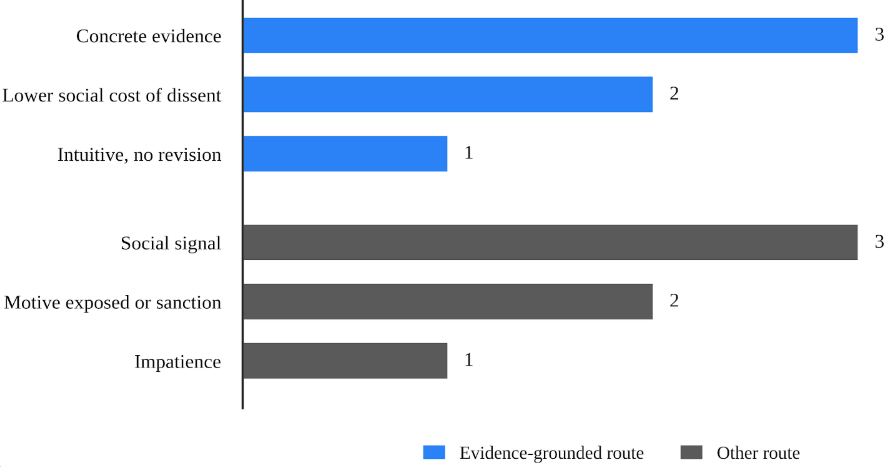
Figure 1: What moved each juror’s position in the film, by route (number of jurors)
• The initial 11–1 vote seemed strong evidence of guilt, but it carried relatively little information, because the votes were public, sequential and correlated.
• Rationality alone may not protect against bias. Juror 4 was the least pressured and the most logical, and yet he remained attached to the anchor of the prosecution’s theory.
• Overall, 42% of the jurors directly or subconsciously adopted the majority decision merely because they were aware of it.
• Dissent succeeded partly by design. Juror 8 was eloquent, but he was not himself overwhelmingly certain. He asked for a secret ballot, found an ally, split a large claim into smaller tests, and accepted a social cost, reducing the price for others.
• The secret ballot worked because, without knowing the others’ votes, the jurors regained their independence, and the behavioural limitations of herding, cascades and conformity could be eliminated.
• The conditions for rational revision are consistent across the group. The disconfirming evidence had to be concrete and checkable, such as a stopwatch, a second knife or a pair of glasses. The social cost of admitting doubt had to be low, through a secret ballot or an ally. And the motive behind the belief had to be removed or exposed. Where those conditions were missing, as with Jurors 7 and 12, votes changed without beliefs changing. Hypothesis 1 is overwhelmingly supported, with the qualification that for some jurors revision was social or impatient.
ii. RQ2: how each juror contributed to the deliberation
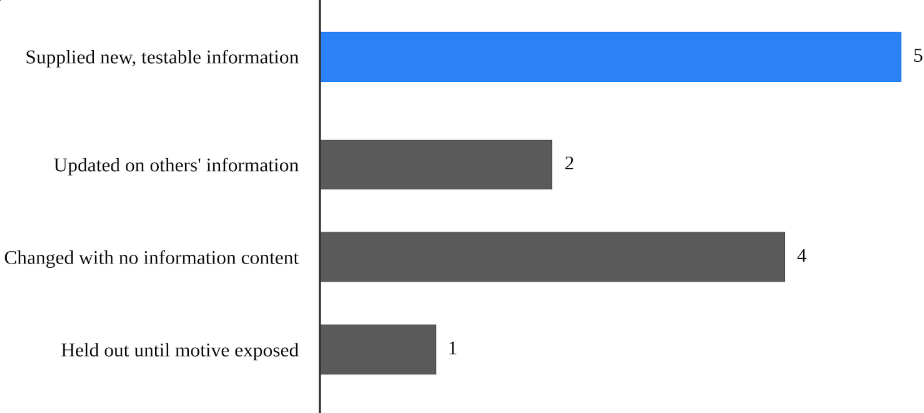
Figure 2: How each juror contributed to the deliberation (number of jurors)
The evidence for improvement is strong (Figure 2). Deliberation brought out facts no juror held alone: the identical knife, the timing of the old man’s walk, the glasses, and Juror 5’s knowledge of how a knife is used. Yet some jurors were entirely swayed by the majority’s judgement.
B. The experiment
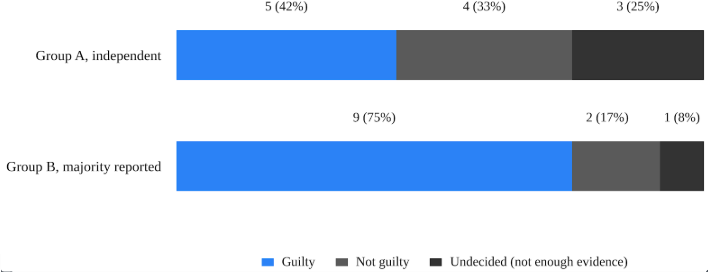
Figure 3: Votes in Group A (independent) and Group B (majority reported)
• The results show how social information can influence individual decision-making even when the underlying evidence remains identical: guilty votes rose from 5 of 12 (42%) in Group A to 9 of 12 (75%) in Group B (Table 2 and Figure 3). Individuals use others’ judgement as informational cues when forming their own opinion.
• The pattern also resembles an information cascade: participants in Group B may have interpreted the supposed majority opinion as an indication that others had sufficient reasons to believe the defendant guilty. They may therefore have relied less on their own assessment of the evidence and more on the reported poll.
• The fall in undecided responses from 25% in Group A to about 8% in Group B may be connected to ambiguity aversion, whereby individuals prefer a seemingly definite position to an uncertain one. It may indicate that exposure to a majority opinion reduces people’s willingness to remain uncertain and encourages premature commitment to a particular conclusion.
• Ultimately, the results support the central concern raised in 12 Angry Men: collective agreement may influence the perception of evidence without necessarily improving its evaluation. The danger is that individuals may mistake the confidence of a majority for the correctness of its conclusion.
Interdisciplinary engagement
Within psychology, social psychology supplies some of the empirical groundwork for this paper. Asch’s conformity studies and the groupthink model describe the forces visible in the film: the pull of unanimity, the power of one ally, and the habit of a cohesive group of no longer testing its own conclusion.30 Economics and psychology differ on awareness: in economics, people are assumed to weigh costs and benefits rationally, while in psychology people may simply feel certain without any weighing.31 This matters for RQ1, because a juror who does not know he is conforming will not correct it. Cognitive psychology is also relevant, because the prosecution’s case rests on two memories. Research shows that memory is reconstructive and can be altered by suggestion;32 distance, darkness, stress and spectacles all reduce reliability, as the film shows through the woman and the elderly neighbour. This lowers the likelihood ratio of such evidence in Bayesian reasoning.33
Law supplies the entire frame for the Bayesian odds model through the reasonable doubt threshold. Blackstone’s maxim, that it is better that ten guilty persons escape than that one innocent suffer, is, as explained earlier, rooted in loss aversion.34 A behavioural study has implications for jury unanimity and independence, pointing towards fair procedure and the secret ballot. Law assumes that unanimity protects the accused; behavioural economics adds nuance by questioning the pattern and motive of the jury’s reasoning.35
Sociology would treat the jury room as a small society with status, class and identity. Social identity theory would explain why one juror sorts people into ‘us’ and ‘them’ and immediately presumes guilt on the basis of class, and why another fears being placed on the wrong side.36 The room is also a gendered one: all twelve jurors are men, and several act out roles of honour, anger and fatherhood in a public institution.
Limitations and implications
A. Limitations
1. Fiction: The film is fiction; the jurors are types, not representative samples. All twelve are men of the same era, and the film has no counterpart in real juries or modern legal adjudication.
2. Unrevealed guilt: The film does not reveal whether the accused was actually guilty. This paper measures process, not accuracy, and cannot say whether the collective deliberation led to an accurate outcome.
3. Post-hoc interpretation: Many behavioural concepts overlap, and a single action may be fitted to several concepts with equal ease. The concepts were chosen after watching the film, so they may fit by construction, and a reader might assign different motives to the same behaviour. The film does not supply the jurors’ psychology in much detail; the ARCB/F readings are interpretations, and other viewers may interpret differently.
4. Bayesian framing: No priors, likelihood ratios or posteriors can be measured from the film, so Bayes’ rule works only as a metaphor. The independence of the evidence items is an assumption; both witnesses were questioned by the police, so their errors may be correlated, and the compounding of doubt may be overstated.
5. Asymmetry in persuasive influence: Juror 8 is the principal driver of deliberation and receives disproportionate attention. The paper does not consider whether similar results could be obtained by a less eloquent or convincing speaker.
6. Small experimental sample: The experiment had only 24 participants. This small size narrows the statistical reliability of the findings and prevents broader conclusions about majority influence and the reasons for the difference in votes between the two groups.
7. Restricted setting and variables: Participants gave their opinion on a fictional case without actual consequences or personal stakes, which may have affected their willingness to deliberate independently. The experiment also did not test other variables, such as the majority’s authority, social pressure and group identity, so the observed difference cannot be attributed exclusively to conformity.
8. Causation: While guilty votes increased from 42% in Group A to 75% in Group B, the absence of fuller experimental controls makes it difficult to conclude whether majority influence alone caused the difference, or whether individual characteristics and pre-existing beliefs also contributed.
9. Purpose identification: Participants may have guessed that the experiment was examining majority influence, or expected that the majority information was intended to influence their responses. Their answers may therefore not have been spontaneous opinions.
10. Lack of qualitative reasons: Neither the juror analysis nor the experiment systematically examines participants’ explanations for their decisions through questioning or written reasoning. The reasons for the change in voting behaviour therefore cannot be established; this study presumes them to be majority influence, since that is the only variable that differs between the two groups.
B. Ethical and societal implications
1. Danger of socially manufactured guilt: Disclosure of a supposed majority opinion increased guilty votes even though the underlying evidence remained the same. The phenomenon may extend to media narratives and public opinion surrounding criminal accusations: an individual may gradually be perceived as guilty because the same allegation has been consistently endorsed by others. This creates a danger of trial by public opinion, where the confidence of the crowd may substitute for scrutiny of the evidence.
2. Discriminatory preferences: Juror 10 is termed a bigot, and this has a wider societal implication, because individuals from disadvantaged backgrounds may be judged through stereotypes and perceived class. The ethical concern is that the justice system may reinforce existing social inequalities if decision-makers are not aware of their prejudices.
3. Cost of an incorrect decision: A wrongful conviction carries consequences for the accused, the family and the wider community. The film’s insistence on examining evidence carefully before imposing an irreversible punishment shows the ethical significance of error. The reasonable doubt standard must be understood as a conscious allocation of the risk of error.
4. Limits of behavioural interventions: Behavioural interventions can improve decision-making, but they must be designed with care. The same psychological techniques that encourage independent adjudication may also be used to steer towards a predetermined outcome: selectively framing evidence or introducing authoritative opinions can manipulate the decision-making environment. The ethical objective must be to improve the independence and quality of judgement, not merely to produce a preferred verdict.
Conclusion
Despite its limitations, the relevance of this analysis extends beyond fiction. Although India moved away from trial by jury in the years after K.M. Nanavati v. State of Maharashtra,37 multi-member benches, tribunals, selection committees and boards deliberate in similar ways, which raises questions about bias and early opinions among judges and members. Systems should make dissent cheap to admit and keep it free from political pressure, and should recognise that deliberation cannot repair evidence that has not been properly tested.
The quality of a decision is measured not by the number of people who support it but by the independence, reliability and scrutiny of the underlying reasoning. Bayesian decision-making rests on the willingness to change an initial belief when met with credible disconfirming information.
Judges are not infallible; they are subject to emotional, social and cognitive constraints, and institutions must accommodate this. They should encourage independent initial assessments, through secret ballots, to reduce information cascades and premature anchoring, and dissent should be institutionalised, free of social or professional cost, for instance by engaging a devil’s advocate. Perhaps one flaw of group thinking is that while opinions are contagious, rationality rarely is.
*****
Footnotes
1. 12 Angry Men (Sidney Lumet dir., United Artists 1957). ↑
2. Daniel Kahneman & Amos Tversky, Prospect Theory: An Analysis of Decision Under Risk, 47 Econometrica 263, 279 (1979), https://doi.org/10.2307/1914185 Google Scholar; Daniel Kahneman, Jack L. Knetsch & Richard H. Thaler, Anomalies: The Endowment Effect, Loss Aversion, and Status Quo Bias, 5 J. Econ. Persps. 193 (1991), https://doi.org/10.1257/jep.5.1.193. Google Scholar ↑
3. Kahneman & Tversky, supra note 2, at 279. ↑
4. Michael O. Finkelstein & William B. Fairley, A Bayesian Approach to Identification Evidence, 83 Harv. L. Rev. 489 (1970), https://doi.org/10.2307/1339656. Google Scholar ↑
5. Thomas Bayes, An Essay Towards Solving a Problem in the Doctrine of Chances, 53 Phil. Transactions 370 (1763), https://doi.org/10.1098/rstl.1763.0053. Google Scholar ↑
6. Gary L. Wells & Elizabeth A. Olson, Eyewitness Testimony, 54 Ann. Rev. Psych. 277 (2003), https://doi.org/10.1146/annurev.psych.54.101601.145028. Google Scholar ↑
7. Sushil Bikhchandani, David Hirshleifer & Ivo Welch, A Theory of Fads, Fashion, Custom, and Cultural Change as Informational Cascades, 100 J. Pol. Econ. 992 (1992), https://doi.org/10.1086/261849. Google Scholar ↑
8. Finkelstein & Fairley, supra note 4. ↑
9. Dennis J. Devine et al., Jury Decision Making: 45 Years of Empirical Research on Deliberating Groups, 7 Psych. Pub. Pol’y & L. 622 (2001), https://doi.org/10.1037/1076-8971.7.3.622. Google Scholar ↑
10. William Samuelson & Richard Zeckhauser, Status Quo Bias in Decision Making, 1 J. Risk & Uncertainty 7 (1988), https://doi.org/10.1007/BF00055564. Google Scholar ↑
12. Solomon E. Asch, Studies of Independence and Conformity: I. A Minority of One Against a Unanimous Majority, 70 Psych. Monographs: Gen. & Applied 1 (1956), https://doi.org/10.1037/h0093718. Google Scholar ↑
13. Timur Kuran, Private Truths, Public Lies: The Social Consequences of Preference Falsification (1995). ↑
14. Ziva Kunda, The Case for Motivated Reasoning, 108 Psych. Bull. 480 (1990), https://doi.org/10.1037/0033-2909.108.3.480. ↑
15. Daniel Kahneman & Amos Tversky, Subjective Probability: A Judgment of Representativeness, 3 Cognitive Psych. 430 (1972), https://doi.org/10.1016/0010-0285(72)90016-3. ↑
16. Hal R. Arkes & Catherine Blumer, The Psychology of Sunk Cost, 35 Organizational Behav. & Hum. Decision Processes 124 (1985), https://doi.org/10.1016/0749-5978(85)90049-4. ↑
18. Henri Tajfel & John C. Turner, An Integrative Theory of Intergroup Conflict, in The Social Psychology of Intergroup Relations 33 (William G. Austin & Stephen Worchel eds., 1979); George A. Akerlof & Rachel E. Kranton, Economics and Identity, 115 Q.J. Econ. 715 (2000), https://doi.org/10.1162/003355300554881. ↑
19. Tajfel & Turner, supra note 18; Akerlof & Kranton, supra note 18. ↑
20. Stanley Milgram, Obedience to Authority: An Experimental View (1974). ↑
21. Ted O’Donoghue & Matthew Rabin, Doing It Now or Later, 89 Am. Econ. Rev. 103 (1999), https://doi.org/10.1257/aer.89.1.103. ↑
22. Daniel Kahneman, Thinking, Fast and Slow ch. 1 (2011). ↑
23. Daniel Kahneman & Shane Frederick, Representativeness Revisited: Attribute Substitution in Intuitive Judgment, in Heuristics and Biases: The Psychology of Intuitive Judgment 49 (Thomas Gilovich, Dale Griffin & Daniel Kahneman eds., 2002). ↑
24. Derek Sivers, How to Start a Movement (TED2010, Long Beach, Cal., Feb. 2010), https://www.ted.com/talks/derek_sivers_how_to_start_a_movement. ↑
25. Ernst Fehr & Simon Gächter, Fairness and Retaliation: The Economics of Reciprocity, 14 J. Econ. Persps. 159 (2000), https://doi.org/10.1257/jep.14.3.159. ↑
27. Gary S. Becker, The Economics of Discrimination (1957). ↑
28. Edward L. Deci & Richard M. Ryan, Intrinsic Motivation and Self-Determination in Human Behavior (1985). ↑
29. Bikhchandani, Hirshleifer & Welch, supra note 7. ↑
31. Kahneman, supra note 22. ↑
32. Frederic C. Bartlett, Remembering: A Study in Experimental and Social Psychology (1932). ↑
33. Finkelstein & Fairley, supra note 4. ↑
34. 4 William Blackstone, Commentaries on the Laws of England 352 (1769); see also Kahneman & Tversky, supra note 2, at 279. ↑
35. Cass R. Sunstein & Reid Hastie, Wiser: Getting Beyond Groupthink to Make Groups Smarter (2015). ↑
36. Harry Kalven, Jr. & Hans Zeisel, The American Jury (1966). ↑
37. K.M. Nanavati v. State of Maharashtra, AIR 1962 SC 605 (India). ↑