
Introduction
India is a country with diversity. We are diverse but united by one the force of democracy and our constitution. Since Independence we have implemented various reforms in indirect tax. Two major tax reforms before implementation of GST are:
Service Tax: In 1994 we have introduced tax on services. It was introduced through finance Act of 1994. It started with four services and by 2016 all services except those falling under negative list were made taxable.
Value Added Tax: VAT was introduced in 2005. Haryana was the first state to implement VAT in 2003. VAT has replaced the age old sales tax regime. Earlier tax was levied at the stage of sale of goods but after introduction of VAT tax was levied only if value is added to the earlier product and input tax credit was allowed. This removed cascading effect.
As days rolled up shortcoming have been incurred in this VAT system regime and possible remedial measures have been enforced to rationalize the same. Also the new additions made to the existing list of service tax has created issues of overlapping. This lack of clarity in the tax structure resulted into state of confusion which further led to floods of litigation. So in order to manage these circumstances, the government decided to harmonize the Good and Services tax so that both can be levied in a comprehensive and rational manner in a new system of tax regime namely the Goods and Services tax [GST]
(A) Brief introduction of GST:
The replacement of old can regime with GST is not a one day legislation. A lot of discussion and debate has gone into the structuring of the GST. It took over two decade to convert the dream of “One Nation One tax” into reality. Finally the Constitutional Amendment Act, 2016 pave the way for GST. This amendment has inserted three new article in the Constitution of India and make changes in half a dozen of existing provisions. The new article includes:
1. Art. 246A2 which gives the authority to State and Union government to make law with respect to GST simultaneously.
2. Art. 269A3 talks about the inter-state transaction. It states that in case of inter-state trade, the tax will be levied and collected by the Government of India and shared between the Union and the state.
3. Art. 279A4 under this article the GST Council was established which is chaired by Finance Minister. This council decides on the slab rates and decision is taken by majority. 2/3rd of the voting rights are with Union and 1/3rd are with States.
(B) A Brief Introduction of Real Estate Sector
What is Real-estate sector?
Real estate sector is though not specifically defined under GST Act, 2017 but in general it means "property consisting of land and the buildings on it, along with its natural resources such as crops, minerals or water; immovable property of this nature; an interest vested in this (also) an item of real property, (more generally) buildings or housing in general. Also: the business of real estate; the profession of buying, selling, or renting land, buildings, or housing5.
a) What are the types of Real-estate?
There are four type of real estate:
1. Residential real estate includes both new construction and resale homes. The most common category is single-family homes. There are also condominiums, co-ops, townhouses, duplexes, triple-deckers, quadplexes, high-value homes, multi-generational and vacation homes.
2. Commercial real estate includes shopping centers and strip malls, medical and educational buildings, hotels and offices. Apartment buildings are often considered commercial, even though they are used for residences. That's because they are owned to produce income.
3. Industrial real estate includes manufacturing buildings and property, as well as warehouses. The buildings can be used for research, production, storage, and distribution of goods. Some buildings that distribute goods are considered commercial real estate. The classification is important because the zoning, construction, and sales are handled differently.
4. Land includes vacant land, working farms, and ranches. The subcategories within vacant land include undeveloped, early development or reuse, subdivision and site assembly6.
Literature Review
Dr.R.Vasanthagopal (2011): Studied “GST in India: A Big Leap in the Indirect Taxation System” and found that the positive impacts are dependent on a neutral and rational design of the GST, full political commitment for a fundamental tax reform with a constitutional amendment, the implementation of GST would be a big leap in the indirect taxation system and give a new incentive to India’s economic change. In the same paper he has also discussed the impact of GST on agriculture, manufacturing industry, MSME, employment, factors of production, price level, housing, Exim trade, poverty reduction, GDP, Government revenue. The whole paper focused on these elements and their impact on the implementation of GST.
Gupta, N. (2014), Goods and service tax: its impact on Indian economy, this paper focuses on the concept of GST and its impact in the Indian economy, problems of the current tax system in India and its feasibility in the current scenario. The paper also analyses the benefits of the implementation of GST over the current taxation system in India.
C.A. Sumit Das (2018): Overview of GST in Real Estate Sector: This paper was presented in National CA Conference. The paper has discussed about GST in the Real Estate sector. The study talks about changes brought about by the new tax reform in the real estate sector. The study further discussed the schedule II of CGST Act which includes Supply of services, works contract and composite services and also talks about input tax credit in this sector. The article suggest that GST shall help in reducing the overall cost of construction and hence shall benefit the consumer. It also suggest that government should immediately implement the anti-profiteering provisions so that it will help to achieve the goal of reduced cost.
C.A. Pritam Mahure (2019): The study analyses the new GST tax rates on real estate sector, types of real estate transaction, rates of GST on real estate before 30th of March, 2019 and new tax rate implemented after 33rd and 34th GST Council meetings. The study further evaluate the impact of the change of GST rates and future of development rights, TDR, JDR etc. The study looks into all the relevant changes that GST council has taken in its recent meetings.
India Brand Equity Foundation-Indian real estate Industry Report (2019): this report analyses the subsectors of real estate sector, its market size and GDP contribution of this sector. The report also analyses the future prospects and investments and development of real estate sector. This report is based on the data released by Department of Industrial Policy and Promotion (DIPP). It also takes into consideration the government initiative like PM awash Yojna, Smart Cities etc which has given boost to Real Estate Sector.
Niraj Dubey, Dr. Devesh Kumar, Sitaram Pandey (2017): An Enquiry into the Effect of GST on Real Estate Sector of India. The paper studies the basics of GST, explore the earlier tax regime of the real estate sector and effect of GST on the real estate sector. The study says that the cost of House could increase by upto 2%. It further says that if the Developer pass on the credit completely and bring down the base price then only house buyer may marginally get benefited under the new regime.
Economy and Real Estate Sector:
Real estate is a very important role to play in the growth of economy. With development of infrastructure, education, and change in the life style of the people demand is very high in real estate sector both housing and commercial. India is experiencing high rate of urbanization in the 21st century. Our cities and town are burden with unexpected number of migrants from the rural India. Due to increase in population there is lot of pressure on land. Farm holdings were divided into very small parts which made farming not very economical so in search of better employment opportunity and life style rural India is started moving to urban hubs. About 34% of India's population now lives in urban areas7. This is an increase of about three percentage points since the 2011 Census.8
This has further led to the increase of demand of houses and commercial property in the cities and growth of real estate sector. Real estate sector contributes about 6-8% in the Indian GDP9. This sector is also one of the labour consuming sector. Real estate is highly driven by government policy. In past few years this sector has seen a lot of chaos and disturbance due to triple shock of RERA, Demonetization and GST. But after three years the demand in the real estate sector is picking up and prices are being stabilized. Further more after being regularized by proper government policy and judicial decision, consumer’s interest is also being protected10. According to the report produced jointly by FICCI and Deloite in the present scenario even smaller developers are encouraged to join forces with bigger players to maintain future business viability. This, in turn, has caused a consolidation of the entire real estate market11.
For the real estate sector implementation of GST is both disruptive and calming. Earlier order of work in the real estate sector was alarming and dubious. The transactions were not transparent. It was assumed to be a sector were most of illegal money goes. Though the implementation of GST has created chaos in the earlier order but it made the sector more accountable and more transparent.
The very intention of Government in bringing the Real Estate sector into the regime of GST and providing input tax credit was to help in the reduction of increasing prices of property and ensuring timely delivery of property to the Home Buyers.
Real estate sector in the old regime
The real estate sector it is next to agriculture sector i.e. second largest sector in terms of employment generation in our country. It is expected that the growth rate of this sector would be at 30% over next decade. This sector can be divided into four sub-sectors i.e. - housing, retail, hospitality, and commercial. It is expected that Indian real estate market will touch US$ 180 billion by 2020. The housing sector alone contributes around 5-6% to the Gross Domestic Product (GDP). In the period FY 2008-2020, the market size of this sector is expected to increase at a Compound Annual Growth Rate (CAGR) of 11.2 %. Retail, hospitality and commercial real estate are also growing significantly, providing the much-needed infrastructure for India's growing needs. Recent Development in Indian Real Estate Sector12.
Though GST is one nation one tax has subsumed all indirect tax (except Custom) in most of the sectors of our economy but this is not the case with Real estate sector. The indirect taxes which was levied under the old regime in the real estate sector are not completely brought under the ambit of GST. Stamp duty is continue to be levied in a real estate transaction by the respective estate. GST Council is making its efforts towards subsuming the stamp duty. Under the Old tax regime the following tax was applicable: - Value Added tax, Service-tax, Stamp Duty, and Registration Charges.13
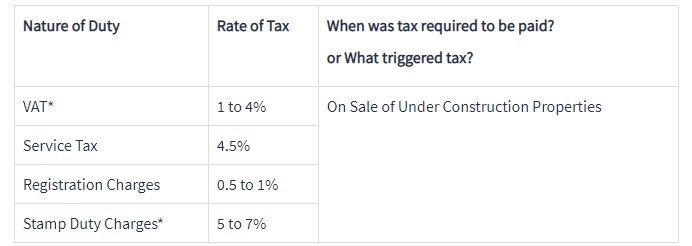
In the GST era, Residential buildings which are intended to be sold to the buyers, partly or wholly, will attract 12 % GST14. But at the same time full input tax credit will be available to the sellers. Earlier states with composite VAT require developers to pay lower VAT rates on the total property value without any input tax benefit or partial benefit. Under this regime, developers pass on the transaction cost – VAT (1%) and service tax (4-5%) to buyers (total 5- 6%).
Real Estate under new regime:
From the point of view of real estate developers’, the sale of under-construction properties would attract GST which means before the receipt of Occupancy Certificate (OC) GST would be applicable. When GST was introduced, the tax rate had been pegged at 18% (or 12% for specified affordable housing projects), with a standard 33% abatement being provided towards the value of the land. Thus, for sale of under construction properties the effective GST rates was is 12% or 8% of the entire agreement value as compared whereas it was around 5.5% (i.e. 4.5% Service Tax and 1% VAT under the composition scheme with limited credits) under the pre GST regime15. It is also brought to the notice that GST does not cover Stamp duty16 thus GST levy is over and above the stamp duty (around 5%) which is payable on the agreement value. This has led to an overburdening of tax to around 17%-13%. This heavy tax burden has actually resulted in cost escalations for the final consumers in the sector. However, GST when introduced has allowed broader level of ITC, the agreement value should ideally reduce. There are multiple GST rates (5%, 12%, 18% and 28%) on procurement of inputs and input services which is another aspect that added to the complexity to the taxation system and leads to unwarranted classification disputes.
The GST Council realizes the problem and has finally decided in its 33rd and 34th meeting on 24th February 2019 and 19th March 2019, to reduce the complexity in the tax system under GST regime. They have finally come up with a solution and tries to simplify these complex structure by introducing the new tax rates. In its Press Release (‘PR’), GST council has recommended to implement the same from 1st April 2019, the revised rates for residential properties as under:
1. GST @ 1% without ITC for affordable housing properties
2. GST @ 5% without ITC for residential properties other than affordable segment
3. GST @ 12% with ITC for commercial properties (other than specified ones which will attract GST @ 5%)
Tax incidences after introduction of GST and rate of taxes:17
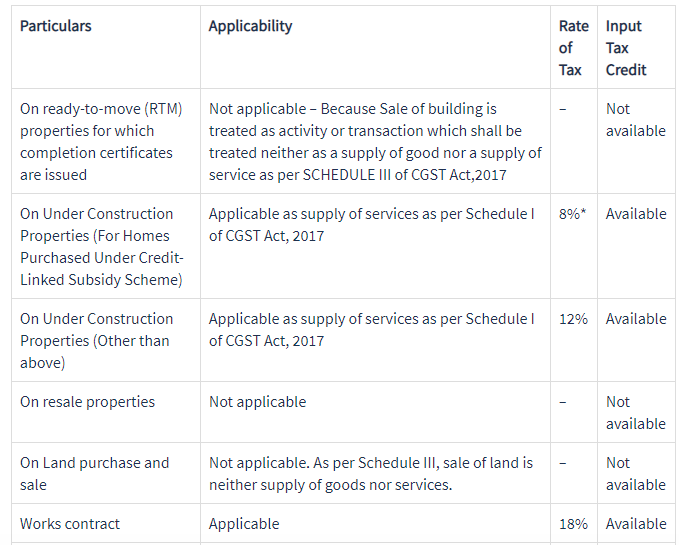
The above rates are effective from 01-04-2019 and are applicable to construction of residential apartments in a project which commences on or after 01-04-2019 as well as in on-going projects. However, in case of on-going project, the promoter has an option to pay GST at the old rates, i.e. at the effective rate of 8% on affordable residential apartments and effective rate of 12% on other than affordable residential apartments and, consequently, to avail permissible credit of inputs taxes; in such cases the promoter is also expected to pass the benefit of the credit availed by him to 2 the buyers.
“Affordable Housing means: Affordable residential apartment is a residential apartment in a project which commences on or after 01-04-2019, or in an ongoing project in respect of which the promoter has opted for new rate of 1% (effective from 01-04-2019) having carpet area upto 60 square meter in metropolitan cities and 90 square meter in cities or towns other than metropolitan cities and the gross amount charged for which, by the builder is not more than forty five lakhs rupees. [Cities or towns in the notification shall include all areas other than metropolitan city as defined, such as villages.] In an ongoing project in respect of which the promoter has opted for new rates, the term also includes apartments being constructed under the specified housing schemes of Central or State Governments. [Metropolitan cities are Bengaluru, Chennai, Delhi NCR (limited to Delhi, Noida, Greater Noida, Ghaziabad, Gurgaon, Faridabad), Hyderabad, Kolkata and Mumbai (whole of MMR) with their geographical limits prescribed by Government.”]18
“Ongoing Projects: A project which meets the following conditions shall be considered as an ongoing project:
(a) Commencement certificate for the project, where required, has been issued by the competent authority on or before 31stMarch, 2019, and it is certified by a registered architect, chartered engineer or a licensed surveyor that construction of the project has started (i.e. earthwork for site preparation for the project has been completed and excavation for foundation has started) on or before 31st March, 2019.
(b) Where commencement certificate in 3 respect of the project, is not required to be issued by the competent authority, it is to be certified by any of the authorities specified in (a) above that construction of the project has started on or before the 31st March, 2019.
(c) Completion certificate has not been issued or first occupation of the project has not taken place on or before the 31st March, 2019.
(d) Apartments of the project have been, partly or wholly, booked on or before 31stMarch, 201919.”
| Particulars | Tax Rate | Abatement | Effective tax rate |
|---|---|---|---|
| 31st March 2019 | 18% | 33% | 12% |
| 1st April 2019 – Other than affordable | 7.50% | 33% | 5% |
| 1st April 2019 – Affordable | 1.50% | 33% | 1% |
But its not that the developer cannot avail the old benefit.There are some option still there for the builder or the developer to pay GST at old effective rate of 8% and 12% with ITC but only in case of “ongoing projects”. To avail the same the developer or the builder has to exercise one time option in the prescribed form and submit the same manually to the jurisdictional Commissioner by the 10th of May, 2019. However, in case where a promoter or builder does not exercise option in the prescribed form, it shall be deemed that he has opted for new rates in respect of ongoing projects and accordingly new rate of GST i.e. 5% / 1% shall be applicable and all the provisions of new scheme includ20ing transitional provisions shall be applied. There is no such option available in case of projects which commence on or after 01.04.2019. Construction of residential apartments in projects commencing on or after 01.04.2019 shall compulsorily attract new rate of GST @ 1% or 5% without ITC21.
Taxation of TDR or FSI:
Supply of TDR or FSI or long term lease of land used for the construction of residential apartments in a project that are booked before issue of completion certificate or first occupation is exempt. Supply of TDR or FSI or long term lease of land, on such value which is proportionate to construction of residential apartments that remain un-booked on the date of issue of completion certificate or first occupation, would attract GST at the rate of 18%, but the amount of tax shall be limited to1% or 5% of value of apartment depending upon whether the residential apartments for which such TDR or FSI is used, in the affordable residential apartment category or in other than affordable residential apartment. TDR or FSI or long term lease of land used for construction of commercial apartments shall attract GST of 18%. The above shall be applicable to supply of TDR or 6 FSI or long term lease of land used in the new projects where new rate of 1% or 5% is applicable.22
Government policy: In the span of two years government has brought a lot of changes to bring the real estate sector under the purview of GST. earlier the burden of tax was fixed on the buyers but the recent decision of GST council regarding the rates of GST has actually a change of business where the shift was made from consumer to the developer as ITC will not be allowed in case of affordable housing and residential property other than affordable housing. Government has realized that despite there is a provision of Anti-profiteering in the GST law, the benefits of Input tax credit is not been transferred to the ultimate consumers. The aforesaid changes in the rate is going to impact:
a. Input tax credit (‘ITC’)
b. Cost of existing and ongoing projects
c. Cost of new projects
d. Anti-profiteering computations
e. Procurement contracts with vendors
f. Contracts/ agreements with customers
g. Spill over transactions
h. IT/ERP systems etc23.
To support this industry and to improve the condition of home buyers in the country the government has also constituted a “stress fund”which will ensure timely delivery of the houses to the home buyers. New regime will also ensure payment of taxes. Further the government has also increased the circle rates so that there would be no variation in government rates and market rates. Further government scheme such as smart city, PM Atal Awash Yojana (Gramin/ Shehri) will also provide the boost to this sector.
Conclusion
GST has both positive and negative impact on Real estate sector. In the span of two year we have seen that GST Council has tried different experiment with the rates and ITC to reduce the price for the home buyer and shift the tax burden from buyer to developer. The GST was implemented in such a way that it has overcome the problem of cascading effect that was there in earlier taxation system. Home buyer has to pay VAT, stamp duty registration charges etc no ITC was available to them. Input tax credit was made available to the Home buyer in the new system.
When it comes to impact of GST on the developers we realized that in the older tax system, developers had to bear Excise duty, VAT, Customs duty, Entry taxes etc. on raw materials supplies like cement bricks sand etc and Service tax on various input services like approval charges, architect professional fees, labor charges, legal charges etc. A developer could not avail ITC for duties like CST, Customs duty, Entry Tax etc paid in the earlier system. This would impact the pricing and subsequently the burden was transferred to the buyer. Under GST, developers’ construction costs are significantly reduced as multiple taxes are subsumed and due to the availability of input tax credit. Also, reduction in cost of logistics will be an added benefit. Hence developers may see improvement in margins.
Whereas developers have to do multiple calculations to arrive at ITC in order to pass it on to the buyers. There is a lack of transparency and it was found that the developer were not transferring the IT benefits to the buyer thus GST council switch to the new rates i.e. 1% and 5% without ITC.24
The main aim of this was to reduce the cost of housing. But the developers has not passed the benefits of ITC to the buyers and thus GST council has taken a decision in its 34th meeting that the rates of GST would be reduced to 1 % for affordable housing and 5% for house other then affordable housing segment without any input tax credit on the supply and services related to real estate sector. To give a boost to real estate sector government has also With time the GST is evolving. Focus of government is towards three important aspect when it comes to real estate sector: 1. Reduction in the price of houses by reducing the tax. 2. ensuring timely delivery of the possession of house to the Home Buyer and thus Reducing the suffering of the home buyers. 3. Collection of taxes and control the evasion of tax.
Suggestions
1. Government and GST Council shall stop making frequent changes in the tax rates as Real estate is one of the industry where process of procurement starts way earlier than actual initiation of construction so frequent policy changes causes lo of chaos and problem to the developers.
2. Government and GST Council shall try to subsumed the stamp duty under the GST as it varies from state to state and is also an extra burden on the Home buyers.
Government shall try to implement the taxation policy in such a way that there is no evasion.
*****
Footnotes
2. Constitution of India, P.M.Bakshi ↑
5. "Real estate": Oxford English Dictionary online: Retrieved September 18, 2011 ↑
6. https://www.ibef.org/industry/real-estate-india.aspx ↑
7. the U.N. World Urbanization Prospects 2018 report ↑
8. Urbanisation on the rise in India, The Hindu, 15th May, 2018. (https://www.thehindu.com/news/national/growth-in-urbanisation/article23925543.ece) ↑
9. Real Estate Sector Expected To Contribute 13% To India's GDP By 2025, Business Standard, March 8, 2019 ↑
10. Indian realty sector market to reach $180 billion, economictimes, March 14, 2018. (https://economictimes.indiatimes.com/wealth/personal-finance-news/indian-realty-sector-market-to-reach-180-billion/articleshow/63301570.cms?from=mdr) ↑
11. http://www.ficci.in/ficci-in-news-page.asp?nid=15587 ↑
12. An enquiry into the effects of GST on Real estate sector, International Journal of Trend in Scientific Research and Development (IJTSRD), Volume 1, Issue 6, Oct 2017 ↑
13. https://cleartax.in/s/gst-real-estate-sector-affect ↑
14. https://www.caclubindia.com/articles/gst-exclusion-of-value-of-land-in-residential-complex-30994.asp ↑
15. F. No. 354/32/2019-TRU Government of India Ministry of Finance Department of Revenue (Tax Research Unit) ↑
16. Rate of Stamp duty varies from State to State and is in the range of 3 per cent to 10 per cent. Further, Stamp duty does not have provision for claiming credit of stamp duty (say paid on purchase of land) ↑
17. GST positive impact on Real Estate Sector, published on May 22, 2019 ( https://cleartax.in/s/gst-real-estate-sector-affect) ↑
18. https://quickbooks.intuit.com/in/resources/gst-center/34th-gst-council-meeting-key-decisions-taken/ ↑
19. Cbic.gov.in F. No. 354/32/2019-TRU Government of India Ministry of Finance Department of Revenue (Tax Research Unit) ↑
20. Cbic.gov.in F. No. 354/32/2019-TRU Government of India Ministry of Finance Department of Revenue (Tax Research Unit) ↑
23. https://taxguru.in/wp-content/uploads/2019/03/Real-Estate-Handbook-on-New-GST-rates-and-challenges-26-March-2019.pdf ↑