
Introduction
Two twentieth-century novels offered rival pictures of how freedom might be lost. Orwell imagined a state that would seize it through force, censorship and fear; Huxley imagined a population that would surrender it willingly in exchange for comfort, distraction and pleasure.1 Neil Postman built his critique of television on that contrast, arguing that a culture is more likely to be undone by what it loves than by what it fears.2 In the digital economy, Huxley’s picture is the more recognisable one. Nobody is obliged to open a social media account, tap “I agree” on a payment application or accept a cookie banner. People do so because it is convenient, because everyone else has, and because the alternative is exclusion from services that now carry work, public life and commerce.
Contract, consumer and data protection law resolve this situation with consent. The person who clicks is treated as a rational actor who weighed the terms and chose, and the resulting arrangement is treated as legitimate because the choice was free and informed. This paper argues that, in digital markets, consent has become a formal act detached from the autonomy it is supposed to express, and that the failure is most damaging in developing jurisdictions that are digitising quickly without the institutional depth that partly compensates for it elsewhere. Bangladesh is a well-timed case. On 10 April 2026 it enacted the Personal Data Protection Act 2026 (PDPA), which makes consent the main lawful basis for processing personal data.3 The question is whether a consent-centred statute, transplanted into a market with uneven digital literacy, a consumer law built for the sale of goods and a new regulator, can protect people whose choices are shaped by design.
The failure of notice-and-consent is well documented. Solove shows that individuals can neither assess the risks of data uses they do not understand nor manage the sheer number of data relationships modern life involves,4 and he now argues that most privacy consent is a fiction that should confer only a weak licence.5 Corren shows that consent regimes shift informational and decisional burdens from firms to individuals,6 and Ben-Shahar and Schneider document the wider failure of mandated disclosure.7 Calo, and Luguri and Strahilevitz, show how firms design the moment of decision itself.8 The leading institutional response, Balkin’s “information fiduciary”, has been criticised by Khan and Pozen as unstable and as legitimising platform power.9 Two gaps remain. This literature is written largely from the United States and the European Union, where consent operates alongside strong regulators, competition authorities and consumer litigation, while work on the Global South tends to treat digital regulation as a question of data extraction rather than doctrine.10 Recent regional scholarship, such as Hutagalung and colleagues’ proposal to treat psychological manipulation as a defect of consent in Indonesian contract law, stays within contract doctrine.11 Bangladesh’s statute, moreover, is too recent to have been analysed in its Bangla text.
The paper is doctrinal and comparative. It reads the Contract Act 1872, the Sale of Goods Act 1930, the Consumers’ Right Protection Act 2009 and the Bangla text of the PDPA, which prevails over any English version,12 against the GDPR, the EU Digital Services Act and India’s data protection and dark-pattern rules, and it uses national survey data to describe the conditions in which consent is given. Translations are the authors’ own. Because no implementing rules or decisions under the PDPA yet exist, statements about enforcement are predictive. Part II sets out how consent was supposed to work. Part III shows how digital design empties it of content. Part IV explains why the problem is sharper in the Global South. Part V proposes a statutory duty of care, and Part VI concludes.
How consent was supposed to work
Classical contract theory pictures the person as a self-interested chooser who knows what she wants, weighs costs against benefits and commits only when the bargain leaves her better off. The economic analysis of law makes the picture explicit: if parties are rational and informed, voluntary exchange allocates resources efficiently. Freedom of contract follows. Each party is presumed the best judge of its own interests, and courts need do little more than enforce what was agreed. Two supporting ideas carry the picture into consumer markets: caveat emptor, which leaves the buyer to inspect and judge, and the unspoken assumption that parties bargain on roughly equal terms. Both were strained long before the internet. Behavioural research showed that real decision-makers satisfice within limits of information and are steered by the way choices are presented.13 Kessler and Radin showed how standard-form contracts can strip rights from the people they bind, drafted by the stronger party and presented for acceptance rather than negotiation, while the law still calls the arrangement consent.14
The baseline in Bangladesh is the Contract Act, 1872. An agreement becomes a contract when made by the free consent of competent parties, and consent is free when it is not caused by coercion, undue influence, fraud, misrepresentation or mistake.15 The test looks for defects in the process of agreement, not at the structure of the market in which agreement takes place. A person who clicks “accept” in an environment designed to produce clicks has suffered none of the listed defects, because nobody threatened, deceived or dominated her in the sense the sections contemplate. One provision has unused potential: where a party able to dominate another’s will enters a transaction that appears unconscionable, the burden of proving the absence of undue influence shifts to the dominant party.16 Courts elsewhere in the common-law world have used similar reasoning against grossly unequal standard-form terms,17 but these authorities are only persuasive in Bangladesh, and the doctrine has not, to the authors’ knowledge, been developed there for online terms. Sale-of-goods law adds the traditional presumption that no warranty of quality or fitness is implied except as the statute provides.18
The Consumers’ Right Protection Act 2009 (CRPA), the principal consumer statute, shares the same paradigm. A “consumer” is a person who buys goods or hires services for a consideration paid or promised, “service” is an enumerated list of sectors such as transport, telecommunication, utilities, hotels and health care, and the listed “anti-consumer right practices” are those of a physical marketplace: overpricing, adulteration, false advertisement and non-delivery.19 The Act says nothing about standard-form terms in digital services, the collection of behavioural data or interface design. Online trade is governed mainly by the Digital Commerce Operation Guidelines 2021, which regulate sellers’ registration, product description and delivery and require the buyer’s permission before personal data are collected, but do not address the terms on which users give up data.20 The user of a free platform, who pays in attention and data rather than money, is therefore not clearly a “consumer” at all. Each of these sources of protection presupposes that consent, once given, is meaningful. In digital markets it often is not.
The Huxleyan reality: manufactured consent
A. Terms designed not to be read
Digital contracting runs on terms of service and privacy policies that are long, technical and not meant to be read, and the rational response is often not to read them. McDonald and Cranor estimated that an average privacy policy takes about ten minutes to read and that the national opportunity cost of reading the policies Americans encounter would be on the order of $781 billion a year.21 When Obar and Oeldorf-Hirsch invited 543 students to join a fictitious social network, 74 per cent skipped the privacy policy through a “quick join” option, and 98 per cent missed clauses that would have shared their data with the National Security Agency and their employers and required a first-born child as payment.22 This behaviour is not irrational. A person who cannot negotiate, cannot meaningfully compare and cannot use the service otherwise acts sensibly in declining to study a document she cannot change.
Better disclosure will not cure the problem. Even careful readers cannot predict the future uses and aggregations of their data.23 The “privacy paradox”, the observation that people claim to value privacy yet disclose freely, is often cited as proof that they do not care; Solove shows that it is produced by comparing general attitudes with behaviour in settings where meaningful choice is unavailable.24 Adding notices and tick-boxes increases the volume of consent without improving its quality. What remains is a ritual: the legal significance of the click is full, while its cognitive reality is nearly empty.
B. Dark patterns
Dark patterns are what is added to produce the click. The term covers interface designs that steer users towards choices that benefit the designer: pre-selected options, visual emphasis on acceptance, hidden or multi-step refusal paths, repeated prompts and false urgency. A crawl of some 11,000 shopping websites found them on more than one in ten.25 Luguri and Strahilevitz tested their effect experimentally: mild dark patterns more than doubled the share of subjects who signed up for a dubious service, aggressive ones nearly quadrupled it, and less educated subjects were significantly more susceptible to the mild variety.26 The last finding matters for any country where formal education is unevenly distributed. Figure 1 summarises the evidence. Regulators have accepted it. The United States Federal Trade Commission and the OECD treat dark patterns as unfair or deceptive practices,27 and the EU Digital Services Act prohibits online platforms from designing interfaces that deceive or manipulate users or materially distort their ability to make free and informed decisions.28
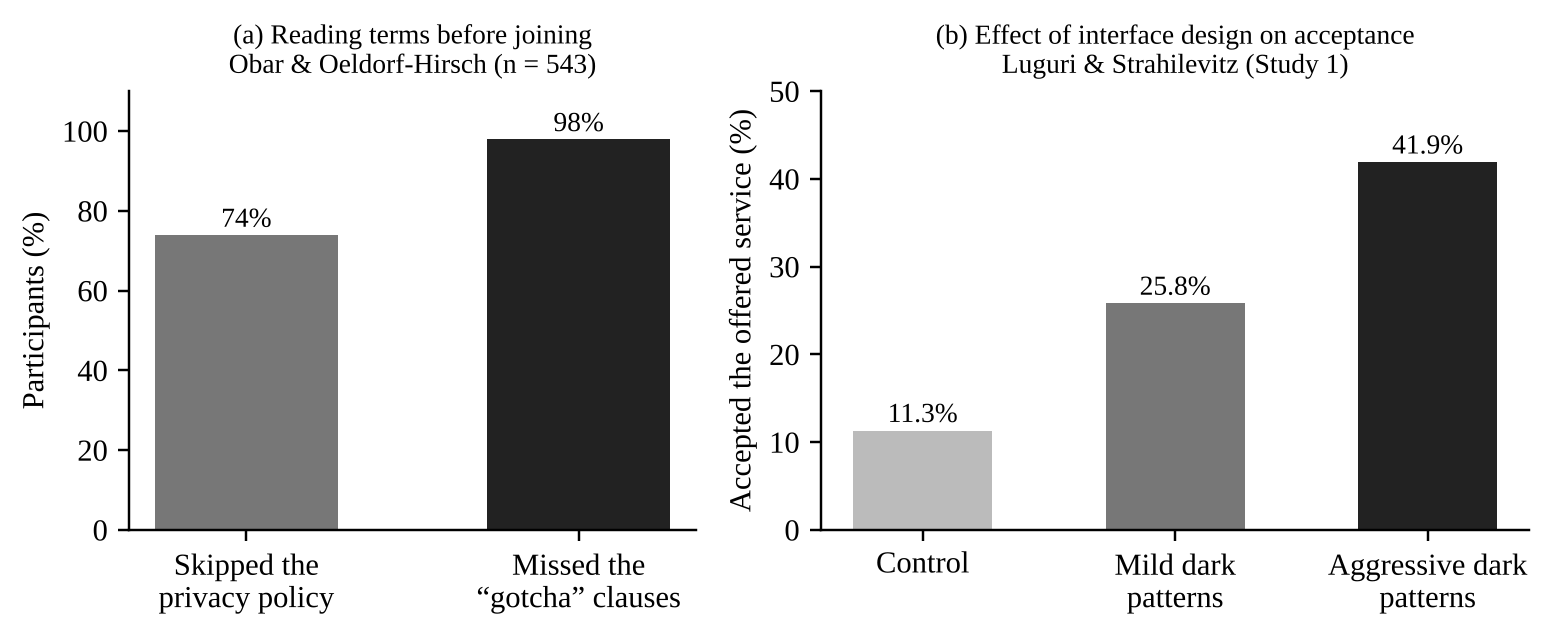
Figure 1: What users read, and how design changes what they accept. Sources: Obar & Oeldorf-Hirsch (2020) (panel a); Luguri & Strahilevitz (2021), first experiment (panel b). Chart prepared by the authors.
Dark patterns are the visible edge of a wider logic. Calo describes “digital market manipulation” as the use of data and design to exploit the particular biases of individual consumers at the moment of decision,29 and Zuboff places it in an economy that extracts behavioural data in order to predict and shape conduct.30 Here Postman’s Huxleyan point acquires legal content. The user is not coerced; they are rewarded. Frictionless sign-up, personalised feeds and one-tap payments create habit and dependence, and the system that supplies the pleasure also collects the consent. Refusal is hard because it is designed to be hard; acceptance is easy because it is designed to be easy. A rule that treats the resulting click as evidence of free choice mistakes the product of design for the exercise of will.
C. The absent bargain
Between a user and a global platform there is no bargaining. Acceptance is frequently deemed from continued use, and the terms are fixed, often unilaterally alterable. The only choice is to accept or go without. Network effects make going without costly, and in Bangladesh the services concerned are increasingly close to necessity. Wages, remittances and small payments move through mobile financial services, urban transport and food delivery run through applications, and small traders reach customers through social-commerce pages.31 A person who declines the terms does not merely forgo a convenience; she may be excluded from ordinary economic life. The more essential a service becomes, the less the act of accepting its terms can bear the weight that the doctrine of consent places on it.
Doctrine does not describe this transaction accurately. The user pays no price in money, and what the platform receives, attention and data of uncertain future value, is neither priced nor disclosed. Her loss is diffuse, deferred and hard to attribute, so the individual remedies on which consent-based regimes depend, namely complaint, avoidance and damages, are rarely worth pursuing. The law thus asks the person least able to protect herself to police a relationship whose terms she did not set, whose risks she cannot assess and whose breach she may never discover. That is the Huxley trap in legal form: a regime of free choice administered where free choice is unavailable. Figure 2 sets out the sequence and the alternative developed in Part V.
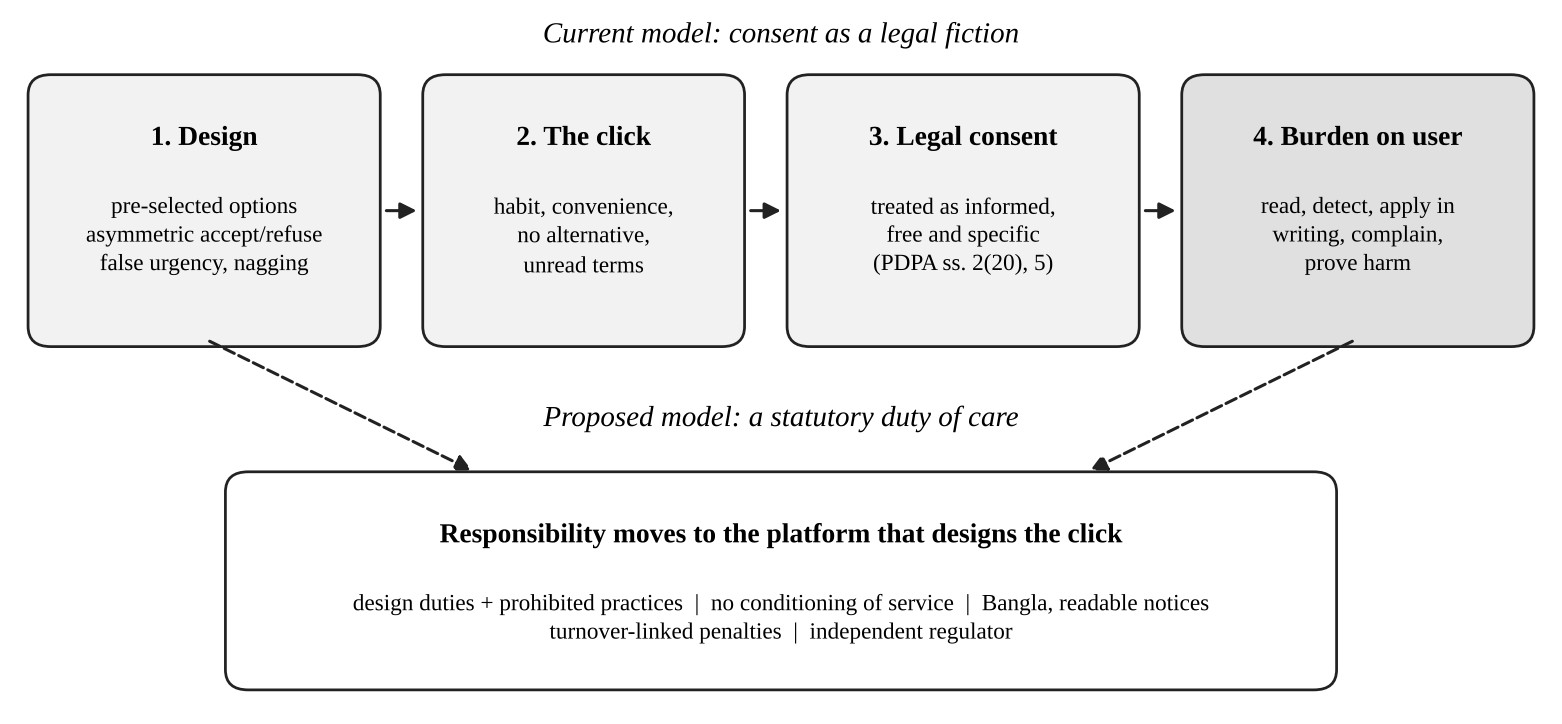
Figure 2: The Huxley trap and the proposed alternative. Source: authors’ own conceptualisation.
Why the Global South is different
A. The transplant problem
Bangladesh’s data protection law is a legal transplant: its architecture and vocabulary derive from the GDPR and its Indian counterpart. Watson famously argued that law is largely borrowed and that rules can live a life of their own, detached from the circumstances that produced them.32 Legrand replied that a rule is inseparable from the culture and interpretive practice that give it meaning, so that what crosses a border is a text, not a rule.33 Kahn-Freund took a middle position: a transplant succeeds to the degree that the institutional and political context of the receiving system resembles that of the source.34 The evidence favours caution. Berkowitz, Pistor and Richard find that transplanted law works better where the receiving population was already familiar with its principles or where the law was adapted to local conditions.35
Data protection law shows the pattern. The GDPR has become a global template,36 and a statute can be copied in a legislative session. The ecosystem that makes consent protective in Europe cannot: well-staffed regulators with large penalties, competition authorities, a culture of consumer litigation and organised civil society. Bangladesh’s own path demonstrates the risk. A Personal Data Protection Ordinance was promulgated in November 2025, amended in February 2026 and replaced by the present Act in April 2026, three instruments in under six months.37 A text assembled at that speed has had little chance to absorb local evidence about how Bangladeshi users meet terms and interfaces. The danger is not that the borrowed rules are bad, but that consent, the part of the model easiest to copy, is made to carry weight that the missing parts were meant to share.
B. The PDPA 2026: perfect form, missing conditions
The PDPA is in several respects a careful statute. Consent must be an informed, clear, specific and voluntary affirmative indication, given after the person has been told the purpose, retention period, transfers and withdrawal procedure.38 Apart from exemptions for public purposes such as national security and the investigation of crime, processing without consent is confined to a closed list of grounds, such as performance of a contract, legal claims and vital interests, each subject to necessity, proportionality and purpose limitation.39 The burden of proving valid consent rests on the data-fiduciary.40 Data-subject rights are declared inviolable and cannot be excluded by contract or notice, and consent may be withdrawn at any time.41 These are real protections; the anti-waiver rule in particular blunts the most familiar abuse of boilerplate.
The difficulty lies in what the Act leaves unsaid. It perfects the form of consent but, in the provisions examined, does not address the conditions under which consent can be called free. The GDPR requires utmost account to be taken of whether a service is made conditional on consent to unnecessary processing, and treats a clear imbalance between the parties as putting consent in doubt.42 India’s statute requires consent to be “unconditional”.43 The Digital Services Act regulates interface design directly.44 The Bangladeshi text has no equivalent rule on bundling, take-it-or-leave-it consent or manipulative design, and it leaves both the “easier” method of withdrawal and the form of notices to future regulations.45 A platform that presents a long English-language notice, a prominent “Accept” button and no practical alternative can therefore satisfy the statutory vocabulary while defeating its purpose. The burden of proof helps only after the event, once a person has discovered a violation and complained in writing,46 and the data-fiduciary can discharge it with the very evidence, a logged click, that the design produced.
Three further features reinforce the point. First, the Act’s long title treats personal data as belonging to the individual.47 Ownership plus consent is the Huxley trap in statutory form: it gives the individual a proprietary right that cannot be exercised in practice and invites the market to buy it at the price of a click. Second, the Act borrows India’s term “data-fiduciary”, but the Bangla term used connotes custody, and the duties attached to it are operational duties of transparency and security rather than a general duty to act in the individual’s interest.48 The vocabulary of trust is imported; its legal content is not. Third, processing that began before the Act may continue until its original purpose changes,49 so the stocks of personal data already gathered under unread terms are carried into the new regime on the strength of the very consent whose quality is in question.
C. Literacy, capacity and the consumer gap
The consent model assumes a person who can understand what she is told. In the April–June 2026 quarter, 89.6 per cent of people aged five and above in Bangladesh used a mobile phone and 59.2 per cent used the internet, but only 11.8 per cent used a computer.50 Access is thus overwhelmingly mobile: terms are met, if at all, on small screens where long documents are hardest to read and interface design does most of the work. Almost every household has a mobile phone, yet only about two-thirds of individuals own one,51 which suggests widespread shared use; on a shared handset it is uncertain whose consent a click records. Internet use is also lower among women than men.52 Figure 3 presents the data. Language compounds the gap. Terms for the services most used in Bangladesh are commonly drafted abroad, in English or in translations of uncertain legal status, and the PDPA, in the provisions examined, does not require notices in Bangla or in plain language. The point is not that Bangladeshi consumers are less capable than others. It is that the model gives them a task it does not equip them to perform.
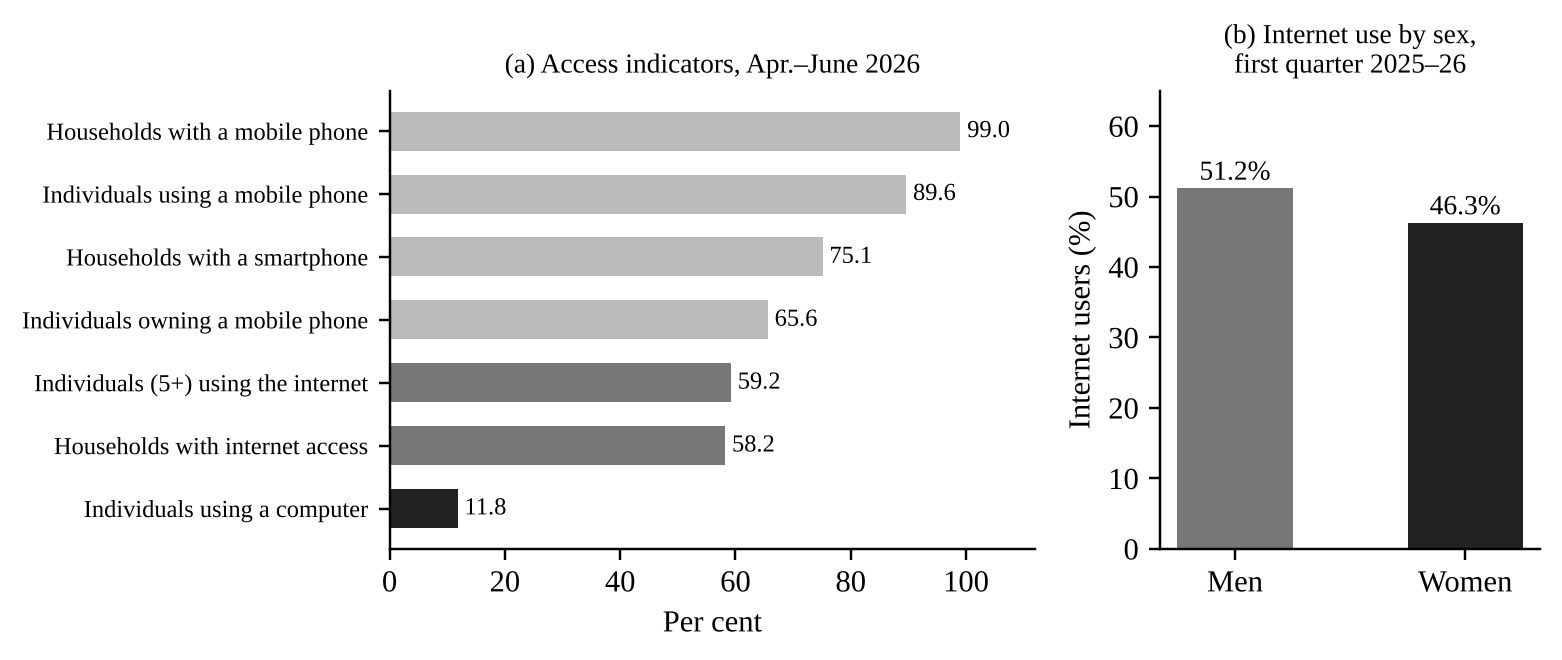
Figure 3: ICT access in Bangladesh, 2025–26. Sources: Bangladesh Bureau of Statistics, ICT Access and Use Survey 2025–26, as reported by United News of Bangladesh (panel a, fourth quarter) and Dhaka Tribune (panel b, first quarter). Chart prepared by the authors.
The asymmetry is also structural. Platforms know how their systems use data, how often interfaces are tested for conversion, and which design variants produce acceptance; users know none of this. Where researchers, journalists and consumer organisations monitor platforms, the asymmetry is partly offset. Where such intermediaries are thinner, the individual stands alone with the notice.
Institutions are the second difficulty. The GDPR allows fines of up to four per cent of worldwide annual turnover;53 the PDPA sets fixed ceilings of 25 lakh taka, or 50 lakh for significant data-fiduciaries.54 For a multinational platform that is a cost of doing business. Appeals go to the tribunal established under the Information and Communication Technology Act,55 and in August 2024 the country’s eight cyber tribunals already had 5,818 cases pending.56 The Authority must also comply with government directions issued in the interest of sovereignty, state security, foreign relations or public order,57 which sits uneasily with its role as protector of individual rights against a state that is itself a major collector of data. Experience sharpens the concern: some 1,340 “speech offence” cases were pending before the tribunals or under investigation under the country’s successive cyber laws when the government decided in November 2024 to repeal the latest of them.58 Other tools are young. The Competition Commission, constituted only in 2016, has begun to act in digital markets, fining a food-delivery platform for restrictive terms imposed on restaurants.59
The third difficulty is conceptual. Because the CRPA protects those who buy goods or hire listed services for consideration, the user of a free platform may fall between a consumer statute that does not clearly see her as a consumer and a data protection statute that offers her only the procedural machinery of consent.60
D. India’s two-track response
India is the most instructive comparator. It shares Bangladesh’s common-law inheritance, including near-identical contract and sale-of-goods statutes, a similar pattern of mobile-first digitisation and the same global platforms, and it has responded along two tracks. The first is data protection. The Digital Personal Data Protection Act 2023 requires consent to be “free, specific, informed, unconditional and unambiguous with a clear affirmative action”, makes withdrawal as easy as giving consent, and creates registered consent managers through which individuals can manage consent across services.61 The word “unconditional” supplies, at least textually, the rule against conditioned consent that the PDPA lacks. Consent managers respond, if imperfectly, to the structural problem Solove identifies, that no individual can manage hundreds of data relationships alone; but they lower the cost of managing consent without changing what is consented to. The implementing Rules, notified in November 2025, phase the regime in over eighteen months.62
The second track matters more for Bangladesh. India’s Consumer Protection Act 2019 expressly covers online transactions and empowers the Central Consumer Protection Authority to issue guidelines against unfair trade practices.63 In November 2023 the Authority issued the Guidelines for Prevention and Regulation of Dark Patterns, which prohibit any platform offering goods or services in India from using dark patterns and list thirteen specified practices, including false urgency, confirm shaming, forced action, subscription traps and nagging.64
Two lessons follow. The consumer gap is not inevitable: a short definitional amendment can bring online users within consumer law, and the European Union has similarly extended contract-law protection to digital services supplied in exchange for personal data.65 And design can be regulated through a consumer authority that already exists, using a published list it can update. The Indian model also has limits Bangladesh should not copy: the Guidelines carry no independent penalty,66 and the members of the Data Protection Board are appointed by the Central Government.67 Table 1 compares the three regimes.
| Issue | Bangladesh: PDPA 2026 | EU: GDPR and DSA | India: DPDP Act 2023 and Dark Patterns Guidelines 2023 |
|---|---|---|---|
| Definition of consent | Informed, clear, specific, voluntary affirmative indication (s. 2(20)) | Freely given, specific, informed and unambiguous; clear affirmative action (GDPR art. 4(11)) | Free, specific, informed, unconditional and unambiguous; clear affirmative action (s. 6(1)) |
| Conditioning a service on consent | No express rule | Utmost account taken of conditionality (art. 7(4)); imbalance (recital 43) | Consent must be “unconditional” (s. 6(1)) |
| Withdrawal | At any time; the “easier” method is left to regulations (s. 13(1)) | As easy to withdraw as to give (art. 7(3)) | Ease comparable to giving consent (s. 6(4)) |
| Burden of proving consent | On the data-fiduciary (s. 5(4)) | Controller must demonstrate consent (art. 7(1)) | On the data fiduciary (s. 6(10)) |
| Interface design and dark patterns | No express rule | Prohibited for online platforms (DSA art. 25) | Thirteen specified dark patterns prohibited (Guidelines 2023) |
| Online users as consumers | Unclear: consumer tied to consideration and listed services (CRPA s. 2(19), (22)) | Digital services supplied for personal data covered (Directive 2019/770 art. 3(1)) | Expressly covered (CPA 2019 s. 2(7) expl. (b)) |
| Maximum fine | Fixed: BDT 25 lakh; BDT 50 lakh for significant data-fiduciaries (ss. 32–33) | Up to €20 million or 4% of worldwide annual turnover (GDPR art. 83(5)) | Fixed: up to ₹250 crore per breach (s. 33 and Schedule) |
| Regulator | Must comply with government directions (s. 38) | Complete independence required (GDPR art. 52) | Board appointed by the Central Government (s. 19) |
Table 1: Consent and its enforcement in three regimes. Sources: statutes as cited in Parts IV.B to IV.D; authors’ analysis.
A statutory duty of care
A. Why not a fiduciary duty?
The analysis points to one conclusion: the law must stop treating the individual as the primary guarantor of her own protection. Where terms are unreadable and design is adaptive, responsibility belongs to the party that designs the environment, which is also the party best placed to prevent harm. Corren’s call for regulators to measure the “consent burden” makes the same point.68 The question is what form that responsibility should take. Balkin’s answer is to treat platforms as information fiduciaries owing duties of care and loyalty, as doctors and lawyers do.69 Khan and Pozen object that managers’ duties to shareholders conflict with loyalty to users, that business models built on monetising attention cannot support undivided loyalty, and that the label may legitimise the market power it was meant to restrain.70 Richards and Hartzog defend a narrower, statutory duty of loyalty.71
In a developing jurisdiction the objection has extra force. A loyalty standard demands that courts and regulators can determine whether a platform has put its own interests ahead of its users’, and Bangladesh’s adoption of the term “data-fiduciary” without any fiduciary content highlights how a name can come without its substance. Solove’s recent proposal points in a better direction: duties that do not depend on consent at all, including a duty to avoid unreasonable risk.72 Where enforcement capacity is limited, such duties can be clearly defined and monitored against conduct. The concept is also known in Bangladeshi law, which adopted the common-law principle that a person is required to take reasonable steps to prevent foreseeable harm to those closely and directly affected by her acts.73 Platforms, which design every step of the interaction and test how users respond, satisfy that relationship more obviously than the manufacturer in the classic case.
B. The proposal
This paper proposes that platforms owe their users a statutory duty of care that is clear and specific, defined by rules rather than by a general standard. It has five elements. First, significant data-fiduciaries should be obliged to design consent flows that do not impair users’ choice, and a regulator should maintain a list of prohibited practices, including pre-selected consent, asymmetric accept and refuse paths, repeated prompting and false urgency. Second, a service should not be made conditional on consent to processing that is unnecessary for it. Third, notices should be layered, standardised and available in Bangla, with privacy-protective defaults, and consents carried forward from before the Act should be reviewed against these rules. Fourth, serious breaches should attract penalties linked to turnover, and the burden of proof should extend from consent to compliance with the design duties. Fifth, the Authority should be operationally independent in individual cases, and exchanges of data for access should be recognised as consumer transactions under the CRPA.
A provision for insertion into the PDPA might read as follows:
Duty of care in design. (1) Every significant data-fiduciary shall design and operate the interfaces through which consent is sought, given or withdrawn so as not to deceive, manipulate or materially impair the ability of a data subject to make a free and informed decision.
(2) The Authority shall by regulation specify, and from time to time revise, practices that are presumed to breach sub-section (1).
(3) Consent obtained by a practice specified under sub-section (2) shall not be valid consent for the purposes of section 5.
(4) The provision of a service shall not be made conditional on consent to processing that is not necessary for that service.
The operative content lies in the regulator’s list, which can be revised as practices change, and in sub-section (3), which gives users and the Authority a remedy that does not depend on proving individual loss.
Much of this needs no new primary legislation. The PDPA already leaves the form of notices and the method of withdrawal to subordinate legislation and gives the Authority power to make regulations,74 so design duties, readable notices and protective defaults can be specified there. The consumer gap requires a short amendment to the CRPA’s definitions on the Indian model. Turnover-linked penalties and regulatory independence require amendment of the PDPA itself and are longer-term reforms. Table 2 links each element to the gap it addresses. Consent would remain for genuinely discretionary choices, such as optional features, but it would no longer be asked to legitimise the architecture of the transaction.
| Gap identified | Where discussed | Proposed rule | Comparable model |
|---|---|---|---|
| No rule against conditioning a service on consent | Part IV.B | A service may not be conditional on consent to unnecessary processing | GDPR art. 7(4); DPDP Act s. 6(1) |
| No regulation of interface design | Parts III.B, IV.B | Duty of care in design and a regulator-maintained list of prohibited practices | DSA art. 25; India Dark Patterns Guidelines 2023 |
| Notice form left to regulations; no language rule | Parts IV.B, IV.C | Bangla, layered and standardised notices; protective defaults | Regulations under PDPA s. 15(3) |
| Pre-existing consents carried forward | Part IV.B | Review of legacy consents by significant data-fiduciaries | Transitional rules under PDPA s. 40 |
| Online users outside the CRPA | Parts II, IV.C, IV.D | Amend CRPA s. 2(19) and (22) to cover online and data-for-access transactions | India CPA 2019 s. 2(7) expl. (b); Directive 2019/770 art. 3(1) |
| Fixed, low penalty ceilings | Part IV.C | Turnover-linked penalties for serious breaches | GDPR art. 83(5) |
| Executive direction of the regulator | Part IV.C | Operational independence in individual cases | GDPR art. 52 |
Table 2: From diagnosis to proposal. Source: authors’ proposal.
C. Objections
Three objections deserve an answer. The first concerns capacity: a regulator unable to police consent will not police design. But bright-line prohibitions are cheaper to enforce than case-by-case inquiries into whether consent was informed, because they can be checked by inspecting the interface rather than reconstructing a person’s state of mind, and they can be enforced through complaints by civil society and the consumer-rights directorate as well as by the data Authority. The second is that such duties would burden innovation in a young digital economy. The proposal addresses only practices involving manipulation or conditioning and, like India’s Rules, can be phased in, more gradually for small domestic companies. The case for tolerating manipulative design because the economy is young is weak, since those most recently exposed to digital markets are the most affected by it.
The third is that borrowing from India or the European Union reproduces the transplant problem. The proposal borrows techniques, not institutions. A list of prohibited practices, definitional changes and proportionate penalties can be administered by existing Bangladeshi structures and tailored to local evidence, whereas a consent architecture relies on an enforcement ecosystem that Bangladesh does not yet have. Nor is the proposal a rejection of the PDPA. Its burden-of-proof rule, its bar on contractual waiver and its closed list of non-consent grounds show that the legislature saw part of the problem; the duty of care builds on them.
Conclusion
Consent, in the sense of contract and data protection law, has become a formal gesture, divorced from the autonomy it is supposed to express. Standard-form terms are not read, interfaces make acceptance easy and refusal difficult, and the user has no bargaining power. The result fits Postman’s Huxleyan account: people are not compelled to give up their data and rights but rewarded for doing so, and the law records the giving as a choice.
The failure is global, but its costs fall unevenly. Bangladesh’s PDPA 2026 perfects the form of consent while leaving unaddressed, in the provisions examined, the conditions that make consent free: the conditioning of service, manipulative design and unreadable notices. It relies on fixed penalties and a regulator open to executive direction, sits beside a consumer statute designed for the sale of goods, and operates in a market where access is mobile, shared and unequal. India’s experience shows that these gaps can be narrowed through an “unconditional” consent standard and a consumer authority’s list of prohibited dark patterns.
The solution proposed is to shift the burden from the individual who clicks to the platform that designs the click, through a statutory duty of care stated in design rules, banned practices, proportionate penalties and independent enforcement. Laws that protect citizens in developing economies must be designed around how people actually decide, not how they “should” decide.
*****
Footnotes
1. George Orwell, Nineteen Eighty-Four (1949); Aldous Huxley, Brave New World (1932).
2. Neil Postman, Amusing Ourselves to Death: Public Discourse in the Age of Show Business vii–viii (1985).
3. Byaktigata Upatta Suraksha Ain, 2026 [The Personal Data Protection Act, 2026], Act No. 63 of 2026, Bangl. Gazette, extra. (Apr. 10, 2026), https://bdlaws.minlaw.gov.bd/act-1692.html [hereinafter PDPA]; see id. § 44 (repealing Byaktigata Upatta Suraksha Adhyadesh, 2025 [The Personal Data Protection Ordinance, 2025], Ordinance No. 61 of 2025, Bangl. Gazette, extra. (Nov. 6, 2025) [hereinafter PDPO] and the Personal Data Protection (Amendment) Ordinance, No. 23 of 2026).
4. Daniel J. Solove, Introduction: Privacy Self-Management and the Consent Dilemma, 126 Harv. L. Rev. 1880, 1880–81 (2013), https://harvardlawreview.org/print/vol-126/introduction-privacy-self-management-and-the-consent-dilemma/.
5. Daniel J. Solove, Murky Consent: An Approach to the Fictions of Consent in Privacy Law, 104 B.U. L. Rev. 593, 594 (2024).
6. Ella Corren, The Consent Burden in Consumer and Digital Markets, 36 Harv. J.L. & Tech. 551, 551–52 (2023), https://jolt.law.harvard.edu/assets/articlePDFs/v36/Corren-Consent-Burden.pdf.
7. See generally Omri Ben-Shahar & Carl E. Schneider, More Than You Wanted to Know: The Failure of Mandated Disclosure (2014).
8. Ryan Calo, Digital Market Manipulation, 82 Geo. Wash. L. Rev. 995, 999 (2014), https://www.gwlr.org/wp-content/uploads/2014/10/Calo_82_4.pdf; Jamie Luguri & Lior Jacob Strahilevitz, Shining a Light on Dark Patterns, 13 J. Legal Analysis 43, 43 (2021), https://academic.oup.com/jla/article/13/1/43/6180579.
9. Jack M. Balkin, Information Fiduciaries and the First Amendment, 49 U.C. Davis L. Rev. 1183, 1186 (2016), https://lawreview.law.ucdavis.edu/archives/49/4/information-fiduciaries-and-first-amendment; Lina M. Khan & David E. Pozen, A Skeptical View of Information Fiduciaries, 133 Harv. L. Rev. 497, 502 (2019), https://scholarship.law.columbia.edu/faculty_scholarship/2451.
10. See generally Nick Couldry & Ulises A. Mejias, The Costs of Connection: How Data Is Colonizing Human Life and Appropriating It for Capitalism (2019).
11. Rico Leonardo Hutagalung et al., Beyond Formal Consent: Protecting Consumer Autonomy Against Psychological Manipulation in Contract Law, 20 Fiat Justisia: Jurnal Ilmu Hukum 407, 407 (2026), https://doi.org/10.25041/fiatjustisia.v20no4.5665.
12. PDPA § 45(2).
13. Herbert A. Simon, A Behavioral Model of Rational Choice, 69 Q.J. Econ. 99, 99 (1955); see generally Richard H. Thaler & Cass R. Sunstein, Nudge: The Final Edition (2021).
14. Friedrich Kessler, Contracts of Adhesion: Some Thoughts About Freedom of Contract, 43 Colum. L. Rev. 629, 632 (1943); see generally Margaret Jane Radin, Boilerplate: The Fine Print, Vanishing Rights, and the Rule of Law (2013).
15. The Contract Act, No. 9 of 1872, Bangl. Code (1872), §§ 10, 13–19 [hereinafter Contract Act].
16. Id. § 16(3).
17. Cent. Inland Water Transp. Corp. v. Brojo Nath Ganguly, (1986) 3 SCC 156, ¶ 89 (India); see also Lloyds Bank Ltd. v. Bundy [1975] QB 326 (CA) 339 (Eng.) (inequality of bargaining power).
18. The Sale of Goods Act, No. 3 of 1930, Bangl. Code (1930), § 16 [hereinafter Sale of Goods Act].
19. The Consumers’ Right Protection Act, No. 26 of 2009, Bangl. Gazette, extra. (Apr. 6, 2009), §§ 2(19), 2(20), 2(22) [hereinafter CRPA].
20. Digital Commerce Operation Guidelines, 2021 (Ministry of Commerce, Bangl., July 4, 2021) [hereinafter Digital Commerce Guidelines]; see An Overview of the Digital Commerce Operation Guidelines 2021, Daily Star (Dhaka) (July 12, 2021), https://www.thedailystar.net/law-our-rights/news/overview-the-digital-commerce-operation-guidelines-2021-2128871 (summarising the Guidelines, including the requirement to obtain the buyer’s permission, with reasons, before collecting personal data).
21. Aleecia M. McDonald & Lorrie Faith Cranor, The Cost of Reading Privacy Policies, 4 I/S: J.L. & Pol’y for Info. Soc’y 543, 554–55, 563–64 (2008).
22. Jonathan A. Obar & Anne Oeldorf-Hirsch, The Biggest Lie on the Internet: Ignoring the Privacy Policies and Terms of Service Policies of Social Networking Services, 23 Info., Commc’n & Soc’y 128, 128 (2020), https://doi.org/10.1080/1369118X.2018.1486870.
23. Solove, Privacy Self-Management, supra note 4, at 1888–91.
24. Daniel J. Solove, The Myth of the Privacy Paradox, 89 Geo. Wash. L. Rev. 1, 4–5 (2021), https://www.gwlr.org/wp-content/uploads/2021/01/89-Geo.-Wash.-L.-Rev.-1.pdf.
25. Arunesh Mathur et al., Dark Patterns at Scale: Findings from a Crawl of 11K Shopping Websites, 3 Proc. ACM on Hum.-Comput. Interaction art. 81, at 81:2 (2019), https://doi.org/10.1145/3359183.
26. Luguri & Strahilevitz, supra note 8, at 43.
27. Fed. Trade Comm’n, Bringing Dark Patterns to Light: Staff Report 2, 14 (Sept. 2022), https://www.ftc.gov/system/files/ftc_gov/pdf/P214800%20Dark%20Patterns%20Report%209.14.2022%20-%20FINAL.pdf; see generally Org. for Econ. Coop. & Dev., Dark Commercial Patterns (OECD Digit. Econ. Papers No. 336, Oct. 2022), https://doi.org/10.1787/44f5e846-en.
28. Regulation 2022/2065, of the European Parliament and of the Council of 19 October 2022 on a Single Market for Digital Services and Amending Directive 2000/31/EC (Digital Services Act), art. 25(1), 2022 O.J. (L 277) 1 (EU) [hereinafter DSA].
29. Calo, supra note 8, at 999, 1003.
30. See generally Shoshana Zuboff, The Age of Surveillance Capitalism: The Fight for a Human Future at the New Frontier of Power (2019).
31. See Bangladesh Bank, Mobile Financial Services (MFS) Statistics: Transaction Statistics (Sept. 2026), https://www.bb.org.bd/econdata/fin_digitalfstat/tab9.pdf (monthly figures for salary disbursements, merchant payments and inward wage-earner remittances through MFS); Ride-Sharing Services Get Cabinet Nod, Daily Star (Dhaka) (Jan. 15, 2018), https://www.thedailystar.net/frontpage/ride-sharing-services-get-cabinet-nod-1520506 (app-based transport services legalised under the Ride-sharing Service Guidelines 2017); Foodpanda Fined for ‘Limiting Business’ of Nando’s, Peyala, Bus. Standard (Dhaka) (Jan. 16, 2024), https://www.tbsnews.net/bangladesh/foodpanda-fined-tk10-lakh-abusing-its-dominant-position-775898; Morshed Noman & Abul Kashem, Selling Products on Facebook Page? You Will Need Licence Soon, Bus. Standard (Dhaka) (Mar. 19, 2021), https://www.tbsnews.net/economy/trade/selling-products-facebook-page-you-will-need-licence-soon-219142 (reporting more than five lakh small traders selling through Facebook and other social media).
32. See generally Alan Watson, Legal Transplants: An Approach to Comparative Law (2d ed. 1993).
33. Pierre Legrand, The Impossibility of “Legal Transplants”, 4 Maastricht J. Eur. & Compar. L. 111, 114–20 (1997).
34. Otto Kahn-Freund, On Uses and Misuses of Comparative Law, 37 Mod. L. Rev. 1, 27 (1974).
35. Daniel Berkowitz, Katharina Pistor & Jean-François Richard, The Transplant Effect, 51 Am. J. Compar. L. 163, 167–68 (2003).
36. See generally Anu Bradford, The Brussels Effect: How the European Union Rules the World (2020).
37. PDPA § 44.
38. Id. §§ 2(20), 5(2).
39. Id. §§ 5(3), 24.
40. Id. § 5(4).
41. Id. §§ 10(4), 13(1).
42. Regulation 2016/679, of the European Parliament and of the Council of 27 April 2016 on the Protection of Natural Persons with Regard to the Processing of Personal Data and on the Free Movement of Such Data, and Repealing Directive 95/46/EC (General Data Protection Regulation), art. 7(4), 2016 O.J. (L 119) 1 (EU) [hereinafter GDPR]; id. recital 43.
43. The Digital Personal Data Protection Act, No. 22 of 2023, India Code (2023), § 6(1) [hereinafter DPDP Act].
44. DSA art. 25.
45. PDPA §§ 13(1), 15(3).
46. Id. §§ 10(1), 31.
47. Id. long title (“কোনো ব্যক্তির ব্যক্তিগত উপাত্ত তাহার মালিকানাধীন গণ্য করিয়া” [treating a person’s personal data as owned by that person]); see also id. pmbl.
48. Id. §§ 8(2), 15, 17. But see id. § 22(c) (requiring data-fiduciaries to process data lawfully while preserving confidentiality and the interests of the data subject).
49. Id. § 40.
50. Mobile Phone Ownership Rises: BBS, United News of Bangladesh (Sept. 20, 2026), https://unb.com.bd/category/Bangladesh/mobile-phone-ownership-rises-bbs/195830; see also Mobile Phone Use Reaches 89.6% in Bangladesh: BBS, Daily Star (Dhaka) (Sept. 20, 2026), https://www.thedailystar.net/news/technology/news/mobile-phone-use-reaches-896-bangladesh-bbs-4278021 (giving the mobile phone and internet figures for people aged five and above).
51. Mobile Phone Ownership Rises: BBS, supra note 50 (99 per cent of households with a mobile phone; 65.6 per cent of individuals owning one).
52. BBS: Half of Bangladesh’s Population Still Doesn’t Use Internet, Dhaka Tribune (Dec. 18, 2025), https://www.dhakatribune.com/bangladesh/bangladesh-others/399044/bbs-nearly-half-of-bangladesh%E2%80%99s-population; see also Nearly Half of Bangladeshis Remain Offline: BBS, Daily Star (Dhaka) (Dec. 20, 2025), https://www.thedailystar.net/business/economy/news/nearly-half-bangladeshis-remain-offline-bbs-4062786 (51.2 per cent of men and 46.3 per cent of women using the internet, July–September 2025).
53. GDPR art. 83(5).
54. PDPA §§ 32(1)–(2), 33 (ceilings of Tk 25 lakh, or Tk 50 lakh for a significant data-fiduciary under § 32(2)); see also id. § 1(3) (sections 23 and 31–35 to come into force on a date the Government notifies after eighteen months from the Act’s promulgation).
55. Id. § 37; The Information and Communication Technology Act, No. 39 of 2006, Bangl. Gazette, extra. (Oct. 8, 2006), § 68 [hereinafter ICT Act].
56. Govt Decides to Repeal Cyber Security Act, Daily Observer (Dhaka) (Nov. 8, 2024), https://observerbd.com/news/498326.
57. PDPA § 38.
58. Govt Decides to Repeal Cyber Security Act, supra note 56 (879 speech-offence cases pending before the tribunals and 461 under investigation).
59. The Competition Act, No. 23 of 2012, Bangl. Gazette, extra. (June 21, 2012), § 16 [hereinafter Competition Act]; Foodpanda Fined for ‘Limiting Business’ of Nando’s, Peyala, supra note 31 (reporting a fine of Tk 10 lakh imposed on Jan. 15, 2024).
60. See CRPA §§ 2(19), 2(22).
61. DPDP Act §§ 2(g), 6(1), 6(4), 6(7)–(9).
62. The Digital Personal Data Protection Rules, 2025, G.S.R. 846(E), Gazette of India, pt. II sec. 3(i) (Nov. 13, 2025), r. 1(2)–(4) [hereinafter DPDP Rules]; Ikigai Law, A Closer Look at the DPDP Rules 2025, Mondaq (Nov. 19, 2025), https://www.mondaq.com/india/data-protection/1706890/a-closer-look-at-the-dpdp-rules-2025.
63. The Consumer Protection Act, No. 35 of 2019, India Code (2019), §§ 2(7) expl. (b), 18 [hereinafter CPA 2019].
64. Guidelines for Prevention and Regulation of Dark Patterns, 2023, Gazette of India (Nov. 30, 2023), guidelines 3, 4 & annex 1, https://ccpa.doca.gov.in/files/The%20Guidelines%20for%20Prevention%20and%20Regulation%20of%20Dark%20Patterns%2C%202023_1732707717.pdf [hereinafter Dark Patterns Guidelines]; see also Khaitan & Co LLP, CCPA Issues Guidelines for Prevention and Regulation of Dark Patterns, 2023 – Effective 30 November 2023, Mondaq (Dec. 4, 2023), https://www.mondaq.com/india/consumer-trading-unfair-trading/1398262/ccpa-issues-guidelines-for-prevention-and-regulation-of-dark-patterns-2023-effective-30-november-2023.
65. Directive 2019/770, of the European Parliament and of the Council of 20 May 2019 on Certain Aspects Concerning Contracts for the Supply of Digital Content and Digital Services, art. 3(1), 2019 O.J. (L 136) 1 (EU) [hereinafter Digital Content Directive].
66. Khaitan & Co LLP, supra note 64.
67. DPDP Act § 19.
68. Corren, supra note 6, at 600–11.
69. Balkin, supra note 9, at 1186, 1208.
70. Khan & Pozen, supra note 9, at 502–04, 511–15, 518–19.
71. Neil M. Richards & Woodrow Hartzog, A Duty of Loyalty for Privacy Law, 99 Wash. U. L. Rev. 961, 966 (2021), https://wustllawreview.org/2022/03/02/a-duty-of-loyalty-for-privacy-law/.
72. Solove, Murky Consent, supra note 5, at 594.
73. Donoghue v. Stevenson [1932] AC 562 (HL) 580 (appeal taken from Scot.).
74. PDPA §§ 13(1), 15(3), 42; see also id. § 27(2) (empowering the Authority, with the prior approval of the Government, to issue standard operating procedures on matters including the conditions for giving consent).