
Introduction
In India Gambling is experienced from many decades. It presents as a form of entertainment, but as society develops people using this as a mode of earning money. There is a very great opportunity of Gambling in Indian Market but most of the Gambling is Illegal in Indian State. Gambling includes Skill Games, Casino Gambling, Online Gambling and Sports betting and many more. There are some states in which gambling are practiced under government laws. Gambling has both pros and cons to the Indian economy. On the positive side, gambling provides employment to poor and marginalized people. In the lottery, some five million are working on a part-time basis. Casino generates employment in many ways, such as preparing food, parking car, serving customer etc2. On the negative side, we can say illegal Gambling is like a termite to the Indian economy which is degrading it slowly. Due to its crime rate is also increasing at a fast rate. Money generates from this illegal means is generally deployed to market, which sometimes discouraged honest businessman because it creates illicit competition for them. Gambling generally does the transfer of money from poor to rich people by giving them a false idea of making more money. Gambling generates illegal or black money which not shows in accounts so it does nothing to make the economy better. Gambling is also affecting the moral values as well as social life and economic condition of the country. Gambling in India, being a subject of state matter gives the power to formulate laws to govern such activities.
When we think about it, the first question come in our mind is "What is Gambling?" “Whenever money is put at stake and rest is left to luck, is gambling.” Major Economist thinks Gambling is a Consumption Good, where one put a small sum of money in lottery or betting and expecting greater value. Gambling has a different impact on different dimensions such as Economic Dimension, Legal Dimensions and Political Dimension. What is the impact on Government state revenue after legalizing lottery under government laws? All of this will be discussed in this paper. The objective of our term paper is to analysis the present situation of gambling in India, Current laws made to prevent illegal gambling and how illegal gambling put impact on the socioeconomic condition.
Historical Growth of Gambling in India
Gambling in India has a very long history. The gambling activity has a long and well-recorded history in the country, appearing in many ancient texts. In ancient times they generally do not distinguish between what is game playing and what is gambling. The origin of gambling can be traced back from the epic story of Mahabharata. In which Yudhishthira along with his kingdom lost his four brothers and wife in the game of dice. This is a great example of reckless gambling. The role of gambling in generating revenue is not new, during the time of Kautilya's gambling was regulated by the state in which they charge a 5 percent tax on every winning. By the 15th century, gambling is structured by the king in which he takes the profits of all legalized gambling houses. At that time people used to bet on bullfighting, cockfighting, goats fighting, etc. In some fights of animal, they tied knives on their head to harm each other during the fight. The fight does not end until one animal dies or defeated and then the bet amounts are honoured. Gambling is also more advanced during the emerging of new technologies, especially with the growth of the IT sector. Bets are placed on the lottery by mobile phone, fax and internet. Gambling hosts are linked to each other by networks and transfer of money easily possible through net banking. The stock market lottery has been practiced by television and radio. Gambling on cricket, hockey and football has been possible by satellite-based live telecasts. Many middle-class people watch Television and increase their enjoyment by placing bets over phone or fax. All participants think that their action is personal, private and not socially offensive. Now a day's gambler using a different technology from which they can do online betting from anywhere in the world and it is nearly impossible to trace them3.
The Development of Internet Gambling
With the advent of technology, the internet has entered into every field of market and one of its potential outcomes has been market for online gambling. There has been a rapid development of online gambling in the past few years, not just because of the development in technology and mass communication but because of the fact that it can be played from anywhere and at any time. Internet gambling is quite different from the traditional form of gambling. It is desirable both from the point of view of consumers and operators. Also, the scope of online gambling was limited earlier but now a lot of people gamble online in India. The gambling industry has widened up its scope so much that it is hiring “professional gamblers” to gamble online. Nazara, a mobile company, is planning to invest $ 20 million on Indian e-sports4. It is also estimated that the current market of online gaming in India will rise from $360 million to $1 billion by 20215. Also, the prize money which is offered in such tournaments has increased from 3 Lakhs to 1 Crore in the past two years.
There are a number of factors which are responsible for the expeditious growth of this market. Gamblers are driven by this market because of:
(i). Accessibility: it can be played from anywhere and anytime. With the easy accessibility of these gambling sites, the numbers of gamblers are increasing day by day and as such, the market for internet gambling is also expanding.
(ii). Privacy: some gamblers like to play in private because of the social stigma attached to gambling and they won’t have the fear of being judged even if they lose while playing.
(iii). Equality: internet gambling endorses equality as everyone is treated equally on the internet regardless of his or her status unlike in traditional casinos.
(iv). Abhorrence towards the ambience of a casino: some gamblers don’t like to visit casinos because of loud music, crowded and smoky environment. So, online gambling is convenient for them.
(v). Event Frequency: online gambling allows gamblers to play many games at once through multiple screens.
Even companies prefer to invest in the market for online gambling rather than traditional casinos because:
(i). A Substantial amount of profit: Online gambling companies face much lower administrative and overhead costs compared to traditional casinos. For instance, online casinos substitute technology for human labour; instead of hiring and training casino employees (e.g. dealers, croupiers, gaming attendants, and supervisors), computer algorithms are used to run the games6.
(ii). less investment required: online gambling doesn’t have to invest in setting up a physical based casino which is quite expensive. Also, they don’t have to spend money maintaining it and getting insurance.
The market for online gambling is proving to be beneficial both for the consumers as well as service providers as it provides a lot of opportunities and scope for development. But, corollary to this, it has given rise to many issues like problem gambling, criminal behaviour. Problem gambling is defined as ‘participation in gambling to the point where it causes serious harm to oneself and others7.’ Online gambling causes two types of problems: severe ones like depression, thoughts of suicide, debt, poverty, crime, divorce, and more moderate ones like chasing debts, guilt, concealment, depression, high expenditure8. Another problem is that online gambling can induce criminal behaviour in the society and can increase the number of organized crime like money laundering and fraud etc. For example, many internet websites which claim to provide gambling services are not authentic and there are no regulatory measures to check the legitimacy of these sites which, makes it really easy for these sites to defraud the consumers and raises a lot of security and privacy issues.
Analysis of the Major Types of Gambling Prevailing in India:
1. Underground Lottery
An underground lottery is very common in Indian household. They buy a lottery ticket on which there is some number is written when the result is declared if their number matched with that result number then that person announced as a winner of the lottery. Both urban and rural people are used to it. The lotteries are regulated by the government under the Lotteries (Regulation) Act, 1998. After legalizing the lottery the state is able to generate a very good amount of revenue every year. Even revenue data which shows to us is not reliable as half of the lottery is done in an illegal manner which not counts in revenue turnover. The lotteries are very popular in the backward class of India. At present, approximately the online lottery markets are worth Rs 10 billion and the paper lottery market is worth Rs 500 billion. A study of Reserve Bank of India shows that there is a tremendous increase in states profits from lotteries. The aggregate losses in 2000-01 turned into whopping profits till 2018-19. The revenue generated from Meghalaya in the year 2018-19 is 145 million and in 2018-19 the revenue was 156.1 million. Mizoram revenue in the year 2017- 2018 is 125.2 million and in 2018-19 revenue was 135 million. Kerala generates very great amount of revenue from state lotteries, in the year 2017-18 revenue was 91,969 million and in the year 2018-19 revenue was 111,100 million. Haryana generates very low revenue ,in the year 2017-18 and in 2018-19 the amount of revenue is the same 0.3 million. This revenue receipt is helping the state to increase its budget for public welfare.
Legalizing lotteries proved a better decision in favour of state government9. Legalizing gambling is open a set of choice for the consumer to maximize his utility function. Gambling is nothing but a consumer action with some entertainment value attached to it. The person who hosts gambling/lotteries want to maximize their benefit. They also compete with other gambling/lotteries industries to get a large share of the consumer's disposable income. The consumer on the other side sees it as an action which satisfies his/her desires by making quick money (not earning). The benefits of making easy money by gambling/lotteries bring with them many challenges for its consumers. The first problem with gambling is that it makes people addicted towards it and consumer not able to control over his/her losses which put them in heavy financial losses, that have a negative impact on his/her economic life. Most of the lotteries are conducted in a backward state, service provider influence them by giving false imagination of making more money, in reality, it makes the financial condition of people worse. The second problem attached to gambling puts a direct impact on Social repercussions. The gambling leads individual to committing crime as they stuck in heavy financial losses, to recover from that they use unlawful means to obtain money. Even sometimes they take a loan at the heavy interest rate and later they became inadequate to repay them, this directly puts a negative impact on the economy. It makes living standards of the poor and lower middle class worse.
2. Horse Racing
Horse racing is very prominent in India. It is not illegal in India. Supreme Court held it to be legal in 1996. The first question comes to individual mind is that why horse racing is not prohibited in India rather other types of gambling are illegal to practice? The response to this question was given by the Supreme Court in a case of Dr K.R. Lakshmanan vs. State of Tamil Nadu; the Court held that horse racing does not come in the ambit of gambling as it is not defined as gambling under the State legislation. In this leading case law, the court ruled that horse racing is a game which is based on skill and cannot be considered to be a game of pure chance and it is not illegal to bet on horse racing. The Winning of a horse does not completely depend upon chance, but is determined by several other factors such as – adequate training received by the horse as well as his rider (a jockey), pedigree given to the horse, nature of the race, the health of the horse etc. Based on these multiple factors, the horse gets a chance of winning the said race10. The horse racing is regulated by the individual state government under the state regulation act. Some state regulations Act is Andhra Pradesh (Andhra Pradesh Gaming Act, 1974), Maharashtra (Bombay Prevention of Gambling Act, 1867), and Kerala (Kerala Gaming Act, 1960).
In India, the core authority who conduct horse racing is Turf Authority of India. This authority consists of five main race clubs11 which are:
1. Royal Calcutta Turf Club at Kolkata.
2. Royal Western India Turf Club, Ltd. racing at Mumbai and Pune.
3. Madras Race Club racing at Chennai and the hill station of Ootacamund.
4. Bangalore Turf Club Ltd at Bangalore.
5. Hyderabad Race Club at Hyderabad.
Horse racing also helps the state government to earn a huge amount of revenue annually. Each state has a different tax rate according to their state laws. This revenue helps the government to increase its aggregate revenue. The money obtains from this will be used in the development of different sectors such as Health Sector, Education Sector, Agriculture Sector etc. For instance, in Karnataka, the rate is 8 per cent and the Bangalore Turf Club, on a turnover of ₹1,926 crore, paid the State government ₹154.10 crore in 2016-17. Similarly, in Telangana, the rate is 7.32 per cent and, on a turnover of ₹1,271 crore, the State got ₹93.10 crore. On the other hand, Tamil Nadu at a high tax rate of 21 per cent, got just ₹7.4 crore on a turnover of ₹35.68 crore12.
3. Sports Gambling:
Sports Gambling became very widespread in India. The people of India saw sports gambling as lucrative to earn handsome amount of money. Cricket betting is very common in an urban area. Cricket gambling has risen from the recent past as the advent of new technology such as the internet, laptop, cell phone etc. provides easy access to do betting. The punter (Customer) would call the bookie to put a bet on a certain team or on a certain player, after results they exchanged the money and later bookie destroy the notebook in which he maintains loose accounts. The IPL matches considered as the best source of earning money in a short period of time. Each IPL match generates approximately 5000 crore rupees of black money. Betting being illegal in India, most of the bookies are using their cars to hide, as in moving cars it is difficult to trace mobile signals so they can easily evade the police. Match-fixing is also an unlawful activity for which the player is banned from playing the sports for his whole life. As we saw a few years back one incidence of match-fixing in which players like Ajay Jadeja, Azharuddin, and Manoj Prabhakar were all charged with match-fixing. They all have been banned for life. Betting on hockey, basketball, football, badminton matches is very common in India.
Match-fixing is against social norms. People with their family go to watch the match for their entertainment, but when they get to know that match is already fixed, it creates a bad image of sports in their eyes. It also wastes money and time of the spectators. There are many people who are against legalizing sports betting. "People's emotion and their expectation are being traded on. The sport in the game is dead. Rather, it affects the productivity of the people across the country.”
4. Casino Gambling:
The casino is defined as a public room or building in which gambling games are played. In India, the Public Gambling Act, 1867 prohibits running or being in charge of a public gaming house or a ‘Casino’. The penalty for breaking this law is a fine of Rs.200 or imprisonment of up to 3 months13. This law empowers the state to make specific laws to allow a casino in their state territory. At present two states and one Union Territory allow for gambling. Goa was the first state to allow casino gaming. Goa has 10 casinos out of which 6 are land-based and 4 are floating casinos. The government of Goa charges 10 percent tax on these casinos. In December 2015, the Home Ministry Department of India prepares a couple of laws that put a restriction on the local citizen to visit casinos and it also includes the provision regarding the rising of age to 21 for playing casino games. The largest casino of India is in Daman & Diu. 14According to the Goa, Daman and Diu Public Gambling Act, 1976, casinos can be set up only at five-star hotels or offshore vessels with the prior permission of the government.
Economic Dimension:
Gambling Industry has an important Economic Dimension. It serves two purposes, first it provides entertainment to people and it also provides them the other way to invest money in the market, which can provide them a greater return in short span of time. Second, it provides an opportunity to state government to raise their revenue by legalizing gambling under their regulation. It also provides employment to many people in casinos and lottery centre, employment generate income for them, which indirectly decrease the crime rate as people will stop using unlawful means to generate income. Employees will spend their income in the local market, causing more business and more income for grocery stores, clothing stores, and this will lead to the formation of the business cycle. Earning a good income also raise the standard of living, this directly puts a positive impact on the economy. Calculations from an RBI report, 'State Finances -A study of Budget 2018-19, show that there is a tremendous increase in states' profits from lotteries and casinos. The revenue generated from legalizing gambling such as lotteries and casinos is used in the welfare of the public sector, such as Education Sector, Health Sector and Agriculture Sector. Gambling is an entertainment product for the consumer. It has an entertainment value. The entrepreneurs want to maximize their gains and compete with other gambling industries to get a share of the consumer's disposable income. The consumer on the other side views it as an activity yielding utility. There are problems which affect the economy due to gambling. One main problem is related to financial loss to the gambler which often resorts him to the crime in order to pay debts, appease bookies, and garner more money to gamble. Several descriptive studies have reported widely ranging estimates of the proportion of pathological gamblers who commit offenses and serve prison terms for such offenses as fraud, stealing, embezzlement, forgery, robbery, and blackmail. Gamblers take a large sum of money from the bank for gambling, later they not able to repay loans money, which causes a negative impact on the economy, due to which money supply decrease in the economy which cause a recession in the economic trend15.
Legal Dimension
There are many laws which are governing lottery and other gambling activities in India. There is one common Act in India, which is the Public Gambling Act, 1867 it gives legal validity to certain types of gambling. In India enforcement of the law is the main challenge of controlling illegal gambling. As this Public Gambling Act is old, it doesn’t include the laws related to online gambling and international gambling. Under Entry 34 of the State list of Constitution of India, it gives power to each State to legislate any laws related to gambling activities. The literal interpretation of this Act gives enough power to the police officer to harass people and to conduct raids at an illegal gambling place. Certain times police officer raids gambling places only to extort money. Many prominent people of India are involved in gambling and they are strictly against making it completely illegal. The laws which currently in enforcement to curbing illegal gambling are mostly neutralized by these prominent people by doing corruption. Gambling activities day-today becoming more widespread in society. At present gambling is done by rural, urban, rich and poor. Laws are improbable to succeed in controlling the widespread of these illegal gambling. 16In 2008 the payment and settlement Act, 2007 was enforced which gives authority to the Reserve Bank of India (RBI) to regulate all forms of electronic payment. The state has two major arguments in outlawing these gambling activities, a) the state has a duty towards each individual to protect him from doing self-damage. b) These gambling activities put indirect effects on poverty and crime. On this second argument, there are fewer consensuses on making gambling criminalized. A large number of people participate in it which shows social great acceptance by people. One approach is to make it illegal and suppress it effectively. The Owner and players should be penalized by fines or jail terms. The other approach is to admit that suppression is too difficult because the costs outweigh the gains.
Recent Judicial Trends
1. In case of Shri Varun Gumber vs. UT of Chandigarh & Ors, 201717 the High Court of Punjab and Haryana became the first and only Indian court to rule fantasy sport to be predominantly skill-based. The plaintiff in this matter was registered as a player with the respondent company, Dream 11 Fantasy Private Limited (“Dream 11”). He lost his bet of INR 50,000 while playing fantasy sports tournaments offered by Dream 11. The plaintiff moved Court alleging that fantasy sports were not based on skill and that Dream 11 was carrying on business covered within the definition of ‘Gambling' under the Gambling Legislation applicable to the state of Punjab. The Court relied on the Supreme Court’s decision in K.R. Lakshmanan v State of Tamil Nadu, which had held that betting on horse races was a game of skill. The Punjab and Haryana Court construed that the SC had held that competitions in which success depended upon a substantial degree of skill were not gambling, and despite there being some element of chance if a game was preponderant of skill, it would be a game of ‘mere skill’. The Court reasoned that playing fantasy sports required the same level of considerable skill, judgment and discretion. Hence, it was held that the element of skill pre dominated the outcome of the fantasy game and fantasy games were of “mere skill” and could not amount to gambling. Pertinently, the Punjab and Haryana Court also held that since fantasy sports did not amount to gambling, Dream 11 was conducting a business activity protected under Article 19(1)(g)7 of the Constitution.”
2. In the case of Bimalendu De vs. Union of India & Ors18., the legality of the popular show Kaun Banega Crorepati ("KBC") was an issue. A Public Interest Litigation was filed before the Calcutta High Court requesting that the game show KBC (a game show based on the format of popular British show ‘Who wants to be a Millionaire’) and Jackpot Jeeto be prohibited from being telecast on television on the grounds that the same amounted to gambling, and were hence prohibited under the laws. The court reviewed the provisions of the West Bengal Gambling and Prize Competition Act, 1957 (which has an analogous provision to the Prize Competitions Act) and held that game show did not fit within the definition of a ‘prize competition.’”
Political Dimension
Gambling in India has an ambiguous political dimension. It is integrated with the power of politician, police and bureaucrats. In Country like India, there is no quick answer to any social issue. On every social issue, citizens have divided opinion. On the issue of legalizing gambling, some firmly argue that these kinds of activities must be criminalized, on the basis of ethics and morality while others argue to decriminalize these activities on practical ground. Particularly casino gambling is made legal in Goa, Sikkim and Daman and Diu to reduce corruption, as the earlier police officer was blackmailed them and obtain a heavy amount of extortion money. Now, these casinos generate a large amount of revenue receipt for state government. The main point is that many people appreciate that branding an activity as a criminal, but then failing to suppress it effectively creates a high profit in terms of black money. The profits have a distorting impact on law enforcement and on politics. This will be creating doubt of distrust towards police and politician. It is impossible to suppress or control the illegal economy as long as its income flows are so important source for some police officers and for the funding of politics. It is also difficult to raise public support for legalization as long as police and politicians are viewed with public distrust. The starting point must be reformed, which reduce the scope of money politics which totally improve the police. The pressure of such reforms must come from below, from the people, as it is unlikely to come from the above.
Need for Regulation of Online Gambling
The reason internet gambling is becoming an issue of concern is because of the rapid growth in its market and there is a lot of ambiguity regarding the legality of this online market for gambling due to lack of a comprehensive law to deal and address the issues related to it. Therefore, it becomes immensely important that the laws relating to online gambling and betting should be reviewed. It is quite evident that there is no stop on these activities in the future and it is impossible for the state to curb these activities entirely. Even if the government imposes a ban or prohibits online gambling, it won’t help as it is very difficult to monitor all these activities online due to the vast nature of the internet. So, the least which government can do is to regulate them instead of banning it completely. India is a welfare state and it is the duty of the state to protect its citizen from any malpractices which will affect them. As, there are many problems which are associated with the unregulated framework of online gambling like:
Unethical practices: There are high chances that a lot of unethical practices are being practiced in this business which puts the interest of consumers at stake. For example, some of the fraudulent gambling websites can tamper with the results generated online by fixing it which increases the potential for consumer loss. Also, these websites inculcate different kinds of software which manipulates the result and reduce the chances of winning which is against the interest of gambler. Moreover, because these activities are unregulated the gambler always has he fear of not receiving the payments of his winnings and also there is no provision for legal framework which will enable the consumer to initiate a suit against the fraudulent website for the recovery of the due payment. These websites also collect the information of the consumer who gamble online and creates a database which stores all the information of the consumer regarding how long he gambles and what do they usually gamble upon etc. Then these databases are sold to different companies who come up with even more appealing websites which induce consumers to gamble even more. Regulating these online websites would ensure a minimum standard of ethical practices being practised as these websites would be monitored and would comply with the fair and ethical standards. Also, it is really important for consumers who gamble online to have a sense of trust in the same manner, as they have in the traditional form of gambling where they can check the fairness of the game which is not in the case of online gambling due to lack of a physical connection.
Creation of Illegal parallel economy: A complete ban on these activities leads to the creation of black market making regulation even more difficult. It also leads to creation of various alliances that will benefit from these unregulated illegal practices. Moreover, these illegal gambling activities creates a severe impact on the economy as the profits generated from these are unaccountable and also goes unnoticeable because of which, they don’t come within the ambit of taxation which leads to increase in dissemination of the black money in market. In precise, such illegal activities would damage the economy of our country; hence there is a need for regulation.
Money laundering: Online gambling has been one of the major reasons for the commission of economic crime relating to money laundering which is a three-stage process involving placement, layering, and integration. In this, the individual first physically moves the illicit money from the market, then disguises the audit trail of the money and then brings it back into the economy appearing to be legitimate.
Benefits of Regulation of Online Gambling:
As we have seen that there a lot of consequences of unregulated gambling so it becomes the need of the hour that such activities should be monitored and regulated as the market for online gambling are increasing day by day. The various benefits of regulating online gambling are:
• If the government opts to regulate this market of gambling activities then the fairness of these activities can be ensured, and unethical practices being practised can be curbed too. Consumer protection can also be increased and as such, they will have a sense of trust that they won’t be cheated. Also, in case of a fraud being committed upon the consumers, they can always have recourse for legal action.
• A proper age identification check can be done in order to ensure that minors are not allowed to gamble online. Security provisions would be there on every gambling website which means that individuals have to provide documents for age verification while logging in which will prevent underage individuals from gambling online.
• Regulation would ensure that all the industries involved in providing online services for gambling would be monitored and as such all the revenues generated can be traced by the government and can be taxed which will generate revenue for the government and the same can be used for public welfare.
• The rights of the gamblers who go online to gamble can be protected as they will have a legal protection and wouldn’t be left at the hands of loan sharks.
• Regulation of online gambling would also see that online websites are following responsible gaming which allows consumers to set an upper limit for the amount they want to place a wager and can also decide the maximum amount of loss they can bear which serves as a protection to those who are addicted to gambling.
• Regulation of online gambling would allow the government to monitor all the transactions, so it will also help in curbing money laundering.
Laws Governing Gambling in India
• The Constitution of India in its Seventh Schedule, List II (State List) (1) empowers the State Governments to make laws regarding gambling and betting activities. Pre-independence there was no such distinction and the Public Gambling Act, 1867, governed gambling and betting activities in the country. The Public Gambling Act, 1867, a central legislation enacted during the pre-independence era, prohibits any games of chance and probability except lotteries19. The Act prohibits owning, keeping and being found in a common gaming house (2), however, the Act excludes "games of skill" from its ambit.
• Post independence, most States have enacted State laws governing gambling and betting that are based on the central legislation i.e. Public Gambling Act, 1867. Some of the State laws that are enacted pertaining to gambling and betting activities are West Bengal Gambling and Prize Competition Act, 1957, Bombay Prevention of Gambling Act, 1887, Punjab Public Gambling Act, 1961, Kerala Gambling Act, 1960, Goa, Daman and Diu Public Gambling Act, 1976, Sikkim Regulation of Gambling (Amendment) Act, 2005 etc. Most of the States have passed enactments prohibiting gambling and betting (other than exceptions like horse racing, some card games etc.) but two States i.e. Goa and Sikkim have legalized many forms of gambling and betting.
• Goa and Sikkim permit the setting up of casinos. The Goa, Daman and Diu Public Gambling Act, 1976, with prior permission of the State Government authorises any game of electronic amusement/ slot machines in five star hotels and such table games and gaming on board in offshore vessels, as may be notified, subject to such conditions including the payment of recurring and non recurring fees.
• The Sikkim Casino Games (Control and Tax Rules), 2002 authorises the Sikkim Government to grant licenses to individuals and businesses that are interested in operating a casino within the State. Also, the Sikkim Regulation of Gambling (Amendment) Act, 2005 gives the Sikkim Government the authority to authorise gambling on certain days and to make certain gambling houses legal at their own discretion by way of grant of license.
• The Maharashtra State Legislative Assembly has passed the Maharashtra Casino (Control & Tax) Act, 1976 but has failed to enforce and notify the same till date.
• In the year 2008, the Sikkim State Legislative Assembly has passed the Sikkim Online Gaming (Regulation) Act, 2008 which came into force from 1 July 2009. The Act provides for regulating online gaming in Sikkim, which was originally limited to poker and casino games, such as, Black Jack, Pontoon, Bingo, Poker, Baccarat etc. The Act was subsequently amended on 1 August 2009 to make online sports betting in the State of Sikkim legal, subject to the operator holding a license granted by the State Government of Sikkim. Thus, Sikkim is the only State in India that permits online betting in sports through websites whose servers are based in Sikkim.
• Although the State of Sikkim has permitted online betting in sports, there is a grey area whether this step by the State of Sikkim may be affected by the provisions of the Information Technology Act, 2000 (3) and the Rules (4) (being a central legislation) that prohibit the sharing of any information online that may relate to or encourage gambling20.
Impact of Gambling in India
Poverty is the main one. Gaming in the UK had been heavily regulated up until the incredibly reckless gambling act 2005 was passed. The result was gambling becoming very damaging for the country. Gambling is addictive first and foremost. Anyone who thinks it isn't does not know what they're talking about. Sure it doesn't affect everyone, but for the people it does, I have to say I consider it the worst addiction someone can have.
• Let's look first at casinos. These are actually some of the least harmful venues. They are almost all run by very large international companies, and therefore training in social responsibility and gambling problem awareness is very good. Of course the issue is that the staff are only told to report it to management, and the management from my experience (myself included, I'm not proud to say) having spent many years in the industry, tend to become very cynical and apathetic.
• As an example of this after having a customer lose over £120,000 one night and wanting to ban himself forever for his role gambling. The manager offered to write his resignation letter for him. And knowing he would come back if we were allowed to let him in - he left out the part about 'forever' and 'problem gambling'. By doing this when the customer wants to come back in the Casino can allow him straight away. Whereas if problem gambling is mentioned, they must legally do all they can to ensure he doesn't come in to a casino again? And the casino must also enforce the customer’s resignation for as long as the person requested.
• The recent explosion of slot machines is something I particularly despise. I would love to see some research about the effects these machines have on the brain. As I have seen people from all walks of life turned into zombies sitting for hour and hours on these things misunderstanding what 92% payout actually means when it is written on them. Being: this machine will KEEP 8% of each bet!! But for far worse for the country, are Bookmakers shops. Which for the last ten years have spread like wildfire through the countries poorer towns? Often two or three in a quarter mile stretch of high street. In particular the FOBT, or Fixed Odds Betting Terminals. The accurately dubbed 'crack cocaine of gambling'. These things can consume a person's month's wages in less time than their daily lunch break. And that is no exaggeration. I have seen countless people lose thousands of punks in those machines playing the virtual roulette games. For bookmakers they are a license to print money. And for teenagers they are a gateway to a life of poverty, depression and desperate dangerous behaviour. Almost none of the money these companies make gets back to the community they destroy. The business is often foreign owned. They employ the bare minimum of people possible and try to bring in staff from other areas rather training locals, due to the expense involved.
International Perspective
Different kinds of measures are adopted by different countries to regulate online gambling activities. Countries who give prime importance to religion and morality have chosen to completely ban and prohibit these activities and gambling in those countries is considered to be an illegal activity. On the other hand, some countries have permitted online gambling and see it as a source of revenue. While some countries choose to operate between two of these extremes where they regulate these activities in a controlled manner by which they earn a substantial tax revenue which can be used for promoting sports, cultural, charitable activities or any other activity aimed at the economic growth or development21.
United Kingdom: The UK decided to regulate online gambling and passed an Act for the same in 2005. Within, this legislation was the provision to establish an investigatory body composed of around 100 investigators and a Gaming Commission who together would be responsible for regulating the industry22. In making their decision, the United Kingdom recognized and accepted the “inevitability of Internet gambling” and moderated its policy to reflect this view23. The Act provides the requirement of a license in order to run remote gambling services and the commission is associated with various organizations that deal with problem gambling issues. Finally, the site would need to include safeguards that protect the privacy and security of online gambling consumers24.
South Africa: They enacted a new legislation for the regulation of internet gambling which is known as interactive gambling under section 2 of the National Gambling Act 2004 and is defined as: “a gambling game played or available to be played through the mechanism of an electronic agent accessed over the internet other than a game that can be accessed for play only in licensed premises, and only if the licensee of such premises is authorized to make such a game available for play”.
The prime objective of the Act is to provide for licenses and regulate online gambling by National Gambling Board. The board also ensures that internationally recognized standards are observed so that their reputation is not jeopardized.
United States of America: USA has enacted many laws regarding the regulation of online gambling like Illegal Gambling Business Act of 197025 and The Unlawful Internet Gambling Enforcement Act, 200626 (UIGEA). The UIGEA Act regulates internet gambling in the USA. Unlawful Internet Gambling is defined to mean “to place, receive, or otherwise knowingly transmit a bet or wager by any means which involves the use, at least in part, of the Internet where such bet or wager is unlawful under any applicable Federal or State law in the State or Tribal lands in which the bet or wager is initiated, received, or otherwise made27”. Violations of its provisions are punishable by imprisonment and/or fine28.
Canada: Regulation of interactive gambling in Canada occurs through a mix of federal and provincial legislation. While federal legislation prohibits the provision of online gambling under the Criminal Code of Canada, provinces have the power to regulate interactive gambling within their province29. Canadian federal law has been interpreted by provincial governments as allowing them to legally operate an Internet gambling website as long as patronage is restricted to residents within that province30.
Crime and Gambling
Crime and illegal gambling are very much related to each other. They both have one common characteristic which is that; they both are committed against the law. The problem of gambling not directly lead to crime, it first turns into financial losses, then into depression, in that depression to repay that financial loss person commits the crime. (As shown in below figure).
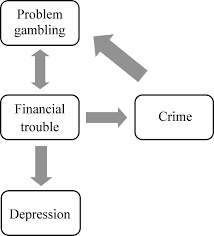
Figure: Relationship of Gambling to financial troubles, depression and crime.
The gambler needs money not only for gambling but also for his basic necessities for living. However, the money gained through criminal activity only accelerated gambling. In most of the property crimes, the majority of the stolen money was consumed by gambling. The money, therefore, did not to serve either to solve the financial trouble or to maintain a certain desired means of life. This cycle continued as long as the opportunity for the crime remained, and or person was not caught31.
Conclusion
There is a huge market of gambling in India, but most of the fall in an illegal domain. This term Paper starts with five research questions, which all are answered. Our main aim of the study is to gain more knowledge about the different types of gambling, how they practised in India and what is the positive and negative impact of it on the economy. This term paper also includes the deep study of economic, political and legal dimension with recent case laws and briefly it also discussed the relationship between the gambling and crime. This term paper also comprises of laws under which the gambling is conducting. Every state has the power to make laws and Acts to control gambling in their territory. From the economics perspective, our main aim of this study is to decide all the economic factors that are important to be considered when studying the effect of gambling in the country. The three main factors which directly get impacted due to gambling are Social factor, Employment and Public revenue.
Social Factors: The availability of casinos and lotteries increase the suicidal thoughts in the mind of gamblers when he/she is in depression this further increase the mortality rate, on other hand casinos and lotteries generate employment and income, which increase the economic well being of person, this lead to decrease in the mortality rate.
Employment: After legalizing the lotteries, casinos and horse racing by the government, it generates great employment opportunity for tribal population. Providing employment can keep them away from other unlawful activities which they commit to fulfilling their basic needs and it further helps to decrease the crime rate in the country.
Public Revenue: Casino and lotteries businesses are subject to taxation and therefore have a direct impact on public revenue. Insofar as casinos generate additional business income as casino owner annually has to pay a certain amount of money for usage of land and they also have to pay renewal fees for their licensee annually, this directly increases the state revenue. Casinos might indirectly affect public revenue as well.
The government can make gambling more effective by enforcement of proper laws to legally regulate it and Complaint filed by citizen related to gambling fraud must be treated like other frauds. Private agencies should publish data about gambling activities which make people aware of the frauds. The persons should do gambling only after acquiring the proper information about the casinos in which he/she going to invest.
At last, a major issue common across all forms of legalized gambling is the efficiency costs associated with the established market structure. Any explicit limitation on entry into a market imposes a deadweight economic loss on society. Future research should investigate the consequences of this market structure for consumers. Many important economic issues remain to be studied and additional rigorous research is needed. The issue of substitutability across gambling types has been widely addressed in the literature but is still not entirely cover.
*****
Footnotes
2. Gambling, N. (2019). Social and Economic Effects. NCBI, (Apr. 23, 2021, 02:46 PM) https://www.ncbi.nlm. nih.gov/books/NBK230628/] ↑
3. Palai, N. (2006). [online] Helsinki.fi. Available at: http://www.helsinki.fi/iehc2006/papers1/Mishra24.pdf [Accessed on 26th June 2020] ↑
4. Shalina Pillai, “Now, online gaming is a career for some”, (25th June 2020) available at: https://timesofindia.indiatimes.com/india/now-online-gaming-is-a-career-forsome/articleshow/64056984.cms ↑
5. Study by KPMG and Google, online gaming in India: Researching a new Pinnacle, May 2017. See also https://www.stoodnt.com/blog/career-in-online-gaming/[Accessed on 25th June 2020] ↑
6. Morse, E.A. (2006). Extraterritorial Internet Gambling: Legal Challenges and Policy Options. [Accessed on 26th June 2020] ↑
7. Ranade, S., S. Bailey, and A. Harvey. 2006. A literature review and survey of statistical sources on remote gambling. [Accessed on 27th June 2020] ↑
8. Ranade, S., S. Bailey, and A. Harvey. 2006. A literature review and survey of statistical sources on remote gambling[Accessed on 27th June 2020] ↑
9. Rbi.org.in. (n.d.). Reserve Bank of India - State Finances: A Study of Budgets. [online] Available at: https://rbi.org.in/Scripts/AnnualPublications.aspx?head=State%20Finances%20:%20A%20Study%20of%20Budgets[Accessed on 27th June 2020] ↑
10. Pandey, A. (2017). Why is betting on horse racing legal in India? - iPleaders. [online] iPleaders. Available at: https://blog.ipleaders.in/betting-horse-racing-legal-india/[Accessed on 28th June 2020] ↑
12. Somasekhar, M. (2018). Turf clubs worried over GST ‘hurdle’. [online] @businessline. Available at: https://www.thehindubusinessline.com/news/sports/turf-clubs-worried-over-gst-hurdle/article9709967.ece [Accessed on 28th June 2020] ↑
13. Aggarwal, N. (2017). Are Casinos Legal in India. [online] iPleaders. Available at: https://blog.ipleaders.in/casinoslaws-india/[Accessed on 28th June 2020] ↑
15. "The Economic and Social Effects of Casinos." Gambling: What's at Stake?. . Retrieved june 28, 2020 from Encyclopedia.com: https://www.encyclopedia.com/reference/social-sciences-magazines/economic-and-socialeffects-casinos [Accessed on 25th June 2020] ↑
16. Ssrana.in. (n.d.). Gambling Laws in India. [online] Available at: https://www.ssrana.in/Intellectual%20Property/Gambling-laws/Gambling-laws-in-India.aspx[Accessed on 27th June 2020] ↑
17. Desai, N. (2018). The Curious Case of the Indian Gaming Laws. [online] Nishithdesai.com. Available at: http://www.nishithdesai.com/fileadmin/user_upload/pdfs/Research%20Papers/The_Curious_Case_of_the_Indian_G aming_Laws.pdf[Accessed on 29th June 2020] ↑
18. Desai, N. (2018). The Curious Case of the Indian Gaming Laws. [online] Nishithdesai.com. Available at: http://www.nishithdesai.com/fileadmin/user_upload/pdfs/Research%20Papers/The_Curious_Case_of_the_Indian_Gaming_Laws.pdf[Accessed on 25th June 2020] ↑
19. Entry No. 32 of List II (i.e. State List) deals w ith betting and gambling. Entry No. 62 of List II (State List) deals w ith taxes on luxuries, including taxes on entertainments, amusements, betting and gambling. [Accessed on 28th June 2020] ↑
20. Section 67 of the Information Technology Act, 2000, [Accessed on 28th June 2020] ↑
21. Regulating Sports Betting in India: FICCI available at :http://blog.ficci.com/sports-bettingindia[Accessed on 28th June 2020] ↑
22. Heydary, J. (2005). Advertising for Online Gambling – Is It Legal? Accessed from www.heydary.com/publications/online-gambling-laws.html[Accessed on 25th June 2020] ↑
23. McMillen, J. (2000). Online gambling: Challenges to national sovereignty and regulation. Prometheus, 18(4): 391-401. [Accessed on 29th June 2020] ↑
24. MacKay, T. (2004). Internet Gambling in Canada Waits in Legal Purgatory. National Policy Working Group: Policy Discussion Document ↑
25. 318 U.S.C. 1955[Accessed on 25th June 2020] ↑
26. 531 U.S.C. 5361 et seq. [Accessed on 28th June 2020] ↑
27. 31 U.S.C. 5362[Accessed on 25th June 2020] ↑
28. 631 U.S.C. 5366(a), 18 U.S.C. 3571. [Accessed on 29th June 2020] ↑
29. Review of current and future trends in interactive gambling activity and regulation, Literature Review, Report to the Australian Government Department of Families, Housing, Community Services and Indigenous Affairs, by the Allen Consulting Group, June 2009, p. 38. [Accessed on 26th June 2020] ↑
30. Williams, R.J. & Wood, R.T., Internet Gambling: A Comprehensive Review and Synthesis of the Literature, Report prepared for the Ontario Problem Gambling Research Centre, Guelph, Ontario, Canada, 2007, p. 38. [Accessed on 27th June 2020] ↑
31. Lind, K. and Kääriäinen, J. (2015). From problem gambling to crime? Findings from the Finnish National Police Information System. [online] Jgi.camh.net. Available at: https://jgi.camh.net/index.php/jgi/article/down load/3920/4044 [Accessed on 230th June 2020] ↑