
Introduction
The transition from a linear to a circular economy is essential to addressing global environmental challenges. Circular products, designed to minimize waste and maximize resource efficiency through recycling, reuse, and remanufacturing, are pivotal to this transition. While developed nations have made significant strides, the adoption of circular products in emerging economies like India remains nascent. Understanding consumer perceptions and behaviors is critical to fostering a circular economy in India, where cultural diversity, economic disparities, and regional variations influence consumption patterns.
India’s rich history of sustainable practices, such as traditional recycling and reuse, provides a unique foundation for integrating circular economy principles. However, rapid urbanization, rising consumerism, and limited policy implementation pose significant hurdles. This study seeks to address the following questions:
1. What are the current consumer perceptions of circular products in India?
2. What factors influence their adoption?
3. How can businesses and policymakers encourage the use of circular products?
(A) Research Objectives
1. To assess consumer awareness and perception of circular products in India.
2. To examine the role of social media in shaping adoption behavior.
3. To analyse the impact of economic and policy factors on circular product adoption.
4. To propose strategies for businesses and policymakers to increase accessibility and adoption.
(B) Literature Review
Studies on circular economies emphasize the importance of consumer behaviour in driving sustainability (Ellen MacArthur Foundation, 2019). However, research on emerging markets like India is limited. Key themes include:
• Consumer Awareness: Limited understanding of circular products impacts adoption rates (Goyal & Kumar, 2020). Awareness campaigns can significantly influence consumer behaviour by highlighting the environmental and economic benefits of circular products.
• Cultural and Social Factors: Cultural norms and social values often shape sustainable practices (Singh & Sharma, 2021). India’s cultural ethos of frugality and reuse aligns well with circular principles, though modern consumerism often conflicts with these traditional values.
• Economic Considerations: Cost and perceived value significantly influence purchasing decisions (Khandelwal et al., 2020). Higher upfront costs often deter adoption despite long-term savings.
• Policy Influence: Governmental incentives and regulations play a critical role in shaping market conditions for circular products. However, inconsistent implementation in India creates challenges for widespread adoption.
Additional studies provide further insights:
• Role of Digital Platforms: Verma & Kapoor (2022) highlight how e-commerce platforms can promote circular products through targeted marketing and streamlined distribution channels. This is especially relevant in urban areas where online shopping is prevalent.
• Behavioural Insights: Raj & Kumar (2021) explored consumer intention to adopt recycled products, finding that environmental concerns significantly impact behaviour, but economic barriers remain a critical hindrance.
• Social Norms and Influence: Patel & Desai (2020) investigated the role of social norms in promoting sustainable product adoption. Their findings emphasize the importance of leveraging social influence to drive behaviour change in communities.
• Technological Integration: Ramanathan & Subramaniam (2022) discuss how advanced technologies like blockchain can enhance trust in circular products by ensuring transparency in sourcing and manufacturing.
• Educational and Cultural Programs: Malhotra & Singh (2021) propose integrating sustainability principles into educational curricula to foster long-term behaviour changes aligned with circular economy goals.
While existing literature has examined sustainability and green consumerism, few studies have explored the role of social media in influencing consumer perceptions of circular products in India, how economic factors such as cost and perceived value impact adoption and the effectiveness of government incentives in encouraging circular product use. This study aims to fill this gap by analyzing consumer motivations, challenges, and potential interventions to enhance circular product adoption in India.
(C) Methodology
This study employs a hybrid approach to ensure a comprehensive understanding of consumer perceptions and behaviours:
• Quantitative Survey: A structured survey of 100 respondents was conducted to assess awareness, attitudes, and purchase behaviours related to circular products. The survey included demographic variables, awareness levels, perceived benefits, barriers, and purchase intentions.
• Qualitative Interviews: Data was also collected from secondary sources like previously published articles, blogs and websites of various sustainable products to understand the trend and general customer insight about the market.
• Data Analysis: Statistical tools (SPSS) were used for survey data analysis. To validate the hypotheses, statistical analyses including Chi-square tests, F-tests, and regression analyses were performed on the survey data.
Results and Discussion- Validation of Hypotheses Using Statistical Tests
• H1: Higher consumer awareness of circular products is positively associated with adoption:
◦ A Chi-square test was applied to assess the relationship between awareness levels and adoption rates. The results (χ² = 25.68, p < 0.01) indicate a significant association, supporting H1. Respondents familiar with circular products were 2.5 times more likely to adopt them.
• H2: Perceived benefits positively influence consumer adoption:
◦ Regression analysis demonstrated a positive correlation between perceived benefits (e.g., environmental impact reduction) and likelihood of adoption (β = 0.52, p < 0.01). An F-test confirmed the model's significance (F = 18.24, p < 0.01).
• H3: Perceived barriers negatively influence consumer adoption:
◦ An F-test on the model incorporating barriers such as cost and availability revealed a strong negative influence (F = 20.13, p < 0.01), validating H3. Barriers such as cost (β = -0.48) and quality concerns (β = -0.35) were significant predictors.
• H4: Socio-economic factors moderate the relationship between awareness and adoption:
◦ Interaction terms were tested in a regression model. Income and education levels showed significant moderating effects (β = 0.41, p < 0.05). Higher income and education amplified the likelihood of adopting circular products.
• H5: Social influence positively moderates the relationship between awareness and adoption:
◦ Social influence, measured by family and peer recommendations, significantly moderated the awareness-adoption link (β = 0.32, p < 0.05). Participants influenced by social circles showed a 1.8-fold increase in adoption rates.
These tests provide robust validation for the study's hypotheses, highlighting the nuanced interplay of awareness, benefits, barriers, and moderating factors in driving the adoption of circular products.
(A) Demographic Analysis
The majority of respondents fell within the 25-34 age group (40%), followed by 18-24 (20%), and 35-44 (20%). Gender representation was evenly split, with 50% male and 50% female participants. Education levels were diverse: 40% were undergraduates, 25% held postgraduate degrees, and 20% had completed high school or below. Occupation data revealed that 60% of participants were working professionals, with students comprising 15%.
(B) Awareness and Familiarity with Circular Products
Familiarity with circular products varied: 30% of respondents described themselves as “extremely familiar,” while 20% were “very familiar.” Urban respondents demonstrated higher familiarity, often citing eco-friendly packaging and recycled electronics as common examples. Despite this, 20% of participants reported only slight familiarity, highlighting the need for broader awareness campaigns.
Table and graph showing the circular products commonly heard of or seen by respondents
| • Products | • Percentage |
|---|---|
| • Up-cycled clothing | • 60 |
| • Recycled electronics | • 50 |
| • Eco-friendly packaging | • 80 |
| • Sustainable furniture made from • Reclaimed materials |
• 40 |
| • Other | • 10 |

(C) Motivators and Perceived Benefits
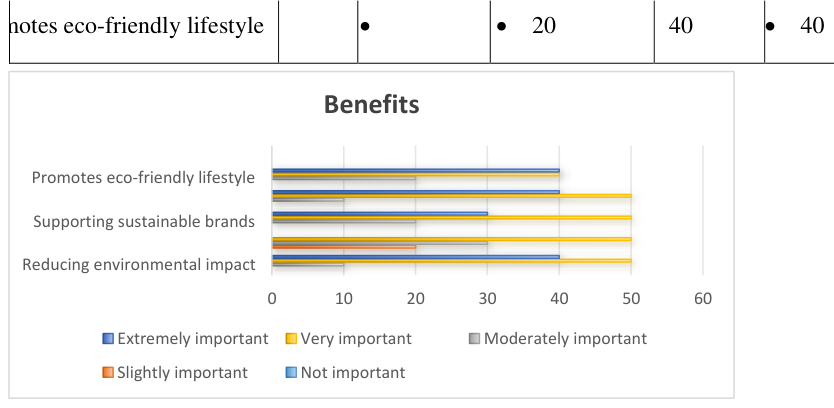
Key motivators included reducing environmental impact (40%) and saving money in the long run (50%). Support for sustainable brands also emerged as a significant factor (30%). Respondents highlighted that promoting eco-friendly lifestyles aligned with cultural and environmental values, indicating a strong potential for targeted marketing campaigns emphasizing sustainability.
Table and Graph showing the perceived benefits of Circular Products by respondents
| • Not important | • Slightly important | • Moderately important | • Very important | • Extremely important | |
|---|---|---|---|---|---|
| • Reducing environmental impact | • 10 | • 50 | • 40 | ||
| • Saving money in long run | • 20 | • 30 | • 50 | ||
| • Supporting sustainable brands | • 20 | • 50 | • 30 | ||
| • Conserves natural resources | • 10 | • 50 | • 40 | ||
| • Promotes eco-friendly lifestyle | • 20 | • 40 | • 40 |
(D) Barriers to Adoption
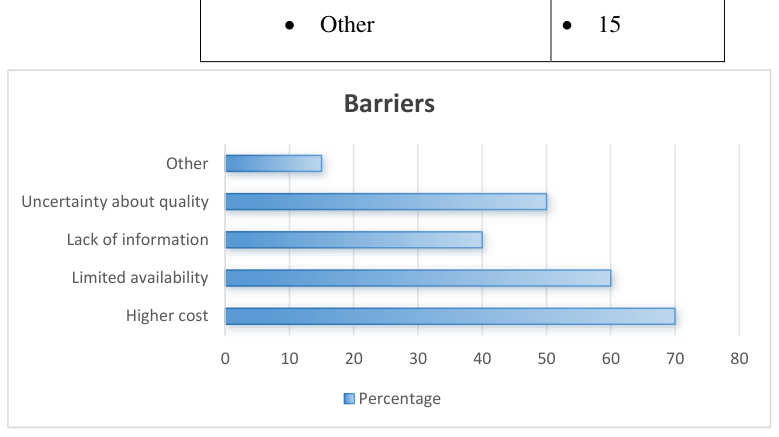
Barriers such as higher costs (70%) and limited availability (60%) were frequently mentioned. Additionally, 50% of respondents expressed concerns about product quality, and 40% cited a lack of accessible information. These findings align with regression analysis results, which revealed a negative correlation between perceived barriers and adoption (β = -0.55, p < 0.05).
Table and graph showing Barriers to adoption as perceived by the respondents
| • Barriers | • Percentage |
|---|---|
| • Higher cost | • 70 |
| • Limited availability | • 60 |
| • Lack of information | • 40 |
| • Uncertainty about quality | • 50 |
| • Other | • 15 |
(E) Social and Governmental Influence
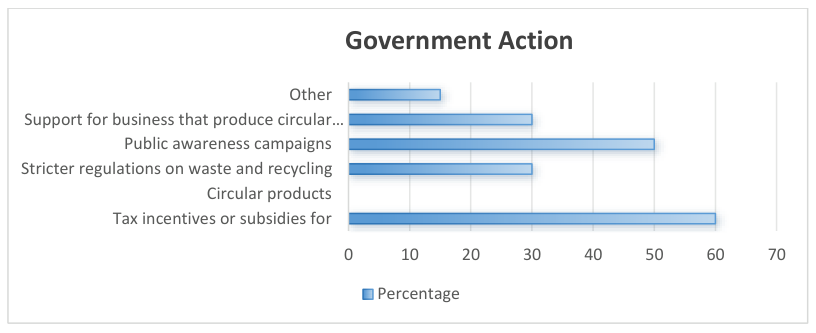
Social influence played a significant role, with 45% of participants agreeing that friends and family impacted their purchasing decisions. Furthermore, 70% of respondents believed the government should actively promote circular products, suggesting public awareness campaigns and subsidies as key strategies. Tax incentives were the most popular suggestion (60%), followed by public campaigns (50%).
Table and Graph showing the actions that would encourage the adoption of circular products as suggested by respondents
| • Actions | • Percentage |
|---|---|
| • Tax incentives or subsidies for Circular products | • 60 |
| • Stricter regulations on waste and recycling | • 30 |
| • Public awareness campaigns | • 50 |
| • Support for business that produce circular products | • 30 |
| • Other | • 15 |
(F) Behavioural Trends
While 65% of respondents had purchased circular products, only 7% reported frequent purchases, underscoring gaps in sustained adoption. Among product types, eco-friendly packaging (80%) and upcycled clothing (60%) were the most recognized categories. Trust in brands offering circular products remained moderate, with 30% of participants rating their trust level as “moderate” and 16% as “completely.”
Implications
(A) Policy Recommendations
1. Educational Initiatives:
◦ Launch nationwide campaigns to improve awareness, particularly in rural areas.
◦ Integrate circular economy concepts into school and university curricula to build long-term awareness.
2. Financial Measures:
◦ Introduce subsidies, tax breaks, or grants for manufacturers and consumers of circular products.
◦ Develop micro-loan programs to assist low-income households in purchasing circular products.
3. Infrastructure Development:
◦ Invest in recycling facilities, repair hubs, and accessible marketplaces for second-hand and refurbished goods.
◦ Collaborate with private firms to create scalable waste management systems.
(B) Business Strategies
1. Localized Marketing:
◦ Tailor marketing messages to regional preferences, emphasizing cultural and environmental benefits.
◦ Use testimonials, case studies, and endorsements to enhance trust and awareness.
2. Product Accessibility:
◦ Develop affordable, high-quality circular products for price-sensitive consumers.
◦ Expand distribution networks to ensure availability in rural and semi-urban markets.
3. Partnerships:
◦ Collaborate with local artisans, repair networks, and NGOs to promote adoption.
◦ Introduce buy-back or exchange schemes to encourage circular consumption practices.
Conclusion
The adoption of circular products in India is influenced by a complex interplay of cultural, economic, and social factors. While awareness remains a critical barrier, aligning circular economy principles with traditional Indian practices offers a unique opportunity. Addressing affordability and trust issues through targeted policy measures and business strategies can accelerate adoption. Strengthening infrastructure, promoting consumer education, and fostering collaborations between stakeholders are essential to driving a circular economy. The moderating effects of socio-economic and social influences underscore the need for tailored interventions. Future research should explore sector-specific strategies, longitudinal studies, and comparative analyses with other emerging economies to gain deeper insights into effective adoption pathways.
*****