
Introduction
Optimal infant and young child feeding (IYCF) practices are among the most effective public health measures for child survival, growth and cognitive development in the first 1,000 days of life (North et al., 2022). The World Health Organization (WHO) recommends initiating breastfeeding within one hour of birth, exclusive breastfeeding for six months, and safe complementary foods from six months with continued breastfeeding up to two years of age or beyond. Proper IYCF boosts immunity, reduces infectious disease and supports better nutritional and developmental outcomes. In India, about 63.7% of infants under six months are exclusively breastfed, but only 45.9% of children aged 6 to 8 months receive complementary foods alongside breast milk, and only about 11% of children aged 6 to 23 months receive a minimum acceptable diet (International Institute for Population Sciences [IIPS] & ICF, 2021; Reddy et al., 2023). These gaps are most concerning in Scheduled Tribe communities, where poverty, isolation, food insecurity and limited healthcare shape child nutrition.
Scheduled Tribes remain among India’s most disadvantaged groups in maternal and child health outcomes. Despite programmes such as the Integrated Child Development Services (ICDS), POSHAN Abhiyaan and the National Health Mission, IYCF improvements have been uneven among tribal communities (Sathiyamoorthy et al., 2026). Jharkhand matters as a study location because its Scheduled Tribe population is among India’s largest and child undernutrition remains high. Community health and social work interventions address both healthcare access and the social factors behind feeding behaviour (Sharma et al., 2020). Anganwadi Workers (AWWs), Auxiliary Nurse Midwives (ANMs) and Accredited Social Health Activists (ASHAs) provide antenatal and postnatal counselling, growth monitoring and nutrition education (Joshi et al., 2024), supported by home visits, community awareness and supplementary nutrition. Evidence on their effectiveness, however, remains scattered across designs and settings.
This paper therefore asks: How effective are community health and social work interventions in improving IYCF practices among Scheduled Tribes in Jharkhand? Its objectives are to identify these interventions, evaluate their effect on breastfeeding and complementary feeding, examine barriers and enabling factors, and identify evidence gaps for research, policy and practice. By synthesising qualitative, quantitative and mixed-methods evidence, the review identifies interventions that work and the contextual factors shaping their implementation (Jahnavi et al., 2025). It is intended to help policymakers, healthcare workers and social workers design culturally competent, evidence-based programmes and to reduce nutritional disparities among tribal communities.
Methodology
A systematic literature review design was adopted (Marzi et al., 2025) and the PRISMA 2020 guidelines were followed throughout. Eligibility criteria were set in advance using the PICOS framework (Hosseini et al., 2024): studies had to concern Scheduled Tribe mothers, caregivers or children aged 0–24 months; examine community health or social work interventions such as nutrition education, counselling, home visits, behaviour change communication (BCC), ICDS, ASHA or Anganwadi programmes; report IYCF, caregiver knowledge or child nutrition outcomes; and be full-text, peer-reviewed, English-language primary studies published between 2019 and 2026. Reviews, editorials, abstracts, protocols and hospital-only or pharmaceutical interventions were excluded.
Since no single database fully indexes this field (Gusenbauer, 2024), PubMed, Scopus, Web of Science, ScienceDirect and Google Scholar were searched, as they hold high-quality peer-reviewed literature on maternal and child health, nutrition, community health and social work. Searches combined controlled vocabulary and free-text keywords through Boolean combinations of terms such as “IYCF”, “community health intervention”, “social work intervention”, “breastfeeding”, “complementary feeding”, “home visits”, “Scheduled Tribes” and “Jharkhand” (Harari et al., 2020). Further records were identified through citation searching, grey literature and hand-searching of the reference lists of eligible studies. After duplicates were removed, manually and in Covidence, titles, abstracts and full texts were screened (O’Dea et al., 2021), and records unrelated to community health or social work interventions, to IYCF or to tribal populations were excluded (Figure 2). Data were extracted on a standardised form (Schmidt et al., 2025) covering author, year, location, design, participants, sample size, intervention, outcomes, main IYCF findings, barriers and facilitating factors. Quality was appraised with the MMAT 2018 (Oliveira et al., 2021), which assesses qualitative, quantitative and mixed-methods studies within one framework. Studies meeting almost all criteria were rated high quality, those meeting most criteria with minor limitations moderate, and those with several weaknesses but continued relevance lower quality. Because the studies were heterogeneous, meta-analysis was inappropriate and findings were synthesised narratively into themes (Buus et al., 2021), following the process shown in Figure 1.
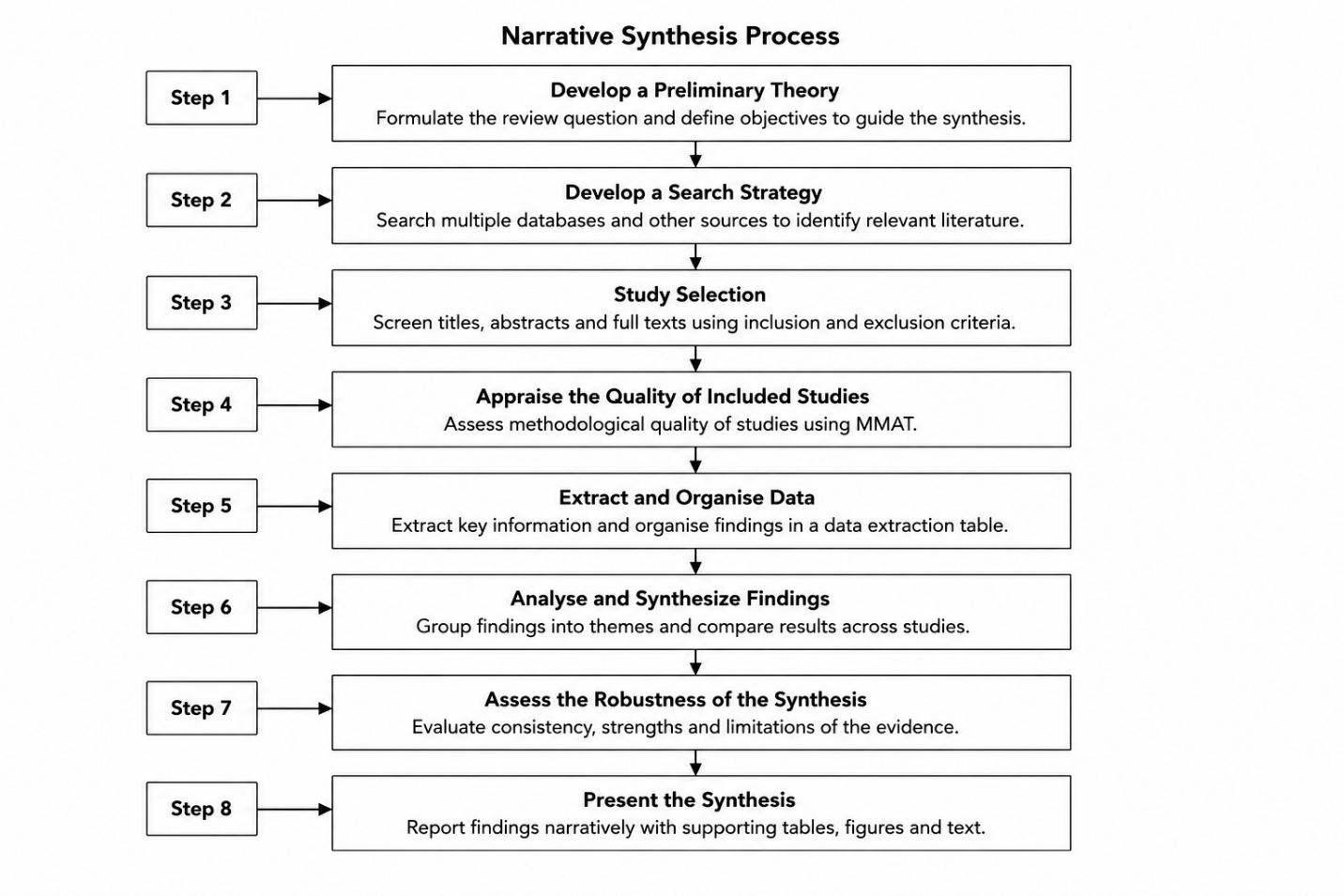
Figure 1: Narrative Synthesis Process
Results
Fourteen studies published between 2019 and 2026 were included (Figure 2; Table 1), all from India, several drawing on nationally representative survey data (e.g., Dhawan et al., 2023; Petrikova, 2022). Cross-sectional designs predominated, particularly on maternal knowledge, complementary feeding and service use, while mixed-methods and qualitative studies illuminated community experiences and the sociocultural barriers to implementation. Quality was moderate to high (Table 2): four quantitative, two qualitative and three mixed-methods studies were rated high, and five cross-sectional studies moderate to high (Harrison et al., 2021). Cross-sectional designs, however, could not establish causality, so their associations should be read cautiously.
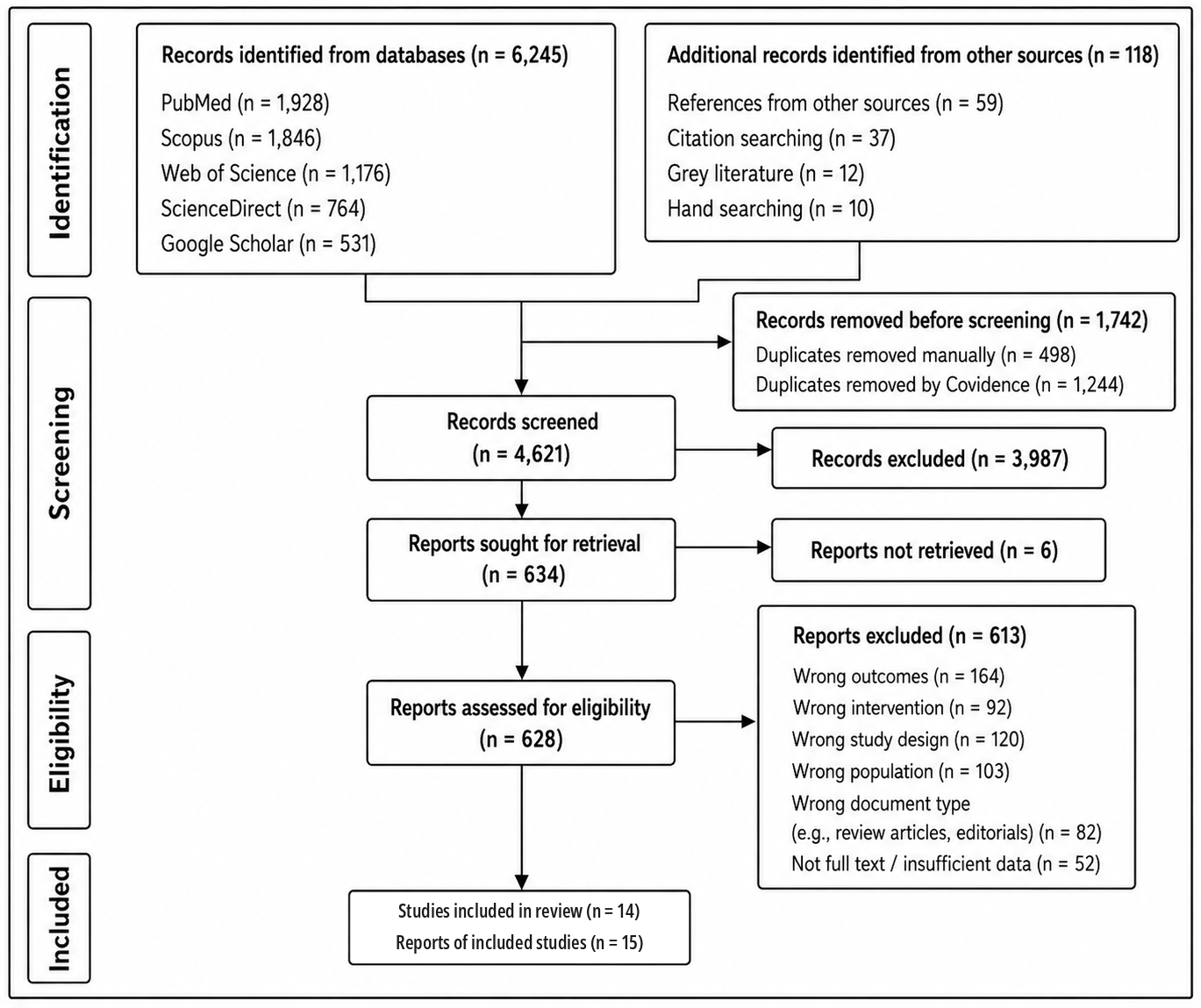
Figure 2: PRISMA 2020 Flow Diagram
| Author Name and Year | Study Methodology | Study Population | Intervention and Focus | Main Outcomes |
|---|---|---|---|---|
| Diamond-Smith et al. (2022) | Cross-sectional | Mothers and caregivers | Respectful community health worker support | Breastfeeding and IYCF practices |
| Petrikova (2022) | Quantitative | National child dataset | Complementary feeding and ICDS | Child nutrition outcomes |
| Rekha et al. (2023) | Quantitative | Tribal children | Nutritional inequalities | Child nutrition indicators |
| Dhawan et al. (2023) | Cross-sectional | Mothers | Behaviour Change Communication | Feeding knowledge and practices |
| Lakhanpaul et al. (2022) | Qualitative | Tribal caregivers | Community experiences | Barriers to IYCF |
| Garg et al. (2023) | Cross-sectional | Tribal households | Mitanin home visits | Dietary diversity and complementary feeding |
| Chaand et al. (2019) | Qualitative | Tribal communities | Community perceptions | Health-seeking behaviour |
| Rekha et al. (2024) | Quantitative | Women and children | RMNCH interventions | Maternal and child health service utilisation |
| Kumari et al. (2025) | Cross-sectional | Pregnant tribal women | Nutrition knowledge and awareness | Knowledge, attitudes and practices |
| Kumar et al. (2025) | Mixed methods | Santhal women | ANC utilisation and counselling | Service utilisation and maternal knowledge |
| Kiran et al. (2026) | Community-based cross-sectional | Mothers of children aged 6–24 months | Complementary feeding education | Knowledge, attitudes and practices |
| Akkiraju (2022) | Mixed-method comparative | Tribal and non-tribal districts | Maternal and child health services | Health inequalities |
| Das et al. (2023) | Mixed-method cross-sectional | Indigenous populations | Maternal and child vulnerability | Child health disparities |
| Panda (2024) | Quantitative | Tribal populations | Nutritional inequality | Child nutritional outcomes |
Table 1: Characteristics of Included Studies
| Study Design | Number of Studies | Overall Quality | Common Strengths | Common Limitations |
|---|---|---|---|---|
| Quantitative | 4 | High | Appropriate statistical analysis, valid outcome measures. | Limited ability to establish causality. |
| Cross-sectional | 5 | Moderate–High | Large samples, relevant public health outcomes. | Potential recall bias, cross-sectional design. |
| Qualitative | 2 | High | Rich contextual evidence, appropriate thematic analysis. | Limited generalisability. |
| Mixed methods | 3 | High | Integration of quantitative and qualitative findings. | Variation in reporting quality. |
Table 2: Summary of MMAT Quality Assessment
A. Theme 1: Community health worker-led interventions
Frontline workers were the main contact with tribal households. More respectful interactions with community health workers were associated with better recall of health messages and greater adoption of recommended feeding practices (Diamond-Smith et al., 2022), and in Chhattisgarh, advice from Mitanin community health workers during home visits was associated with timely complementary feeding, more frequent feeding and greater dietary diversity (Garg et al., 2023). Daily receipt of ICDS food was linked to better complementary feeding and somewhat lower malnutrition (Petrikova, 2022), and wealth- and education-related inequalities in the use of reproductive, maternal, newborn and child health (RMNCH) services among Scheduled Tribes in Jharkhand narrowed between the fourth and fifth National Family Health Surveys (NFHS-4, 2015–16, and NFHS-5, 2019–21), though better-educated and wealthier women still had easier access (Rekha et al., 2024). Among Santhal women, knowledge of antenatal care was a significant determinant of its use, while poor accessibility, affordability, trust and availability of services remained barriers (Kumar et al., 2025). Yet poorer health indicators persisted in tribal areas despite similar institutional delivery and antenatal care coverage (Akkiraju, 2022), and persistent disparities were attributed to poverty, poor infrastructure and socioeconomic disadvantage (Rekha et al., 2023; Das et al., 2023). Sustained contact with frontline workers thus appears more effective than isolated healthcare contacts, but improving IYCF also requires investment in the structural determinants of health.
B. Theme 2: Nutrition education, BCC and social work approaches
Education worked when it went beyond information to continuous counselling and family involvement. Programmes appear most likely to succeed when integrated with wider community health and social work strategies rather than run as isolated awareness campaigns. Exposure to mass media, one channel of BCC, was associated with higher odds of adopting recommended IYCF practices (Dhawan et al., 2023). In Ranchi district, Jharkhand, good maternal knowledge was strongly associated with positive attitudes and good complementary feeding practice, with maternal education and household income as the key determinants, and the authors called for targeted nutrition education and BCC through frontline health workers to translate knowledge into practice (Kiran et al., 2026). Pregnant tribal women in Santhal Pargana had limited nutritional knowledge despite widespread anaemia, and education was the only significant independent predictor of that knowledge, pointing to the need for targeted awareness programmes during pregnancy (Kumari et al., 2025). Family relationships, cultural beliefs and traditions strongly shaped feeding choices, so targeting mothers alone can neglect wider household conditions (Lakhanpaul et al., 2022), and traditional and cultural practices continued to shape care and feeding decisions alongside limited access to and use of local health services (Chaand et al., 2019).
C. Theme 3: Home visits, community participation and integrated support
Mitanin home visits gave caregivers age-appropriate advice on feeding and childhood illness and allowed workers to assess most children’s previous-day feeding and recent illnesses (Garg et al., 2023), and more respectful contact with community health workers was associated with better recall of health messages (Diamond-Smith et al., 2022). Since grandmothers and other family members guide mothers’ feeding decisions, maternal-only education can miss key decision-makers (Lakhanpaul et al., 2022), and community education and engagement were identified as critical to programme success (Chaand et al., 2019). Integrated delivery mattered: full participation in ICDS (food at least weekly, regular preschool attendance and monthly weighing and check-ups) was associated with better feeding practices (Petrikova, 2022), Rekha et al. (2024) called for a multi-dimensional approach to the socioeconomic, cultural and geographical factors that affect access to care, and Akkiraju (2022) stressed the role of behaviour change communication and system strengthening, together with better infrastructure, in improving the use of maternal and child health care.
D. Theme 4: Effects on IYCF practices
Respectful worker support was associated with exclusive breastfeeding (Diamond-Smith et al., 2022), and mass media exposure with early initiation and exclusive breastfeeding (Dhawan et al., 2023). Advice during home visits, daily receipt of ICDS food and good maternal knowledge were associated with better complementary feeding (Garg et al., 2023; Petrikova, 2022; Kiran et al., 2026); higher education was associated with better nutritional knowledge among pregnant tribal women (Kumari et al., 2025); knowledge of antenatal care was associated with greater use of antenatal services (Kumar et al., 2025); and narrowing inequalities in RMNCH service use (Rekha et al., 2024) may create conditions for better IYCF outcomes. Repeated counselling and ongoing community interaction appear to work by building maternal confidence and knowledge. Nevertheless, tribal children remained disproportionately undernourished (Rekha et al., 2023; Das et al., 2023; Panda, 2024), and tribal and non-tribal health gaps persisted despite similar healthcare use (Akkiraju, 2022), showing that food security, education and living conditions must improve alongside health services.
E. Theme 5: Barriers to effectiveness
Poverty, food insecurity and unequal healthcare access were the most powerful barriers (Rekha et al., 2023; Panda, 2024), and indigenous groups remained vulnerable owing to poor living conditions, limited household resources and inadequate basic healthcare (Das et al., 2023). Maternal education was a key determinant of feeding knowledge and practice (Kumari et al., 2025; Kiran et al., 2026), which suggests that education-based interventions reach literate mothers with access to health information more readily than others. Collective family decision-making and embedded community beliefs also limited maternal-focused interventions (Lakhanpaul et al., 2022; Chaand et al., 2019). Long-term change is therefore unlikely unless fathers, grandparents and other influential relatives are involved, which supports culturally aware social work practice that respects local traditions while encouraging evidence-based feeding behaviours.
Discussion
Community health worker-led interventions are the backbone of IYCF improvement in Scheduled Tribe communities. Trust and sustained contact make them more effective than single healthcare encounters, and frontline workers act as facilitators rather than mere information providers. Respectful communication is associated with better recall of the advice on which uptake depends (Diamond-Smith et al., 2022), and advice given during home visits is associated with better complementary feeding (Garg et al., 2023). Their effect is strongest within integrated delivery, as the ICDS findings (Petrikova, 2022) and narrowing access gaps (Rekha et al., 2024) show, consistent with the goals of the National Health Mission and POSHAN Abhiyaan. Greater service availability does not, however, guarantee equal outcomes, since disparities persist among tribal children in disadvantaged areas (Akkiraju, 2022; Das et al., 2023). Equally, knowledge does not automatically become practice: because family structure and culture shape feeding decisions, interventions should involve fathers, grandparents and communities, and social work principles of participation, empowerment and cultural sensitivity offer a useful framework.
A central tension emerges: maternal knowledge and media exposure were associated with better feeding practices (Kiran et al., 2026; Dhawan et al., 2023), yet undernutrition persisted (Rekha et al., 2023; Panda, 2024). Behaviour change cannot overcome poverty, food insecurity and limited food diversity, while transport, cost and inconsistent services restrict access (Kumar et al., 2025; Rekha et al., 2024). Child nutrition must therefore be treated as both a development and a public health issue. The review’s strengths lie in its predesigned criteria, comprehensive search, PRISMA-guided selection (O’Dea et al., 2021), inclusion of diverse designs and MMAT appraisal, which together minimised selection bias and enhanced transparency. It is, however, limited by its English-only, 2019–2026 scope, the few Jharkhand-specific studies and design heterogeneity, which precluded meta-analysis and may limit the extrapolation of findings from other tribal areas. Future research should generate region-specific evidence reflecting Jharkhand’s tribal diversity, use longitudinal designs to test whether gains persist beyond the intervention period, and compare intervention models to identify which combinations of education, home visits, BCC and community participation give the best long-term outcomes.
Conclusion and recommendations
Community health and social work interventions improve IYCF practices among Scheduled Tribes, but their success depends on social, economic and health system conditions. They work best when delivered consistently, grounded in local culture and backed by policies on poverty, education, food security and health system capacity. Frequent home visits, antenatal and postnatal counselling, growth monitoring and uninterrupted community support increased caregivers’ knowledge and service use, and nutrition education worked best when delivered through culturally relevant, community-based methods rather than short-term campaigns. Social work plays a crucial role by empowering families, promoting participation and addressing the wider social factors behind feeding choices, which calls for collaboration between healthcare teams, social workers, local government and community organisations. Accordingly, frontline workers should receive regular training in IYCF guidelines and culturally responsive counselling (Jahnavi et al., 2025), with strong supervision and adequate logistics in remote areas; nutrition, home visits, maternal care and social work support should be integrated in one coordinated model, with health, nutrition and welfare departments cooperating to improve continuity of care; families and community leaders should be actively engaged (Lakhanpaul et al., 2022); multisectoral action should address poverty and food insecurity; and long-term monitoring and longitudinal research should be strengthened (Reddy et al., 2023).
*****