
INTRODUCTION
The concept of dynamic pricing that can be driven by big data and real-time algorithms is one of the key aspects of current e-commerce and revenue management. Even though dynamic pricing provides the seller with the freedom to maximize his/her revenues depending on supply, demand, and other competitive factors, it causes various psychological reactions in the buyer’s behavior. Such reactions include, for example, reference prices, inequity perceptions, strategic postponing, and loss aversion. The goal of this study is to combine theoretical insights and empirical evidence on behavioral aspects associated with dynamic pricing with actual data collected from Indian customers.
Review of literature
The paper Dynamic Pricing in the Presence of Reference Price Effect and Consumer Strategic Behaviour studies how the use of dynamic pricing strategy by sellers will be affected by the reference price effect and the consumer strategic behavior. With the help of a mathematical model developed by the authors, it is illustrated that although the reference price effect might be advantageous for a business due to its positive impact on consumer perception of product value, the consumer strategic behavior lowers down these advantages as consumers tend to postpone purchase of goods or services in expectation of further reduction in price. A major conclusion reached by the authors is that when the effects of the RPE and CSB coincide, it is better for businesses to pursue a markdown skimming strategy. What makes markup strategy unprofitable for a firm is its ability to eliminate all the positive consequences of the reference price effect.
This paper Dynamic Pricing in the Presence of Strategic Consumers and Oligopolistic Competition provides a common stochastic dynamic game framework to examine the intricacies involved in dynamic pricing in a monopolistically competitive market environment, where the consumers exhibit strategic behavior. While other studies have assumed myopic behavior on part of the consumers, this paper incorporates the behavior of consumers who discount their utility over time and may decide not to purchase when prices are expected to fall due to available capacities. It has been shown that there exists a unique subgame perfect equilibrium in such an environment. The key finding in the paper is that not incorporating strategic behavior can result in a loss of up to 30% of profits. An important insight provided by this paper is that limiting the information about capacity availability to consumers may result in higher profits than merely reacting to their strategic behavior.
In this article titled Dynamic Pricing Strategies with Reference Effects, the question of dynamic pricing by a monopolist under conditions where there exists a reference price because of dependence of the consumer demand on historical prices is considered. Under the assumptions of the prospect theory, the paper models purchases as being based on discount/surcharge with respect to the reference price. The main result obtained by the authors is that the optimal pricing policies involve a mechanism that aims at sustaining the idea of monotonicity of the prices; thus, there can be either a penetration or skimming pricing policy. In addition, it is shown that if consumers are loss averse, i.e., the utility of price increase is less than that of price decrease, then, in the end, the optimal price will approach a certain constant value (steady state).
The current empirical research Effects of Price Framing on Consumers’ Perceptions of Online Dynamic Pricing Practices seeks to analyze the potential of the use of certain pricing strategies aimed at decreasing consumers' negative attitudes toward dynamic pricing in e-commerce. In particular, the authors prove the hypothesis that framing price differences as discounts/rewards for other people rather than surcharges for themselves leads to a heightened perception of dissimilarity of transactions and thus decreased price unfairness perceptions among consumers. If the perceived dissimilarity of transactions is high (i.e., there is a noticeable difference between transactions in terms of when they occur or membership status), consumers tend to experience fewer feelings of being charged an unfair price for their purchases. Thus, appropriate framing of price difference improves the level of consumers' trust and intentions to make subsequent purchases.
In this paper Effects of Price Framing on Consumers’ Perceptions of Online Dynamic Pricing Practices, the problem of compatibility between highly differentiated tariffs like differential road pricing and the consumer ability to interpret these signals is discussed. Using theoretical concepts from the field of Prospect Theory and Bounded Rationality together with evidence from the telecommunication industry, the paper investigates how people make use of heuristics in their decision-making processes. As it turns out, the consumers prefer simplicity of tariffs greatly; however, if the structure of the tariff is understandable, people can interpret complicated tariff structures successfully. Nevertheless, if the signal is too complicated, it will yield a bad outcome or even no usage of the offered good at all. This paper is important as far as it brings about new conclusions that can be used by government policy-makers for successful implementation of dynamic road pricing systems.
The present study Price Fairness and Its Linear Dependence on Consumer Attitude focuses on antecedents to price fairness and how the same affect consumer attitudes and perceptions with a comparison made between metro and non-metro city consumers of India. Based on extensive literature review, there are nine key variables identified that play an important role in affecting consumer perception related to fairness of prices, such as price transparency, reliability, and price relative. Using the tools of linear regression and z-tests, a positive relationship is identified between consumer perceptions of price fairness and overall consumer attitudes. It was found interesting that the study found variation in behavior between metro and non-metro consumers, indicating that metro consumers probably have a different perspective when it comes to pricing procedures and practices.
This paper Price Guarantees in Dynamic Pricing and Revenue Management presents a model of revenue management whereby dynamic pricing is accompanied by a price guarantee mechanism that safeguards the consumers against any future price reductions. In case the price of the product drops below a certain “strike price” level after purchase, the customer receives some form of compensation for the price difference. Viewing the problem as one of optimal discrete time control, the researchers establish that there exists an optimal strategy that sets prices and price guarantees simultaneously. The findings suggest that the use of such a mechanism can effectively counter the effects of strategic behavior on the part of consumers by offering them the assurance to buy early. The numerical study shows that the mechanism can generate significant profits in cases of perishable products with fixed stocks.
The review article under consideration Pricing Practices: A Critical Review of Their Effects on Consumer Perceptions and Behaviour thoroughly analyzes six different pricing mechanisms based on behavioral economics: drip pricing, reference pricing, the concept of "free," bait pricing, bundling, and limited-time offers. In particular, the authors demonstrate the way in which consumers can be manipulated via various psychological tricks, including anchoring effects and the commitment principle. Thus, drip pricing implies concealing information about the total price up until the final stages of negotiation, whereas bait pricing entices customers through the provision of low-price products that might not even be available at all. It should be mentioned that "free" offers have a considerable effect in terms of capturing consumer interest and stimulating purchases that would not have been made otherwise.
This paper Dynamic Pricing and Consumer Fairness Perceptions investigates through the means of three separate studies how price differentiation, which can be done by means of selling, consumption, timing, or auctions, affects the perception of fairness and purchase satisfaction. With technological development increasing opportunities for individual-based price discrimination, the authors point out the threat of such practice resulting in dissatisfaction and reduced profits due to negative fairness perception on the part of customers. The results indicate that consumers react strongly to the reason behind a price differentiation, where price differentiation based on time is perceived as fairer than consumer-based one. The study reveals the "dark side" of price discrimination, which can have significant negative effects due to consumers' perceiving prices as unfair and therefore purchasing less or not coming back again.
In the study The Dark Side of Good Reputation and Loyalty in Online Retailing, the researchers examine the surprising phenomenon where consumers with a high degree of loyalty toward a brand or business entity and those who exhibit the highest level of trust in a retailer might respond in a manner opposite to what would be expected, resulting in adverse responses towards dynamic pricing. From data collected among 997 participants, this study examines how feelings of price inequity result in consumers' actions of retaliating against price changes through online mechanisms and "revenge intentions." Among the results of this study is the observation that in reputable companies, dynamic pricing can be viewed as a betrayal of trust and that customers with a high degree of loyalty will respond to the changes with greater ferocity compared to less loyal patrons. The study uses moderated mediation analysis to reveal that competence trust mediates these responses.
This paper Dynamic Pricing in the Presence of Inventory Considerations: Research Overview, Current Practices, and Future Directions conducts an extensive review of dynamic pricing literature, with particular emphasis on the cases when sellers control inventory levels. First, the authors emphasize the growing popularity of dynamic pricing, which despite its early emergence in the airline industry due to a need to manage fixed and perishable capacity is now being adopted by retailers owing to availability of better demand data, price-changer technologies, and better decision support tools. Second, the paper classifies dynamic pricing models according to consumer behavior ("myopic" or "strategic") and ability (yes or no) to replenish inventories. Third, a common theme explored in this paper is the difficulty of identifying the "right" price point as it requires substantial understanding of consumers' valuation and forecast of future demand. Finally, the authors identify one of the gaps in existing research – the mismatch between theoretical models and "real-world" solutions – and recommend focusing on heuristic algorithms applicable to large-state spaces in real-life situations where inventories are transferred. Optimal Dynamic Pricing Problem Considering Patient and Impatient Customers' Purchasing Behaviour. In this paper, the authors look at optimal dynamic pricing in light of different buyer types: "impatient" consumers purchasing immediately and "patient" consumers waiting until the price drops
ANALYSIS
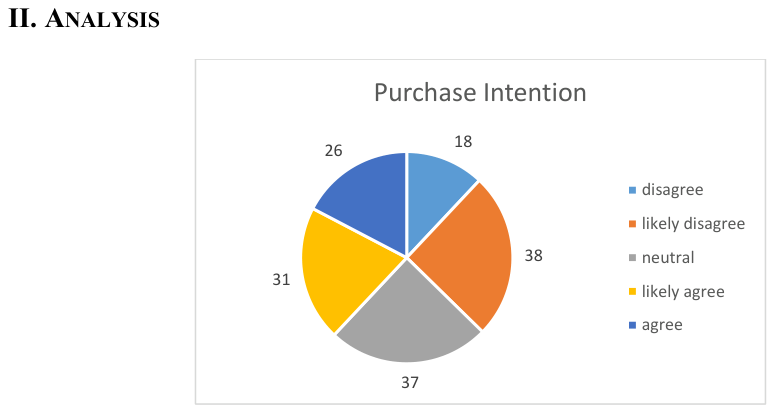
Purchase intention appears moderately positive but not overwhelmingly strong, suggesting that while some consumers are willing to proceed with purchases under dynamic pricing, a significant portion remains hesitant. This hesitation is closely tied to perceptions of fairness and trust.
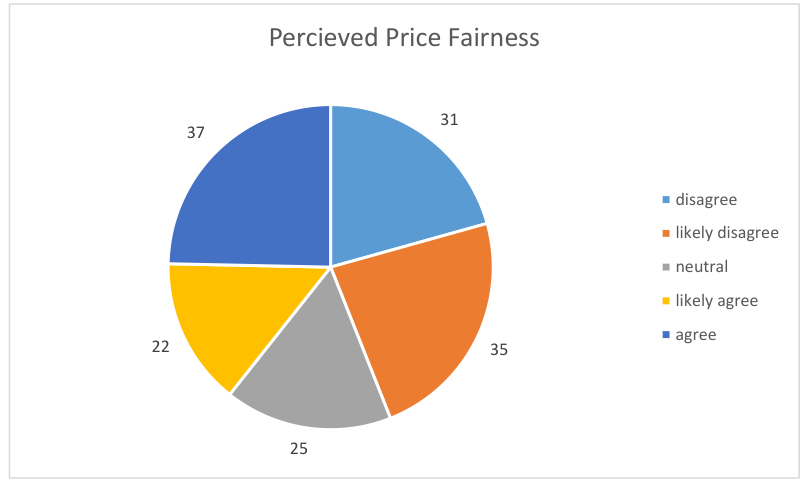
Price fairness perception results show a fairly even distribution of answers, but there is a slight tendency towards “agree” (37) and “likely to disagree” (35). It shows that certain customers perceive the pricing system as being acceptable, while others do not agree with it. These differences influence the willingness to purchase.
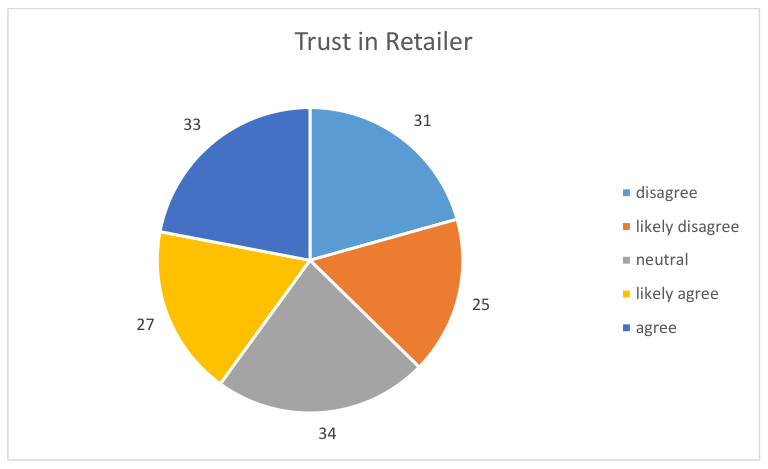
Trust in the retailer, shows a relatively balanced distribution, with “neutral” (34) and “agree” (33) dominating. This suggests that while trust is not critically low, it is not strong enough to fully reassure customers about algorithmic pricing practices. The presence of notable disagreement also implies concerns about ethical use of personal data, which can dampen willingness to purchase.
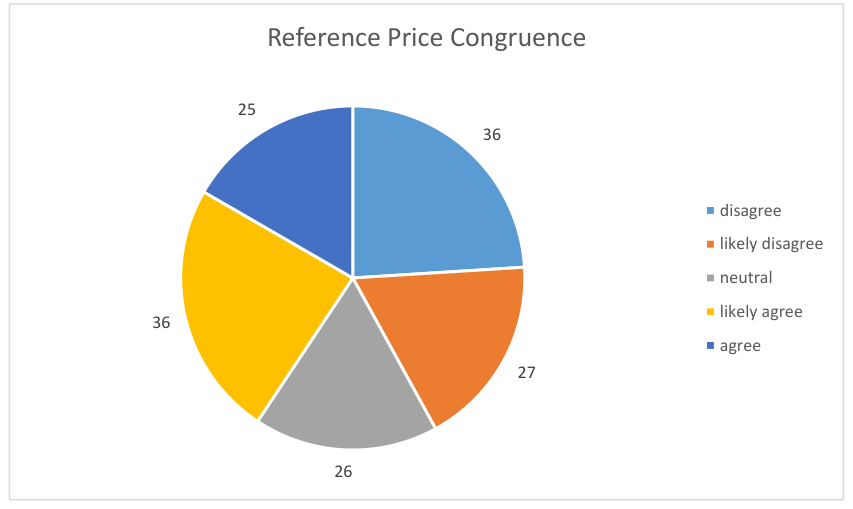
Price congruency, the answers tend towards agreement ("likely agree" = 36), suggesting that many consumers perceive congruency between their expectations and the price level. Price congruency, the answers tend towards agreement ("likely agree" = 36), suggesting that many consumers perceive congruency between their expectations and the price level.
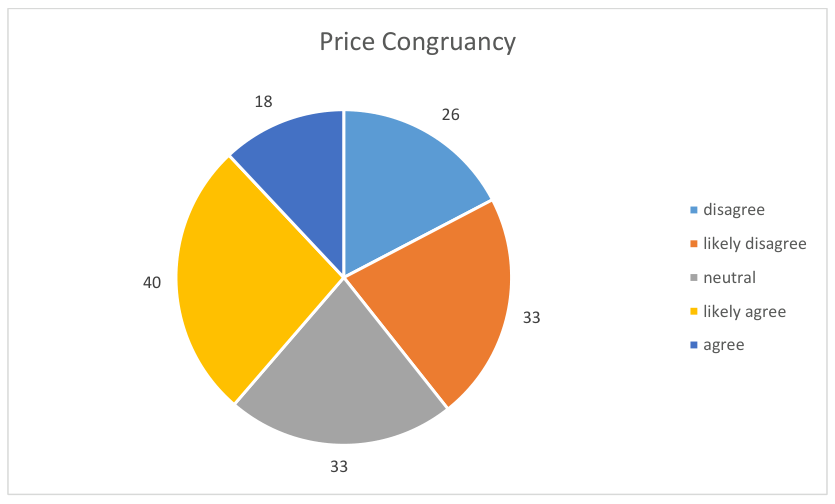
Price transparency, otherwise known as price congruency in the graph below, shows an indication that even though some consumers may be happy with having reasons behind price differences, it does not seem to be totally transparent yet. Improvement in this area would go a long way in ensuring fairness..

Strategic Waiting Tendency demonstrates a distinct tendency to be ready to wait before purchasing goods. Thirty-five respondents disagree ("I don't wait strategically"), but thirty-four respondents probably agree, and twenty-nine respondents agree ("I usually wait for cheaper prices"). Thirty-one respondents are neutral, and twenty-one respondents probably disagree with this statement. Thus, the number of people who are prone to strategic waiting behavior—waiting before purchasing goods hoping to receive cheaper prices—is quite substantial.
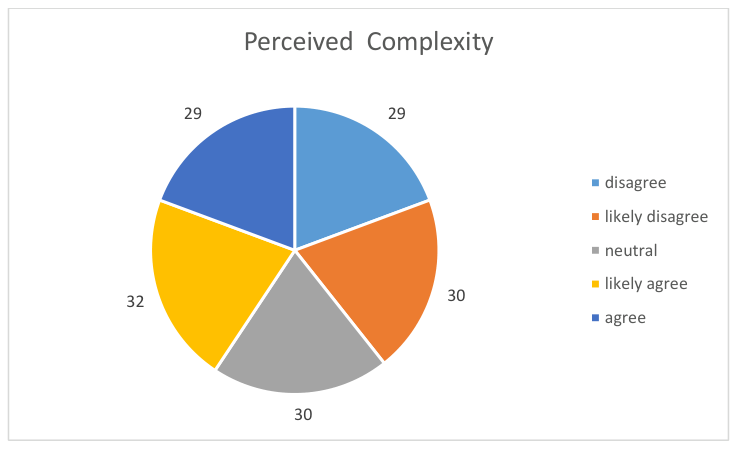
Complexity of Dynamic Pricing is relatively evenly distributed but slightly skewed towards acceptance. There are 32 consumers who are likely to agree and another 29 who agree that dynamic pricing is complex. On the other hand, there are 30 consumers who are neutral about its complexity, 30 who are likely to disagree and 29 who strongly disagree. This implies that although most consumers consider dynamic pricing complex, there are still those who do not find it very complex.

The Loss Aversion category exhibits a moderate inclination among the respondents. Thirty-eight people agree, while twenty-nine others tend to agree with the question on whether they experience loss aversion when the price varies dynamically, which implies their discomfort with overpayment or getting less value for money spent (Stern et al.). On the other hand, thirty-two people tend to disagree, while twenty-nine others disagree with this statement, while twenty-two are neutral regarding the issue.

Loyalty Program Value comes out as another important positive influence. This is evident from the large number of people (39) who disagree and those (39) who are likely to agree that loyalty programs bring considerable value especially in relation to dynamic pricing. On the other hand, only 18 people are likely to disagree, while 26 agree. However, taking into account the size of colored circles, it should be noted that the largest segments of the pie chart include dark blue 39 and yellow 39, while neutral 28 and orange 18 are much smaller. This indicates the importance of consumers' perceptions of loyalty programs as an effective means of offsetting negative consequences of dynamic pricing or rewarding themselves regardless of price changes.
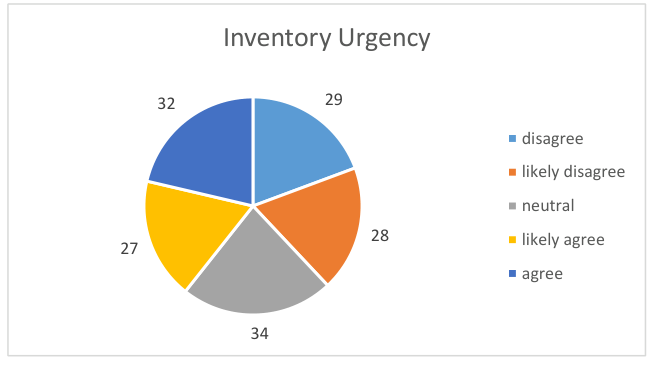
The Inventory Urgency attitude demonstrates a strong tendency towards neutral and positive emotions. Neutral responses were 34, agreeing responses were 32, disagreeing were 29, likely disagreement was 28, and likely agreement was 27. It can be seen that a number of customers are not strongly feeling or denying any urgency from inventory levels in dynamic price strategies.
The Regression Equation Analysis
The equation Y = 2.92 - 0.016*X1 - 0.043*X2 + 0.047*X3 - 0.009*X4 + 0.007*X5 + 0.004*X6 + 0.003*X7 - 0.028*X8 + 0.02*X9
Dependent Variable (Y)
Purchase Intentions: Considering the price shown now, there is a great probability of making this purchase today.
Independent Variables (X)
1. Price Perceived As Fair (X1): I feel that the price being charged to me is fair relative to what other people are paying for this product.
2. Trust In Retailer (X2): There is a belief that the retailer uses pricing algorithm fairly rather than only to take advantage of my personal information.
3. Price Reference Congruence (X3): The current price is congruent with my expectation of this product price.
4. Price Transparence (X4): The retailer explains why the price was different.
5. Strategic Waiting Bias (X5): I think that if I do not buy it now but wait, I will be able to get it for much less money soon.
6. Cognitive Ease (X6): The present pricing system and all the discounts involved are easily understood and calculated by me.
7. Loss Aversion (X7): If I were to purchase this product right away and then found it available at a cheaper price next day, I would have felt much remorse.
8. Rewards vs. Discounts Bias (X8): Being a loyal customer gives me a sense that I am getting rewarded with this reduced price and not being overcharged with a surcharge price.
9. FOMO Bias (X9): My need for immediate purchase of this product overrides my need for waiting, fearing that the product might run out of stock.
Several key insights regarding Purchase Intention (Y):
• Dominant Predictors: Reference Price Congruence (X3), the variable with the highest coefficient (+0.047), shows the greatest impact. In effect, this means that purchase intention will be higher if price matches the consumer’s price expectation, as compared to any other influence. On the other hand, the negative value of Trust in Retailer (X2; -0.043) makes sense given “The Dark Side of Reputation,” where high trust leads to greater betrayal and lower purchase intent as a consequence of fluctuations in pricing.
• Low Predictors: Inventory Urgency (X9) and Complexity (X6), which are associated with small coefficients, seem to contribute little toward purchase intention among consumers.
• Intercept Value: The intercept of 2.92 reflects the base rate of purchase intention when other psychological variables are at zero, although the baseline of purchase intention is still low in the context of a 1-10 Likert Scale.
Interpretation of Diagnostic Charts
1. Residuals vs. Fitted (Rplot01)

This graph tests the assumption of linearity.
• Observation: The dots seem to form “stripes” vertically, and this is common with data from the Likert Scale as they have only discrete integers. The smooth curve appears relatively straight yet with a slight “U” shape.
• Interpretation: Although the trend can be captured by the model, the “stripes” show that predicting individual Likert score values could prove difficult for a linear model. Nevertheless, there does not seem to be a huge “fan” effect, hence the variance appears homoscedastic.
2. Normal Q-Q Plot (Rplot02)

This plot tests the normality of residuals.
• Observation: The points lie near to the dotted diagonal line through the middle, but diverge from it at both ends ("tails").
• Interpretation: The residual plot indicates that there is lightness in the tails. This implies that although the model is relatively good in estimating average intentions, it may not be very effective in estimating extreme ones.
Summary for "Dynamic Pricing Perception"
From the data above, it can be concluded that X3 and X9 are the major forces driving the decision to buy, whereas X2 and X8 actually have a negative effect on Y. This means that in your particular case, where you have a sample mostly comprised of young people studying, "rational" price-to-expectation consistency (X3) takes precedence over "emotional" loyalty (X8).
OBJECTIVES
1. To evaluate the influence of psychological variables (fairness perception, trust, reference price alignment, transparency, strategic delay, complexity, loss aversion, loyalty benefits, and urgency of inventory) on purchase intention of consumers in the context of dynamic pricing.
2. To review the available literature regarding dynamic pricing, reference effects, and consumer strategies to develop a theoretical framework and its practical applications.
3. To explore the relationship between theoretical literature findings and practical research findings through a study conducted among Indian consumers.
FINDINGS
1. Price consistency has the highest positive effect on purchasing intentions (+0.047), which means that the harmony between the present and future prices considerably stimulates the likelihood of buying.
2. Surprisingly, trust in the seller has a negative correlation with purchasing intentions (−0.043), proving the “dark side of reputation” when loyal buyers are more sensitive to the deception in dynamic pricing.
3. Finally, the loyalty programs are highly appreciated as a counterbalance measure; the high level of agreement indicates that they help alleviate negative attitudes towards changes in prices.
CONCLUSION
Overall, dynamic pricing poses a dual edged sword in the sense that whereas price reference congruence and loyalty schemes can increase purchase intent and profitability, unresolved matters such as trust decline and strategic delay have the potential to weaken the relationship with customers. In markets such as India, retailers need to use transparency, pricing guarantees, and markdown skimming techniques, taking into consideration the influence of reference prices rather than leveraging on them. Through filling up the noted research gaps with empirical investigations as well as heuristics, firms can convert the disadvantages associated with dynamic pricing to a competitive edge.