
Introduction
Social media refers to the online communication channels that allow people to connect and share information. On these platforms, mainly Web 2.0 services, users create content in the form of text, photographs and videos, and their profiles link them into online social networks that they reach through apps on computers or mobile devices. The platforms are interactive: users share, discuss and modify content, and they use social media to record memories, to learn, to promote themselves and to keep up friendships. Social media differs from traditional media in quality, in reach and in the way people interact with it: traditional media works one-to-many, whereas a social network is many-to-many. Popular sites include Facebook, TikTok, Instagram and Twitter (now X). Social media has many effects: it helps people connect, and it carries messages from businesses, organisations and governments.1
In November 2023 a video of the actor Rashmika Mandanna went viral and alarmed social media users. The short clip, a deepfake, showed a woman with Mandanna’s face entering a lift in a bodysuit; the original video was of the British Indian influencer Zara Patel. Mandanna wrote on social media that such misuse of technology was “extremely scary” and could harm anyone.2
Artificial intelligence (AI) is used to make deepfake audio and video that appear real but are not. Such content can damage reputations, fabricate evidence and undermine trust in democratic institutions.3 As elections approach, the technology is increasingly used in politics. Before the Delhi Legislative Assembly election of February 2020, as reported by Vice, the Delhi unit of the Bharatiya Janata Party (BJP) circulated on WhatsApp two videos of its state president, Manoj Tiwari, criticising the Delhi government led by Arvind Kejriwal; the videos had been altered with a lip-sync deepfake so that Tiwari appeared to speak in English and in Haryanvi, and they reached some 5,800 WhatsApp groups.4 In April 2024 a clip of the Congress leader Kamal Nath was overlaid with an AI-cloned voice to make him appear to promise land for a mosque and to say that he would “look at” Article 370; the fact-checker BOOM traced the footage to a 2018 meeting at which he said nothing of the kind.5
Countries all over the world are dealing with the challenges of AI. During the Buenos Aires City legislative election of May 2025, AI-generated videos falsely showed the former President Mauricio Macri and the candidate Silvia Lospennato announcing that she had withdrawn from the race.6 In March 2022 a deepfake of the Ukrainian President Volodymyr Zelenskyy falsely showed him telling his troops to surrender.7
The impact of deepfake technology is gendered. Although the technology has uses in education and the arts, it can also mislead and deceive people, and most deepfakes are pornographic. A 2019 study by Sensity (then Deeptrace) found that 96 per cent of deepfakes online were pornographic, and Security Hero’s 2023 study found that 99 per cent of the individuals targeted in deepfake pornography were women.8 Women have become victims of deepfakes used to shame them, with serious psychological effects. Existing Indian legislation, such as the Information Technology Act, 2000 (IT Act), gives some protection against deepfakes: sections 66D and 66E of the IT Act, and several provisions of the Indian Penal Code (now the Bharatiya Nyaya Sanhita, 2023), can be applied. These provisions are not, however, sufficient for dealing with an evolving technology such as AI-generated content.9
Shehnaz Ahmed of the Vidhi Centre for Legal Policy has said that the law needs to evolve with time. Apar Gupta of the Internet Freedom Foundation (IFF) has pointed out that there is too little emphasis on prevention because of excessive reliance on complaints from victims, which produces a poor experience of law enforcement. The reform proposals include a framework, grounded in market studies, for assessing the harms of AI and the mechanisms of enforcement. After the uproar over Mandanna’s video, Ashwini Vaishnaw, the Union Minister of Electronics and Information Technology, met stakeholders, acknowledged the problem of deepfakes and spoke of creating a separate system of verification; the suggestions included the accountability of creators and social media platforms and the labelling of deepfakes. Rajeev Chandrasekhar, then Minister of State for Electronics and Information Technology, took the view that existing laws were sufficient, and stressed the need for a special officer to track violations and an online platform for complaints about deepfake crimes. An advisory reminded social media firms to take such content down immediately; Gupta described the advisory as legally ineffective and inadequate, since people receive information through other channels as well.10
In December 2023 the Delhi High Court heard a public interest petition seeking the blocking of websites that provide access to deepfakes; the bench, led by the Acting Chief Justice, Manmohan, observed that there was no easy solution and that only the government, with all its resources, could address the issue.11 In November 2024 the Court directed the committee on deepfakes constituted by the Ministry of Electronics and Information Technology to consider the petitioners’ suggestions and regulatory frameworks abroad, including the European Union’s, and to hear intermediaries, telecommunication service providers and victims before reporting;12 in March 2025 it gave the committee three more months to complete its report and listed the petitions for July 2025.13 Internationally, the United States, China and the European Union are developing rules to tackle deepfakes, including labelling requirements and legal penalties. In India, experts stress a tailored approach that weighs innovation against safety: while drawing on international models, India must accommodate its developing economy and vibrant start-up sector, possibly through tools such as regulatory sandboxes.14
This paper examines how deepfakes and other manipulated videos spread on social media, the harm they cause in India, and the legal and judicial response to them. The study is qualitative and doctrinal, drawing on statutes, judicial decisions, policy documents and reported case studies.
Literature review
In “Impact of Deepfake Technology on Social Media: Detection, Misinformation and Societal Implications”, Al-Khazraji and others examine deepfake technology, which manipulates audio, video and images, and its spread on social media.15 They review detection strategies, the risks of misinformation and the impact on society, and discuss ethical issues, legal responses and strategies of mitigation, in order to inform future work on detection, prevention and policy.
In “Unmasking Deepfakes: A Systematic Review of Deepfake Detection and Generation Techniques Using Artificial Intelligence”, Abbas and Taeihagh address the spread of information through digital media and the importance of assessing its reliability, especially where deepfakes are concerned.16 Drawing on the literature, frameworks and algorithms, they discuss methods of detecting and generating deepfakes, and examine the challenges, trends and policy recommendations for using AI to address deepfakes and disinformation.
In “Deepfake Video Detection: Challenges and Opportunities”, Kaur and others observe that deepfake videos, manipulated by AI, pose serious threats to politics, security and privacy because they spread false information.17 Most detection methods rely on deep learning, which faces difficulties such as unbalanced datasets and heavy computational demands, and further research is needed on reliable, real-time detection models and on quality datasets. The paper classifies the challenges of detection and addresses the societal impact of deepfakes.
In “Deepfakes and Their Impact on Society”, Shinde examines deepfake technology and its techniques, its impact on society, the ethical and legal issues it raises, its detection, and its effects on politics and the media.18
These studies are largely technical, concerned with how deepfakes are made and detected. This paper addresses the gap they leave by examining, from the standpoint of Indian law, how manipulated videos spread on social media and how Indian legislation and courts have responded.
Deepfakes as a tool of misinformation
The number of people with social media accounts grows every year, largely because smartphones are easily available and affordable. These platforms allow information, opinions and points of view to be shared quickly. People today prefer to share information through images, video and audio, which are more engaging than text alone, and over the past ten years the boom in multimedia editing software and mobile applications has played a significant part in this. Content creators and consumers of information both take an active part in social media, forming a community of individuals, groups and organisations.
Technologies that let users share content modified with filters or editing software are designed to increase visibility and engagement, bringing more likes and followers. Manipulated images are not new: around 1865 a print showed Abraham Lincoln’s head on the body of the politician John C. Calhoun.19 Deepfakes, however, represent a far more advanced form of manipulation of image, video and audio. They are created with deep neural networks, a subset of machine learning, which makes the media appear realistic and difficult to identify as fake. Deepfakes gained notoriety in late 2017, when a Reddit user calling himself “deepfakes” used machine learning to swap celebrities’ faces onto pornographic videos.20 The potential for both beneficial and harmful uses has spurred continuing research into the technology.
Deepfakes are synthetic media, created with AI and deep learning to alter videos, audio or images, often making it difficult to distinguish real content from fake. Unlike shallow fakes, which are made with simple editing tools, deepfakes are particularly sophisticated. The phenomenon has grown rapidly. About 500,000 deepfake videos and voice clips were shared on social media worldwide in 2023, and the number was projected to reach 8 million by 2025, driven by the growing accessibility of AI tools and the abundance of available data.21
Deepfake technology has positive applications, such as interactive learning in education, dubbing and special effects in entertainment, and aids to communication for people with disabilities. In business it enables virtual engagement, personalised experiences and new methods of marketing. Deepfakes nevertheless pose serious risks of misuse. They can harm reputations, create fraudulent situations and spread misinformation, with effects on democracy and social harmony. Techniques such as identity swapping and lip-syncing make detection difficult. Detecting deepfakes is crucial to preventing hatred in society, identity theft and financial fraud. Strong detection measures protect individuals from harassment, safeguard the integrity of the media and strengthen cybersecurity, and they help maintain political stability by preventing deepfakes from influencing electoral outcomes and causing public unrest.22
By 2023 there were 95,820 deepfake videos online, 550 per cent more than in 2019, and one in three deepfake tools allowed users to create pornography.23 Deepfake attempts increased by about 3,000 per cent in 2023.24 In 2024 a deepfake attempt occurred on average every five minutes, and deepfakes accounted for 40 per cent of attempts at video biometric fraud.25 According to the India Cyber Threat Report 2025, cybercriminals will use deepfakes to create convincing malicious content, such as fake video or audio messages from trusted sources, to carry out social engineering attacks and so extract sensitive information or deliver malware. The report treats deepfake-enabled cybercrime as a serious threat.26
Indian courts have noted the malicious use of deepfakes. In Nirmaan Malhotra v. Tushita Kaul, the Delhi High Court could not tell whether the respondent was the person in photographs produced as evidence, took judicial notice that “we are living in the era of deepfakes”, and left the point to be proved before the Family Court.27 In National Stock Exchange of India Ltd. v. Meta Platforms, Inc., the Bombay High Court directed social media platforms to take down deepfake videos in which an AI-generated likeness of the Exchange’s Managing Director and Chief Executive Officer appeared to recommend stocks to investors.28 Akshay Tanna v. John Doe concerned the removal of social media groups and accounts impersonating the plaintiff, an investment professional, including through a deepfake video.29 In Gaurav Bhatia v. Naveen Kumar, the Delhi High Court restrained the circulation of videos, among them deepfake videos, that it found prima facie harmful to the plaintiff’s reputation.30 Courts have also protected celebrities against unauthorised deepfakes, recognising the risk such content poses to their careers. These cases show that deepfakes tarnish reputations and cause financial loss.
Social media as a conduit for deepfakes
There are now some 5.66 billion social media user identities worldwide, and the average user spends more than two hours a day on social and video platforms.31 Social media emerged in the late 1990s and grew with platforms such as Facebook, Instagram and Snapchat. Facebook remains the largest platform, with about 3.07 billion monthly active users, followed by WhatsApp and Instagram with about 3 billion each and YouTube with about 2.58 billion; TikTok, with nearly 2 billion, has grown rapidly, especially among younger users (Figure 1).32
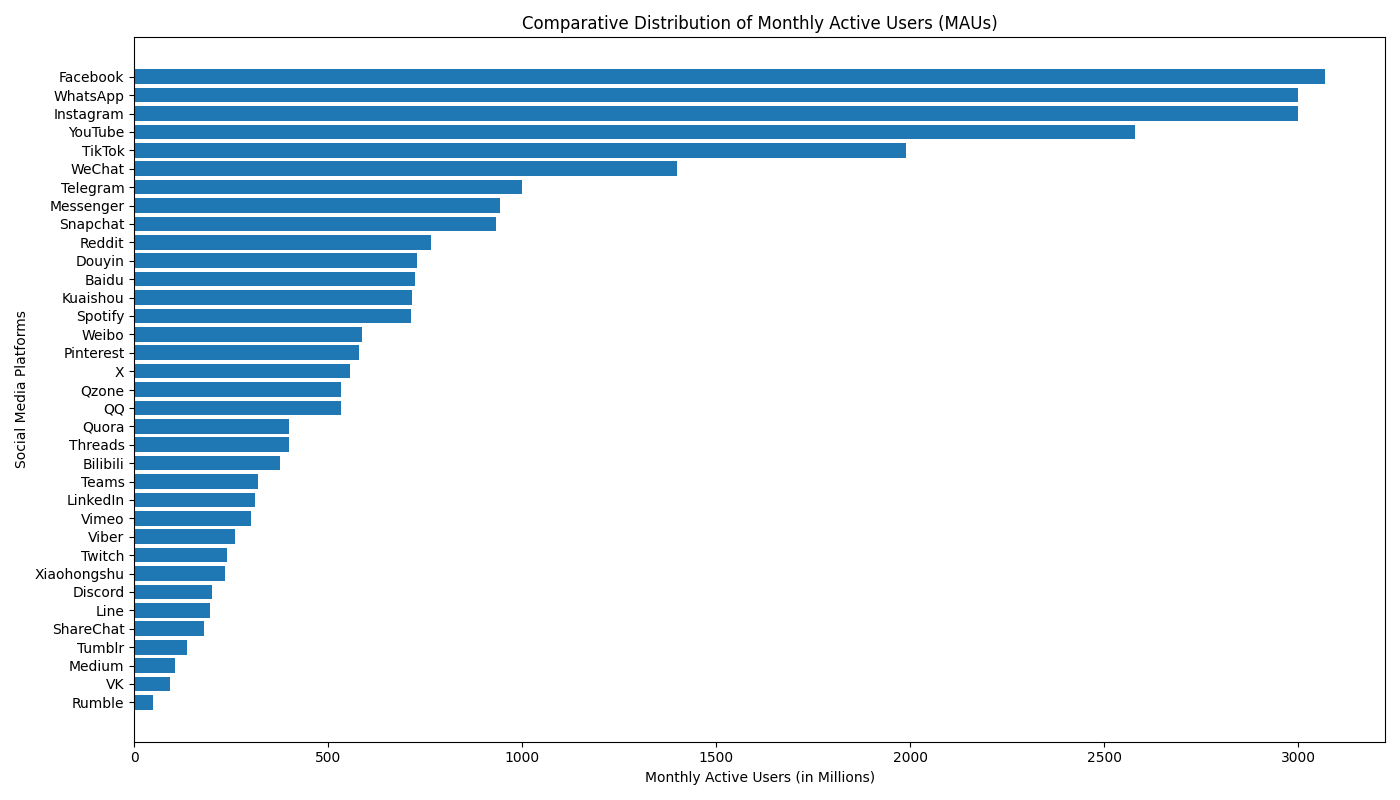
Figure 1: Monthly active users of 35 social media platforms, January 2026 (millions). Source: Fabio Duarte, Top 35 Social Media Platforms (January 2026), Exploding Topics.
Measured by monthly organic web traffic, the order changes: YouTube draws about 17.3 billion visits a month, far ahead of Instagram and Facebook, while messaging services such as WhatsApp and Telegram, which are used mainly through apps, record comparatively little web traffic (Figure 2).33
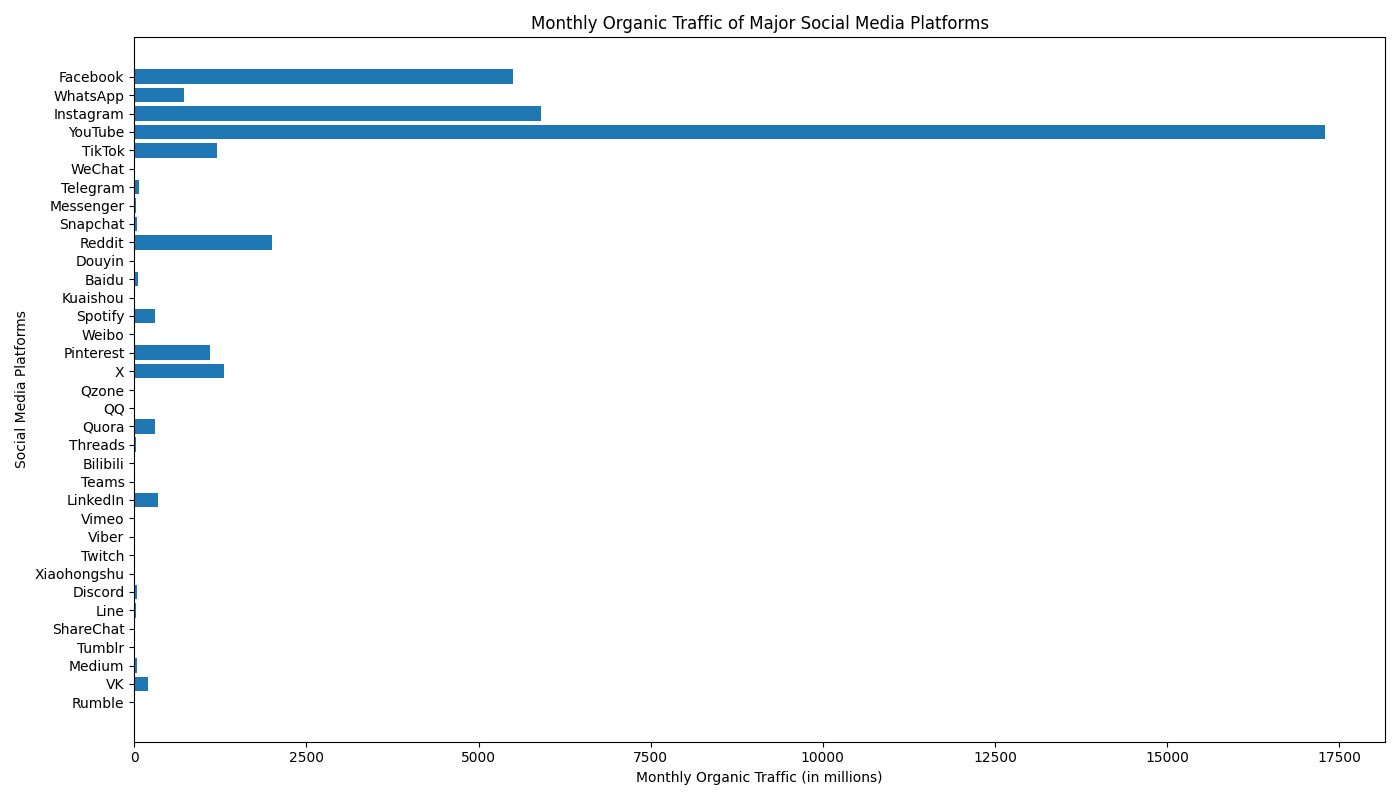
Figure 2: Monthly organic web traffic to the same 35 platforms, January 2026 (millions of visits). Source: as for Figure 1.
Facebook, with more than 3 billion monthly users, is blocked in China, Iran, Russia and several other countries.34 As short video content becomes more popular, YouTube, with about 2.58 billion monthly active users, and TikTok, with nearly 2 billion, have extended their reach. New AI video platforms are emerging: OpenAI’s video app Sora passed one million downloads within five days of its launch in September 2025.35 Messaging apps such as WhatsApp, Messenger and Telegram are gaining popularity for their improved video features, and Telegram, Discord and Reddit are also growing rapidly. As platforms enhance their interfaces for video and social commerce, short-form content has spread across TikTok, Instagram and Pinterest. This reach is what makes social media a conduit for deepfakes: a fabricated clip can reach millions of users across several platforms before anyone checks it.
Legal framework
Article 19(1)(a) of the Constitution guarantees citizens the freedom of speech and expression, and Article 19(2) allows the State to impose reasonable restrictions in the interests of the sovereignty and integrity of India, the security of the State, public order and other concerns. In Justice K.S. Puttaswamy (Retd.) v. Union of India, the Supreme Court recognised the right to privacy as part of the right to life and personal liberty and emphasised the importance of data protection, while calling for a balance between individual privacy and legitimate State interests.36 The State has enacted laws such as the IT Act, the Bharatiya Nyaya Sanhita, 2023 (BNS) and the Digital Personal Data Protection Act, 2023 that address cybercrime, including crime involving deepfakes.
Chapter XI of the IT Act deals with offences including identity theft, violation of privacy and the transmission of obscene or sexually explicit material. Sections 66C and 66D deal with identity theft and with cheating by personation using a computer resource, while sections 66E, 67, 67A and 67B deal with violation of privacy and with obscene, sexually explicit and child sexual abuse material.37 The BNS addresses deepfake-related harms such as voyeurism, criminal intimidation and defamation.38 The Digital Personal Data Protection Act, 2023 sets out the obligations of those who process personal data and the rights of the persons to whom the data relate.39 The Information Technology (Intermediary Guidelines and Digital Media Ethics Code) Rules, 2021 require significant messaging intermediaries to identify the first originator of a message on a judicial or government order, though this can weaken secure communications.40 Since 20 February 2026, amendments to those Rules define “synthetically generated information” and require intermediaries whose services allow such content to be created to label it prominently.41
The Election Commission of India (ECI) launched a “Myth vs Reality Register” to counter misinformation during the 2024 general election,42 and in May 2024 it advised political parties not to use deepfakes and to remove any such content within three hours of learning of it.43 Detecting deepfakes and taking legal action against their makers nevertheless remain difficult, because of the sophistication of the technology and tools that preserve anonymity, such as virtual private networks. Outside the 2026 intermediary rules, the absence of a statutory definition of deepfakes leaves gaps in enforcement.
A response to these problems needs six elements: an explicit legal framework for deepfakes, investment in detection technology, privacy built into the development of AI, accountability of platforms, greater public awareness and capacity in law enforcement, and international cooperation. The aim is not only to suppress deception but also to safeguard democratic integrity.
The Government of India relies on the IT Act and the IT Rules, 2021 to keep cyberspace safe, through consultation with industry, the due-diligence obligations of intermediaries and advisories on deepfakes. The Indian Computer Emergency Response Team (CERT-In) issues alerts and advisories, and runs the Cyber Swachhta Kendra, which detects malicious programs and provides free tools to remove them. The new criminal laws also apply: the BNS penalises the offences through which deepfakes cause harm, and section 63 of the Bharatiya Sakshya Adhiniyam, 2023 governs the admissibility of electronic records.44
Notable incidents of manipulated media in India
Most of the incidents below are not AI-generated deepfakes but shallow fakes, in the sense used above: genuine footage that was edited, cropped or presented out of context. They are included because they show how quickly manipulated video spreads on social media, the conditions in which deepfakes now circulate.
In April 2020 the lynching of two sadhus and their driver at Palghar in Maharashtra was falsely portrayed on social media as a communal attack by Muslims. The three men had been beaten to death by villagers who suspected them of theft; the police said that those arrested were local people and denied any communal angle. Posts claiming that the attackers were Muslims nevertheless spread widely,45 and fabricated posts about local activists, using the photographs of two unrelated professors, followed.46
In another case, a cropped clip made it appear that Rahul Gandhi had promised a machine that would turn potatoes into gold. In the full video of his 2017 rally, Gandhi attributed that promise to Prime Minister Narendra Modi, a claim for which Alt News found no record. The cropped clip circulated widely, misleading many, and the claim was revived in April 2019.47
In a third instance, before the 2022 Uttar Pradesh election, a clip of a Hindi song warning that a Samajwadi Party victory would lead to a Muslim takeover of the State and halt the construction of the Ram temple was circulated with the false claim that it had been composed by Muslims. BOOM found that the song had been sung by Sandeep Acharya, who described himself as a supporter of the BJP.48
A fourth video cropped a speech by the Congress leader Rashid Alvi to suggest that he had called those who chant “Jai Shri Ram” demons, and it was shared by several political figures. In the full speech, Alvi was recounting an episode from the Ramayana to say that not everyone who chants “Jai Shri Ram” is a sage, and he said that the BJP had deliberately misconstrued his remarks.49
Overall, these cases reflect the recurring spread of misinformation across social media, often with political motives, leading to communal tension and public misunderstanding. Fact-checking has been essential in debunking these false claims, but the damage is often done by the time the truth is revealed.
A video that appeared to show the choreographer Terence Lewis touching the actor Nora Fatehi inappropriately on the set of a dance show went viral and drew criticism of Lewis, who said that the video had been morphed.50 A 2019 video of a crowd in Buenos Aires, filmed during the election campaign of the then President Mauricio Macri, was later circulated as footage of Diego Maradona’s funeral.51 In similar fashion, an old clip of the filmmaker Mahesh Bhatt losing his temper at a reporter, recorded at the launch of his daughter’s book, was shared as his reaction to dislikes of the Sadak 2 trailer.52
A widely shared video of a bride laughing on stage after the groom struck the photographer was in fact a scene from the shooting of a film, as the actor in it explained.53 In a religious context, a video was shared with the claim that a Hindu temple in Andhra Pradesh was being used as a quarantine centre for Muslims; fact-checkers found that the building was an indoor lodging in Chittoor district.54 Another video was shared with the claim that two young Muslim men had poured beer on a Shivling; the claim was false, and the police in Panchkula, Haryana, arrested the two men responsible, neither of whom was Muslim.55 A viral video was also claimed to show a rally in Ayodhya demanding that India be declared a Hindu Rashtra after the BJP’s victory in the 2022 Uttar Pradesh election; it was footage of a 2018 procession led by Praveen Togadia for the construction of the Ram temple.56
Many viral videos linked to religious, social and political events have proved to be part of misinformation campaigns or misunderstandings rather than true records of real events. This is a significant problem for social media platforms, on which altered and old videos often resurface in a false context, leading to widespread misconceptions and needless tension between communities. Careful checking and verification before content is accepted and shared is therefore crucial to countering the spread of false information.
In June 2025 fraudsters used deepfake videos of N.R. Narayana Murthy to lure a 79-year-old woman in Bengaluru onto a fake trading website and take nearly ₹35 lakh from her, using false profit reports and invented financial managers.57 Similar deepfake videos of Murthy and Mukesh Ambani cost two other Bengaluru residents some ₹87 lakh in late 2024.58 In Assam, the likeness of the influencer Archita Phukan was used to build a fake online persona that gained 1.3 million followers and earned about ₹10 lakh in subscriptions before the police arrested her former partner.59
These cases show the growing threat of deepfakes, hyper-realistic fabrications made by neural networks that learn from images and videos. Deepfakes are now used in cybercrime. In 2019 fraudsters cloned the voice of the chief executive of the German parent of a UK-based energy company and persuaded the UK company’s chief executive to transfer €220,000 (about US$243,000);60 in early 2024 an employee of the engineering firm Arup in Hong Kong was deceived by a deepfake video conference into transferring about US$25 million.61 Structural features make India vulnerable to deepfakes: a very large number of mobile users, low digital literacy and widespread use of social media. Detection tools are available but unreliable, and, according to the cybersecurity expert Sandeep Shukla, many Indian firms do not report deepfake incidents because they fear reputational harm.62
As Anurag Mehra of IIT Bombay has put it, “Deepfakes that once needed powerful computers can now be made with simple apps.” Ordinary users find them difficult to identify. Celebrities’ images are often misused in fake videos, financial regulators have cautioned the public about deepfaked investment “advice” from cloned corporate leaders, and in the 2024 general election AI-generated audio and video were used on a large scale to reach voters, creating an environment in which the truth is hard to discern.63
Deepfakes, AI-generated videos that manipulate reality, have emerged as a serious threat to democracy in India. The technology makes it possible to create fake political speeches and misleading propaganda that can undermine voters’ trust. In November 2023 Prime Minister Narendra Modi described deepfakes as a matter of serious concern and warned that they could lead society towards “a big crisis”.64 Such videos make it hard for citizens to distinguish truth from fiction; they are not merely a concern of the entertainment world, but affect public perception and can distort the democratic process.
Judicial approach
In State v. Madachirayil Gopinathan Suni, the court of the Chief Metropolitan Magistrate (Central) at Tis Hazari, Delhi, dealt with an accused who had sent the complainant obscene emails attaching a morphed photograph of her, demanding sexual favours and threatening to upload the image to pornographic websites. The image was posted on a public club page of a news website, from which it was later removed. The court convicted the accused under section 67 of the IT Act and sections 506, 507 and 509 of the Indian Penal Code (IPC).65 The corresponding provisions are now sections 351 and 79 of the BNS.66 The court’s reasoning on section 67 turned on whether the material would deprave and corrupt those who saw it, rather than on the violation of the complainant’s privacy or integrity. IT for Change, in its judicial resource guide on online gender-based violence, argues that the judgment relied on a patriarchal notion of modesty and on obscenity provisions rather than on privacy, bodily integrity or the digital misrepresentation and defamation she may have suffered, a framing that serves to regulate women’s behaviour rather than to protect their rights.67
The morphed image was also used for blackmail, as the offender threatened to send it to the complainant’s husband. Even within its framework the court recognised this as criminal intimidation. IT for Change suggests, however, that the court could have considered forgery under sections 463 and 465 of the IPC (now section 336(1) and (2) of the BNS).68
In Vikas Dogra v. State of Himachal Pradesh, the High Court of Himachal Pradesh dealt with a bail application in a case in which a morphed nude image of the complainant had been sent to her brother and in which she later alleged rape. Granting bail, the court viewed the parties’ earlier relationship and the complainant’s delay in alleging rape with suspicion, and observed that it was “for her to maintain her purity, chastity and virtues”.69 IT for Change cites the case as showing the dangers of the modesty framework, which invites inappropriate scrutiny of the victim’s conduct.70 Such reasoning sits uneasily with the rule that a victim’s sexual history is irrelevant: section 53A of the Indian Evidence Act, 1872 (now section 48 of the Bharatiya Sakshya Adhiniyam, 2023) makes evidence of the victim’s character or previous sexual experience irrelevant to the question of consent in prosecutions for sexual offences.71
The actor Anil Kapoor sued platforms that used his persona through AI-generated deepfakes without his consent, and the Delhi High Court granted an ex parte ad interim injunction restraining such use; the case shows the courts acting against the misuse of deepfakes.72 On petitions by the journalist Rajat Sharma and the advocate Chaitanya Rohilla, the Delhi High Court directed the Union Government’s committee on deepfakes to consult technology providers, telecommunication service providers, victims and intermediaries.73 Sharma has separately sued YouTube channels that circulate deepfake videos using his persona.74 The news agency ANI sued OpenAI in the Delhi High Court for using its content without permission, following similar suits abroad, and argued that its works remained stored in ChatGPT’s memory;75 in July 2026 the Court refused ANI an interim injunction, holding prima facie that storing its works to train the model fell within section 52(1)(a) of the Copyright Act, 1957 and that ANI had not shown that ChatGPT had memorised and reproduced them.76
In November 2022 the Delhi High Court granted the actor Amitabh Bachchan an ex parte injunction against the unauthorised commercial use of his celebrity status and persona.77 Though first seen as an isolated case, it has been followed by similar orders addressing digital impersonation, AI-generated deepfakes and the exploitation of celebrities. In August 2025 the Court restrained the circulation of deepfake videos of the spiritual leader Sri Sri Ravi Shankar that used his voice and likeness to promote supposed remedies for serious illnesses, misleading the public and harming his reputation.78 Courts have protected the rights of other public figures in the same way.
Conclusion and suggestions
Deepfake technology, driven by AI, is both an advance in digital content creation and a significant ethical and legal challenge. Deepfakes are AI-generated videos, images or audio that convincingly depict a person saying or doing things that the person never said or did. They are used in entertainment and education, but also for misinformation, identity theft and political manipulation. India has no statute specific to these harms: the 2026 amendments to the IT Rules require intermediaries to label synthetic content, but liability still rests on the IT Act and on older provisions on forgery, defamation and obscenity, which do not fully capture the nature of AI-generated deception. This leaves victims with limited remedies and makes both prevention and prosecution difficult.79
The absence of specific regulation is not unique to India; legislation lags behind technology everywhere. The United States has laws targeting deepfake pornography and election manipulation, and China requires AI-generated content to be labelled. Defining deepfakes in law is difficult because the technology evolves quickly and because harmless and harmful content are hard to tell apart, and global coordination is hampered by differing national positions and by concerns about free speech and innovation.80
Indian forgery provisions can sometimes reach deepfakes, but their application is limited and inconsistent: digital content is difficult to classify as a forged document, and these provisions do not address the less tangible harms of deepfakes. Some jurisdictions recognise a person’s rights over his or her own likeness, a possible model for India, whose courts have so far protected likeness through personality rights. Liability raises further difficulties, as developers of AI and platforms grapple with the misuse of their technologies. India could strengthen its framework by introducing explicit rules on AI-generated content, which would also bring it closer to international practice.81
Deepfakes also threaten democracy: during elections they can manipulate opinion, spread false narratives and erode trust in the democratic process. Indian election law prohibits misinformation but does not specifically address AI-generated deception. Organisations such as Interpol recognise the threat, but enforcement across borders remains patchy, and coordinated international effort of the kind developed against cybercrime would help.82
Deepfakes can also distort memory and perception, particularly when presented as evidence in legal proceedings, which underlines the need for media literacy and public awareness. Preventive measures include comprehensive regulation, AI-driven detection tools and verification of the authenticity of digital content, for example through blockchain. Collaboration between governments, technology companies and academia is essential, and AI itself may offer the best defence, through models that detect the inconsistencies in deepfakes even as their creators improve them.83
The European Union, China and Singapore are developing laws and tools to curb the misuse of deepfakes while fostering responsible innovation. India can learn from them in building a balanced legal framework that supports technological progress while protecting against the harms of AI-generated deception. Legislation is urgently needed against misuse in politics and fraud, and advances in detection and public awareness can support that effort, balancing innovation with responsibility.84
*****
Footnotes
1. Adrija Bose et al., Social Media and the Question of Truth: A Sociological Study of Fake News in India in Pandemic Times, 2 Elec. J. Soc. & Strategic Stud. 178 (2021), https://doi.org/10.47362/EJSSS.2021.2209.
2. ‘Deepfake’ Video Showing Rashmika Mandanna: How to Identify Fake Videos, Indian Express (Nov. 6, 2023), https://indianexpress.com/article/explained/explained-sci-tech/deepfake-video-rashmika-mandanna-how-identify-9015867/ (last visited Feb. 1, 2026).
3. Aaratrika Bhaumik, Regulating Deepfakes and Generative AI in India | Explained, The Hindu (Dec. 4, 2023), https://www.thehindu.com/news/national/regulating-deepfakes-generative-ai-in-india-explained/article67591640.ece (last visited Feb. 1, 2026).
4. Nilesh Christopher, We’ve Just Seen the First Use of Deepfakes in an Indian Election Campaign, Vice (Feb. 18, 2020), https://www.vice.com/en/article/the-first-use-of-deepfakes-in-indian-election-by-bjp/ (last visited Feb. 1, 2026).
5. Nivedita Niranjankumar, Video of Kamal Nath Doctored with AI Voice to Make False Claim, BOOM (Apr. 23, 2024), https://www.boomlive.in/fact-check/kamal-nath-ai-voice-deepfake-elections-2024-congress-muslims-minority-false-claim-viral-video-25018 (last visited Feb. 1, 2026).
6. Martina Jaureguy, Mauricio Macri Denounces Deepfake AI Videos Spread by Pro-Milei Trolls on Election Day, Buenos Aires Herald (May 18, 2025), https://buenosairesherald.com/politics/mauricio-macri-denounces-deepfake-ai-videos-spread-by-pro-milei-trolls-on-election-day (last visited Feb. 1, 2026).
7. Deepfake Video of Zelensky Telling Ukrainians to Surrender Removed from Social Platforms, N.Y. Post (Mar. 17, 2022), https://nypost.com/2022/03/17/deepfake-video-shows-volodymyr-zelensky-telling-ukrainians-to-surrender/ (last visited Feb. 1, 2026).
8. Online Safety in NI: Do 99% of Pornographic Deepfakes Depict Images of Women?, FactCheckNI, https://factcheckni.org/articles/online-safety-in-ni-do-99-of-pornographic-deepfakes-depict-images-of-women/ (last visited Feb. 1, 2026) (discussing Sensity’s 2019 report The State of Deepfakes); Security Hero, 2023 State of Deepfakes: Realities, Threats, and Impact (2023), https://www.securityhero.io/state-of-deepfakes/.
9. Vanya Garima Kachhap, Navigating the Laws Around Deepfakes and AI Generated Deception, LawyersClubIndia (Mar. 31, 2025), https://www.lawyersclubindia.com/articles/navigating-the-laws-around-deepfakes-and-ai-generated-deception-17561.asp (last visited Feb. 1, 2026); Press Information Bureau, Government of India Taking Measures to Tackle Deepfakes (Apr. 4, 2025), https://www.pib.gov.in/PressReleaseIframePage.aspx?PRID=2119050®=3&lang=2 (last visited Feb. 2, 2026).
10. Bhaumik, supra note 3.
11. Delhi HC Seeks Centre’s Stand on PIL Against Deepfakes, Artificial Intelligence, Orissa Post (Dec. 4, 2023), https://www.orissapost.com/delhi-hc-seeks-centres-stand-on-pil-against-deepfakes-artificial-intelligence/amp/.
12. Chaitanya Rohilla v. Union of India, W.P.(C) 15596/2023, with Rajat Sharma v. Union of India, W.P.(C) 6560/2024, ¶ 5 (Del. HC Nov. 21, 2024) (order); see also Tushar Kohli, Centre to Form Committee to Frame Regulations on Deepfakes: Delhi HC Told, Verdictum (Nov. 21, 2024), https://www.verdictum.in/court-updates/high-courts/deepfake-central-government-committee-chaitnaya-rohilla-rajat-sharma-v-union-of-india-1558673 (last visited Feb. 1, 2026).
13. Deepfakes: Delhi HC Grants Panel 3 Months for Comprehensive Report, The Week (Mar. 24, 2025), https://www.theweek.in/wire-updates/national/2025/03/24/lgd21-dl-hc-deepfake.html.
14. Bhaumik, supra note 3.
15. Samer Hussain Al-Khazraji et al., Impact of Deepfake Technology on Social Media: Detection, Misinformation and Societal Implications, 23 Eurasia Proc. Sci. Tech. Eng’g & Mathematics 429 (2023), https://doi.org/10.55549/epstem.1371792.
16. Fakhar Abbas & Araz Taeihagh, Unmasking Deepfakes: A Systematic Review of Deepfake Detection and Generation Techniques Using Artificial Intelligence, 252 Expert Sys. with Applications 124260 (2024), https://doi.org/10.1016/j.eswa.2024.124260.
17. Achhardeep Kaur et al., Deepfake Video Detection: Challenges and Opportunities, 57 Artificial Intel. Rev. 159 (2024), https://doi.org/10.1007/s10462-024-10810-6.
18. Prasanna Shashikant Shinde, Deepfakes and Their Impact on Society, Int’l J. Advanced Rsch. Sci., Commc’n & Tech. 283 (2024), https://doi.org/10.48175/IJARSCT-15749.
19. Parissa DJangi, The Powerful Impact of Manipulated Photos on Political History, Nat’l Geographic (July 24, 2024), https://www.nationalgeographic.com/history/article/political-photo-manipulation-in-history.
20. Samantha Cole, AI-Assisted Fake Porn Is Here and We’re All Fucked, Vice (Dec. 11, 2017), https://www.vice.com/en/article/gal-gadot-fake-ai-porn/.
21. Bharatiya Laws Against Deepfake Cybercrime: Opportunities and Challenges, Vivekananda Int’l Found. (Apr. 28, 2025), https://www.vifindia.org/article/2025/april/28/Bharatiya-Laws-Against-Deepfake-Cybercrime-Opportunities-and-Challenges (last visited Feb. 1, 2026); see also Jack Aldane, UK Government Launches Deepfake Detection Initiative as ‘Urgent National Priority’, Global Gov’t F. (Feb. 12, 2026), https://www.globalgovernmentforum.com/uk-government-launches-deepfake-detection-initiative-as-urgent-national-priority/.
22. Sommya Kashyap, Deepfakes in India: A Legal Analysis of Emerging Challenges and Regulatory Framework, LawArticle (Sept. 9, 2025), https://lawarticle.in/deepfakes-in-india-a-legal-analysis-of-emerging-challenges-and-regulatory-framework/ (last visited Feb. 1, 2026).
23. Security Hero, supra note 8.
24. Onfido Releases 2024 Identity Fraud Report and Launches Fraud Lab, BIIA (Nov. 20, 2023), https://www.biia.com/onfido-releases-2024-identity-fraud-report-and-launches-fraud-lab.
25. Entrust Helps Businesses Fight Fraud with New AI-Powered Facial Biometric Authentication Capability, iTWire (Jan. 23, 2025), https://itwire.com/business-it-news/security/entrust-helps-businesses-fight-fraud-with-new-ai-powered-facial-biometric-authentication-capability (reporting Entrust, 2025 Identity Fraud Report); see also Sofia Ramirez, Deepfake Statistics 2026: The Hidden Cyber Threat, SQ Magazine, https://sqmagazine.co.uk/deepfake-statistics/ (last visited Feb. 1, 2026).
26. Data Security Council of India & Seqrite, India Cyber Threat Report 2025 (2024), https://www.seqrite.com/documents/en/threat-reports/india-cyber-threat-report-2025.pdf (last visited Feb. 2, 2026).
27. Nirmaan Malhotra v. Tushita Kaul, MAT.APP.(F.C.) 180/2024, 2024 SCC OnLine Del 4326, ¶¶ 13–13.1 (Del. HC May 28, 2024).
28. National Stock Exchange of India Ltd. v. Meta Platforms, Inc., Interim Application (L) No. 21456 of 2024 in Com. IPR Suit (L) No. 21111 of 2024 (Bom. HC July 16, 2024).
29. Akshay Tanna v. John Doe, CS(COMM) 92/2024, MANU/DE/8711/2024 (Del. HC Dec. 5, 2024).
30. Gaurav Bhatia v. Naveen Kumar, CS(OS) 274/2024, 2024 LiveLaw (Del) 459, ¶¶ 44–45, 52 (Del. HC Apr. 16, 2024).
31. Simon Kemp, Digital 2026: Global Overview Report, DataReportal (Oct. 2025), https://datareportal.com/reports/digital-2026-global-overview-report; see also Social Media in 2026: Key Trends and Platform Evolution, Bluepilot (Jan. 29, 2026), https://getbluepilot.com/blog/social-media-2026-trends (last visited Feb. 2, 2026).
32. Fabio Duarte, Top 35 Social Media Platforms (January 2026), Exploding Topics, https://explodingtopics.com/blog/top-social-media-platforms (last visited Feb. 2, 2026).
33. Duarte, supra note 32.
34. Duarte, supra note 32.
35. Sarah Perez, Sora Hit 1M Downloads Faster than ChatGPT, TechCrunch (Oct. 9, 2025), https://techcrunch.com/2025/10/09/sora-hit-1m-downloads-faster-than-chatgpt/.
36. Justice K.S. Puttaswamy (Retd.) v. Union of India, (2017) 10 SCC 1 (India).
37. The Information Technology Act, 2000, No. 21, Acts of Parliament, 2000 (India), §§ 66C, 66D, 66E, 67, 67A, 67B.
38. The Bharatiya Nyaya Sanhita, 2023, No. 45, Acts of Parliament, 2023 (India), §§ 77, 351, 356.
39. The Digital Personal Data Protection Act, 2023, No. 22, Acts of Parliament, 2023 (India), §§ 4–14.
40. Information Technology (Intermediary Guidelines and Digital Media Ethics Code) Rules, 2021, G.S.R. 139(E), r. 4(2) (India).
41. Information Technology (Intermediary Guidelines and Digital Media Ethics Code) Amendment Rules, 2026, G.S.R. 120(E), rr. 2–3 (India) (inserting r. 2(1)(wa) and r. 3(3) into the 2021 Rules, in force Feb. 20, 2026).
42. EC Launches ‘Myth vs Reality Register’ to Combat Misinformation in General Elections 2024, ETGovernment, https://government.economictimes.indiatimes.com/news/governance/ec-launches-myth-vs-reality-register-to-combat-misinformation-in-general-elections-2024/108989253 (last visited Feb. 2, 2026).
43. Manish Singh, India Urges Political Parties to Avoid Using Deepfakes in Election Campaigns, TechCrunch (May 7, 2024), https://techcrunch.com/2024/05/07/india-urges-political-parties-to-avoid-using-deepfakes-in-election-campaigns/.
44. Press Information Bureau, supra note 9; The Bharatiya Sakshya Adhiniyam, 2023, No. 47, Acts of Parliament, 2023 (India), § 63.
45. Divya Chandra, Palghar Lynching Incident Shared with a False Communal Angle, The Quint (Apr. 20, 2020), https://www.thequint.com/amp/story/news/webqoof/palghar-case-communal-claims-attacker-misidentified-as-shoaib-fact-check.
46. Palghar Lynching: TISS Professors Caught in Midst of Fake News, The Hindu (Apr. 26, 2020), https://www.thehindu.com/news/cities/mumbai/palghar-lynching-tiss-profs-caught-in-midst-of-fake-news/article31435232.ece (last visited Feb. 2, 2026).
47. Arjun Sidharth, “Aloo Sona Machine”: Previously Debunked Misinformation Revived by ANI, Alt News (Apr. 6, 2019), https://www.altnews.in/aloo-sona-machine-previously-debunked-misinformation-revived-by-ani/ (last visited Feb. 2, 2026).
48. UP Elections: Communal Song by BJP Supporter Peddled as Created by Muslims, BOOM (Nov. 20, 2021), https://www.boomlive.in/fact-check/politics/uttar-pradesh-samajwadi-party-song-mulsim-communal-spin-video-song-hindutva-up-elections-factcheck-15681 (last visited Feb. 2, 2026).
49. Cropped Video from Rashid Alvi’s Jai Shri Ram Speech Shared by BJP Leaders, BOOM (Nov. 17, 2021), https://www.boomlive.in/fact-check/politics/fake-news-cropped-video-congress-rashid-alvi-jai-shre-ram-speech-bjp-leaders-amit-malviya-factcheck-15633 (last visited Feb. 3, 2026).
50. Terence Lewis on Fake Video of Him Touching Nora Fatehi Inappropriately, Times of India (Oct. 8, 2020), https://timesofindia.indiatimes.com/videos/tv/hindi/terence-lewis-on-fake-video-of-him-touching-nora-fatehi-inappropriately-that-kind-of-thing-would-only-tickle-a-17-year-old-i-am-45/videoshow/78548161.cms (last visited Feb. 3, 2026).
51. Sumit Usha, 2019 Video from Argentina Viral as Footballer Maradona’s Funeral, BOOM (Nov. 27, 2020), https://www.boomlive.in/fake-news/2019-video-from-argentina-viral-as-footballer-maradonas-funeral-10848 (last visited Feb. 3, 2026).
52. No, This Is Not Mahesh Bhatt Angry at Sadak 2 Trailer Getting Dislikes, BOOM (Aug. 20, 2020), https://www.boomlive.in/fake-news/no-this-is-not-mahesh-bhatt-angry-at-sadak-2-trailer-getting-dislikes-9387 (last visited Feb. 3, 2026).
53. Vanshika Swami, Viral: What’s the Story Behind This Funny Bride’s Laughter Video?, SheThePeople (Feb. 9, 2021), https://shethepeople.tv/viral-video/viral-brides-laughter-video.
54. Andhra Temple Turned into Quarantine Facility for Muslims? No, It’s Fake News, The Quint (Apr. 14, 2020), https://www.thequint.com/news/webqoof/fact-check-andhra-pradesh-temple-turned-into-quarantine-facility-for-muslims-no (last visited Feb. 3, 2026).
55. No, Youth Pouring Beer on Shivling in This Video Are Not Muslims, Alt News (July 6, 2022), https://www.altnews.in/false-communal-angle-viral-with-a-video-that-muslim-boys-offering-beer-shivling/ (last visited Feb. 3, 2026).
56. Drabanti Ghosh, Old and Unrelated Video Shared as Massive Rally in Ayodhya for Declaring India a ‘Hindurashtra’, Fact Crescendo (Mar. 19, 2022), https://english.factcrescendo.com/2022/03/19/video-from-2018-shared-as-procession-in-ayodhya-demanding-for-a-hindu-rashtra/.
57. AI Scam Uses Narayana Murthy Deepfake, Dupes 79-Year-Old Bengaluru Woman of Rs 35L, Times of India (June 27, 2025), https://timesofindia.indiatimes.com/city/bengaluru/cybercrooks-dupe-79-year-old-bengaluru-woman-of-rs-35-lakh-in-ai-trading-scam/articleshow/122097772.cms (last visited Feb. 3, 2026); Shruti Tripathi, Game of Shadows: India’s Deepfake Dilemma, Outlook Business (Aug. 25, 2025), https://www.outlookbusiness.com/start-up/game-of-shadows-indias-deepfake-dilemma (last visited Feb. 3, 2026).
58. Deepfake Videos of Narayana Murthy, Mukesh Ambani: Bengaluru Residents Lose Rs 87 Lakh in Trading Scam, Indian Express (Nov. 5, 2024), https://indianexpress.com/article/cities/bangalore/deepfake-videos-narayana-murthy-mukesh-ambani-bengaluru-trading-scam-9654607/ (last visited Feb. 3, 2026).
59. Babydoll Archi’s Ex-Boyfriend Turns Revenge into AI Racket, Earns Money by Faking Influencer’s Identity Online, Indiatimes, https://www.indiatimes.com/trending/babydoll-archis-ex-boyfriend-turns-revenge-into-ai-racket-earns-money-by-faking-influencers-identity-online/articleshow/122786353.html (last visited Feb. 3, 2026); Tripathi, supra note 57.
60. Ravie Lakshmanan, Fraudsters Deepfake CEO’s Voice to Trick Manager into Transferring $243,000, The Next Web (Sept. 2, 2019), https://thenextweb.com/news/fraudsters-deepfake-ceos-voice-to-trick-manager-into-transferring-243000 (reporting the Wall Street Journal); Tripathi, supra note 57 (€220,000).
61. Kathleen Magramo, British Engineering Giant Arup Revealed as $25 Million Deepfake Scam Victim, CNN (May 16, 2024), https://abc17news.com/money/cnn-business-consumer/2024/05/16/british-engineering-giant-arup-revealed-as-25-million-deepfake-scam-victim/.
62. Tripathi, supra note 57.
63. Tripathi, supra note 57.
64. PM Modi Says Deepfakes Are a Matter of Serious Concern, Warns They Can Lead to a ‘Big Crisis’, Scroll.in (Nov. 17, 2023), https://scroll.in/latest/1059264/pm-modi-says-deepfakes-are-a-matter-of-serious-concern-warns-they-can-lead-to-a-big-crisis (last visited Feb. 3, 2026).
65. State v. Madachirayil Gopinathan Suni, New Case No. 63/2016, CNR No. DLCT02-000212-2005, ¶¶ 25–29, 67 (Chief Metro. Magistrate (Cent.), Tis Hazari Cts., Delhi Aug. 31, 2018).
66. The Bharatiya Nyaya Sanhita, supra note 38, §§ 79, 351.
67. IT for Change, 2.2 Morphing/Deepfakes, in Online Gender-Based Violence Judicial Resource Guide, https://projects.itforchange.net/online-violence-gender-and-law-guide/module-2-typologies-of-online-gender-based-offenses-in-law/2-2-morphing-deepfakes/.
68. IT for Change, supra note 67; The Bharatiya Nyaya Sanhita, supra note 38, § 336(1)–(2).
69. Vikas Dogra v. State of Himachal Pradesh, Cr.M.P.(M) No. 125 of 2015, ¶¶ 2–3, 8, 10–11 (H.P. HC Feb. 5, 2015).
70. IT for Change, supra note 67.
71. The Indian Evidence Act, 1872, No. 1, Acts of Parliament, 1872 (India), § 53A; The Bharatiya Sakshya Adhiniyam, supra note 44, § 48.
72. Anil Kapoor v. Simply Life India, CS(COMM) 652/2023 (Del. HC Sept. 20, 2023); Kachhap, supra note 9.
73. Chaitanya Rohilla, supra note 12, ¶ 5; Kachhap, supra note 9.
74. Rajat Sharma v. Tamara Doc, CS(COMM) 1147/2024, ¶¶ 2–3, 16, 21–23 (Del. HC Nov. 7, 2025) (order).
75. ANI Media Pvt. Ltd. v. OpenAI Inc., CS(COMM) 1028/2024 (Del. HC Mar. 18, 2025) (order); Kachhap, supra note 9.
76. ANI Media Pvt. Ltd. v. OpenAI OpCo LLC, I.A. 45300/2024 in CS(COMM) 1028/2024, ¶¶ 271–73 (Del. HC July 24, 2026).
77. Amitabh Bachchan v. Rajat Nagi, CS(COMM) 819/2022, ¶¶ 20–22 (Del. HC Nov. 25, 2022).
78. Ravi Shankar v. John Doe(s), CS(COMM) 889/2025, ¶¶ 34.4, 37–39 (Del. HC Aug. 26, 2025).
79. Kachhap, supra note 9.
80. Kachhap, supra note 9.
81. Kachhap, supra note 9.
82. Kachhap, supra note 9.
83. Kachhap, supra note 9.
84. Kachhap, supra note 9.