
Introduction
Crime has its genesis in various factors which can be traced into various social, economical and institutional aspects. In the era of globalisation, crime ratio is much higher than the previous era, as today the internet has also become a threat to everyone which we use in our daily life. Cybercrime is a kind of crime that is committed though a computer and by using computer network. There are various types of Cybercrime such as identity thefts, phishing scams, cyber stalking, online harassment. The social media has become an easy platform for the cyber criminals for collecting the information of an individual. Online harassment, hacking of profiles, email spoofing, SMS spoofing are said to be quite common now-a-days. There have been quite a lot of cases where all these activities have led to people being traumatized. In some worst-case scenarios people have lost their lives too. Rapid change in the technology, lack of awareness about the anti-malware and anti-virus software, lack of transparency by the social media and unable to tackle the unauthorised use of social media are the major reasons for the cybercrimes on social media. The legislature and judiciary are working hard to prohibit such kind of activities and to protect the privacy of an individual. Cybercrimes can be avoided if we report against the suspicious activities and limiting ourselves to known people. The researcher in this paper discussed the various types of cybercrimes on social media and how it violates the individual’s right to privacy.
Social Media and Cybercrimes
Social media becomes the hub of cybercrimes in the present era. The cyber criminals find it very easy to victimise the individual using the data available in the internet. The lack of skilled and trained manpower to tackle the cyber criminals at the initial level are one of the main reasons of the increasing ratio of cybercrimes in India. The cyber criminals generally can hide themselves as it is very easy for them to do so. Therefore, it requires a proper intelligence bureau to catch the cyber criminals.
Hacking
Hacking is a more common form of cybercrime known till date. In hacking the cyber criminals use the computer system in an unauthorised manner and destroy the computer programmes and data available in the computer system. The most dreadful thing in hacking is the victim did not know about the hacking activity and the hacker without the knowledge of the victim steal all the confidential data and tempered with it.
Social media platforms are remunerative targets for cybercriminals these days due to the enormous amounts of personally identifiable information that they gather and store from their users.
Hackers always look for different tools and platforms to exploit vulnerabilities on these social media platforms to steal user’s personal identifiable information (PII). One of the Social media giant Facebook on September 25, 2018 published that their engineering team had discovered, hackers had exploited vulnerability in their code. The attackers exploited the security flaws in Facebook’s “View As” code; it is a feature which helps the users to see how their own Facebook profile looks like to the other Facebook users or to the public in general. Facebook said the stolen tokens were digital keys which were used to take over people’s accounts.
In the month of July, 2017 for the first time the vulnerability in Facebook’s code was first appeared; it is when they made a change in video uploading feature. Facebook didn’t noticed any suspicious activity until September 14, 2018, when there was a sudden jump in user’s access to the site. After this Facebook launched a thorough investigation into the suspicious behaviour and discovered this attack. So, attackers had a total of 14 months from July 2017 to September 2018, to exploit the vulnerability in Facebook’s code.
Facebook earlier said it has reset access tokens for nearly 50 million user accounts that were supposedly affected and another 40 million user accounts that were subjected to “View As” look up. However, in its latest statement they revealed hackers actually stolen access for 30 million user accounts and gained complete access to user’s profiles.
The vulnerability in Facebook’s code was later fixed in September 2018, it alerted and apologised to users. Those users had to log back in to their Facebook account, including any of their apps like Hotstar, Zomato which use Facebook login. Once they logged in, they got notification at the top of their News Feed explaining what happened. At last Facebook turned off their “View As” feature temporarily.
Recently, ‘FireEye’-a cyber security firm located in US reported that, the hackers succeeded in breaking one of the healthcare website which is situated in India and stolen sixty-eight lakh records which contain the information of the patients and doctors. The firm also mentioned that, cyber criminals were directly selling the data which they stole from healthcare organisations and web portals globally including India in the underground markets; these hackers were mostly belonged from China.2
Dissemination of Obscene Material
Various web portal and web sites are used for indecent exposure or pornography using the internet; all these sites contain prohibited and obscene materials which can be harmful for the teenager and adolescent’s mind. Cyber stalking includes the sending of obscene and indecent materials to the victim by using the social networking site or through emails or messaging platforms. Section 292 of the Indian Penal Code (IPC) 1860 mentioned about the obscene materials. In addition to section 292 of IPC 1860, the Information Technology Act 2000 under section 673 discussed about obscenity as an offence when it is published or transmitted or caused to be published in any electronic form. The Supreme Court in Renjith D. Udeshi v. State of Maharashtra4 defined the term ‘obscenity;’ it mentioned that, it means the things which are offensive to modesty or decency; lewd, filthy, and repulsive. Similarly, the Apex Court in Aveek Sarkar v. State of West Bengal5 decided that, a picture of a nude/semi-nude woman cannot itself be called as obscene except it has the propensity to stir the feelings or revealing an overt sexual desire.
E-Mail and SMS Spamming
Spamming is a very common way of hacking; it is when the same message was send indiscriminately to a huge number of internet users. Cyber criminals now-a-days uses social media platform for spamming. With the rise in several phishing and spamming attack claiming them to be originated from the Income Tax Department, Government of India, recently, the department has issued their list of their all official email-id’s, SMS sender Id and even websites used by the taxman to communicate with the tax payer. To avoid any spamming or phishing attempt the Income Tax Department has asked all tax payers to not open any messages from any sender other than the one mentioned in the list. The department of income tax also mentioned that, before you click, always check if the sender is among the listed sources. The department has also asked the tax payers to report any email or SMS or website URL, if they think it is pretending to be of Income Tax Department.
E-Mail and SMS Spoofing
It can be termed as the forgery of an email-id as it misrepresents its origin. Here, the email wrongly shows the intended source and seems to have originated from someone or somewhere other than its actual and true source. It displays the incorrect origin which is different from the source in which it actually originates.
On the other hand, in SMS spoofing the hackers steals the original and authentic identity of the mobile number of an individual and send the SMS by using the internet. The SMS receiver receives the message from that individual person’s mobile number who is actually the victim of such kind of spoofing. However, in the present era, Information Technology Act 2000 under section 66C6 provides the punishment for identity theft.
Cyber Terrorism
In this kind of cyber-crimes the pace and medium is known as the cyberspace; it is usually refers to various actions –simple online propaganda to terrorist attack by using the online platform. This kind of attacks are pre-planned and used by the cyber criminals for an immense violence in the domain of cybercrime.
Cyber-Stalking
“Cyber stalking” is defined as a crime where the stalkers use internet to commit the crime; they can also use any other electronic device to stalk someone for committing cyber-staling. Here stalkers harass or give threat to the victim repeatedly by using the internet. Section 354D of the Indian Penal Code 1860 defines the term stalking which was added by the 2013 amendment Act.7 In the year 2017 the National Crime Record Bureau reported that, the total number of cyber-stalking against the women or children is 542.8
| State | No. of Cases |
|---|---|
| Maharashtra | 301 |
| Andhra Pradesh | 48 |
| Haryana | 27 |
| Telangana | 26 |
| Madhya Pradesh | 25 |
| Total India | 542 |
Online Harassment and Trolling
Online harassment is also known as online bullying. These bullying always starts with cyber stalking and then slowly lead to online harassment. Online harassment mostly happens on social media site such as Facebook, Instagram, and twitter. What happens here is that the perpetrators appear to be friends with the victim at the beginning. The harassments generally start after they gather some information about the victim. Generally, the threats start through emails, messaging services like WhatsApp, Telegram, SMS and so on. Celebrities have millions of followers on their social media account, which sometimes meet with unexpected circumstances, such as bullying or trolling. Now-a-days, cyber criminals troll celebrities on almost every action or event. Such as Sonu Nigam, one of the leading Indian playback singers, in one of the flight used the airline telephone with crew’s permission to entertain the passengers by singing a song; after the video clip went viral on social media platforms he was relentlessly trolled for using airline telephone for singing.
Pornography
Pornography is a common cybercrime which prevail in today’s society; it usually use in order to cause sexual excitement by using the internet. Pornography refers to pornographic websites, pornographic magazines which are used for sexual excitement by using computer and the internet. It can also be delivered over mobile phones so that the viewer can easily get access to these pornographic websites. Child Pornography is again another threat which involves the use of computer and internet to create and distribute the access of such child pornography to sexually exploit the underage children.
Cybercrime and Breach of Privacy
The fast spreading internet network has growing with the advancement of globalisation which in turn leads to threatening the privacy of an individual. The right to privacy is protected under the legal shield of Article 21 of the Constitution of India as rightly mentioned by the Apex Court in K. S. Puttaswamy v. Union of India.9 Hence, if there is any cybercrime which effect the privacy of an individual then the accused can face the legal hurdles and provide remedy to the victim.
In cybercrimes the hackers violate one’s right to privacy and steal the personal information and data of the victim. The hackers steal the intellectual work of the victim while violating the notion of privacy of an individual. Section 66E10 of Information Technology Act 2000 deals with the punishment for violation of privacy. It provides punishment for the cyber criminal who violate the privacy of an individual using the internet.
Statistics of Cybercrime in India
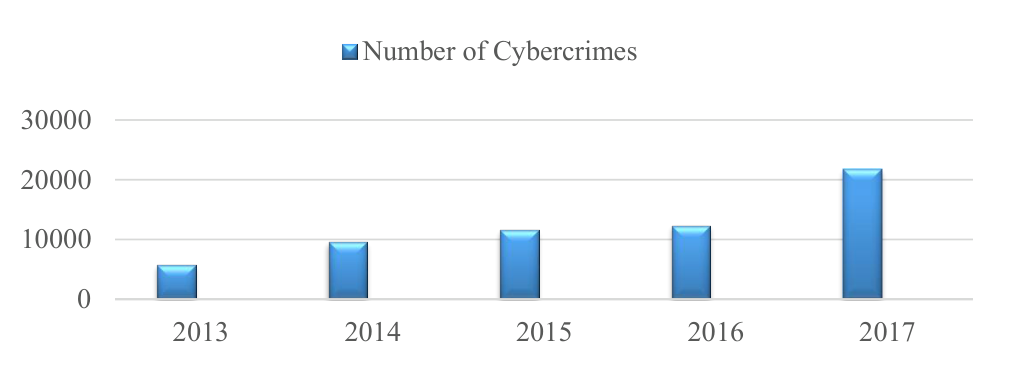
Globalisation has an immense impact in the present era. Every one of us, irrespective of the age group uses social media relentlessly and shares our personal data by using Facebook, Instagram and WhatsApp. Social media becomes a hub of personal data of an individual and the cyber criminals by using these data very easily commit the cybercrimes. The term privacy includes the information access without the consent of the individual. The National Crime Record Bureau reported that, in the year 2017 Uttar Pradesh has the highest number of cases on cybercrimes with 4,971 cases followed by Maharashtra (3,604) and Karnataka (3,174).11 The following chart shows the increasing ratio of cybercrime from 2013 to 2017 in India.12
Apart from this, again in the year 2018, the NCRB report mentioned that, 55.2% of cyber-crime cases were registered for the motive of fraud (15,051 out of 27,248 cases) followed by sexual exploitation with 7.5% (2,030 cases) and causing disrepute with 4.4% (1,212 cases).13
Conclusion
In the present era the internet has an immense impact on everyone’s life as it becomes a part and parcel of our daily life. The data driven society provides easy access to the cyber criminals the information they need and the easiest way to collect the data is from the social media. The popularity of social media platforms is reflected in its user base of 2.22 billion in 2019, which is expected to reach 3.02 billion in 2021. Therefore, the cyber criminals target the social media platform for committing the crimes. To beat the cybercrimes, it is necessary to amend the Information Technology Act 2000 and include new stringent mechanisms to apprehend the cyber criminals. The media which is also known as the fourth pillar of democracy need to work more carefully and prudently so as to play a vital role in making people more conscious and aware while using internet and social media so that, they would not fall prey to the web of cybercrime.
*****
Footnotes
2. IANS, Hackers Attack Indian Healthcare Website, steal 68 lakh records, THE ECONOMIC TIMES, Aug. 22, 2019. ↑
3. Punishment for publishing or transmitting obscene material in electronic form.–Whoever publishes or transmits or causes to be published or transmitted in the electronic form, any material which is lascivious or appeals to the prurient interest or if its effect is such as to tend to deprave and corrupt persons who are likely, having regard to all relevant circumstances, to read, see or hear the matter contained or embodied in it, shall be punished on first conviction with imprisonment of either description for a term which may extend to three years and with fine which may extend to five lakh rupees and in the event of second or subsequent conviction with imprisonment of either description for a term which may extend to five years and also with fine which may extend to ten lakh rupees. ↑
4. A.I.R. 1965 S.C. 881 (India). ↑
5. (2014) 4 S.C.C. 257 (India). ↑
6. Punishment for identity theft - Whoever, fraudulently or dishonestly make use of the electronic signature, password or any other unique identification feature of any other person, shall be punished with imprisonment of either description for a term which may extend to three years and shall also be liable to fine which may extend to rupees one lakh. ↑
7. Stalking - 1) Any man who— follows a woman and contacts, or attempts to contact such woman to foster personal interaction repeatedly despite a clear indication of disinterest by such woman; or monitors the use by a woman of the internet, email or any other form of electronic communication, commits the offence of stalking; Provided that such conduct shall not amount to stalking if the man who pursued it proves that— it was pursued for the purpose of preventing or detecting crime and the man accused of stalking had been entrusted with the responsibility of prevention and detection of crime by the State; or it was pursued under any law or to comply with any condition or requirement imposed by any person under any law; or in the particular circumstances such conduct was reasonable and justified. (2) Whoever commits the offence of stalking shall be punished on first conviction with imprisonment of either description for a term which may extend to three years, and shall also be liable to fine; and be punished on a second or subsequent conviction, with imprisonment of either description for a term which may extend to five years, and shall also be liable to fine. ↑
8. Nishtha Vishwakarma, Cybercrime cases double in 2017, 56% cybercrime cases for fraud motive: NCRB 2017 Report, MEDIANAMA (July 30, 2020, 5:45 PM), https://www.medianama.com/2019/10/223-cybercrime-ncrb-2017/. ↑
10. Punishment for violation of privacy–Whoever, intentionally or knowingly captures, publishes or transmits the image of a private area of any person without his or her consent, under circumstances violating the privacy of that person, shall be punished with imprisonment which may extend to three years or with fine not exceeding two lakh rupees, or with both. Explanation.–For the purposes of this section– (a) ―transmit means to electronically send a visual image with the intent that it be viewed by a person or persons; (b) ―capture, with respect to an image, means to videotape, photograph, film or record by any means; (c) ―private area means the naked or undergarment clad genitals, public area, buttocks or female breast: (d) ―publishes means reproduction in the printed or electronic form and making it available for public; (e) ―under circumstances violating privacy‖ means circumstances in which a person can have a reasonable expectation that– (i) he or she could disrobe in privacy, without being concerned that an image of his private area was being captured; or (ii) any part of his or her private area would not be visible to the public, regardless of whether that person is in a public or private place. ↑
11. Sumant Sen, NCRB Data: Cybercrimes Reached a New High in 2017, the HINDU, Nov. 05, 2019. ↑
13. National Crime Records Bureau, Crime in India Statistics 2018, Volume I, MINISTRY OF HOME AFFAIRS, GOVERNMENT OF INDIA (July 15, 2020, 8:30 PM), https://ncrb.gov.in/sites/default/files/Crime%20in%20India%202018%20-%20Volume%201.pdf. ↑