
Introduction
Homosexuality refers to sexual interaction between individuals of the same gender. It has been broadly insulted as freak or corrupt conduct in many societies, minds originating from religious and philosophical thoughts regarding what practices are in accord with nature and normal law. Then again, many cultures from the beginning of time have explicit jobs for sensual love and sexual articulation between same sex people.2
The idea of considering Homosexuality as an absurd and unnatural offence is history to many of the countries around the world. Efforts are made to combat the homophobic prejudice and to end the discrimination and suffering of the so called ‘Homosexuals’. In 2018,India decriminalized all consensual sex, including gay sex. In May 2015, Ireland legalized same-sex marriage and in June 2015, US Supreme Court ruled that same sex marriage was legal whereas, France, UK, Canada, Australia and Brazil have decriminalized homosexuality. Africa, Iran, Iraq and Singapore are few out of the 72 countries who haven’t declared homosexuality legal.
Singapore being a highly developed market economy, has restricted freedom of speech and freedom of press and has limited some civil and political rights. A law since 1938, Section 377A bans sexual relations between men, but however, the law rarely enforced considers sexual relations between women legal.
On 30th March 2020, the Supreme Court of Singapore, in Ong Ming Johnson v Attorney-General and other matters,3 upheld the colonial-era law that criminalized homosexuality between two consenting adults. The Court held that section 377A of the Singaporean Penal Code does not violate Articles 9(1), 12(1) and 14 of the Constitution and held it constitutional. The bench presided by Justice See Kee Oon further observed that section 377A is important because it safeguards public morality.
The reasoning behind the judgment even though it violates various articles of the Constitution was that section 377A serves the purpose of safeguarding public morality by disapproving various male homosexual acts and that it reflects public sentiments and beliefs.
In the court of Appeal in Lim Meng Suang and another v Attorney- General,4held that Section 377A criminalizing “gross indecency” between men whether occurring in public or private, does not infringe the rights to equality and equal protection guaranteed under Article 12(1), or the rights to life and personal liberty guaranteed by Article 9(1) or the freedom of speech and expression under Article 14(1)(a).
LGBT History in Singapore
Historical and media records were reluctant to publish LGBT activities because of colonial Victorian morality and the current and the current regime's insistence on the censorship of positive portrayals of LGBT Singaporeans. However, if one ploughs through archival reports and reads between the lines which were often derogatory of LGBT people, many instances of salient events can be teased out to reconstruct a credible historiography.
The LGBT history before the British era, under the colonial rule and after the country attaining independence is discussed below.
(A) PRE-BRITISH ERA
There exists no known written records of same-sex love in pre-colonial Singapore and, as a corollary, of any "movement" in reaction to perceived or real oppression of such activity. However, anthropologists like Michael Peletz noted that between the 15th and 18th centuries, Southeast Asia characterizes by gender fluidity, egalitarianism and considerable female autonomy. Furthermore, there were culturally sanctioned positions for transgender individuals all across the region where one finds a tradition of cross-dressing and other forms of gender-transgressive behavior. Associated with this is a rich local lexicon and a variety of rituals. A vast corpus of works by colonial civil servants, missionaries and travelers in the 19th and early 20th centuries yielded accounts of the natives' sexuality, which in many instances shocked the Judeo-Christian morality of their Western colonial masters.5
(B) UNDER THE BRITISH COLONIAL ADMINISTRATION
To effectively govern the Straits Settlements of which Singapore was a part, the British authorities conveniently imported the Indian Penal Code drafted in their largest colony in the 1860s and renamed it the Straits Settlements Penal Code in 1871. It came into effect in Singapore, Penang and Malacca on September 16,1872. The new Penal Code included a section377 which criminalized "carnal intercourse against the order of nature". The latter was interpreted by the courts to mean any form of penetrative sex which did not have the potential of procreation. This included not only homosexual sex, but also oral and anal sex between heterosexual couples.6
Section 377 was modelled after the Buggery Act of 1533, which criminalized the ‘detestable & abominable vice of buggery committed with mankind or beast’. In 1885, anti-sodomy laws in the United Kingdom were modified to specifically target gay male sex with s 11 of the Criminal Law Amendment Act of 1885, commonly known as the Labouchere Amendment. In the United Kingdom, death was the penalty for sodomy convictions until 1861, when the punishment was reduced to life imprisonment. In 1885, the Labouchere Amendment reduced the penalty further to a 10-year maximum. This amendment introduced the language of ‘gross indecency’, which included homosexual acts other than just sodomy, as well as the ability to prosecute such acts, whether conducted ‘in public or private’. These changes made the law more workable and allowed for larger numbers of convictions—the most famous being Oscar Wilde in 1895. In 1938, the Straits Settlements amended its Penal Code to include a section that was similar to the Labouchere Amendment in the United Kingdom, labelling it 377A. The Straits Colonies (which included Singapore) are unique, as other colonies, such as India, retained s 377, without the equivalent of the Labouchere Amendment Immediately after s 377A was enacted, a series of high-profile prosecutions made headlines in Singapore. However, interest in the matter waned due to World War II, and the region being occupied by the Japanese. By the end of the war, when Singapore was returned to the British, colonial authorities were concerned with rebuilding, containing epidemics, and maintaining order in a region with rising demands for independence. After a messy split from Malaysia, Singapore became independent and decided to keep many of the restrictive laws regarding sexuality and political order in place, preserving a British colonial legal legacy that continues today.7
(C) POST-INDEPENDENCE
Post-independence, Singapore became a ‘developmentalist state,’ falling into a category of nations that ruthlessly pursued economic growth ‘over all else’. It relied on the tools of control left behind by the British to organize and discipline its diverse population. The 1970s were a period of explosive growth, and Parliament and the courts responded by enhancing the punitive regime found under the British to ensure that Judges wouldn’t ‘turn soft’. To address fears that Singapore was becoming morally lax due the consumerist lifestyle that accompanied economic growth, from the early 1980s to the 1990s, arrests for homosexual activities increased and were procured by undercover agents who dressed or behaved seductively to entice men to make advances towards them. Many of these men were charged under Section 354 of the Penal Code concerning the ‘outrage of modesty’. In addition to sting operations in which the police targeted popular ‘cruising’ areas in the 1990s, police also frequently raided gay businesses.8
Religious Approach to Homosexuality in Singapore
The National Council of Churches of Singapore (NCCS) said it does not support the repeal of a law against gay sex, saying it believes the “homosexual lifestyle is not only harmful for individuals, but also for families and society as a whole”. NCCS, which represents about 200 churches said it agrees with the Singapore apex court’s decision in 2014 to dismiss a constitutional challenge by a gay couple against the law.9 They said “The Bible clearly and categorically prohibits homosexual behavior because it is a perversion of the way in which God has ordered human sexual relationships and considers the homosexual lifestyle as sinful and unacceptable.”
LGBT History in India
The Indian ethos towards sexual difference has historically been liberal and eclectic, with neither mythology nor history revealing the persecution or prosecution of sexual heterodoxy. In fact, the Hindu epics are dotted with characters like Shikhandi in the Mahabharata, who was born female and became male; many Hindus venerate the half-man, half-woman Ardhanarishvara; and temple sculptures across India depict homosexual acts.
Temples openly depicted erotica, since sensual pleasure (kama) was seen by Hindus as one of the purusharthas, the four vital expressions of human life, along with dharma (righteous conduct), artha (the pursuit of material success and wealth) and moksha (ultimate salvation). The purpose of human life is to pursue all four goals with the same commitment and to lead an existence that harmoniously integrates all four.
The sculptures and carvings on the walls of the 12th-century Khajuraho temple in central India explicitly depict couplings that employ every conceivable sexual position, whether heterosexual, homosexual or bisexual. Lesbians are shown in flagrante, but then they were recognised as swarinis in the 2nd-century text on love and eroticism, the Kama Sutra, which even recognises homosexual marriage as “a union of love and cohabitation, without the need for parental approval”.10
Singapore Court’s Interpretation with Respect to Article 12 and Article 14
Gender identity refers to each person’s deeply felt internal and individual experience of gender, which may or may not correspond with the sex assigned at birth, including the personal sense of the body which may involve a freely chosen, modification of bodily appearance or functions by medical, surgical or other means and other expressions of gender, including dress, speech, and mannerisms. Gender identity, therefore, refers to an individual‘s self-identification as a man, woman, transgender or other identified category.
-Justice Radhakrishnan
The court held in Ong Ming Johnson v. Attorney General11that, Section 377A of the Penal Code was intended to safeguard public morals generally and enable enforcement and prosecution of all forms of gross indecency between males and it didn’t target male prostitution solely, it includes all forms of male homosexual activities, it does not violate Article 12(1) of the Constitution as it was not under- or over inclusive. To adopt a broader test of proportionality for Article 12(1) is not appropriate and it does not violate Article 14(1)(a) of the Constitution as it must be interpreted with the freedom of speech, encompassing matters of verbal communication of an idea, opinion or belief.
(A) CONTENTIONS RAISED
The Plaintiffs contended that Section 377A was contrary to Article 12(1) but the court stated the decision given by the court inLim Meng Suang v Attorney-General 12 where the court had stated that the reasonable classification test operated as a threshold test in determining whether a piece of legislation is consistent with Article 12(1). The court said that a discriminatory law is a good law if it is based on a reasonable or permissible classification, provided that
i) The classification is based on a intelligible differentia which distinguishes people of a particular class who are grouped together from others
ii) The differentia has a rational relation to the object that has been sought to be achieved by the legislation.
The law precisely is made in such a way that the sole purpose is to discriminate and hence the Plaintiffs rightly claimed that the reasonable test of classification is not satisfied.
The reasonable classification and the object sought to achieve in terming the discriminatory law “good” cannot be a reasoning that can be put forward considering the object of the law is not provide equality before law and separating a particular section of the society, mainly in minority, and criminalizing acts done by men only, is undoubtedly discriminating this particular class from the rest of the society.
The law is also both under and over inclusive as, first, section 377A is under-inclusive as it excludes female homosexual conduct and other conduct which harms public morals equally, such as adultery. Secondly, section 377A is over-inclusive as it targets conduct in private which does not harm public morals. Gender equality and cultural rights were enshrined in the Singapore Constitution and not protecting this mere fact is contravening to the values protected by the Constitution. Courts should be more lenient on deciding sensitive issues and focusing more on the fundamental rubric of treating everybody alike should be their sole aim.
With respect to Article 14 (1)(a) of the Singapore Constitution, every citizen of Singapore has the right to freedom of speech and expression and the court has limited the meaning of freedom of speech and expression to be mere verbal communication and eliminates the contention of expression of love and personal closeness once again violating their basic right under the Constitution. Expressing love is an important element in one’s life and when that is taken away by the legislation itself, the other necessities are neutralized for the oppressed. Criminalizing ‘love’ and setting limitations to it is not the finest option a country must choose to suppress the so called class of homosexuals.
India’s Stance on Section 377 and How Singapore Dissented to Follow the Same
The exact opposite scenario was observed by the Indian courts in the case Navtej Singh Johar and Ors.v. Union of India13. It was a historic moment when the Indian Supreme Court unanimously found that Section 377 of the Indian Constitution violated Articles 14, 19 and 21 of the Constitution. The Supreme Court held that the distinction between natural activities and unnatural activities were merely based on the sexual orientation of the persons involved and the objective of the State was not exposing one to any prejudice, therefore section 377 violated Article 14 of the Indian Constitution which states that the state shall not deny to any person equality before the law or the equal protection of the laws within the territory of India.
In Om Kumar v Union of India14, the Supreme Court held that the reasonable classification test encompassed the doctrine of proportionality. The principle of proportionality demanded that while measures have been taken by the legislature or the administrator so as to achieve the object of the legislation, maintaining a proper balance between the adverse effects on implications over the rights, liberties or interests of persons when the purpose is kept in mind. The same was affirmed in the decision of Navtej Singh.
The Singaporean courts dissented from what the Indian Courts had adopted to such an approach, but they’ve strictly continued to adhere to the traditional principles of judicial review.
The approach chosen by the Indian Courts was supported by many but the Singapore Supreme Court noted that the Indian Courts allowed laws to be judged not just on the basis of aims but also the effects that followed later and stated that “the Singapore courts ought not take into consideration extra-legal arguments, regardless of how valid or plausible they may seem to be”.
Article 19(1) (a) of the Indian constitution guarantees to every citizen, freedom of expression, among other things. Majority of the Judges while taking the decision in Navtej Singh’s case found that freedom of speech and expression includes the freedom to express oneself sexually, with a consenting partner of any sex.
Justices Misra and Khanwilkar specifically pointed out such expression does not violate decency or morality, because these concepts are not majoritarian in character. Therefore, societal disgust with this population is not a constitutionally permissible reason to restrict the freedom of expression of LGBT persons.
The High Court of Singapore disagreed on the stance the Supreme Court had taken to decriminalize section 377 on the basis of violation of Article 19 of the Indian constitution and said that “The Indian Supreme Court accepted a wider meaning of what constitutes “expression” which extended beyond verbal communication of ideas, opinions or beliefs.”
The reasoning given by the court of Singapore clearly violated once freedom to choose and express themselves sexually reducing the term expression to just verbal communication, ideas, opinions or beliefs.
Public Opinion on Section 377A of Singapore Penal Code
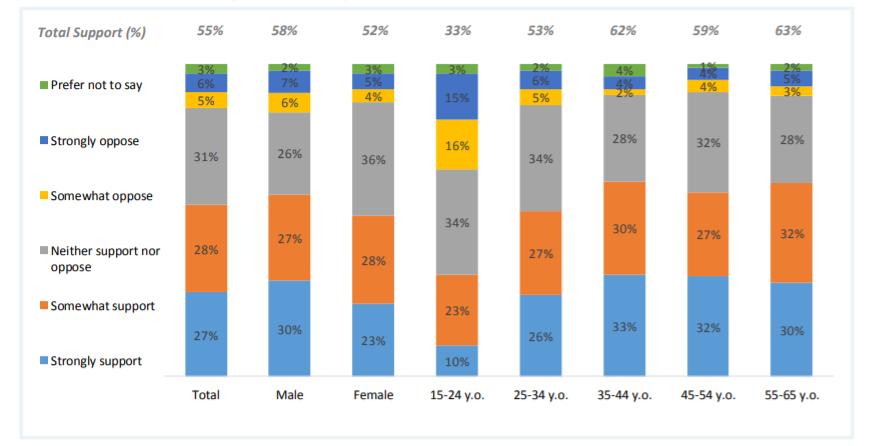
*Support and opposition for Section 377A of the Penal Code,graph by Robert McPhedran, Public Support Split on Section 377A of Singapore Penal Code, 2018.
When asked the extent to which they supported or opposed Section 377A of the Penal Code, more than half of all Singaporeans (55%) indicated that they supported the Section, while 12% indicated that they opposed. Levels of support varied according to gender, with males significantly more likely to have ‘strongly’ supported Section 377A (30%) than females (23%). Sentiment also differed by respondents’ age:
• those aged 15-24 years were significantly more likely to have opposed the Section (30%); and
• those aged 55-65 were significantly more likely to have supported the Section (63%).15
Conclusion
With change of notions in societies, it is right to maintain cultural ideologies but if any of those seem to interrupt with the basic rights of man, it is necessary that the fundamental rights of the citizens be given priority with respect to the changes in society and hence the reasoning given by the courts in Singapore affect the lives of many homosexuals where they do not get any recognition at all and are stamped criminals. Considering the reasoning given by various countries and implementing them and understanding the law in a much broader sense, will help the Courts and the legislature of Singapore to provide justice to the homosexuals in the community. The position of Singapore’s LGBTQ community is constantly evolving in the shadow of Section 377A.
A colonial holdover that the former leader of the UK conservative party, Theresa May, in 2018 described the law as ‘wrong then and wrong now,’ is an unfortunate law that continues to criminalize the sexual activities and lives of gay males in Singapore.16Moreover, the legislation also seem to inflict suffering on a wide range of people other than gay men who are stigmatized and fear discrimination from the state—from lesbians who are raped to ‘set them straight,’ to transgender people who experience bullying and discrimination in the labor market. Lastly, as in the case of UKM v Attorney-General,17 not just gay men, but single parents, children raised by extended family members, and unmarried couples with children will continue to be penalized, even if such family formations have always existed in Singapore’s history.
Repealing section 377A will send out a positive message to society that the government will uphold the constitutional rights of citizens, even if they are in minority. The courts must still tread through the complicated process of disentangling and decoding the history behind the law, its current impact on society, and how both comport with the constitution.18
*****
Footnotes
2. Dr.Renu Pawan, Homosexuality with Special Reference case: Navtej Singh Johar v. Union of India, Volume-3. IJTSRD 16, 16(2019). ↑
3. Ong Ming Johnson v. Attorney-General and other matters, [2020] SGHC 63. ↑
4. Lim Meng Suang and another v. Attorney- General [2015] 1 SLR 26. ↑
5. Singapore Gay history, WIKIA (June 6, 2020,10:30AM),https://the-singapore-lgbt encyclopaedia.wikia.org/wiki/Singapore_gay_history. ↑
7. George Baylon Radics, #Ready4Repeal? Viewing s 377A of the Singaporean Penal Code Through the Lens of Legal Actors and Artists, Vol 20, No 1. AJAL 1, 2(2019). ↑
8. George Baylon Radics, #Ready4Repeal? Viewing s 377A of the Singaporean Penal Code Through the Lens of Legal Actors and Artists, Vol 20, No 1. AJAL 1, 2 (2019). ↑
9. National Council of Churches says it does not support repeal of gay sex law, CHANNEL NEWS ASIA ( June 1, 2020, 5:30PM), https://www.channelnewsasia.com/news/singapore/national-council-churches-not-support-repeal-377a-gay-sex-law-10720824. ↑
10. Shashi Tharoor, On gay sex, India has assumed an ancient position. Read the kama sutra, SCMP( June 3, 2020, 10:35AM),https://www.scmp.com/week-asia/politics/article/2164299/gay-sex-india-has-assumed-ancient-position-read-kama-sutra. ↑
11. Ong Ming Johnson v Attorney-General and other matters, [2020] SGHC 63. ↑
12. Lim Meng Suang and another v Attorney- General, [2015] 1 SLR 26. ↑
13. Navtej Singh Johar and Ors., v. Union of India, A.I.R 2018 S.C. 4321. ↑
14. Om Kumar v. Union of India,A.I.R 2000 S.C. 3689. ↑
15. Robert McPhedran, Public Support Split on Section 377A of Singapore Penal Code, IPSOS (June 4, 2020, 11:30 AM),https://www.ipsos.com/sites/default/files/ct/news/documents/201809/singapore_public_support_split_on_337a_report_sept_2018.pdf. ↑
16. Theresa May 'deeply regrets' UK's colonial anti-gay laws, BBC (June 4, 2020, 6:30 PM), https://www.bbc.com/news/world-africa-43795440. ↑
17. UKM v Attorney-General[2018] SGHCF 18. ↑
18. George Baylon Radics, #Ready4Repeal? Viewing s 377A of the Singaporean Penal Code Through the Lens of Legal Actors and Artists, Vol 20 No 1. AJAL 1, 2(2019). ↑