
Introduction
Artificial intelligence (AI) is the simulation of human intelligence processes by machines, especially computer systems. AI is mainly based on language processing, recognition of speech. Artificial Intelligence (AI) actually requires the human intelligence also for functioning and it is also considered as a branch of computer science.3 AI is having different approaches, but advancements and the development, technical changes are shifting each and every part of tech industry. 4 The main work of the Artificial Intelligence is to build machines that are intelligent.
The term ‘labour’ means the physical or mental work done by unskilled workers for any financial gain. The strength of the employment sector can be decided by enumerating the rate of employment opportunities in the present scenario. It can be determined by taking the result after balancing the employment opportunity with the number of workers. The idea inferred from different statistical data, it can be understood that unemployment rate became higher by virtue of less employment opportunities.
The use of artificial intelligence in the employment sector have a lot of advantages too. The working time will be less for manufacturing of products. The same is applicable in the case of services if it was made with the support of any technology or any other power systems. In a collected data it shows that the expense incurred for the production of a robot is cheaper than the remuneration given to a worker in china for the service. The robot can work for the entire day without any break, cannot become ill, No consequences and threat shall be faced by the employer. Because it is an artificial intelligent being and not a living creature. The accuracy in work will be greater than human and cannot be distracted by any external matters. There will not be any variation in the work and renders constant result without any complaint. Robotic involvement in the risk sector can be an alternative to humans. There are robots which finds the fire and helps in extinguishing without harming anyone and reducing the injury to victims. User can control the functioning of robots and can operate them during the time of accident (in danger zone) by providing signals. In this current century, making investment in computer software and robots is a good idea.
The importance of AI can be perceptible in social communication platforms, marketing digital equipment, brokerage portals etc. Examples is Uber, Ola, Swiggy, Bigbasket, Amazon etc, these technologies made many advantages and disruption to the employment sectors. Autonomous process, robotization and dematerialization are some factors which lead to the emergence of modern era of technologies by subsiding the use of conventional methods are no longer necessary.
The impact on labour market is in a negative manner due to the speedy development in technologies. A major problem will be a mass unemployment that leads to the increase in number of poverty. This results in the lack of financial possibilities in virtue of poverty that is rebounded on the account of unemployment. Type of individual jobs will disappear soon by replacing it by many new jobs.
Analogy Between Development of Artificial Intelligence and Employment Sector
History of Artificial Intelligence
Human thinking is converted to an artificial form and manipulated by machines. The emergence of an idea regarding the artificial intelligence recognized during the time of conducting advanced studies in mathematics, and logical applications by the classical philosophers and logicians behind every work and thus resulted in introduction of this concept, that eventually lead to the invention of Computer. The idea regarding ‘Artificial Intelligence’ came out during the 20th century and that inspired the scientists to move forward with an idea of creation of an artificial intelligent being or a human assistant with an ‘electrical brain’. Alan proposed the imitation game also known as Turing Test.5 This test determines whether a computer is capable of thinking like a human being and he proposed that computer can posses the artificial intelligence if it imitates the human responses in specific conditions. The term called artificial intelligence was first proposed by John McCarthy in the year 1956.6
Benefits of Artificial Intelligence in labour sector
Due to the development of Artificial Intelligence (AI) the use of electronic forms is substituted on behalf of the human power. This resulted in time saving and the accomplishment of better tasks when compared to the traditional way of completion of works. This advantages obtained from the machine power led to the betterment of business efficiency. New opportunities procured by many on account of growth in Artificial Intelligence and provided with many job opportunities too. The completion of work with the help of Artificial Intelligence (AI) in a high accuracy and least human error made the result and outcome more efficient.
Difference between Robotics and Artificial Intelligence
The Robotics and Artificial Intelligence are two entirely different kinds of technology which is helpful for men to substitute their works and to do work for them in an efficient manner. The Artificial Intelligence is a branch of Computer Science. While robotics is a branch of technology which is programmable and deals with robots. They do the work by their own by a series of action and are usually autonomous or semi-autonomous. Artificial Intelligence is mainly used for completion of tasks, logical reasoning, problem solving, reading language and also used as a substitution to the human intelligence.
Artificial Intelligent Robots is a mix of robotics and AI which explained in the below diagram.7 These robots are controlled by AI Programs. The Artificial Intelligent Robots are another type of robots and are merged version of AI and Robotics.
Technological innovation in labour market
Before investigating the technological innovation and the employment it is necessary to know about the product innovation and process innovation. Product innovation is a kind of innovation done for finding new products and the innovation of new process for the implementation of new products is called process innovation. The innovation i.e non-technological innovations are called market innovations or organizational innovations. Some of these innovation creates more issues and makes more problem to the society are called disruptive innovations. Uber, Ola, Bigbasket etc are several type of disruptive innovations which caused many problems to the conventional workers. They will loss their basic salaries and wages due to the emergence of these huge start-ups. The same issues are arising to the workers because of the technological innovation. The technological innovations lead to the increase in productivity.
International Aspects Related to Labour Laws and AI
Establishment of an international cooperation was very much in need for each and every nations to solve their issues and problems that are raising related to labour. Another need was to eradicate the social unrest and to achieve additional economic potentiality which is most important for the nations that leads to future success or usefulness. Samuel Gompers was the chairman at the 1919 Paris Peace Conference.8 That conference was related to the validity and need for the labour legislation in international level and was conducted by the Commission on Labor Legislation. The Peace Conference proposed that the employer-employee-government should treat each other in an equal manner.9 This reflected in the formation of The International Labour Organization (ILO) in the year of 1919.10
International Legislations Related to Labour Laws
a. International Labour Organization
The International Labour Organization was established in the year 1919 after the World war I.11 It paved a way for many social movements and demanded for the social justice and greater living standards for the labour. The structure of ILO is very unique and has the equal power of government to raise voice against the problems that are faced by the working man. International labour organization is having a total number of 193 member-states among which is composed of four representatives from each member states. They mainly discuss about the matters relating to the forced labor, elimination of employment discrimination, promotion for the labors, labor inspection, deals with migrant workers, working hours, structure of wages fixed for the labors etc.
There are many conventions and recommendations proposed by the international labour organization for the implementation of certain principles. There are many international treaties too in connection with right of workers.
b. International Labour Standards (ILS)
(c) International human right treaties
(d) International conventions related to labour
International Legislations Related to Artificial Intelligence and Robotics
There are many international measures which regulates the development of AI and new technological changes in an ethical manner and for the smooth functioning without disrupting any sectors especially employment sector.
a. Policies given by United Nations
• UNICRI and Centre for Artificial Intelligence and Robotics:
• International Telecommunication Union:
b. Convention on Certain Conventional Weapons and Lethal Autonomous Weapons Systems
• CCW Informal Meeting of Experts (2013–2016):
• CCW Group of Governmental Experts Meetings (2017–2018):
United Nations and its Activities on Artificial Intelligence (AI)
There are many conventions, treaties, specialized agencies in international level for different purposes. This paper is going to discuss about these in a brief manner.
a. Comprehensive Nuclear-Test-Ban Treaty (CTBT)
b. Food and agricultural organization (FAO)
c. International Maritime Organization (IMO)
d. International Organization for Migration (IOM)
Indian Legislations Related to Artificial Intelligence and Robotics
Status of AI under Indian Law
The Indian citizen should follow the laws and regulations given under the constitution. But there is no proper or clear-cut provisions provided in the Indian constitution related to AI. There were no proper judgements regarding the legal status of AI, it’s applicability, status of implementation of existing laws. The Indian authorities are yet to be consider the relevance and value of AI. While considering the advantages acquired to the society due to AI, we need to see also the negatives infused too. The growth and development of technologies and AI lead to the growth of inidan economy. The factors for the economical growth has been already discussed above. Certain recommendations and ways to implement policies regulating the economical growth was administered and regulated by the Ministry of Commerce. The reports given by the ministry of commerce includes the matter relating to the relevance of AI system in India, need of agriculture, manufacturing, Agriculture etc. It also covers the technologies which are related to data collection, providing of adequate safety and safeguards, privacy. In the report they are giving certain special recommendations to the Department of Industrial Policy and Promotion (“DIPP”).
There are many provisions and laws which violates the aim of Artificial intelligence. A work done by a person with his own creativity, he is having the bundle of rights as against any other third party in Copy right law. Every individuals work done should be protected against any violation in the case ‘Eastern Book Company and Ors. v.D.B. Modak and Anr’,12 it states that a minimal amount if variation or changes at least is needed for the protection of rights against the trespasser other than expecting the entire variation. It says, not mandatory to meet the ‘modicum of creativity’.
Changes in Working Environment Caused by Introduction of Artificial Intelligence Systems
In some technically advanced countries like South Korea, Japan, and Germany semi-automated systems are already the state-of the-art technology. So, it is possible to study and discern the change in the working environment that results from the introduction of the artificial intelligence systems. Some of them are as follows:
• Occupation safety in the work environment where robots are employed is one important element. Safety zones are prescribed for employees in relation to their interaction with the robots. It is specifically seen that the timing and the space of operation of the robots do not overlap with that of the human employees in order to avoid any untoward incidents.
• In hospitality sector, ‘actroids’ are used. Actroids are humanoid robots, which has visual and mechanical similarities to human beings. They are employed for basic hospitality purposes such as cleaning the rooms, receiving and serving the guests, preparing the food, carrying the luggage etc. In the near future, such robots can be employed in a full-fledged manner for certain hotel operations.
• Moreover, in the recent future, it is expected that the robots will assist the humans in the day to day operations in the work environment. Especially in sectors (for example medical sector), where it will be difficult for humans to do the tasks on account of personal ethics, health and hygiene, etc. these automated machines can be of paramount assistance.
• The employment of such intelligent machines is capable of also preventing human employee from physical sufferings or diseases that they encounter during the usual course of employment operations.
Indian Legislations Related to Labour Law
The Indian labour laws are legal rights and rules provided to the working people in India for the smooth relationship between the employees and employers. If any conflicts or dispute arises the solution can be derived from the laws given for the labour. Mainly it covers the health and safety, solving disputes between employers and employees, minimum wage etc. Collective labour laws and Individual labour laws are two kinds of labour laws. In which collective labour law is to maintain the relationship between the employer, employee and the labour union. Where, the individual labour laws are for obtaining the employee’s their right at work.
a. Constitutional provisions with regard to labour laws
The matters related to the dignity of the human labour is well discussed on the Indian constitution and also providing certain articles related to the same for safeguard and protection of workers and those are Chapter-III (Articles 16, 19, 23 & 24) and 7 Chapter IV (Articles 39, 41, 42, 43, 43A & 54) of the Constitution of India. Both the union and state government are authorized to take the matter and administer the same.
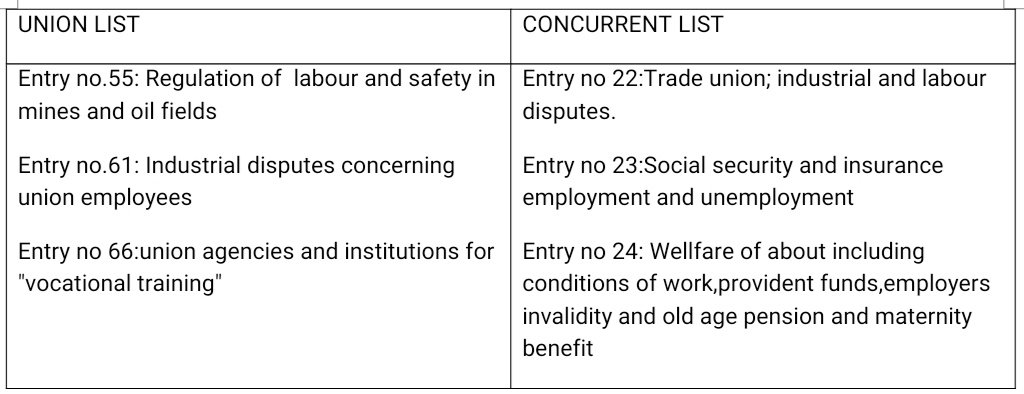
b. Labour policy of India
The introduction of labour policy was mainly for some objectives ie. Maintain industrial peace and welfare of the workmen.
Need for the labour policy:
• For more private and public investment.
• More opportunities for jobs.
• Social security for workers.
• Maintaining the funds for labour welfare
• For smooth employer-employee relationship.
• Committees for labour in all sectors.
• Special conciliation mechanisms.
• Functioning of Labour Department
• Medical and health facilities for workers.
• To study changes in laws related to labour and employment sector.
• To provide rehabilitation packages.
• Balancing Law reforms and statutory amendments
• To suggest required changes in laws and legislation.
c. List of Labour statutes in India
The labour statutes in India, is mainly relating to the Working Conditions, Wage, Welfare of the workmen.13 The enactments are derived and made from the Constitution of India.14
The main central laws dealing with labor issues are given below: -
1. Trade Unions Act, 192615
2. Industrial Disputes Act, 1947.16
3. Payment of Wages Act, 193617
4. Minimum Wages Act, 194818
5. Payment of Bonus Act, 1965.19
6. Factories Act, 1948.20
7. Mines Act, 1952.21
8. Motor Transport Workers Act, 196122
9. Beedi & Cigar Workers (Conditions of Employment) Act, 196623
10. Contract Labour (Regulation & Abolition) Act, 1970.24
11. Maternity Benefit Act, 196125
12. Equal Remuneration Act, 197626
13. Child Labour (Prohibition & Regulation) Act, 198627
14. Workmen’s Compensation Act, 192328
15. Fatal Accidents Act, 185529
d. Case laws relating to Labour Law:
Ritz Hotel (Vegetarian), Pune vs E.S.I.C.30
The court held that there was no manufacturing process or activity in the hotel with the use of power except in the case of one refrigerator which was used to preserve milk and curd even the kitchen had no use of power for making the eatables and hence it cannot come under the preview of factory as there is an absence of manufacturing.
ESI corporation vs Raj keshaw
Those allowances paid for the employers comes within the wages as defined. The wages given to the employees during the vacation time should be consider as wages.
Employee'S State Insurance Corpn vs R.K.Swamy31
The issue in this case was that weather advertising agency can come under the preview of shop. Here it was held that as the advertising agency sells it's skilled and experienced services to clients enabling them to launch an effective campaign for his products so it can be said as a shop
Mr. S C Sharma vs Employees State Insurance
In this case a laid off employee after signing in the layoff register came out of office, but while crossing the road he was hit by a vehicle and sustained injuries but this was covered under the course of employment along with the basic theory of notional.
Indian Legislations Related to Artificial Intelligence and Robotics
AI Algorithm ownership:
Under copy right act algorithms will come under literary works that includes computer programs also. The work of algorithm must be a original work and it should have a proper owner also.
The Competition Act, 200232:
This act mainly restricts the competition arising in the business market and is against the abuse of dominant position also. This act is enforced by the competition commission of India (CCI). This particular act prohibits anti-competitive agreements, abuse of dominant position, mergers and amalgamations relating to anti trusts. AI can function as a factor which helps the business market to make variations in the dominant position and to bring competition between the companies.
Information Technology Act, 2000 (IT Act)33:
In present time were the whole world as become a global village were transactions happen at ease. Protection of data privacy and other intellectual aspects along with the confidential aspect are the need of the hour. As a result country's like India had made strict laws and provisions to protect these private information. A recent survey connected in 2018 on the topic AI with the industrial stake holders revealed that 93% people had expressed there problems regarding data privacy. 2018 was the year were revolution happened in the field of data protection rights were Supreme Court gave a landmark judgment in the case justice K.S puttaswamy vs. union of India34, the informational privacy was brought under the per view of right to privacy making it constitutionally protected along with giving fundamental right status.
Certain case Laws :
Narkesari Prakashan Karmachari Sangh Vs. Shri Narkesari Prakashan Ltd. and Ors.35
Shri Narkesari Prakasha is the respondent in this case and moved under-Section 25-N of the Industrial Disputes Act, permission to retrench 19 workmen who worked in field of hand composing. If the worker is working for more than one year continuously, then 3 months prior notice should be given to the particular workmen before the retrenchment. Because of the change in technology they retrenched almost 19 workers . The workers challenged that it was null and void being violative of Section 9-A (Notice of Change) of the Act.The appellate court held that Section 9-A of the Act had no application in this case.
Batliboi Employees Union Vs. Respondent: Batliboi Ltd. and Ors.36
The company decided to retrench 33 number of employees under the Industrial Disputes Act. Respondents raised contentions and raised issues of jurisdiction. The issues was raised and covered by Item No. 10 of the Third Schedule of the Act, which states that about the reference of disputes to Boards, Courts or Tribunals, The petition was disposed by the court.
Hindustan Lever Limited Vs. Respondent: Hindustam Lever Employees Union and Ors.37
The petitioner filed a complaint for unfair labour practice under item 9 of Schedule IV of the Maharashtra Recognition of Trade Unions and Prevention of Unfair Labour Practices Act, 1971. Workers had work in the Hard soaps department, Sulphanation department, packaging department etc. Many problems arose due to the redeployment of the employees and non-payment of incentives. It amounted to change of their service conditions. Redeployment is necessary to meet the business needs regarding the introduction of new technologies and the introduction of new machines and power system of work. The respondents states that the employees has been agreed for the redeployment and also for introducing new machineries and technologies. Taking this in the account the respondent prays for the dismissal of the complaint filed by the petitioner. The court held that the respondent was engaged in unfair labour practice under item 9 of the fourth Schedule of the Act of 1971. Court found no merit in the appeal and dismissed it with cost.
Conclusion and Suggestions
AI-based digital technologies helps in the development of labor market by improving the rate of productivity and promote the economic growth. Advancement in the artificial intelligence lead to the technical change and it imposed a fear of disruption on labour markets. This can lead to income inequality among the workers over nation and the increment in job destruction and job displacement will result in high poverty rate. It is very much important to know about the economic and social implications of artificial intelligence.
The act of following a basic morale and principles by the authorities without concentrating on the profits, giving more concern to the impecunious group who are trying to meet their life for day-to-day basic needs is very much needed. The central and state authorities should show more concern in the development of ethical Artificial Intelligence rather than supporting disruptive innovation. Taking adaptive measures and implementing the necessary safeguards for the development of AI without excluding the human labour will be an efficient idea. Some special skills and talents are mandatory from the side of the employees for the better production of goods. The growth and development of AI and robotics depends according to the capability and skills of the employees.
It can be inferred that robots functions according to command given it cannot function beyond the command provided by it’s owner. In contrary to this, due to the technical advancements a robot may program by self and can acquire the capacity to give commands by self. While considering these instances, the amount of risk to human beings is higher. the determination of machine hours and man hour should be done first in order to avoid the wage discrimination due to the introduction of artificial intelligence. Minimum wages Act explains the ‘man hour’ as the working hour provided for an adult that shall not exceed beyond nine hours in a day under rules 20 to 25 of Minimum Wages Act, 1948. When it come in the case of machine, the machine hour is not specified in any other Indian legislations. A statute should be constituted which determines the machine and man hour is very much needed.
It can be concluded that the time required for a machine and the time taken by a human should be differentiated. According to the Indian laws an aggrieved party whose rights are adversely affected can claim compensation or remedy. Also the liability attached to this can be decided with the help of Indian statutes and judicial intervention. But the same compensation, liability, punishments relating to the act done by a robot or AI is not defined nowhere in the Indian legislations. There is no place to address the blame or complaint against the autonomous robots and machines. The duration of punishment for the improper conduct, injuries caused by robot is also not mentioned anywhere. A proper wage determination and work classification is lacking in Indian legislation. The time required for a machine and the time taken by a human should be differentiated.
*****
Footnotes
3. What is Artificial Intelligence? How does it works? ↑
5. Gill Press, A very short History of Artificial intelligence (AI), Dec 30, 2016, 09:09am. ↑
6. Chris Smith, The History of Artificial Intelligence, History of Computing CSEP 590A University of Washington (December 2006), 2 1-27. ↑
7. Alex Owen-Hill, What's the Difference Between Robotics and Artificial Intelligence? (Feb 06, 2018) ↑
8. The International Labour Organization (ILO) - Creation, Nations Encyclopedia ↑
10. Labour, Peace Palace library ↑
11. International Labour Organization – History. NobelPrize.org. Nobel Media AB 2020, (8 Mar 2020). ↑
12. Eastern Book Company and Ors. v. D.B. Modak and Anr. (2008) 1 SCC 1 ↑
13. Labour and Employment Laws of India, Page : 1-4 ↑
15. See generally TRADE UNIONS ACT, 1926. ACT NO. 16 OF 1926 ↑
16. See generally Industrial Disputes (Amendment) Act, 2010 (No. 24 of 2010). ↑
17. THE PAYMENT OF WAGES ACT, 1936 (4 of 1936) ↑
18. Minimum Wages Act, Act No. 11 of 1948 ↑
19. Payment of Bonus Act, 1965, 1965. ↑
20. The Factories Act, 1948 (Act No. 63 of 1948) ↑
21. Mines Act, 1952 (35 of 1952) ↑
22. Motor Transport Workers Act, 1961 (No. 27 of 1961) ↑
23. Beedi and Cigar Workers (Conditions of Employment) Act 1966 (No. 32 of 1966) ↑
24. Contract Labour (Regulation and Abolition) Act 1970 (No. 37 of 1970) ↑
25. Maternity Benefit Act 1961 (No. 53 of 1961) ↑
26. Equal Remuneration Act 1976 (No. 25 of 1976). ↑
27. Child Labour- Prohibition and Regulation Act, 1986. [Act 61 of 1986] ↑
28. WORKMEN'S COMPENSATION ACT, 1923. ACT NO. 8 OF 1923 ↑
29. Fatal Accidents Act, 1855. (13 of 1855) ↑
30. Ritz Hotel (Vegetarian), Pune vs E.S.I.C., 1995 (70) FLR 613, (1998) IIILLJ 309 Bom ↑
31. Employee'S State Insurance Corpn vs R.K.Swamy , 1994 AIR 1154, 1994 SCC (1) 445 ↑
33. Information Technology Act, 2000 ,(No 21 of 2000) ↑
34. Justice K.S. Puttaswamy v. Union of India) (2017) 10 SCC 1 ↑
35. Narkesari Prakashan Karmachari Sangh Vs. Shri Narkesari Prakashan Ltd. and Ors.,[1999(81)FLR149], JT1998(7)SC509, (1999)IILLJ145SC ↑
36. Batliboi Employees Union Vs. Respondent: Batliboi Ltd. and Ors, (2005)ILLJ471Bom ↑
37. Hindustan Lever Limited Vs. Respondent: Hindustam Lever Employees Union and Ors, (2006)ILLJ1119Bom ↑