
Introduction
Oxford announced ‘refugee’ to be the children’s word of the year 2016.2 The curiosity around ‘refugees’ and refugee law piqued in the second decade of the 21st century as more instances of Syrian refugees arriving in Greece, Germany, other parts of Europe; the Rohingya refugees knocking on the doors of India and Bangladesh;3 and other instances of displaced persons seeking shelter in foreign land, gained more ink in our news.
The attention of the globe panned towards the United States of America when news reports of the living conditions of the immigrants detained at the detention centre facilities surfaced. The USA which stands for liberty and equality faces a blot on its global image in the humanitarian sphere under the administration of Donald Trump. Human rights violations have been the epicentre of this piece of news gaining widespread and much needed attention. However, what startles one further is the abuse of rights of children. In 2018 when the US government adopted a zero tolerance control strategy for any illegal immigrant entry through the USA-Mexico border, there were rampant issues of human rights violations, much of it was being suppressed by authorities. In the age of day of information surplus, there is also an abundance of misinformation. Accurate facts and figures surrounding the crisis is difficult to verify for its veracity. Through this research, the author attempts to present a holistic view of the socio-political and legal reality surrounding the situation at the USA-Mexico border. No crisis ever was born overnight, it takes years of mal-governance, suppression, mistreatment and subjugation for the volcano of violence, rebellion and terrorism to erupt. The peace-seeking people living in the shadows see no option but to leave behind their homes and re-start life from scratch for survival is a basic human instinct. The present research is a thoroughly structured essay broadly compartmentalised into three segments – the historical and social perspective of the immigration crisis, the legal framework of international laws and human rights, and the present political situation with recommendations for a peaceful way forward.
Methodology
The author will be relying solely on secondary data throughout this research paper. This secondary data includes but is not limited to, articles, commentaries, research papers, international reports and verified data. All statistics cited are also through secondary sources and have been duly referenced. The research is purely doctrinal and does not rely on any non-doctrinal evidence primarily.
Objective
The objective of the researcher is primarily to draw attention to plight of the vulnerable groups of persons – women and minors who flee in search for safer shores. Secondly, the aim of the researcher is to dissect to simpler understanding the existing international laws and domestic legal framework on immigrations. Further, the nexus between immigration and human right is intricate and any violation of the latter has irreparable consequences on the lives of several immigrants. The research question which is at the foundation of this research is – ‘Do immigrants have the humanitarian right to live the Great American Dream?’
Deliberative Analysis
In this section, the author shall delve into the history and the current situation of the USA immigrants’ crisis. Further, a critical analysis of the prevailing international and domestic laws shall be thoroughly looked into. The focus of the author is to highlight the plight of the weaker sections of society with emphasis on women and children and the arduous routes they undertake to partake in the ‘Great American Dream’ only to be met by barbed wires.
The USA-Mexico Border Crisis
The Statue of Liberty which stands tall overlooking Manhattan is a symbolic reminder to all Americans about their great War of Independence of 1776 and the freedom and liberty that the nation stands for. Following this promising dream of liberty, several people from across the globe, usually from war-torn or poverty-stricken countries, leave their homes and histories behind to find shelter and a new life in the USA. The United States has more immigrants than any other country in the world. By 2018, the country had over 44.8 million immigrants within its borders with only about 77% accounting for documented legal immigrants and asylum seekers.4 Nearly 14% of the total population of the USA comprises of immigrants.5 The original settlers in the USA were European immigrants who spread across the nation and over the centuries nearly decimated the indigenous tribes and Native Americans. In the previous decades, mostly Asians belonging to China, India, Pakistan, Philippines, among other Asian nations migrated to the USA for a better standard of living. However, in the last two decades with the growing ‘immigration crisis’ the migrating groups are mostly Hispanic/Latino in ethnicity.
The majority of these immigrants from Central America especially from the countries of Mexico, Honduras, El Salvador, and Guatemala.6 The factors which drive people to leave the countries of their origin in Central and Southern America and move up north, range from natural disaster to gang violence to hyper-inflation and acute poverty to grotesque crimes against women.7 With the breakdown of political systems in countries such as Venezuela, Honduras, Mexico, which often to corrupt dictatorial regimes, people are left with little or no choice for their survival. The influx of billions of dollars of black money often finds channels through drugs, arms and ammunition, and sex slavery. These three have been termites of governmental systems, organizational machineries and social structures. The author shall elaborate the above in the subsequent sections of this paper.
With crime and violence riddling Central America and acute poverty with frequent natural disasters destabilizing Southern American states like Haiti, Honduras, among others, migrations appears as the only solution for the citizens of the affected nations. Amidst all the tragic and deplorable standards of living and quality of life, the most vulnerable groups are usually women and children. Supported by statistics and thorough research, the subsequent sections discuss the history and the present repercussions of age-old politico-legal fallacies.
(A) HISTORICAL PERSPECTIVE
Throughout the 20th century when the world was reeling from the after-effects of the World Wars, Central and Southern America was witnessing brewing social and political unrest.8 Countries such as Cuba, Argentina, Mexico, Puerto Rico, El Salvador, which had been through years of Spanish colonization. As the United States of America grew to be a global leader and economic superpower, in its backyard grew tycoons. The corrupt and ultra-rich laundered money through means of drugs and weapons into these Central and Southern American states. The objective would be to challenge American and European domination, topple existing governments, raise guerrilla warriors and stage military coups. For Latin America, the century belonged to the likes of fierce rebellious forces such as Che Guevara and Fidel Castro.
The constant civil strife and exceedingly corrupt governments forced the impoverished farmers to take up arms and form counter-rebellion groups and join the civil war. This left several already impoverished women and children vulnerable to violent crimes, sexual abuse and trafficking. With the rampant influx of arms and the years of war, the newer generation was born into the lap of poverty and many took routes of drugs and joined drug cartels and ‘gang lords’. With more and more recruited into drug trades and gang wars, several poor people, with no faith in their own governments, started migrating to northern Mexico and to the USA. This brings us to the present crisis.
(B) PRESENT CRISIS
As the gangs multiplied, inter-gang rivalry and the abundance of weapons ravaged the streets of countries like Mexico, Cuba, Guatemala, and El Salvador. The United Nations Surveys on Crime Trends and Operations Criminal Justice System record that these countries rank among the top few in the highest crime rates in the world. 9 While women are at high risk due to their socially repressed standing in majority of these patriarchal states, one of the more vulnerable group are minors. Many gangs and drug cartels and smugglers recruit children and any resistance is met with brutal deaths and sometimes grave crimes against the family of the minor. In order to avoid gruesome fates, several women, teenagers or young men make arduous and risky journeys through deserts taking Mexico as a corridor to reach he gates of the United States.
The United States of America has been a safe haven for immigrants for several years, with thorough procedures established to admit asylum seekers. Post the World War I, several Jews fled persecution and made way to the States. The United States is also home to the largest number of immigrants from Asia – specifically India, China, Vietnam and pre-partition Korea.10 What is the immigrants crisis arising then? The immigrants and humanitarian crisis involved here is manifold. Firstly, the circumstances from which several of these minors and women come are horrifying and added to that is the journeys they undertake to reach the international borders. This causes severe psychological impact and trauma. Secondly, the frequent changes in foreign policies, domestic laws and political ideologies, makes it difficult for any asylum seeker to start a new life. Thirdly, new immigrants’ laws have brought harsher treatments of asylum seekers which becoming one of the biggest crises of human rights violations. The policy of detention and separation has been severely criticized globally but the United States of America has continued to indulge in such practices. All of these factors and more have been the present crisis one of the biggest immigration and human rights issues of the day.
Vulnerable Groups Subject to Human Rights Violations
Human Rights violations against asylum seekers or immigrants usually include denial of civil and political rights. Familial separation, arbitrary detention, isolation, torture and abuse in detention facilities and throughout the process, information isolation and denial of all forms of health, economic, social and educational rights. These denials are rooted in archaic discriminatory laws and xenophobia.11
Under this heading, the author will focus on the humanitarian crisis – the human rights violations which intersects with immigration. Special emphasis will be placed on the impact endured by vulnerable groups of women and more specifically, minors. The objective is to shed light on the atrocities faced by displaced and deprived human beings in the land of liberty.
(A) THE ESCAPE ROUTES
It is never an easy decision to leave one’s family, home, property and all history behind and migrate to a foreign land. Most immigrants detained at the US-Mexico border are primarily asylum-seekers from Guatemala, Honduras and El Salvador; chronically destabilised regions plagued by grave levels of human rights violations, insecurity, poverty, drug cartel infiltration, violence and corrupt justice systems. The US states of Texas and New Mexico border the nation of Mexico. Although the international boundary is well defined and mostly manned or fenced, there exist some porous areas through the deserts where temperatures soar to inhuman conditions. Estimated figures of over 1 million people from Latin America attempt to immigrate to the United States of America each year. After travelling for days through several routes in Mexico, either on foot or by hitch-hiking or through smugglers who take highly dangerous and illegal routes to reach the international border. Several persons go the legal way which by presenting themselves before the US Border Police or the Texas/New Mexico State Police Departments citing ‘credible fear’ as grounds for seeking asylum. However, many others with little to no documentation fear the consequences of reaching the borders without papers. The result usually being sent back to the country they are fleeing. Since returning is not an option, these immigrants choose illegal routes such as giving up the last of their savings and valuables to smugglers who take unconventional routes through deserts, often using container trucks and vessels to stuff people in and smuggle across borders. Those who manage to not asphyxiate to death in these journeys, arrive on the US soil with little to no means of further survival. According to the US Border Patrol, some 688,375 apprehensions of illegal immigration has been made in the year 2019.12
What happens to minors who flee their home countries to migrate to the States for a better life? This issue came to the fore when in between 2013 and 2014, a surge of 90% in the immigration of unaccompanied minors was reported by the US Customs and Border Protection.13 This was at the peak of gang violence and deplorable impoverished conditions of some of the Southern American states. As the crime nexus is trans-national, these minors, most of them between the ages of 11 to 17 spend every single minute in perpetual fear as the consequences of being tracked down by their attackers and abusers would be brutal. Till May, 2020 about 11,500 unaccompanied minors were reported at the Mexican border.14 Now that we have seen the dangers one entails while embarking upon the journey to the international border, it is important to be familiarised with the reality with lies at the border.
(B) THE LINE OF FIRE
The international border at the states of Texas, Arizona, California and New Mexico, separating the United States from its southern neighbours, has several check-posts. Any person who arrives at the border check-post is usually put through the following of the two processes – ‘immigration court removal proceedings’ or ‘expedited removal proceedings’. In the former, the asylum seeker has an opportunity to present their request before an administrative judge. In the latter, the border agents have the authority to deport a person back to their country of origin without a hearing before any court. However, in such a case if the person fear of return to their homeland, they are sent through a screening process known as the ‘credible fear interview’ before a trained asylum officer of the US Citizenship and Immigration Services.15
The above process theoretically appears smooth and simple. However, the reality is far from it. After the administration of George W. Bush, when President Barack Obama took the reign, there were high hopes from his Democratic Government to resolve the border crisis. However, his period of administration was when there was a surge in asylum seekers coming from the Central American states as grave political instability and poverty grew in that region. It was under the Obama administration when some very stringent measures were taken to control the order situation. The installation of ‘detention centres’ at the borders became not a solution but a human rights nightmare for the incoming immigrants. Several county jails were turned into “civil detention” centres as immigrants awaited their turn to be heard before a judge.16 Majority of the people living in detention are so poor that they cannot afford a lawyer or have any access to legal aid and therefore, their turn takes months and even years to come. Most of the cells do not have basic facilities with pictures of people using aluminium sheets as blankets surfacing. Further, the Federal Government has been arguing against the pleas and cries of human rights activists in court that soaps and toothpastes are not essential commodities for the detainees. Such is the outrageous situation. However, the lack of basic amenities is not the grave crime which is startling.
The most inhuman policies of all has been the separation of children from their parents upon arrival at the US-Mexico border. People who have left everything behind to flee for their lives are met with the worst treatment when their children are snatched away from them and kept in separate detention facilities. The detention facilities for children are riddled with their own problems. Children of the age 5-6 who themselves are in need of care and affection are forced to take care of toddlers. They are deprived of their right to parental care, education and a decent standard of living. Further, there are unverified reports of rampant sexual abuse and other physical and mental abuse in these facilities. The psychological trauma from these prolonged periods of separation from families and detention is bound to have severe psychological impact on these growing individuals. Where is the liberty that the United States takes pride in? Where are the human rights that the USA has championed for years?
The number of children impacted per day through personal or parental detention is estimated in millions.17 In many countries, immigration detention remains synonymous with widespread human right violations, lamentable conditions, child maltreatment, abuse and torture.18 Lack of transparency regarding immigration detention is widespread, severely hampering monitoring of practice and informed public and policy debate.19 There is no research available evidencing child detention as beneficial to children or functioning as a successful immigration control strategy. At the end of May 2018, the US Department of Health and Human Services reported 10 773 unaccompanied immigrant children in its custody, including the 20% swell in numbers since April 2018 due to enforced separation of children from parents at the US-Mexico border.20
The above have been the most gruesome forms of human rights violations against immigrants which we have witnessed in the recent years and which continues rampantly. In the next section, the author will deliberate upon the existing international and domestic legal frameworks for the rights of immigrants and displaced persons.
Before proceeding to the legal framework, the author has dedicated the next segment to some statistics which will give the reader a clearer picture of the extent and magnitude of the crisis at hand.
Statistics
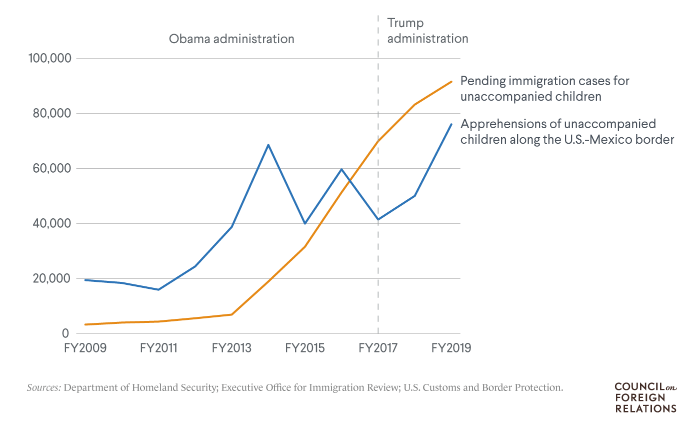
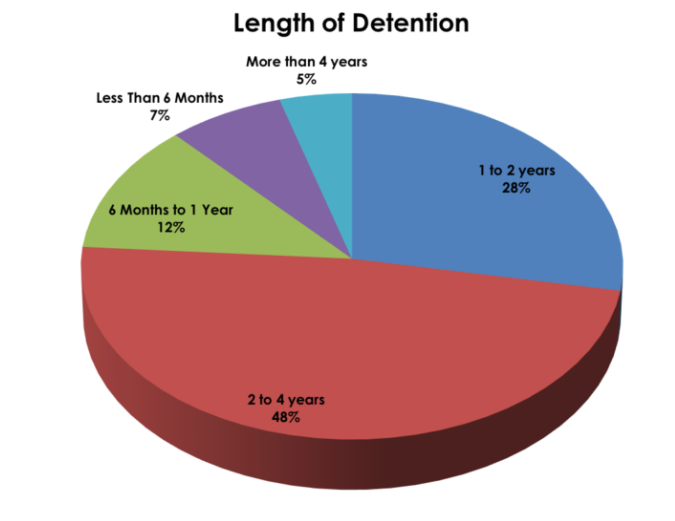
Source: Council on Foreign Relations.
https://www.cfr.org/backgrounder/us-detention-child-migrants
The Legal Framework
(A) INTERNATIONAL LAW ON IMMIGRANTS
The International Law as envisaged by the likes of Hugo Grotius was to facilitate the coming together of the community of nations for mutually beneficial purposes. The International law has recognized various concepts of human migration and refuge/asylum seeking on the grounds of poverty, better livelihood opportunities, better quality of life, religious persecution, ethnic discrimination, environmental degradation, violence, crime, and terror, among other factors. In this section, the author seeks to enunciate on the laws governing immigration and human rights.
International Human Rights law and Refugee law is highly intertwined. The Universal Declaration of Human Rights (UDHR), 1948 guarantees the right to seek and enjoy asylum in other countries.21 Ironically, the major propeller of the UDHR was Eleanor Roosevelt, an American visionary who conceptualised harmonious existence and co-dependence and it is in her America that the most gross violations of human rights of immigrants is taking place. Similar to the UDHR, the American Convention of Human Rights, a powerful regional instrument, states that a person has the “right to seek and be granted asylum in a foreign territory, in accordance with the legislation of the state and international conventions.”22
The term ‘refugee; is defined under Article 1(A)(2) of the 1951 Convention Relating to the Status of Refugees and its Optional Protocol. Under the definition, a refugee is an individual who is “outside his or her country of nationality or habitual residence” who is “unable or unwilling to return” due to a “well-founded fear of persecution” based on his or her “race, religion, nationality, political opinion, or membership in a particular group.” Persons fleeing violence and crime in their homes or victims of natural catastrophes who seek shelter by crossing international borders are not accorded the status of refugees under this 1951 Convention. This stance has been disputes by several international law communities over the years. The Conventions grants the right of ‘non-refoulement’ which is the right to not be returned to the country where the persons have arrived from. A protection greatly needed by the immigrants at the US-Mexico border. The United Nations High Commissioner for Refugees (UNHCR) though provides protection to ‘internally displaced persons’ and ‘stateless individuals’ who are not covered within the ambit of the 1951 Convention.
As the present research is focused on vulnerable groups, we shall look at the international laws which protect the rights and interests of minors. The United Nations adopted the Convention on the Rights of the Child in 1989. This was the fastest ratified Convention of the UN and yet the United States of America has failed to ratify it and is the only country in the world to have not. Children form the most vulnerable sub-sect within the group of refugees and immigrants. This is majorly due to the fact that the psychological impact, stress, trauma, fear and abuse at an impressionable age can have a lifelong affect leading to a generation growing up with mental and emotional health issues. The reluctance and near apathetic marginalisation of ratification of the Convention on Rights of the Child has had very severe consequences leading to far greater human rights violations at the borders. In 2016, the United Nations High Commission for Refugees estimated that 50 million children had migrated across country borders or were forcibly displaced. Twenty-eight million (1 in every 80) children fled violence and insecurity, a figure that has more than doubled between 2005 and 2015.23 Twelve millions of these children were recorded as refugees or asylum-seekers. Sixteen million children were internally displaced within their home country borders. A further 7 million children had been displaced due to natural disasters. In 2015 and 2016, at least 300 000 children were registered unaccompanied or separated as they crossed borders in over 80 countries.24 The ethical and health implications of non-ratification of the Convention are immense. The above are some of the relevant international laws governing this field.
(B) US DOMESTIC LAW ON IMMIGRANTS
As a country with rich diversity of migrants, the United States of America started framing laws and policies on immigration as early as in the mid-19th century. Majority of the migrants reaching American shores were either European or Asian – Chinese or Indian. During World War II and post that, several Jews fled persecution in Austria, Poland, Germany and Hungary among other European states and headed to seek shelter in the United States. The Immigration and Nationality Act was passed in 1965. Prior to the enactment of this Act, Latin Americans could freely enter the States without having to go through any border control procedures. As per this new Act, immigration into the US became more restrictive and streamlined. The priority was family reunification and immigration of skilled labour into the country.
The Immigration Reform and Control Act, 1986 laid down strict guidelines and provisions for immigrants working in the United States. The Act legalised the status of several illegal immigrants who met certain conditions. In 2012, in President Barack Obama’s administration, an executive action was taken to allow young adults who had crossed the border illegally to allow for deportation relief and work permit. In 2014, this program was expanded to Deferred Action for Childhood Arrivals (DACA) and Deferred Action for Parents of Americans and Lawful Permanent Residents (DAPA). The two programs are presently on hold pending a legal decision.
Under the administration of Donald Trump whose election campaigns were mired with controversial statements such as “pushing back” of Mexican and other Central American immigrants, more stringent policies have surfaced. In 2018, the Justice Department announced the “zero tolerance” policy. The Department of Homeland Security termed the US-Mexico border crisis as a “national security” issue. With a series of executive orders, more detention facilities have opened up, families are being separated upon arrival, children are being kept in shoddy facilities and several other human rights violations are taking place under the garb of ‘immigration control’. While emotional torment cannot be measured, the worst sufferers of all have been children.
(C) LANDMARK JUDGMENT
The most important legal protection for immigrant children in detention stems from Flores v. Reno, a Supreme Court case settled in 1997. Flores bears the name of Jenny Lisette Flores, a woman who fled El Salvador's brutal civil war in 1985 and was detained in the United States for two months when she was 15 years old. Flores was held in a detention facility with adults and was repeatedly strip-searched. Human rights lawyers in Los Angeles sued the federal government on Flores' behalf, and, after more than a decade of ligation, they arrived at the 1997 settlement, which established the rights of minors in immigration detention for the first time.
According to the Trafficking Victims Protection Reauthorization Act—a bill signed into law by President George W. Bush in 2008—children cannot be held by the Border Police for more than 72 hours. After those three days, they must be transferred to the custody of the Office of Refugee Resettlement, the division of the Department of Health and Human Services in charge of unaccompanied children. There are other bills being floated in the Congress, we are yet to see concrete measures being taken and the violations continue brazenly.
Concluding Remarks
(A) IMPACT
As global politics witnesses a right-ward leaning, there is a growth of jingoistic and protectionist ideas and heightened sensitivity to nation and nationhood. Often, these public sentiments are but a ruse to gain political mileage. While the immigration crisis continues to surge and the pandemic and its crippling economic effects are bound to displace more people, one must look into the reasons for this rise. Being the election year in the USA, the campaign against Central American immigration is raging on to further President Donald Trump’s national policy.
(B) RECOMMENDATIONS
➢ All illegal pushbacks, arbitrary denial of asylum and any instance of executive overreach must be stopped immediately and must also be called to justice before the Federal Courts.
➢ Reasonable and proportionate measures to deal with instances of irregular entry. International law on not sending back an asylum seeker to the place they have fled, must be followed.
➢ The USA must immediately ratify the Convention on Rights of the Child and make laws to protect the interests of minors.
➢ The previously existing Family Case Management Programme must be re-started with immediate effect. Family separation, strip searching, housing in deplorably maintained detention facilities, is inhuman and a gross violation of the human rights of immigrants.
➢ Deploy more personnel including specialised doctors, paediatricians, psychiatrists and counsellors with the Border Protection Department. Every individual walking up to the fence to seek protection and a better life deserves humanity. This must be ensured in the policies and laws of the State.
It is not the proposed ‘wall’ at the Mexican border that poses a threat to international human rights and immigration laws, but the inner wall that confines humanity within persons, global leaders and States. It is the need of the hour to step up and take a coordinated action to protect the present and upcoming generations from growing up in cells of claustrophobic dimensions. It is the duty of every individual of the international community to remind the State of liberty of the true meaning and essence of freedom and liberty. Only then shall there glimmer the hope of justice.
*****
Footnotes
2. Paula, E. 2016, May 26. ‘Refugee’ is children’s word of the year, declares Oxford University Press. The Guardian. Retrieved from: https://www.theguardian.com/childrens-books-site/2016/may/26/refugee-is-childrens-word-of-the-year. ↑
3. Eleanor, A. 2020, January 23. The Rohingya Crisis. Council on Foreign Relations – Backgrounder. Retrieved from: https://www.cfr.org/backgrounder/rohingya-crisis. ↑
4. Abby, B. 2020, August 20. Key Findings About U.S. Immigrants. Pew Research Centre. Retrieved from: https://www.pewresearch.org/fact-tank/2020/08/20/key-findings-about-u-s-immigrants/. ↑
6. Katrina, B. (2020). Courting Migrants: How States Make Diasporas and Diasporas Make States. Oxford University Press. ↑
7. Steve, H. 2019, November 13. The South American Spiral. Forbes. Retrieved from: https://www.forbes.com/sites/stevehanke/2019/11/13/venezuelas-hyperinflation-drags-on-for-a-near-record36-months/#19ab9d4e6b7b. ↑
8. Livingstone, Grace. (2013). America’s Backyard: The United States and Latin America from the Monroe Doctrine to the War on Terror. Zed Books Ltd. p. 31. ISBN 978-1-84813-611-3. ↑
9. Stefan, H. 2020. International Statistics on Crime and Justice. European Institute for Crime Prevention and Control, affiliated with The United Nations. Retrieved from: https://www.unodc.org/documents/data-and-analysis/Crime-statistics/International_Statistics_on_Crime_and_Justice.pdf. ↑
11. Migration and Human Rights. United Nations Human Rights Office of the High Commissioner. Retrieved from: https://www.ohchr.org/EN/Issues/Migration/Pages/MigrationAndHumanRightsIndex.aspx. ↑
12. Christian, P. 2019, June 11. Is there a crisis on the US-Mexico Border? British Broadcasting Corporation (BBC). Retrieved from: https://www.bbc.com/news/world-us-canada-44319094. ↑
13. Eduardo, P. Rising Child Migration to the United States. Migration Policy Institute. Retrieved from: https://www.migrationpolicy.org/programs/us-immigration-policy-program/rising-child-migration-united-states. ↑
15. Moira, K. 2019, March 1. Is it legal to cross the US border to seek asylum? International Rescue Committee. Retrieved from: https://www.rescue.org/article/it-legal-cross-us-border-seek asylum#:~:text=The%20right%20to%20seek%20asylum,the%20Refugee%20Act%20of%201980.. ↑
16. Emily, K. 2019, September 24. Detained: How the US built the largest immigrant detention system. The Guardian. Retrieved from: https://www.theguardian.com/us-news/2019/sep/24/detained-us-largest-immigrant-detention-trump. ↑
17. David, C. 2016. Ending Child Immigration Detention. Inter-Agency Working Group (IAWG) to End Child Immigration Detention. Retrieved from: https://idcoalition.org/wp-content/uploads/2016/09/End-Child-Detention-Advocacy-Brochure_web_spreads_190816-1.pdf. ↑
18. A Deadly Journey for Children: The Central Mediterranean Migration Route. 2017. UNICEF Report. Retrieved from: https://www.unicef.org/publications/files/EN_UNICEF_Central_Mediterranean_Migration.pdf. ↑
19. The Uncounted: Detention of Migrants and Asylum Seekers in Europe – 2015. 2015. Global Detention Project. Retrieved from: file:///C:/Users/home/Downloads/The%20Uncounted.pdf. ↑
20. Shugerman, E. 2018, May 30. US shelters for migrant children are nearly full after number of unaccompanied minors swells under Trump. The Independent. Retrieved from:https://www.independent.co.uk/news/world/americas/trump-migrant-children-shelters-fullunaccompanied-minors-zero-tolerance-policy-a8376436.html ↑
21. Universal Declaration of Human Rights, 1948. Article 14(1). ↑
22. American Declaration of Rights and Duties of Man, 1948. Article 22(7). ↑
24. Data Brief. Children on the move. Key facts and figures. 2018. UNICEF Report. Retrieved from: https://data.unicef.org/wp-content/uploads/2018/02/Data-brief-children-on-the-move-key-facts-and-figures-1.pdf ↑