
The Medical Termination of Pregnancy Act, 1970: Status of Legal Surgical Abortions in India with Respect to Medical Termination of Pregnancy (Amendment) Bill,2020
In India, the right of abortion as it stands before the passing of the Medical Termination of Pregnancy (Amendment) Bill,2020 (hereinafter referred to as the Bill) stands as a selective right. It is based on classification based on the number of weeks of gestation passed, deeming equivalence to the number of doctors required with no further insight as to how accessibility is to be ensured since we lack enough medical personnel as well as facilities. Regarding the provisions, a pregnancy should be within 12 weeks so as to enable the woman to get abortion with the permission of one medical practitioner. In cases where the pregnancy crosses 12 weeks but is within 20 weeks, opinion of two medical practitioners is mandatory. In both the cases, the opinion of such medical practitioner(s) should be that the continuance of the pregnancy involves risk to woman’s life or her physical or mental health or that there is a substantial risk of the baby being born with mental or physical abnormality. Furthermore, the meaning of what constitutes ‘mental anguish’ is kept narrow. It is mental anguish in case where there is a failure of contraception limited to cases of married woman only, which although, pragmatically has been taken care of in the Bill of 2020 so as to include any woman irrespective of her marital status. In such cases also termination of pregnancy is allowed based on number of weeks a woman is pregnant as distinguished from cases of substantial foetal abnormalities wherein to avail access to abortion, length of the pregnancy is no bar. Apart from that, despite amendment, mental anguish scope can be said to be narrow in the sense that mental anguish is mandatorily presumed in cases of rape as it uses the word ‘shall’ however in case of failure of contraceptive no mandatory inference of mental anguish is drawn.2
The Act even after Amendment is more doctor-centric and less woman-centric. It can also be said to be a selective right as it creates a binary distinction. Even after the landmark cases such as NALSA v Union of India3 and Navtej Singh Johar4, the right under the Act despite proposed amendment fails to extend to third persons, transgender or non-binary persons who are victims of unintended pregnancy. The law as it stands before the amendment bill of 2020, as said, grants the right to terminate pregnancy provided two conditions are met:
1. The opinion of the medical practitioner or practitioners, as the case may be, affirming that the pregnancy falls under the conditions as stipulated under Section 3 of the Act
2. The pregnancy is a result of or involves any of the elements laid down under the conditions of Section 3
The conditions are as follows:
• Continuation of pregnancy would involve a risk to the life of the pregnant woman or
• Its continuation would cause grave injury to her health (mental or physical), or
• Substantial risk of such child being born handicapped due to abnormalities (mental or physical), or
• The pregnancy is a result of rape on woman, or
• Failure of contraception led to unintended pregnancy(in case of married women only)
The Bill specifies multitude of reasons for bringing about the changes in the present act. One of which is that in view of the need and demand for increased gestational limit under ‘certain specified conditions’ and to ensure safety and well-being of women5, the amendment has been proposed in the said Act. It at the same time mentions that owing to advancement in science and technology, the scope for increasing the gestational period of the present 20 weeks can be enhanced especially in case of vulnerable women and for pregnancies with substantial foetal anomalies that are detected late in pregnancy6. Consequentially, gestational period of twenty weeks has been enhanced to twenty four weeks in cases of vulnerable women, and to no limit in latter case, that is where substantial foetal abnormalities are detected later in time. However, the term ‘vulnerable women’ has been confined to the binary distinctive feature that the person undergoing any of the conditions laid down under Section 3 cannot be a transgender or a non-binary. Moreover, the said set of vulnerable women is again classified that the legislature says would be defined later. As of now, it includes rape survivors, incest victims, differently-abled and minors7. The newly substituted section says where the length of the pregnancy exceeds twenty weeks but does not exceed twenty-four weeks in case of such category of woman as may be prescribed by rules made under this Act, it is thus not clear as to other women including internally displaced people, migrant workers, transgenders women, would be considered or not.
It is also averred that several writs were being filed in High Courts and Supreme Court in order to abort pregnancies beyond the limit of 20 weeks in cases of foetal abnormalities or pregnancies caused by rape8. In effect, the bill seeks to amend the present position by establishing a Medial Board for the purpose of diagnosing abnormalities in foetus that can allow abortion even after 24 weeks. Now, the anomaly with the amendment is that what recourse would a pregnant rape survivor have if the gestational period crosses the time limit of 24 weeks. The Bill doesn’t alter the position and it is all the more traumatic for a rape survivor to bear unwanted sexual intercourse resulting in pregnancy, and then attend arduous trials to prove her dire need to get the foetus aborted. It may so happen that despite the long wait the Court, in good faith disallows the abortion keeping in view the risk of fatality of mother and the child caused by delay of more than 24 weeks caused by procedural lapses. Also, practically, every such woman cannot approach the High Court or the Supreme Court. The Bombay High Court in a recent decision observed that only in case there is threat to the woman’s life, it is only then that a registered doctor can without obtaining the Court’s permission go ahead to terminate such pregnancy9. Noting the rising incidence of unsafe abortions in India, the parliamentary panel said in its report, “The judicial process is so slow that the victim’s pregnancy more often than not crosses the legal limit and she is unable to get the abortion done, thus pushing her further to the shoddy and shabby dealings of quacks in both rural and urban areas of our country.”10
Considering the presence of under-representation of rape cases due to societal stigma especially in rural areas, the beneficial legislation cannot be availed of by them. There are also cases wherein in POCSO cases, minor detects pregnancy late, or alternatively, the guardian do not have the knowledge or means or simply avoids to approach the Court. The ambit, could therefore, be expanded to not keep out of purview the peculiarity of conditions prevailing. Simply lack of knowledge or pregnancy or missing out the 24 limit ‘deadline’ cannot be attributed in all cases alike. The decision, should therefore be expanded to so as to consider abortion on request on the facts and circumstances of each case, considering the peculiarity of Indian conditions. Further, long procedural lapses might also occur in case the rape victim is unaware or is misled or simply threatened to not avail of the judicial remedy and thus misses the deadline of twenty four weeks.
A bare perusal of the first paragraph of the Statement of Objects and Reasons of the Bill states that “it has been enacted to provide for the termination of certain pregnancies by registered medical practitioners and for matters connected therewith or incidental thereto”11. The terminology stresses more on the practitioners than on the woman’s rights over herself and her body. Its reading shows to highlight that the Act is inclined more towards strengthening the act of terminating pregnancies by registered medical practitioners rather than to empower women to choose to have or not to have a pregnancy and offspring. Although, alongside, many pragmatic steps have been taken in this direction, one of which is the modification of Explanation 1 to Section 3. It has been modified to substitute ‘woman’ in place of ‘married woman’ facing unwanted pregnancy. In modern times when live-in relationships and living independently is a part and parcel of freedom of choice and liberty, recognizing the right of not continuing with pregnancy even if the woman is unmarried is certainly pathbreaking. It can rightly be said to be in consonance with the modern concept of feminism where a woman’s right to be in a live-in relationship has upheld Khushboo v. Kanniammal.12
The proposed law states that the length of the pregnancy shall not apply to the termination of pregnancy in cases such termination is necessitated by the diagnosis of any of the substantial foetal abnormalities diagnosed by a Medical Board13. While the second paragraph of the Statement of Object and Reasons emphasizes that there is also a need for increasing access of women to legal and safe abortion service. However, despite the provisions of the Bill to constitute and get the nod of Medical Board for the purpose of abortion being mandatory in case of foetal abnormalities, nowhere does it show how the uneven ratio of unavailability of specialized doctor in rural and semi-urban areas shall be met with. While I interviewed Dr. Chitra Setya, MD, HOD Department of OBGY, Apollo Hospitals, Noida, she agrees that “It is justifiable that the opinion of 2 gynecologists should be taken”. She rightly cautions about the risks involved that necessitates the need. “It(abortion) should not be made mandatory for all since there are more risks involved in the procedure and it should not be easily available to all due to lack of attention or just because they have delayed the procedure.” The balancing argument therefore lies in establishing and taking on board more number of qualified experts into the ambit to ensure safe and accessible abortions.
The position as regards the number of medical practitioners whose consent is required has like the existing provisions, been kept different for different gestation periods post amendment. Now, in case of termination of pregnancy between 12 to 20 weeks, advice of one medical practitioner is needed. In case pregnancy exceeds 20 weeks but not 24 weeks, two medical practitioners need to have such an opinion. But again, in this case the pregnant women need to be one of the defined categories under the rules prescribed therein which have not been mentioned so far. In case the pregnancy exceeds 24 weeks, the procedure of the Medical Board is to take charge, but again, only if there exists ‘substantial foetal abnormality’. Apart from the rigid classification, if there lies an inherent risk and the pregnant woman’s life is in danger, fortunately, nod of one doctor is sufficient and the case would be out of purview of Section 312. Thus, in the former three cases, injury, mental or physical is sufficient but that has to be within the time frame. Whereas the time limit of pregnancy is no bar where the Medical Board is convinced of substantial abnormalities in the foetus. On the other hand, injury caused due to failure of contraception, a woman cannot go beyond the prescribed time period to exercise her right of abortion. In my view the whole concept of classifying gestation periods and keeping them in rigid compartments is equivalent to defining liberty in a quantity which cannot be a premise in a welfare state. Can it be said to be promoting eugenic practices and undermining women’s autonomy in her own sphere is another debatable aspect. As the state allows termination of pregnancy to an indefinite period ‘only’ if substantial foetal abnormalities are detected, why an indefinite period could not be considered in case of failure of conception is one aspect, in my view, promotes arbitrary distinction. Not just that, the unavailability of an automatic right to abortion in case pregnancy exceeds 24 weeks is, again, within the confines of arbitrariness. More so, there have been cases where the Court (State) assumes not because it is unsafe for the mother or the child but because the State(court) assumes charge to decide that the child, in its view, should be born. In 2017, permission was denied for abortion to an HIV-positive rape victim for her request to abort her 26-week-old foetus on the ground that the High Court felt that it is the ‘Court’s responsibility to keep alive the child’. The victim’s appeal was even rejected by the Apex Court.14
Those who argue against excessive interference believe that it should not be the decision by judiciary alone to overrule abortion15. Someone else taking a decision on behalf of a woman violates the essence of womanhood. It should be her right to seek abortion whenever she deems fit, of course, mandating the best of her health and only to that extent the third party authorizations (like, the Court) should prevail.
As in the existing laws, prior to the proposed amendment, there is a cap on time limit in cases there are disabilities detected within 20 weeks, it is viewed that denial of abortion and forcing woman to continue her pregnancy despite the fact that the foetus’s abnormality not only kills the joy of motherhood but disrupts the quality of life as envisaged under Article 21. In this way, the financial burden that the family has to go through is also undermined. “The quality of life of such newborns and mental trauma to the parents must be considered before turning down a case completely citing the law as the reason,” says Dr Ajoy Raj Malpe, Group Medical Director, BR Life. The intention of the legislature and the judiciary as seen multiple times, has been in upholding the right of life. The Court, in one instance went a step further when it declined abortion request of an HIV-positive rape victim on extraneous consideration thereby defeating the essence of womanhood and her right to reproductive choices.16
It is understood that there are risks involved and keeping that in view, greater the gestation periods elapsed, more is the number of doctors required as a lot of procedural risks are associated. Also, the conditions of India have been peculiar, including, inter alia, sex-selective abortions, female feticide and thus pre-natal sex determination. However, does the classification really solve the purpose? It is not unknown that woman resort to illegal ways of abortion as out of the approximately 15.6 million abortions in India, a shocking 12.5 million take place outside established public or private healthcare facilities. The next question that arises is, is it because of the dearth of qualified doctors as it is difficult to get in reach to the requisite panel even for an ordinary woman. Or, is it because of the hitherto time limit of twenty weeks as in the existing laws read with other provisions under the unamended Act. In my opinion, it is the combination of both. While the amended Act seeks to achieve a greater good, a lot more is to be done so as to make accessible safer and convenient methods of abortion.
Abortion, being part of reproductive rights, should be based on the woman to decide when she needs it. The purpose sought to achieve is unreasonable to the extent it does not recognize the fundamental right of not to undergo pregnancy at the first place due to the fact that even pregnancy upto first trimester,i.e., upto 12 weeks unnecessary burden has been placed to get on board the opinion of medical practitioner to make a case falling under the subsections of Section 3.
The Bill, in my opinion does not withstand the Article 14 scrutiny also because mental health has been classified on arbitrary distinction. It can be inferred from the wording that the legislature uses which are ‘may be presumed’ in first explanation to Section 3. It states that the aguish faced by woman due to pregnancy occurred as a result of failure of any device or method used by any woman or her partner for the purpose of limiting the number of children or preventing pregnancy by treating the grave injury ‘may be presumed’ but, on the other hand mental injury in rape cases ‘shall be presumed’. Though rape survivor’s trauma is unparalleled nevertheless the anguish one suffers as a result of unwanted pregnancy is itself very challenging. Furthermore, had the Legislature wanted to really subserve the rape survivor’s interests, it wouldn’t have kept the time frame of 24 weeks as the upper limit. Although, she can move the court beyond that time frame through a writ, but the ordeal that she would have to face itself defeats the object that Explanation 2 seeks to achieve by limiting the time frame. In a country like ours, where basic needs to make ends meet is itself a challenge for majority, other factors such as unaffordability to raise a child, such family being refugee, past experience, such victim being victim of repeated sexual violence, or victim of previous assaults such as acid attack, stalking, rape are kept out of domain.
The Globe’s Take
Legal provisions for abortion on economic or social grounds or on request differ widely across regions. Eighty-five per cent of countries in Europe and Northern America authorized abortion for economic or social reasons and 80 per cent permitted abortion on request as in 2017. Conversely, Oceania had the lowest share of countries authorizing abortion on economic or social grounds or on request of 6 per cent each, followed by sub-Saharan Africa (10 per cent each), and Latin America and the Caribbean17 (18 per cent and 12 per cent, respectively).
Research shows that ‘banning abortion doesn’t stop it from happening — it just drives it underground.’18
A total of 23,000 die each year due to unsafe abortion with thousands more experiencing serious health complications according to the WHO. Legal restrictions on abortion do not result in fewer abortions, instead they compel women to risk their lives and health by seeking out unsafe abortion care.19
The plight of women belonging to rural and marginalized groups are ignored. They tend to suffer the most as unlike the financially well-off counterparts, they do not have the alternative to travel overseas where abortion is legal to be able to exercise her right of abortion. Thus, reproductive rights even in the 21st century falls short of a globally recognized right20. Prior to 2005, even the international mechanisms did not consider abortion as human right. In the 2016 Irish case21, the UN HRC found that since the Irish laws ban abortion in cases of fatal foetal abnormalities, it stands violative of ICCPR. It is just the ‘legal’ abortions cease due to constraints on abortion laws, but its impact do not.
Article 9 of the Genetic Health Act of Taiwan requires third party authorization that of the spouse’s consent before the married woman can be allowed to have abortion. Similar is the case in Japan and ten more countries. In our country, though spouse has no role yet the judicial authorization in case of rape survivors beyond the time limit of twenty-four weeks, in my view, stands bad in law. The CEDAW Committee in its concluding observations in Bolivia, 2016 submitted that is disinclined towards requirement of third-party authorization. Countries such as Bolivia and Rwanda have recently struck down judicial authorization in case of pregnant rape or incest survivor and adult woman respectively.
The WHO gives clear explanation that while interpreting laws related to abortion on grounds of health, all member states to the WHO accept the definition of health as enshrined in the Constitution of the WHO. Health, as defined therein, includes not only mental, physical and social health which is not limited to being devoid of a particular disease. Therefore, overall social circumstances should be given due consideration when health risks posed by continuance of pregnancy are to be assessed22. The WHO also states that policies on abortion care should aim to “promote and protect the health of women, as a state of complete physical, mental and social well-being.”23
The Case of Poland: Eugenic Practices v. Woman’s Autonomy
The UN convention on Child Rights states that a child after birth or even before birth needs special protection and care by reason of physical and intellectual want of maturity that must be backed by ‘appropriate legal protection’. Considering this and substantiating the same by absence of any law of abortion in European law, the Constitutional Court in Poland, recently, struck down the provisions on that ground that it allows eugenic abortion.
With this landmark ruling, two very complex issues emerge. While it is necessary to create an atmosphere to end discrimination against the differently-abled persons, can the Poland’s ruling be said to be excessively interfering in establishing complete autonomy of woman’s over her body, her life and her rights. The overall societal good is nonetheless intended, that seems to reinforce the acceptance of people with specially needs and not consider them socially expendable, that too, right before their birth by not letting them born in the first place. More so, when the early Catholic thinkers acknowledge that it is unclear when the ensoulment can be said to take place. It is continued, that, ‘And probabilism may not be used where the life of a human person may be involved,24 (this is because abortion can be considered to be killing a living being which is a sin) and so the human being must be treated as a person from conception.25
As per Health Ministry’s data of Poland, 98 percent of the legal abortions each year in Poland owing to fatal defects in foetus, which means the new ruling is a near complete ban on abortions in the conservative country26.Does a ban really stop abortion? And even if the State thinks it does, would it not hamper a woman’s dignified life and lead her live a life which is not of her choice but of the Church’s.
In a Jacobin article27, the authors propose the solution lies in not just granting women ‘freedom to choose’ in a restricted sense limited to the choice of abortion, but an expansive one in which she has right over her body, her pleasures, her sexual desires. There is, in their view, to which I agree, a need for ‘feminist internationalism’ which should be pervading across all tenets of reproductive life. Abortion is just a part of a woman’s right to choose. A life that grants services for care, housing, social and wage justice is what makes it equally liberating. This is needed to ensure that nation doesn’t imposes the national character to conform and use women’s bodies in servitude to nations’ s ideologies and beliefs so as to only maintain the dignity and honour as defined by such nation.
Impact of COVID: The Essential v. Non-Essential Debacle
The maternal healthcare is oft-neglected one, right from making available the right kind of nutrition to postpartum and postabortion services. During the pandemic, it was shocking to know that the United States, which is considered to be one of the most developed nations suspended or delayed abortion categorizing abortion as elective right or even ‘non-essential’. Governors suspended medical and surgical abortion and surgical abortion only in some jurisdictions. It had been argued at the time when the pandemic set in, that abortion is considered to be an ‘outside’ health care service under the idea of abortion exceptionalism wherein therapeutic abortion are favoured as against elective abortions. However, as asserted earlier, it should best be left with the inner virtues and call of the mother, rather than the politicians, the State and the third party. In India, the impact of pandemic induced lockdown on ‘elective’ surgeries wasn’t spared too. ‘Right to healthcare as well as accessibility to maternal healthcare was badly lacking during the lockdown period which led to a lot of mis-diagnosis’, affirms Dr. Setya. The government, in my view, should prioritize reproductive rights and healthcare. She adds that the lockdown period led to lack of diagnosis as well as fatal fatalities as well as maternal problems. “Lots of abnormal fetuses were not diagnosed and they could not be aborted also due to the time slot being over” Though the hospitals and clinics were open, but most of them performed only ‘essential’ functions. This is one aspect of woman’s right to life which was violated but was silenced as not being considered essential. The time limit being twenty weeks as in the present laws, as observed, must have led to irreversible psychological and mental anguish when abnormal fetus were detected but could not be aborted. There must have been an extraordinary provision in place to deal with such circumstances. an estimate says some 1.85 million abortions in India are likely to be "compromised" by Covid-1928.That could mean women undergoing a surgical procedure because of a delayed medical abortion (the use of pills) or unintended pregnancies forcing women to choose unsafe abortions. The decision to continue with pregnancy should be that of the mother. The third-party’s role in authorizing abortion should be limited and it should be remain with the mother and her physician alone.29 A concerted action, is therefore required so that all nation states instead of considering abortion a ‘sin’, a ‘taboo’ or just ‘non-essential’ realize the importance of a woman’s right to womanhood.
Conclusion and Suggestions: A March for Global Equity on Reproductive Rights
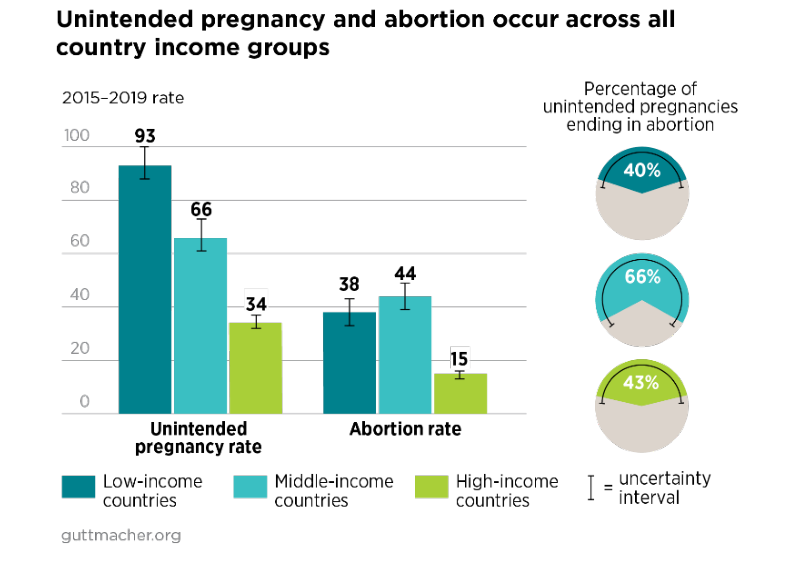
Image source: https://www.guttmacher.org/fact-sheet/induced-abortion-worldwide
1. Abortion should have the least control of the State, to the matters where regulation is necessary for safe and smooth carrying of it. This is because abortion is sought for is and is considered necessary even in settings where it is banned altogether or heavily restricted so as to allow only in cases to save women’s life or preserve her health. A study conducted by Guttmacher highlights the fact that unwanted pregnancies are highest where abortion access is restricted. While, where abortion is legal, unintended pregnancy rate is the lowest30.
2. The picture is gloomy if we look at developing countries where 93% of such countries offer restrictive laws. We need to ramp up efforts to achieve global level equity in sexual and reproductive health so that women don’t resort to clandestine methods for abortion. That required continued engagement and investment to ensure full access to horizon of sexual and reproductive rights. The Guttmacher-Lancet Commission31 recommends that a comprehensive package of essential sexual and reproductive health services, including contraception and safe abortion care, be included in national health systems so that the taboo associated with abortion ends. The same study highlights that since there is a vast majority of unintended pregnancy induced abortions, countries that are having access to effective modern use of contraceptives saw steepest decline in abortion rates.
3. The route to safe and equal abortion laws to whoever undergoes pregnancy including women, transgender and non-binary lies in guaranteeing them with secure abortion access, safer use of modern contraceptives, availability of medical abortion drugs in primary healthcare facilities, complete autonomy on abortion on request, and postabortion services. In rural areas, even if the law doesn’t mandate spouse’s consent, it has been seen that the concept of abortion being confidential and autonomous is hugely missing. In rural clinics, insistence has been made on getting husband’s or relative consent before granting the woman her right of abortion. The government can take steps in making within women’s reach especially in rural areas subsidized rates of abortion procedures, and medical drugs and fill in gaps of dearth of medical professionals. Dr Setya recommends there is a definite need to increase awareness about laws related to abortion as well as counselling where there is dearth of medical professionals, maternal clinics and post abortion services.
4. Lastly, it is suggested that the definition of ‘termination of pregnancy’ and ‘vulnerable women’ be specified as well as expanded so as to further purposive interpretation of beneficial legislation. Furthermore, including Ayurvedic, Unani and like legitimate practitioners by establishing standard guidelines within the definition of registered medical practitioners will go a long way in eradicating clandestine methods of abortion. Even after five decades of the original act we have kept the original beneficiaries away from the reaps of the beneficial legislation. After all, it is the woman who has autonomy over her body. As a recommendation, it shall be better if the government instead of keeping the ambit of ‘vulnerable women’ narrow in respect of which upper gestational period is proposed to be increased from 20 to 24 weeks, be expanded to include in its realm so as to include not just rape and incest survivors and differently abled women but woman of every kind instead of confining it to the whims of a definition. Mere omission to fall in any of the specified categories can prove to be disastrous if the woman fails to adhere to any of the defined vulnerability but the vulnerability of being pregnant and not being able to abort for this reason alone.
*****
Footnotes
2. Medical Termination of Pregnancy, Bill No. 55 of 2020,Section 3. ↑
3. NALSA v Union of India, A.I.R 2014 S.C. 1863 (India). ↑
4. Navtej Singh Johar v. Union of India, A.I.R 2018 S.C. 4321 (India). ↑
5. Medical Termination of Pregnancy (Amendment) Bill, 2020, TAX GURU, (Mar. 02, 2020), https://taxguru.in/corporate-law/medical-termination-pregnancy-amendment-bill-2020.html. ↑
7. Cabinet approves the Medical Termination of Pregnancy (Amendment) Bill,2020, PIB DELHI, ( Jan. 29, 2020, 1:57PM), https://pib.gov.in/PressReleasePage.aspx?PRID=1600916. ↑
9. HC: Docs can abort over 20-wk pregnancy to save mother, DECCAN HERALD, (Apr. 04, 2019, 02:12 PM), https://www.deccanherald.com/amp/national/west/hc-docs-can-abort-over-20-wk-pregnancy-to-save-mother-726941.html. ↑
10. Bombay high court allows aborting pregnancies older than 20 weeks without court permission, THE PRINT, (Apr. 04, 2019 3:14 PM), https://theprint.in/india/governance/bombay-high-court-allows-aborting-pregnancies-older-than-20-weeks-without-court-permission/216829/. ↑
11. Namita Choudhary, MTP : Medical Termination Of Pregnancy Or Must To Procreate? (Co Authored Namita Choudhary), JURIS ONLINE, (Sep. 19, 2014), http://www.jurisonline.in/article-description/social-legislations/mtp-medical-termination-of-pregnancy-or-must-to-procreate-co-authored-namita-choudhary-/284. ↑
12. Khusbhoo v Kanniamal, A.I.R 2010 S.C. 3196 (India). ↑
13. Medical Termination of Pregnancy (Amendment) Bill, 2020, TAX GURU, ( Mar. 02, 2020), https://taxguru.in/corporate-law/medical-termination-pregnancy-amendment-bill-2020.html. ↑
14. Rashmi Mabiyan, India’s Conditional Right to Abortion, ET HEALTH WORLD, (June 07, 2019, 11:42 AM), https://health.economictimes.indiatimes.com/news/policy/indias-conditional-right-to-abortion/69686368. ↑
17. Singh S et al., Abortion Worldwide 2017: Uneven Progress and Unequal Access, GUTTMACHER INSTITUTE, (2017), https://www.guttmacher.org/report/abortion-worldwide-2017. ↑
18. Margaret Wurth, What Life is When Abortion is Banned, HRW, (Jun. 10, 2019), https://www.hrw.org/node/330982/printable/print. ↑
19. Maya Margit, Framing the Abortion Picture in the Arab World, THE JERUSALEM POST, (May 22,2019 01:04 PM), https://www.jpost.com/Middle-East/Framing-the-Abortion-Picture-in-the-Arab-World-590346. ↑
20. Margaret Wurth, What Life is When Abortion is Banned, HRW, (Jun. 10, 2019), https://www.hrw.org/node/330982/printable/print. ↑
21. Mellet v Ireland CCPR/C/116/D/2324/2013. ↑
22. The World’s Abortion Laws, CENTRE FOR REPRODUCTIVE RIGHTS, https://reproductiverights.org/worldabortionlaws#law-policy-guide. ↑
24. New Catholic Encyclopedia, Abortion II, p.29, Col 1 ↑
25. Pacholczyk Tadeusz, The Wisdom of the Church Is in Her Silence, Too, NATIONAL CATHOLIC REGISTER, (Aug. 10, 2003), https://www.ncregister.com/commentaries/the-wisdom-of-the-church-is-in-her-silence-too-vizp 1mwu. ↑
26. Rinki Sanyal, ‘This is War’: Why Women in Poland are fuming over Abortion Rights, THE QUINT (Nov. 02,2020, 12:21 PM), https://www.thequint.com/voices/women/poland-protests-over-abortion-ban#read-more. ↑
27. Tithli Bhattacharya, Varsha Gandikota-Nellutla & Tessy Schlosser, This is About More Than Abortion Rights in Poland, JACOBIN, (Nov. 13, 2020),https://jacobinmag.com/2020/11/abortion-poland-law-international-womens-strike-labor. ↑
28. Compromised Abortion Access to COVID-19: A Model to determine impact of COVID-19 on women’s access to abortion, IPAS DEVELOPMENT FOUNDATION (May 28, 2020), https://www.ipasdevelopmentfoundation.org/publications/compromised-abortion-access-due-to-covid-19-a-model-to-determine-impact-of-covid-19-on-women-s-access-to-abortion.html. ↑
29. Bearak J et al., Unintended pregnancy and abortion by income, region, and the legal status of abortion: estimates from a comprehensive model for 1990–2019, Lancet Global Health, 2020. ↑
31. Accelerate Progress Executive Summary, GUTTMACHER INSTITUTE, https://www.guttmacher.org/guttmacher-lancet-commission/accelerate-progress-executive-summary. ↑