
Introduction
Social media has become the principal advertising channel for small sellers in Mongolia. Facebook pages, live streams and influencer posts reach consumers without the editorial filters of print and broadcast, and make it easy to present a product as more environmentally beneficial, “natural” or “organic” than the evidence supports. Because such attributes are credence qualities that consumers cannot verify,1 unsubstantiated claims weaken the consumer’s capacity to choose on accurate information, an interest protected by statute and by the Constitution.
International regulators have documented the problem at scale. In a 2021 screening of websites, the European Commission and national consumer authorities found that in 59% of the suspicious environmental claims examined the trader had not provided easily accessible evidence, and that 37% relied on vague, general wording.2 The European Union has since amended its unfair commercial practices rules to restrict generic environmental claims,3 and the OECD has documented the prevalence and harms of misleading green claims and the enforcement and policy responses of its members and partner economies.4 Mongolia has general rules on misleading advertising, and earlier work has examined the constitutional dimension of consumers’ right to accurate information in influencer marketing,5 but there is little empirical evidence on how green-adjacent claims are made on Mongolian social media, and little analysis of whether existing rules satisfy the State’s constitutional obligations.
This article addresses that gap. It asks a precise question: is the existing legal framework sufficient to enable consumers to recognise environmental claims in social media advertising, to verify them, and to obtain a remedy when misled?
The article translates Article 19.1 into an operational standard (recognise, verify, remedy), provides the first coded quantitative evidence on green-adjacent wording in Mongolian health-product advertising, and specifies the consumer survey needed to test the remaining propositions. It differs from the earlier study, which assessed the constitutional right to accurate information in influencer marketing generally, combining doctrinal and comparative analysis with case studies, a survey and interviews, and a content analysis of influencer posts,6 in concentrating on environmental and “natural” claims for health products and in adding official monitoring figures and post-level coding of green-adjacent terms.
Constitutional and legal framework
A. The State’s duty to guarantee rights
Article 19.1 of the Constitution of Mongolia obliges the State to create legal and other guarantees for human rights, to combat their violation and to restore infringed rights.7 It does not itself define advertisers’ duties; it supplies the benchmark against which statutory protection is evaluated (Table 1).
| Provision | Right or duty | Role in this study |
|---|---|---|
| Art. 19.1 | State duty to guarantee rights, combat violations and restore infringed rights | Benchmark for evaluating the adequacy of statutory protection |
| Art. 16.17 | Right to seek and receive information | Constitutional frame of the consumer’s interest in accurate product information; Consumer Protection Law Art. 4.1.2 is the direct sectoral basis |
| Art. 16.2 | Right to live in a healthy and safe environment | Connects misleading environmental claims to environmental protection; the content of a post and actual environmental harm are assessed separately |
| Art. 16.16 | Freedom of opinion, expression, speech and publication | Limits regulation: personal reviews, commercial advertising and verifiable factual claims must be distinguished; measures must be lawful, necessary and proportionate |
| Arts. 16.12, 16.14 | Right to petition and to judicial protection, including compensation | Tests whether consumers can identify the competent body, preserve digital evidence and obtain redress |
Table 1: Constitutional provisions and their analytical role. Source: Constitution of Mongolia (1992, as amended); authors’ analysis.
B. The statutory layer
Three statutes translate these guarantees into conduct rules. The Consumer Protection Law makes the consumer’s access to accurate information about goods, works and services a guiding principle (Art. 4.1.2), gives the consumer a right to objective information about goods, and lists the information that producers must provide (Arts. 7.1–7.2).8 The Advertising Law treats as unlawful, and prohibits, advertising that misleads consumers by omitting sufficiently clear information (Art. 7.2.3) and advertising that misleads them about a product’s characteristics, quality certification or conformity marking (Art. 7.3.1).9 For health products, the Law on Medicines and Medical Devices prohibits the advertising of medicines through social networks (Art. 26.5.9) and the promotion of health supplements as if they could diagnose or treat disease (Art. 26.5.10).10
These rules are general enough to reach misleading environmental claims. What they do not specify is (a) what level and form of substantiation an environmental claim requires, (b) whether substantiation must be accessible to the consumer at the point of exposure, and (c) how responsibility is allocated between the brand, the page operator, the influencer and the platform.
C. Freedom of expression and proportionality
Restrictions on advertising content engage Article 16.16 of the Constitution11 and Article 19 of the International Covenant on Civil and Political Rights.12 Under General Comment No. 34 of the UN Human Rights Committee, which recognises that protected expression may include commercial advertising, such restrictions must be provided by law, pursue a legitimate aim and be necessary and proportionate.13 A substantiation requirement is most easily justified for commercial claims about verifiable product attributes, not for personal opinions.
Theoretical background and propositions
A. Information asymmetry and credence qualities
Akerlof showed that when sellers know more about quality than buyers, markets can fail to reward real quality.14 Environmental attributes are credence qualities that buyers cannot assess even after use,15 so certificates, eco-labels and test reports act as quality signals. The key question for each signal is whether the belief it creates matches what it actually certifies: a certificate covering one ingredient, used to suggest that the whole product is organic, creates a belief that exceeds its scope.
B. Persuasion knowledge
The Persuasion Knowledge Model explains how consumers interpret messages once they recognise persuasive intent.16 On social media a paid influencer post can look like a personal recommendation. Disclosure of a paid partnership tells consumers that a post is commercial; accessible substantiation tells them whether its environmental claim is true. Neither substitutes for the other.
C. An institutional view of greenwashing
Delmas and Burbano explain greenwashing through market demand, competitive pressure, organisational incentives and regulatory uncertainty,17 and Lyon and Montgomery emphasise its many forms, from vague wording to selective disclosure.18 This view directs attention to who checks evidence before publication and how misleading content is corrected, and predicts that claim practices cluster within organisations sharing the same incentives and routines, a prediction tested in Part V.C.
D. Techniques of green-adjacent misleading claims
Drawing on the European Commission screening19 and Directive (EU) 2024/825,20 five techniques relevant to health products are distinguished (Table 2). Health products add a further risk: consumers infer from “natural” not only environmental benefit but also safety and efficacy. In two experiments, about 86% and 93% of participants chose a pain reliever described as natural over a synthetic one.21
| Technique | What to look for | How misleading risk is assessed |
|---|---|---|
| 1. Unverifiable claim | “Certified organic”, “low environmental impact” without visible certificate, method or source | Code accessibility of evidence and whether the evidence supports the claim as two separate indicators |
| 2. Vague or broad claim | “100% eco”, “eco-friendly”, “zero waste” without specifying attribute or conditions | Identify which life-cycle stage (ingredients, production, packaging, transport, disposal) the claim covers |
| 3. Part-to-whole attribution | One organic ingredient or a recycled outer box presented as if the whole product qualifies | Compare the impression created with the scope of the certificate, label or measurement |
| 4. Overstated symbols | Own logo resembling a third-party eco-label; registration numbers or lab results used as environmental proof | Check issuer, validity period and what exactly the document certifies |
| 5. Nature imagery | Leaves, forests, clean water, green colour combined with packaging or text | Assess the overall impression; imagery alone is not sufficient evidence of greenwashing |
Table 2: Techniques coded for health-product advertising. Source: authors’ synthesis of the European Commission screening (2021) and Directive (EU) 2024/825.
E. Propositions and hypotheses
Three propositions guide the study. P1: When the scope of a claim is unclear, consumers are more likely to attribute an environmental benefit to the whole product. P2: Clear disclosure of a commercial partnership increases consumers’ recognition of an influencer post’s persuasive intent. P3: Clear substantiation requirements, defined responsibilities of market actors and a functioning complaint procedure make the consumer’s rights enforceable. P1 and P2 concern consumer perception and require experimental or survey data (Part VI). P3 is examined through doctrinal analysis and the content data, which permit two statistical hypotheses:
• H1 (publisher clustering). The use of green-adjacent terms varies systematically between publishing pages, as the institutional view predicts.
• H2 (co-occurrence). Posts that use “natural” are more likely also to use “organic”, that is, the two terms form a common claim repertoire.
Methodology
A. Research design
The study combines doctrinal legal analysis with two quantitative evidence layers (Figure 3 in Part VII summarises the design). Doctrinal analysis identifies what the law requires; official monitoring data describe the structure of online health-product advertising; and the content analysis measures the use of green-adjacent wording and its distribution across publishers.
B. Official monitoring data
Two official sources were used. The Medicines and Medical Devices Regulatory Agency’s 2022 online monitoring identified 45 advertisements for 34 products, classified by publisher type.22 The National Audit Office’s 2025 compliance audit of the implementation of medicines and medical devices policy (¶¶ 2.2.5–2.2.9) reports the results of Facebook monitoring in 2023–2024.23 Because the scope and indicators of these sources differ, they are not pooled into a trend.
C. Content sample and coding
The unit of analysis is one post. Posts targeting Mongolian consumers and visible in publicly accessible archived copies were selected purposively from eight Facebook pages selling health supplements and nutrition products, covering 21 September 2021 to 15 September 2026 (2021: 1 post; 2025: 3; 2026: 33; 1–7 posts per page). Each post was coded for the presence (1) or absence (0) in its visible text of the term “natural” (байгалийн, N) and the term “organic” (органик, O). The full post-level coding is available from the authors. The coding measures word presence only; it does not establish that a claim is false. Synonyms, imagery, certificate validity and claim accuracy are outside these two indicators, so the resulting proportions are not estimates of greenwashing prevalence.
One case was examined in depth: a 21 September 2021 advertisement on the page “GOLI USDA Organic MGL” presented apple cider vinegar gummies as “organic” together with weight-loss and immunity claims, without stating whether “organic” referred to the finished product or to specific ingredients. The product label recorded in the U.S. National Institutes of Health Dietary Supplement Label Database (entered 25 February 2021) designates particular ingredients as organic (apple, carrot, beet, black currant and pomegranate) and also describes the gummies themselves as organic, certified by Oregon Tilth.24 The case is coded “organic claim, scope requires verification”, not confirmed greenwashing, until the version sold in Mongolia and the certificate valid at the time are matched.
D. Statistical analysis
Proportions are reported with exact Clopper–Pearson 95% confidence intervals. For H1, page-by-term tables were tested with a permutation χ² test (20,000 permutations), with Cramér’s V, an ANOVA-based intraclass correlation (ICC) and the design effect. For H2, association was measured by the φ coefficient (permutation p-value; page-clustered bootstrap interval), Fisher’s exact test with the conditional odds ratio, and a page-stratified exact test. Logistic regression of O on N was estimated by maximum likelihood, with page-clustered robust standard errors, and by Firth’s penalised likelihood,25 which corrects bias from sparse cells.26 Sensitivity analyses excluded the 2021–2025 posts, the Anti Alcohol page and the GOLI page. Factor-analytic suitability was assessed with eigenvalues, Bartlett’s test, KMO and a tetrachoric correlation; power was estimated by simulation. Analyses used Python 3.13 with SciPy and statsmodels.
Results
A. Structure of online health-product advertising
In the 2022 official monitoring, 36 of 45 advertisements (80.0%, 95% CI 65.4–90.4) were posted by private individuals, far exceeding an even split (exact binomial p < 0.001) (Table 3).27 The 2023–2024 Facebook monitoring found that 60.1% of monitored advertisements concerned unregistered medicines or supplements and 42.8% used informal names or images that may differ from the registered design.28 These figures concern registration and naming, not environmental claims, so they are not greenwashing rates; they show that consumers struggle to identify products and check registration even before environmental claims are considered.
| Source | Indicator | Value | 95% CI / note |
|---|---|---|---|
| MMRA 2022 (n = 45 ads, 34 products) | Posted by private individuals | 36 (80.0%) | 65.4–90.4 |
| Online shops | 6 (13.3%) | 5.1–26.8 | |
| Supplier websites | 2 (4.4%) | 0.5–15.1 | |
| Live-stream sales | 1 (2.2%) | 0.1–11.8 | |
| National Audit Office, Facebook 2023–24 | Ads concerning unregistered products | 60.1% | Denominator not published |
| Informal names / images differing from registration | 42.8% | Overlap with previous row not published |
Table 3: Official monitoring of online health-product advertising. Note: CIs are exact Clopper–Pearson intervals computed by the authors. MMRA = Medicines and Medical Devices Regulatory Agency. Sources: MMRA, 2022 activity report; National Audit Office, 2025 compliance audit.
B. Prevalence of green-adjacent wording
Of the 37 posts, 13 (35.1%, 95% CI 20.2–52.5) contained at least one of the two terms (Table 4). “Natural” appeared in 10 posts (27.0%, 13.8–44.1) and “organic” in 4 (10.8%, 3.0–25.4); only one post used both (2.7%, 0.1–14.2). Whether these posts displayed substantiation, and how far each claim extended, was not part of the two-indicator coding and requires the extended coding scheme in Table 2. The width of the intervals reflects the small sample and the purposive selection; the figures describe this sample, not the Mongolian market.
| Indicator | k / n | % | 95% CI |
|---|---|---|---|
| “Natural” (N) | 10 / 37 | 27.0 | 13.8–44.1 |
| “Organic” (O) | 4 / 37 | 10.8 | 3.0–25.4 |
| Either term | 13 / 37 | 35.1 | 20.2–52.5 |
| Both terms | 1 / 37 | 2.7 | 0.1–14.2 |
| By year: 2021 | 1 / 1 | 100.0 | O only |
| By year: 2025 | 2 / 3 | 66.7 | N 2, O 1 |
| By year: 2026 | 10 / 33 | 30.3 | N 8, O 2 |
Table 4: Use of green-adjacent terms in 37 posts. Note: Exact Clopper–Pearson intervals. Year rows show posts with either term.
C. Publisher clustering (H1)
Use of the terms was strongly concentrated by page (Figure 1; Table 5). Five of the ten “natural” posts came from one page (Anti Alcohol Mongolia) and three from another (German Vitamin), while two pages used neither term. Page identity was significantly associated with the use of “natural” (χ² = 18.29, permutation p = 0.006, Cramér’s V = 0.70) and with the use of either term (χ² = 15.01, p = 0.023, V = 0.64), but not with “organic” alone (χ² = 11.69, p = 0.135, V = 0.56), whose four occurrences were spread across four pages. The ICC for “natural” was 0.40, implying a design effect of 2.46: the 37 posts carry about as much information as 15 independent posts. H1 is supported for “natural” and for green-adjacent wording overall.
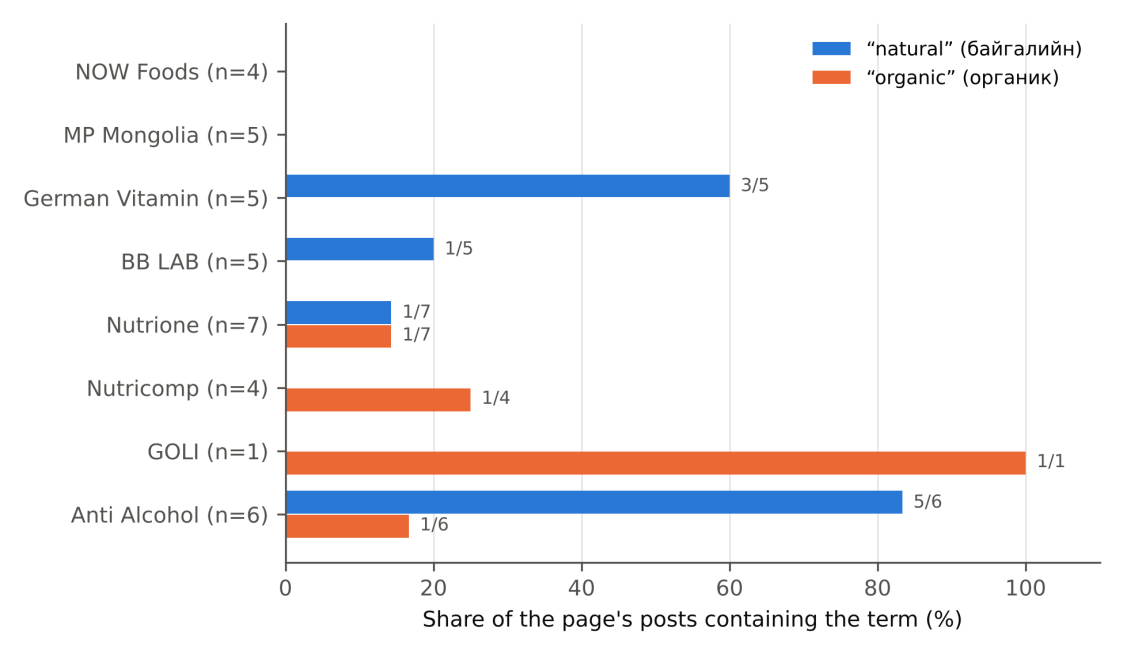
Figure 1: Share of each page’s posts that contain “natural” or “organic” (labels give counts). Source: authors’ content analysis.
| Term | χ² (7 df) | Permutation p | Cramér’s V | ICC | Design effect | Effective n |
|---|---|---|---|---|---|---|
| “Natural” | 18.29 | 0.006 | 0.70 | 0.40 | 2.46 | ≈ 15 |
| “Organic” | 11.69 | 0.135 | 0.56 | 0.17 | 1.61 | ≈ 23 |
| Either term | 15.01 | 0.023 | 0.64 | 0.29 | 2.04 | ≈ 18 |
Table 5: Publisher clustering of green-adjacent terms. Note: 20,000 permutations. ICC = ANOVA estimator with pages as clusters (mean cluster size 4.6).
D. Correlation and logistic regression (H2)
Table 6 cross-tabulates the two terms. The proportion of posts using “organic” was 10.0% among posts using “natural” and 11.1% among the rest. The correlation was essentially zero (φ = −0.016, permutation p = 1.00; page-clustered bootstrap 95% CI −0.22 to 0.21), and Fisher’s exact test gave p = 1.00 (conditional OR = 0.89, exact 95% CI 0.015–12.90).
| Organic = 0 | Organic = 1 | Total | % organic | |
|---|---|---|---|---|
| Natural = 0 | 24 | 3 | 27 | 11.1 |
| Natural = 1 | 9 | 1 | 10 | 10.0 |
| Total | 33 | 4 | 37 | 10.8 |
Table 6: Cross-tabulation of “natural” and “organic”.
The logistic models (Table 7) lead to the same conclusion. The maximum-likelihood estimate was logit[P(O = 1)] = −2.079 − 0.118·N (OR = 0.89, Wald 95% CI 0.08–9.69; likelihood-ratio χ²(1) = 0.009, p = 0.922; McFadden R² < 0.001). Page-clustered standard errors narrowed the interval only slightly (0.15–5.29). The Firth estimate, which corrects small-sample bias, was close to the null (OR = 1.11, profile 95% CI 0.10–7.85, p = 0.924). Only two pages varied on both indicators, so the page-stratified exact test was uninformative (p = 1.00). Sensitivity analyses (Figure 2) changed the sign of φ but not the conclusion: excluding the 2021–2025 posts or the Anti Alcohol page removed the only co-occurrence (φ = −0.144), and excluding the GOLI page gave φ = 0.037; all Fisher p-values were 1.00. H2 is not supported: in this sample “natural” and “organic” do not form a common claim repertoire; they are alternative ways of signalling naturalness.
| Estimator | β₀ (SE) | β₁ (SE) | OR | 95% CI for OR | p |
|---|---|---|---|---|---|
| Maximum likelihood | −2.079 (0.612) | −0.118 (1.219) | 0.89 | 0.08–9.69 (Wald) | 0.923 |
| ML, page-clustered SE | −2.079 (0.571) | −0.118 (0.910) | 0.89 | 0.15–5.29 | 0.897 |
| Firth penalised | −1.946 (0.582) | 0.100 (1.090) | 1.11 | 0.10–7.85 (profile) | 0.924 |
| Conditional exact | n/a | n/a | 0.89 | 0.015–12.90 | 1.000 |
Table 7: Logistic regression of “organic” on “natural” (n = 37). Note: Model fit (ML): log-likelihood −12.669; null −12.674; LR χ²(1) = 0.009, p = 0.922; AIC = 29.34. Predicted P(O = 1) = 0.111 for N = 0 and 0.100 for N = 1. n/a = not applicable.
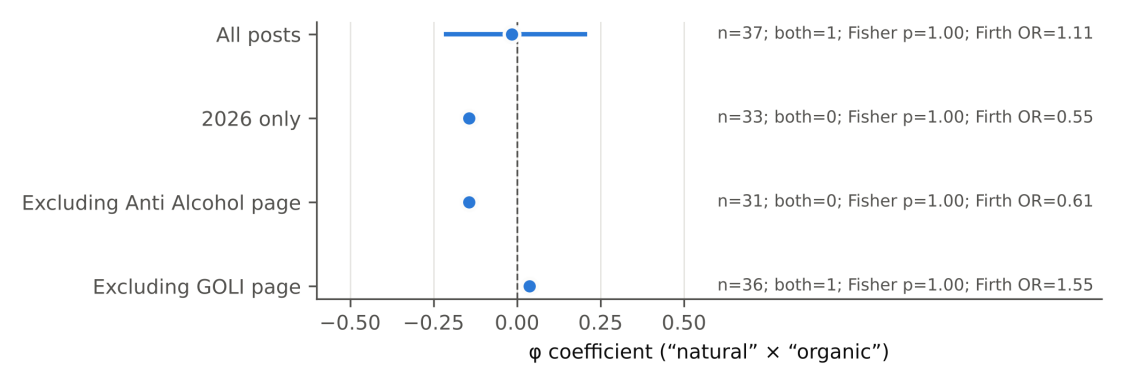
Figure 2: φ coefficient under sensitivity analyses (bar: page-clustered bootstrap 95% CI for the full sample). Source: authors’ analysis.
E. Factor-analytic diagnostics
With only two binary indicators, a one-factor model has two loadings to estimate from a single correlation and is not identified; a larger sample would not remove this problem.29 The diagnostics in Table 8 confirm that there is no shared variance to model: both eigenvalues are close to 1, Bartlett’s test is non-significant, and KMO equals 0.50, its fixed value for any two-variable matrix. No latent “green-claim” factor is therefore reported; construct-level factor analysis is specified for the consumer survey (Part VI).
| Diagnostic | Value | Interpretation |
|---|---|---|
| Observed indicators | 2 (binary) | Fewer than the three needed to identify a one-factor model |
| Pearson / φ correlation | −0.016 | No shared variance |
| Tetrachoric correlation | −0.036 (95% CI −0.64 to 0.60) | Near zero; unstable because of sparse cells |
| Eigenvalues | 1.016; 0.984 | First component explains 50.8%, the chance level for two variables |
| Determinant of R | 0.9997 | Matrix is close to identity |
| Bartlett’s test | χ²(1) = 0.009, p = 0.926 | Identity matrix not rejected |
| KMO | 0.50 | Fixed by construction for two variables; uninformative |
Table 8: Factor-analytic suitability of the content indicators. Note: Tetrachoric interval from the profile likelihood.
F. Statistical power
Simulation shows that Fisher’s test would detect an odds ratio of 5 with only 40% probability and an odds ratio of 10 with 77%. The null result for H2 therefore rules out only very strong co-occurrence, whereas the H1 effect was detected despite low power, indicating a large effect.
Consumer survey protocol for testing P1 and P2
Propositions P1 and P2 concern what consumers understand, which content data cannot show. The study therefore specifies a survey of adults who saw social media advertising for medicines or supplements in the previous three months, adapting an instrument developed in earlier, as yet unpublished, Mongolian research on greenwashing in imported food. No identifying or health data are collected.
| Construct | Items | Scoring | Planned analysis |
|---|---|---|---|
| Trust in green claims (TRUST), adapted from Chen30 and from Chen and Chang31 | T1–T4 | 5-point agreement; mean (≥3 valid items) | EFA with polychoric correlations, parallel analysis and oblique rotation; CFA with CR, AVE, the Fornell–Larcker criterion32 and HTMT33 |
| Verification behaviour (VERIFY) | V1–V4 | 5-point frequency; mean (≥3 valid items) | As above; TRUST and VERIFY expected as two correlated factors |
| Green-claim knowledge (KNOW) | K1–K6 | True/false; number correct, 0–6 | Not entered in factor analysis; Spearman ρ with other scores |
| Greenwash recognition (RECOG) | R1–R6 | Support / contradict / insufficient; number correct, 0–6 | As KNOW; predictor in extended regression |
| Controls | AGE, EDU, INC, FREQ, TYPE | Categorical dummies with pre-set reference groups | Hierarchical OLS: Model 1 TRUST ~ KNOW + controls; Model 2 adds RECOG and VERIFY; VIF, residual and influence diagnostics; HC3 SEs if needed |
Table 9: Constructs, measures and planned analyses.
Sample size was derived from the planned hierarchical regression (11 predictors including dummies, α = 0.05, power = 0.80). Detecting a small-to-medium overall effect (f² = 0.05) requires n = 346; detecting the increment of two added predictors requires n = 196 for f² = 0.05 and n = 485 for f² = 0.02. A target of at least 400 completed responses also satisfies common recommendations for stable factor solutions with eight items and two factors.34,35 A vignette experiment varying claim scope (“60% recycled body of the bottle” versus “100% eco-friendly”) and disclosure (“paid partnership” label present or absent) within the same instrument would allow causal tests of P1 and P2.
Discussion
A. Applying the constitutional standard
Figure 3 brings the analysis together. The consumer-facing content of the State’s duty under Article 19.1 can be stated as three questions about any advertisement: can the consumer recognise the post as commercial and understand what the claim covers; verify the claim against accessible evidence; and obtain a remedy by complaining, preserving the original post and obtaining correction or compensation?
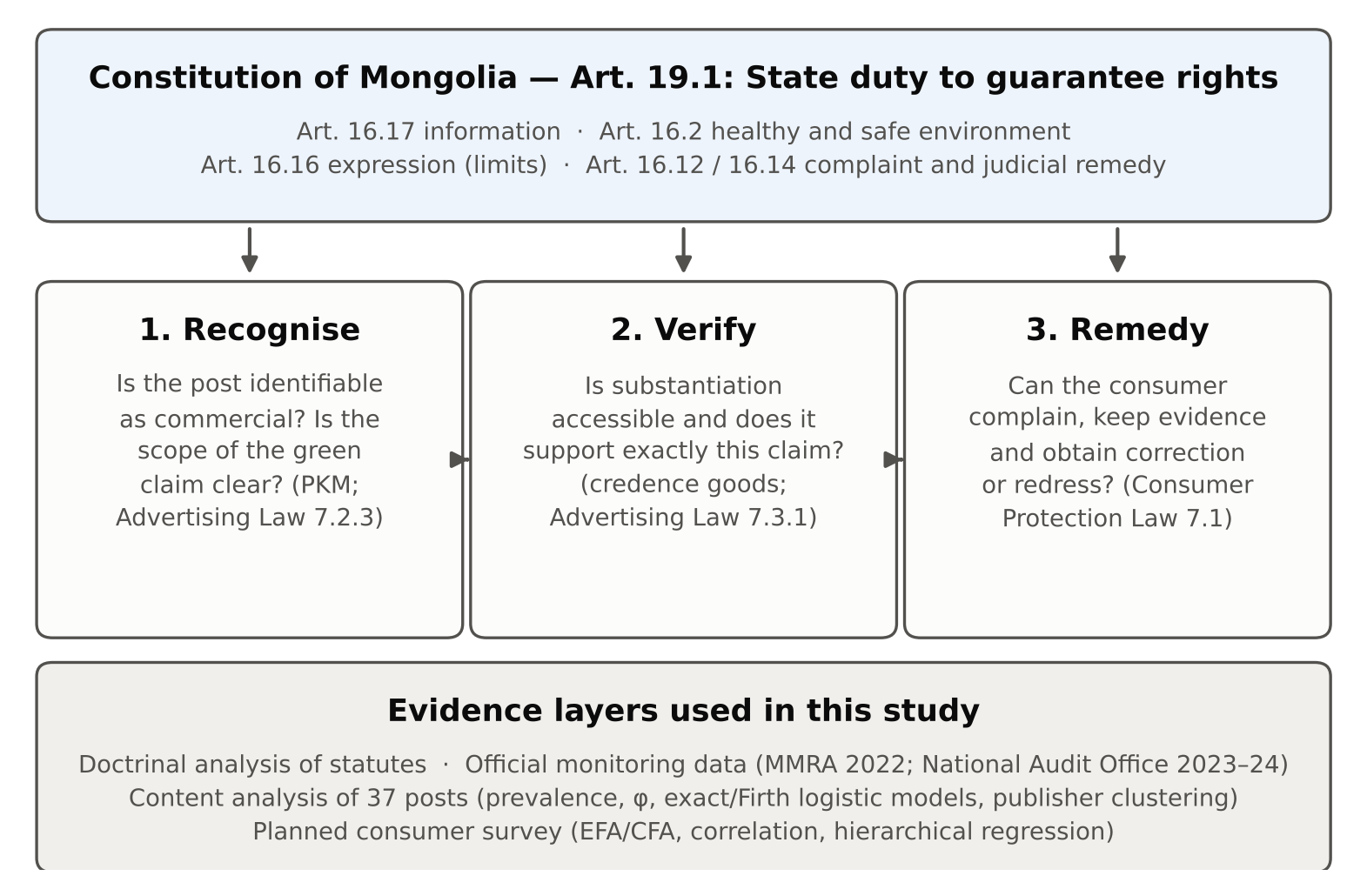
Figure 3: Constitutional evaluation framework and evidence layers. Source: authors’ conceptualisation. Note: the court remedy under the Consumer Protection Law is art. 8.1; art. 7.1, cited in the figure, is the consumer’s right to information.
On recognition, the official data show that most online health advertising is posted by private individuals, whose posts are the least likely to be identified as commercial. On verification, about one post in three used green-adjacent wording that the consumer cannot check from the term itself, and the GOLI case illustrates how “organic ingredient”, “certified organic product” and “health benefit” can be fused in one message. On remedy, statutory rules exist, but the law does not oblige page operators to keep the original version of edited or deleted posts, which weakens the evidential position of a complaining consumer. The gap is therefore not an absence of rules; it lies in unspecified substantiation standards, unallocated responsibility among online actors, and fragile evidence.
B. Why publisher clustering matters
The strongest finding is that green-adjacent wording is a property of publishers rather than of individual posts, consistent with the institutional view: once a page adopts “natural” as brand language, the term can recur across its products irrespective of their characteristics. Duties to substantiate and disclose should therefore attach to the page operator, influencer or seller who controls the account, and monitoring should sample by publisher.
C. Regulatory recommendations
Consistent with the proportionality requirement of Article 16.16, the following measures target verifiable commercial claims rather than opinion:
• Substantiation before publication. Amend the Advertising Law to require that environmental and “natural/organic” claims be substantiated before publication, with the burden of proof on the advertiser.
• Scope and accessibility. Require that the post itself state what the claim covers (ingredient, packaging, production stage) and link to the supporting certificate or report; prohibit generic claims such as “eco-friendly” unless recognised excellent environmental performance can be shown, as Directive (EU) 2024/825 now does in the European Union.36
• Actor responsibility. Define the responsibilities of the brand, page operator, influencer and platform, including mandatory labelling of paid partnerships.
• Evidence preservation and remedy. Require page operators to retain original versions of edited or deleted commercial posts for a fixed period, and create a single online complaint channel shared by the consumer protection authority and the Medicines and Medical Devices Regulatory Agency.
• Monitoring design. Ask regulators to publish the denominators and unit-level codes of their monitoring, and to code environmental claims separately from registration and health-claim violations, so that prevalence can be estimated.
D. Limitations
The content sample is small, purposive and concentrated in 2026, and covers one product category on one platform; it supports conclusions about this sample, not population prevalence. The two indicators record word presence, not falsity, so neither prevalence figure is a greenwashing rate. Synonyms, imagery and certificates were not coded, and coding was performed by a single coder, so inter-coder reliability could not be estimated;37 double coding is planned for the extended coding scheme. Official data come from monitoring exercises with different scopes and incomplete denominators. Propositions P1 and P2 remain untested pending the consumer survey.
Conclusion
Mongolia’s legal framework already prohibits misleading advertising, but measured against the State’s duty under Article 19.1 it does not yet ensure that consumers can recognise, verify and contest environmental and naturalness claims on social media. In the sample examined, about one post in three used green-adjacent wording, the one case examined in depth did not allow the scope of its “organic” claim to be verified, and the use of such wording was concentrated by publisher. The constitutional standard proposed here (recognise, verify, remedy) offers legislators and regulators a practical test for each advertisement, and the publisher-level pattern indicates where responsibility should be placed. The specified consumer survey will establish how these practices affect consumer trust and understanding.
Declarations
Funding: None. Author contributions: Both authors contributed to the conception, analysis and writing of the article and approved the final manuscript. Conflict of interest: The authors declare no conflict of interest. Ethics: The content analysis used publicly accessible posts and contains no personal data; the consumer survey will be submitted for institutional ethics approval before data collection. Data availability: The post-level coded data set, the survey instrument and the analysis code are available from the corresponding author on request. Use of AI tools: AI-assisted tools were used for language editing and to run the statistical computations reported; the authors reviewed all analyses and take responsibility for the content.
*****
Footnotes
1. Michael R. Darby & Edi Karni, Free Competition and the Optimal Amount of Fraud, 16 J.L. & Econ. 67 (1973), https://doi.org/10.1086/466756. Google Scholar ↑
2. Press Release, European Commission, Screening of Websites for ‘Greenwashing’: Half of Green Claims Lack Evidence (Jan. 28, 2021), https://ec.europa.eu/commission/presscorner/api/files/document/print/en/ip_21_269/IP_21_269_EN.pdf. ↑
3. Directive (EU) 2024/825 of the European Parliament and of the Council of 28 February 2024 Amending Directives 2005/29/EC and 2011/83/EU as Regards Empowering Consumers for the Green Transition Through Better Protection Against Unfair Practices and Through Better Information, 2024 O.J. (L 2024/825), http://data.europa.eu/eli/dir/2024/825/oj. ↑
4. OECD, Protecting and Empowering Consumers in the Green Transition: Misleading Green Claims (OECD Digital Economy Papers No. 375, 2025), https://doi.org/10.1787/12f28e4f-en. Google Scholar ↑
5. Boldbaatar Gonchigjav & Odontuya Khuukhlee, Constitutional Implementation of Consumers’ Right to Accurate and Safe Information in the Influencer Marketing Environment in Mongolia, 3 Int’l J. Legal Rsch. & Analysis 3090 (2026), https://www.ijlra.com/public/uploads/924247862.pdf. ↑
7. Constitution of Mongolia art. 19.1 (1992, as amended) (Mong.). Provisions are quoted from the unofficial English translation published on the Government’s legal information portal, https://legalinfo.mn/en/edtl/16532180497951; there is no official English text. ↑
8. Law of Mongolia on Consumer Rights Protection arts. 4.1.2, 7.1–7.2 (Dec. 26, 2003, as amended) (Mong.), https://legalinfo.mn/mn/detail/551 (Mongolian text, with an unofficial English translation on the same portal). ↑
9. Law of Mongolia on Advertising arts. 7.1, 7.2.3, 7.3.1, 7.7 (May 30, 2002, as amended) (Mong.), https://legalinfo.mn/mn/detail/259 (Mongolian text; no official English translation is published). ↑
10. Law of Mongolia on Medicines and Medical Devices (revised) arts. 26.5.9, 26.5.10 (June 5, 2024, in force Oct. 1, 2024) (Mong.), https://legalinfo.mn/mn/detail?lawId=17140713569541 (Mongolian text; no official English translation is published). ↑
11. Constitution of Mongolia, supra note 7, art. 16.16; see also id. art. 16.17 (right to seek and receive information). ↑
12. International Covenant on Civil and Political Rights art. 19, Dec. 16, 1966, 999 U.N.T.S. 171. ↑
13. U.N. Hum. Rts. Comm., General Comment No. 34: Article 19: Freedoms of Opinion and Expression, ¶¶ 11, 22, U.N. Doc. CCPR/C/GC/34 (Sept. 12, 2011). Google Scholar ↑
14. George A. Akerlof, The Market for “Lemons”: Quality Uncertainty and the Market Mechanism, 84 Q.J. Econ. 488 (1970), https://doi.org/10.2307/1879431. Google Scholar ↑
15. Darby & Karni, supra note 1. ↑
16. Marian Friestad & Peter Wright, The Persuasion Knowledge Model: How People Cope with Persuasion Attempts, 21 J. Consumer Rsch. 1 (1994), https://doi.org/10.1086/209380. Google Scholar ↑
17. Magali A. Delmas & Vanessa Cuerel Burbano, The Drivers of Greenwashing, 54 Cal. Mgmt. Rev. 64 (2011), https://doi.org/10.1525/cmr.2011.54.1.64. Google Scholar ↑
18. Thomas P. Lyon & A. Wren Montgomery, The Means and End of Greenwash, 28 Org. & Env’t 223 (2015), https://doi.org/10.1177/1086026615575332. Google Scholar ↑
19. European Commission Press Release, supra note 2. ↑
20. Directive (EU) 2024/825, supra note 3. ↑
21. Brian P. Meier et al., A Behavioral Confirmation and Reduction of the Natural versus Synthetic Drug Bias, 39 Med. Decision Making 360 (2019), https://doi.org/10.1177/0272989X19838527. Google Scholar ↑
22. Medicines and Medical Devices Regulatory Agency of Mongolia, 2022 Activity Report of the Drug Safety Surveillance and Research Department 13 (2022) (Mong.), https://mmra.gov.mn/?id=200801. ↑
23. National Audit Office of Mongolia, Compliance Audit Report: Results of the Implementation of State Policy and Related Legislation on Medicines and Medical Devices ¶¶ 2.2.5–2.2.9 (Audit Code NAG-2025/26-ShTA-NA, 2025) (Mong.), https://audit.mn/audit/report_detail/40314. ↑
24. Office of Dietary Supplements, National Institutes of Health, Dietary Supplement Label Database, Goli Nutrition, Apple Cider Vinegar Gummies, DSLD ID 245473 (entered Feb. 25, 2021), https://dsld.od.nih.gov/label/245473. ↑
25. David Firth, Bias Reduction of Maximum Likelihood Estimates, 80 Biometrika 27 (1993), https://doi.org/10.1093/biomet/80.1.27. Google Scholar ↑
26. Georg Heinze & Michael Schemper, A Solution to the Problem of Separation in Logistic Regression, 21 Stat. Med. 2409 (2002), https://doi.org/10.1002/sim.1047. Google Scholar ↑
27. Medicines and Medical Devices Regulatory Agency of Mongolia, supra note 22, at 13. ↑
28. National Audit Office of Mongolia, supra note 23, ¶ 2.2.7. ↑
29. Robert C. MacCallum et al., Sample Size in Factor Analysis, 4 Psych. Methods 84 (1999), https://doi.org/10.1037/1082-989X.4.1.84. Google Scholar ↑
30. Yu-Shan Chen, The Drivers of Green Brand Equity: Green Brand Image, Green Satisfaction, and Green Trust, 93 J. Bus. Ethics 307 (2010), https://doi.org/10.1007/s10551-009-0223-9. Google Scholar ↑
31. Yu-Shan Chen & Ching-Hsun Chang, Greenwash and Green Trust: The Mediation Effects of Green Consumer Confusion and Green Perceived Risk, 114 J. Bus. Ethics 489 (2013), https://doi.org/10.1007/s10551-012-1360-0. Google Scholar ↑
32. Claes Fornell & David F. Larcker, Evaluating Structural Equation Models with Unobservable Variables and Measurement Error, 18 J. Mktg. Rsch. 39 (1981), https://doi.org/10.2307/3151312. Google Scholar ↑
33. Jörg Henseler, Christian M. Ringle & Marko Sarstedt, A New Criterion for Assessing Discriminant Validity in Variance-Based Structural Equation Modeling, 43 J. Acad. Mktg. Sci. 115 (2015), https://doi.org/10.1007/s11747-014-0403-8. Google Scholar ↑
34. Leandre R. Fabrigar et al., Evaluating the Use of Exploratory Factor Analysis in Psychological Research, 4 Psych. Methods 272 (1999), https://doi.org/10.1037/1082-989X.4.3.272. Google Scholar ↑
35. MacCallum et al., supra note 29. ↑
36. Directive (EU) 2024/825, supra note 3. ↑
37. Klaus Krippendorff, Content Analysis: An Introduction to Its Methodology (4th ed. 2018). Google Scholar ↑