
Research Objective:
The objective of this research paper is to-
i. The history behind Article 370 and how it came into effect.
ii. Analyze the Article and the provision applicable under it
iii. Analyze the legal aspects of abrogation of the article
And Conclusively reach a consensus on the views and beliefs of the people on whether abrogation of the article was logically a right decision.
Literature Review:
1. Amitabh Hoskote in his paper titled “JAMMU & KASHMIR & THE POLITICS OF ARTICLE 370: SEEKING LEGALITY FOR THE ILLEGITIMATE” (2017) questioned the very basis of Article 370 and said it is the sole basis for creating inequality in India, promulgating the biased stances adopted by it. He further believed that Article 370 itself was responsible for creating anger, inequality and bias within the state. He argued asking have an article in the Indian constitution that leaves so much room for continued misinterpretation, which has been repeatedly proved by events over the intervening years.
However, keeping in mind, the research paper was written in 2017, it focused majorly on the political aspects of Article 370 and the tussle between political parties to abrogate it or keep it. It failed to consider the legal and constitutional aspects involved in it.
2. On the other hand, Sunatu Kumar’s “A STUDY OF ARTICLE 370 WITHIN THE FRAMEWORK OF THE INDIAN CONSTITUTION” GIVES A DETAILED ACCOUNT OF ARTICLE 370, (2003) its genesis, its evolution and how it came to exist in its current form. It talks about how the article has been eroded from time to time by putting forth presidential orders and how bit by bit various articles were amended to include J&K within the ambit of constitutional orders. It meticulously articulates the history of the article and the states through 10 detailed chapters. It includes include, a short history of J&K, Events leading to the drafting of the Jammu and Kashmir constitution, Provisions under the article, the “permanent status” of citizens, position of the Indian constitution, Judicial position, and finally the question of whether J&K should indeed have their own separate constitution.
The author can be lauded for his extensive research and detailed analysis put into the paper which covers a wide array of topics within Article 370. It is an in-depth analysis of the history and evolution of the article but fails to cover the present scenario.
3. ARTICLE 370: AN ADVANTAGE OR DISADVANTAGE by Aditya Shukla and Sumit Mishra starts with the historical background of Article 370, encompasses the provisions under it, and moves on to state the loopholes in the article itself which can be used to manipulate it. It deals with the question of why Article 370 was incorporated and what is the procedure which is to be followed to remove it. It then states all the landmark judgements which dealt with Article 370. It then lays out a map of the advantages and disadvantages of Article 370 and how it would benefit the people. It finally reaches a conclusion saying the Article should be revoked because the advantages outweigh the disadvantages of the same. It also says the article is responsible for poor administration and is the reason for separatism between India and the state.
Research Gap: All the previously written papers deal extensively with the history and provisions of Article 370 but because the Abrogation of Article 370 is relatively new, there are not many papers dealing with the same. The researcher in the present paper will be dealing with the topic of Abrogation of Article 370 and conversion of the state into a union territory.
Introduction
Bernier the first European to visit Kashmir wrote in 1665: “In truth the kingdom of Jammu and Kashmir surpasses in beauty all that my warmest imagination had anticipated. The splendor and salubriousness of the Kashmir valley is legendary. The Mughal emperor Jahangir once said while living in a houseboat in dal lake “gar firdaus, ruhe zamin ast, hamin asto, hamin asto, hamin asto” which means if ever there is heaven on earth, it’s here, it’s here, it’s here. Article 370 is a temporary legal provision which grants “special status” to the state of Jammu and Kashmir. It includes privileges like, dual citizenship, separate constitution and the laws of India are not applicable to the state. For eg: Kashmir has its own penal code, civil code and its own constitution. Outsiders are not allowed to buy property in the state.
This paper will be dealing with this topic in detail and analyzing such provisions under it.
1947: Going Back 72 Years in History
After the British rule ended in and when the Indian subcontinent was divided into two parts, India and Pakistan, Maharaja Hari Singh the ruler of Jammu and Kashmir at that time wanted to remain neutral and refused to accede either to India or to Pakistan. He signed a standstill agreement with Pakistan, who breached it and invaded J&K in 1947. India did not intervene till the maharaja signed the instrument of accession on 26th October 1947 and the Indian army helped push the Pakistani forces back. Soon Hari Singh sought special privileges for his people on the lines of a 1927 law that denied outsiders the right to own property in the state.This had been brought apparently to keep the Britishers away from the Valley of Kashmir2. Another reason stated for such special privileges was to preserve the culture and heritage of the state. The Jawaharlal Nehru government agreed to provide a special status to J&K subject to further approval. The matter was placed before the Constituent Assembly of India, which was dealing with the task of framing the Constitution of India. After a lot of deliberation, Article 370 was inserted in the Constitution's twenty-first part that proclaimed it to be "Temporary, Transitional and Special Provision.”3 The origins of Article 370 can be found in Article 306A, inserted by the Constituent Assembly as an interim measure in October 1949, limiting the accession of Jammu and Kashmir to defence, foreign affairs and communications4
Article 370 was drafted by Gopalaswamy Ayyangar, who had served as the prime minister of Kashmir for a period of six years alongside Hari Singh and provided for a special status to Jammu and Kashmir, which was granted to it through the Presidential Order of 1954. Ultimately, the Government of India on October 17, 1949, accepted special status. All the Princely states which joined India were given special status, later on they surrendered it, and signed Instrument of Merger, while J&K was never asked to sign the latter for J&K through Article 370 (at initial stage it was 306) of the Indian Constitution.5 The people of the Kashmir Velley regard this article as an "Article of Faith" which guaranteed their internal autonomy and Kashmiri identity as well while many in Jammu regard this article as the greatest hurdle in the way of the integration of the state with India.6 Nehru intended for it to be a temporary provision and believed that it would get eroded over a period, but 72 years after independence the article still stands.
Article 370: Analysis and Provisions under It
Article 370, which grants a special autonomous status to the state of Jammu and Kashmir has been enumerated under part XXI of the Indian Constitution relating to Temporary, Transitional and Special Provisions.
Part(a) of Clause 1 states that the provisions of Article 238 shall not apply in relation to the State of Jammu and Kashmir7. This essentially means that this article the provisions of Article 238, which was omitted from the Constitution in 1956 when Indian states were reorganised, shall not apply to the state of Jammu and Kashmir.
Further clause(b) of the article states notwithstanding anything in the Constitution, the Article limits Parliament’s powers to make laws to those matters in the Union and Concurrent Lists, in consultation with the state government, as declared by the President, which should correspond with matters specified under of Instrument of Accession.8
Some other rights enjoyed by the citizens of J&K which is not applicable to other states in the country are:
• The citizens of J&K enjoy dual citizenship and permanent citizens were defined under Article 35-A of the Indian Constitution
• The constitution of India applies to the whole of India and includes all the states except Jammu and Kashmir who adopted their own constitution, The Constitution of Jammu and Kashmir, 1956.
• The permanent citizens defined under Article 35-A are the only ones who can buy property in the state and “outsiders” i.e. people from other states are not allowed to buy or own property in the state.
• The state has its own flag unlike other states which only adhere to the Indian National flag
• Article 356 and Article 360 i.e. state and financial emergency couldn’t be applied in the state without prior approval of the state government
• Duration of state legislative assembly was 6 years in the state as compared to 5 years in the rest of the country
• The quota applicable for minorities in rest of the country was not applied in the state. There exists no reservation in the state
• Right to Information act and Right to Education act was not applicable in the state
• Further various schemes promulgated by the government for eg: Pradhan Mantri Awas Yojna couldn’t be applied in the state.
• Various laws including the Indian Penal code wasn’t applicable in J&K and the state has its own penal code.
• If a Kashmiri woman marries a man “outside the state”, she and her children lose inheritance rights and cannot buy property in the state.
The above-mentioned points entail certain provisions which grant special powers to the citizens of Jammu and Kashmir which are different from the ones granted to the other states.
Abrogation of Article 370, Right or Wrong? an Analysis:
Recently, on 5th August 2019, a bill was introduced in the Indian Parliament for abrogation of Article 370 and dividing the state of J&K into two union territories, i.e. that of J&K and Ladakh. The bill introduced known as Jammu and Kashmir (Reorganization) bill, 2019 was passed by both the Lok Sabha and Rajya Sabha. This is a historic move and would bring about a lot of changes. One of the major reasons why people believe abrogation of Article 370 was a positive move is that it would bring development into the state of Jammu and Kashmir. Because of the existence of scenic beauty, natural terrain and the mesmerizing dal lake, there exists immense scope for tourism and other related employment prospects, yet J&K is underdeveloped and there exists room for improvement. The finance commission, the apex agency which decides how funds are to be distributed among states, has always favoured J&K more than any other special category state. There are 10 states with special status in India. The per capita central assistance for J&K was not only the highest but was more than double the average of the rest of the Indian states. J&K was then proposed to get Rs 117 per head of its population against an average of Rs 57 for the remaining states. India's most populous state of Uttar Pradesh, which makes up about 13 per cent of the country's population, received only 8.2 per cent of central grants from 2000 to 2016. J&K, on the other hand, with only one per cent of India's population, reportedly received 10 per cent (Rs 1.14 lakh crore) of the total central funds in the same 16-year period. J&K is not able to generate enough money, either tax or non-tax, to run its government. About one-third of the revenue comes from the central government as 'grant in aid'.
The average loan and deposit ratio for the state has also declined, which shows that the investment environment is not promising for trade and industry.
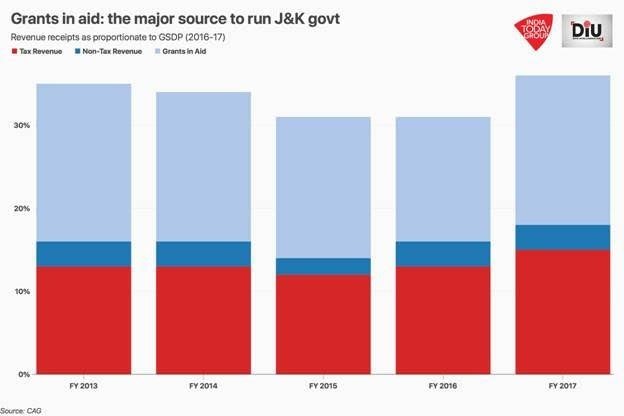
Data shows that despite J&K receiving 10 per cent of taxpayers’ money for one per cent of India's population in the last 70 years of autonomy, its economy has remained fragile, to say the least. Terrorism and debt both flourished even after substantial financial assistance from the Centre.

The tourism sector counted as one of the prominent areas also witnessed a downtrend in J&K. According to the state economic survey 2017, tourism accounts for around 6.98 per cent of the state's GDP. J&K is not among the top 10 domestic destinations in the country based on the number of tourist arrivals.11
Jammu and Kashmir was placed 21st for rural unemployment rate in 2011-12. Out of every 1,000 people, 25 were unemployed in the rural areas of J&K.12 In 2016-17, Jammu and Kashmir had per capita net State GDP of ₹62,145 but there also exist conflicting views regarding this. It is believed that Kashmir fares quite well in comparison to other states and sometimes even better. Jammu and Kashmir surpassed Kerala as the state with the highest life expectancy in India for all ages, barring life expectancy at birth, according to the data released on October 19, 2016, by the Registrar General of India (RGI), custodian of census data.13 3,060 persons were served by one government doctor in J&K in 2018. Only six States have had lesser people served by one doctor. The best State was Delhi (2,203 people per government doctor) while the worst State was Bihar (28,391 persons served by one government doctor. J&K stood eighth in terms of poverty rate (10.35) %. Goa had the lowest poverty rate of 5.09%, while Chhattisgarh had the highest poverty rate of 39.93%. The national average was 21.92%. In 2017, Jammu and Kashmir’s Human Development Index (HDI) was 0.68, higher than even States like Andhra Pradesh and Gujarat. Kerala had the highest HDI (0.77) while Bihar had the least (0.57). 14The Human Development Index (HDI) is a composite index of life expectancy, education, and per capita income indicators. 15
Therefore, it can be said that there exists conflicting views regarding the development of J&K and how it fares in respect to the other states, but it can be unequivocally stated that Jammu and Kashmir due to its special status receives more funding that the other states, for e.g.: even though Bihar is the poorest state in the country J&K receives 11 times more funding from the central government. In terms of the huge amount of resources granted to it, the state is underdeveloped and does not contribute to India’s GDP to a huge extent.
Further there exists an ever-increasing problem of corruption in the state and money rests in the hands of the top few, this is mostly triggered because law enforcement agencies are not allowed entry into the state, for e.g. the CBI. The Right to Information Act, 2005 is not applicable in the state but Jammu and Kashmir has had a Right to Information Act since 2004, a year before the Central RTI Act came into existence. However, the State didn't approve the Central legislation for a long time. In 2007, the State's RTI Act was amended on the lines of the Central Act; however, activists criticized it for not having the High Court and private bodies under its ambit.16
Also, there exists no right which makes education compulsory for children between 14-16 years of age as in the rest of the country because right to education act is also not applicable in the state. Private industries are unwilling to operate in the state because of which children lose out on quality education.
Unlike the rest of India, reservation is provided only in appointment and admission in professional institutions, to SC, ST and socially backward classes. There is no reservation for minorities. Further no panchayat elections are held in J&K because of which approximately 40,000 Sarpanch’s’ lose their rights. A wide array of women centric laws is also not applicable in the state. The 73rd and 74th Amendments which introduced local self-governance including existence of “panchayats and municipalities” are also not applicable to the state, taking away the rights of thousands of people.
An interesting fact to be point out here is that cement in J&K is sold at a price which is 100 Rs more than the rest of India, because there exists a monopoly there. Only a selected few can trade because of which a complete monopoly is created, and people are at the mercy of a selected few. At the time of Independence, one acre of land costed approximately 3000 rupees and has in the present times increased almost tenfold varying and depending from area to area but it still remains the same in Kashmir due to the fact that property cannot be bought and sold, so people who own land and have the prospects of making profits are at a huge loss. There also exists numerous hotels and travel agencies and also big and small scale industries who want to operate in the state but are unable to do so because of the Article 370 which prevents them from owning property there and in turn the Kashmiri youth lose out on job opportunities like working for the hotels, acting as travel guides various vacancies etc. which would be created due to the setting up of such industries.17
Coming to healthcare, even though there exist the public private partnership models, there are essentially no private hospitals. Schemes like the PM Ayushman Yojna are also not applicable there. Further the doctor- patient ratio does not speak volumes,3,060 persons were served by one government doctor in J&K in 201818. Private doctors are unwilling to practice there as they will not receive “permanent citizen” status and their children will have no inheritance rights, because of these reasons the state is lagging in healthcare and eventually affecting morality rates.
Going back to the very roots i.e. during the period of Independence, when India and Pakistan split into two, the people who came from Pakistan to J&K got no citizenship in the state but were Indian citizens, a prominent example of this being former prime minister of India, Dr Manmohan Singh. So stringent are the laws there that a person who had come from Pakistan at the time of partition, can become the Prime minister of India but not a citizen of Jammu and Kashmir.
Article 370: A Legal Perspective
Judicial view couples with opinion of citizens forms an integral part of this researcher paper. Hence it is important to look at how the courts have dealt with Article 370 in the past.
Neither the High Court of Jammu and Kashmir, nor the Supreme Court of India had many occasions to deal with and judicially interpret the provisions of Article 3 70 of the Constitution of India and the Constitution of Jammu and Kashmir.19
One of the most important cases on Article 370 is case of Mohammad Subhan v. State of Jammu and Kashmir20 where a Full Bench of the Jammu and Kashmir High Court observed that Article 370 is a self-contained provision and has a specific purpose of its own. While interpreting the word 'modify' as used and understood in Article 370(1), the Supreme Court of India gave the widest effect to the word and its meaning included the power to amend. 21 It was held that the meaning of the word 'modification' used in Article 370(1) must be given the widest effect, including making radical modifications.22
In the case of Sampat Prakash v. State of Jammu and Kashmir23 it was argued before the Supreme Court Article 370 was a temporary provision and that it ceased to be effective immediately after the Constitution of Jammu and Kashmir 1957 came into force. However it was held by the Supreme Court that by virtue of Article 370(3), Article 370 would continue to be operative until the President makes a notification on the recommendation of the Constituent Assembly of the State declaring that this article shall cease to be operative or shall be operative with such exceptions or modifications and from such date as specified by him. It was found that no such recommendation had been made by the Constituent Assembly of the State.24
Cases such as Mohd. Maqbool Damnoo v. State of Jammu and Kashmir25 and Ghulam Mohammad Magray v. Ghulam Qadir Bedar26 are of major significance and recorded the history of Article 370, hence showing the relevance of the Article. Regarding Article 370 the Supreme Court has pointed out that Article 370 is a special provision for amending the Constitution in its application to the State of Jammu and Kashmir and Article 368 does not curtail the power of the President under Article 370.27 In the case of Puranlal Lakhanpal v. President of lndia 28 Supreme Court has held that the President may issue orders extending certain provisions of the Constitution to the State of Jammu and Kashmir with such modifications and exceptions as he thinks fit.29He also has power to make subsequent amendments or modifications of such orders.
A 11-judge bench in the case of Madhav Rao Jivaji Rao Scindia Bahadur and Ors. vs. Union of India (UOI) and Ors30 held that the accession instrument was an act of state on the part of the ruler of a sovereign princely state and bound all concerned, and the relations between the princely states and India were governed by the Instrument of Accession.
Given that India was to be a democratic republic, the Constitution-makers contemplated a transfer of power from the Ruler of J&K to a duly elected state constituent assembly, and for this state constituent assembly to finally determine the constitutional relationship of J&K with the Indian Union, as emphasized by the Constitution Bench decision of the Supreme Court in Premnath Kaul (1959).. In Prem Nath Kaul vs State of J&K, decided in 1959, a Constitution Bench consisting of five judges unanimously held that Article 370 (2) "shows that the Constitution-makers attached great importance to the final decision of the Constituent Assembly, and the continuance of the exercise of powers conferred on the Parliament and the President by the relevant temporary provision of Article 370 (1) is made conditional on the final approval by the said Constituent Assembly in the said matters". It referred to Clause 3 and said that "the proviso to Clause (3) also emphasises the importance which was attached to the final decision of Constituent Assembly of Kashmir in regard to the relevant matters covered by Article 370". The court ruled that "the Constitution-makers were obviously anxious that the said relationship should be finally determined by the Constituent Assembly of the State itself."
In important observations, the J&K High Court in the case of held that the Constitution of J&K is sovereign in character and the State Assembly, exercises sovereign power to legislate laws.
Relying upon the above two decisions of the Supreme Court, the high court also held that in the community of States of India, the State of J&K occupies a distinct, unique and special position. Thus, in law, the State of J&K constitutes a class in itself and cannot be compared to the other states of the country. Justice Rajinder Sachar in a 2016 case held that, “Article 370 in the Constitution is an article of faith and as such the autonomy of Jammu and Kashmir under it should not be trifled with”.31
Legal Problems Relating to Abrogation of Article 370
Clause (3) of Article 370 states that the President may by notification declare that this article shall cease to be operative, but the article also clearly points out that the president must acquire the assent of the state’s constituent assembly before passing such notification.32
In the present scenario, the article was made operative through a presidential order while there existing no legislative assembly functioning in Jammu and Kashmir. The state was under president’s rule since December 2018, making the governor the senior most political functionary at that time. This leads to a legal complication because Article 370 according to clause (3) can be abrogated only with the permission of “constituent aseembly” which over the years has been interpreted to mean “state legislative assembly”. But in such a situation, the abrogation was done with the assent of the governor who himself is an appointee of the centre. The governor acts on the advice of the central government. This summarily means that the Article 370 was abrogated by using its own consent.
Further a brilliant loophole in the law has been used. Article 370(1) was used to amend Article 367. In Article 367, under "Interpretation", a clause was added in relation to the state of Jammu and Kashmir. As per the amendment, now the government of Jammu and Kashmir equals the governor of Jammu and Kashmir; the Sadar-i-Riyasat equals to the governor, and most important, the Constituent Assembly of Jammu and Kashmir now equals the state legislature.33 In plain words, to scrap Article 370, the President needed a recommendation of the Constituent Assembly of the state. This amendment of Article 367 equated the Constituent Assembly to the state legislature, and the state legislature was made equal to the governor, and the abrogation was completed.34
However there exists counterarguments to this. The Supreme Court in the case of Santosh Gupta35(para 10) held that after the dissolution of the Constituent Assembly, an order under Article 370(3) can be made with the concurrence of the “State Government”. This must be seen in consonance with the Presidential Order of 1954 extending Emergency Provisions under Articles 356 and 357 of the Constitution of India to Jammu and Kashmir.
Furthermore, unlike other States, President’s Rule under Article 356 runs concurrently with Governor’s Rule under Section 92 of the Constitution of Jammu and Kashmir. This is important as Section 92 allows for far more expansive powers to the Governor: under Section 92(1)(a), the Governor may assume to himself all or any of the functions of the Government of the State. This action is not only legally justifiable but also has precedent: in 1986, then Governor of Jammu and Kashmir, Jagmohan, approved an order extending Article 249 of the Constitution of India to the State. This suggests that scheme of Governor’s Rule is unique and incomparable to other provisions of the Constitution, such as those concerning promulgation of ordinances. In sum, while the Assembly is in suspended animation, the Governor alone is embodied with the powers of the Constituent Assembly of Jammu and Kashmir. Hence, as the 2019 Order correctly notes, it is made “with the concurrence of the Government of Jammu and Kashmir.36
In the Rajya Sabha, former finance minister P. Chidambaram asked: “How can the government use Article 370 to modify Article 370? At best they could have used Article 370 to modify other provisions.” He said the resolution was beyond his comprehension.37 But constitutional provisions in no way imply that Article 370 cannot be used to modify itself. In the case of Santosh Gupta it was held that, the word “modify” under Article 370(1) have to be given “the widest possible amplitude” and not a restrictive meaning38. This would imply that the President by order would also have the power to amend Article 370 itself and hence the president has the authority to amend the Article.
Further another important legal aspect that has to be taken into consideration is federalism. In his book on the Indian Constitution, the historian Granville Austin described it as a “highly centralized federalism.” Federalism is one of the basic features of the Indian constitution and express provisions for the division of powers as per part XI and XII which is considered to be the essence of federalism. But with the abrogation of Article 370 and bifurcation of the state into two union territories, powers have indirectly shifted to the central government. The state of Jammu and Kashmir which has been converted into a union territory as on 7th August 2019, because of which J&K will now essentially be appointed a lieutenant governor who along with the elected chief minister of the state will be responsible for the administrative functions of the state. Because of converting J&K into a union territory, the state has been brought under the purview of the centre directly and the basic spirit of federalism which is the division of power between the centre and state is being taken away. Calling the bifurcation of Jammu and Kashmir into two UTs a blow for cooperative federalism, Mathew Idiculla, Research Consultant at the Centre for Law and Policy Research said, “Any claim of this government promoting cooperative federalism sounds hollow. If you shut down a state, impose curfew and President's rule, there is no Assembly and you impose Union Territory status without any form of consultation from people and stakeholders, it is a blow for cooperative federalism, and is against Constitutionalism.”39
Further another interesting aspect of the abrogation of article 370 and conversion of the state into a union territory is that such a move is unprecedented in the history, i.e. never has a state been converted into a union territory before. There have been previous instances of a union territory being converted into a state but never vice-versa. Goa, which was a Portuguese territory even after independence became a union territory in 1961 and thereafter became a state in the year 1987 and Sikkim which was also under the Indian protectorate became a state in 1975. Hence it can be seen that this move is essentially unprecedented and herein forth sets a precedent that can be used in the future also to convert a state into a union territory. This rings alarm bells because this goes against the very spirit of federalism as this reduces the role of state government and brings the state directly under the control of the central government.
Current Views and Belifs of People on the Abrogation of Article 370 and Conversion of the State into Union Territories
Based on primary and secondary research, the following views of people have been obtained regarding the abrogation of Article 370 and conversion of the state into union territories.
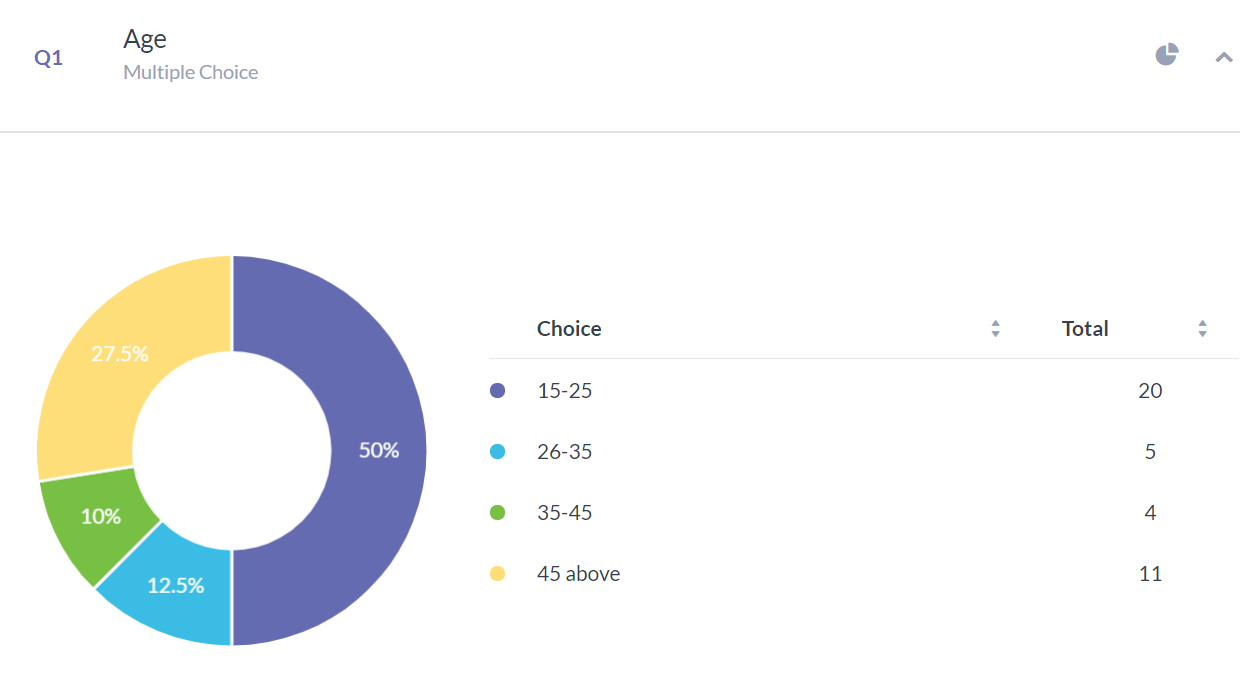
Out of a total of 40 participants who took the survey, 20 participants belonged to the age bracket of 15-25, 5 participants belong to the 26-35 age group, 4 in the 35-45 range and 11 participants were above 45 years of age. It can be concluded that most participants who took the survey were youngsters followed closely by middle aged participants.
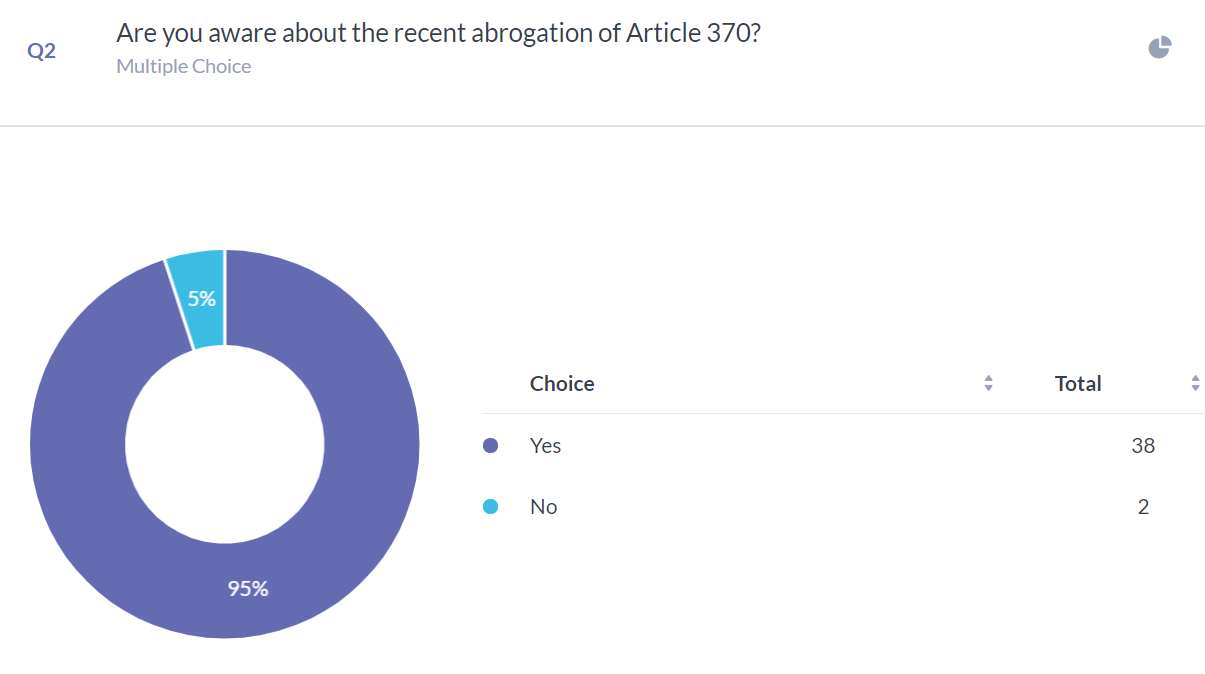
When a total of 40 participants were asked whether they were aware of the recent abrogation of Article 370, 38 participants answered in the affirmative (95%) and 2 participants said they were not aware of the same (5%).
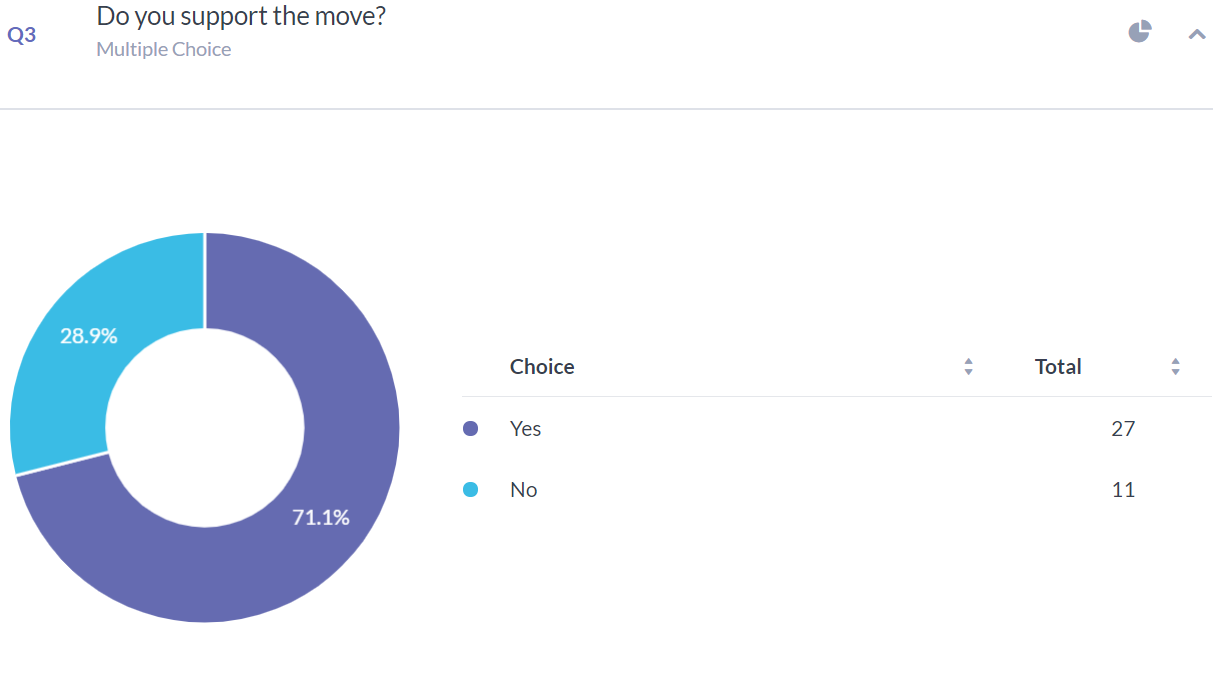
When asked if they support the move, 71.1% said they supported the decision of abrogation of the article and its conversion into a union territory whereas 28.9% participants said they did not support the move.
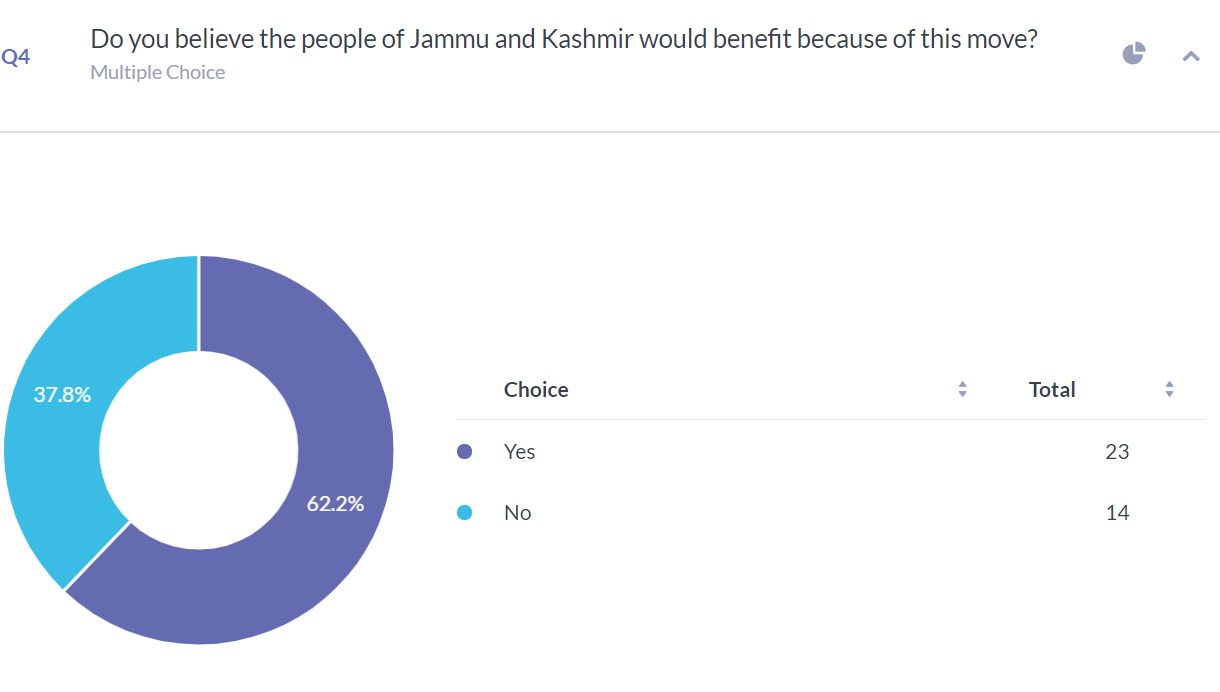
When asked if they believed this move would benefit the citizens of Jammu and Kashmir. A majority of 62.2% participants i.e. 23 participants felt that this move would prove to be an advantage to the people of J&K whereas 37.8% participants felt that this move would not be beneficial to the citizens.
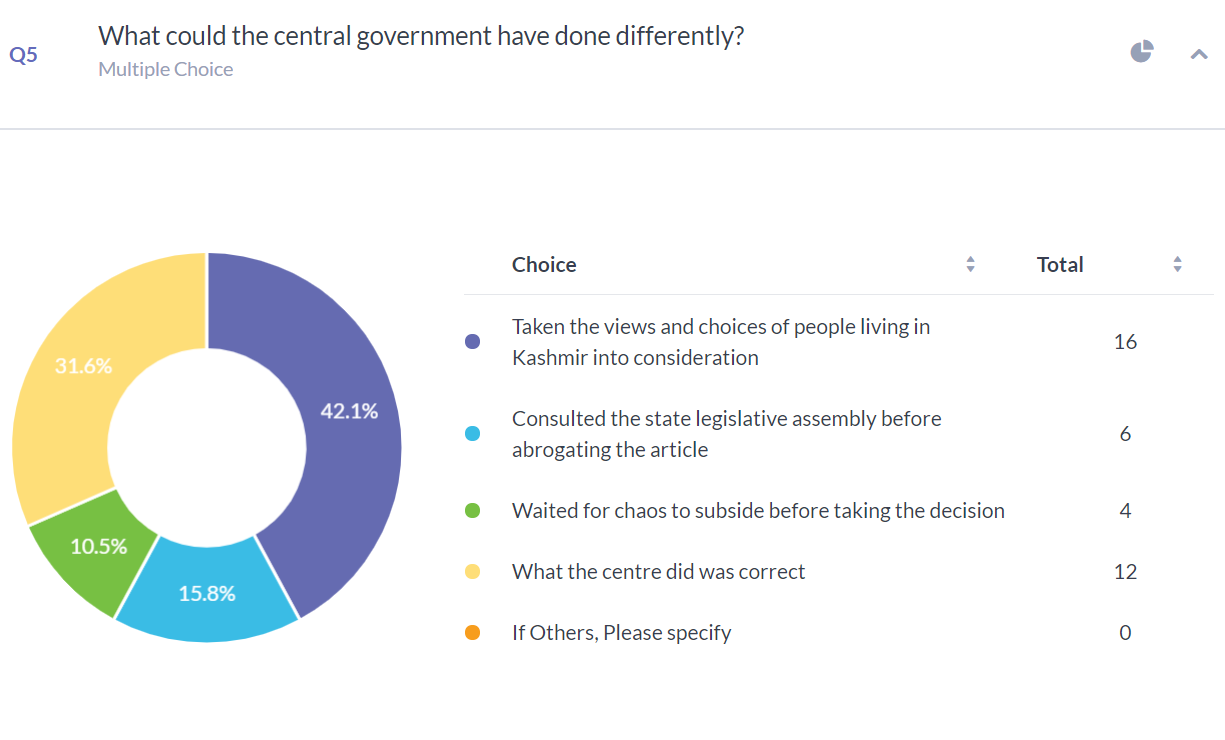
When posed with the question of what the central government could have done differently in context of the move, 42.1% participants believed that they should have taken the views and choices of people living in J&K into consideration. 31.6% believed the centre was correct in its move and didn’t need any change. 15.8% participants felt the state legislative assembly should have been consulted before the abrogation and 10.5% felt they should have waited for chaos to subside before making a move.
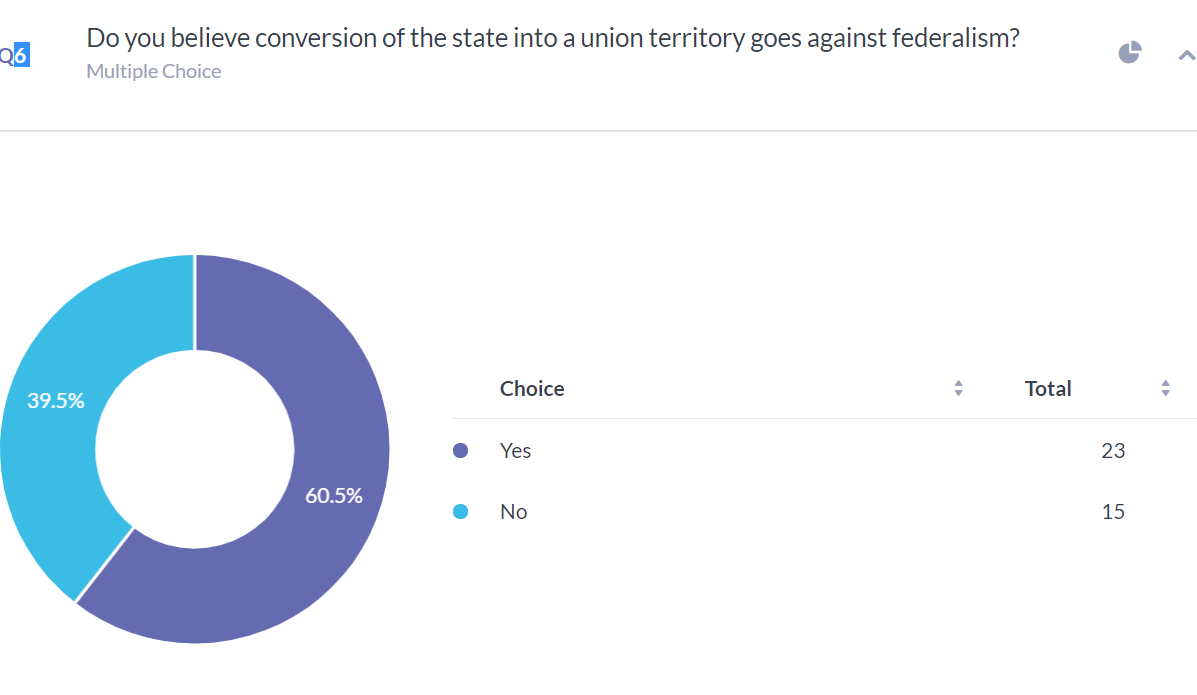
When the participants were asked if they felt conversion of J&K goes against federalism, 60.5% participants answered in the affirmative whereas 39.5% said they did not believe that the move was against federalism.
Suggestions & Conclusion
On the basis of the survey conducted above and on through analysis conducted on the topic of abrogation of Article 370, it can be logically held that the move would indeed prove beneficial to the citizens of J&K. This move was welcomed by citizens all over the country but at the same time also received a lot of criticism. The move was correct, but the procedure adopted by the centre was not correct.
I say with all respect to our Constitution that it just does not matter what your Constitution says, if the people of Kashmir do not want it, it will not go there. Because what is the alternative? The alternative is compulsion and coercion...We have fought in good fight about Kashmir on the field of battle... (and) ...in many a chancellery of the world and in the United Nations, but, above all, we have fought this fight in the hearts and minds of men and women of that State of Jammu and Kashmir40
The central government was right in its move of abrogating the article, but a better procedure could have been followed. Some of these are:
• The government failed to take into consideration the views and consideration of the people living in Jammu and Kashmir. The bill was passed at a time when the state was under president’s rule.
• Converting a state into a union territory is essentially unprecedented in the history of India and it goes away from the basic spirit of federalism. It would bring the state under direct purview of the centre.
• Administration decisions in a union territory would be taken by a lieutenant governor appointed by the centre in consultation with the chief minster of the territory. In such a scenario, power lies mainly with the state.
• Also, the Article was abrogated under clause (3) of Article 370 under which the word “constituent assembly” was evolved to mean “state legislative assembly” after the dissolution of the constituent assembly. While passing the bill, the state legislative assembly was suspended because of imposition of president’s rule which why the procedure was done without the assent of the state.
*****
Footnotes
2. Prabash K Dutta, How Kashmir got article 370: History Retold (Aug. 8, 2019), https://www.indiatoday.in/news-analysis/story/kashmir-situation-article-370-history-1578495-2019-08-08 ↑
4. Sugata Bose, Jammu and Kashmir reorganization: reckless assault on federalism (Aug. 6, 2018), https://www.telegraphindia.com/india/jammu-and-kashmir-reorganisation-reckless-assault-on-federalism-and-democracy/cid/1695920 ↑
5. Constituent Assembly of India Dep’t. X. (Oct. 17, 1949), at 244. ↑
6. Shailender Singh Jamwal,Article 370: It’s genesis and reactions in J&K state, https://www.jstor.org/stable/44143001 ↑
7. India Const. art. 370 (1950). ↑
9. Dipu Rai, Despite Autonomy, massive central aid, J&K poor (Aug. 6, 2019), https://www.indiatoday.in/diu/story/despite-autonomy-massive-central-aid-successive-govts-in-j-k-kept-the-state-poor-1577999-2019-08-06 ↑
10. Economic Survey of India, 2017 ↑
11. State economic survey, 2017 ↑
12. Ministry of Statistics and Problem Implementation, Key indicators of employment and unemployment in India, 2011-2012, http://mospi.nic.in/sites/default/files/publication_reports/KI-68th-E%26U-PDF.pdf ↑
13. Abridged Life Tables 2010-2014, http://www.censusindia.gov.in/Vital_Statistics/SRS_Life_Table/2.Analysis_2010-14.pdf ↑
14. Samrat Sharma, Jammu and Kashmir: All you need to know about the new Union territory’s economy (Aug. 6, 2019), https://www.financialexpress.com/economy/jammu-and-kashmir-all-you-need-to-know-about-the-new-union-territory/1667700/ ↑
15. Vigesh Radhakrishnan, Sumant Sen, Is Jammu and Kashmir underdeveloped as stated by Amit Shah (Aug. 7, 2019). ↑
16. K. Deepalakshmi, Fact check: what is true and what isn’t on J&K (Aug. 6, 2019), https://www.thehindu.com/ ↑
17. Amit shah in his speech on 8th August in the Indian Parliament ↑
18. National Health Profile, 2018 ↑
19. Bimal Kumar Chatterjee, Article 370 of the Constitution- Its Past and Present (2016). ↑
20. Mohammad Subhan v. State of Jammu and Kashmir, AIR 1956 J&K 1 (India). ↑
21. Puranmal Lakhanpal v. President oflndia, AIR 1961 SC 1519 (India). ↑
22. M. P. Singh, The Constitution oflndia- Eighth Edition 720 (2014). ↑
23. Sampat Prakash v. State of Jammu and Kashmir, AIR 1970 SC 1118 (India). ↑
24. M. P. Singh, The Constitution oflndia- Eighth Edition 720 (2014). ↑
25. Mohd. Maqbool Damnoo v. State of Jammu and Kashmir, AIR 1972 SC 963 (India). ↑
26. Mohammad Magray v. Ghulam Qadir Bedar, AIR 1974 J&K 69 (India). ↑
27. Sampat Prakash v. State of J & K, AIR 1970 SC I I 18, 1125 (India). ↑
28. Puranlal Lakhanpal v. President of India, AIR 1961 SC 1519 (India). ↑
29. Mohd. Maqbool Darnnoo v. State of J & K, AIR 1972 SC 963 (India). ↑
30. Madhav Rao Jivaji Rao Scindia Bahadur and Ors. v. Union of India (UOI) and Ors, AIR 1971 SC 530 (India). ↑
31. Ajay Kumar Pandey v. State of Jammu and Kashmir, ↑
32. Section 370(3), Constitution of India ↑
33. Furquan Ameen, Article 370: what are the legal questions? (Aug. 10, 2019), https://www.telegraphindia.com/india/article-370-what-are-the-legal-questions/cid/1695917 ↑
35. State bank of India v. Santosh Gupta, AIR 2017 SC 25 (India). ↑
36. Pranay Lekhi, Guest post: Article 370 a counter point, Constitutional Law and Philosophy (Aug. 15, 2019), https://indconlawphil.wordpress.com/2019/08/15/guest-post-article-370-a-counter-point/ ↑
37. Furquan Ameen, Article 370: what are the legal questions? (Aug. 10, 2019), https://www.telegraphindia.com/india/article-370-what-are-the-legal-questions/cid/1695917 ↑
38. State bank of India v. Santosh Gupta, AIR 2017 SC 25 (India). ↑
39. Anna Isaac, From state to Union Territories: Is Jammu and Kashmir an anomaly or a precedent?, The News Minute (Aug. 7, 2019), https://www.thenewsminute.com/article/state-union-territories-jammu-and-kashmir-anomaly-or-precedent-106810 ↑