
Introduction:
India has a long tradition of tolerance for all the kinds of beliefs, faiths, philosophies, orientations and ways of living. India is a deeply religious country but at the same time it is a country which has accepted non- religious communities as well. In ancient India there was a place for all kinds of diverse cultures, arts and literatures; the society was very assimilative. At one place India have purely and strictly religious painting and sculptors like at Konark or at Jagganath Puri temples and at another place India have monuments like Khajuraho which is famous all over the world for its erotic arts and sculptors; it also includes sculptors with homosexual activities. It depicts that not only all types of sexual orientations were there in ancient time but also people were so liberal and broad minded that paintings and sculptors were also depicting the same sex love-making were being freely created and displayed.
But in modern society somehow has become less liberal towards anything which is not common according to their collective perception; whether we study India's society behaviour towards religious minorities such as Islam or Christianity or the behaviour towards sexual minorities such as gays, lesbians or bisexuals. In such cases, it can be found that people in minority are the target of people in majority and harassment or discriminations against such minorities is widely prevalent.
Thus in unlike ancient India, people with different sexual choices i.e. homosexuals are not treated equally in today’s society and their basic human rights are nevertheless violated frequently.
Like food, shelter and water, sexual needs are one of the basic human needs without which life cannot be fully realized or enjoyed. Sexual orientations may vary from person to person. Though persons with same sexual behaviour are in minority but they are a reality. Same sexual behaviour may be understood as sexual preference and attraction not with opposite sex but with same sex persons.
What Is Homosexuality?
Homosexuals are as normal as ‘you’ and ‘me’. Yet, just because they love ‘their own kind’. Homosexuals are normal humans attracted to their own gender. Homosexuality (rarely Homophilia) is a sexual orientation or orientations characterized by romantic or sexual desire for, or sexual attraction towards member of the same sex. The term implies a predominant sexual orientation toward persons of the same sex and is differentiated from bisexuality as well as heterosexuality. In addition to referring to sexual orientation, the term homosexuality is also used for sexual behaviour between people of the same sex1.
Discrimination Against Homosexuals
Discriminations are faced by homosexuals in our society are at various levels; beginning from their homes to outside world as a whole. Their entire life is a complete struggle only because they are born with a particular sexual orientation which is completely different from others. In facts it is also proved by various scientific or psychological studies that such behaviours are perfectly natural.
Indian society is a very complex one; at one side we are most modern of societies of the world with all the liberal thoughts and beliefs but at on another level we are the most conservative’s societies of the world. We avoid facing so-called taboo social issues such as pre-marital sexual relationship, live-in relationship, inter-caste or inter-religion marriages etc. Homosexuality is one of the most detested issues in our society. Even the mentioning of the terms Gays or Lesbians is a strict no-no. Thus, society as whole has not accepted persons with different or so-called unnatural sexual behaviour2.
The discriminations against LGBT community persons is fairly common. And it starts from their own houses; their own family members treats it as a disease and accordingly treats them badly and family members feel ashamed of in the society if anyone member of their family has such sexual orientation3.
Outside of home, they experience all the more extreme and hateful behaviour of people, be it at work area, school, and colleges or at any other public location. Everywhere homosexuals turn out to be a target of obnoxious comments and sexually colored jokes. This problem is due to their appearances and manner of walking or talking they are easily recognizable and turns into victim of such derogatory remarks etc. In our everyday existence we pass jokes and messages ridiculing and making a laugh of LGBT people; even in our movies those people are presented in a very objectionable way simply to invoke some kind of laughter among the audiences4.
So overall general perception of the society is against such individuals and we are not ready to accept them as one among ourselves.
Countries That Allowed Gay Marriages:
A number of countries around the world are considering a major question whether to allow or grant legal recognition to get married in same-sex or not. Till now, over 24 countries have enacted their respective laws to allow gays and lesbians to marry, mostly countries in the west. In Mexico there is a contradiction regarding same-sex marriage some jurisdiction allow them to do so while the other oppose them.
List of countries that allow Same-Sex marriage-
Argentina(2010), Australia(2017), Belgium(2003), Brazil(2013), Canada(2005), Colombia(2016), Denmark(2012), England/Wales(2013), Finland(2015), France(2013), Germany(2017), Greenland(2015), Iceland(2010), Ireland(2015), Luxemburg(2014), Malta(2017), Uruguay(2013), The Netherlands(2000), New Zealand(2013), Norway(2008), Portugal(2010), Scotland(2014), South Africa(2006), Spain(2005), United state(2015), Sweden(2009)5.
Laws in Mexico: In 2015, the Mexican Supreme Court issued a decision making it substantially less demanding for gay and lesbian couples to marry. The choice gave same-sex couples the privilege to look for a court order against state laws restricting gay marriage; in spite of the fact that it didn't in fact sanction same-sex associations across the nation, it was a noteworthy advance toward that path. Mexico's Supreme Court likewise issued a decision for same-sex marriage in 2010, saying that same-sex relational unions performed in Mexico City were substantial and that they should be acknowledged all through the nation (Mexico City had sanctioned gay marriage in December 2009).6 Since 2011, the southern Mexican territory of Quintana additionally has permitted gay relational unions. In 2014, the congress of the northern province of Coahuila endorsed same-sex marriage, and in 2015, neighboring Chihuahua took action accordingly.
Countries still criminalized same-sex marriages: after so many years down the line homosexuality have been decriminalized in England and Wales, still there are 72 other countries and territories worldwide which continue to criminalize same-sex marriages and relationships, among them 45 are the countries in which sexual relationships between women are outlawed.
There are eight countries in which the result of homosexuality can be even death penalty, and more than twelve countries in which homosexuality acts can result in a prison sentence, according to an annual report by the International lesbian, Gay, Bisexual, Trans and Intersex Association7.
In Iran, Sudan, Saudi Arabia and Yemen, same-sex relationship can result in or is punishable by death, under sharia law. The same thing applies in parts of Somalia and northern Nigeria. In Syria and Iraq the death penalty is carried out by non-state actors, including Islamic state.
Same-sex relations-which are variously criminalized under laws covering sodomy, buggery and “acts against nature” among others – could lead to a prison sentence in 71 states in all.

List of countries which still criminalized same-sex relationships:
Algeria, Angola, Botswana, Burundi, Cameroon, Comoros, Egypt, Eritrea, Ethiopia, Gambia, Ghana, Guinea, Kenya, Liberia, Libya, Malawi, Mauritania, Mauritius, Morocco, Namibia, Nigeria, Senegal, Sierra Leone, Somalia, South Sudan, Sudan, Swaziland, Tanzania, Togo, Tunisia, Uganda, Zambia, Zimbabwe, Afghanistan, Bangladesh, Bhutan, Bruni, India, Iran, Kuwait, Lebanon, Malaysia, Maldives, Myanmar, Oman, Pakistan, Palestine/Gaza, Strip, Qatar, Saudi Arabia, Singapore, SriLanka, Syria, Turkmenistan, United Arab Emirates, Uzbekistan, Yemen, Antigua & Barbuda, Barbados, Dominica, Grenada, Guyana, Jamaica, St Kitts & Nevis, St lucia, St Vincent & the Grenadines, Cook Islands, Indonesia, Kirbati, Papua New Guinea, Samoa, Solomon Islands, Tonga, Tuvalu.
Laws in India and Homosexuality
India has a completely dynamic and progressive constitution which in a way is the backbone of this very vast and complex state. The Indian constitution provides rights and protections to each and every citizen of this country whether he is in majority or in minority. The constitution treats every person equally without any discrimination. it is the responsibility of the state to make sure that no person ought to be discriminated against.
LGBT community people are in minority and that they too have equal constitutional rights. But their right to equality and right to get equal remedy in the society are violated on regular basis. Not only society as whole but state machinery also treat them in a different way, especially police. They’re regular victim of rights violations. They are deprived of their fundamental human right and right to life which includes right to enjoy life properly. Section 377 of IPC and Rights of LGBT community:
One of the major lacuna or contentious legal provision in our laws is Section 377 of the Indian Penal Code, 1860.
Section 377 of the IPC says:
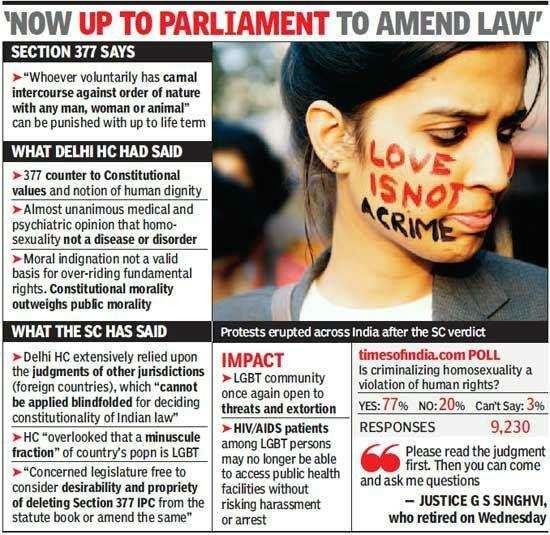
Unnatural offences: “Whoever voluntarily has carnal intercourse against the order of nature with any man, woman or animal shall be punished with imprisonment for life, or with imprisonment of either description for term which may extend to ten years, and shall also be liable to fine.”
Explanation: Penetration is sufficient to constitute the carnal intercourse necessary to the offense described in this section.
Thus the section makes any sexual activity against the order of the nature as criminal offence. Even voluntary act of such kind is punishable. Thus consent between two persons of same gender for such activity is immaterial.
Therefore, section 377 criminalizes homosexual activity and makes it punishable with as high punishment as life imprisonment.
This provision of IPC has become a major debatable point and subject matter of debate nowadays. People of LGBT community are trying from quite sometimes to persuade and pressurize our law makers to decriminalize section 377. LGBT groups demanded that if consenting adults of same sex are involved in homosexual activity, it should not be a criminal offence.
However when their plea was no longer responded by legislatures, they went to the court for appropriate and just solution to their grievances through a Public interest Litigation (PIL). The said PIL was filed by way of a NGO namely Naz foundation in Delhi high court.
In the case of Naz foundation v Govt. of NCT of Delhi (2009 Delhi H C) passing a landmark judgment on 2nd July 2009, Delhi high court declared section 377 as illegal as far as it criminalizes same intercourse sexual activity between consenting adults done in private. As a result, in effect Delhi high court, in its historic decision upheld and secured the LGBT people’s right to sexuality.
Naz foundation v. Govt. of NCT of New Delhi:
Section 377 of the Indian Penal Code, presented amid British administer of India, criminalizes "bodily intercourse against the request of nature". This expression was deciphered to mean all types of sexual movement other than hetero penile-vaginal intercourse.
The development to revoke Section 377 was driven by the Naz Foundation (India) Trust, a non-legislative association, which recorded a claim in the Delhi High Court in 2001, looking for legitimization of gay intercourse between consenting grown-ups. This was the second such request, the primary recorded in 1994 by AIDS Bhedbhav VirodhiAndolan. In 2003, the Delhi High Court declined to consider an appeal to with respect to the legitimateness of the law, saying that the solicitors had no locus standi in the issue. Naz Foundation spoke to the Supreme Court of India against the choice of the High Court to expel the request of on specialized grounds. The Supreme Court chose that Naz Foundation had the remaining to document an open intrigue claim for this situation, and sent the case back to the Delhi High Court to revaluate it on the benefits.
In 2006, the National AIDS Control Organization documented a testimony expressing that the requirement of Section 377 disregards LGBT rights. In this manner, there was a huge mediation for the situation by a Delhi-based coalition of LGBT, ladies' and human rights activists called "Voices against 377", which upheld the request to "peruse down" area 377 to reject grown-up consensual sex from inside its domain.
The case came up for hearing before a seat involving Chief Justice Ajit Prakash Shah and Justice S. Muralidhar, and the judgment was conveyed on 2 July 2009. The Court found the rights to nobility and protection inside the privilege to life and freedom ensured by Article 21 (under the central Right to Freedom sanction) of the Constitution, and held that criminalization of consensual gay sex disregarded these rights.
The Court additionally held that Section 377 annoys the assurance of equity revered in Article 14 (under the major Right to Equality contract) of the Constitution, since it makes a preposterous arrangement and targets gay people as a class. Open hostility and appal towards a specific social gathering or defenceless minority, it held, is certainly not a legitimate ground for characterization under Article 14. Article 15 of the Constitution prohibits segregation in view of specific attributes, including sex. The Court held that "sex" incorporates natural sex as well as sexual introduction, and subsequently separation on the ground of sexual introduction isn't allowable under Article 15. The Court additionally noticed that the privilege to life under Article 21 incorporates the privilege to wellbeing, and reasoned that Section 377 is an obstruction to general wellbeing since it ruins HIV-anticipation endeavours.
The Court did not strike down Section 377 all in all. The area was pronounced unlawful insofar it criminalizes consensual sexual demonstrations of grown-ups in private. The judgment keeps flawless the arrangement seeing that it applies to non-consensual non-vaginal intercourse and intercourse with minors. The court expressed that the judgment would hold until the point that Parliament altered the law.
The Supreme Court and Lgbt Rights
The decision of Delhi high court in Naz foundation Case was further challenged in appeal at the supreme court of India8.
The SC in a far reaching judgment quashed the decision of the Delhi high court and reverted back to the earlier function i.e., once again made gay relationship as criminal offence. The decision came as a shock to the LGBT community and additionally to the liberal members of the society. The reasoning of the SC was that the Indian society is not yet absolutely mature to accept same intercourse relationships and if necessary adjustments are needed to decriminalize phase 377 of the IPC, it should be done by the Parliament and not by means of the SC.
Several legal and constitutional specialists have criticized the decision as regressive and disappointing. Experts are of the view that the SC could have upheld the decision of Delhi high court or could have advised the Parliament to make necessary changes in the IPC; but unfortunately the SC fell short of in fulfilling such expectations and securing fundamental human rights of sexual minorities.
Therefore as per the prevailing situation, LGBT community people are again feeling themselves insecure and discriminated against. If the SC had given an authoritative judgment on the problem, the matter might have been settled for all times. And it was also anticipated of the highest court of the country that it'd recognize the rights of LGBT people and would decriminalize the same sex relationship but as many specialists are pointing out, the SC has missed a historic opportunity to provide equal constitutional and human rights to LGBT people9.
Now again the ball is in the hands of our law makers to amend the regulation and decriminalize the same sex relationship among consenting adults done in private sphere because now the only hope for LGBT people is country’s Parliament.
Recent hearing in Supreme Court:
Open acknowledgment of individuals in gay connections will help meet wellbeing concerns and control the spread of HIV, Justice D.Y. Chandrachud told legal advisors who contended in help of criminalizing homosexuality10.
Same sex couples living trying to claim ignorance with no entrance to restorative care were more inclined to contracting and spreading sexually-transmitted maladies, Justice Chandrachud watched. "All concealment isn't right."
Justice Chandrachud, who is a piece of the five-judge Bench drove by Chief Justice Dipak Misra hearing a supplication to strike down Section 377 that criminalizes gay sex regardless of whether it is between consenting grown-ups, was responding to contentions that gay conduct prompts spread of HIV.
“The cause of sexually transmitted diseases is not sexual intercourse, but unprotected sexual intercourse. A village woman may get the disease from her husband, who is a migrant worker. This way would you now want to make sexual intercourse itself a crime?” Justice Chandrachud asked lawyers supporting Section 377 IPC.
“Love you may, so long as there is no physical manifestation of your love,” said Justice Chandrachud about the attitude of the pro- section 377 side to the LGBTQ community11.
Justice Rohinton Nariman clearly said that prohibition has never resolved the social issues. “if you license prostitution, you control it.” It would be like the same situation the more you hold the sand in your hand the more it will slip.
Fundamental right
Giving a strong indication that the Bench will declare that Section 377 violates the right under Article 21 of
the LGBTQ community to sexuality, sexual orientation and choice of sexual partner, Justice Nariman said the whole objective of Fundamental Rights is to empower the court to strike down laws like Section 377. The court was not dependent on public views like a majoritarian government in power, whose views were swayed by its vote bank. “We don’t wait for majoritarian governments to strike down the offending law. They may enact, repeal or do whatever they want, but the moment we find that a law violates fundamental rights, we strike it down12.”
Conclusion:
Since according to the Constitution of India, Article 14 states that state shall not deny any person equality before the law or the equal protection of the laws within the territory of India, Article 15 says that the state shall not discriminate against only of religion, race, sex, place of birth or any of them, Article 19(1) talks about freedom of speech and expression, Article 21 deals with the protection of life and personal liberty. All the above articles of Indian constitution do not demarcate its citizen on the basis of sex. Even if in 21st century third gender persons are given recognition but their personal liberties are curved by the external entities. They should have their freedom to do whatever they want to do subject to some restriction. But this does not mean that restriction should be imposed on their personal life. They should have equal status to put forward whatever issues they have regarding their liberties which our own constitution provides them. And state cannot discriminate them on the basis of their sex. State should protect their rights and liberties. But till now our Indian Parliament has not taken any step to bring them in equal lights.
*****
Footnotes
1. Homosexuality Stanford Encyclopedia of Philosophy, https://plato.stanford.edu/entries/homosexuality/ (last visited Jul 20, 2018)
2. "No Choice but to Deny Who I Am" | Violence and Discrimination against LGBT People in Ghana Human Rights Watch, https://www.hrw.org/report/2018/01/08/no-choice-deny-who-i-am/violence-and-discrimination-against-lgbt-people-ghana (last visited Jul 20, 2018)
3. "No Choice but to Deny Who I Am" | Violence and Discrimination against LGBT People in Ghana Human Rights Watch, https://www.hrw.org/report/2018/01/08/no-choice-deny-who-i-am/violence-and-discrimination-against-lgbt-people-ghana (last visited Jul 20, 2018)
4. A serious business: what can comedy do? Home, https://mosaicscience.com/story/comedy-humour-jokes-political-satire-taboo/ (last visited Jul 20, 2018)
5. Some countries missing out on slice of £160 BILLION in annual tourism because they have homophobic laws The London Economic, https://www.thelondoneconomic.com/travel/some-countries-missing-out-on-slice-of-160-billion-in-annual-tourism-because-they-have-homophobic-laws/20/06/ (last visited Jul 20, 2018)
6. Some countries missing out on slice of £160 BILLION in annual tourism because they have homophobic laws The London Economic, https://www.thelondoneconomic.com/travel/some-countries-missing-out-on-slice-of-160-billion-in-annual-tourism-because-they-have-homophobic-laws/20/06/ (last visited Jul 20, 2018)
7. Some countries missing out on slice of £160 BILLION in annual tourism because they have homophobic laws The London Economic, https://www.thelondoneconomic.com/travel/some-countries-missing-out-on-slice-of-160-billion-in-annual-tourism-because-they-have-homophobic-laws/20/06/ (last visited Jul 20, 2018)
8. Decriminalization of Homosexuality In India The problem of Prostitution an Indian perspective, http://www.legalserviceindia.com/articles/homosexuality_In_India.htm (last visited Jul 20, 2018)
9. Decriminalization of Homosexuality In India The problem of Prostitution an Indian perspective, http://www.legalserviceindia.com/articles/homosexuality_In_India.htm (last visited Jul 20, 2018)
10. Decriminalization of Homosexuality In India The problem of Prostitution an Indian perspective, http://www.legalserviceindia.com/articles/homosexuality_In_India.htm (last visited Jul 20, 2018)
11. Decriminalization of Homosexuality In India The problem of Prostitution an Indian perspective, http://www.legalserviceindia.com/articles/homosexuality_In_India.htm (last visited Jul 20, 2018)
12. Decriminalization of Homosexuality In India The problem of Prostitution an Indian perspective, http://www.legalserviceindia.com/articles/homosexuality_In_India.htm (last visited Jul 20, 2018)