

Introduction
Where eyewitness testimony and post-mortem findings diverge, the central problem of adjudication becomes one of method: how courts are to weigh competing levels of abstraction, reconcile inconsistencies, and apply the standard of proof. Indian murder jurisprudence relies primarily on eyewitnesses, while medical examination, and the post-mortem report in particular, serves to elucidate the injuries sustained and the mechanism of death. Under the Bharatiya Nyaya Sanhita, murder is treated as the gravest form of homicide, and conviction requires proof both that the victim is dead and that the accused was the author of the death.[1]
This study adopts a doctrinal approach. It situates the existing framework under the Bharatiya Sakshya Adhiniyam and the Bharatiya Nagarik Suraksha Sanhita and evaluates the Supreme Court’s seminal authorities on ocular and medical evidence. Although most of the cornerstone judgments were delivered under the earlier criminal law, their fundamental reasoning continues to guide contemporary jurisprudence, and the principles governing direct oral evidence, expert opinion, and the sufficiency of witnesses have largely been retained in the new legislation.[2] The focus throughout remains on murder cases and appeals in India.
The term ocular evidence is understood, in the conventional legal sense, as direct oral evidence given by a witness from first-hand perception of the fact. Medical evidence comprises the post-mortem examination report, the testimony of the examining physician, the description of injuries including the probable weapon, and the assessment of the timing and manner of death. The post-mortem report therefore affords more than mere description: it records the findings of a scientific and surgical examination conducted and reported by a qualified medical officer, and in valuing the evidence the significance of a contradiction is more readily appreciated in the medical analysis than in the testimonial account.[3]
Indian doctrine applies a calibrated hierarchy rather than a binary choice. As a general rule, eyewitness accounts are preferred over medical opinion because they speak to first-hand occurrences, but that preference is conditional. Where a medical opinion renders an eyewitness account impossible, highly improbable, or unquestionably contradictory, a conviction founded on that account ought to be set aside. The Courts have stated this proposition repeatedly, yet its application has been inconsistent. Trial courts accordingly need a clearer structure that reconciles the testimonial narrative with forensic and interpretive analysis, so that the requisite standard of proof is reached with confidence.[4]
Statutory and evidentiary foundations under the new criminal laws
The new legal paradigm does not entirely displace the older doctrine; rather, it changes the statutory language through which that doctrine is expressed. A comprehensive analysis must therefore begin with the new criminal statutes in order to demonstrate the continuing validity of the earlier Supreme Court decisions on the reconciliation of evidentiary materials in murder trials. The substantive offence of murder is now governed by Section 103 of the Bharatiya Nyaya Sanhita. Under the new framework, the prosecution must prove the act of murder through bodily harm supported by a forensic explanation, and must establish authorship of the act through eyewitness accounts or interpretive inference.[5]
Under Section 39 of the Bharatiya Sakshya Adhiniyam, the opinion of persons specially skilled in science is relevant, so that expert medical evidence retains its traditional role in criminal courts. Relevance, however, is not the same as conclusiveness.[6] Expert opinion assists the court in matters beyond common experience, such as the character of wounds, internal damage, and the post-mortem interval, but it does not supplant the court’s duty to assess the evidence for credibility, coherence, and probability. The statutory scheme thus supports the judicial position that the medical expert speaks to scientific or medical probability, while the judge must decide whether the case is proven beyond reasonable doubt in the light of that opinion.
Sections 54 and 55 of the Bharatiya Sakshya Adhiniyam preserve the standards governing direct and oral evidence, providing that evidence may be given as a verbal account, while Section 139 confirms that no particular number of witnesses is required to prove any fact.[7] In Indian courts it is the quality of the evidence, rather than the number of witnesses, that matters. What is decisive is the consistency of the oral evidence and the overall integrity of the case: the case must be stable enough that the evidence warrants conviction and is congruent with the medical record.
The Bharatiya Nagarik Suraksha Sanhita strengthens this position by regulating the procedure for the medical examination of the body and for medical reporting. The medical examination of a suspect or an arrested person is permitted and made a standard element of the investigative process, so that the handling of medical evidence becomes part of the procedure itself.[8] The post-mortem report is prepared in the course of the investigation into the cause of death, and these provisions confirm that modern criminal procedure expects scientific evidence to accompany testimony.[9] The judge is therefore obliged to consider not an isolated report but a complete body of evidence.
Doctrinal standards for resolving ocular and medical conflict
The Supreme Court has developed guidelines for managing contradictions between eyewitness accounts and medical evidence. Rather than designate a preferred class of evidence, these guidelines pose a sequence of questions about credibility, compatibility, materiality, and cumulative plausibility. In Solanki Chimanbhai Ukabhai v. State of Gujarat, the Court observed that medical evidence is ordinarily corroborative and can displace an eyewitness account only where it wholly negates that account.[10] This was developed in State of Uttar Pradesh v. Krishna Gopal, where the Court held that the independent credibility of eyewitnesses cannot be displaced by simply substituting medical opinion.[11]
The first question is whether the contradiction is irreconcilable. In Abdul Sayeed v. State of Madhya Pradesh, the Court reiterated the long-standing rule that ocular evidence is not to be discarded unless the medical evidence entirely excludes the possibility of the event as described.[12] This sets a high threshold to be met before medical evidence may prevail. The court must therefore assess whether the medical evidence establishes impossibility, or something close to it, rather than mere inconsistency. A discrepancy as to, for example, the expected pattern of bleeding may be material, but it does not, without more, render the ocular account incredible.
The law distinguishes substantive contradictions from minor discrepancies. In Kamaljit Singh v. State of Punjab, the Court held that minor discrepancies between eyewitness and medical evidence should not lead to rejection of the testimony.[13] This rule reflects the nature of perception and recollection: witnesses rarely give perfectly constructed accounts, and doctors do not observe the violence but interpret it through its physical traces. The court’s task is therefore to compare, not to apply a mechanical formula, and to determine whether a discrepancy goes to the core of the case or merely reflects the gaps inherent in human observation.
It is often said that injured eyewitnesses occupy a stronger position, since their injuries furnish an internal guarantee of presence at the scene. The law does not assume that injured witnesses are immune from the tendency to exaggerate, to shield co-participants, or to misperceive events; but injury does contradict the suggestion of absence. Courts are right to be cautious, since the account of a witness may be affected by the weapon used, the conditions at the scene, and the dynamics of the event. The court considers whether the medical evidence of injury supports the witness’s presence at the scene.[14]
Post-mortem evidence may be less useful in fixing the precise sequence of injuries, their timing, or the type of weapon used. Scholarship on eyewitness testimony underscores the importance of distinguishing inaccuracy arising from honest error from deliberate falsehood.[15] In Mahavir Singh v. State of Madhya Pradesh, the Court treated a serious medical contradiction as a circumstance that demolished the prosecution case.[16] Some recent decisions tread more cautiously where the medical opinion is probabilistic. In Vijay Singh @ Vijay Kr. Sharma v. State of Bihar, the Court observed that post-mortem reports and findings on the time of death may become especially significant where the alleged eyewitness account is found to be unreliable.[17]
A further question concerns proof of the report itself. In Baleshwar Mahto v. State of Bihar, the Court held that the prosecution cannot discharge its burden as to the contents of a post-mortem report merely by exhibiting it on a concession by the defence.[18] A report is not self-proving; its value depends on presentation, explanation, and critical evaluation. Trial courts must therefore be careful not to treat the report as an informative document that proves its own contents. Where the defence adduces contradictory material, the report, its contents, and the reasoning by which the doctor reached his conclusions become pivotal.
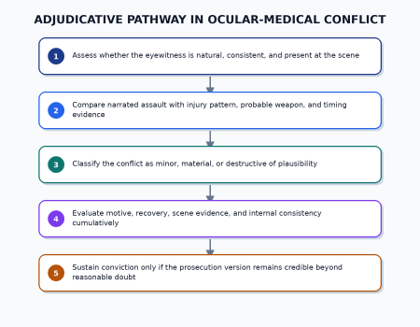
Figure 1. Judicial sequence for reconciling eyewitness testimony and post-mortem findings.
Figure 1 illustrates the doctrinal principles derived from these authorities, representing the order of inquiry most appropriate to such cases. It consolidates fragmented judicial language into a single decision-making framework capable of guiding trial and appellate courts where conflicts in the evidence are asserted.[19]
Indian doctrine thus does not require the court to prefer witness evidence over expert evidence as a matter of course. It calls for a framework in which the court first assesses the reliability of the witness evidence, then evaluates the materiality of any contradiction, and finally asks whether the prosecution case as a whole survives scrutiny.[20]
Judicial application in recent supreme court murder appeals
Recent Supreme Court decisions exhibit a combination of consistency and variation. They have not abandoned the long-standing approach to ocular evidence, but they display the variability that arises where medical evidence weakens the prosecution case. Dharmendra Kumar @ Dhamma v. State of Madhya Pradesh illustrates the Court relying on eyewitness testimony that was supported by the medical evidence.[21] Nitya Nand v. State of Uttar Pradesh shows the medical record and the oral account together establishing the homicidal nature of the death.[22] The Court does not insist on perfect symmetry between testimony and autopsy.
Scholarship has noted the rhetorical force of testimony given by injured witnesses. In Haalesh @ Haleshi @ Kurubara Haleshi v. State of Karnataka, the Court relied on the testimony of injured witnesses as a primary basis for conviction.[23] The decision is notable because evidence of bodily injury can lend assurance to an otherwise uncertain account, reducing the scope for a false-implication defence. The fact of injury does not, however, compel an automatic conviction: the testimony must still be evaluated against the circumstantial and medical evidence and the logical consistency of the prosecution case. Injury can strengthen a case, but the evidence remains subject to the court’s scrutiny.
Difficult cases arise where the medical evidence contradicts the ocular version in a substantial way. The earlier jurisprudence, which treated serious medical contradiction as a powerful consideration against conviction, continues to apply. In Zainul v. State of Bihar, the Court held that, where the medical evidence contradicted a substantial part of the witness account, the accused were entitled to the benefit of the doubt.[24] The case demonstrates that the doctrine serves a protective purpose where a contradiction rises to the threshold of structural improbability of the incident.
The more developed model appears in the 2024 authority on post-mortem timing. The Court did not lay down a general rule that medical opinion on timing is invariably superior to eyewitness proof. It held instead that post-mortem evidence on timing assumes greater relative importance to the extent that the eyewitness account is deficient.[25] The reasoning has analytical merit because it dispenses with a false duality: medical opinion is never self-sufficient, nor is it always subordinate, and its weight varies with the relative strength or deficiency of the competing direct evidence. Trial courts must therefore weigh testimony on timing, digestion, and the estimated interval since death in the light of the evidence as a whole.
The cumulative method remains the most coherent way to read the case law. Thaman Kumar v. State of Union Territory of Chandigarh insisted on a careful appraisal of eyewitness credibility on its own terms.[26] State of Uttarakhand v. Darshan Singh reiterated that inconsistency with medical opinion is not automatically fatal.[27] More recent authority in Kunhimuhammed @ Kunheethu v. State of Kerala upheld a conviction where the ocular version was found trustworthy and broadly consistent with the medical record,[28] and Baban Shankar Daphal v. State of Maharashtra follows the same pattern of integrated reasoning.[29] The doctrine therefore rewards cumulative evaluation and discourages selective reading.
The implication for trial courts is that judgments should be organized around four distinct questions: witness presence, the methodology of the assault, medical correlation, and reasonable doubt. Conflating these questions produces inadequate analysis. A witness may be genuinely present yet mistaken about the sequence of events, while a medical expert may be persuasive that a violent, homicidal act occurred yet unable to fix the precise weapon or time. The most effective judgments articulate the extent to which the medical evidence corroborates the visual narrative, the extent to which it fails to do so, and, most importantly, the extent to which it renders the narrative impossible. This keeps the reasoning structured and reduces the likelihood of reversal on appeal.[30]
Empirical patterns and evidentiary pressures
Doctrinal rules operate in a trial environment marked by a high volume of murder cases and considerable pressure on investigations. The available official data do not answer doctrinal questions directly, but they help explain why evidentiary contradiction is both frequent and legally significant in Indian murder cases. National figures indicate that registered murder cases declined modestly across the three years from 2021 to 2023, though the absolute volume remained substantial.[31]
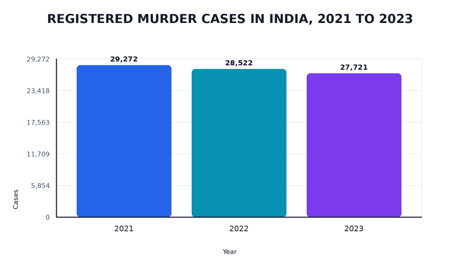
Figure 2. National trend in registered murder cases, 2021 to 2023.
Registered murder cases showed little change across this three-year window, with totals of 29,272 in 2021, 28,522 in 2022, and 27,721 in 2023. The trend is largely flat, but the continuing volume means that the need for rigorous evidentiary scrutiny in murder cases is undiminished.[32]
The distribution of motives is also instructive. The 2023 data record categorical breakdowns of murders by motive, including murder arising from disputes, murder due to personal enmity, and murder for gain.[33] These categories matter to the legal analysis because they bear on intent and frequently arise in settings of known, familial, communal, or domestic conflict.
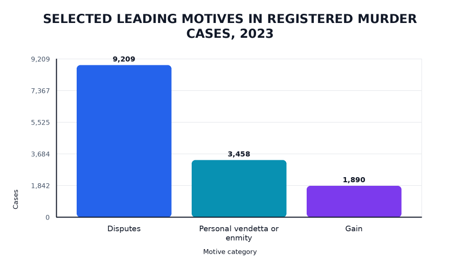
Figure 3. Selected leading motive categories in registered murder cases, 2023.
For 2023, the distribution of motives is led by disputes (9,209 cases), followed by personal vendetta or enmity (3,458 cases) and gain (1,890 cases). The pattern indicates that socially proximate, contentious conflict, in which an eyewitness is typically present, is a common source of murder prosecutions.[34]
These data counsel careful interpretation of eyewitness accounts. Such accounts may be more reliable where the murder occurs in a proximate social setting, since the witness is likely to have been present and to know the participants. Yet that same proximity creates a motive for selective or partisan narration. Post-mortem analysis then functions as a useful check, rather than as an a priori substitute for the court’s adjudicative function. Courts must resist both the impulse to accept testimony uncritically and the opposite tendency to over-rely on the post-mortem analysis. The doctrinal approach described earlier is a considered response to the practical realities of homicide litigation rather than an abstract preference.[35]
The value of forensic capacity is underscored by recent policy change. The Union Government’s National Forensic Infrastructure Enhancement Scheme, approved in June 2024, provides for additional campuses of the National Forensic Sciences University and for new Central Forensic Science Laboratories.[36] The Bureau of Police Research and Development has issued recommendations to improve audio and video recording of the scene of crime.[37] These measures aim to improve the documentation of crime-scene evidence alongside witnesses’ accounts; they enhance institutional capacity for the collection and examination of evidence without eliminating the need for testimony.
The prevailing principle has been articulated clearly enough for practitioners and judges to construct a coherent legal theory. The greater challenge is to adhere to that principle rigorously and to avoid both a rhetorical over-emphasis on ocular evidence and a rhetorical over-emphasis on forensic evidence. The proper approach is to ask whether the prosecution case is legally and technically complete. There is, on this view, no insurmountable opposition between eyewitness accounts and post-mortem reports in Indian law: the Bharatiya Sakshya Adhiniyam treats both expert opinion and direct oral testimony as relevant, and in practice the two are generally complementary.[38]
Conclusion
The prosecution stands on firm ground where natural witnesses give a consistent account of the assault and the medical record is broadly consistent with a homicidal injury. That strength is not, however, an immunity. The standard of proof is not satisfied once the prosecution version is shown to be impossible, far-fetched, or incoherent when tested against the medical findings. The judicial task is then decisive and essentially classificatory: the court must decide whether a discrepancy concerns a peripheral matter, an uncertain scientific inference, or the very mechanics of what occurred. That classification cannot be performed by formula. It requires examination of the post-mortem report, purposeful scrutiny of the physician, attention to the witness’s opportunity to observe, and a structured engagement with motive, recovery, and the conditions at the scene.[39]
Slogans, that ocular evidence is the best evidence, or that medical evidence is the opposite of ocular evidence, are analytically incomplete. The law’s demand is for reasons that justify why a contradiction is, or is not, fatal to the prosecution story. The Indian doctrine of murder conviction is, in this sense, cumulative. Eyewitness testimony is usually credible and carries a measure of primacy because it is first-hand evidence of the occurrence. Medical evidence supplies a scientific test of plausibility, not an automatic veto. Where the two forms of evidence, taken together with the surrounding circumstances, yield a story that withstands reasonable doubt, conviction is warranted; where the bodily findings reveal an irreparable fracture in the story, acquittal is justified.[40]
Suggestions
The reforms proposed here aim to improve the quality of evidence and the rigour of judicial reasoning in integrating testimony and medical evidence.
- Structured contradiction analysis. Trial courts should identify, specifically, the presence contradiction, the assault-manner contradiction, the weapon contradiction, and the time-of-death contradiction. A short, issue-wise list in the judgment would curb vagueness about whether the medical evidence supports or contradicts the ocular version.
- Fuller examination of the autopsy doctor. Where medical opinion conflicts with the ocular account, courts and prosecutors should focus on the margin of error and probability, and on whether the documented findings support or contradict the testimony. This would discourage the tendency to treat a medical document as if it were testimony in itself.
- Standardised injury mapping in medico-legal reporting. Reports should explain the probable weapon and its use more fully, employing clear anatomical diagrams, wound-numbering systems, and annotations describing the nature of the weapon. Better injury mapping helps courts establish that eyewitnesses are correct as to participation and the general nature of the assault even where they err as to sequence.
- Stronger scene-of-crime documentation. Police should follow precise evidence-control guidelines and instructions for the use of audio-visual recording and photography in field conditions, including photography of the scene, so that the court has a fuller evidentiary context in which to evaluate both testimonial and medical claims.
- Use of forensic-capacity schemes for case quality. The enhancement of national forensic infrastructure should be treated not merely as an increase in capacity but as a means of improving the quality of homicide investigations. Greater laboratory capacity and better-trained personnel should improve report quality and the medico-legal linkage in serious violent crime.
- Greater digital integration through the Inter-operable Criminal Justice System. Homicide investigations should use integrated criminal-justice systems so that forensic post-mortem reports, crime-scene reports, and eyewitness accounts are linked and remain traceable across agencies, reducing evidentiary gaps from investigation through trial.
- Laboratory quality control and turnaround standards. Forensic laboratories should state report dates, the basis of their evaluation, and any limitations on the medical opinion, enabling the court to assess delay, incompleteness, and methodological reliability rather than speculate about them.[41]
- Clearer appellate reasoning on fatal contradiction. Appellate courts should classify contradictions as fatal, material but surmountable, or peripheral. Clearer classification would improve the precedents and help trial courts avoid the equally harmful errors of over-correcting in favour of either testimony or clinical reasoning.
- Judicial training on the limits of the post-mortem interval. Judicial education should include modules emphasising that estimates of the time of death are not conclusive. Better training would prevent unwarranted certitude and help judges articulate the reasons for including or excluding such evidence.[42]
- Preserving the distinction between proof of death and proof of authorship. Judicial and prosecuting authorities should consider the fact of the homicide and the identification of the perpetrator separately. The distinction is especially valuable where the post-mortem leaves little doubt about the mechanism of injury but the witness evidence is weak, delayed, or suspect.
*****
Footnotes
[1]The Bharatiya Nyaya Sanhita, 2023, § 103, No. 45 of 2023, Acts of Parliament, 2023 (India).
[2]Ratanlal & Dhirajlal, The Law of Evidence 83 (LexisNexis, 27th ed. 2021).
[3]Jaising P. Modi, A Textbook of Medical Jurisprudence and Toxicology 118 (LexisNexis Butterworths Wadhwa, 26th ed. 2018).
[4]State of Uttarakhand v. Darshan Singh, (2020) 12 S.C.C. 605.
[5]K.D. Gaur, Textbook on the Indian Penal Code 132 (LexisNexis, 8th ed. 2023).
[6]The Bharatiya Sakshya Adhiniyam, 2023, § 39, No. 47 of 2023, Acts of Parliament, 2023 (India).
[7]The Bharatiya Sakshya Adhiniyam, 2023, §§ 54, 55, 139, No. 47 of 2023, Acts of Parliament, 2023 (India).
[8]The Bharatiya Nagarik Suraksha Sanhita, 2023, §§ 51, 53, No. 46 of 2023, Acts of Parliament, 2023 (India).
[9]K.N. Chandrasekharan Pillai, R.V. Kelkar’s Criminal Procedure 174 (Eastern Book Co., 7th ed. 2021).
[10]Solanki Chimanbhai Ukabhai v. State of Gujarat, (1983) 2 S.C.C. 174.
[11]State of U.P. v. Krishna Gopal, (1988) 4 S.C.C. 302.
[12]Abdul Sayeed v. State of Madhya Pradesh, (2010) 10 S.C.C. 259.
[13]Kamaljit Singh v. State of Punjab, (2003) 12 S.C.C. 155.
[14]Gary L. Wells & Elizabeth A. Olson, Eyewitness Testimony, 54 Ann. Rev. Psychol. 277 (2003).
[15]Kenneth A. Deffenbacher, Brian H. Bornstein et al., A Meta-Analytic Review of the Effects of High Stress on Eyewitness Memory, 28 Law & Hum. Behav. 687 (2004).
[16]Mahavir Singh v. State of Madhya Pradesh, (2016) 10 S.C.C. 220.
[17]Vijay Singh @ Vijay Kr. Sharma v. State of Bihar, 2024 INSC 735.
[18]Baleshwar Mahto v. State of Bihar, (2017) 3 S.C.C. 152.
[19]Ratanlal & Dhirajlal, The Law of Evidence 83 (LexisNexis, 27th ed. 2021).
[20]B.V. Subrahmanyam, Parikh’s Textbook of Medical Jurisprudence, Forensic Medicine and Toxicology 140 (CBS Publishers & Distributors, 8th ed. 2019).
[21]Dharmendra Kumar @ Dhamma v. State of Madhya Pradesh, 2024 INSC 480.
[22]Nitya Nand v. State of Uttar Pradesh, 2024 INSC 655.
[23]Haalesh @ Haleshi @ Kurubara Haleshi v. State of Karnataka, Criminal Appeal No. 1954 of 2012 (decided Feb. 2, 2024).
[24]Zainul v. State of Bihar, 2025 INSC 1192.
[25]Vijay Singh @ Vijay Kr. Sharma v. State of Bihar, supra note 17.
[26]Thaman Kumar v. State of Union Territory of Chandigarh, (2003) 6 S.C.C. 380.
[27]State of Uttarakhand v. Darshan Singh, (2020) 12 S.C.C. 605.
[28]Kunhimuhammed @ Kunheethu v. State of Kerala, 2024 INSC 937.
[29]Baban Shankar Daphal v. State of Maharashtra, 2025 INSC 97.
[30]K.N. Chandrasekharan Pillai, R.V. Kelkar’s Criminal Procedure 174 (Eastern Book Co., 7th ed. 2021).
[31]National Crime Records Bureau, Crime in India 2023 22 (Ministry of Home Affairs 2024).
[32]National Crime Records Bureau, Crime in India 2023 77 (Ministry of Home Affairs 2024).
[33]National Crime Records Bureau, Crime in India 2023 81 (Ministry of Home Affairs 2024).
[34]National Crime Records Bureau, Crime in India 2023 86 (Ministry of Home Affairs 2024).
[35]Nancy M. Steblay, A Meta-Analytic Review of the Weapon Focus Effect, 16 Law & Hum. Behav. 413 (1992).
[36]Press Info. Bureau, Cabinet Approves Central Sector Scheme “National Forensic Infrastructure Enhancement Scheme” (June 2024).
[37]Bureau of Police Rsch. & Dev., SOP of Audio-Video Recording for Scene of Crime 4 (Ministry of Home Affairs 2024).
[38]The Bharatiya Sakshya Adhiniyam, 2023, §§ 39, 54, 55, 139, No. 47 of 2023, Acts of Parliament, 2023 (India).
[39]K.S. Narayan Reddy & O.P. Murty, The Essentials of Forensic Medicine and Toxicology 152 (Jaypee Brothers Medical Publishers, 35th ed. 2022).
[40]Ratanlal & Dhirajlal, The Law of Evidence 83 (LexisNexis, 27th ed. 2021).
[41]Government of India, Rajya Sabha Unstarred Question No. 2310: Modernisation of Forensic Science Laboratories 2 (Ministry of Home Affairs, Aug. 2023).
[42]Saul M. Kassin, Itiel E. Dror et al., The Forensic Confirmation Bias: Problems, Perspectives, and Proposed Solutions, 2 J. Applied Rsch. Memory & Cognition 42 (2013).