
INTRODUCTION
India custodial violence questions more than police brutality.1 It questions constitutional governance’s ability to sustain dignity and the basic fact of the State’s total physical dominion over a person. This paper attempts to answer that question through the lenses of constitutional theory, statutory protections, judicial redress, and the accountability of the State through law.2
Violence in custodial settings includes a variety of acts, such as physical abuse, psychological intimidation, coercive methods of interrogation, public humiliation, denial of medical services, acts of a sexual nature, administrative detention, and deaths of persons in custody. In Indian law, torture includes more than just the infliction of injuries to a person that are visible. It also includes psychological injuries, humiliation, and the use of custodial deprivation as a means of obtaining an imposition, confession, subordination, or apprehension. The importance of such an understanding is that numerous custodial injuries are aimed at doing more than injuring the body, especially the target of breaking the person’s will, dignity, and credibility. In this regard, the most serious concern is the absence of visible injuries. It is the unequal relationship that exists in the exercise of power, which makes denial of injury easy, evidence of the injury difficult, and the obtaining of an effective remedy in the injury distant.
While the Indian constitution never states the term torture, the commitment to the constitution’s pledge to life, liberty, and justice, the extensive body of anti-torture case law is clear. Still, India is internationally normatively incomplete.3 India is a signatory to the International Covenant on Civil and Political Rights and is a signatory but not a ratifying State party to the Convention against Torture and Other Cruel, Inhuman or Degrading Treatment or Punishment contradictions and incomplete outlines normatively injures the constitution and the anti-torture case law, and it is everywhere. That is why it is inexplicable that courts are so central in developing anti-custodial frameworks that, in most other countries, would more likely be found in the relevant statutes.4
The two-pronged nature of the challenge in India is captured in the following. One the one hand, the law takes violent acts of custodial violence very seriously, as illustrated by the protections against violence in the custodial context in articles 14, 20(3), 21, and 22, the exclusionary evidentiary rules, and the Supreme Court protections on arrest and detention. On the other hand, due to the absence of a central anti-torture law, the prosecution of custodial violence is structurally weak; accountability is closed disciplinarily rather than punitively; and legislative gaps of this kind are what the Law Commission of India illustrated in Report No 273 in her call for a more consolidated approach.
The author’s position is that Indian law has responded positively to challenges of custodial violence through the development of effective remedial frameworks involving writs, compensation, legal protective measures, and oversight of custodial violence, but the punitive side of the law remains underdeveloped, punitive jurisprudence is undeveloped, and enforcement is inadequate.5 Judicial responses to custodial violence have been incorporated to some extent and the focus remains on dignity, however, this has not led to the consistent criminal accountability that is needed. The law is inconsistent because there is an answer and there is compensation for the wrong done, but there is not a consistent response for the accountability needed. There is a principle, and the problem is doctrinal. The problem is a lack of institutional response to the problem.6
CONSTITUTIONAL AND NORMATIVE FRAMEWORK
The constitution involves the premise that while detention reduces liberty, it does not eliminate personhood. Indian judiciary has consistently dismissed the notion of a prisoner or detainee being a right-less entity in the possession of the State. At the level of constitutional law, custodial violence, by and large, law of the State’s self-limitation.7
A. Constitutional Text and Arrest Safeguards
While these articles do not specifically mention custodial torture, they do address the concerns of violence and arbitrary conduct in the police’s custodial authority. Article 21 speaks to the contact of life and personal liberty. Article 22 pertains to arbitrary detention. Article 20(3) refers to the right against self-incrimination which is of particular importance, as custodial violence is aimed at obtaining self-incriminatory confessions, not lawful interrogations. Article 14 provides that all of the rights recognized above are provided without the context of arbitrariness. In Joginder Kumar v. State of Uttar Pradesh8, the Supreme Court noted that arrests should not be viewed as an administrative function. Jailings must be based on necessity, and there should be justification, and the opportunity to inform a relative or friend. This highlights that arbitrary arrests are the root of custodial violence. In D. K. Basu v. State of West Bengal9, the Supreme Court of India noted the mere proceduralisation of liberty. The Court interpreted the Constitution’s broad guidelines and provisions to articulate specific responsibilities with respect to the arrest and detention of persons. Memorializing, verifying, and informing people about a person’s arrest and the documenting, medical examination, and presentation of a person arrested to a Magistrate, are all administrative functions. It is a Constitutional response to the reality of violent custodial situations, and the process of ‘smoothing current custody’ (Judith Resnik, again) is violent and opaque. D. K. Basu’s genius is in proceduralising the notion of liberty. More crucially, the (American) Constitution may be said to apply to those incarcerated as long as the LOP is recorded, which also indicates that the LOP is at its potential to be infringed.
B. Prisoner Dignity Jurisprudence
Sunil Batra v. Delhi Administration10 was the first case to rule on the rights of prisoners in Indian law and break away from the older more passive approach on the matter, where the Supreme Court judges wrote that ‘imprisonment does not expel a person from the Constitution’. That case is a landmark case reestablishing the boundaries in the field of prison administration from executive discretion to constitutional control. The Court began self-imposed limitations on the (national) sovereignty) of the Executive regarding ‘cruel and degrading prison conditions and the practices of unduly lengthened solitary confinement. This approach puts an end to the predominant view of prisoners being ‘merely under sentence’ and not being the subject of a morally defensible claim to the legal and constitutionally protected the personal integrity of their body. This shift remains the foundation of the law on prisons and the subsequent other legal disciplines regarding restraints on personal liberty.11
In the case Prem Shankar Shukla v. Delhi Administration12, the Court extended the dignity principle to the issue of handcuffing, meaning that the practice of routine handcuffing is inconsistent with civilized constitutionalism. The Court’s reasoning was constitutional, but lacking in any specialist constitutional justification. The Court’s argument was that, in general, public restraints (without the justification of individual case considerations) is a humiliation that is more than the law allows for custody. A similar reasoning was employed in Citizen’s for Democracy v. State of Assam, where the Court noted that the use of fetters and ropes should not be regarded as self-legitimizing simply because the handcuffs are used for security reasons, in vague or stereotyped justification for their use. These cases are relevant because custodial violence is often not limited to the interrogation room, but to the public humiliation and deliberate symbolic public humiliation and the ostentatious display of subordination.
In Sheela Barse v. State of Maharashtra13, the Supreme Court focused on the treatment of women in police lock-ups and the need for ways to mitigate the specific dangers of custodial abuse to women. This case brought to the fore the impact of gender on rights in the context of custody, and demonstrated that the law’s description of the context of custody will always be incomplete and inaccurate when all the living realities are not neutral. Humane treatment, legal access, de-gendered detention, and other practices sensitive to detention were to be taken as constitutional imperatives, and not purely as administrative acts. That insight is still necessary in any of the contemporary accounts, for custodial violence is highly class, caste, and socially variable.14
In Dr. Mehmood Nayyar Azam v. State of Chhattisgarh15, a lucid articulation of custodial wrong’s psychological aspect was captured, with the court acknowledging that humiliation, indignity, and mental anguish constitute serious injuries to one’s constitution. This points to an important development in the doctrinal space. Indian law relating to custodial violence goes beyond the injuries and death caused by violent attacks. It also includes the emotional distress, loss of self-worth, and the erosion of social standing that the State’s abusive conduct inflicts. The significance of Mehmood Nayyar Azam case is that it highlights the often-overlooked mental damage that the self-harm in custodial violence inflicts. If degradation in custody is a harm that is secondary, then it is a direct affront to the violation of one’s liberty.16
C. International Commitments and the Legislative Gap
The international context clarifies the normative commitment and legislative gaps of the Indian discourse. India is a signatory to the International Covenant on Civil and Political Rights, which includes a prohibition on torture and cruel, inhuman, or degrading treatment, and subsequently, signed the Convention against Torture and Other Cruel, Inhuman or Degrading Treatment or Punishment. However, the lack of ratification of this treaty continues to be both legally and symbolically significant.17 It illustrates the absence of a comprehensive domestic anti-torture legal framework. While Indian courts have creatively invoked international human rights standards to enhance the scope of constitutional interpretation, it is the absence of legislative precision in the definitional context of the offence, allocation of the burden, standards of investigation, and institutional responsibilities that clarifies the gaps of judicial creativity.18
That is why India Law Commission Report No 273 is pivotal. The Report acknowledged that a system relying solely on disparate penal provisions were, and will always be, structurally inadequate. The provisions on hurt, grievous hurt, culpable homicide, murder, unlawful confinement, and misconduct of a public servant, capture fragments of custodial abuse, but do not capture its institutional dimension.19 Torture in custody is different because it is, legal, violence, and in a coercive situation, the victim is, legally speaking, within the control of the perpetrator, and the normal rules of evidence do not apply. Thus, the constitutional and international materials may be simplified to this. Indian law, in principle, detests torture, but is still without the law which is necessary to make the principle operative, and in this regard, Indian law is by the international legal standards applying to that principle.20
STATUTORY ARCHITECTURE OF PROTECTION AND LIABILITY
The current legal framework in India is most accurately characterized as an indirect system of prohibition. There is a law that punishes several acts of custodial violence, but it is typically done in a piecemeal fashion through lex specialis, evidential exclusions, arrest rule, and oversight mechanisms, rather than through an anti-torture statute.21
A. Dispersed Penal Provisions
The Bharatiya Nyaya Sanhita, 2023, although not providing a standalone general offence for custodial abuse, has several applicable provisions for custodial abuse. Section 120, which handles voluntarily causing hurt or grievous hurt, for the purpose of obtaining a confession or a piece of information, is quite significant, as it pertains to the quintessential coercive logic of abusive interrogation. In cases of violence in custody leading to death, criminal proceedings may also be instituted under the provisions for murder or culpable homicide not amounting to murder.22 Additionally, the provisions regarding the criminal public servant disobeying the law, or who makes a false record or omits to perform a duty encumbered to him under the law, are applicable in the situation of violence and subsequent record alteration, concealment, or wilful omission of medical aid. The point is simple. The Sanhita has a custodial wrongdoing provision, but it is fragmented.23
There are threats of fragmentation in what a standalone torture offence would do. How wrong would the offence express? How would a custodial context be an aggravating factor? How would one distinguish the ordinary assault from the State-induced violence perpetrated against a powerless and abused detainee? Within the current configuration of facts, a prosecutor must choose between a fit that aggravates more harm, serious harm, death, a confinement that is wrongful, a public servant that is actuating misconduct, and a manipulation of evidence.24 It is not plainly feasible, but it does reduce the abstraction of torture as a distinctive and unique evil in the Constitution. More importantly, there is a risk of under-description, in that, the custodial context of the violence may disappear once the violence is framed as an ordinary assault and not as torture. Penal law may distinguish the injury, but it is not always precise in capturing the unconstitutional violence that the injury embodies.25
B. Procedural and Evidentiary Safeguards
While the Bharatiya Nyaya Sanhita, 2023 may indirectly address the substantive wrongs, the Bharatiya Sakshya Adhiniyam, 2023 tackles the evidentiary lure that creates the wrong in the first place. Sections 23 and 24 (do/?) keep alive the classical rule that confessions made to police officers or police custody (in absentia of a Magistrate) are inadmissible. This is one of the most significant anti-torture provisions in Indian law.26 It removes the legal incentive for the coercive extraction of confessions and indicates a constitutional distrust of confessions obtained in a manipulative and custodial setting. The exclusion is more than evidentiary housekeeping. It is a structural effort to sever the link between the use of violence and the availability of evidence.27
The Bharatiya Nagarik Suraksha Sanhita 2023 only enhances this logic with further safeguards on arrests. An arresting officer’s identification must be visible, they must prepare a memorandum of arrest, and they must communicate the arrest to a relative, friend, or nominated individual. Sanhita requires the arrested individual to undergo a medical examination, and out of concern for the arrested individual’s health and safety, continues the rule that the arrested individual must be brought before a Magistrate within 24 hours. The importance of these provisions is cumulative. When an arrested individual disappears into an unrecorded expanse, custodial abuse flourishes. Each medical, documentary, or communicative requirement places an external mark into that expanse and reduces unaccountability.28
Procedure alone is not enough to make things happen. A memo can be missed, a medical record can be untimely, a relative can be informed at any time, and a Magistrate can consider a remand as routine. Statutory safeguards, therefore, are necessary but not enough. Their power is really based on police station record-keeping, on doctors’ independent examinations of detainees, on Magistrates’ independent reading of remand files, and on the ability of defence attorneys, and family members to act expeditiously to correct the disorder. The lesson of Indian custody law is that protective procedures occur only when the system is more than a formality.29
C. Institutional Oversight
The Human Rights Protection Act of 1993 adds an additional layer of oversight by establishing the National Human Rights Commission, State Human Rights Commissions, and Handing the Human Rights Courts. This Act’s significance lies, not in direct punishment, but in the monitoring, inquiry, recommendations, provision of compensation, and the impact caused by this Act being more publicly visible.30 In custodial cases, these bodies often become the first external body to documents the abuse, call for reports, and resist the administrative burying of the case. Their intervention is crucial especially in instances where criminal investigations are slow, or the victims’ family lacks the means to pursue investigations, or local police are conducting the investigations and are investigating their fellow colleague. The act therefore institutionalizes an accountability gap that exists between a constitutional provision and mere prosecution.31
The information of the subject shows the significance of the oversight layer. Deficient numbers on custodial deaths show the scale of evidence available and remind us that the abuse is not merely a few anecdotal horror stories. It is a systemic and recurrent problem that needs longitudinal analysis. The data set below uses the Ministry of Home Affairs data which can be represented as a clustered bar chart, stacked bar chart or a line graph for year wise comparison.
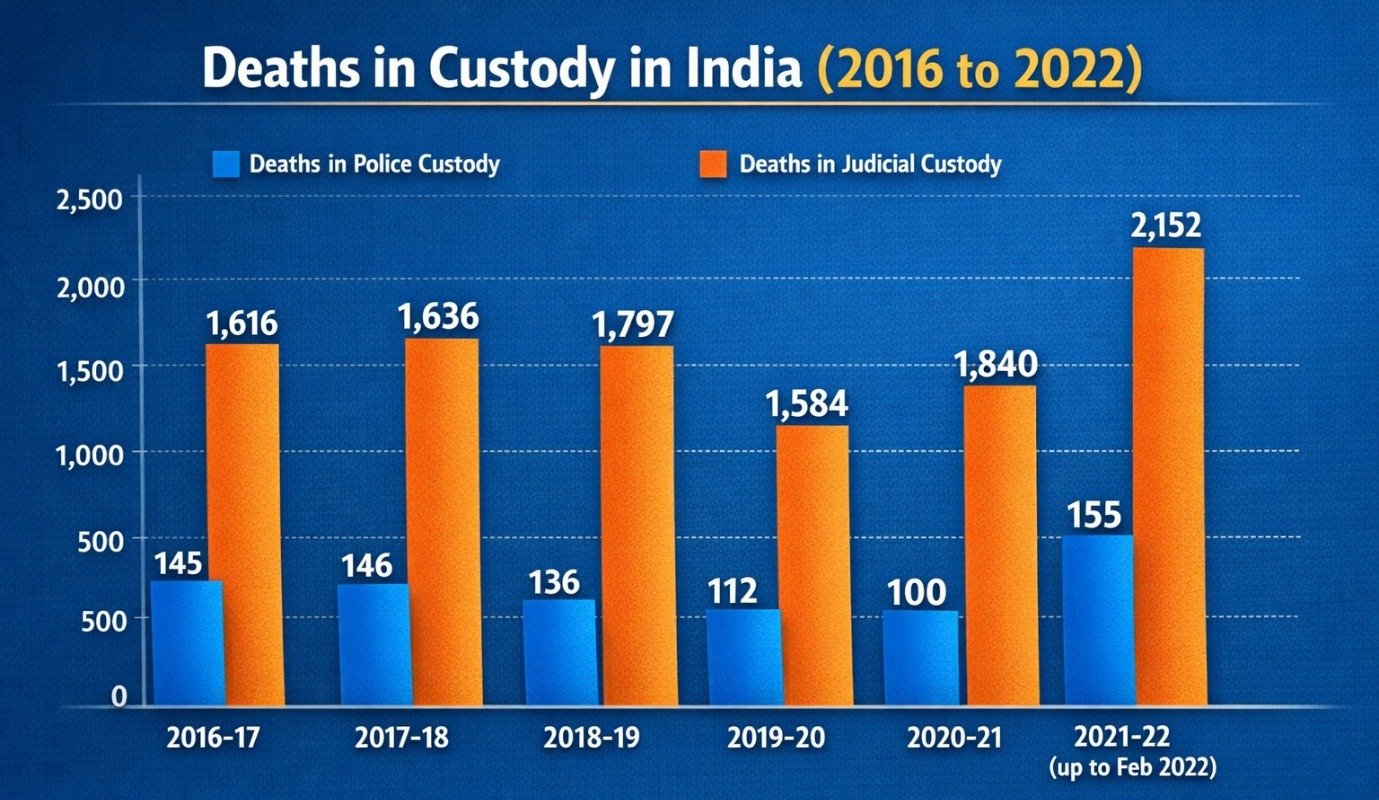
Figure 1: Deaths recorded in police and judicial custody in India from 2016 to 2022.32
The figure shows two correlated facts. Both sites of coercive investigation are police custody and judicial custody. However, police custody is much ‘sharper’, whereas judicial custody has a much larger death burden overall. This is because judicial custody has the deaths due to the neglect of the health system, the neglect of the structural system, and the institutional system. It is thus necessary to correlate police violence and the neglect of prisons within the same constitutional article.
These statistics make it difficult to sustain the custom of talking about custodial violence as solely a police station problem. Judicial custody, however, differs in form but is still custody. The moment the State takes away a person’s freedom, it takes on a duty to ensure the person is not harmed, and that humane conditions prevail.33 The distinction between police custody and prison custody should not detract from the fact that both situations involve the Constitution’s near- total control of a person’s body. That is why, even when the focus is on police violence, a serious analysis of torture and custodial violence in India must consider prison conditions, medical neglect, overcrowding, and neglect.34
JUDICIAL REMEDIES AGAINST CUSTODIAL VIOLENCE
The Indian courts have constructively addressed custodial violence through remedies instead of running apprehension on routine prosecution. The combination of Writ Jurisdiction, compensation, declaratory principles, monitoring directions, and Continuing Mandamus, has produced a unique and distinct Judicial process/comprehensive model of custodial violence protection that surpasses the standard criminal process.35
A. Public Law Compensation
The most significant doctrinal development in this area was accomplished by the Supreme Court in Nilabati Behera v. State of Orissa36; the Court stated that the death of an individual in police custody constitutes a public law violation of the fundamental rights of a person, and therefore, in such instances, the Court can award compensation. The Court was able to change the viewpoint of the public by stating that public constitutional relief should not and does not have to be dependent on the time-consuming and uncertain prospects of a private civil suit and public action for compensation. The Court was able to provide and recognize for the first time, a public constitutional remedy where a constitutional court is allowed to provide compensation for a public wrong that the State has committed by virtue of official action or official custody when the state action has breached the constitutional right to life and liberty. Nilabati Behera did in fact transform Article 21 of the Constitution into a right that has some substantive meaning to a person’s body. The State, like the police, can no longer violate a person’s body and defend themselves behind the right of a person to sue under private law or any other mere technical or procedural restriction to a court action.37
D. K. Basu v. State of West Bengal38 expanded on this line of reasoning by directly connecting custodial violence and custodial death to the constitutional courts’ jurisdiction to award compensation. The court also clarified that compensation under public law and criminal action are separable. The former addresses the constitutional violation and the latter the criminal liability. This is an important distinction. The State will not wash its hands off the wrong by offering compensation. It is an encumbrance that the State is legally compelled to assume when the injury caused by the State’s custodial power is so severe and so directly associated with the violation of the Constitution that it is an injury that calls for constitutional compensation, even, or particularly, when the ordinary trial is still pending.
Simultaneously, the Supreme Court articulated caution in Sube Singh v. State of Haryana39. It was stated that there is no presumption of compensation in writ jurisdictions for claims of custodial violence. 18 The Court attempted to delineate the cases in which an constitutional infringement is evident, and cases which are factually contested, and which require the level of proof that would significantly different. The concern is understandable, as otherwise writ courts would become de facto trial courts on bare record. The concern however shows a tension. The concern with the Sube Singh case is understandable, but it also shows the limitations of a system that focuses on remedies when there is no factual opacity.40
The recent Supreme Court case Somnath v. State of Maharashtra41 has demonstrated the court’s dignity-based approach to the case by showing that the court not only dealt with the humiliation and verbal assault of a detainee by a police officer and the abuse of power by an officer, but also awarded the claimant compensatory relief. The value of Somnath goes beyond the fact that it granted relief. The Court recognized the public humiliation, verbal abuse of a person of a certain caste and the illegal detention of the victim as something constitutionally relevant, not as something that should be considered a marginal excess. The case is important especially with respect to the modern doctrine because it shows that the Indian Constitution still perceives the state of being in custody as an issue of dignity rather than an issue concerning only the infliction of injuries to the body. In that sense, Somnath case continues the older line of cases but more with respect to contemporary police harassment.42
B. Preventive and Supervisory Remedies
Judicial remedies can take forms other than after-the-fact compensation. In the case of Paramvir Singh Saini v. Baljit Singh43, the Supreme Court instructed that Closed Circuit Television (CCTV) cameras be placed in police and investigative offices so that custodial spaces would not be evidentiary black holes. This is one of the most important preventive measures in the field. The Court noted that the ordinary model of complaint, denial, and self-certification departmental is structurally insufficient. Violence cannot be removed by the use of technology; however, the evidentiary balance can be changed. With the presence of evidence, there are less opportunities for fabrication, whereas the absence of evidence may become suspect. The decision is therefore about surveillance of State power and not of the citizen.44
Supervisory Methodology can also be seen in Re Inhuman Conditions in 1382 Prisons45 where the Supreme Court used persistent directives to deal with issues such as overcrowding, understaffing, unnatural deaths, mental health issues, and the overarching inhumanity of prison administration. The case exemplifying the orders attests to the fact that there is a constitutional issue of neglect that is persistent and ongoing, as opposed to being a one-off issue. This is significant as most custodial injuries are systemic rather than isolated. They stem from a combination of systemic underfunding, managerial apathy, and operational opacity. Any purely case-based approach would fall short of addressing the issues. Though imperfect, continuing judicial supervision at least acknowledges the fact that systemic issues and violence demand systemic solutions.46
India’s judicial remedies flexibility is one of their most important attributes. For example, courts may order a victim’s compensation, infringement of a specific right, require arrests to be made, incorporate recording devices, supervise the reform of a prison, etc. Their weaknesses, however, are just as obvious. Courts are not investigators. Courts do not prosecute.47 They do not supervise police departments, and they do not create a culture of lawful custody. As a result, judicial remedies are strongest as constitutional corrective and weakest as the tools of operational justice. They can reveal the state of lawlessness, but cannot replace the regulatory ethics and the prosecutorial will necessary for true accountability.48
CRIMINAL ACCOUNTABILITY MECHANISMS AND THEIR LIMITS
Judicial empathy must end where criminal accountability begins. A system that only compensates, chastises, and recommends without convicting, runs the risk of socialising custodial violence as regrettable but survivable at an institutional level. Hence, the most difficult question here is punishment and not recognition.49
The most recent data provided by the National Human Rights Commission illustrates the magnitude of the issue and the constricted scope of remedial results. The subsequent official indicators can be depicted in bar charts, pie charts, or comparative graphics related to complaints, disposals, and recommendations for compensations.
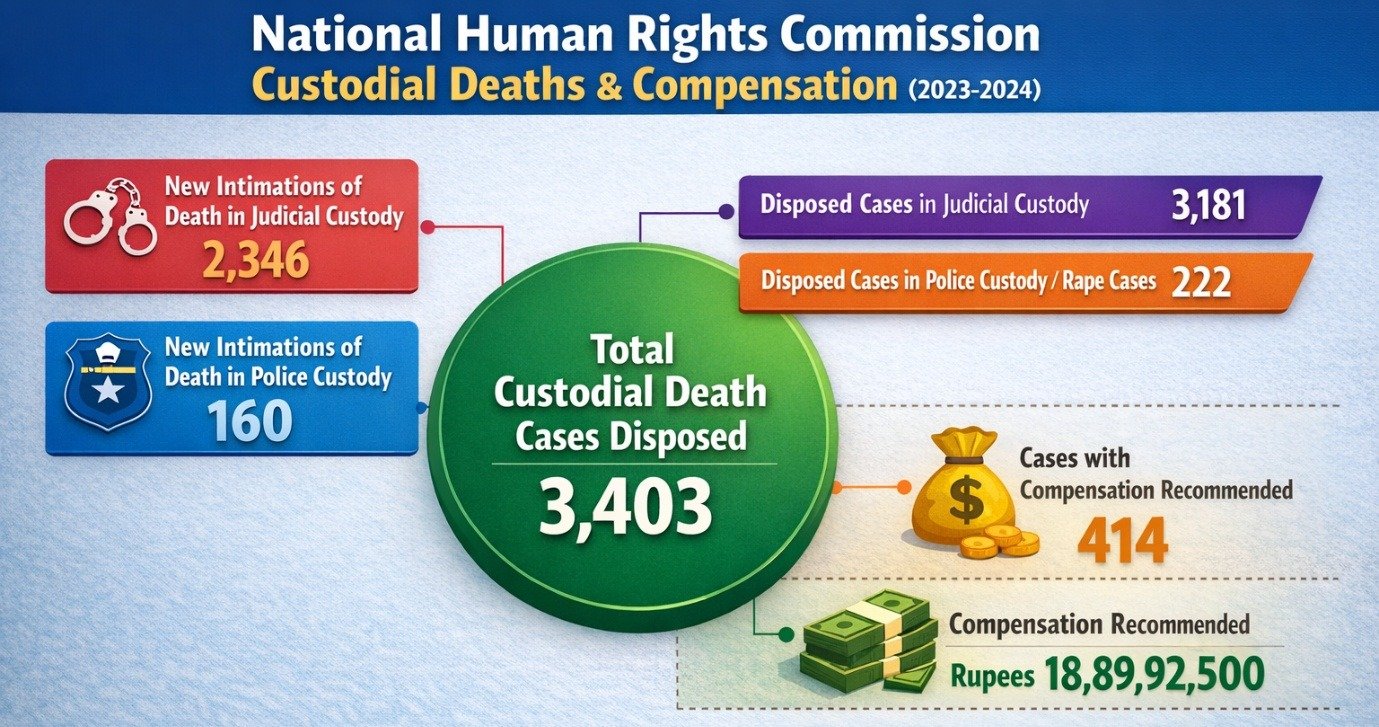
Figure 2: 2023 to 2024 NHRC Metrics on Custodial Deaths and Compensations.50
The figure 2 is revealing for two reasons.51 Firstly, it shows that custodial death continues to be a live institutional complication within both prison and police environments. Secondly, it shows that systems of oversight often end in disposal and compensation which, while important, are not the same as criminal accountability. The difference between recommendation and conviction remains pivotal.52
A. Evidentiary Opacity
The crime scene of custodial violence is particularly challenging when it comes to obtaining criminal accountability because the location is controlled by the person accused of the crime. Usually, the victim is alone and isolated. There are no relatives present and independent witnesses are virtually non-existent. The institution that may be responsible for the violence is also the one creating the documents.53 This is why custodial violence cases are so poor in the criminal justice system. The barriers are created by the delays that are orchestrated in order to conduct medical examinations by the police, fabricated general diaries, untold remand stories, and situations where injuries are ‘strategically’ omitted. The expectation of the norm when it comes to custodial State violence also contributes to the barriers created by the violence when victims are socially marginalized, poor, or vulnerable.54
In State of Madhya Pradesh v. Shyamsunder Trivedi55. the Supreme Court acknowledged the issue at hand and issued a warning on what is reasonable on evidentiary expectations in the case of custodial deaths. The Court stated that if judges require independent eyewitnesses that remain in the police station, many true cases would be lost. The Shyamsunder Trivedi case is, therefore, doctrinally methodological. It guides judges on how to appreciate circumstantial and medical evidence, custody records, and the various official accounts that may be inconsistent, in the light of the crime’s ‘controlled’ situs. It does not suggest abandoning the burden of proof, but rather that custodial settings should not be a mechanism of default acquittals.
In Munshi Singh Gautam v. State of Madhya Pradesh56, the Court raised apprehension on the question of identification, appreciation of evidence, and the duty of the Court not to lose sight of the realities of criminal proof in difficult situations. While the matter does not pertain only to custodial violence, it is nevertheless cited in that context, to show the courts’ pragmatic evaluation of evidence when direct evidence is scant or eroded. The reference to custodial violence lies in the context the court assumes in reviewing the evidence. One does not have to present the proof in a cinematic way. In such cases, the timeline, the injuries, the chain of custody, the omissions, and the post and pre-issuance conduct of the police may be as important as direct testimony.57
One of the ways the Supreme Court. shows the necessity of distinguishing the truth from the distortion in Shakila Abdul Gafar Khan v. Vasant Raghunath Dhoble58 is that the case revolves around police brutality and the danger of the police playing the role of the violator and the need for the courts to do their jobs carefully. This decision is significant for the reason that it chooses a different route from the other cases of the courts taking a passive role in making a decision when faced with evidence that is partly true. Many custodial cases have unfriendly witnesses, faulty or missing paperwork, and ulterior motives. A court that demands evidentiary neatness may reward the very disordered coercive administrative structures of which the Shakila Abdul Gafar Khan case tried to show the flaws. Shakila Abdul Gafar Khan therefore justifies why a judge needs to remain active to distinguish the good from the bad when state terror has polluted the evidence.59
B. Structural Barriers to Prosecution
As is the case with almost all evidence, procedural obstacles remain. While Section 218 of the Bharatiya Nagarik Suraksha Sanhita, 2023, maintains the prior sanction requirement for the prosecution of certain public servants for acts done or purported to be done in the course of official duty, it also, however, makes provision for prosecution under Sections 199 and 200 of the Bharatiya Nyaya Sanhita, 2023. Doctrinal disputes and procedural disputes generally lie in characterization.60 Is custodial violence or torture something done in the colour of duty, or is it something done out of the duty? Courts have said time and time again that, while some acts of office may be protected by the cloak of the office; the reality is that acts involving criminal sanctions are almost always protected by the absence of a sanction. The end result is that the formal right to access a criminal trial is in itself a contested issue, even before the question of guilt is interrogated.61
Another barrier is the protection of their own institutions. Police stations are investigative units of other police stations. Colleagues write the first primary account. While departmental investigations might be quicker than the criminal ones, they end much more frequently with admonishments, personnel changes, or case closures due to retirement than with criminal accountability. Even if a departmental inquiry finds that an employee engaged in misconduct, the response from criminal law is, as a rule, not serious and often absent.62 This pattern creates the incentive structure of the institution. If the likely outcome of violent conduct is merely administrative censure, the law’s deterrent message is absent. In that regard, accountability fails not just because the law is absent. It is also that institutions, in the face of serious violations of the constitution, treat them as minor lapses in service delivery.63
C. Toward Credible Criminal Accountability
A more plausible model of criminal accountability would start with an unambiguous legal recognition of the public wrongdoing of custodial torture. A new offence should clearly articulate custody, control, coercive, and abusive power, while maintaining, for other means, the liability of hurt, grievous hurt, sexual injury, or death under the applicable general criminal law.64 At the level of procedure, independent centric studies should become the norm for serious injuries and deaths of custodial victims, especially where local institutional bias is evident. Immediate medical examination, video recording and preservation, electronic evidence and record custody, and documented chain of custody for physical evidence should be considered critical. Without this design, the truth of custodial violence will continue to rely too heavily on judicial prescience and the posteriori rebuilt case.65
Meanwhile, conceptualizing criminal accountability as a substitute for judicial remedies is a mistake, as both serve different purposes. While prosecution serves the purpose of punishing an abuser of State power, and injury and damage compensation serves the purpose of providing a remedy for the constitutional injury sustained. While departmental sanctions may have a role, it is only as an addition, and not a substitute.66 Oversight by the various bodies, including the National Human Rights Commission, Magistrates, prison visitors, and even the courts, is a way of exerting some external pressure, but oversight without enforcement is a way of expressing concern without the prospect of any consequences. Therefore, the aim has to be the ultimate and thorough convergence of all of the above, i.e. constitutional remedy, independent investigation, legislative clarity, and ordinary criminal prosecution.67
CONCLUSION
There is no shortage of moral clarity in Indian law with regard to custodial violence. What is missing is complete institutional conversion of that clarity into accountability, on a routine basis. The constitution is doctrine, the court’s remedy structure is developed, and the safeguards are ample. Yet, principle still outpaces punishment.68
While reviewing the relevant literature one of the most noticeable features is the unevenness of the terrain. On the basis of the case law developed in the cases Joginder Kumar v. State of Uttar Pradesh69, D. K. Basu v. State of West Bengal70, Sunil Batra v. Delhi Administration71, Sheela Barse v. State of Maharashtra72, Nilabati Behera v. State of Orissa73 and Somnath v. State of Maharashtra,74 the Indian judiciary has held that even within lock-ups and prisons, detainees and prisoners still hold some dignity, bodily integrity, and fair procedural and constitutional rights. This is also provided for in the law, for example, in arrest and detention memos, the right and obligation of the police to take a detainee’s confession, the right to inform a relative, and the right to oversight of the detention and arrest process by some human rights bodies. Therefore, in legal terms, the Indian legal system has long ceased to view and consider custodial torture as being in harmony with constitutionalism. The idea is settled, and the issue is no longer open to debate. It is a settled constitutional issue.
The challenges are not in the ETS system. Phased custodial sentencing is weak and poorly integrated into the case processing system. By the time the prosecution is initiated, the case record will have been largely formed by the very institution accused of the misconduct. The State is wealthier than most families, the State’s victims are usually more defenceless than the State’s offenders, and the consequences of disciplinary action tend to be more severe than those of criminal action.75 The absence of a separate offence of torture, the persistent controversy surrounding punitive versus non-punitive sanctions, a reliance on self-regulation in the agency being scrutinized, and the fact that control over a social setting usually balances the burdens of proof regarding the non-consensual infliction of harm, are all factors that tend to minimize the legal implications of criminal wrongdoing. For this reason, the legal literature on remedies is more extensive than that on criminal law. Indian law has come to be more concerned with the recognition of harm than with the imposition of criminal sanctions.76
There are the criticisms of the status quo, but what is the bad status quo an example of? It is time for a more serious, non-rhetorical reform agenda. Consider the custodial context as a locus of greater constitutional responsibility than less. Entitlement to a thorough, independent medical examination, the preservation of audiovisual records, and external investigations are all non-negotiable. The right to compensation and the duty to prosecute are both obligations, but the latter must not offset the former. The reform must also ensure that the constitutional conception of dignity be transformed into the language of ordinary criminal law that focuses on the offence of torture. This means that the criminal law will capture the truth of the situation; that is, the public official’s exercise of, or the acquiescence to, the use of violence, or other forms of degrading detention, on a person who is incarcerated. This is a thorough description of the situation. The Indian legal system will, for as long as it takes to make this change, remain powerful in terms of its legal and moral norms but will be lacking in the fullness of its institutional reality.77
SUGGESTIONS
Following the analysis of India’s legal responses to violence and torture in custody, the reforms listed below can expand the scope of judicial remedies, and improve consistency of criminal accountability.78
1. Introduce a separate Prevention of Torture legislation defining torture and cruel, inhuman or degrading treatment as acts done or omitted to be done by, or at the request or approval of, public officials in custody. Incorporate the Law Commission’s recommend structure for defining offences and protecting victims, and, in the case of the references to the Bharatiya Nyaya Sanhita and Bharatiya Nagarik Suraksha Sanhita, modernize these references. The Act should regard custody and coercive purpose (whether by way of confession, information, intimidation, punishment, discrimination) as constitutive of the offence and prescribe greater punishment for offences that result in death, sexual violence or permanent disability. The Act should also make provision for compensation, rehabilitation and protection of witnesses as rights linked to the criminal proceedings, and not as discretionary afterthoughts.
2. Bridge the international-to-domestic divide by closing the Convention against Torture, deferring domestically, and reporting definitions and obligations to its stipulations. Dual ratification with an unambiguous implementation package outlining the policing, prison, prosecution, and health system responsibilities, with compliance indicators and unambiguous criteria. Translate treaty obligations into operating processes by law mandating custodial death and injury case reporting, including investigation timelines and outcomes. Within each reporting period, identify states or regions with chronic patterns of non-compliance and implement focused audits and corrective action.
3. Establish independent review for every custodial death and every allegation of serious injury in custody, with automated removals from implicated police stations or units. Mandate that First Incident Reports, scene documentation, and custody record and digital footage seizures be handled by an external unit that operates independently. Issue protocols relating to the scene video, duty roster, lock-up register, and medical referral seizures within hours to ensure “settling” does not occur. Defer evidence and personal accountability to supervisory officers for delay, record, or referral tampering to default within seizes.
4. Standardize medical documentation and make it legally defensible proof, by instituting a system where a medical-legal exam is done immediately at the point of a person being taken into custody, after any interrogation, and at regular intervals while the person is in custody. Establish a system where an independent doctor digital injury mapper and digital injury mapper and time-stamped photograph system transport and store images in a locked government server system, and develop an automated injury and timestamp photo system and automated injury mapper systems for individual custodial interactions. Establish an independent doctor system and a tagging system where the independent doctor system triggers an automatic transport of the individual to a hospital if there is a loss of consciousness, or suspected internal injury, or if there is a claim of sexual abuse, and develop an electronic audit system to track who approved the transport or who is responsible for the delay. Treat unexplained delays in the exam or the absence of documentation of injuries as a basis for a departmental suspension and an assumption in adverse proceedings.
5. Treat CCTV compliance as an evidence-preservation regime and not an exercise in hardware installation, by installing coverage of all custody and interrogation points without blind spots and with audio synchronized with video where applicable and/or legally permissible. Legally mandate audio and video retention periods that are usable and practical for litigation plus add hash-based integrity check systems to demonstrate edits and/or deletions. Create audit teams at the District level to perform random monthly compliance audit checks, disclose to the public the compliance audit score for each facility, and obliterate access to the storage device as to any suspected or reported custodial injuries. Create legal liability for the intentional deactivation, interference with, or non-production of custody-related evidence and attach liability to the operational and supervisory sign-off positions.
6. Transform remand hearings into actual protections by instituting a magistrate checklist to be completed on the record for every custodial extension. Require magistrates to speak with the accused regarding their treatment while in custody, examine injuries on the accused, and order a medical examination if the accused person complains of a medical issue. to examine the accused, and to order a medical examination if any medical complaints exist. Audio and video recording of remand hearings is necessary to prevent extensions of remands which facilitate the ongoing abuse of detainees. Establish a process for expedited appeal reviews when a remand order is issued without the checklist or without addressing allegations of injuries.
7. To reduce delays caused by sanctions, clarify in the law and in practice that custodial assault and torture are acts not “in discharge of official duty”, so that such acts are not covered by broad sanction shielding arguments. Apply the decision-making timeframe requirement on sanction requests along with an explanation, and implement an automatic grant of a sanction when the time frame has been exceeded. Each state should have a distinct unit for sanction reviews, with a reporting system that tracks and publishes compliance by the state units and identifies patterns of obstruction. Treating the misuse of sanctions as a misfeasance will enable the courts to penalize state units for raising spurious “official duty” defenses in custodial violence cases.
8. Policing should be re-oriented away from reliance on confessions by enhancing the operational importance of the legal rule excluding police confessions through a system of mandatory audio video recording of police interrogations and a system of strict control of the duration of questioning. Create a presumption of interrogations, i.e. their recordings, to determine the legality of extended police detention. The State then has the onus to prove that the questioning was legal. Allocate funds to develop forensic science and the associated training that emphasizes and rewards evidence-based work as opposed to ‘winning’ by obtaining a confession, and include this in the evaluation of officers. Consider any injury to a suspect’s health while in police custody, including unexplained deterioration and any deterioration of the suspect’s health that is linked to a confession, a basis for independent investigation and the initiation of a judicial review.
9. Develop public and time-bound access to action-taken reports on custodial death recommendations to bolster NHRC and state commission follow-through. Engage special prosecutors on custodial violence cases that interface with commissions, families, and the courts to stop cases from fronting to departmental closure. Construct an escalation pathway so that non-compliance with commission recommendations triggers an automatic notification to the relevant High Court regarding oversight, particularly in repeat-offender districts. Strengthen victim and witness support cells so that complainants do not have to face intimidation, delays, and paperwork on their own.
10. Dedicate constitutional accountability to the judicial custody issue, linking the outcome of prison health to constitutional accountability concerning standard staffing, and standard screening and referral, and emergency referrals. Use undertrial reviews to limit overcrowding and detention of a medically vulnerable population by conducting monthly reviews on a medically vulnerable population,. Review cases of undertrial detainees who are minors and have been detained for a long duration. Implement independent prison inspections and publish dashboards on the number of deaths, hospital transfers, mental health changes, and the number of complaints filed and disposed of by prison unit. Consider every custodial death as requiring a health-systems audit along with a legal accountability track to field to ensure that “neglect” is not aligned to administrative inevitability.
*****
Footnotes
1. R.S. Saini, “Custodial Torture in Law and Practice with Reference to India”, 36 Journal of the Indian Law Institute 166 (1994).
2. R. S. Verma, I. B. S. Thockchom, Law Relating to Custodial Death and Human Rights 94 (Verma Publications, Delhi, 1st edn., 2000).
3. Praneeta Kumari, Seema Kashyap, “Unabated Custodial Violence in India: A Critical Study”, 3 International Journal of Civil Law and Legal Research 10 (2023).
4. Durga Das Basu, Human Rights in Constitutional Law 118 (Prentice-Hall of India, New Delhi, 2nd edn., 1994).
5. Suresh Chandra Sagar, Uday Veer Singh, “Legislative Reforms in India and Custodial Violence: A Legal Upgradation in Present Scenario”, 4 International Journal of Criminal, Common and Statutory Law 214 (2024).
6. N.S. Kamboj, “Police Custodial Death: A Growing Abuse to Human Rights in India”, 36 Journal of the Indian Law Institute 372 (1994).
7. M. P. Jain, Indian Constitutional Law 143 (LexisNexis, Gurgaon, 9th edn., 2025).
8. (1994) 4 SCC 260.
9. (1997) 1 SCC 416.
10. (1978) 4 SCC 494.
11. S. R. Myneni, Prison Administration 188 (New Era Law Publications, Faridabad, 1st edn., 2019).
12. (1980) 3 SCC 526.
13. (1983) 2 SCC 96.
14. Ezekial Jarain, “Prisoners’ Dignity: A Forgotten Dignity”, 3 The Delhi University Journal of the Humanities and the Social Sciences 155 (2016).
15. (2012) 8 SCC 1.
16. Richa Kaur, “Prisoners’ Rights in India: A Human Rights Perspective”, 14 Christ University Law Journal 105 (2025).
17. Arif Majruddin, Pooja Singh, “Custodial Violence in India with Reference to the Prevention of Torture Bill and International Legal Framework”, 8 International Journal of Law and Social Sciences 33 (2022).
18. Jai S. Singh, V. P. Upadhaya, Law of Human Rights 97 (Whytes & Co., New Delhi, 1st edn., 2016).
19. The Prevention of Torture Bill, 2010, available at: https://prsindia.org/theprsblog/the-prevention-of-torture-bill-2010?page=2&per-page=1 (last visited on March 20, 2026).
20. A. S. Shamrin, “Custodial Torture in India: A Critical Examination of the Need for an Anti-Torture Law”, 11 Journal of Emerging Technologies and Innovative Research 389 (2024).
21. K. N. Chandrasekharan Pillai, R. V. Kelkar’s Criminal Procedure 204 (EBC Publishing, Lucknow, 7th edn., 2021).
22. N. Arora, “Custodial Torture in Police Stations in India”, 41 Journal of the Indian Law Institute 514 (1999).
23. Joshua N. Aston, Torture Behind Bars: Role of the Police Force in India 88 (Oxford University Press, New Delhi, 1st edn., 2020).
24. Custodial Torture in India: Intersection of Criminal Law and Constitutional Rights, available at: https://www.scconline.com/blog/post/2024/03/23/custodial-torture-in-india-intersection-of-criminal-law-and-constitutional-rights/ (last visited on March 18, 2026).
25. Alden D’Souza, “Judicial Approach and Reformation in the Law Regarding Custodial Violence in India”, 2 Indian Journal of Integrated Research in Law 1 (2022).
26. The Impact and Implementation of the DK Basu Guidelines on Custodial Violence in India, available at: https://www.legalserviceindia.com/legal/article-17822-safeguarding-fundamental-rights-the-impact-and-implementation-of-the-dk-basu-guidelines-on-custodial-violence-in-india.html (last visited on March 17, 2026).
27. K. I. Vibhute, Criminal Justice: A Human Rights Perspective of the Criminal Justice Process in India 146 (Eastern Book Company, Lucknow, 1st edn., 2004).
28. Saurabh Ajay Gupta, “Custodial Torture and Violation of Fundamental Rights in India”, 2 Indian Journal of Integrated Research in Law 1 (2022).
29. Niharika Srivastava, Prashant Kumar Varun, “Custodial Interrogation and the Risk of Torture: A Critical Examination”, 5 International Journal of Advanced Research in Science, Communication and Technology 1 (2025).
30. Pankaj Katiyar, “Torture and Custodial Deaths: Role of the Indian Judiciary and National Human Rights Commission in Building Human Rights Jurisprudence”, 7 International Journal for Multidisciplinary Research 1 (2025).
31. Surendra Kumar Pachauri, Prisoners and Human Rights 119 (A.P.H. Publishing Corporation, New Delhi, 1st edn., 1999).
32. Government of India, “Lok Sabha Unstarred Question No. 3019: Custodial Deaths” (Ministry of Home Affairs, March 22, 2022).
33. Guidelines – Death in custody/ encounter etc., available at: https://nhrc.nic.in/acts-and-rules/guidelines (last visited on March 16, 2026).
34. Vinay Attri, Maneesh Yadav, “Role of the National Human Rights Commission in Safeguarding Prisoners’ Rights”, 3 Indian Journal of Law 21 (2025).
35. Noorjahan Bava, Human Rights and Criminal Justice Administration in India 203 (Uppal Publishing House, New Delhi, 1st edn., 2000).
36. (1993) 2 SCC 746.
37. V. R. Krishna Iyer, Human Rights and Inhuman Wrongs 61 (B.R. Publishing Corporation, Delhi, 1st edn., 1990).
38. (1997) 1 SCC 416.
39. (2006) 3 SCC 178.
40. Sushila Rao, “Constitutional Rights Violations and Compensatory Jurisprudence in India and U.S.A.: Justifications and Critique”, 18 Student Bar Review 93 (2006).
41. 2024 INSC 232, Criminal Appeal arising out of Special Leave Petition (Criminal) No 2600 of 2019, judgment dated 18 March 2024.
42. S.N. Jain, “Money Compensation for Administrative Wrongs Through Article 32”, 25 Journal of the Indian Law Institute 118 (1983).
43. (2021) 1 SCC 184, Special Leave Petition (Criminal) No 3543 of 2020, order dated 2 December 2020.
44. Sankar Sen, Tryst with Law Enforcement and Human Rights: Four Decades in Indian Police 134 (A.P.H. Publishing Corporation, New Delhi, 1st edn., 2002).
45. Writ Petition (Civil) No 406 of 2013, order dated 25 September 2018.
46. Clemens Arzt, “Police Reform and Preventive Powers of Police in India – Observations on an Unnoticed Problem”, 49 Verfassung in Recht und Übersee / Law and Politics in Africa, Asia and Latin America 53 (2016).
47. Cuffed But Unbroken: Understanding Arrest Rights And Due Process, available at: https://www.livelaw.in/articles/cuffed-but-unbroken-understanding-arrest-rights-and-due-process-268933 (last visited on March 13, 2026).
48. Arghya Sengupta, “Confessions in the Custody of a Police Officer: Is it the Opportune Time for Change”, 18 Student Bar Review 31 (2006).
49. P.S. Krishna Deva Rao, “Custodial Deaths”, 6 National Law School Journal 42 (1994).
50. Annual Reports, available at: https://nhrc.nic.in/publications/annual-reports (last visited on March 18, 2026).
51. R.K. Raghavan, “The Indian Police: Problems and Prospects”, 33 Publius: The Journal of Federalism 119 (2003).
52. Krishna Mohan Mathur, Crime, Human Rights, and National Security 177 (Gyan Publishing House, New Delhi, 1st edn., 1996).
53. SC directs all States & UTs to install CCTV Cameras in all Police Station. Read how CCTV Cameras will help curb custodial violence, available at: https://www.scconline.com/blog/post/2020/12/02/sc-directs-all-states-uts-to-install-cctv-cameras-in-all-police-station-read-how-cctv-cameras-will-help-curb-custodial-violence/ (last visited on March 25, 2026).
54. Manjula Batra, Protection of Human Rights in Criminal Justice Administration: A Study of the Rights of the Accused in Indian and Soviet Legal Systems 146 (Deep & Deep Publications, New Delhi, 1st edn., 1989).
55. (1995) 4 SCC 262.
56. (2005) 9 SCC 631.
57. R. Deb, “Police Investigation: A Review”, 39 Journal of the Indian Law Institute 260 (1997).
58. (2003) 7 SCC 749.
59. M. V. Miruthula Varshini, “A Study on Confessions and Interrogation Practices in India”, 5 International Journal of Advanced Research in Science, Communication and Technology 408 (2025).
60. A. G. Noorani, “Accountability for Torture”, 34 Economic and Political Weekly 3160 (1999).
61. Sankar Sen, Enforcing Police Accountability Through Civilian Oversight 184 (SAGE Publications, New Delhi, 1st edn., 2010).
62. Can We Really Police Our Police?, available at: https://www.livelaw.in/columns/can-we-really-police-our-police-159189 (last visited on March 24, 2026).
63. H. Suresh, “Human Rights and Criminal Justice Functionaries”, 31 Economic and Political Weekly 1441 (1996).
64. Beatrice Jauregui, “Beatings, Beacons, and Big Men: Police Disempowerment and Delegitimation in India”, 38 Law & Social Inquiry 643 (2013).
65. K. S. Subramanian, Political Violence and the Police in India 133 (SAGE Publications, New Delhi, 1st edn., 2007).
66. Police Reforms in India, available at: https://prsindia.org/policy/analytical-reports/police-reforms-india (last visited on March 23, 2026).
67. Shengkuo Hu, Courtenay R. Conrad, “Monitoring via the Courts: Judicial Oversight and Police Violence in India”, 64 International Studies Quarterly 699 (2020).
68. Sanjoy Hazarika, Madhurima Dhanuka, Hope Behind Bars: Notes from Indian Prisons 171 (Macmillan Publishers, New Delhi, 1st edn., 2022).
69. (1994) 4 SCC 260.
70. (1997) 1 SCC 416.
71. (1978) 4 SCC 494.
72. (1983) 2 SCC 96.
73. (1993) 2 SCC 746.
74. 2024 INSC 232, Criminal Appeal arising out of Special Leave Petition (Criminal) No 2600 of 2019, judgment dated 18 March 2024.
75. Custodial Torture And Deaths: The Dark Side Of Indian Police, available at: https://www.livelaw.in/lawschool/articles/custodial-torture-and-deaths-the-dark-side-of-indian-police-160035 (last visited on March 22, 2026).
76. Jinee Lokaneeta, “Defining an Absence: Torture ‘Debate’ in India”, 49 Economic and Political Weekly 69 (2014).
77. Diksha Ramakant Dubey, “An Analysis of Human Rights Violation in Police Custody”, 6 International Journal for Multidisciplinary Research 1 (2024).
78. Sankar Sen, Police in Democratic Societies 211 (Gyan Publishing House, New Delhi, 1st edn., 2000).