

Introduction
In 2025, the Indian judiciary fell six places in the World Justice Project’s Rule of Law Index, an indicator widely read as evidence of a judicial crisis. The Indian judiciary sits for roughly 220 days a year and adjudicates over 27 lakh cases a month; yet rising case pendency and delay in adjudication have emerged as among the most pressing challenges that the system faces. As of June 2026, the judiciary is burdened with over 5.5 crore cases, a backlog that sets off a domino effect in which delayed justice triggers a chain reaction, eroding public faith in the judiciary, contributing to the breakdown of social order, and often leading to vigilantism and witness fatigue. In Swaran Singh v. State of Punjab, for instance, the Court noted a pattern in which lawyers seek successive adjournments to a point where the witness is tired, threatened, or won over, with the result that the administration of justice suffers.1
A further consequence of rising pendency is the dire state of the prisons, which run at an over-capacity of 114 per cent,2 and where undertrials often spend longer in custody than the maximum sentence their alleged offence would attract.3 According to the National Legal Services Authority’s review of the functioning of the Under Trial Review Committees, undertrials constituted 74.2 per cent of the total prison population. Recognising the grave impact that pendency has on society and on rehabilitation, the judiciary has delivered several important precedents, such as Hussainara Khatoon v. State of Bihar, in which the right to a speedy trial was recognised as a fundamental right under Article 21 of the Constitution.4
The figures on Supreme Court institution, disposal, and pendency are shown in the figure below (Source: Supreme Court Annual Report 2024-25).
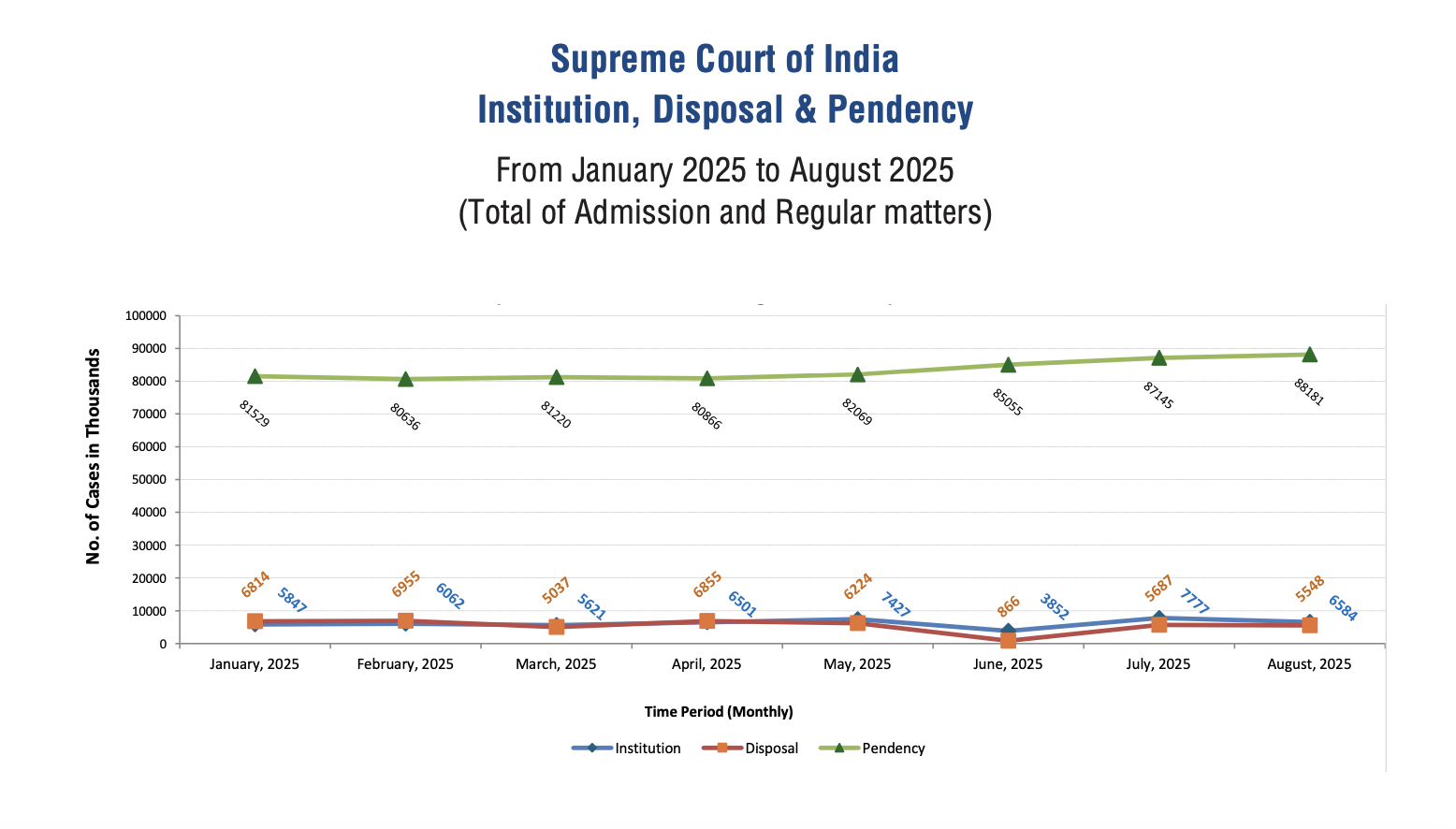
Figure 1: Supreme Court of India – Institution, Disposal and Pendency (Jan-Aug 2025)
There is a discernible trend in the search for solutions to this problem, one that focuses primarily on the supply side, that is, on the poor judge-to-population ratio, massive vacancies, and infrastructure deficits. As the data published by the Ministry of Law and Justice indicate, the present working capacity of the courts in India falls short of the sanctioned strength by around 300 judges.
There are, however, multivariate reasons behind the pendency of cases in India that go beyond judicial inefficiency, which is in fact a smaller part of a much larger problem. Moreover, this resource gap has been gradually narrowing through the addition of new judges and through capacity-building measures such as the computerisation of cases and the e-courts project. These initiatives entail the release of Rs. 12,101.89 crore under the scheme for the development of judicial infrastructure and, in the period 2014 to 2025, the appointment of 70 judges to the Supreme Court and 1,058 to the High Courts. With these measures in place to reduce infrastructural and resource constraints, it becomes imperative to look for causes beyond judicial insufficiency.
Ambiguous, obsolete, and archaic laws
Recent efforts have approached the problem from the demand side, identifying the areas in which disputes are most concentrated in order to curtail frivolous litigation.5 One illustration is the Environment (Protection) Act, 1986, which lays down a skeletal framework and delegates to the executive, namely the Ministry of Environment, Forest and Climate Change, the power to regulate environmental clearances and exemptions through orders, notifications, and circulars. This generates an inordinate number of notifications that fuel excessive litigation and ultimately reduce the search for legal certainty to navigating a maze rather than interpreting a statute.6
In order to maintain continuity after independence, colonial laws were not amended unless they offended the fundamental rights, as provided in Articles 13 and 372 of the Constitution. As a result, the criminal justice system came to be plagued with several archaic and decontextualised laws. Seeking to overcome these shortcomings, the Ramanujam Committee was appointed, and it identified 1,741 statutes as outdated and requiring repeal.
Similarly, acting on the suggestions of the four reports published by the Law Commission of India under the title Legal Enactments: Simplifications and Streamlining (LESS), several Acts were revoked and repealed. A pertinent example is the Drugs Act, 1950, significant portions of which were revoked by the Repealing and Amending Act, 2016, the reason being that drugs had been brought within the Essential Commodities Act, 1955, and the functions of the earlier Act had been subsumed.
There also exist obsolete laws, such as the Sarais Act, 1867, which deals with the medieval sarai or rest house. The Act defines a sarai as “any building used for the shelter and accommodation of travellers, and includes, in any case in which only part of a building is used as a Sarai, the part so used of such building”, and certain provisions empower the magistrate, in defined circumstances, to close down or repair a sarai and to sell its materials. Because the definition is so vague, the Act extends to virtually every lodging house, paying-guest accommodation, and hotel; and, according to the Law Commission, its provisions are being misused by police and tourism officials to harass hotel owners for non-compliance.7
This shows that obsolete and redundant laws must be revised and repealed to ease the strain on the judicial system. Former Chief Justice N.V. Ramana observed that ambiguous legislation provides greater scope for litigation, and that the legislature must therefore strive for clarity.8 The subject of labour, for instance, appears in the Concurrent List and falls within the jurisdiction of both Parliament and the State legislatures. This previously produced a voluminous body of around 100 State and 40 central labour laws, which generated overlapping definitions of “appropriate government”, “worker”, “employee”, “establishment”, and “wages”, and deep mutual inconsistency, thereby increasing litigation.
The recent legislative intervention that consolidated the several labour laws into four codes, namely the Code on Wages, 2019, the Industrial Relations Code, 2020, the Code on Social Security, 2020, and the Occupational Safety, Health and Working Conditions Code, 2020, was aimed at simplifying compliance, modernising provisions, promoting entrepreneurship, and streamlining enforcement.
Another recent development is the Income-tax Act, 2025, which simplifies the language, removes redundant provisions, and consolidates the earlier amendment Acts so as to reduce fragmentation. This pattern of legislature-led reform reflects an acknowledgement that poorly drafted laws and fragmented legislative design contribute to disputes and excessive litigation.
Several kinds of ambiguity exist in the legal system, and the judiciary resolves them through the principles of statutory interpretation. Lexical ambiguity arises where a word or phrase in a statute admits of more than one legitimate interpretation, and the courts address it through principles such as the plain-meaning rule and the rule of lenity, under which, in criminal law, ambiguous statutes are construed strictly in favour of the defendant so that citizens are not penalised by vague laws. Semantic ambiguity, by contrast, refers to situations in which unclear, vague, or contradictory provisions leave room for varying interpretation.9 These ambiguities contribute to inconsistency in judicial decisions and to prolonged litigation, and the courts often construe contentious provisions by examining the object and purpose of the law, together with the doctrine of harmonious construction where possible.
Contextual ambiguity arises when the terms of a statute are taken out of context and used to bolster an argument. A measure of ambiguity was probably also left in place to secure contextual justice. Evidence for this may be traced through history: religio-legal laws in India were never rigidly or opaquely codified and took account of the various factors and determinants of a case before a verdict was passed, until they were stripped of their contextual flexibility and compiled under the British in 1776 as the Code of Gentoo Laws.
Excessive litigation by the State
A substantial contributor to litigation is the government, which emerges as the single largest litigant in the country and accounts for over 50 per cent of the cases before the Indian courts. Pointing to the State’s contribution to insignificant disputes, former Chief Justice of India B.R. Gavai remarked that around 40 per cent of the litigation by the Union and the State governments was unnecessary.
Earlier, in 2023, while hearing a dispute, Justice Gavai had observed orally: “we heard a case today over a former employee receiving Rs 700 extra per month. Over this, the government will spend Rs 7 lakhs in an appeal. The money comes from the public exchequer.”10 The consistent acknowledgement by successive Chief Justices and other judges indicates that the problem concerns not merely public expenditure, capacity building, and accounting, but also the substantial overburdening of the judiciary.
According to the Economic Survey 2020-21, the government loses around 73 per cent of its cases in the Supreme Court and 87 per cent in the High Courts, particularly in taxation matters; yet this does not deter it from filing successive appeals. The Economic Survey 2017-18 likewise identified the tax department as the biggest litigant, accounting for nearly 85 per cent of all appeals in direct-tax cases. Seeking to explain the frequency of these appeals, Justice Nagarathna noted that the practice of successive appeals reflects a structural and pragmatic logic: a government officer who settles a dispute is subject to audit and vigilance, so that an appeal becomes not a choice but a mandate.
The revenue department, in particular the Central Board of Indirect Taxes and Customs and the Central Board of Direct Taxes, has repeatedly issued circulars noting the continued filing of avoidable appeals and of cases below the prescribed monetary limits. These circulars have directed field officials to weigh the gravity and merits of a case beyond mere monetary thresholds and have issued strict instructions against filing appeals beyond two failed appeals.11 The guidelines recognise, and highlight, a persistent trend of inconsequential appellate litigation pursued by the tax department.
Misuse of writs and public interest litigation
Empowered under Articles 32 and 226 of the Constitution, the Supreme Court and the High Courts may issue writs that serve as instruments for safeguarding constitutional democracy. As of 2025, over 4 lakh writs had been disposed of in the High Courts, of which 3.35 lakh were disposed of with or without direction. Around 68 per cent of the writs in the High Courts are disposed of within one year,12 yet many of these were frivolous and served only as a drain on judicial time and resources.
The figures on writ disposal in the High Courts are shown in the figure below (Source: National Judicial Data Grid (High Courts)).
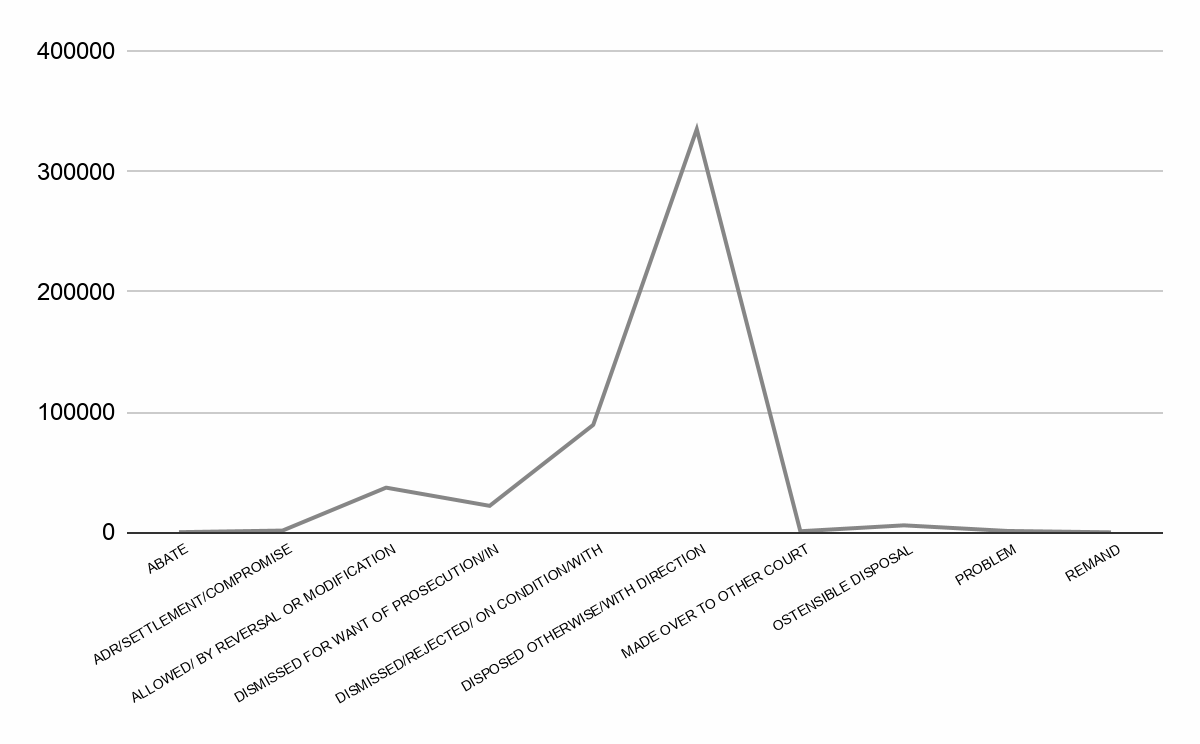
Figure 2: Disposal of Writ Petitions in the High Courts (NJDG)
Since the genesis of public interest litigation in India, the number of writ petitions filed has grown enormously, with a significant proportion serving as instruments of cheap publicity wielded by busybodies.13 The Supreme Court has often rebuked the lower courts for entertaining such petitions as a matter of routine, a practice that floods the system with frivolous public interest litigation for which the judiciary has no ready remedy. The courts have lamented that public interest litigation has come to mean “publicity interest litigation”, “private interest litigation”, “politics interest litigation”, or, in the latest trend, “paise income litigation”.14 What was conceived as a socio-legal measure to ensure equal representation and equitable justice by relaxing the requirement of locus standi under Articles 14, 21, 32, 39A, and 226 has thus been driven to a point where it is used as a tool in unscrupulous hands to wreak vengeance.15
The tribunal paradox
The Constitution (Forty-second Amendment) Act, 1976, often called the “mini-Constitution”, inserted Articles 323A and 323B and mediated a shift in the judicial landscape. As recommended by the Swaran Singh Committee, tribunals emerged as quasi-judicial bodies intended to transfer administrative and service-related matters elsewhere, to ensure quick disposal and technical oversight, and to de-burden the High Courts. It was expected that the transfer of service-related matters to administrative tribunals would enable the High Courts to deliver justice more effectively; yet the appeal from most tribunals lies to the High Court, which only adds to its workload. A major shift came with the Tribunals Reforms Act, 2021, under which certain appellate bodies, such as those under the Customs Act, 1962, and the Patents Act, 1970, were disbanded and their functions transferred to the High Courts.16 This undercut the very aim and purpose of establishing tribunals and placed significant additional strain on the High Courts.
Initiatives and recommendations
Acknowledging the systemic constraints and the complex character of the judicial crisis, several committees have proposed a range of reforms aimed at improving the efficiency and accessibility of the justice system. A directive published by the Department of Legal Affairs suggested a formalised litigation risk assessment to classify cases by priority and to guide the judicial cause list.17 Such a reform would help to prioritise and ensure the timely disposal of cases requiring immediate judicial attention, especially criminal cases, in which every passing day carries significant consequences. In the same vein, the POCSO Act was enacted to protect minors (those under 18 years) from sexual abuse and exploitation; it mandates time-bound trials and the establishment of special courts for child victims. As held in Alakh Alok Srivastava v. Union of India, however, implementation has not matched legislative ambition, and there remains a significant shortage of trained prosecutors and fast-track courts.18 This not only causes litigation to pile up but also delays, and thereby denies, justice to the most vulnerable section of society.
The same directive observed that contempt proceedings initiated against government officials for non-compliance with judgments and orders can be averted by strengthening departmental monitoring and compliance. Addressing capacity constraints, it noted that many officials who handle litigation are not qualified in law, which impedes their understanding of the legal implications.19 To address the government’s litigation burden, grievance-redressal mechanisms within departments need to be strengthened. The Centralised Public Grievance Redress and Monitoring System (CPGRAMS) handles departmental grievances at the central and State levels and aims to resolve them within 21 days. The training imparted to nodal and appellate officers must be of an uncompromising standard, and the process must be transparent and monitored. This would serve as a capacity-building measure, dispose of cases at the first point of contact, and thereby reduce litigation before the courts.
The problem of excess litigation generated by subordinate laws and executive orders is, moreover, worsening. As a result of the proliferation of orders, disagreements over the application of multiple procedural pathways illustrate how layered drafting converts governance into continuous interpretative litigation.20 Ambiguity in the law must therefore be reduced, and multiple statutes must be consolidated and streamlined to close loopholes and limit competing interpretations.
An effort must also be made to strengthen alternative dispute resolution mechanisms, which serve as substitutes for traditional adjudication and focus primarily on settlement. The forms of alternative dispute resolution available in India include arbitration, mediation, negotiation, conciliation, and the Lok Adalat. The Lok Adalats dispose of several million cases annually and offer fast, cost-effective resolution; to relieve the case burden of the district courts, Lok Adalats should be held regularly and on the same date each month, ensuring predictability and regularity.
In its twenty-first report, the Committee on Subordinate Legislation observed the inefficiency of the nodal agency, the Ministry of Parliamentary Affairs, in coordinating between departments, ministries, and the Committee. Its recommendation that law officers be appointed in all ministries was, moreover, met with a lack of seriousness.
Legislative oversight of subordinate legislation must therefore be strengthened, and an annual report on non-compliance with the recommendations of the Parliamentary Committee on Subordinate Legislation should be published. Concurrently, the Ministry of Parliamentary Affairs, in consultation with the Ministry of Law and Justice and the Department of Personnel and Training, should create the post of law officer in every ministry and department, and delegated legislation should be issued at informed, periodic intervals so as to maximise public engagement and ensure predictability in line with stakeholder expectations.
In Imtiyaz Ahmad v. State of Uttar Pradesh, while addressing pendency in criminal cases, the Court suggested that stay orders in criminal matters be treated as an extraordinary power, to be used sparingly; and a 2016 study by the Law Ministry in Madhya Pradesh, Rajasthan, Gujarat, and Odisha found that stays on proceedings delayed trials by up to 6.5 years.21 Legislation should therefore be enacted to limit a stay to a period not exceeding six months and to provide that matters listed for stay be taken up daily. An extension could be granted only in extraordinary and justifiable situations.
Reflecting on this reality, Justice Nagarathna remarked that the volume of disputes grows with population, economic activity, and regulatory expansion, while the institutional capacity of the courts grows slowly. In such a climate, judicial impact assessments, as undertaken in major democracies such as the United States and the United Kingdom, can serve as a regulatory check prior to legislation. Every Bill introduced in Parliament should be accompanied by a financial memorandum and by estimates of the likely caseload, infrastructure requirements, human-resource and training needs, appellate jurisdiction, and disposal. A pecuniary imposition of costs might also serve as a deterrent to frivolous filing.
Conclusion
Enhancing the efficiency of the judiciary is not a task that rests with the judiciary alone. Because India does not follow Montesquieu’s rigid idea of the separation of powers, the balance of power in the Indian context is somewhat overlapping, as it is in many democracies.
There must therefore be greater congruence between the three organs. The legislature must ensure legality, clarity, and brevity in its drafting and must take seriously, and incorporate, the recommendations of the parliamentary committees. The executive must improve its grievance-redressal mechanisms, strengthen monitoring, and enhance in-house dispute resolution, including by establishing empowered committees to investigate frivolous petitions. As for the judiciary, the Bar Council of India must maintain strict standards of excellence in training and producing competent lawyers, and the judiciary must adopt litigation risk assessment, impose substantial costs on cases that are at their core cheap publicity stunts, and, above all, exercise oversight in the prioritisation of cases.
*****
Footnotes
1. Swaran Singh v. State of Punjab, (2000) 5 SCC 668, ¶ 36 (India).
2. Roshni Sinha, Examining Pendency of Cases in the Judiciary, PRS Legislative Research (2019), https://prsindia.org/policy/vital-stats/pendency-cases-judiciary.
3. National Legal Services Authority, Review of Functioning of the Under Trial Review Committees (2025).
4. Hussainara Khatoon v. State of Bihar, (1980) 1 SCC 98 (India).
5. Maja B. Micevska & Arnab K. Hazra, The Problem of Court Congestion: Evidence from Indian Lower Courts (2004), as cited in Vidhi Centre for Legal Policy, https://vidhilegalpolicy.in/wp-content/uploads/2020/06/InefficiencyandJudicialDelay_Vidhi-1.pdf.
6. Sumeer Sodhi, A Country Governed by Footnotes: The Case for Better Drafted Laws, Bar & Bench (Jan. 22, 2026), https://www.barandbench.com/columns/a-country-governed-by-footnotes.
7. Alabh Anant Lal, The Sarai Act of 1867: Time to Let Go, India L.J., https://indialawjournal.org/the_sarai_act_of_1867.php.
8. Awastika Das, 40% of Litigation by Centre & States Unnecessary & Frivolous: Supreme Court, Live Law (May 2023), https://www.livelaw.in/top-stories/supreme-court-litigation-centre-states-frivolous-unnecessary-228234.
9. Mehavarshni S. & Madhumitha C., Ambiguity in Statutes: How Courts Address and Resolve Uncertain Language, 8 IJSDR 534 (2023).
10. Awastika Das, supra note 8.
11. National Litigation Policy 2021, Press Information Bureau (2021), https://www.pib.gov.in/PressReleasePage.aspx?PRID=1782618.
12. National Judicial Data Grid (High Courts).
13. Santosh Kumar Pandey v. State of U.P., 2024 SCC OnLine All (India) (observing that “it has become a trend to file frivolous PILs just to put undue pressure on the contractors/builders. Time and again … the Supreme Court and this Court has deprecated this practice and directed for imposing exemplary cost on such kind of busybodies, who file PIL for extraneous considerations and ulterior motive”).
14. Dattaraj Nathuji Thaware v. State of Maharashtra, (2005) 1 SCC 590 (India).
15. Ashok Kumar Pandey v. State of W.B., (2004) 3 SCC 349 (India).
16. The Tribunals Reforms Act, 2021, No. 33, Acts of Parliament, 2021 (India).
17. Ministry of Law and Justice, Department of Legal Affairs, Directive for the Efficient and Effective Management of Litigation by the Government of India (Apr. 2025), https://legalaffairs.gov.in/sites/default/files/Directive_Efficient_and_Effective_Management_Litigation_GoI.pdf.
18. Alakh Alok Srivastava v. Union of India, (2018) 17 SCC 291 (India).
19. Directive for the Efficient and Effective Management of Litigation, supra note 17.
20. Sodhi, supra note 6.
21. Leah Verghese, Time Limit on Stay Orders, DAKSH (Feb. 22, 2019), https://www.dakshindia.org/time-limit-on-stay-orders/.