

Introduction: reprofiling the ambit of election law vis-a-vis Gardner’s democratic theory
A. Through the looking glass: understanding the significance of the term ‘elections’
The term ‘election’ refers to a kaleidoscopic array of operations, beginning from the date on which elections are notified and culminating in the declaration of the returning candidate. It is a unilateral and self-accomplishing process. An election is synonymous with an inevitable choice between alternative options. Such alternative options are inconsistent with one another: they exist simultaneously, yet cannot both be adopted or realised. An election is therefore always premised on the existence of inconsistent options, for without inconsistency there can be no need to elect.
An election is also an informed, conscious, or even deliberate choice. The precise extent of knowledge required remains open to debate and appears to vary according to the category into which a given election falls, but there is a general consensus that at least some degree of knowledge is required. The law thus insists that ignorance is fatal to an election. Finally, an election, once made, is in itself final, binding, and irrevocable. This ‘assumed conclusiveness of choice’ has been described as the only thread of identity that runs through all categories of election.
B. Perusing the united knots of election and democracy: Gardner’s portmanteau of ideas
Election law is not co-extensive with democracy; it tends to focus predominantly on issues relating to representation, the transmission of public opinion to representative bodies and officials, and the democratic accountability of public institutions. Regardless of its proper scope, however, election law as a body of law cannot be coherently understood except in relation to the nature and extent of a society’s underlying desire to adopt for itself, and to live and flourish under, some form of democracy, a desire that may be described as its ‘democratic commitments’.
A society may conceive its commitment to democracy at a very high level of generality, without attention to the myriad details of operationalisation that the bodies enacting or administering election law may be called upon to decide. Constitutions may simply carry forward existing practices and institutions from prior regimes without significant reflection or adaptation. In older states, conceptions of democracy and popular preferences concerning the form of its implementation may change over time.
In practice, modern democratic states tend to adopt one of two approaches, namely democratic universalism and democratic particularism. The first approach proceeds from the assumption that the conceptual foundations and goals of democracy are well understood and universally shared among states committed to democracy, and that these principles derive directly from the enlightenment concepts of liberalism associated with J.S. Mill.
The latter approach, termed democratic particularism, holds that a society’s commitment to democracy is deeply shaped by its own unique and tangled history. That history typically begins with a struggle to throw off a prior undemocratic regime and a commitment to refound society on principles of liberal democracy, together with a continuing struggle with a lingering ancien regime over the institutional structure of the state, leading to the gradual adoption and expansion of democratic practices and institutions as opportunities present themselves.1
Liberal democratic theory begins with individual human beings, whom it conceives to be, in their natural state, fully free and autonomous. Finding their condition in the state of nature to be precarious and filled with risk, groups of humans rationally and voluntarily agree among themselves to gather into civil societies for their own protection. In forming these societies, the members agree to exchange some of their natural freedom for the security provided by collective life subject to the rule of law. Having formed a civil society, the members then agree among themselves to create a government to rule them, always subject to their own continuing consent, and they typically prescribe, in a constitution they adopt, the institutional arrangements to which they agree to submit.
The core principles of liberalism include the basic political equality of citizens; popular sovereignty; the rule of law; the normalisation of political opposition, including an expectation of periodic alternation of the party controlling the government; a civil society in which individuals form their political opinions freely, unconstrained by governmental interference; and a basic package of human rights guaranteeing the ability of citizens to participate meaningfully in processes of self-governance, which in many cases include rights protecting the dignity of the person, such as rights against torture and cruel punishment, slavery, and compulsory religious belief.2
These theories may be further quantified through aggregative models, which typically proceed from utilitarian premises and thus understand the goal of democracy, like that of any other morally defensible form of government, to be the maximisation of overall social utility. On this view, democratic citizens are best understood as rational, self-interested maximisers of their own personal utility. Democracy, in aggregative models, is well structured to maximise social utility because it institutionalises programmatic competition among parties and candidates, and voters choose among the options by voting for those most conducive to their own welfare.
Theories of protective democracy, associated with thinkers such as John Locke, hold that the principal purpose of democracy is to protect the rights of citizens from incursions by the government. Theories of developmental democracy, linked closely with the nineteenth-century philosopher John Stuart Mill and, more recently, with participatory theorists such as Benjamin Barber and Carole Pateman, consider a significant purpose of democracy to be the training of citizens to govern themselves and others wisely in pursuit of the common good.3
Decoding the structural and architectural landscape of the Election Commission in the context of India
Some of the most compelling and consequential functions of the Election Commission of India (ECI) are exercised through extra-legal modalities of regulation. The Commission shapes the electoral environment and behaviour through non-legal modalities of architecture and notice-based regulation. It is this character of the ECI’s functions, rather than merely their widening breadth, that poses the most significant challenge for democratic accountability. Election management bodies (EMBs), of which the ECI is one, are especially crucial for preserving the integrity of democratic processes. Political insulation allows EMBs to prevent the capture and subversion of democracy. Scholars have, at the same time, noted the need for stronger accountability of EMBs, since institutional accountability maintains public trust and impedes capture by ruling majorities.
Powerful EMBs in particular exercise wide-ranging, complex, and granular functions that other institutions may not always be in a position to assess. The ECI is in many ways a paradigmatic permanent institution, established under Article 324 of the Constitution. The Constitution provides for the appointment of the Commission’s members and secures the tenure and conditions of service of the Chief Election Commissioner (CEC). It confers on the Commission the power to supervise, direct, and control the conduct of elections, which includes the crucial task of preparing electoral rolls for all national and local elections. Parliament and the state legislatures have the power to legislate on electoral matters. Since its inception, however, and particularly since the 1990s, the ECI has gone beyond the strict confines of these framework laws, laying down new rules, processes, and mechanisms, most notably in relation to the registration of political parties, disclosure requirements for candidates, and the enforcement of election campaign standards.
A striking example of the ECI’s architectural regulation is its exclusive control over physical infrastructure such as polling stations and booths. The locations of polling stations determine the costs of participation for voters and thus influence electoral outcomes. This function is an exercise of architectural regulation because, while it does not directly lay down rules of conduct, it indirectly incentivises or disincentivises behaviour through design. The ECI’s most significant architectural regulation, however, lies in how it regulates non-physical aspects of the electoral environment, for instance the registration of political parties and the determination of election schedules. In both cases, the Commission has focused its regulation on the design of electoral activity, in other words the electoral architecture. This regulation matters because it constitutes the behaviour of political actors.4
Democratic experimentalism: a brief perusal of the Constitution and the Representation of the People Act, 1951
A. Reprofiling the constitutional ecdysis qua election law
Under Article 324, the superintendence, direction, and control of elections is vested in an Election Commission, which is therefore the supreme authority for conducting elections in India. The first clause vests the superintendence, direction, and control of all elections in a single, independent body, the Election Commission of India. It covers elections to the offices of the President and Vice-President, to both Houses of Parliament (the Lok Sabha and the Rajya Sabha), and to the State Legislative Assemblies and Councils.
The second clause provides for the composition of the Election Commission. It mandates the appointment of a Chief Election Commissioner, allows for such additional Election Commissioners as the President may determine, and permits the appointment of Regional Commissioners to assist the Commission, with all appointments made by the President subject to the relevant laws. The third clause governs the conditions of service of Election Commissioners: their tenure and service conditions are determined by Parliament and cannot be varied to their disadvantage after appointment. The Chief Election Commissioner may be removed only through a process similar to that applicable to Supreme Court judges, while other Election Commissioners cannot be removed except on the recommendation of the Chief Election Commissioner. The fourth and fifth clauses ensure administrative efficiency by requiring the President, or the Governor of a State, to make available such staff as may be requested by the Commission, thereby ensuring that it has adequate resources to fulfil its constitutional duties.
Article 325 states unequivocally that no person shall be ineligible for inclusion in, or entitled to be included in, any special electoral roll on grounds of religion, race, caste, or sex. This article establishes the principle of a unified electoral roll: there shall be one general electoral roll for every territorial constituency, and no person may be excluded from it on grounds of religion, race, caste, or sex. This provision reinforces the fundamental right to equality under Article 14 and prevents the creation of separate electorates.
Article 326 provides that elections to the House of the People and to the Legislative Assemblies of States shall be conducted on the basis of adult suffrage. It thereby democratises the voting process and, following the Constitution (Sixty-first Amendment) Act, 1988, sets the voting age at eighteen years (reduced from twenty-one). It also prohibits discrimination in voting rights except on grounds of non-residence, unsoundness of mind, crime, or corrupt or illegal electoral practices.
Article 327 confers on Parliament the power to make provision with respect to elections to the legislatures, empowering it to make laws regarding all matters relating to elections to either House of Parliament and to the State Legislatures, the preparation of electoral rolls, the delimitation of constituencies, and all other aspects of election administration.
Article 328 confers a corresponding power on the legislature of a State to make provision with respect to elections to that legislature. Article 329, finally, provides the bar to interference by courts in electoral matters. It protects the electoral process from judicial interference during the election period, establishes a specialised mechanism for resolving election disputes, requires that election challenges be made only through election petitions, and specifies the appropriate forums for hearing election disputes.5
In Azhar Hussain v. Rajiv Gandhi,6 it was held that the results of an election are subject to judicial scrutiny and control only with two ends in view: first, to ascertain that the ‘true will’ of the people is reflected in the results, and second, to secure that only persons eligible and qualified under the Constitution obtain representation. In order that the true will is ascertained, the courts will step in to protect and safeguard the purity of elections; for if corrupt practices have influenced the result, or the electorate has been embroiled in fraud, deception, or compulsion on any essential matter, the will of the people as recorded in their votes is not the free and true will exercised intelligently by deliberate choice.
B. Untying the Gordian knot over the Representation of the People Act, 1951
Chapter II of the Act deals with the presentation of election petitions. It comprises Sections 80 and 80A (High Court to try election petitions), 81 (presentation of petitions), 82 (parties to the petition), 83 (contents of petition), and 84 (relief that may be claimed by the petitioner), through to Section 86 (trial of election petitions), 87 (procedure before the High Court), 93 (documentary evidence), 94 (secrecy of voting not to be infringed), 95 (answering of criminating questions and certificate of indemnity), 96 (expenses of witnesses), 97 (recrimination when a seat is claimed), 98 (decision of the High Court), 99 (other orders to be made by the High Court), 100 (grounds for declaring an election to be void), 101 (grounds on which a candidate other than the returned candidate may be declared to have been elected), 102 (procedure in the case of an equality of votes), 103 (communication of orders of the High Court), 106 (transmission of the order to the appropriate authority and its publication), and 107 (effect of orders of the High Court). Chapter IV governs the withdrawal and abatement of election petitions through Sections 109 to 111 and Sections 112 to 116 respectively. Chapter IVA sets out the appeal procedure under Section 116A (appeals to the Supreme Court), Section 116B (stay of operation of an order of the High Court), and Section 116C (procedure in appeal). Chapter V deals with costs and security for costs.7
With respect to corrupt practices under Section 123 of the Act, an empirical study has demonstrated that the corruption-enhancing effect of elections is greater where electoral contestation is highly competitive; by contrast, in authoritarian regimes where ruling elites systematically manipulate the electoral process, the effect is weaker. It appears that politicians manipulate public procurement processes to edge ahead of their rivals. Incentives, however, are only part of the story: politicians also require the capacity to divert public funds and convert them into votes. While well-organised political parties provide formidable vehicles for organising the theft of public resources, strongly institutionalised party systems create disincentives against corrupt practices. Although existing research has largely studied elections in isolation from contextual factors, the study concludes that elections increase public-procurement corruption especially strongly where elections are highly competitive, party-system institutionalisation is medium, and parties link to voters through the clientelist distribution of localised public goods.8
Transparency’s ideological drift? Delving into the case studies from N.P. Ponnuswami to T.N. Seshan
A. N.P. Ponnuswami v. Returning Officer, Namakkal Constituency
Factual matrix: The appellant filed his nomination paper for election to the then Madras Legislative Assembly from the Namakkal Assembly Constituency in Salem District. On scrutiny of nomination papers on 28 November 1951, the Returning Officer rejected his nomination paper on certain grounds. Aggrieved, the appellant moved the Madras High Court under Article 226 of the Constitution, seeking a direction to the Returning Officer to include his name in the list of validly nominated candidates. The High Court dismissed the writ petition on the ground that it had no jurisdiction to interfere with the order of the Returning Officer in view of Article 329(b) of the Constitution.
Held: The appellant then appealed to the Supreme Court, which also dismissed the appeal and confirmed the view of the High Court. The Court held that the word ‘election’ in Article 329(b) connotes the entire electoral process, commencing with the issue of the notification calling the election and culminating in the declaration of the result, and that the electoral process, once started, could not be interfered with at any intermediate stage by the courts.9
B. Mohinder Singh Gill v. Chief Election Commissioner
Factual matrix: At the 1977 general election to the House of the People, the poll in the Ferozepur Parliamentary Constituency was taken on 16 March 1977. That constituency consisted of nine assembly segments. Counting in five of these segments was completed on 20 March 1977 and in the remaining four on 21 March 1977. The respective Assistant Returning Officers made entries in the result sheet in Form 20 and announced the number of votes received by each candidate in their segments. According to these result sheets, the petitioner, Mohinder Singh Gill, was leading over his nearest rival by 1,921 votes, with only 769 postal ballot papers remaining to be counted by the Returning Officer. The Returning Officer took up the counting of these postal ballot papers at his headquarters at Ferozepur on 21 March 1977 at 3 p.m. and rejected 248 of the 769. At that stage, mob violence broke out in the counting hall, and the postal ballot papers remaining to be sorted and counted candidate-wise were burnt.
On 22 March 1977, on receipt of reports about these disturbances and the destruction of election records, including a report from one of its own Under-Secretaries who was present at Ferozepur as an Observer, the Election Commission declared the poll taken on 16 March 1977 in the entire Ferozepur Parliamentary Constituency void and directed a fresh poll to be taken on a date to be notified later. This order was challenged by the petitioner through a writ petition before the Delhi High Court, which dismissed the petition, upheld the order of the Commission, and held that the petition was barred by Article 329(b) of the Constitution.
Held: On appeal, the Supreme Court dismissed the appeal, holding that the order of the Election Commission directing a re-poll was a step in the process of election and that, as the process was not yet complete, a writ petition under Article 226 challenging the Commission’s order was not maintainable in view of the bar under Article 329(b). The Court examined at length the provisions of Article 324 and held that the Commission may be required to cope with situations in the conduct of elections that are not provided for in the enacted laws and rules, and that Article 324 was a reservoir of power enabling the Commission to act in such a vacuous area in its own right, as a creature of the Constitution. The Court also held that Article 329(b) imposed a blanket ban on litigative challenges to electoral steps taken by the Commission and its officers to complete an election, ‘election’ in this context bearing a very wide connotation commencing from the notification calling the election and culminating in the final declaration of the returned candidate.10
C. Indira Nehru Gandhi v. Raj Narain
Factual matrix: Smt. Indira Nehru Gandhi was elected to the House of the People from the Rae Bareli Parliamentary Constituency in March 1971. Her election was challenged by a rival candidate, Shri Raj Narain, before the Allahabad High Court by an election petition. By its judgment and order dated 12 June 1975, the High Court allowed the petition and declared her election void, holding that she had procured the assistance of Shri Yashpal Kapoor, a gazetted officer of the Government of India, as well as of the District Magistrate and Superintendent of Police, Rae Bareli, the Executive Engineer of the PWD, and the Engineer of the Hydel Department, for her election campaign, and had thereby committed corrupt practices under Section 123(7) of the Representation of the People Act, 1951.
Aggrieved, Smt. Indira Nehru Gandhi appealed to the Supreme Court, and a cross-appeal was filed by Shri Raj Narain. During the pendency of these appeals, Parliament passed the Election Laws (Amendment) Act, 1975, and inserted a new Article 329A into the Constitution by the Constitution (Thirty-ninth Amendment) Act, 1975. Article 329A provided, inter alia, that the election to Parliament of a person holding the office of Prime Minister or Speaker of the Lok Sabha at the time of such election, or appointed to either office thereafter, could be called in question only before a specially prescribed authority, and not before the High Court under Article 329(b). By the same Amendment Act, Parliament also purported to validate the election of Smt. Indira Nehru Gandhi. One of the grounds of challenge to these enactments was that many members of Parliament had been placed under preventive detention after the Proclamation of Emergency in June 1975, and that the Acts had therefore not been validly passed in their absence.
Held: The Supreme Court upheld the validity of the Election Laws (Amendment) Act, 1975 and, in the main, of the Constitution (Thirty-ninth Amendment) Act, 1975, save for that part of the latter by which Parliament had validated her election, which was struck down as violative of the basic structure of the Constitution. Applying the law as retrospectively amended by the Election Laws (Amendment) Act, 1975, the Court upheld the election of Smt. Indira Nehru Gandhi to the House of the People, allowing her appeal and rejecting the cross-appeal of Shri Raj Narain.11
D. Jyoti Basu v. Debi Ghosal
Factual matrix: Shri Mohd. Ismail, sponsored by the Communist Party of India (Marxist), was elected to the House of the People from the 19-Barrackpore Parliamentary Constituency in West Bengal at the general election held in January 1980. An election petition was filed before the Calcutta High Court by a rival candidate, Shri Debi Ghosal. In that petition, the petitioner joined, apart from the returned candidate, Shri Jyoti Basu, then Chief Minister of West Bengal, and two other Ministers of the Government of West Bengal, as respondents, alleging that they had colluded and conspired with the returned candidate to commit various corrupt practices.
Issue: Whether Shri Jyoti Basu could be impleaded as a respondent to an election petition under the provisions of the Representation of the People Act, 1951.
Held: The Supreme Court upheld the appellants’ contention and allowed the appeal, holding that under Section 82 of the Representation of the People Act, 1951 only candidates at the impugned election could be joined as respondents to an election petition, and no one else.12
E. Harbans Singh Jalal v. Union of India
Factual matrix: The Election Commission announced the programme for the general election to the Punjab Legislative Assembly on 30 December 1996. Simultaneously, the Commission informed the State Government and all other authorities concerned that the Model Code of Conduct would come into effect from the date of announcement of the election schedule, that is, from 30 December 1996. The enforcement of the Model Code from that date affected the implementation by the State Government of welfare schemes due to commence on 1 January 1997.
Issues framed: Whether the Model Code of Conduct could be brought into force only from the date of the actual notification of the election by the Governor of the State, and not from the date of announcement of the election schedule by the Election Commission; and whether the Commission could not regulate the activities of the Government during the period between the announcement of the schedule and the notification of the election by the Governor.
Held: The High Court dismissed the writ petition, holding that the Election Commission is entitled to take necessary steps for the conduct of a free and fair election even before the date of issuance of the notification of election by the Governor, that is, from the date of announcement of the election by the Commission. In doing so, the Commission may direct that the Model Code of Conduct, adopted to be followed by all political parties, be observed from the date on which it announces the election schedule.13
Comparative prisms: reconstructing Richard Hasen’s critique of the United States judiciary vis-a-vis its election system
On Hasen’s line of argument, the Supreme Court of the United States usually divides ideologically in its election cases, but the split now frequently runs along party lines as well. Republican-appointed Justices have been far less protective of voting rights than Democratic-appointed ones. The Court’s present conservative and originalist majority, sceptical of earlier readings of the Equal Protection Clause of the Fourteenth Amendment, could readily weaken or overturn key voter-protective precedents of the earlier, more liberal Courts.
The aim, Hasen argues, is that a transformed election law must go beyond a focus on retrogression to become more ambitiously and unambiguously pro-voter. This pro-voter approach is grounded in political equality as reflected in democratic theory and in international human-rights norms, and it engages legal doctrine, political action, and election-law scholarship to advance five principles: that all eligible voters should be able to register and vote easily in fair, periodic elections; that each voter’s vote should carry equal weight; that free speech, a free press, and free expression should assure voters reliable access to accurate information so as to enhance their capacity for reasoned voting; that the winners of fair elections should be recognised and able to take office peacefully; and that political power should be fairly distributed across groups in society, with particular protection for those who have faced historical discrimination in voting and representation. Ultimately, on this view, the future of American democracy depends first and foremost on a commitment to free and fair elections and to peaceful transitions of power.14
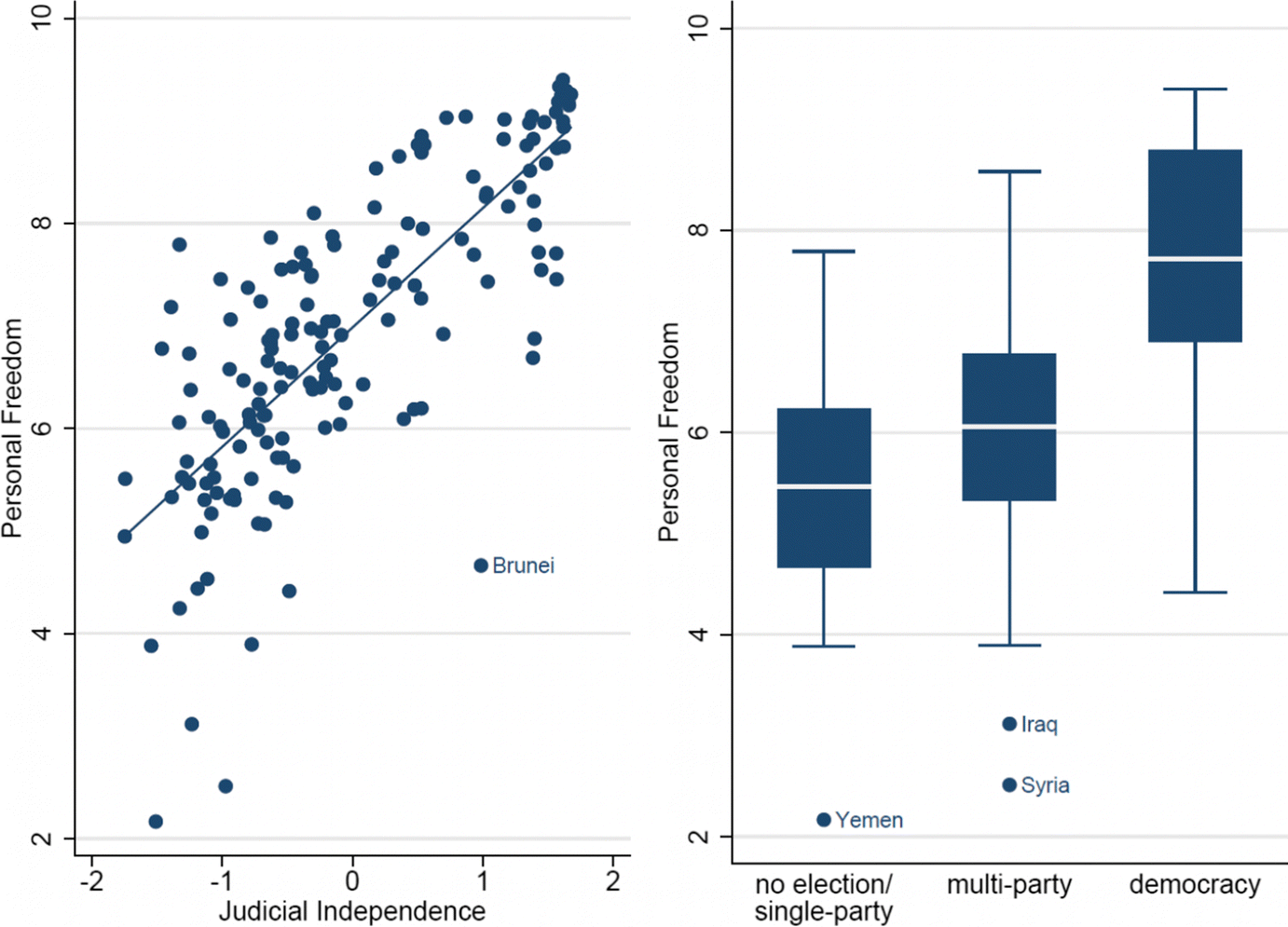
A. Global trade-offs between judicial independence and ballot politics
In the representation reproduced above, the left-hand plot shows a clear positive relationship between judicial independence and personal freedom, with Brunei as an outlier. The right-hand plot compares the personal freedom associated with three systems of government: democracies, multi-party systems without free elections, and systems without elections or with only one party. Democracies exhibit the highest degree of personal freedom; multi-party systems the second highest, with Iraq and Syria scoring exceptionally low; and systems without elections or with only one party the lowest.15
Enduring faultlines: suggestions for reform to ensure stricter judicial oversight of the trial of election disputes
The Indian judiciary has been proactive in the reform of election law. On the issue of the disqualification of candidates, for instance, which is a critical aspect of maintaining electoral integrity, the landmark judgment of the Supreme Court in Lily Thomas v. Union of India16 significantly affected the disqualification criteria applicable to candidates convicted of certain offences. The stages at which election disputes may be raised can be summarised as follows. The pre-election litigation phase serves as a vital mechanism to address grievances that could otherwise undermine the integrity of the electoral process. It ensures that issues such as the improper rejection of nomination papers, the inclusion or exclusion of voters in the electoral roll, and other procedural irregularities are scrutinised and rectified before they can affect the results, in accordance with the Act. This judicial scrutiny is essential to uphold the principles of free and fair elections mandated by the Constitution.
In N.P. Ponnuswami v. Returning Officer,17 the Supreme Court underscored the paramount importance of allowing the electoral process to proceed uninterrupted. The Court held that pre-election challenges, such as those to the rejection of nomination papers, should not be entertained by the courts during the electoral process, owing to the bar under Article 329(b) of the Constitution. In Baidyanath Panjiar v. Sitaram Mahto,18 which concerned the inclusion of voters’ names in the electoral roll after the last date for nominations, the Supreme Court held that such inclusions were illegal and invalidated the votes cast by those voters, thereby reinforcing the principle that the electoral roll must be finalised before the nomination deadline in order to ensure transparency and fairness.
The post-election litigation phase is initiated after the electoral process has concluded, primarily through election petitions. Such petitions challenge election results on grounds such as corrupt practices, malpractice, or non-compliance with election laws. Section 100 of the Representation of the People Act, 1951 in particular sets out the grounds on which an election may be called in question, including the improper acceptance or rejection of nominations and votes. Judicial intervention here serves two purposes: it ensures that elections are not unduly delayed or obstructed by pre-election disputes, allowing the democratic process to proceed smoothly, and it provides a mechanism for addressing grievances and ensuring that the outcome genuinely reflects the will of the voters.
Violations of the Model Code of Conduct can likewise have significant implications for the fairness and integrity of the electoral process. In India, the Model Code of Conduct is a set of guidelines issued by the Election Commission of India to regulate the conduct of political parties and candidates during elections. These guidelines are designed to ensure free and fair elections and to maintain the sanctity of the democratic process.
The way forward for the judiciary in maintaining electoral integrity in India involves several strategic enhancements and proactive measures. First, continued emphasis on technological advances, such as the integration and refinement of Voter-Verified Paper Audit Trails (VVPATs) with Electronic Voting Machines (EVMs), will further bolster transparency and public trust. Vigilance against newer forms of electoral malpractice, including cybersecurity threats and the spread of misinformation on digital platforms, is equally essential.
To mitigate these hurdles, collaboration among the judiciary, the Election Commission of India, and technology experts is necessary to develop robust cybersecurity frameworks and fact-checking mechanisms. Strengthening the enforcement of the Model Code of Conduct through quicker judicial review and more stringent penalties for violations will help to ensure a level playing field during elections.
Enhancing the accessibility of judicial processes for ordinary citizens will empower more individuals to report and challenge electoral malpractice, while regular training and sensitisation programmes for judicial officers on electoral laws and emerging challenges can ensure more informed and effective adjudication.
Ultimately, fostering greater public awareness of electoral integrity and of the judiciary’s role in safeguarding it will encourage civic engagement and vigilance, ensuring that the democratic process remains resilient and reflective of the will of the people. Through the reforms outlined above, the labyrinth of obstacles that lies ahead in the electoral enterprise may be overcome.
*****
Footnotes
1. James A. Gardner, Comparative Election Law 2-4 (2021).
2. Adrian Oldfield, Liberal Democratic Theory: Some Reflections on Its History and Its Present, in The Demands of Citizenship (2000).
3. James A. Gardner, Election Law as Applied Democratic Theory, 56 St. Louis U. L.J. 689 (2012).
4. M. Mohsin Alam Bhat, Governing Democracy Outside the Law: India’s Election Commission and the Challenge of Accountability, 16 Asian J. Comp. L. S85 (2021).
5. 1 D.D. Basu, Commentary on the Constitution of India (9th ed. 2014).
6. Azhar Hussain v. Rajiv Gandhi, AIR 1986 SC 1253, (1986) 2 SCC 578.
7. Representation of the People Act, No. 43 of 1951.
8. Mihaly Fazekas & Olli Hellmann, Elections and Corruption: Incentives to Steal or Incentives to Invest?, St. Comp. Int’l Dev. (2023).
9. N.P. Ponnuswami v. Returning Officer, Namakkal Constituency, AIR 1952 SC 64, 1952 SCR 218.
10. Mohinder Singh Gill v. Chief Election Comm’r, AIR 1978 SC 851, (1978) 1 SCC 405.
11. Indira Nehru Gandhi v. Raj Narain, AIR 1975 SC 2299, 1975 Supp SCC 1.
12. Jyoti Basu v. Debi Ghosal, AIR 1982 SC 983, (1982) 1 SCC 691.
13. Harbans Singh Jalal v. Union of India, (1997) 116 PLR 778 (P&H).
14. Richard L. Hasen, The Stagnation, Retrogression, and Potential Pro-Voter Transformation of U.S. Election Law, ConLaw NOW (2024).
15. Lawrence Baum, Elections and Judicial Independence: The Voter’s Perspective (Ohio State University).
16. Lily Thomas v. Union of India, AIR 2013 SC 2662, (2013) 7 SCC 653.
17. N.P. Ponnuswami (n 9).
18. Baidyanath Panjiar v. Sitaram Mahto, AIR 1970 SC 314, (1969) 2 SCC 447.