
Introduction
Reservation policy in India is a constitutional policy that reserves a portion of seats in education and public employment for groups that faced historical exclusion and exploitation. It responds to the hierarchies of the caste system and has a long history of reform, from Jyotirao Phule’s critique of caste and the 1902 Kolhapur quota to Dr B.R. Ambedkar’s efforts for the depressed classes. The Constitution gives effect to it through Articles 15(3), 16(4) and 46 and, from 1951, Article 15(4), initially for women, children, the Scheduled Castes and the Scheduled Tribes, and later for the Other Backward Classes on the basis of the 1980 Mandal Commission report. Rather than being viewed as an exception to equality, reservation came to be seen as a tool of substantive equality, aligning legal equality with real access to education, jobs and social dignity. Over time the policy has been intensely debated, over the criteria of backwardness, the exclusion of the creamy layer, the limits on quotas and the role of economic factors alongside caste. Landmark rulings such as Indra Sawhney v. Union of India (1992), together with the Constitution (One Hundred and Third Amendment) Act, 2019, have shaped the legal foundations of Indian reservation jurisprudence.
This paper examines how the 103rd Amendment departs from the rulings and logic of the Indra Sawhney judgment by introducing economic criteria as an independent basis for classification and by apparently exceeding the 50% ceiling.
It analyses the Supreme Court’s decision in Janhit Abhiyan v. Union of India (2022), in which a 3:2 majority upheld the amendment. It evaluates the competing opinions on whether the amendment violates the basic structure doctrine, whether the exclusion of SC, ST and OBC beneficiaries from EWS benefits offends equality, and whether the 50% limit is a binding constitutional principle or a flexible rule of prudence. The paper argues that the amendment, as validated, has transformed the doctrinal foundations of reservation. It shifts the justification from remedying historical, caste-based exclusion toward a broader conception of disadvantage, and it weakens the ceiling that had long served as a limit on affirmative action.
A. Historical evolution and importance of the reservation system in India
Reservation in India is a system of affirmative action designed to address historical social discrimination, exclusion and inequality rooted in the caste system.
The primary goal of the reservation system is to provide fair representation and equal opportunities in higher education, government jobs and political bodies for historically disadvantaged groups.
When India became independent in 1947, the nation did not begin from a level playing field. Generations of exclusion had left some communities without access to schools, temples, land, or even the dignity of being treated as equals. The framers of the Constitution were acutely aware of this reality. They knew that simply writing “equality” into the text would not erase centuries of inequality lived on the ground. That is why the idea of reservation was introduced. It was not about giving special treatment or favouring one group over another. It was about offering a ladder to those who had been kept at the bottom for far too long, so that they could stand shoulder to shoulder with others and compete fairly. Over time, this policy became one of the most debated features of Indian democracy. It has inspired protests, shaped amendments, and been tested in landmark Supreme Court judgments. To understand why reservation exists and how it has changed, its journey must be traced through history, legislation and the cases that define its meaning.
i. Evolution of the reservation system before and after independence
Reservation in India has a long history, and its roots go back to the colonial period.
People often ask who first came up with the idea of reservation. The earliest seeds were planted in 1882, when Jyotirao Phule submitted his views to the Hunter Commission. He argued that every citizen should have access to free and compulsory education and a fair chance at government jobs. This is widely seen as the starting point of the idea of caste-based reservation. In 1902, the princely state of Kolhapur issued a notification setting aside 50% of the posts in its services for economically and socially disadvantaged people. It was the first such order in the country meant to uplift the underprivileged. The Madras Presidency later went further. From 1921, a series of government orders known as the ‘Communal G.O.s’ provided for government posts to be distributed among communities such as Brahmins, non-Brahmins, Indian Christians and Muslims, creating one of the most detailed communal reservation systems of its time.1 The Constitution of India came into force on 26 January 1950.
Dr B.R. Ambedkar and the members of the Constituent Assembly did not view reservation as an act of charity. To them it was a way to correct deep-rooted historical injustice, and they gave it a firm footing through constitutional guarantees.
To understand reservation policy in India, one must begin with Article 14 of the Constitution, because reservation is, at its core, a question of how equality should work.
Article 14 of the Constitution of India: the equality code
Article 14 provides that the State shall not deny to any person “equality before the law” or the “equal protection of the laws” within the territory of India. The first limb, equality before the law, is a negative concept: it prohibits special privilege and subjects all persons to the ordinary law of the land. The concept is taken from English law and is associated with A.V. Dicey.2
The second limb, “equal protection of the laws”, is a positive concept: it requires that persons similarly circumstanced be treated alike, so that no one is treated unequally before the law. It means that persons in similar circumstances shall be given the same rights and liabilities: equals are to be treated equally, and there must be no discrimination among them. The underlying principle of equality, therefore, is not uniformity of treatment for all in all respects, but the same treatment in those respects in which persons are similar and different treatment in those respects in which they differ. In a nutshell, equals must be treated equally, while unequals must be treated differently. Under the latter aspect of Article 14, “equal protection of the laws”, which is the essence and core of the right to equality, the State is under an obligation to take the necessary steps so that every individual receives the equal respect and concern to which he or she is entitled as a human being. Thus Article 14, though much wider and more general in its scope, must be read in conjunction with Articles 15 to 18, and should neither permit anything those Articles prohibit nor prohibit anything they permit.
The second aspect of Article 14, “equal protection of the laws”, can be understood through a hypothetical example.
Suppose the Army publishes a notification to fill vacancies in various departments, stating strictly that only persons six feet tall and above are eligible to apply. Suppose also that average heights among candidates from the north-eastern States, such as Manipur, Mizoram and Arunachal Pradesh, are lower than among candidates from the rest of India; a uniform criterion would operate unjustly against them even though the notification formally demands the same of everyone. Suppose, therefore, that the recruiting authority also states in the notification that candidates from the north-eastern States receive a relaxation of one foot, so that the minimum height for them is five feet.
Two inferences can be drawn from this example:
1. Candidates from the north-eastern region and candidates from the rest of India form two different categories and cannot be put on the same footing. Candidates in the first category are similarly circumstanced; they will be given the same rights and liabilities and treated as equals among themselves without any discrimination.
2. The second category consists of candidates from the rest of India. They too will be treated as equals among themselves and given the same rights and liabilities without any discrimination.
Giving a relaxation of one foot to one group, therefore, does not amount to discrimination. It is affirmative action (positive discrimination) that brings both categories onto an equal footing under the concept of substantive equality, so that the law protects everyone equally.
The same logic underlies the Constitution (One Hundred and Sixth Amendment) Act, 2023 (the Nari Shakti Vandan Adhiniyam), which provides for reserving, as nearly as may be, one-third of the seats in the House of the People, the State Legislative Assemblies and the Legislative Assembly of Delhi for women. This is positive discrimination, as its purpose is to bring women onto an equal footing with men as elected representatives in Parliament and the State legislatures. Under Article 334A, however, the reservation takes effect only after a delimitation exercise undertaken on the basis of the first census taken after the amendment’s commencement, so it is not yet in operation.3
A. Need for reasonable classification and the logic behind it
Historically, many categories or communities of people were, for one reason or another, not on an equal footing with the rest of society, and for long they were denied the opportunity to improve their standard of living. They are the exploited and socially weaker sections of society. Such communities or classes, which are socially, educationally and economically backward and not at par with others, need to be protected and uplifted through governmental schemes and beneficial policies. For this reasonable and justifiable purpose, the State relies on the “doctrine of reasonable classification”.
In D.S. Nakara v. Union of India, the Supreme Court observed that the doctrine of classification was evolved by the Court for the purpose of sustaining legislation or State action designed to help weaker sections of society.4
In R.K. Garg v. Union of India, the Supreme Court held that Article 14 forbids class legislation but does not forbid reasonable classification by the legislature for the purpose of achieving specific ends. Class legislation is legislation that applies to a particular class of persons without any reasonable basis; where there is no basis for the classification, the classification may be declared discriminatory.5
State of West Bengal v. Anwar Ali Sarkar laid the foundation of the “reasonable classification” test under Article 14. The test allows laws to treat different groups differently but requires a logical justification, preventing arbitrary discrimination while leaving room for measures that promote social justice.6 It has become a standard for evaluating the constitutionality of laws.
i. The reasonable classification test
The classification of persons, objects and transactions with a view to attaining specific aims, especially where it is necessary for the progress of society as a whole, is permitted, but the classification must not be “arbitrary, artificial or evasive”, and it must fulfil the following two conditions:
1. The classification must be founded on an “intelligible differentia” which distinguishes persons or things that are grouped together from others left out of the group.
2. The differentia must have a rational relation to the object sought to be achieved by the Act. The object of the Act and the differentia on which the classification rests are two distinct things, and there must be a nexus between the object of the Act and the basis of the classification.7
For example, section 20 of the Bharatiya Nyaya Sanhita, 2023 provides that nothing is an offence which is done by a child under seven years of age, so such a child is not criminally liable even for a heinous act.8 This is a reasonable classification: it separates children under seven from everyone older for the purpose of criminal liability. The age limit is connected to a reasonable and justifiable object, namely to exempt from criminal liability children too young to form the mens rea needed to grasp the nature of their act (doli incapax).
In E.P. Royappa v. State of Tamil Nadu, the Supreme Court developed the “new doctrine of equality”, also known as the doctrine of non-arbitrariness, under Article 14.9
Before this case, Article 14 was interpreted through a narrower, traditional lens, the doctrine of reasonable classification. That test permitted differential treatment only if the State could show an “intelligible differentia” (a clear distinction between those grouped together and those left out) and a “rational nexus” to the object of the law.
Justice P.N. Bhagwati departed from this rigid formulation, holding that equality is a dynamic concept which cannot be “cribbed, cabined and confined” within traditional and doctrinaire limits.10
The decision marked a turning point in Indian constitutional law, reshaping the understanding of Article 14 through the principles set out below:
1. Equality and arbitrariness are sworn enemies: the Court famously held that “equality is antithetic to arbitrariness”. Where an act is arbitrary, it is inherently unequal and violates Article 14.
2. A dynamic and expansive dimension of equality: Article 14 was transformed from a passive, defensive right into an active constitutional principle. Its concern is no longer confined to preventing impermissible classification; it extends to securing fairness in every exercise of State power.
3. A safeguard against arbitrariness: the doctrine ensures that the State cannot act on caprice, prejudice or political vendetta. Every State action must be grounded in reason, rationality and the public interest.11
Article 15: prohibition of discrimination and ensuring equality beyond the general rule (substantive equality)
Articles 14, 15 and 16 are all facets of the right to equality, and the reservation clauses in Articles 15(4) and 16(4) are not exceptions to Articles 15(1) and 16(1) but an emphatic statement of equality.12 Articles 14, 15 and 16 can be pictured as three concentric circles. Article 14 is the outermost, laying down the broad principle of equality. Article 15 sits in the middle, applying that principle to a specific situation, namely discrimination by the State on grounds such as religion, race, caste, sex or place of birth. Article 16 is the innermost circle, applying equality to the narrower field of public employment. Article 14 is the genus (the general rule), while Articles 15 and 16 are the species (specific applications).13
Taken together, Articles 14, 15 and 16 of the Indian Constitution establish the foundation of substantive equality by addressing equality before the law, non-discrimination and equal opportunity in public employment. Articles 15(4) and 16(4) should be viewed not as exceptions to the principle of equality but as constitutional measures designed to achieve genuine equality through affirmative action. Together, these provisions promote social justice by recognising that equal treatment sometimes requires special measures to uplift disadvantaged sections of society. Figure 1 depicts the three Articles as concentric circles of equality.14
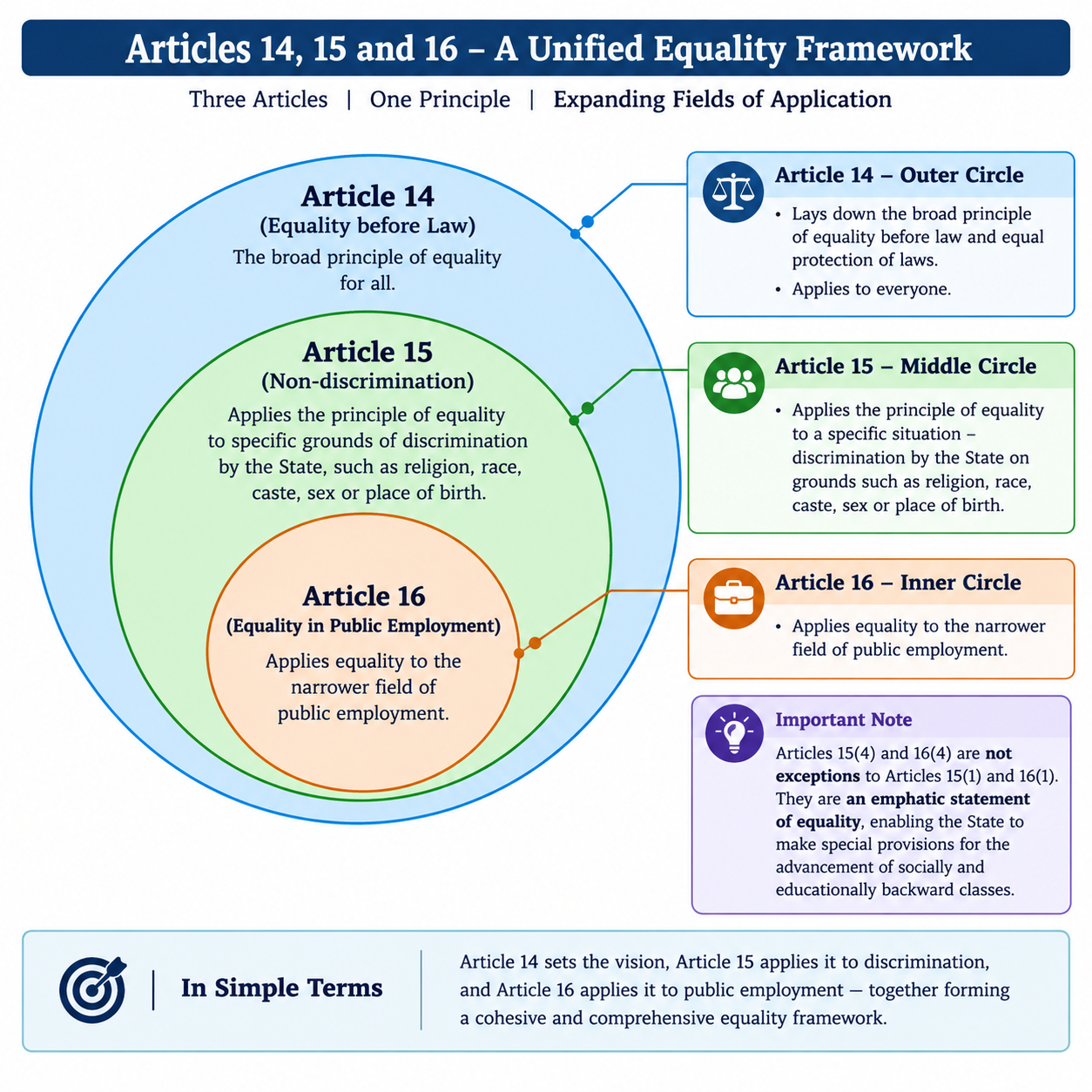
Figure 1: Articles 14, 15 and 16 as concentric circles of equality under the Indian Constitution
Article 15(1) provides that the State shall not discriminate against any citizen on grounds only of religion, race, caste, sex, place of birth or any of them.15 The word “only” matters: the State may not discriminate on these grounds alone.
This does not prevent the State from adopting positive discrimination (affirmative action), as the later clauses of Article 15 make clear.
Article 15(2) provides that no citizen shall, on any of those grounds, be subjected to any disability, liability, restriction or condition with regard to access to shops, public restaurants, hotels and places of public entertainment, or the use of wells, tanks, bathing ghats, roads and places of public resort maintained wholly or partly out of State funds or dedicated to the use of the general public.16
Article 15(3) provides that nothing in Article 15 shall prevent the State from making any special provision for women and children.17 This is where positive discrimination (affirmative action) begins, using the doctrine of reasonable classification in the interest of women and children to uplift them and bring them onto an equal footing with others.
Some of the special laws made by the State under Article 15(3) are the Maternity Benefit Act, 1961, the Protection of Children from Sexual Offences Act, 2012, the Protection of Women from Domestic Violence Act, 2005 and the Sexual Harassment of Women at Workplace (Prevention, Prohibition and Redressal) Act, 2013.
Article 15(4) was not part of the original Constitution. It was added by the Constitution (First Amendment) Act, 1951, and the reason for the amendment lies in State of Madras v. Champakam Dorairajan. Under the Madras Communal G.O., seats in the State’s medical and engineering colleges were filled in proportions fixed by religion and caste: out of every fourteen seats, six went to non-Brahmin Hindus, two to backward Hindus, two to Brahmins, two to the Scheduled Castes (termed “Harijans” in the order), one to Anglo-Indians and Indian Christians and one to Muslims. When this order was scrutinised by the Supreme Court, it held that the classification violated the fundamental right guaranteed by Article 29(2), under which no citizen may be denied admission into a State-maintained or State-aided educational institution on grounds only of religion, race, caste, language or any of them, and that the Communal G.O. was therefore void.18
In response to this judgment, Parliament enacted the Constitution (First Amendment) Act, 1951, which inserted clause (4) in Article 15.19
Article 15(4) provides: “Nothing in this article or in clause (2) of article 29 shall prevent the State from making any special provision for the advancement of any socially and educationally backward classes of citizens or for the Scheduled Castes and the Scheduled Tribes.”20
As regards the Scheduled Castes and Scheduled Tribes, their members carry certificates issued by the Government, and there is no doubt about who belongs to these groups. The question and the confusion arose over the socially and educationally backward classes (SEBCs): how would the State recognise castes, and who deserves to be in the SEBC category?
The First Amendment does not provide for reservation on the basis of caste but of class, that is, the socially and educationally backward classes, so that all the castes which deserve to be in the SEBC category may be placed within it.
The question that arose at the time, therefore, was how the State would recognise who falls within the SEBCs.
It was answered through a series of cases, discussed below.
In M.R. Balaji v. State of Mysore, the State of Mysore, relying on Article 15(4), reserved 68% of the seats in engineering and medical colleges and other technical institutions for the socially and educationally backward classes and the Scheduled Castes and Scheduled Tribes, leaving only 32% for the merit pool. The matter reached the Supreme Court, which examined whether this reservation was justifiable, given the inequality it produced. The Court held that the order classified the backward classes on the sole basis of caste, which Article 15(4) does not permit, and that a reservation of 68% was inconsistent with the concept of a special provision. The interests of the weaker sections had to be adjusted with the interests of the community as a whole, and in uplifting the backward classes the State could not disregard the legitimate claims of the rest of society. There had to be a reasonable limit to reservation, consistent with Articles 14 and 15. “Speaking generally and in a broad way”, the Court said, a special provision should be less than 50%, the actual percentage depending on the circumstances prevailing in each case.21
In T. Devadasan v. Union of India, the Court, following Balaji, struck down the “carry forward” rule because it allowed more than 50% of the vacancies in a particular year to go to reserved candidates.22 Later, in State of Kerala v. N.M. Thomas, the Court treated reservation not as an exception to equality but as necessary to establish it. It held that the conception of equality in Article 16(1) itself includes remedial measures to secure due representation for hitherto excluded classes.23 N.M. Thomas is considered the first definite judicial endorsement of the philosophy of reservation.
The second question that arose was whether the State can enforce reservation in unaided private educational institutions.
It was answered in P.A. Inamdar v. State of Maharashtra, in which the Supreme Court held that the State cannot impose its reservation policy on unaided private educational institutions.24
In response to this judgment, Parliament enacted the Constitution (Ninety-third Amendment) Act, 2005. It added clause (5) to Article 15, which provides: “Nothing in this article or in sub-clause (g) of clause (1) of article 19 shall prevent the State from making any special provision, by law, for the advancement of any socially and educationally backward classes of citizens or for the Scheduled Castes or the Scheduled Tribes in so far as such special provisions relate to their admission to educational institutions including private educational institutions, whether aided or unaided by the State, other than the minority educational institutions referred to in clause (1) of article 30.”25
Along with it, Parliament passed the Central Educational Institutions (Reservation in Admission) Act, 2006, through which the Other Backward Classes (OBCs) secured a 27% quota in central educational institutions such as the IITs, IIMs, AIIMS, BHU and IIITs.26
But the question of who is to be considered backward for the purposes of the SEBC/OBC category still needed an answer.
That answer had been given by the landmark judgment in Indra Sawhney v. Union of India, also known as the Mandal Commission case.27
After India became independent in 1947, a commission was formed to identify the classes of people who had been disadvantaged for generations on the basis of caste and background. Known as the Kalelkar Commission and set up in 1953, it was the first Backward Classes Commission, and its task was to identify the socially and educationally backward classes of society.28
After the Kalelkar Commission came the most important commission of all, the Mandal Commission, whose chairman was B.P. Mandal. It was set up on 1 January 1979 by the Janata Party government under Prime Minister Morarji Desai.29
A. The Mandal Commission (Socially and Educationally Backward Classes Commission)
The aim of the Mandal Commission was to identify the socially and educationally backward classes. It evolved eleven indicators to determine who should fall within the Socially and Educationally Backward Classes (SEBCs/OBCs), grouped under three heads.30
i. Social indicators
1. Castes or classes considered as socially backward by others.
2. Castes or classes which mainly depend on manual labour for their livelihood.
3. Castes or classes where at least 25% of females and 10% of males above the State average get married at an age below 17 years in rural areas, and at least 10% of females and 5% of males do so in urban areas.
4. Castes or classes where the participation of females in work is at least 25% above the State average.
ii. Educational indicators
1. Castes or classes where the number of children aged 5 to 15 years who never attended school is at least 25% above the State average.
2. Castes or classes where the rate of student drop-out in the age group of 5 to 15 years is at least 25% above the State average.
3. Castes or classes amongst whom the proportion of matriculates is at least 25% below the State average.
iii. Economic indicators
1. Castes or classes where the average value of family assets is at least 25% below the State average.
2. Castes or classes where the number of families living in kutcha houses is at least 25% above the State average.
3. Castes or classes where the source of drinking water is beyond half a kilometre for more than 50% of the households.
4. Castes or classes where the number of households having taken consumption loans is at least 25% above the State average.
Using these eleven social, educational and economic indicators, the Commission identified 3,743 castes as socially and educationally backward, comprising about 52% of India’s population. It recommended 27% reservation for OBCs in public-sector jobs and higher educational institutions, in addition to the existing 22.5% reservation for the Scheduled Castes (SCs) and Scheduled Tribes (STs), bringing total reservation to 49.5%.31
The V.P. Singh government decided to act on this recommendation in 1990. When Prime Minister V.P. Singh announced in August 1990 that the Mandal Commission’s recommendations would be put into effect, the decision set off a wave of protests across the country, some of them violent, and some students even attempted self-immolation. It was a turbulent time, and public opinion was sharply divided. The Government’s decision implementing the recommendation was challenged in the Supreme Court in Indra Sawhney v. Union of India.
The Indra Sawhney case, also known as the Mandal verdict, is a landmark public interest case decided by a nine-judge Constitution Bench of the Supreme Court of India.
On 16 November 1992 the Supreme Court, by a 6:3 majority, upheld the reservation for backward classes based on the Mandal Commission’s recommendations, subject to conditions. Among the principles it laid down for framing reservation policy were these:
1. The backwardness contemplated by Article 16(4) is mainly social backwardness; it need not be both social and educational. A backward class cannot be identified only and exclusively with reference to economic criteria, although economic criteria may be considered along with social backwardness.32
2. Caste can be, and quite often is, a social class in India, and it may be taken as the starting point for identifying backward classes. Caste alone does not confer the benefit of reservation; it is a factor that may be taken into consideration in determining whether the people of the caste concerned are socially and educationally backward.33
The Court also upheld the 50% ceiling on reservation laid down in M.R. Balaji, allowing relaxation only in extraordinary situations, such as for populations of far-flung and remote areas, and then with extreme caution.34 It further held that the creamy layer must be excluded whenever posts are reserved for the backward classes, and directed the Government to specify the basis of exclusion.35
Article 16: the constitutional anchor of fair employment where merit meets social justice
Article 16 guarantees equality of opportunity for all citizens in public employment and bars discrimination on grounds only of religion, race, caste, sex, descent, place of birth, residence or any of them. Within that framework, Parliament may prescribe residence requirements for certain posts, the State may reserve appointments or posts for backward classes which are not adequately represented in the services under the State, and it may also reserve promotions for SCs and STs and carry forward unfilled reserved vacancies to later years. The Article also permits laws requiring that the holders of offices connected with religious or denominational institutions belong to that religion or denomination.
A. Other recommendations of the Mandal Commission
The Mandal Commission recommended that OBCs should get reservation in promotions too, but in Indra Sawhney the Supreme Court held that Article 16(4) does not permit reservation in promotions.36
The idea of the “creamy layer” is also bound up with this case. The expression was already in judicial use before it, for instance in Justice Chinnappa Reddy’s opinion in K.C. Vasanth Kumar v. State of Karnataka, but Indra Sawhney made the exclusion of the creamy layer mandatory.37 The logic was simple: better-off OBC families should not take up benefits meant for those who need them more. The income limit was first set at Rs 1 lakh a year in 1993, and it has stood at Rs 8 lakh since 2017.38
The Commission also looked beyond reservation and suggested a range of welfare measures for OBCs, including financial assistance and support for education.
In education, it proposed setting up special facilities in phases, starting with areas having a high concentration of OBCs. The aim was to help students grow up in a richer cultural and learning environment.
For livelihoods, it recommended skill-upgrading programmes for village artisans, along with subsidised loans from financial institutions so that they could start small-scale industries of their own.
Finally, it called for land reforms to improve the living conditions of OBC communities.
B. Reservation in promotion for the Scheduled Castes and Scheduled Tribes
The Central and State Governments had for decades provided reservation in promotions for SCs and STs through executive orders, to address their severe under-representation in higher posts. Reservation in promotions for SCs and STs got its constitutional footing through the Constitution (Seventy-seventh Amendment) Act, 1995, which added Article 16(4A). This was a response to Indra Sawhney, which had held that Article 16(4) confined reservation to initial appointment.39 After Union of India v. Virpal Singh Chauhan and Ajit Singh v. State of Punjab had denied consequential seniority to candidates promoted through reservation, the Constitution (Eighty-fifth Amendment) Act, 2001 amended Article 16(4A) to give “consequential seniority” to SC and ST employees promoted ahead of their peers.40 Together, these changes give the Government a way to open senior positions in public service to historically disadvantaged communities.
The Supreme Court has since drawn firm limits around how this can be done. In M. Nagaraj v. Union of India (2006), the Court upheld these amendments but required the State, before providing reservation in promotion, to show the backwardness of the class, the inadequacy of its representation, and that overall administrative efficiency would not be affected.41 In Jarnail Singh v. Lachhmi Narain Gupta (2018), a Constitution Bench held that the requirement to collect quantifiable data showing the backwardness of SCs and STs was contrary to Indra Sawhney, so States do not have to keep proving that these groups are backward; but the creamy layer must be excluded from promotional reservation, and quotas in promotion cannot be rolled out mechanically.42 Governments must also ensure that reservation does not undermine administrative efficiency, as Article 335 requires.43
More recently, a 2022 Supreme Court judgment added another layer. Before providing reservation in promotions, the State must collect quantifiable data showing that representation is inadequate, and the unit for collecting that data is the cadre, meaning the particular grade or class of post, and not an entire service or group.44 The point is that quotas should apply only where real gaps exist, with periodic review, the period of which is left to the Government, to balance social justice against efficiency in administration.
The 102nd and 105th Constitutional Amendment Acts
The Constitution (One Hundred and Second Amendment) Act, 2018 gave the National Commission for Backward Classes (NCBC) constitutional status by inserting Article 338B. It also introduced Article 342A, under which the President specifies the socially and educationally backward classes in relation to each State and Union Territory.45 In Jaishri Laxmanrao Patil v. Chief Minister (2021), the Supreme Court read Article 342A as taking away the States’ power to identify such classes.46 The position changed later in 2021. The Constitution (One Hundred and Fifth Amendment) Act, 2021 restored the States’ own authority to identify Socially and Educationally Backward Classes (SEBCs), also known as Other Backward Classes (OBCs). It amended Articles 338B, 342A and 366 of the Constitution.47
EWS judgment: a fundamental shift from caste, reshaping affirmative action as an anti-poverty measure
Decided in 1951, Champakam Dorairajan was the first reservation dispute to reach the Supreme Court of India; it struck down the Madras Communal G.O. and prompted the First Amendment. In the decades that followed, the Court was repeatedly urged to define “backward classes” by economic standing, meaning household income or wealth, rather than by caste. It did not accept that caste was irrelevant. In Balaji, it held that caste could be a relevant factor, though not the sole test, and in Indra Sawhney (1992) it held that a caste can be a social class, so that identifying Other Backward Classes by caste for reservation purposes was constitutionally valid, provided the castes identified were socially backward.48 As a result, Indian constitutional law, unlike its American counterpart, has no caste-blind equality doctrine that could be used to strike down caste-based affirmative action. The political demand for reservation based on economic class nevertheless persisted for seven decades.
As earlier legislative and executive attempts to introduce such economic reservation ran into judicial roadblocks, Parliament enacted the Constitution (One Hundred and Third Amendment) Act, 2019, creating a new category of reservation for “economically weaker sections”, to be identified on the basis of “family income and other indicators of economic disadvantage”. Under the Union Government’s criteria, notified in January 2019, persons not covered by the SC, ST or OBC reservation qualify as economically weaker if their family’s gross annual income is below Rs 8 lakh, subject to exclusions based on asset holdings such as agricultural land.49
Reservation programmes have traditionally been justified as a limited, backward-looking remedy, a way to make up for the social and economic disadvantages that flowed from historical discrimination. The EWS reservation shifts that logic. It turns affirmative action into a forward-looking tool for fighting poverty and promoting social mobility more broadly.
This shift lay at the heart of the basic structure challenge. Its context is the judgment delivered by a nine-judge Bench in Indra Sawhney in November 1992. Besides the reservation for Other Backward Classes notified by the V.P. Singh government in 1990, the Court examined an Office Memorandum of 25 September 1991 which reserved a further 10% of posts for “other economically backward sections of the people who are not covered by any of the existing schemes of reservation”.50 The Court struck that clause down. Reserving vacancies among open-category candidates on the basis of income or property-holding, it held, would debar citizens from being considered for appointment to an office under the State solely on the basis of their income or property, which is inconsistent with the guarantee of equal opportunity in Article 16(1).51 Its reading of Article 16(4) pointed the same way. The object of that clause was to give backward communities, kept out of an administrative apparatus that had been manned almost exclusively by members of the “upper” castes, a share in State power; the backwardness it contemplates is therefore mainly social, and a backward class cannot be identified only and exclusively with reference to economic criteria. Poverty by itself, on this reasoning, could not ground a classification for reservation in public employment. Justice R.M. Sahai, in his separate opinion, put the point directly: although the eradication of poverty is one of the ideals set out in the Preamble, reservation on economic criteria or wealth cannot be upheld under the doctrine of reasonable classification, for, in his words, “Indigence cannot be rational basis for classification for public employment”, and Article 16(4) by its nature and purpose cannot apply to the economically backward “except probably when a proper methodology is worked out to determine inadequacy of representation of such class”.52 The Court did, however, hold that Article 16(4) is not exhaustive of the concept of reservation; it is exhaustive only of reservations in favour of backward classes.53
The need for amendments to Article 16 (and Article 15) thus becomes clear when viewed against the Indra Sawhney verdict. In January 2019 the Union Government brought the Constitution (One Hundred and Twenty-fourth Amendment) Bill, 2019, which the Lok Sabha passed on 8 January and the Rajya Sabha on 9 January, creating a separate reservation for EWS on top of the existing reservations of 49.5% for the Scheduled Castes, Scheduled Tribes and Other Backward Classes. Most parties backed the Bill in Parliament, although a few, mainly regional, parties walked out in protest. The Act amended Articles 15 and 16 of the Constitution by inserting clause (6) in each. It received the President’s assent on 12 January 2019, was published in the Gazette the same day, and came into force on 14 January 2019.54
Article 15(6) enables the State to make special provisions for the advancement of any economically weaker sections of citizens other than the classes covered by clauses (4) and (5), including provisions relating to admission to educational institutions. Such provisions may extend to any educational institution, including private institutions, whether aided or unaided, except the minority educational institutions covered by Article 30(1). Reservation under it is subject to a ceiling of 10% of the total seats in each category, which means that up to 10% of seats can be reserved for citizens in the EWS category, and it is in addition to the existing reservations.55
Article 16(6) enables the State to provide for the reservation of appointments or posts in favour of economically weaker sections other than the classes mentioned in clause (4). Again, such reservation is subject to a ceiling of 10% of the posts in each category, in addition to the existing reservation.56
A. EWS reservation: Janhit Abhiyan v. Union of India
The matter reached the Supreme Court, where more than 20 petitions were filed challenging the constitutional validity of the 103rd Amendment. The petitioners argued that the amendment violates the basic features of the Constitution and the fundamental right to equality under Article 14. In particular, they made the following arguments:
• Reservations cannot be based solely on economic criteria, given the Supreme Court’s judgment in Indra Sawhney v. Union of India (1992).
• SCs, STs and OBCs cannot be excluded from economic reservations, as this would violate the fundamental right to equality.
• The amendment introduces reservations that exceed the 50% ceiling on reservations established in Indra Sawhney.
• Imposing reservations on educational institutions that do not receive State aid violates the fundamental right to equality.57
Before the EWS reservation, 49.5% of seats in education and public appointments were reserved, with quotas of 15%, 7.5% and 27% for the Scheduled Castes, Scheduled Tribes and Other Backward Classes respectively.
After five days of hearings in 2019, the Court reserved its order on whether to refer the case to a Constitution Bench. On 5 August 2020, a three-judge Bench referred it to a five-judge Constitution Bench. In 2022, a Constitution Bench led by the then Chief Justice U.U. Lalit took up the case; on 6 September 2022 it stated that it would decide when to hear the EWS reservation case first, and on 8 September 2022 it took note of the issues suggested by the Attorney General for India, which were as follows:58
1. Whether the 103rd Amendment breaches the basic structure of the Constitution by permitting the State to make special provisions, including reservation, based on economic criteria.
2. Whether it breaches the basic structure by permitting the State to make special provisions in relation to admission to private unaided institutions.
3. Whether it breaches the basic structure by excluding the SEBCs/OBCs/SCs/STs from the scope of EWS reservation.
4. Whether the 50% cap referred to in earlier decisions of the Supreme Court is part of the basic structure and, if so, whether the 103rd Amendment breaches it.
The Court treated the first three as the main issues. On 27 September 2022, the Bench finished hearing arguments from all the parties and reserved judgment. On 7 November 2022, by a 3:2 split, it declared the 103rd Amendment and EWS reservation constitutionally valid. Justices Dinesh Maheshwari, Bela M. Trivedi and J.B. Pardiwala wrote separate concurring opinions forming the majority, and Justice S. Ravindra Bhat wrote a dissent on behalf of himself and Chief Justice U.U. Lalit.59
B. Supreme Court’s observations on reservation for economically weaker sections
i. Constitutionality of the economic criterion for reservation
The majority held that reservation is an instrument for including not only the socially and educationally backward classes but any class or section so disadvantaged as to answer the description of a weaker section, and that reservation structured singularly on economic criteria does not violate any essential feature of the Constitution or damage its basic structure. Reservations based exclusively on economic criteria were thus held constitutionally permissible as a means of uplifting the poorest segments of society.60
Economic backwardness was recognised as not being confined to those covered by existing reservations (SCs, STs and OBCs).
The Court emphasised that economic justice, recognised in the Preamble and in Articles 38 and 46, justified such affirmative action.
Justice Bhat, in his dissent, accepted that economic criteria are permissible for special provisions under Article 15, which concern access to public goods such as education. He distinguished, however, between reservation for “access” to public goods and reservation for “representation” in public employment under Article 16, whose goal is the empowerment of communities hitherto kept out of State services. In his view, the economically weaker sections targeted by the amendment, drawn from the forward classes, had never been consciously discriminated against, and EWS reservation in employment snapped the link between reservation and representation.61
ii. Exclusion of SCs, STs and OBCs from EWS benefits
By a 3:2 majority, the Court held that the amendment drew a reasonable line between “economically weaker sections” and the other disadvantaged groups who already benefit from existing reservations. It relied on the idea that treating unequals in the same way is as unfair as treating equals differently. The majority also saw the exclusion as necessary if the intended beneficiaries were to receive the full benefit of the quota, much like the creamy layer exclusion that already applies within existing reservations. In its view, the poorer members of the SCs, STs and OBCs were already covered through their own reservation categories, so leaving them out of the EWS quota did not shut them out of support.62
iii. Dissent of Justice Bhat and Chief Justice Lalit
Justice Bhat and Chief Justice Lalit held that keeping SCs, STs and OBCs out of a reservation based on economic criteria violated the right to equality. They pointed out that poverty touches people of every background, not only those who are socially backward, and that for communities already facing discrimination its effects are harsher still. The dissent also questioned the exclusion of the combined SC, ST and OBC groups, roughly 82% of the population, whose poorest members would otherwise qualify for EWS benefits, and held that this exclusion violated the principle of non-discrimination, which forms part of the basic structure.63
iv. The Court’s observations on the 50% reservation ceiling
The majority held that the 50% ceiling set in Indra Sawhney is not inflexible and, in any case, applies only to the reservations envisaged by Articles 15(4), 15(5) and 16(4). Justice Maheshwari added that no decision of the Court could be read to mean that, if Parliament finds another affirmative action necessary for a section in need, it can never be provided. Justice Bhat disagreed with this reasoning and warned against breaching the 50% limit: in his view, doing so would become a gateway for further infractions and could reduce the right to equality to little more than a right to reservation. Given his conclusion on the exclusion, however, he left the question of a violation of the 50% rule open.64
v. No violation of the basic structure
Justice Dinesh Maheshwari, with whom Justice Bela M. Trivedi and Justice J.B. Pardiwala concurred in separate opinions, upheld the 103rd Amendment. He reasoned that introducing economic criteria for reservation did not violate the equality code or the basic structure, since the Constitution’s vision of social justice is broad enough to encompass economic disadvantage as an independent basis for affirmative action.65
Relying on Pramati Educational and Cultural Trust v. Union of India, the majority held that the amendment, in permitting EWS reservation in admissions to private unaided educational institutions under Article 15(6), does not breach the basic structure. Justice Bhat agreed that unaided private institutions would be bound by Article 15(6) to provide EWS reservation, but considered the question moot, since he had already found the amendment unconstitutional.66
Conclusion
The Janhit Abhiyan decision sits at the heart of the constitutional debate around the 103rd Amendment (EWS reservations), and three takeaways connect directly to how affirmative action is evolving in India.
A. Poverty as a protected marker
By recognising socio-economic disadvantage as a potential ground for protection, the Court has effectively given constitutional legitimacy to the EWS reservation scheme. This aligns with the 103rd Amendment, which carved out a quota for economically weaker sections outside the traditional caste framework. The decision thus strengthens the idea that poverty itself can be a constitutionally relevant axis of disadvantage, not merely social or caste-based identity. This could reshape discrimination law by expanding its scope beyond identity markers such as caste, religion or gender.
B. Clarifying Article 15(1) of the Constitution
The difference between Justice Bhat and Justice Pardiwala reflects a deeper tension: should Article 15(1) be read strictly as a prohibition of discrimination on the listed grounds, or can doctrines such as “reasonable classification” enter its interpretation? For EWS reservations this matters, because the amendment introduced a new category of affirmative action that does not fit neatly into the traditional Article 15 framework.
Future Benches will need to clarify whether economic criteria can stand alone under Article 15, or whether they must always be tethered to broader equality principles.
C. The 50% reservation ceiling question
The unresolved issue of the 50% cap is crucial. The 103rd Amendment pushed reservations beyond this ceiling, sparking debate on whether the limit applies only to caste-based reservations under Article 16(4) or to all reservations. If a larger Bench confirms that the ceiling is flexible, it could permanently alter the architecture of affirmative action in India. This will directly shape the future of EWS reservations and the meaning of “equality of opportunity” in the constitutional scheme.
The Janhit Abhiyan case does not merely settle the validity of EWS reservations; it sets the stage for a broader transformation of Indian equality jurisprudence.
*****
Footnotes
1. Gurpreet Kaur Dutta, The Great Reservation System in India: Key Amendments & Case Laws Explained, Finology Legal Blog (Nov. 27, 2025), https://finologylegal.in/blog/legal-news/reservation-system-in-india; see also Abhinav Chandrachud, Long Before 1947, How India’s Reservations Policy Developed Under British Rule, The Quint (Mar. 10, 2023), https://www.thequint.com/lifestyle/books/book-excerpt-these-seats-are-reserved-abhinav-chandrachud-india-affirmative-action-reservations-policy.
2. V.N. Shukla, Constitution of India 47–48 (Mahendra Pal Singh ed., 12th ed. 2013).
3. India Const. arts. 330A, 332A, 334A, inserted by The Constitution (One Hundred and Sixth Amendment) Act, 2023; India Const. art. 239AA, amended by The Constitution (One Hundred and Sixth Amendment) Act, 2023.
4. D.S. Nakara v. Union of India, (1983) 1 SCC 305, AIR 1983 SC 130 (India).
5. R.K. Garg v. Union of India, (1981) 4 SCC 675, AIR 1981 SC 2138 (India).
6. State of West Bengal v. Anwar Ali Sarkar, 1952 SCR 284, AIR 1952 SC 75 (India).
7. Id.
8. The Bharatiya Nyaya Sanhita, No. 45 of 2023, India Code (2023), § 20.
9. E.P. Royappa v. State of Tamil Nadu, (1974) 4 SCC 3, AIR 1974 SC 555 (India) (Bhagwati, J., for himself, Chandrachud and Krishna Iyer, JJ.).
10. Id.
11. Id.
12. State of Kerala v. N.M. Thomas, (1976) 2 SCC 310, AIR 1976 SC 490 (India); see Indra Sawhney v. Union of India, 1992 Supp (3) SCC 217, ¶ 741 (India) (noting that the majority in N.M. Thomas held Article 16(4) to be not an exception to Article 16(1) but an emphatic way of stating a principle implicit in it).
13. E.P. Royappa, (1974) 4 SCC 3, AIR 1974 SC 555 (India) (Bhagwati, J.) (describing Article 14 as the genus and Article 16 as a species); State of Jammu & Kashmir v. Triloki Nath Khosa, (1974) 1 SCC 19, (1974) 1 SCR 771 (India) (Chandrachud, J.); Indra Sawhney, 1992 Supp (3) SCC 217, AIR 1993 SC 477, 541 (India) (Jeevan Reddy, J.).
14. Figure 1 is the author’s illustration, adapted from Indra Sawhney, 1992 Supp (3) SCC 217, AIR 1993 SC 477, 541 (India), and E.P. Royappa, AIR 1974 SC 555, 1974 SCR (2) 348 (India).
15. India Const. art. 15(1).
16. India Const. art. 15(2).
17. India Const. art. 15(3).
18. State of Madras v. Champakam Dorairajan, 1951 SCR 525, AIR 1951 SC 226 (India).
19. India Const. art. 15(4), inserted by The Constitution (First Amendment) Act, 1951.
20. India Const. art. 15(4).
21. M.R. Balaji v. State of Mysore, 1963 Supp (1) SCR 439, AIR 1963 SC 649, 1962 INSC 279 (India).
22. T. Devadasan v. Union of India, (1964) 4 SCR 680, AIR 1964 SC 179 (India).
23. N.M. Thomas, (1976) 2 SCC 310, AIR 1976 SC 490 (India).
24. P.A. Inamdar v. State of Maharashtra, (2005) 6 SCC 537, AIR 2005 SC 3226 (India).
25. India Const. art. 15(5), inserted by The Constitution (Ninety-third Amendment) Act, 2005.
26. The Central Educational Institutions (Reservation in Admission) Act, No. 5 of 2007, India Code (2007).
27. Indra Sawhney, 1992 Supp (3) SCC 217, AIR 1993 SC 477 (India).
28. Kaka Kalelkar Commission, Report of the First Backward Classes Commission (1955).
29. B.P. Mandal Commission, 2 Report of the Second Backward Classes Commission (1980); see Indra Sawhney, 1992 Supp (3) SCC 217 (India) (Pandian, J.) (noting the appointment of the Commission on Jan. 1, 1979).
30. B.P. Mandal Commission, 1 Report of the Second Backward Classes Commission ¶ 11.23, at 52 (1980), reproduced in Indra Sawhney, 1992 Supp (3) SCC 217 (India) (Jeevan Reddy, J.).
31. B.P. Mandal Commission, supra note 29; Indra Sawhney, 1992 Supp (3) SCC 217 (India) (Pandian, J.) (noting the identification of 3,743 castes as socially and educationally backward).
32. Indra Sawhney, 1992 Supp (3) SCC 217, ¶¶ 788, 799, AIR 1993 SC 477 (India) (Jeevan Reddy, J.).
33. Indra Sawhney, 1992 Supp (3) SCC 217, AIR 1993 SC 477 (India).
34. Indra Sawhney, 1992 Supp (3) SCC 217, ¶¶ 809–810 (India).
35. Id. ¶¶ 790, 792–793.
36. Indra Sawhney, 1992 Supp (3) SCC 217 (India) (Jeevan Reddy, J.).
37. K.C. Vasanth Kumar v. State of Karnataka, 1985 Supp (1) SCR 352 (India) (Chinnappa Reddy, J.), quoted in Indra Sawhney, 1992 Supp (3) SCC 217 (India).
38. Dep’t of Pers. & Training, Gov’t of India, Office Memorandum No. 36012/22/93-Estt. (SCT) (Sept. 8, 1993); Dep’t of Pers. & Training, Gov’t of India, Office Memorandum No. 36033/1/2013-Estt. (Res.) (Sept. 13, 2017), https://www.ncbc.nic.in/Writereaddata/OM8Lakha.pdf (raising the limit from Rs 6 lakh to Rs 8 lakh with effect from Sept. 1, 2017).
39. India Const. art. 16(4A), inserted by The Constitution (Seventy-seventh Amendment) Act, 1995.
40. India Const. art. 16(4A), amended by The Constitution (Eighty-fifth Amendment) Act, 2001; Union of India v. Virpal Singh Chauhan, (1995) 6 SCC 684 (India); Ajit Singh v. State of Punjab, (1999) 7 SCC 209, AIR 1999 SC 3471 (India).
41. M. Nagaraj v. Union of India, (2006) 8 SCC 212, AIR 2007 SC 71 (India).
42. Jarnail Singh v. Lachhmi Narain Gupta, (2018) 10 SCC 396, AIR 2018 SC 4729 (India).
43. India Const. art. 335; Nagaraj, (2006) 8 SCC 212 (India); see also State of Punjab v. Davinder Singh, 2024 INSC 562, 2024 SCC OnLine SC 1860, ¶ 295 (India) (Gavai, J.) (observing that the State must evolve a policy for identifying the creamy layer among the Scheduled Castes and Scheduled Tribes as well).
44. Jarnail Singh v. Lachhmi Narain Gupta, Civil Appeal No. 629 of 2022, 2022 SCC OnLine SC 96, ¶¶ 31, 45–47 (India) (Jan. 28, 2022) (holding that B.K. Pavitra v. Union of India, (2019) 16 SCC 129, AIR 2019 SC 2723 (India), erred in approving the collection of data by groups rather than cadres).
45. The Constitution (One Hundred and Second Amendment) Act, 2018.
46. Jaishri Laxmanrao Patil v. Chief Minister, (2021) 8 SCC 1 (India).
47. The Constitution (One Hundred and Fifth Amendment) Act, 2021.
48. Champakam Dorairajan, 1951 SCR 525, AIR 1951 SC 226 (India); Balaji, 1963 Supp (1) SCR 439, AIR 1963 SC 649 (India); Indra Sawhney, 1992 Supp (3) SCC 217, AIR 1993 SC 477 (India).
49. India Const. art. 15, expl.; Ministry of Soc. Just. & Empowerment, Gov’t of India, Office Memorandum F. No. 20013/01/2018-BC-II (Jan. 17, 2019), as summarised in Janhit Abhiyan v. Union of India, (2023) 5 SCC 1, Writ Petition (Civil) No. 55 of 2019 (India) (Pardiwala, J.); Dep’t of Pers. & Training, Gov’t of India, Office Memorandum No. 36039/1/2019-Estt. (Res.) (Jan. 31, 2019).
50. Indra Sawhney, 1992 Supp (3) SCC 217, AIR 1993 SC 477 (India) (setting out the Office Memorandum of Sept. 25, 1991).
51. Id. ¶ 845.
52. Id. ¶¶ 788, 799 (Jeevan Reddy, J.); id. (Sahai, J.).
53. Id. ¶ 744.
54. The Constitution (One Hundred and Third Amendment) Act, 2019; see Janhit Abhiyan, (2023) 5 SCC 1 (India) (Maheshwari, J.) (noting that the Act came into effect on Jan. 14, 2019); id. (Trivedi, J.) (reproducing the Act as published in the Gazette of India on Jan. 12, 2019).
55. India Const. art. 15(6), inserted by The Constitution (One Hundred and Third Amendment) Act, 2019.
56. India Const. art. 16(6), inserted by The Constitution (One Hundred and Third Amendment) Act, 2019.
57. Supreme Court Observer, EWS Reservation: Janhit Abhiyan v. Union of India, https://www.scobserver.in/cases/janhit-abhiyan-union-of-india-ews-reservation-case-background/ (last visited Oct. 12, 2026).
58. Janhit Abhiyan, (2023) 5 SCC 1 (India) (Maheshwari, J.) (reproducing the referral order of Aug. 5, 2020 and the issues noted on Sept. 8, 2022); Supreme Court Observer, supra note 57.
59. Janhit Abhiyan, (2023) 5 SCC 1 (India); Supreme Court Observer, supra note 57.
60. Janhit Abhiyan, (2023) 5 SCC 1 (India) (Maheshwari, J.).
61. Janhit Abhiyan, (2023) 5 SCC 1 (India) (Bhat, J., dissenting); Drishti Judiciary, Constitutional Law: Janhit Abhiyan v. Union of India (2022) (Sept. 8, 2025), https://drishtijudiciary.com/landmark-judgement/constitution-of-india/janhit-abhiyan-v-union-ofindia-2022.
62. Janhit Abhiyan, (2023) 5 SCC 1 (India).
63. Janhit Abhiyan, (2023) 5 SCC 1 (India) (Bhat, J., dissenting); Drishti Judiciary, supra note 61.
64. Janhit Abhiyan, (2023) 5 SCC 1 (India) (Maheshwari, J.); id. (Bhat, J., dissenting).
65. Janhit Abhiyan, (2023) 5 SCC 1 (India) (Maheshwari, J.).
66. Id.; Pramati Educational and Cultural Trust v. Union of India, (2014) 8 SCC 1, 2014 INSC 362 (India).