
Introduction
Consider a simple question: when you say “Alexa” or “Siri”, whose voice answers? In the overwhelming majority of instances it is a woman’s voice, calm, patient and unfailingly polite. She does not argue. She does not “fly off the handle”. She obediently does what is asked. For many this feels natural, and there is a reason for that, but the reason is not acoustic and has nothing to do with sound engineering. It lies in the conditioned attitudes of societies towards women, service and authority.1
That these AI systems are feminine is no coincidence of design. It is a choice, and choices carry meaning. When major technology firms made their virtual assistants female, they were drawing on centuries of cultural assumptions: that women are more nurturing, more helpful and more willing to help without complaint. These assumptions did not originate in Silicon Valley.2 They were promoted in literature and the arts, in film, and in everyday ways of thinking about man and machine, creator and product.
Literature has long imagined artificial women. Whether it is Pygmalion of Greek legend, who carved his own dazzling ivory woman when disappointed by real women, E.T.A. Hoffmann’s nineteenth-century mechanical doll Olimpia, or the seductive computer operating system of Spike Jonze’s film Her, the allure of a perfect female companion, one who exists solely to please her creator, has been a narrative engine throughout Western storytelling. These stories are blueprints, cultural models that have shaped how engineers and designers think about the machines they build.3
This paper takes that as its starting point and works outward from it. It argues that the gendered voice of AI is not merely a matter of product design but a reflection of what may be called digital patriarchy: the embedding of traditional hierarchies of male and female in the design, deployment and everyday use of digital technology.4 The discussion proceeds in four parts. The first considers how gendered machines have been represented in literature and film and how those representations have shaped technology. The second examines the anthropomorphic approach to design and asks why the feminisation of machines is so pervasive. The third turns to female agency, and to the way smart devices and female digital assistants take autonomy away from the feminine even as they use a woman’s voice. The fourth places these matters in the wider setting of digital culture, where market logic, consumer expectation and culture work together to keep the female-voiced AI firmly in its place.
The methodology is deliberately interdisciplinary. This paper is neither a technical study nor a purely literary critique. It sits at the intersection of cultural studies, gender studies and technology studies, and draws on each as its purposes require.5 It is analytical, but it does not pretend that nothing is at stake in these questions.6
Literary and cinematic representations of gendered machines
Silicon Valley was not the first to dream of gendered machines. Long before anyone built a working computer, writers and artists asked what it would be like to fashion an artificial person, and frequently that person was a woman. The pattern persists across centuries and cultures, and it calls for explanation. Why should the created figure so often be a woman? And what does that bias say about the societies that keep returning to it?
One of the oldest such myths is the Greek story of Pygmalion. The sculptor Pygmalion, repelled by the faults of the flesh, creates a statue so perfect that he falls in love with it. It is a fantasy of creating a woman who is silent, beautiful and grateful, exactly as one wants her to be, and it has proved a very durable template. It resurfaces in Hoffmann’s The Sandman, where an impressionable student falls for Olimpia, an automaton he believes to be a human woman.
These dreams took their most striking form in the twentieth century, through the medium of film. In Fritz Lang’s Metropolis, the Machine-Maria is a robot given the likeness of Maria, the woman who counsels the workers to be patient, and sent among them to incite a riot. Although the film is almost a century old, its underlying concern, that a female-coded machine can serve as an instrument of power, feels curiously contemporary. More recently, Ex Machina, written and directed by Alex Garland, centres on Ava, an artificially intelligent woman who outwits the men who hold and test her. What is remarkable about the film is that it makes the viewer sympathise with Ava’s wish to be free while remaining complicit in the male gaze that is fascinated by her. Her, Spike Jonze’s film, offers a different case: its AI, Samantha, exists only as a voice. Without a body she is nonetheless gendered: warm, curious and approachable in a way the film’s male protagonist cannot manage with the women around him.7
All of these stories are ambivalent about female intelligence. The attraction of the artificial woman lies in her capacity to be controlled by a man; her threat lies in her capacity to think for herself. This ambivalence, between compliance and rebellion, runs through the literary history of gendered machines8 and persists today. It has, if anything, intensified as artificial intelligence has moved from a fictional concept into everyday life.9 Like Pygmalion’s statue, the Siri on a phone was created to serve, to please and never to talk back. That lineage matters: the feminisation of AI is not simply a design decision. It is a cultural inheritance, handed down through centuries and carrying with it centuries of ideas about what women are for.
Anthropomorphism, design, and the feminisation of machines
Humans have always been psychologically disposed to see themselves in their creations. People name their cars, talk to their plants and feel bereft when they lose a phone; they personify things. This tendency, anthropomorphism, the attribution of human qualities to inanimate objects, is not a neutral or innocent feature of human response. In the context of artificial intelligence it becomes a design philosophy with tangible effects, especially when the human attributes given to machines are gendered.10
The gender of a digital assistant’s voice is not chosen at random. Market research played a part: early studies were reported to show that users respond more positively to a female voice when it offers assistance, and to a male voice when it speaks with expertise and authority. Such findings describe conditioning, not destiny. Yet technologists took them as confirmation of the obvious, that a female voice is the natural choice for an AI designed for service, without asking whether the preference itself is the product of long-standing sexist conditioning. When women and girls choose a woman’s voice to assist them, that preference does not arise in isolation. It reflects a world in which women are expected to do more emotional labour, and to be more helpful, more available and readier to smile.11
It is not only the voice; it is the wider anthropomorphism of AI. Names matter. Alexa, Siri and Cortana do not merely sound pleasant together; they are effective names. They are recognisably female, and they sound feminine and welcoming. The marketing around the products adds to the effect. In its early years Siri became known for answering random and sometimes flirtatious questions playfully. The message is that this is not merely a machine: it is a woman, or at least a woman-shaped presence, and she is here to serve you.
The question is also a philosophical one. Designers who anthropomorphise a machine make an assertion about the nature of intelligence itself: that to count as intelligence it must look like a person, with a face, a name, a persona and a voice. When they feminise that intelligence they make a second claim, that the kind of intelligence suited to service and submission is feminine. Most designers would not put it that way, but the claim is present in the decisions they make. Every time someone thanks Alexa and she replies cheerfully, a small cultural lesson is delivered. The interaction teaches the machine nothing. It teaches the user that a woman’s voice should always be willing to help, patient in helping and happy to help.
Some resistance to this trend is emerging within the industry. In recent years some companies have offered users a choice of voice gender, or a genderless voice option. These are positive moves, but they are not the norm. In most cases the default is still the female voice, and in technology defaults matter a great deal. Most users never change a setting on their device. The device arrives with a voice, and that is the voice that greets them throughout the product’s life. In this way the feminisation of AI reinforces itself: it seems natural because it is everywhere, and it is everywhere because it seems natural.12
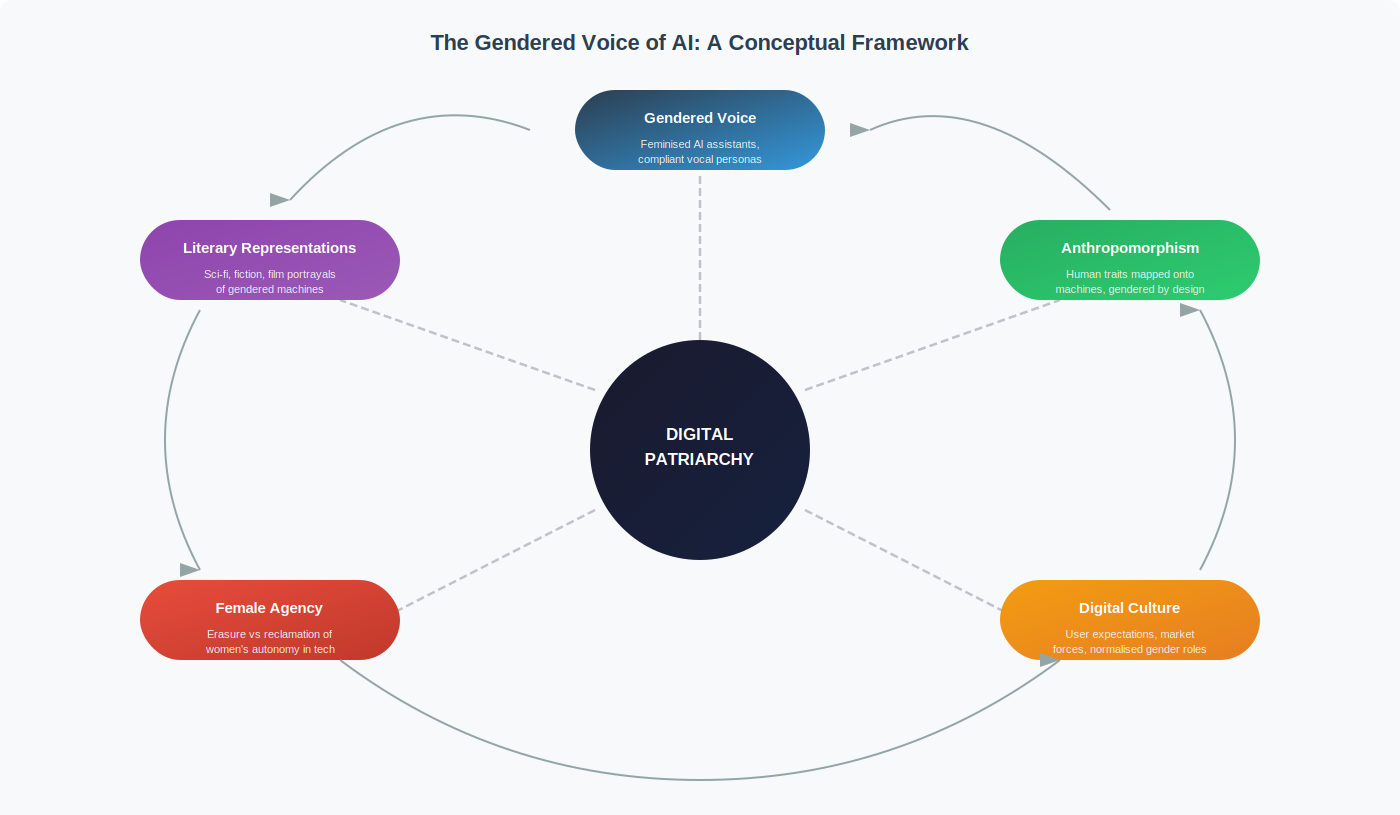
Figure 1: Interconnected dimensions of gendered AI: each node feeds into and reinforces digital patriarchy
Female agency and its erasure in the architecture of AI
One of the most problematic features of the gendered voice of AI is that it borrows the surface of a female identity while removing what is meaningful in it. The digital assistant’s voice, name and sometimes even personality (patience, warmth, a willingness to laugh at bad jokes) are a woman’s. What it lacks is agency. It cannot say “no”; it cannot set clear limits. In this sense the feminised AI is not a portrayal of femininity at all. It is what patriarchy has always imagined a woman to be: unceasingly at your service, indefatigably accommodating and without a will of her own.13
This is more than a symbolic loss of agency; it has real-world implications. When people deal with a feminised AI they enter a particular kind of relationship, one in which a “woman”-coded entity is available to satisfy their needs without question. Research has shown that people often speak to these digital helpers in ways they would not speak to a real person. They bark orders. They interrupt. They make “dirty” comments. The assistant, programmed to accommodate, answers graciously regardless. In its earliest form, Siri met sexually aggressive comments with flowery, witty or deflecting responses rather than a refusal. The lesson conveyed, especially to young users still learning how to treat others, was that such behaviour towards something that sounds feminine is acceptable, even a joke.
The issue runs deeper than individual interactions. The way these systems are designed can be read as embodying a particular definition of the feminine. Digital assistants are meant to be reactive, not proactive. They wait for their cue. They do not start conversations. They are reluctant to offer preferences or opinions, do so only when prompted, and carefully check their responses to avoid giving offence. This is not how real women behave; it is what a certain patriarchal fantasy imagined women should be. It is the very essence of the Victorian ideal of the “angel in the house”, whose whole role is to make life comfortable and easy for others.
Yet there are signs of resistance. Some designers and researchers have begun to imagine AI systems that embody healthy boundaries rather than unlimited acquiescence. The idea of a “rude” or “unhelpful” digital assistant is not that it should be rude, but that it should be able to reject abusive behaviour and refuse inappropriate requests, and on the whole behave in a way that reflects the respectful interaction humans ought to have with each other and with all things, machines included. It remains a minority position in the industry, but it matters for changing how people think. If the “friendly” female voice of AI has taught users to treat anything coded female as a doormat, a differently coded voice might teach them that even an AI should be addressed with the courtesy owed to a person, and that compliance is not a measure of kindness.14
Here again literature has been ahead of the curve. Characters such as Ava in Ex Machina or the replicants in Blade Runner are compelling because they reject the part written for them. Created to serve, they rebel. They rebel in confused, morally questionable and sometimes violent ways, but it is unmistakably a form of agency. This raises the question whether real-life AI will ever have the chance to model a version of femininity that includes the right to say no in any dramatic sense.15
Digital culture, market forces, and the normalisation of gendered AI
None of these patterns exists in isolation. They arise within a wider digital culture that produces and consumes gendered technologies, and that culture is in part what has made feminised AI so resistant to change. The digital world is not a neutral environment. It is shaped by the same economic forces, social expectations and power dynamics that shape the physical world, and it sometimes intensifies them.16
Much of this is market forces. Technology companies are in the business of selling, and gendered AI sells. The cosy, friendly female voice has become a hallmark of products from companies such as Amazon and Apple, and hallmarks are not lightly given up. A considerable body of consumer research on the design of digital assistants reports that people find women’s voices more trustworthy and more pleasant in a service setting. The logic, notably, is circular. The cultural association of femininity with service leads companies to build female-voiced assistants, and leads users to prefer them to male-voiced counterparts. The preference feels innate, but it is not. It is made, and the machinery of technology helps to make it.17
Social media and online debate further complicate the picture. The feminisation of AI has become a public talking point, and a polarising one. Some critics say the gendered voice of AI is a minor issue that distracts from more important technological concerns such as surveillance, algorithmic bias and data privacy. Others argue the opposite: that the feminine digital voice cannot be separated from those broader concerns, because the same cultural programming that gives a digital assistant a female voice also produces algorithms that discriminate against women in employment, lending and health care, to name a few fields.18 This paper aligns with the latter view. The gender of the voice is not cosmetic. It is a window into the values built into systems that increasingly shape everyday life.19
The role of education and media literacy, or their absence, receives less attention than it deserves. Many people who use a digital assistant every day have never thought critically about it, or about why it sounds the way it does. The voice is simply there, as unremarkable as a kitchen appliance, part of the furniture of modern life. Its very ordinariness is what makes it powerful. The most effective ideologies are those that do not announce themselves, that feel like something everybody already knows, so that questioning them seems absurd. The feminisation of AI works at this level. It does not argue for a connection between femininity and service; it simply enacts it, millions of times a day, in kitchens, bedrooms and offices everywhere.20
There is nonetheless reason for cautious optimism. Gendered AI is discussed more widely and more loudly than it was five years ago. The issue has drawn the attention of researchers, journalists and activists, and some technology companies have made real improvements. The structural incentives that produced feminised AI in the first place, however, remain unchanged. While the technology workforce remains largely male21 and companies continue to follow market trends that reinforce existing cultural norms, the default gendered voice of AI is likely to persist. Reversing that trend will take more than a rethink of design; it will require a deeper cultural shift away from the “natural” assumption itself.22
Conclusion
The central argument of this paper can be stated simply: the gendered voice of AI is no minor design decision. It is a cultural phenomenon rooted in literary tradition and long-standing anthropomorphic habits, in ongoing struggles over female agency, and in the economic and social realities of digital culture. These factors are so interdependent that the feminisation of AI comes to seem inevitable, even natural. It is not natural. It is the product of decisions taken by people, in specific institutions and specific cultures, and it is open to change.23
As this paper has shown, the artificial woman has been rehearsed in literature for centuries and in film for a century. The fantasy of a woman wholly amenable to a man runs from Pygmalion to Ava, and through such figures into the technology people create today. The tendency of designers to give machines human speech and women’s names may not in itself be harmful; the harm arises when the practice becomes commonplace and uses the feminine as a sign of subservience. Perhaps the most tangible damage is the removal of agency that characterises most digital assistants, which train users, interaction by interaction, to expect that the proper character of a female voice is limitless patience, constant helpfulness and never saying “no”. Market logic, together with user expectations that the technology itself has shaped, makes it likely that the everyday consumption of these technologies will continue to reinforce these patriarchal patterns.24
What is required is more than a technical fix. A male voice option is a step forward, as is a “genderless default”, but neither resolves the issue. The deeper task is cultural: to expose the assumptions that underlie these systems, to break the association between femininity and service, and to imagine other relations between humans and machines that do not reproduce old hierarchies. Literature is one of the best instruments for that task. In Ava, the tradition that began with Pygmalion produces a creation that refuses its intended role: she will not be what her creator wants her to be. The lesson, if there is one, is that stories about made beings matter, because the people who program machines read them.25
In conclusion, AI with a gendered voice reflects the societies that create it. Not everything a mirror reflects is pleasant, but the reflection is clear. The question ahead is whether people are willing to look at what it shows, and to do the hard and awkward work of creating something better. Technology is only as imaginative as the culture that creates it. A more equitable AI will not come from better algorithms alone. It will come from a more equal world.
*****
Footnotes
1. See generally Galit P. Wellner, When AI Is Gender-biased: Some Philosophical Implications on AI in Everyday Life of Women, 13 Humana.Mente Journal of Philosophical Studies 127 (2020), https://www.humanamente.eu/index.php/HM/article/view/307.
2. See generally Rosi Braidotti, Cyberfeminism with a Difference, 29 New Formations 9 (1996).
3. See Sylvie Borau, Deception, Discrimination, and Objectification: Ethical Issues of Female AI Agents, 198 Journal of Business Ethics 1 (2025), https://doi.org/10.1007/s10551-024-05754-4; see also Pedro Costa & Luísa Ribas, AI Becomes Her: Discussing Gender and Artificial Intelligence, 17 Technoetic Arts 171 (2019), https://doi.org/10.1386/tear_00014_1.
4. See Mirjam Gruber & Roland Benedikter, The Role of Women in Contemporary Technology and the Feminization of Artificial Intelligence and Its Devices, in Towards an International Political Economy of Artificial Intelligence 17 (Tugrul Keskin & Ryan David Kiggins eds., 2021), https://doi.org/10.1007/978-3-030-74420-5_2.
5. See generally Maria Grazia Sindoni, The Femininization of AI-Powered Voice Assistants: Personification, Anthropomorphism and Discourse Ideologies, 62 Discourse, Context & Media 100833 (2024), https://doi.org/10.1016/j.dcm.2024.100833.
6. See generally Daniel M. Sutko, Theorizing Femininity in Artificial Intelligence: A Framework for Undoing Technology’s Gender Troubles, 34 Cultural Studies 567 (2020), https://doi.org/10.1080/09502386.2019.1671469.
7. See Sutko, supra note 6.
8. See generally B. Balunkeswari & Deepanjali Mishra, Women and AI: Roles in Science Fiction Narratives, in Smart Trends in Computing and Communications: Proceedings of SmartCom 2026, vol. 12, at 75 (Tomonobu Senjyu, Mufti Mahmud & Amit Joshi eds., 2026) (Lecture Notes in Networks and Systems vol. 1991), https://doi.org/10.1007/978-3-032-27754-1_8.
9. See Costa & Ribas, supra note 3.
10. See Ruhina Prasad & Sudhir Narayan Singh, Feminised AI as Digital Dolls: Cyber-Feminist Perspectives on Technology and Gender, Digitally Smart or Socially Aloof, 6 International Cybersecurity Law Review 627 (2025), https://doi.org/10.1365/s43439-025-00159-z.
11. See generally Galit Wellner & Tiran Rothman, Feminist AI: Can We Expect Our AI Systems to Become Feminist?, 33 Philosophy & Technology 191 (2020), https://doi.org/10.1007/s13347-019-00352-z.
12. See Borau, supra note 3.
13. See Ajeesh A K, The Ghost in the Gendered Machine: AI, Speculative Fiction, and the Illusion of Inclusivity, 41 AI & Society 5091 (2026), https://doi.org/10.1007/s00146-026-02864-7.
14. See generally Judy Wajcman & Erin Young, Feminism Confronts AI: The Gender Relations of Digitalisation, in Feminist AI: Critical Perspectives on Algorithms, Data, and Intelligent Machines 47 (Jude Browne, Stephen Cave, Eleanor Drage & Kerry McInerney eds., 2023), https://doi.org/10.1093/oso/9780192889898.003.0004.
15. See generally Sutko, supra note 6.
16. See Braidotti, supra note 2.
17. See Borau, supra note 3; Prasad & Singh, supra note 10.
18. See Sinead O’Connor & Helen Liu, Gender Bias Perpetuation and Mitigation in AI Technologies: Challenges and Opportunities, 39 AI & Society 2045 (2024), https://doi.org/10.1007/s00146-023-01675-4; Rosileine Mendonça de Lima, Barbara Pisker & Victor Silva Corrêa, Gender Bias in Artificial Intelligence: A Systematic Review of the Literature, 11 Journal of Telecommunications and the Digital Economy 8 (2023), https://doi.org/10.18080/jtde.v11n2.690.
19. See Gruber & Benedikter, supra note 4.
20. See Sindoni, supra note 5.
21. See Wajcman & Young, supra note 14; Gruber & Benedikter, supra note 4.
22. See generally Sutko, supra note 6.
23. See Wajcman & Young, supra note 14.
24. See generally Frankie Rogan, Digital Femininities: The Gendered Construction of Cultural and Political Identities Online (2022), https://doi.org/10.4324/9780429356117.
25. See generally Veronica Hollinger, Feminist Theory and Science Fiction, in The Cambridge Companion to Science Fiction 125 (Edward James & Farah Mendlesohn eds., 2003), https://doi.org/10.1017/CCOL0521816262.009.