

Introduction
Outer space is an operational environment. Orbital regions, tracking infrastructure, and digital command systems are used for civil, commercial, and military purposes, and orbital congestion results from the combination of military and civilian activity. Space debris arises increasingly from dual-use military and civilian operations, and questions of answerability, attribution, and deterrence among formally equal States are central to its regulation.[1] States are physically interdependent in orbit. In legal terms, space debris raises issues of answerability and deterrence across a range of risks. Space debris is no longer a mere externality: debris originating from national or military assets is not simply an environmental by-product of space activity.
India occupies a significant place in this field. It has interests across the commercial, developmental, and strategic space sectors, a growing private space industry, and a stated commitment to the peaceful use of outer space. In March 2019, however, Mission Shakti demonstrated India’s anti-satellite capability and underscored the growing military use of space.[2] The problem this paper addresses is whether the existing international legal framework adequately governs the space-debris risks created by military and dual-use activity, and whether India’s current domestic law on space debris is adequate to fulfil its international obligations.
This paper makes two claims. First, although evidential, debris-related, and security concerns strain the practical utility of treaty-based regulation, the existing duties of international responsibility, due regard, consultation, registration, and liability already cover a significant part of the legal terrain governing debris. Second, the accountability gap as it relates to India stems from the absence of domestic legislation to allocate liability, to govern the private sector, and to require due diligence on debris within the licensing regime.[3] The emerging constraints on direct-ascent anti-satellite (ASAT) testing, articulated through international practice, are important because they help to clarify the boundaries of responsible conduct under existing international law.
International legal architecture of orbital responsibility
The law governing debris risk is neither absent nor without effect. Its core rules were drafted for an era of far less orbital debris, yet they continue to shape the legal order within which military and other dual-use practices must be disciplined.
A. Treaty Duties of Responsibility and Due Regard
Article VI of the Outer Space Treaty[4] provides that States bear international responsibility for national activities in outer space, whether carried out by governmental agencies or by non-governmental entities, and must authorise and continuously supervise such activities. For India, this provision reaches well beyond classical inter-State diplomacy, because Indian space activity now comprises commercial launch services, satellite operations, and private actors operating under public governance. Article VI is far-reaching in the responsibility it imposes: at a minimum, it requires the State to exercise authorisation and continuing supervision over actors whose conduct it might otherwise be unable to control.
Article IX[5] complements that responsibility by requiring States to conduct their activities with due regard to the corresponding interests of all other States, which entails coordination, restraint, and consultation. This duty is particularly significant for debris, where it should be read as more than a rhetorical courtesy: due regard requires States to take account of the less predictable consequences of their activities, especially as the orbital environment becomes more congested and less controllable.
B. Liability, Registration, and the Limits of Formal Attribution
The Convention on International Liability for Damage Caused by Space Objects establishes an asymmetric liability framework. Damage caused by a space object to persons or property on the surface of the Earth or to aircraft in flight attracts absolute liability, whereas damage caused elsewhere, that is, in outer space, depends on proof of fault.[6] This reflects the assumption that collisions in space would remain infrequent and technically straightforward to characterise. In an environment shaped by space debris, however, fault is the most difficult element to establish. A debris cloud may outlive the mission that created it, interact with many operators, and cause damage only after a long and attenuated chain of events.
The Convention on Registration of Objects Launched into Outer Space advances attribution without fully resolving it. By recording launching States, objects, and basic identifying data, registration serves important legal, diplomatic, and jurisdictional functions.[7] Registration is, however, object-focused, whereas debris disputes turn on fragments. Once a space object degrades into debris, its constituent parts may become untraceable, impossible to connect to any single negligent act, and indistinguishable from the surrounding population of objects. Legal attribution therefore remains valuable, but it is not an effective route to operational accountability for militarised or dual-use debris that later creates a collision risk.
C. Environmental Due Diligence by Analogy
Although the international space-law regime contains no dedicated environmental-liability code, it can be read in the light of general international law. In Corfu Channel (United Kingdom v. Albania),[8] the International Court of Justice held that a State must not knowingly allow its territory to be used for acts contrary to the rights of other States. The arbitral tribunal in the Trail Smelter case (United States v. Canada)[9] articulated the related principle that a State must not permit activities within its control to cause significant harm to other States. These authorities should not be read as transplanting terrestrial environmental regulation wholesale into outer space, but they support reading a duty of due diligence into Articles VI and IX.
More recent environmental jurisprudence supports this reading. In Pulp Mills on the River Uruguay (Argentina v. Uruguay),[10] the International Court of Justice treated environmental impact assessment and a duty of due diligence as integral to the prevention of significant transboundary harm, and the 2024 Request for an Advisory Opinion Submitted by the Commission of Small Island States on Climate Change and International Law[11] before the International Tribunal for the Law of the Sea affirmed the role of due diligence in this context. By analogy, the prevention of transboundary harm can be applied to outer space: the generation of space debris is precisely the kind of conduct that produces transboundary harm.
India’s exposure to military and dual-use debris risks
India’s legal position must reflect operational realities. Debris governance cannot be reduced to a theoretical compliance checklist. India faces tangible congestion of its spacecraft, launch systems, and strategic missions, frequent collision alerts, and reputational exposure within a fast-changing and complex security environment.[12]
A. Operational Vulnerability in Congested Orbits
According to the Indian Space Research Organisation’s Indian Space Situational Assessment Report for 2024, ISRO analysed more than 53,000 conjunction alerts generated by the Combined Space Operations Center of United States Space Command in respect of India’s satellites during the year, and carried out collision-avoidance manoeuvres in both low Earth and geostationary orbits.[13] These figures matter for legal analysis: they indicate that India is not merely an observer of a shared problem. India is a frequent subject of tracking, warning, and risk management. Figure 1 places these conditions in global perspective by illustrating the estimated population of space debris across the major size categories.
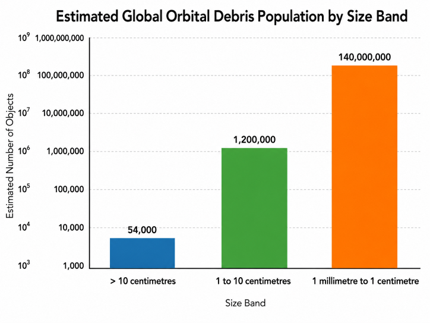
Figure 1. Estimated global orbital debris population by size band.
The European Space Agency’s 2025 report indicates that, as debris decreases in size, its population rises sharply and becomes increasingly difficult to monitor; the smallest fragments cannot be individually catalogued.[14] As that challenge grows, so does the inadequacy of a legal system that depends on fault and attribution. For India, the conclusion is that even relatively low-risk missions remain exposed to a legal system whose responses are slower and less effective than the hazards themselves.
B. Mission Shakti and the Security Dimension
Mission Shakti illustrates the tension between India’s sovereign-security priorities and the collective security of the outer-space environment. According to India’s Ministry of External Affairs, the anti-satellite test was conducted in a low orbit so that the resulting debris would re-enter and burn up in the atmosphere within weeks, and India remains committed to preventing an arms race in outer space and to transparency and confidence-building measures. The episode presents what may be called a “responsibility dilemma.”[15] Even so, the legal system provides no agreed metric for what counts as “acceptable” residual risk.
Recent analyses of India’s space policy indicate a broad shift toward a combination of security and prestige objectives, while retaining a developmental focus. This duality makes India a revealing case study.[16] India cannot realistically set aside its security concerns, but neither can it sustain a legally defensible position that normalises debris clouds as a routine exercise of strategic autonomy. Figure 2 illustrates the international response to destructive ASAT testing and situates India’s policy choices within a developing climate of restraint.
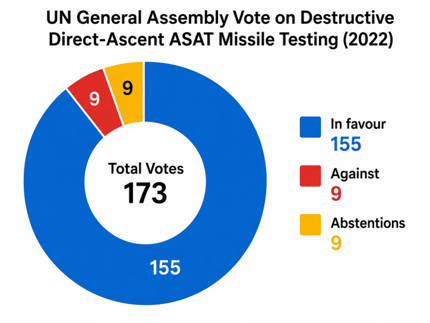
Figure 2. United Nations General Assembly voting on destructive direct-ascent anti-satellite missile testing.
C. Economic and Strategic Consequences
Debris also raises economic concerns: a higher collision probability increases the cost of insurance, the burden of operational safety measures, and the expense of redesigning missions and of possible future remediation. For a country with expanding launch, remote-sensing, and navigation services and a developing private sector, these costs bear directly on economic development.[17] For India, they translate into competitive disadvantage for domestic operators and a risk to confidence in India’s capacity to regulate the sector. The legal case for action strengthens as Indian operators come to depend on a stable orbital environment.
Dual-use technology adds a further layer. Active debris removal, rendezvous and proximity operations, and autonomous servicing can advance sustainability, yet the same capabilities may be perceived as counterspace assets. India must therefore balance the development of these capabilities against measures to govern their counterspace potential.[18] From a legal perspective, India’s ability to regulate the development of such capabilities is necessary to ensure that it is not perceived as inherently destabilising and that an adequate evidentiary record is maintained.
Accountability gaps in the existing regime
The principal deficiency in the law as it stands is not a total absence of norms but a failure of implementation. Military and dual-use debris activity exposes several chronic gaps: uncertain attribution, an almost non-existent remedial framework, and a lack of domestic systems through which international obligations can be translated into enforceable, operational rules.[19]
A. Attribution, Opacity, and the Burden of Proof
The most obvious gap concerns attribution. The Registration Convention may identify the original launching State, but a debris dispute may require answers to further questions: which fragment, at what time, from which mission, and under whose operation. Military and dual-use missions aggravate the problem, because key data on mission design, control, and disposal may be classified.[20] The resulting asymmetry means that the State best placed to explain an incident may also have the strongest incentive to withhold information.
Greater surveillance does not by itself cure the problem of incomplete observation. NASA’s 2024 cost-benefit analysis of orbital-debris tracking and remediation indicates that, although tracking and cataloguing additional objects improves safety, no system can capture every fragment or every potential collision path. Legally, the difficulty is not simply locating information.[21] It is that the relevant information is dispersed among entities with differing levels of access, motivation, and accountability, which dilutes the formal and informal pressure that might otherwise push parties toward early settlement.
B. Fault-Based Liability and the Remedial Deficit
A further gap concerns harm caused in orbit to space objects. A claimant State must generally show that the harm is attributable to the fault of the launching State or of those for whom it is responsible. That burden is demanding in any setting, and more so for orbital debris, where intervening acts such as a failure to passivate a spent stage, a poor disposal orbit, or even a test once assumed to be benign may only later produce a damaging fragment.[22] The extended causal chains in such cases make them extraordinarily complex and politically sensitive.
Because harm and remedy are weakly connected, many serious orbital threats are difficult to litigate. Even where fault can be shown, the available remedies are slow, inter-State in character, and ill-suited to the pace of commercial and strategic activity. This is why emerging norms of restraint matter, even before they harden into binding obligations.[23] As the meaning of restraint, negligence, and foreseeability is worked out in the absence of a comprehensive treaty, these emerging norms can fill the gaps. Conduct that today attracts widespread diplomatic disapproval may become tomorrow’s benchmark for the limits of care and restraint.
C. India’s Incomplete Domestic Legislative Framework
In March 2026, the Department-related Parliamentary Standing Committee on Science and Technology, Environment, Forests and Climate Change observed that, pending comprehensive legislation, India’s space activities continue to be governed largely by guiding policies and mission-specific instruments, even though draft legislation is at an advanced stage. This matters in practice because the aspirations expressed in administrative policy must, for the purposes of Article VI, be capable of legislative definition: the treaty contemplates responsibility, supervision, accountability, and remedial action.[24]
In March 2026, data placed before Parliament indicated that trackable orbital debris of Indian origin includes defunct satellites, spent launch-vehicle stages, and fragments from various break-up events; Figure 3 depicts this composition.[25] The aim here is not to overstate India’s relative contribution to the global debris problem. Rather, India’s credibility as a responsible spacefaring nation depends on a domestic policy that addresses its legacy objects, future missions, and private actors with consistent concern. A State that applies its space-law principles selectively at home cannot expect those principles to command full respect abroad.
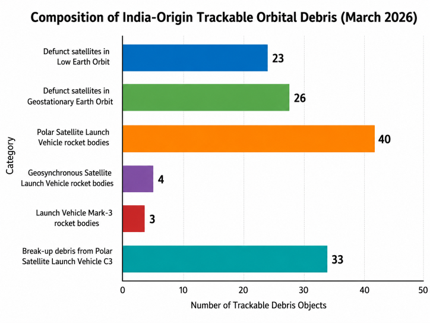
Figure 3. Composition of India-origin trackable orbital debris reported in March 2026.
Emerging restraint norms and their legal significance
Recent diplomatic practice has moved from abstract opposition to the weaponisation of outer space toward more precisely defined restraint of particular behaviours. Although these developments do not yet amount to a comprehensive prohibition on weaponisation, they increasingly shape arguments about the legality, reasonableness, and responsibility of military activities that may create space debris.[26]
A. The Behavioural Turn in Multilateral Practice
A significant example is the 2022 United Nations General Assembly resolution on destructive, direct-ascent anti-satellite missile testing. Its importance lies less in its status as a source of formal international law than in the relative specificity of the behaviour it addresses.[27] Earlier debates about a potential arms race in outer space often foundered on broad abstractions and political deadlock. By contrast, the resolution targets a specific, observable, and generally undesirable practice: the creation of long-lived debris through destructive testing. The resolution is therefore more than a voting record. It expresses an emerging effort to isolate and discourage a particular form of conduct, separating it from wider strategic disagreement and stigmatising it on sustainability grounds.
B. Restraint as Evidence of a Developing Standard of Care
This behavioural turn is significant for India because it broadly aligns with India’s own diplomatic positions. The Ministry of External Affairs has consistently emphasised the peaceful uses of outer space, support for the core space treaties, and the importance of transparency and confidence-building. While such positions do not preclude military activity, they allow India to support and call for restraint by others without compromising its own security. A State that advocates sustainability, transparency, and responsible conduct can credibly argue, in both legal and diplomatic terms, that some military capabilities are harder to justify than others.[28]
Informal guidance points in the same direction. The Space Debris Mitigation Guidelines of the Committee on the Peaceful Uses of Outer Space provide that the generation of debris during normal operations should be limited, that break-ups should be minimised, and that end-of-life spacecraft and spent upper stages should be removed from protected regions of outer space. Although these instruments are formally soft law, in practice they set increasingly clear parameters for mission planning.[29] As States, operators, and regulators repeatedly invoke the Guidelines, they may come to be treated as binding in substance, so that even without a formal treaty obligation they help to define the applicable standard of care and, ultimately, of liability.
The advisory opinion in Obligations of States in Respect of Climate Change[30] indicates that the existence of a detailed treaty regime does not displace general international-law duties of due diligence and the prevention of harm. By analogy, operational constraints in outer space can advance norms of State responsibility even without a comprehensive treaty. For the management of military and dual-use debris, diplomacy, operational guidance, and emerging restraints are likely to shape the standards against which conduct is judged.
C. Limits of Voluntary Commitments
In the absence of binding law, voluntary commitments cannot always prevent States from causing harm, although they help to generate shared expectations. Such commitments can encourage compliance with emerging norms, but adherence ultimately remains discretionary.[31] Informal regulatory frameworks shape State conduct alongside diplomacy and developing law; their principal value lies in articulating norms of conduct that align with broader constraints.
India’s interest lies in providing normative leadership without incurring unilateral vulnerability. On that approach, India could forgo debris-generating tests, support operational transparency where feasible, and develop and advocate standards for safer rendezvous, passivation, and end-of-life disposal. Figure 4 sets out the categories of norms gaining prominence in the accountability debate. While such a posture would not eliminate strategic rivalry, it could strengthen India’s position and support the argument that self-imposed restraint on certain capabilities serves both security policy and orbital sustainability.[32]
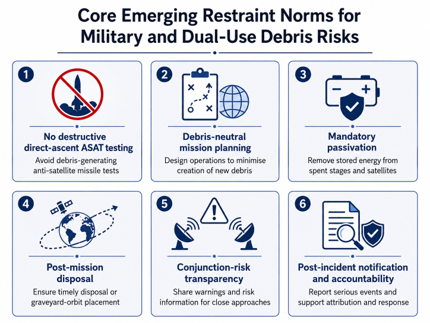
Figure 4. Core restraint expectations relevant to military and dual-use debris risks.
Domestic reform pathways for india
India’s most significant contribution to the international legal order on debris depends on the degree of domestic legislative coordination it achieves. A sound system should translate broad treaty obligations and diplomatic commitments into specific rules on authorisation, oversight, accountability, and incident management.[33]
A. Comprehensive Legislation and Regulatory Clarity
Indian space law should allocate clear responsibilities among the Department of Space, the Indian National Space Promotion and Authorisation Centre, the Indian Space Research Organisation, and the relevant defence authorities. The authorisation, registration, and supervision functions reflected in the Indian Space Policy 2023 should be placed on a statutory footing. Legislation should define the criteria and thresholds for authorising and approving missions, the requirements for debris mitigation, and the sanctions for non-compliance.[34] This would reduce reliance on opaque administrative practice and demonstrate that India’s Article VI obligations are met through known legal norms rather than arbitrary or implicit measures.
Legislation should distinguish ordinary civil operations from higher-risk military or dual-use operations. Sensitive missions may require confidentiality, but they must still fall within a legal framework, particularly where there is significant potential for break-up or debris generation. That framework should require the creation of auditable decision-making records, retained for later review, together with risk assessment and legal review. These measures need not compromise operationally sensitive information, but would establish a contemporaneous record against which accountability can be assessed should a mission later give rise to diplomatic protest, insurance claims, or international legal disputes.[35]
B. Liability, Insurance, and Environmental Precaution
Indian law should contain explicit provisions allocating primary and secondary liability among public authorities, private licensees, contractors, and insurers. Such a framework should reflect international law by distinguishing inter-operator loss, State-to-State loss, and loss to third parties, with State liability where appropriate. For high-risk but socially beneficial activities, M.C. Mehta v. Union of India[36] supports placing a stringent liability on the enterprise that carries on the hazardous activity. A comparable regulatory rationale applies to space operations, which, like other socially beneficial but hazardous industrial activities, warrant a demanding liability standard.
The precautionary principle, articulated in Vellore Citizens’ Welfare Forum v. Union of India,[37] can also inform debris governance. Precaution in outer space does not require paralysis or blanket risk aversion. It calls instead for the proactive design of systems in light of scientific uncertainty and the potential for irreversible harm, including conservative disposal planning, mandatory passivation, defined collision-risk thresholds, and independent technical evaluation of high-impact missions. Insurance regulation should reinforce such conduct by making premiums and coverage conditional on adherence to debris-minimisation standards. The result would be an alignment of public law, private ordering, and international obligations.
C. Data-Sharing, Incident Response, and Norm Entrepreneurship
India should establish a national framework for managing orbital conjunctions, break-up events, and debris generation. The framework should specify who must report, in what sequence, how foreign tracking data is to be handled, and when an event should be made public. Where several States are involved, it should provide for a public announcement accompanied by an account of the event, so that India treats the matter, in international law, as a shared risk rather than a question of prestige, thereby helping to lower tensions when debris-generating events occur. Such protocols become all the more important where the events are of a dual-use character.[38]
Finally, India’s multilateral diplomacy places it on a middle path: it can resist operating outside legitimate security bounds while also questioning the legitimacy of debris-generating conduct. India is well placed, having faced both the security and the commercial dimensions of space development. Coupled with legislation, supervision, and supportive diplomacy, that experience can contribute substantially to the development of space policy, positioning India as, at the least, a participant in, and at most an architect of, emerging norms.[39]
Conclusion
The risks that military and dual-use debris pose to the public and to space assets stretch existing space law to its limits. The governing treaties remain essential, yet the difficulty of proving fault and the secrecy surrounding the relevant decisions create persistent, long-term challenges.[40]
This paper has shown that India’s international commitments are already considerable. Taken together, international responsibility, due regard, consultation, registration, liability, and debris-mitigation standards provide a coherent benchmark for evaluating military and dual-use conduct in space. That benchmark nonetheless leaves clear accountability voids where debris is dispersed, evidence is asymmetrical, and the only remedial pathway is a fault-based inter-State process. These conditions illustrate the gap between formal commitment and actual accountability: the law may exist, but accountability and remedy remain most tenuous precisely where the stakes are highest.[41]
For India, the central challenge is to translate its international standing into domestic practice. Diplomacy that balances competing responsibilities cannot rest on treaty adherence and policy statements alone. It must be supported by legislation that allocates responsibility, supervises both public and private actors, and provides for the preservation of information. India can strengthen its legal credibility and strategic autonomy by treating debris management and orbital sustainability not as concessions of national power, but as integral to it.[42]
Suggestions
The issues set out above suggest that long-term accountability in outer space depends on combining strategic capability, legal constraint, institutional openness, and sound operational judgement across the full lifecycle of military and dual-use missions. The following measures are recommended.
Enact comprehensive space legislation. India should move from reliance on policy frameworks to a statutory framework addressing authorisation, ongoing oversight, accountability, record-keeping, penalties, and compensation. Legal certainty is essential, because Article VI responsibility cannot be discharged consistently through ad hoc administrative action.
Create a debris-specific licensing regime. Licences for launch, operation, servicing, or disposal should carry debris-mitigation conditions tailored to the mission profile, orbital altitude, and break-up risk. A dedicated licensing chapter would convert sustainability from an aspiration into a measurable, legally binding obligation.
Mandate mission-level risk assessment. Demanding missions, particularly those with military or dual-use dimensions, should undergo rigorous legal and technical risk assessment before approval, addressing expected debris, disposal assumptions, and contingency planning, so that responsibility is anticipated rather than assigned only after an event.
Link insurance to mitigation performance. Operators who comply with passivation, disposal, and conjunction-response criteria should benefit in their insurance premiums. Where formal sanctions for poor debris practices are few, premium design can make such practices financially unattractive and so serve as a regulatory lever.
Preserve confidential audit trails. Even where operations require secrecy, India should create and retain protected internal documentation explaining operational decisions. Treated as a confidential audit trail, such records would support retrospective investigation, parliamentary oversight, and dispute resolution without disclosing security-sensitive information.
Adopt a national orbital incident protocol. India should standardise its responses to conjunction warnings, break-ups, and potential debris events through formal procedures for preserving telemetry, coordinating among agencies, engaging foreign tracking services, and deciding when to make an event public.
Support restraint on destructive testing. India should support the prohibition of destructive direct-ascent anti-satellite (ASAT) missile tests and contribute to the development of debris-neutral alternatives. Doing so would reduce diplomatic criticism while preserving India’s strategic credibility.
Strengthen supervision of private operators. As private participation grows, oversight should include scheduled compliance reporting, audits, and legally binding end-of-life obligations. Sustained supervision is legally necessary, because accountability for activities in outer space extends beyond governmental actors.
Invest in national space situational awareness. Improved national tracking, conjunction analysis, and data-fusion capacity would enhance both safety and legal preparedness. India’s ability to assign accountability, defend its operators, or substantiate a claim against third parties depends heavily on the quality and preservation of technical evidence.
Use diplomacy to shape operational standards. India should develop pragmatic criteria for passivation, disposal, close-approach behaviour, and incident reporting, and advocate them in multilateral fora. Norm entrepreneurship is most credible where domestic regulation and international advocacy are aligned.
*****
Footnotes
[1] Bin Cheng, Studies in International Space Law 118 (1997).
[2] Francis Lyall & Paul B. Larsen, Space Law: A Treatise 74 (3d ed. 2024).
[3] Ram S. Jakhu & Paul Stephen Dempsey, Routledge Handbook of Space Law 145 (2017).
[4] Treaty on Principles Governing the Activities of States in the Exploration and Use of Outer Space, Including the Moon and Other Celestial Bodies art. VI, Jan. 27, 1967, 610 U.N.T.S. 205.
[5] Id. art. IX.
[6] Convention on International Liability for Damage Caused by Space Objects arts. II, III, Mar. 29, 1972, 961 U.N.T.S. 187.
[7] Convention on Registration of Objects Launched into Outer Space, Jan. 14, 1975, 1023 U.N.T.S. 15.
[8] Corfu Channel (U.K. v. Alb.), Judgment, 1949 I.C.J. 4 (Apr. 9).
[9] Trail Smelter (U.S. v. Can.), 3 R.I.A.A. 1905 (1941).
[10] Pulp Mills on the River Uruguay (Arg. v. Uru.), Judgment, 2010 I.C.J. 14 (Apr. 20).
[11] Request for an Advisory Opinion Submitted by the Commission of Small Island States on Climate Change and International Law, Advisory Opinion, ITLOS Case No. 31 (May 21, 2024).
[12] Ram S. Jakhu & Joseph N. Pelton, Global Space Governance: An International Study 176 (2017).
[13] Indian Space Research Org., Indian Space Situational Assessment Report for 2024 (2025).
[14] Eur. Space Agency, ESA Space Environment Report 2025 (2025).
[15] Ministry of External Affairs, Gov’t of India, Frequently Asked Questions on Mission Shakti, India’s Anti-Satellite Missile Test Conducted on 27 March 2019, https://www.mea.gov.in/press-releases.htm?dtl/31179/ (last visited May 6, 2026).
[16] Rajeswari Pillai Rajagopalan & Dimitrios Stroikos, The Transformation of India’s Space Policy: From Space for Development to the Pursuit of Security and Prestige, 69 Space Pol’y 101633 (2024).
[17] Molly K. Macauley, The Economics of Space Debris: Estimating the Costs and Benefits of Debris Mitigation, 115 Acta Astronautica 160 (2015).
[18] C. Priyant Mark & Surekha Kamath, Review of Active Space Debris Removal Methods, 47 Space Pol’y 194 (2019).
[19] Stephan Hobe, Space Law 102 (2019).
[20] Brian Weeden, Overview of the Legal and Policy Challenges of Orbital Debris Removal, 27 Space Pol’y 38 (2011).
[21] Jericho Locke et al., Cost and Benefit Analysis of Mitigating, Tracking, and Remediating Orbital Debris 1 (Nat’l Aeronautics & Space Admin., Off. of Tech., Pol’y & Strategy 2024).
[22] Frans G. von der Dunk & Fabio Tronchetti, Handbook of Space Law 285 (2015).
[23] Jie Long & Chuying Huang, Obligations and Liabilities Concerning the Active Removal of Foreign Space Debris: A Global Governance Perspective, 222 Acta Astronautica 422 (2024).
[24] Rajya Sabha, Dep’t-Related Parliamentary Standing Comm. on Sci. & Tech., Env’t, Forests & Climate Change, Four Hundred Tenth Report on Demands for Grants (2026-2027) of the Department of Space 1 (2026).
[25] Press Info. Bureau, Gov’t of India, Space Debris Management, https://www.pib.gov.in/PressReleaseDetail.aspx?PRID=2241770&lang=1®=1 (last visited May 5, 2026).
[26] Ching Wei Sooi, Direct-Ascent Anti-Satellite Missile Tests: State Positions on the Moratorium, UNGA Resolution, and Lessons for the Future 7 (Secure World Found. 2023).
[27] G.A. Res. 77/41, Destructive Direct-Ascent Anti-Satellite Missile Testing (Dec. 7, 2022).
[28] Frequently Asked Questions on Mission Shakti, supra note 15.
[29] U.N. Off. for Outer Space Affs., Space Debris Mitigation Guidelines of the Committee on the Peaceful Uses of Outer Space 2 (2010).
[30] Obligations of States in Respect of Climate Change, Advisory Opinion, 2025 I.C.J. (July 23) (General List No. 187).
[31] M.Y.S. Prasad, Technical and Legal Issues Surrounding Space Debris: India’s Position in the United Nations, 21 Space Pol’y 243 (2005).
[32] U.N. Off. for Outer Space Affs., Guidelines for the Long-Term Sustainability of Outer Space Activities of the Committee on the Peaceful Uses of Outer Space 3 (2021).
[33] Hobe, supra note 19, at 184.
[34] Dep’t of Space, Indian Space Policy 2023 (2023).
[35] Lyall & Larsen, supra note 2, at 212.
[36] M.C. Mehta v. Union of India, (1987) 1 S.C.C. 395.
[37] Vellore Citizens’ Welfare Forum v. Union of India, (1996) 5 S.C.C. 647.
[38] Locke et al., supra note 21, at 4.
[39] Prasad, supra note 31, at 243.
[40] Cheng, supra note 1, at 221.
[41] von der Dunk & Tronchetti, supra note 22, at 318.
[42] Rajya Sabha, supra note 24, at 11.