

Introduction
The The right to livelihood, and a safe work environment are universally acknowledged fundamental and human rights, workplace sexual harassment is an open challenge to both. It is a multifaceted issue as it infringes on human rights, equality, women’s employment rights, and labour laws. Workplace sexual harassment presents unique challenges, as the victim often faces additional issues like job insecurity, humiliation, intimidation, fear of retaliation, and a hostile work environment. Such peculiar circumstances further demotivate to come forward with complaints and take action against the perpetrator(s), thus forcing victim to suffer in silence.
In India, women workers are particularly vulnerable to sexual harassment due to economic dependence, job insecurity, societal stigma associated with victims of sexual offences, lack of dialogue on the issue, and the pervasive influence of patriarchy and societal norms in the workplace. To address this issue, a specialized legislation titled the “Sexual Harassment of Women at Workplace (Prevention, Prohibition and Redressal) Act, 2013,” (PoSH Act).[1]
Objectives of the Study
This study aims to understand the evolution of Indian law on workplace sexual harassment, analyse provisions of the Act of 2013, and find out statutory gaps and implementational challenges, especially in the light of emerging trends of employment and workplace.
Evolution of legal framework
Prior to the Vishaka guidelines came into force India, sexual harassment at work was a problem that was largely ignored. In absence of any specific legislative provision, women who face such harassment at the workplace had to file a complaint as per the provisions of Indian Penal Code (IPC)[2]. The Code’s only sections that could be applied to deal with such complaints were; Section 294 (Obscene Acts and Songs), Section 354 (Outraging the modesty of a woman) and Section 509 (Insulting the modesty of a woman).
Punjab and Haryana High Court in Rupan Deol Bajaj[3] case deemed the recourse under the provisions of the IPC was insufficient. It identified that there was a legal loophole and that more specialised legislation was required. The absence of any specialised legal framework, amplified the underreporting, and the attitude of indifference towards the plight and suffering of women.
It was only in the year of 1997; the Apex Court of India adjudicated upon a writ of Mandamus in the popularly known as of Vishaka[4] case; which later became a watershed moment for millions of working women in India.
It was prompted by public outcry following the injustice faced by Bhanwari Devi, who became victim of gangrape for her opposition to child marriage, as a part of her duty as a social worker (Saathin) affiliated to a Project on Women’s Development sponsored by the Rajasthan state government. Showing solidarity with Bhanwari Devi and millions of other unknown unnamed women of this nation who suffer through sexual harassment daily to earn a living, a Writ of Mandamus was filed in the Supreme Court of India by the women’s organization “Vishaka” by invoking PIL jurisdiction.
The Hon’ble Court recognized workplace sexual harassment as a violation of women’s fundamental rights to equality under Article 14 and Article 15 and their right to live with dignity under Article 21 of the Constitution of India. These ruling established guidelines aimed at preventing and addressing sexual harassment complaints. The Vishaka Guidelines mandated that employers create a safe work environment for women through both preventive and remedial measures. In absence of specific legislation these guidelines provided relief and redressal to victims.
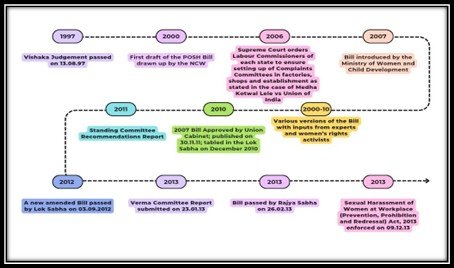
Figure-1: Timeline of the Evolution of the PoSH Act, 2013
A brief analysis of the act
The sexual Harassment of Women at Workplace Act, and the Rules, became enforceable along since December 9 of 2013.[5] This Act also fulfills commitment to the United Nations Convention on the Elimination of Discrimination against Women[6], ratified in 1993.
The Act comprises only 30 Sections, discussed over 8 chapters. The legislative focus is divided into three key areas, its objectives are to prevent sexual harassment at workplaces, protect women from such danger, and provide suitable redressal mechanism.
A. What is legally recognized as Sexual Harassment?
The Act explicitly prohibits sexual harassment of women at workplace.[7]
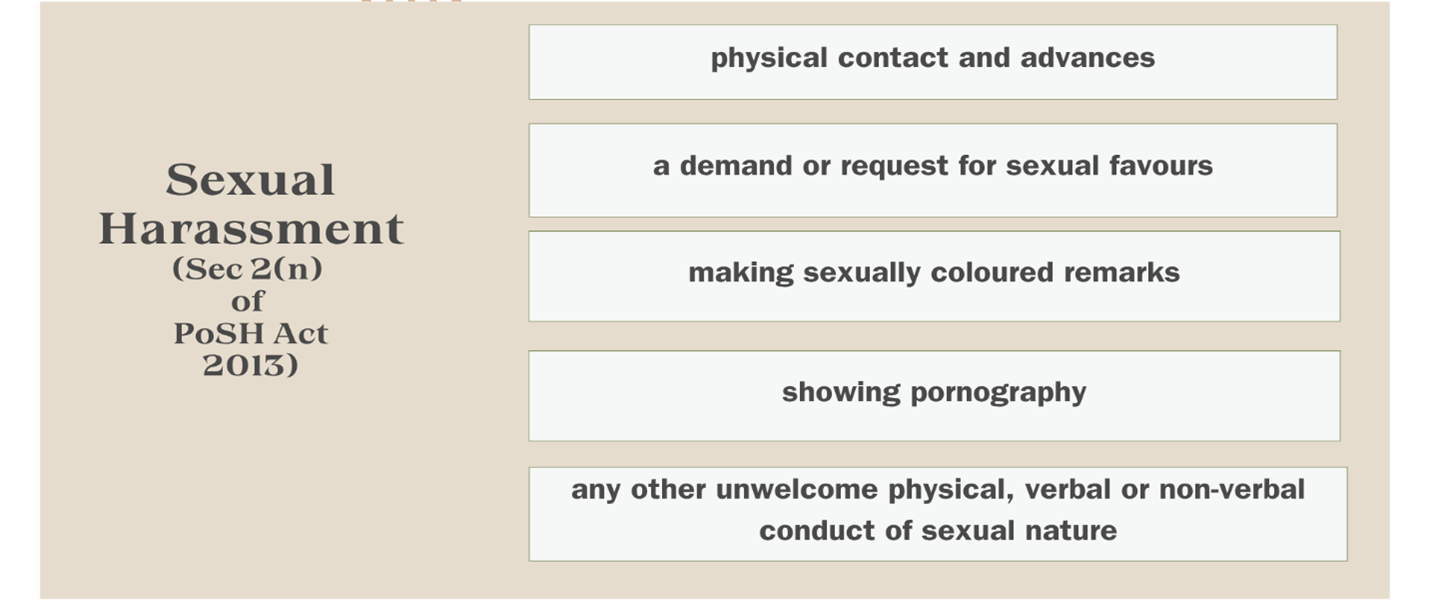
Figure-2: Statutory definition
This definition provided under the Act 2013, is borrowed from the definition framed by the Apex Court in the Vishaka Guidelines. Later on, this same definition was also adopted by the Indian Penal Code[8] and the Bharatiya Nyaya Sanhita[9] to define the offence of “sexual harassment”.
Further, it is specified that offering preferential treatment or threatening detrimental treatment in employment, or making threats regarding present or future employment status, or interfering with work or creating a hostile environment, or humiliation that may affect a woman’s health or safety, is also an offence under the Act, if any of the activity is connected to sexual demands.
This definition under Section 3 incorporates the definition approved by the International Labour Organization (ILO). It acknowledges two main forms sexual harassment at workplace. One version is “Quid Pro Quo” (“this for that”) which means implicit or explicit promise of favorable or unfavorable treatment in employment, or implicit or explicit threats regarding a person’s current or future job status. Another form is creating hostile work environment, which is creating an atmosphere filled with intimidation at work, or subjecting someone to humiliation that could impact their health or safety.
It’s apt to mention that, apart from above discussed certain circumstance some other behaviors are described as sexual harassment, as per the Handbook on the PoSH Act[10], prepared by the of the Government of India. Remarks about body or sex life of a person, or asking inappropriate questions, or displaying sexist or otherwise offensive material, or extending unwelcome social invitations with sexual undertones, or stalking, or invading personal space or threatening or retaliating against an employee who reports above mentioned unwelcome behavior, etc. are to be treated as instances of sexual harassment.
On a combined reading of the Section 2(n) and Section 3 of the Act, it’s evident how conscientiously the term “sexual harassment” is defined, so as to cover every foreseeable instance of sexual misconduct at workplace.
As differing perspectives of men and women is prevailing in society, some behaviors considered harmless by some men may be offensive to many women. Thus, the subjective perception of the complainant must be kept in mind, while deciding whether an act is unwelcome.[11]
B. The Redressal Mechanism
The PoSH Act establishes two forums: Internal Committee (IC) and Local Committee (LC). The Vishaka guidelines only prescribed for a Complaints Committee in every organisation for addressing complaints made by victims. However, due to socio-economic factors affecting employment sector in India, establishment of Complaints Committee in every organisation was later revealed to be unfeasible. In absence of Internal Committee working women were not able to access the benefits of Vishaka Guidelines.
By the amendment to the Act in the year of 2016[12], the middle term “complaint” is officially dropped from the “Internal Complaints Committee” and “Local Complaints Committee”. This change is more aligned with the role ensigned by the Act for the Committees. The new nomenclatures denote the Committee not as only a forum for redressal, rather encompasses the objectives of protecting women, preventing workplace sexual harassment and creating awareness about sexual harassment at workplaces.
The Act requires every workplace in the organised sector to form an Internal Committee (IC) and instructs district officials to create Local Committees (LCs) in each district to handle complaints from unorganised sector or if the complaint is directed at the employer (regardless of industry). [13]
As per the Act, ‘workplace’ is deemed organised if it has ten or more employees; otherwise, it falls under the unorganised sector.[14] This definition of unorganised sector in regards to workplace sexual harassment is much wider than other statutory definitions of unorganised sector, and it is intended to provide protection to maximum number of vulnerable women and to ensure there is no legal gap which may deprive a working woman of approaching the justice system.
The Act of 2013, prescribes the composition of the Committees and terms of engagement. It also lays down procedure for conciliation or inquiry to be followed when a complaint is received. Provisions for implementation of recommendations of the Committee and Appeal thereof in appropriate cases, are also contained in the Act. The employers have been directed to set up ICs, prohibit sexual harassment at their workplaces, publicise such prohibition, conduct awareness programs etc., and in case of non-compliance if such duties penalty has also been mentioned to be imposed.
Lacunas in the legislation
A. Gendered Notion of Victim of Sexual Harassment
The Act is a positive step towards gender neutrality by using the term “person” to define a “respondent” as any individual against whom a complaint is made under the Act, regardless of gender.[15] This inclusive definition allows allegations to be brought against both men and women.
However, the same legislation exclusively recognises “women” as victims of workplace sexual harassment. An “aggrieved woman” is defined as “a woman of any age, employed or not, who claims to have experienced harassment at work, or a domestic worker who alleges harassment at place of residence”.[16] Since the Act does not define “woman,” the term may be interpreted narrowly as a female human being, raising questions about whether it extends to transgender or non-binary individuals who identify as women.
India legally recognizes three genders male, female, and transgender. Delhi High Court has clarified that complaints relating to sexual harassment under Sec.354A IPC may also be filed by transgender person[17], and Uttarakhand High Court has held that a transwoman identifying herself as female must be treated as a woman for the purposes of criminal law protections[18]. However, the extension of such protections has not yet been expressly codified within sexual harassment legislation.
The legal framework’s failure to expand its scope leaves non-binary and transgender persons without recourse under its provisions. While the POCSO Act of 2012 and subsequent recognition of male sexual abuse demonstrated legislative momentum toward gender-neutral protections, the Act’s exclusion of all but cisgender women limit its effectiveness, compromising its own objectives.
The Hon’ble Court has emphasised that the guidelines of Vishaka are not supposed to be mere symbolism and the implementation has to be observed in substance and spirit.[19]. If the PoSH Act truly aspires to secure a safe workplace, its exclusion of vast segments of the workforce fundamentally undermines that goal, leaving many without recourse to the very protections the Act promises.
B. Narrow Definition of Workplace
In the Vishaka judgment the Court recognised all women engaged at a workplace, irrespective of their employment status, as an employe. However, the definition of “workplace” remained narrow covering only traditional employer-employee relationship within a typical office setting. To overcome this shortcoming of the Vishaka Guidelines the Act of 2013, has broadened understanding of what constitutes a workplace.
The Act recognises government organisations and institutions, private sector entities, NGOs), various service providers, hospitals or nursing homes, sports complexes (for training or competition or other sports-related activities), locations visited by employees during their employment (including transportation provided by the employer), and residential premises or houses where domestic workers are employed as workplace for the application of the Act.[20]
A significant development upon the enactment of the 2013 Act is the inclusion of a dwelling place as workplace. However, the Act restricts its application to women employed in such spaces, like domestic workers, as aggrieved women. As a result of today’s work culture, where work from home and virtual workspaces are increasingly common, the boundaries of workplace is blurry. This current definition of a workplace falls short in protecting women working in these environments.
The Act does not explicitly mention agricultural sector as workplace; which employs majority of the vulnerable seasonal laborers. Though, such seasonal labourers maybe treated as employee as per the statutory definition. This oversight gives rise to unnecessary confusion pertaining to protection provided to the women employed in the agricultural sector.
Additionally, the legislation does not recognize incidents of sexual harassment as workplace harassment taking place outside of the physical workplace or beyond working hours, though arising out of the professional relationship between the victim and the accused. Even outside the office space, during private interaction between parties, in cases in which the parties are familiar to each other through professional relationships, the power dynamics of workplace remains more or less unchanged.
C. Lack of Choice in choosing the redressal forum
There are two types of system of remedy envisioned under the Act, Internal Committee (IC) at every workplace having more than 10 employees and Local Committee (LC) at district level to handle complaints from the unorganised sector and in cases where the complaints are against the employer himself. This redressal system operates independently and their jurisdiction is defined. Thus, an employee of workplace having an Internal Committee can only approach the IC to make a complaint, unless such complaint is against the employer itself.
The current composition makes the IC dominated by employees of the organization (3 members; including the senior woman employees as presiding officer), and though one outsider is supposed to be added to the Committee, that person is also nominated by the organization. This raises serious questions about impartiality, especially from the prospective of a complainant.[21]
D. Period of Limitation
Under the PoSH Act, the time period for filing a complaint with the Committee is 3 months [22] , in contrast, for Section 354A of the IPC [23] and Section 75 of the BNS 2023[24], both of which address sexual harassment, the limitation period for taking cognizance is 3 years from the date of the incident. It is pertinent to mention that no such time limit was mentioned in the Vishaka Guidelines.
It takes a lot of courage to file complaints in such cases; such a short time frame is highly likely to end up depriving the victims of the redressal system. It is pertinent to mention that no such restriction has been mentioned in Vishaka guidelines or any other judicial decision.
E. No Timeframe or Guidelines for Conciliation
As the legislation only allows Conciliation at voluntary request of victim, if pressure or influence can be avoided it would be very helpful in quick timely resolution of such issues. It has the potential to be a helpful alternate remedy for women who are apprehensive of the lengthy procedure of formal inquiry but do not wish to suffer in silence. However, there is no proper procedure prescribed to ensure a safe environment to the victim during the proceeding, parity and fairness to parties.
The concerned Committee, upon request from the aggrieved woman, can proceed through conciliation before initiating an inquiry. However, it’s specified that no monetary settlements can be part of the conciliation process. If a settlement is reached, the Committee will document it and send it to the District Officer for appropriate action based on the recommendation. Both parties shall be supplied copies of the settlement. If a settlement is reached through conciliation, no further inquiry by the Committee will be conducted.
The Act prescribes a specific timeline for conducting inquiries, preparing reports, and implementing the recommendations outlined by the committee in the report. However, it does not establish a statutory timeframe or prescribe any guidelines for conducting conciliation or enforcing any settlement reached through the conciliation process.
Treating sexual harassment as one of the labour law issues, in place of viewing it as a woman only issue would be helpful in destigmatization.
F. Failure to Protect Domestic Workers
The aim behind enactment of alternate redressal system has been to provide speedy justice and ensure the victims feel protected and comfortable while raising their grievances, something that has always been absent in the traditional court system.
However, this Act mandates for the LC to forward any sexual harassment complaint to the Police to proceed under the criminal law, if prima facie case exists.[25] This deprives domestic workers of availing the benefit of a forum like LC, thus further alienating an already vulnerable group.
G. Lack of Guidelines for Employers in Outdoor Workspaces
The Act requires employers to visibly display the penalty for sexual harassment within the workplace.[26] While this is feasible in conventional indoor office environments, enforcing it in outdoor workspaces such as; agricultural fields, construction sites, and brick kilns etc. is simply impractical. This issue is even more pressing for women in these areas, particularly those from marginalised communities, as they are more susceptible to exploitation and often have limited access to information and legal protection.
Above discussed deficiencies in the current legislative framework are resulting in subversion of the redressal system, obstruction to vindication of rights of victims, and facilitating the perpetrators to evade accountability. It can be inferred that the shortcomings of the statute itself has undermined the very objectives of the Act (to prevent sexual harassment and provide a comprehensive protection and redressal system) and has not succeeded in ensuring safe and equitable workplace to the women of India.
H. Absence of Labour Department
Previously, the Court directed that Commissioner of Labour Department at State level to ensure adherence of Vishaka guidelines at commercial and unorganized sectors.[27] However, the legislation of 2013 is silent on the role of the Labour department in enforcement of the laws.
The lack of involvement from the labour department regarding an issue at the workplace is a significant oversight. While sexual harassment is an issue predominantly affecting women, addressing it solely as a women’s issue limits effective discourse as it overlooks the broader impact on workplace culture. The perplexing absence of representation of the labour department in the Local Committee and zero involvement in an issue that is happening at workplaces, affecting rights of workers is not helping the goal of protecting and preventing workplace sexual harassment.
In contrast, involving the Labour Department, tasked with upholding labour standards, would reinforce preventive measures, integrate harassment prevention into occupational health and safety protocols, and ensure rigorous enforcement across all sectors.
I. Issue of Funding for Functioning of the Local Committee
The apex court has noted the significance of LC for the unorganised sector, and the critical role of District Officers in enforcement of the Act, stressing the need for proper notification and training.[28] The Court also discussed how dependence of committees on Union Government funds, which are transferred to district officers via state agencies is a significant limitation on effective implementation of the Act. Sections 20 and 24, requiring district officers and appropriate governments to publicise the Act, are dependent on available resources. Without a designated budget for officer payments and awareness activities, many LCs remain ineffective or vacant. Therefore, budgeting at district and state levels and grants by Union Government, is crucial.
While, the Hon’ble Court acknowledged the focus of the Union Government on awareness campaigns, the court emphasised the need for a solid structural framework for redressal to address actual complaints effectively. The Court called for continuous efforts to appoint, train, and sensitise officials responsible for implementing the Act, ensuring the legislative intent of protecting women in workplaces is fully realized.
Conclusion
True empowerment requires more than courage, it demands a responsive justice system that protects against retaliation, ensures impartial investigations, and holds perpetrators accountable, thereby safeguarding women’s dignity and reinforcing their right to a safe and equal environment. It’s been years since enactment of PoSH Act in 2013 with hopes for a better society by taking another step to ensure equality, the promise of protecting all women at their workplaces, the dream of a safe workplace to every working woman. This illusion unravels once one reads through the text of law. It raises question, if the legal framework is riddled with so much shortcomings how well it operates in real world scenario. As the victims are already at the short end due to stigma, unbalanced power dynamics, fear of retaliation. Above discussion reveals even when victims come forward and seek justice the loopholes in the statute fails to provide an effective redressal system.
For genuine progress, there is an urgent need for immediate action through amendment of the current legislative framework, adoption of dynamic policies, frequent comprehensive awareness programs, stricter enforcement, and stronger collaboration between employers and authorities. Only through these measures can meaningful progress be made toward fostering safer and more inclusive working environments.
Suggestions
From the foregoing discussion, it is apparent that shortcomings in the existing legal framework are jeopardizing the objective of the legislation. Thus, to address these lacunas the Act of 2013, could be amended to include following provisions to meet the lacunas in the legislation in force at present.
- The definition of “workplace” under the Act should be amended to explicitly cover virtual workplaces, and agricultural sector.
- As even during private interaction between parties, in cases in which the parties are familiar to each other through professional relationships, the power dynamics of workplace remains more or less unchanged. Thus, the statute could be amended to recognize situation where the sexual harassment occurs predominantly due to the professional relations between the victim and the accused as a form of sexual harassment at workplace, though it may occur outside the workplace or working hour.
- The victims of workplace sexual harassment of organised sector having an Internal Committee, should be given the choice to whether file complaints with the Local Committee or Internal Committee, as per their comfort.
- The limitation period to file a complaint could be extended from within three months to a time period of 3 years from the from the date of the last incident(s).
- The Internal Committee could be restructured to be a 5 members Committee including 1 practicing advocate having experience dealing with sexual offences or labour issues, 1 member from NGOs or prominent social worker dedicated to labour issues, 1 member from NGOs or prominent social worker dedicated to issue of sexual offences, 1 employee from the organization representing the employees, the concerned regional labour inspector as an ex-officio member.
- The number of members of Local Committee could be extended to include 1 retired District Judge to act as the chairperson and 1 officer from the concerned department dealing with Labour Welfare and Emploment in each district. Thus, the restructured Local Committee could consist of 1 retired District Judge to act as the chairperson, 2 members from NGOs or prominent social worker dedicated to causes of women & gender justice,1 member from NGOs or prominent social worker dedicated to labour issues, 1 practicing Advocate having experience dealing with sexual offences, 1 officer from the department dealing with Labour Welfare and Employment in the district, and the Social Welfare officer of the district as the ex-officio member.
- Detailed guidelines could be issued for conciliation to ensure fairness and justice. Conciliation could be the alternate for women who have apprehensions regarding fully fledged inquiry, given that the Local Committee or Internal Committee ensures such proceedings are free from compulsion, coercion or ignorance.
- The mandate to forward complaints of domestic workers upon satisfaction of existence of a prima-facie case, could be amended so the domestic workers might seek justice with the assistance of the Local Committee.
- For effective compliance of the statutory duty by the employers, the duty of supervision in place of the District Magistrate could be entrusted to the department dealing with Labour Welfare and Employment in the district, which would make report on the status of compliance to the District Magistrate.
*****
Footnotes
[1] The Sexual Harassment of Women at Workplace (Prevention, Prohibition and Redressal) Act, 2013.
[2] Indian Penal Code, 1860.
[3] Mrs. Rupan Deol Bajaj & Anr. v. Kanwar Pal Singh Gill & Anr., (1995) SCC (6) 194.
[4] Vishaka and Ors. v State of Rajasthan, AIR (1997) 6 SCC 241.
[5] Sexual Harassment of Women at Workplace (Prevention, Prohibition, and Redressal) Rules, 2013.
[6] Convention on the Elimination of All Forms of Discrimination Against Women, Dec. 18, 1979, 1249 U.N.T.S. 13.
[7] The Sexual Harassment of Women at Workplace (Prevention, Prohibition and Redressal) Act, 2013, §3.
[8] Indian Penal Code, 1860, §354A.
[9] Bharatiya Nyaya Sanhita, 2023, § 75.
[10] Handbook on sexual harassment of women at Workplace by Ministry of Women & Child Development ( Apr 29, 2026, 10.43 PM) https://wcd.nic.in/act/handbook-sexual-harassment-women-workplace .
[11] Justice J.S Verma Committee, Committee on Amendments to Criminal Law 119-141 (2013).
[12] The Repealing and Amending Act, 2016, §3.
[13]Sexual Harassment of Women at Workplace (Prevention, Prohibition and Redressal) Act, 2013, §§ 4, 6.
[14] Id., § 2(p).
[15] Id., § 2(m).
[16] Id., § 2(a).
[17] Anamika v. Union of India MANU/DE/4785/2018 (Delhi High Court).
[18] Ms. X v. State of Uttarakhand MANU/UC/0448/2019 (Uttarakhand High Court).
[19] Medha Kotwal Lele & Ors. v. U.O.I. & Ors., (2013) 1 SCC 297.
[20] Sexual Harassment of Women at Workplace (Prevention, Prohibition and Redressal) Act, 2013, §2(o).
[21] Id., § 4.
[22] Id., § (1).
[23] Code of Criminal Procedure Code, 1973, §468(2) (c), No. 2.
[24] Bharatiya Nagarik Suraksha Sanhita, 2023, §514 (2) (c).
[25] Sexual Harassment of Women at Workplace (Prevention, Prohibition and Redressal) Act, 2013, §11(1).
[26] Id. §19(1) (b).
[27] Medha Kotwal Lele & Ors. v. U.O.I. & Ors., (2013) 1 SCC 297.
[28] Initiatives For Inclusion Foundation & Anr. v. Union Of India & Ors., (2024) 1 SCC 799.