
INTRODUCTION
Generally speaking, tribes are described as culturally homogeneous social groups that share a shared language, customs, and social governing systems while occupying a certain territory. Despite specific welfare programs and constitutional protections, tribal communities in India are among the most socioeconomically disadvantaged groups. The Toto tribe is a rare and critically endangered tribal group that requires special scholarly and policy attention due to its geographic isolation, cultural distinctiveness, and demographic fragility.
A “tribe” is defined as a group of people who live in the same area and speak the same dialect (Jaganath, 1984). According to Madan and Majumder (1956), a tribe is generally defined as a “collection of families on group of families bearing a common name members of which occupy the same territory, speak the same language, and observe certain taboos regarding marriage, profession, or occupation and have developed a well assigned system of reciprocity and mutuality of obligation.” According to the Dictionary of Sociology, a tribe is a “social group, usually with a defined area, dialect, cultural homogeneity, and unifying social organization.” The word “tribe” has a Latin origin. In many nations, it has had distinct meanings. In India, the “Toto” community, which belongs to the underprivileged portion, is uncommon. With a very small number, the Toto tribe of Madarihat Block in Alipurduar District in the northern region of West Bengal is one of the state’s most endangered tribes. Despite interacting with the developing local community, they have maintained a distinct identity of their own with their own socioeconomic and cultural existence (Nitisha, 2015). The Totos may be distinguished from all other tribes in West Bengal due to their unique culture (Dawn, 2014). According to Sinha and Pal (1983), Totos are thought to be Mongoloid, having small eyes, broad cheeks, and a flat nose. The state of West Bengal is home to 38 tribal groups, including three primitive tribes like the Birhor, Lodhas, and Totos. The Totos are the most significant endangered tribal group in West Bengal, with a small population that is limited to Totopara in the Alipurduar district. The Toto tribe was deliberately chosen because to the PTG’s concentration in West Bengal’s Alipurduar area (Seal, 2016). The phrase “socio-economic aspects” is frequently used to refer to a wide range of variables, such as need satisfaction, wellbeing, and favorable or unfavorable working conditions. All of the material facets of human existence are included in this conception, and it may go further to include the psychological and bodily components. It addresses the many and varied needs of people. Elementary-level human requirements may include necessities for survival, such as warmth, shelter, drinking water, and necessities for reproduction. Our nation’s tribal citizens are backward. However, it is a sobering reality that our nation’s tribes are plagued by a number of issues even after 60 years of independence. According to Paul et al. (2015), occurrences are motivated by the need to understand how those people live in such bad conditions. various subtribes have various socioeconomic statuses based on their educational attainment.The tiny settlement of “Toto tribe” is home to a primitive, ethnic, and remote tribe. Totopara is located in West Bengal (WB), India’s Alipurduar district. Totos’ homeland, Totopara, is located under the Madarihat Block of Alipurduar district in WB, on the western bank of the River Torsa, at the foot of the eastern Himalayas, just inside the WB-Bhutan international boundary (IB). Totopara is a secluded location surrounded by rivers and dense trees, tucked away on the hills of the sub-Himalayan region. The Totopara region was ruled by Bhutan until 1865. In addition to the Vedic gods, the Toto tribes identify as Hindus with two primary gods, Ishpa and Chiema (Barman & Gupta 2022).To appease their gods, Totos frequently offer drinking liquor “Eu” and animals. The Totos are a Mongloid race that is part of the Indo-Bhutanese tribal clan. They have small eyes, thick lips, broad, square cheekbones, a black iris, and a flat nose. Their close proximity to the equator is reflected in their somewhat darker skin (Egiye Bangla e-Bangla 2022).The Totos are incredibly remote tribal communities that inhabit the sub-Himalayan region’s hills, surrounded by rivers and covered in dense forests. The “Toto tribe” is a primitive, ethnic, and remote tribe that lives in a small village in West Bengal. They are an animist, homogeneous tribal population with a unique territory and culture.
A. Literature Review
The socioeconomic position of the Toto Tribe and other aspects of their survival have been the subject of numerous studies to date. According to a recent study on the socioeconomic status of the Toto Tribe in West Bengal, the majority of Toto families lived below the poverty line due to their extremely low income, high rate of illiteracy, and extremely backward socioeconomic standing (Das, J. 2011). They needed a comprehensive set of development policies to transmit their socioeconomic progress.
Another study, “Impact of Globalization on Tribal World of West Bengal,” showed how much globalization in West Bengal had altered the way of life and patterns of socially disadvantaged people (the tribal people), especially the Toto tribal population. A society’s or an individual’s well-being was determined by their quality of life.
In his research on the livelihood status and agricultural practices of the Toto community in W.B., P.P. Roy (2018) noted that agriculture remained the Toto community’s primary source of income. The younger generation regularly skipped school, and most Totos had no formal education. It was strongly recommended that the government take immediate, drastic action to protect their legitimacy.
In their study on the Toto Tribe’s evolving sociocultural behavior in West Bengal, Jamal Upadhyay and A R Dua (2021) strongly advised that all pertinent authorities, including the state government, district administration, and local authorities, take immediate action to improve Toto’s living conditions.
In their study on the effects of globalization on the Toto Tribe, N. Barman & N.S. Gupta (2022) made the important observation that the Toto tribe had been shifting from a subsistence economy to a commercial one due to globalization.
B. Objectives of the Study
The specific objectives of the study are:
i. To investigate the Toto tribe’s population trends.
ii. To examine the socioeconomic circumstances, such as health, education, and patterns of livelihood.
iii. To record the Toto community’s social, linguistic, and cultural structures.
iv. To evaluate how globalization and outside socioeconomic influences affect the Toto tribal ethnic group.
v. To assess Toto development-related government and non-government initiatives.
vi. To determine the main obstacles to sustainable tribal development and the priorities for policy.
C. Methodology And Data Collection
The work is mostly based on secondary data gathered from the Government of West Bengal, the Census Report 2011, the Backward Classes Welfare Department, published and unpublished works, and journal articles. An inference has been made based on the analysis and processing of the available secondary data. The District Census Handbook, several Indian censuses, the North Bengal Development Department, and the Ministry of Tribal Affairs are further sources of secondary data. To gain a critical comprehension of the study, other significant material from the internet has also been combined. A thorough literature review and a comprehensive field survey using stratified random sampling form the foundation of the study’s main framework. The study’s goals have been met thanks to primary and secondary data gathered from a variety of sources, including empirical analysis of field survey data and literature survey analysis. The information utilized for empirical analysis is gathered from field surveys through interviews, group discussions, in-person interactions, and responses to carefully crafted questionnaires with ethnographic intervention. The Community Development Office, the Backward Classes Welfare Department, the Government of West Bengal, the Ministry of Tribal Affairs, the Government of India, the Anthropological Survey of India, libraries with tribal resources, other government reports, reports from relevant NGOs, reports from earlier researchers, reports from print and electronic media, published articles in journals, etc. have all provided data for the literature survey. During the field survey, both quantitative and qualitative data are gathered. A questionnaire survey was used to gather the quantitative data. For the purpose of the survey, both closed-ended and open-ended questions are designed using a stratified simple random sample technique. Throughout the field survey, a laptop diary was used to document the qualitative data gathered through interviews, group discussions, and face-to-face interactions. With the aid of computer software, traditional statistical approaches have been used to compile, analyze, and interpret the collected data, which are then depicted using a variety of cartographic techniques. In order to determine the designated areas of objective, complied data analysis has been suitably interpreted.
D. Study Area: Totopara Village
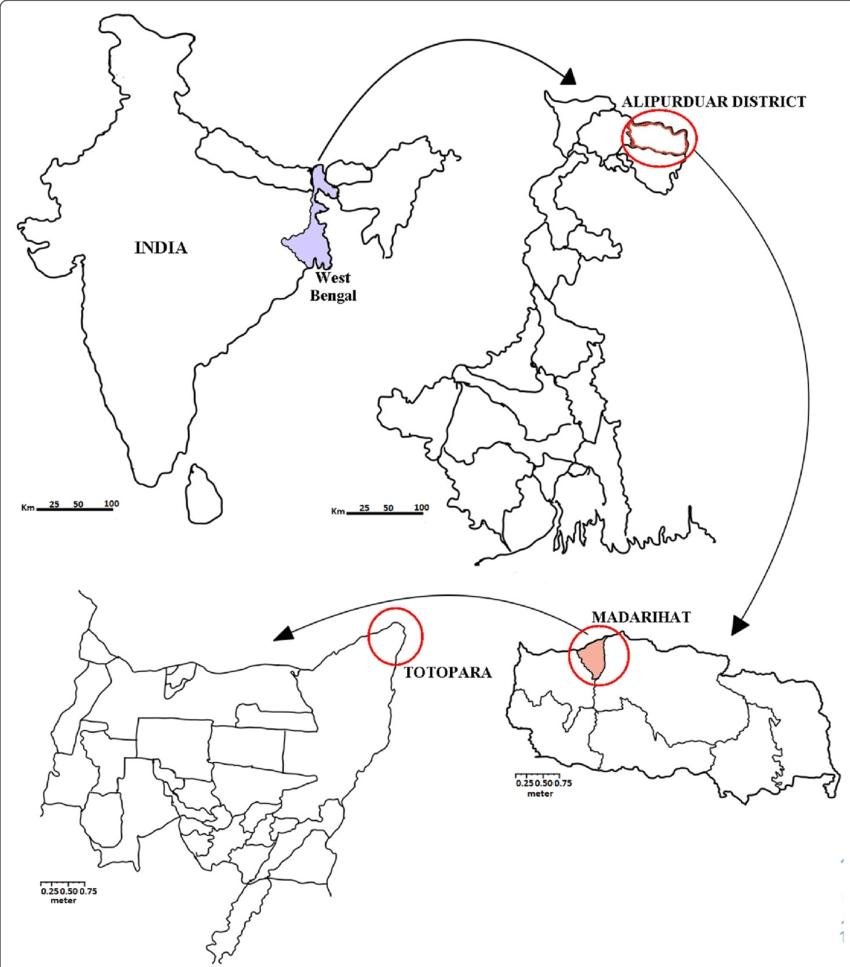
 The majority of the locals live in Totopara, a small village under the Madarihat police station in the Alipurduar district. It is located between 89° 20′ East Latitude and 26°50′ North Longitude. Since the beginning of time, the Totos have lived in a little village called Totopara in the Alipurduar district of West Bengal, in the foothills of the Himalayas near Bhutan. Situated on the banks of the Torsha River, the Totopara is administratively under the Ballalguri Gram Panchayat. Its total size is 3.12 square miles, or 1996.39 acres. It is four kilometers long and stretches from north to south. whereas the east-west width is almost one mile. The maximum distance between east and west is shaped like a trapezoid. The Tadong hill, which touches the southern boundary of Bhutan, borders the settlement to the north, while the Tithi Reserve Forest lies to the west. The village’s latitude ranges from 500 to 2024 feet. from Totopara’s southern to northern regions. Six hamlets, including Panchayat Gaon, Subba Gaon, Mandol Gaon, Mitra Gaon, Puja Gaon, and Dhumchi Gaon, make up the Mouza of Totopara.
The closest trading town to Totopara is Madarihat, which is roughly 32 kilometers distant. Totopara-Ballalguri Road is the only route that connects to the block headquarters in Madarihat. The majority of the road is spiral, unmetalled, and ruined during the wet season. Even so, there are seven rivers that cross the route before it reaches the Totopara. Titi, Bangree, Ratee, Kalikhola, Doyamara, and Hauri are the principal rivers. Madarihat (32 km) and Hasimara (16 km) are the closest train stations.
PHYSICAL ENVIRONMENT
A. Topography and Landscape
Totopara is a component of the Dooars piedmont zone, which is distinguished by riverine valleys, forested hill slopes, and rolling topography. The elevation varies from about 150 to more than 600 meters above sea level. To the east of the village, the Torsha River runs, creating a valley and contributing to the drainage system. Beyond natural borders, there are low hills and wooded regions of the Bhutanese foothills to the north and west.
B. Location: In the Dooars district of Northwest Bengal, Totopara is situated at the base of the Himalayan range. It is a portion of the Bhutanese Sub-Himalayan piedmont region.
 C. Soil and Vegetation: The landscape shifts from hillsides covered in forests to terrace and riverine areas used for settlement and small-scale agriculture. The region is a part of the Dooars piedmont’s distinctive biological mosaic of rivers, forests, and grasslands.
D. Water and Erosion: Riverbanks may disintegrate and several tiny streams may swell during the monsoon. Cutting off road access frequently has an impact on settlement and agriculture throughout the region.
E. Climate of Totopara: The Indian monsoon system and the region’s Sub-Himalayan position have a major impact on Totopara’s climate.
F. Temperature: There aren’t many precise local temperature records for Totopara. In general, the area has subtropical weather, which is characteristic of the Northern West Bengal Dooars.
i. Summers that are warm to hot before the monsoon
ii. A hot, humid monsoon month.
iii. Elevation and forest cover, as well as mild and pleasant winters (November through February). It’s a mild temperature.
The subtropical climate of Alipurduar district is typified by scorching summers from March to May and evenly spaced rainfall during the southwest monsoon from June to October. From November to February, the region’s winter season is characterized by dry and cold weather. This region often receives between 1500 and 1800 mm of rain. There are roughly 72 days with rain from February through October. The lowest temperature is between 6.8 and 9.5°C, while the maximum temperature is between 31°C and 35°C. This station has a generally hot and muggy climate.
1. Monsoon season: Totopara has a monsoon-dominated climate, just as a large portion of northeastern India. The months of June through September have the most rainfall. Heavy rainfall and the ensuing runoff fell on Bhutan’s neighbouring highlands.
2. Rainy season: The severe monsoon rains can cause rivers and streams to swell, isolating the village for periods of time, flooding nearby routes, creating landslides, or temporarily cutting off the village from the outside world.
3. Seasonal Variability: Cooler, drier weather with clear skies occurs throughout the dry season (winter and spring). The weather was very warm in the pre-monsoon (late spring), while the monsoon brings significant rains, humidity, and the possibility of floods. The post-monsoon weather was progressively getting better.
4. Flood
The recurrence of floods in the Alipurduar district needs special attention. The district is located in the foothills of the Himalayas and is crisscrossed by Himalayan rivers; excessive rainfall of short duration on small catchments; and continuous rainfall for several days on larger catchments are the three main causes of floods in these districts. It has been noted that the perennial rivers flood as a result of the high mountains’ melted snow, adding to the concerns of the general public. According to history, the district has not been spared by flooding in a single decade. Between 1985 and 1999, every riverbank in the district rose to a height of one to two and a half meters. Between 1993 and 1999, nearly all rivers had their courses altered due to ruthless riverbank erosion. The district’s riverbeds have grown by two to four times over the past century, and if environmental degradation keeps up its current pace, it is likely that by 2050, a coalescing mega valley made up of a few rivers within a radius of three to fifteen kilometers will be visible at the Himalayan foothills. Two-thirds of these districts’ forestry and tea gardens would be destroyed as a result (Source: Census, 2011).
LANGUAGE AND CULTURAL IDENTITY
A. Toto Language:
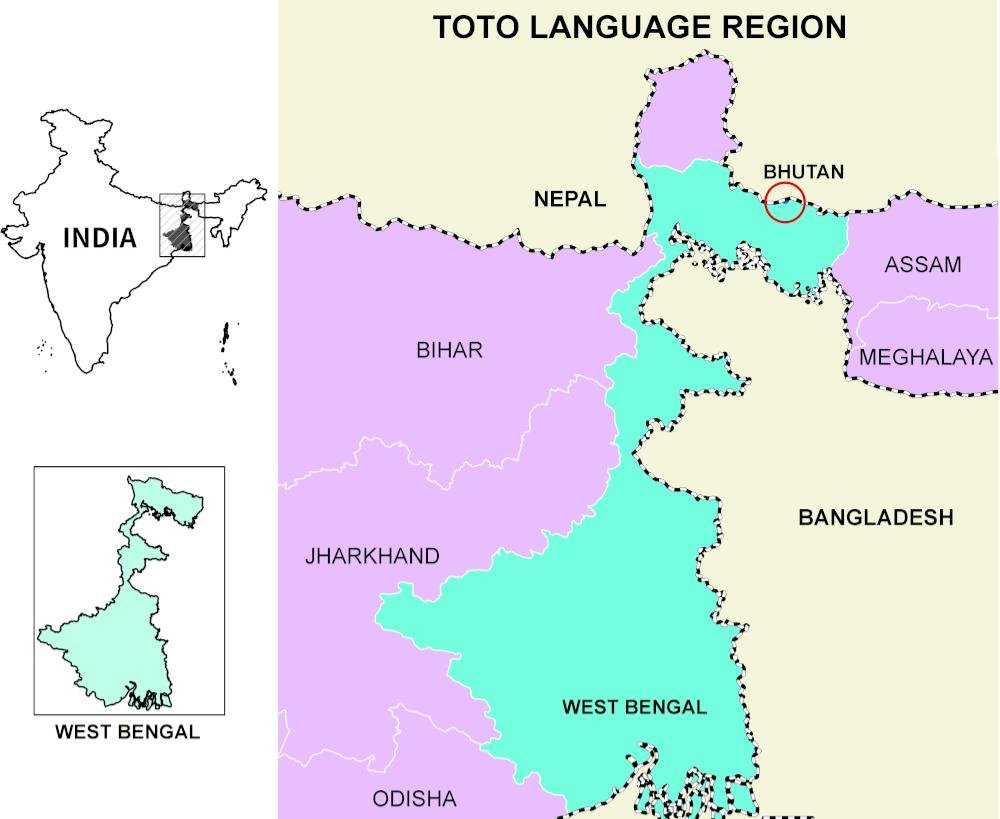
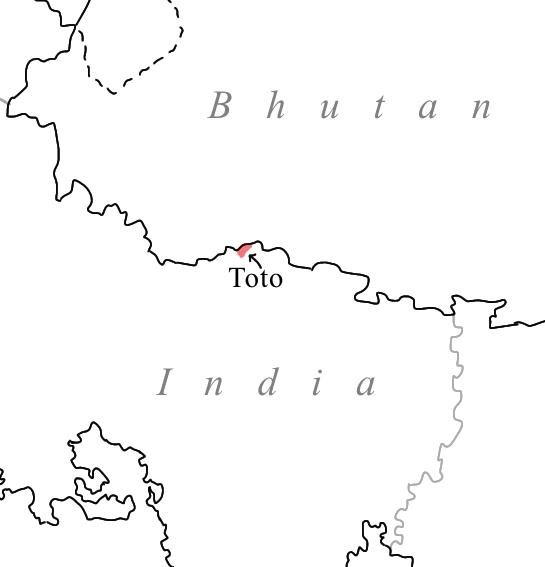
Grierson stated in 1895 that “the language of the Toto people is free from the influence of any other language, and it is completely the language of that people.” The “Toto language belongs to the Tibeto-Burman family of the Sub-Himalayan group,” according to Hodgson and Grierson. They have no script for the language. The majority of Toto Para’s youth currently speak Bengali and Nepali, which supports the local school’s teaching methods. as Toto lacks an alphabet or script. In essence, they communicate verbally in their native tongue. Over the past three to four years, Padmashri Dhaniram Toto, a well-known member of the community, has authored two novels in Toto. One of these, “Dhanua Toto’s Kathamala,” was written in both Toto and Bengali. Additionally, he is putting up a lot of effort to preserve the Toto community’s native tongue. As of 2023, the University of Calcutta is working with Bhakta Toto, a bank Sangraha, to preserve their language. However, Bengali, Nepali, and Bihari are currently the most often spoken languages in the Toto Para area. Many Nepalese and Bihari families have also settled in these areas, which has led to the growth of Hindi. The Toto community is actually now multilingual. They can comprehend and speak in addition to their mother tongue, such as Nepali, Hindi, and Bengali.
B. Society
The language and culture of the Toto are extremely distinct from those of the nearby tribes, such as the Bhutanese Sharchop and Koch (Singh, 2014).However, their language lacks an alphabet. Dhaniram Toto, a highly literate member of the Toto Community, has been working to develop the script and alphabets for his language, Dengka. Dhaniram Toto argues that if everyone on the planet has access to unique letters and languages, why should the Totos be denied this opportunity? With the assistance of an Australian, he has already created a 37-letter alphabet. The nuclear type predominates in the patrilocal Toto family. Joint families are not uncommon, though. Although polygamy is not forbidden, monogamy is the most popular type of marriage among the Toto. Totos typically don’t have more than one wife. Gender inequality is demonstrated by the fact that a woman cannot marry her deceased husband’s brother, but a man may marry the younger sister of his deceased wife. Before being allowed to get married again after the death of a spouse, a husband or wife must remain single for a full year. There are four different ways to find partners: (1) marriage by negotiation (Thulbehoea), (2) marriage by escape (Chor-behoea), (3) marriage by capture (Sambehoea), and (4) love marriage (Lamalami). The Totos do not have a divorce custom. “Toto Shabda” is a trilingual dictionary published by a poet and employee of Toto communities.
C. Food habits
The Toto tribe typically eats rice, milk, curd, and marua chura (parched rice), although their primary food source is marua, a type of millet. They also consume fowl, goat, hog, and venison. Additionally, a variety of fish are introduced to their menu. When it comes to eating any kind of food, there is no gender discrimination. They also consume Haria Eu, a fermented beverage made from rice powder, malt, and marua. Rice, parched rice, milk, and curd make up the basic diet.
D. House
The Toto tribe has a relatively straightforward standing. Totos reside in elegant cottages made of bamboo. These have straw thatches and are raised on machas, or elevated platforms. To reach the hut, there is a single plank that must be hauled up at night. Basak et al. claim that Totos, who identify as Hindu, live in raised bamboo huts and practice kindred marriage, which keeps them in the same area even after marriage (Basak et al. 2009). Some Totos now only reside in pucca and semi-pucca homes (Daw, 2015). Their economic growth and the housing provided by the Indian government through the Indra Awas Yojona Gramin or the state government’s Gitanjali Yojona are the reasons for this advancement.
E. Communication
There are around thirteen rivers between the Totopara area and Madarirhat town. The major route to Totopara travels about 2 km along the Titi River. They must exercise extreme caution when crossing the river because even a tiny boulder might get under your foot and seriously hurt you. The state of the roads deteriorates during the rainy season since all of them flood. Totopara lacks any type of transportation, and in order to get there, residents must cross a number of arid rivers that are flooded during the monsoon season (Mukherjee, 2017). There is still no road connectivity throughout the Totopara-Ballalguri region.
SOCIO-ECONOMIC STATUS
A. Livelihood and Economic Practices
The Toto tribe’s economy, which was once centered on subsistence, has undergone substantial transformation throughout time, shifting from a subsistence model to one that is market-oriented. As a result of this shift, individual land holdings have supplanted collective land ownership, and occupations now comprise settled agriculture, animal husbandry, and daily wage labor. However, the Toto tribe faces serious economic challenges, such as land alienation, which has left many families very impoverished and landless. The Land Reform Act of 1979 and the introduction of private land ownership in 1969 severely weakened the community’s capacity to sustain itself by forcing many into precarious wage labor. Another economic barrier that limits output and prevents diversification beyond traditional single-crop farming is a lack of modern agricultural knowledge. Deforestation has also had a detrimental effect on their traditional forest-based livelihoods by reducing the availability of resources that they traditionally relied on. Economic hardship, debt, and poverty are common issues in the community. Only 1% of Totos are employed by the government, and their low educational attainment makes it challenging for them to pursue more secure and diverse careers.
B. Education and Literacy
The Toto community has been implementing formal education since the mid-1950s, and since 1979, significant progress has been made. Toto’s literacy rates remain poor and much below the national average, at 33.33% in 2004 and 30.35% in 2011. Only 5.19% of Totos finish Class VI–VII, 2.96% finish secondary school, 1.30% finish higher secondary school, and 0.79% enroll in college, demonstrating how few of them achieve higher education levels. Bengali is the main language of instruction in schools, and Toto students often struggle to understand it, which is a major barrier to academic advancement. A weak educational foundation is the outcome of this linguistic mismatch, which hinders academic performance and maintains low literacy rates. The language barrier also contributes to the demise of the Toto people’s indigenous language since children must learn and converse in dominant languages to access educational and job opportunities. Other problems that are linked to their parents’ socioeconomic condition and educational attainment include a shortage of teachers, poor infrastructure, and low professional aspirations, particularly among girls. These conditions create a loop of limited opportunities that perpetuate the Toto community’s lack of ambition.
Table 1: Record of Students of the Toto Tribe Community
| Year | Boy Student | Girls Student | Total |
|---|---|---|---|
| 1972 | 35 | 1 | 36 |
| 1974 | 34 | 6 | 40 |
| 1977 | 44 | 11 | 55 |
| 1980 | 58 | 14 | 72 |
| 1983 | 41 | 9 | 50 |
| 1986 | 43 | 14 | 57 |
| 1988 | 56 | 19 | 75 |
| 1989 | 51 | 7 | 58 |
| 1990 | 50 | 15 | 65 |
| 1991 | 58 | 19 | 67 |
| Total | 470 | 115 | 615 |
Source: majumdar.B.Totos1998
C. Health and Well-being
The Toto tribe is facing a severe health crisis as a result of high rates of morbidity and mortality, poor healthcare services, and a high prevalence of Thalassaemia, a genetic blood disease. Approximately 80% of Totos either have the gene or are susceptible to this inherited illness. The tribe’s long-standing endogamous marriage traditions, particularly with regard to marrying cousins, exacerbate the issue. The Totos’ average lifespan has dropped to 35 years, highlighting how dangerous this condition is. The sickness burden is influenced by a number of factors, including their geographic location, specific dietary habits, hazards at work, and unhygienic living situations. It is believed that environmental pollution, such as air pollution from quartzite stone quarrying and the movement of stone chips, is the reason of the high incidence of tuberculosis. Access to modern healthcare facilities is still limited, and severe illnesses require lengthy travel to larger hospitals. The Totos’ dependence on traditional healers and self-medication with medicinal herbs reflects their cultural practices and practical obstacles to accessing certified medical care.
D. Occupation
There were primarily two types of vocations in Toto society: primary and secondary. Regardless of gender, primary and secondary occupations were closely associated with both males and females. When it came to their major vocation, Toto’s men were primarily employed as laborers in animal husbandry, performing home chores and orange porterage in Bhutan. Females worked in agriculture, as 100-day workers, and collected wood, honey, and other materials from forests as their secondary occupations. Approximately 31% of Toto Para’s labor force was employed in agriculture as of the 2011 census.
Table 2: Socio-Economic Indicators of the Toto Tribe
| Indicators Value | Values |
|---|---|
| Current population (Est). | ~1,670 individuals |
| 2011 census Population | 1,387 (737 M, 650 F) |
| 2011 Sex Ratio | 882 females per 1000 males |
| 2011 Literacy Rate | 30.35% (36.36% M, 23.53% F) |
| Primary Income Sources | Sale of betel nuts, settled agriculture, animal husbandry (pigs), |
| Traditional Housing Type | Elevated bamboo huts (‘na-ke-sha’) |
| Prevalent Health Issues | Thalassemia (high prevalence), TB, dysentery, malaria, cold/cough |
| Land Ownership Status | Shift from collective to individual; significant land alienation post-1969/1979 acts |
| PVTG Classification | Yes, since 1975 |
| Language Status | Critically Endangered (UNESCO) |
E. Education
Even though education started in the 1950s, only 30.35% of people were literate in 2011. High dropout rates and low levels of higher education achievement are caused by socioeconomic limitations, inadequate infrastructure, and language hurdles.
F. Health
Thalassemia, TB, and water-borne illnesses are among the serious health issues the population suffers. Health risks are made worse by dependence on conventional medicine, geographic isolation, and restricted access to healthcare.
POLITICAL PARTICIPATION AND DEVELOPMENT INTERVENTIONS
Even though the majority of adult Totos take part in elections, there is still little political representation. The goal of government programs like PM JANMAN, EMRS schools, and livelihood missions is to raise living standards; yet administrative inefficiencies and contextual mismatches continue to cause implementation gaps.
Despite the lack of organization and documentation, NGOs have made contributions to community development, education, and language preservation.
A. Traditional Governance and Community Norms
Toto community maintains social norms through oral traditions and collaborates with a village council to address internal conflicts. Religious and ceremonial life is overseen by a group of sixteen priests, led by a high priest known as the Devpao or Kaiji and subordinates known as the Deosi. The person in charge of secular leadership is known as the “Mondal.” Every year, “lachijanwa,” or get-togethers, are hosted in Demra or the Kaiji house to discuss personal or family issues. Girls are not need to meet any additional requirements, and membership is normally granted at the age of 18. The continuation of traditional governance structures, which suggest a parallel system operating alongside the official state-introduced political framework, raises questions about the degree of autonomy maintained by the tribe and potential areas of interaction or conflict between these two systems of authority.
B. Social Organization and Governance
Although there are some blended families, the Toto society is predominantly patrilocal and nuclear. In addition to official state institutions, traditional governance is carried out by village councils, religious priests (Deosi), and a chief priest (Devpao). Both cultural autonomy and possible administrative conflicts are highlighted by this dual governing arrangement.
C. Political Participation and Representation
According to the 2024 survey report, 75% of the 1,670 residents of Toto are eligible to vote. Despite taking part in democratic processes, many Totos feel marginalized and helpless due to their remote location and small population. They believe that politicians have ignored their concerns and that their votes are meaningless to any political party. Local problems like limited health care and bad road infrastructure are disregarded. As of January 2017, there were only 37 Totos employed in various government positions, and according to a 2024 report, just 1% of the population works in the government sector. It shows that government officials are not really involved. The absence of representation suggests a structural issue with how the Toto community’s minority status is integrated into West Bengal’s broader political scene and raises the potential that their political influence is still elusive.
D. Government Policies and Initiatives
After being officially recognized as a Scheduled Tribe in 1956, the Toto tribe in India was classified as a Primitive Tribal Group (Vulnerable) in 1975. Beginning in 1951, government initiatives to improve education led to the establishment of primary schools and welfare centers in Totopara.
1. Several government programs, including
i. Pradhan Mantri Adi Adarsh Gram Yojana: Introduced to integrate DAPST and enhance infrastructure in tribal settlements.
ii. The goal is to improve tribal communities’ access to resources and facilities in order to raise their standard of living.
iii. Pradhan Mantri Janjati Adivasi Nyaya Maha Abhiyaan (PM-JANMAN): Focusing on 75 PVTG communities (11 lakh families) throughout 18 states and 1 UT, the program was introduced on November 15, 2023, with a budget of Rs 24,104 crore.
iv. The project entails easing regulations for building roads, establishing Anganwadis, supplying water, and supplying power.
2. Infrastructure Relaxations:
i. Under the Pradhan Mantri Gram Sadak Yojana (PMGSY) and Jal Jeevan Mission, regulations about road building, Anganwadi centers, and health facilities in tribal communities have been loosened to increase accessibility and basic services in tribal areas.
ii. In isolated tribal areas, special facilities have also been developed for solar power to supply electricity to households without electricity.
3. Educational Initiatives:
i. Scholarship Programs: With a higher budget of Rs 2500 crore in 2023–2024, the Ministry of Tribal Affairs offers five scholarship programs that help over 35 lakh students each year.
ii. The scholarship distribution process has been expedited by the integration of State and Tribal portals with DBT (Direct Benefit Transfer).
iii. EMRS (Eklavya Model Residential Schools): By 2026, 440 new schools in tribal blocks are to be established under a new Central Sector Scheme. These educational institutions will provide instruction comparable to those of Navodaya Vidyalayas. There will be more than 728 schools (288 of which have already received approval), and a sizeable budget will be allocated for the construction of infrastructure, such as sports facilities and teacher hiring.
4. Livelihood and Economic Empowerment:
i. Pradhan Mantri Janjatiya Vikas Mission (PMJVM): Focuses on livelihood-driven development by establishing Van Dhan Producer Enterprises and Van Dhan Vikas Kendras, which connect tribal people to Minor Forest Produce (MFP) markets. This mission has been given a five-year budget of Rs 1612 crore.
ii. Van Dhan Karyakram: Since its launch in 2019, more than 3800 Dhan Vikas Kendras have been approved, serving 10 lakh individuals in 28 states and UTs. Tribal groups that collect forest products would profit from the addition of 87 MFPs to the list of goods eligible for Minimum Support Price (MSP).
5. Health and Nutrition:
i. Sickle Cell Disease Mission: The government has launched a mission to test 7 crore individuals and put treatment and preventive measures in place with the goal of eradicating sickle cell disease by 2047.
ii. Mobile Medical Units and PVTG dormitories: To enhance health and nutrition in tribal communities, PM-JANMAN has provided for mobile medical units, multipurpose centers, and PVTG dormitories.
However, the Toto tribe often faces significant obstacles to obtaining the promised advantages, including as insufficient working days and delayed wage payments, persistent language barriers in the school, and unresolved infrastructure problems. These challenges indicate a disconnect between the formulation of federal or state policies and their effective execution in practice. The lack of local expertise and responsiveness of implementing agencies, systemic issues with delivery systems, or bureaucratic impediments could all contribute to this disparity.
COMPARATIVE PERSPECTIVE: TOTO AND OTHER PVTGS
The Toto tribe stands out from other PVTGs in West Bengal (Birhor and Lodha) because to their exceptionally tiny population, exclusive territorial concentration, endangered language, and severe genetic health concerns. Because of these distinctive features, policy solutions must be very targeted and culturally sensitive.
A. Non-Governmental Organizations (NGOs)
Non-governmental organizations (NGOs) have been crucial to the development and maintenance of the Toto community since 1951. One notable example is the Bright Eyes Global Action Project (BEGAP), which was established in 2009 to address educational difficulties and establish a self-sustaining education and cultural heritage center in Totopara. The project aims to preserve the unique characteristics of the Toto culture, offer instruction in the Toto language, transcribe the endangered Toto language, and create employment opportunities in the area. NGOs also assist tribal development through livelihood, education, healthcare, infrastructure development, economic growth, environmental protection, and community empowerment. However, while interacting with native groups, they have to get past language barriers and build trust. These challenges highlight the complexity of tribal development efforts and the need for extensive knowledge and sustained engagement. While many NGOs, like Simelane, Krishi Vikas Pariyojana, Hirwani’s World Organization, and Shib Athpur Yuba Sangha, operate in or serve the Totopara region, their specific projects for the Toto tribe are not necessarily well documented.
B. Comparative Analysis with Other PVTGs in West Bengal
West Bengal formally recognizes three Particularly Vulnerable Tribal Groups (PVTGs), such as Toto, Birhor, and Lodha communities. Even though all three have fundamental vulnerabilities resulting from socioeconomic marginalization, their distinct problems, cultural norms, and historical histories necessitate highly customized development interventions rather than a conventional approach. The Lodha community is the largest of the three PVTGs in West Bengal, with 108,707 members as of 2011. The Birhor population was 2,241 in 2011, while the Toto population was 1,387 in 2011 and is predicted to increase to 1,670 by 2024. Due to their common vulnerabilities, all three PVTGs are marginalized. These include low literacy rates overall, high rates of poverty and persistent financial hardships, landlessness, accessibility and remoteness issues, a lack of basic facilities and healthcare, and social marginalization. But each tribe also has its own unique traits and difficulties:
1. Toto: The Toto tribe is distinguished by the unique and critically endangered Dengka language. They also have a high prevalence of Thalassaemia, a hereditary disorder exacerbated by their endogamous marital practices. One of their distinctive traits is their concentration in Totopara village, which renders them particularly susceptible to localized stressors.
2. Birhor: The Birhor, who were formerly a nomadic or semi-nomadic hunting-gathering people, are gradually moving to the highland woodlands of Purulia. They deal with issues of inadequate infrastructure development and the decline of their traditional cultural norms as they adapt to settled life.
3. Lodha: Due to their designation as a “Criminal Tribe” by British colonialists, the Lodha community has a unique historical weight. Although this label has evolved over time, it is still highly stigmatized. Many of them now work as migrant and agricultural laborers, despite the fact that they used to hunt and gather. Most Lodha families are economically challenged, partly because they lack agricultural land. They continue to face extreme social marginalization and have the highest rates of acute undernutrition among PVTGs in West Bengal, according to studies.
Table 3: Comparative Overview of PVTGs in West Bengal (Toto, Birhor, Lodha)
| Tribe Name | Approximate population | Primary Livelihood | Key shared vulnerabilities | Distinctive features | Development status |
|---|---|---|---|---|---|
| Toto | 1,387 (2011). ~1,670 (2024 Est. | Hunter-gatherers, porters; now settled agriculture, betel nut sale, day labor, pig rearing | Low literacy, poverty, land alienation, poor healthcare, remoteness | Critically endangered unique language (Dengka), high Thalassemia prevalence due to endogamy, exclusive concentration in Totopara | Least developed. facing cultural erosion and land loss |
| Birhor | 2241 (2011) | Nomadic/semi- nomadic hunting- gathering; now settling, forest produce, daily labor | Low literacy, poverty, landlessness, poor healthcare, remoteness | Traditionally nomadic, now settling in Purulia hill-forests; inadequate infrastructure, erosion of traditional practices | Economically backward. struggling with transition to settled life |
| Lodha | 108,707 (2011) | Hunter-gatherers; now agricultural laborers, migrant laborers, minor forest produce collection | Low literacy, poverty, landlessness, poor healthcare, social exclusion | Historical “Criminal Tribe” designation, deep-rooted stigma, highest undernutrition among PVTGs | Highly marginalized. struggling with social acceptance and economic stability |
While there are similarities among PVTGs, this comparative research shows that their distinctive vulnerabilities, socio-cultural characteristics, and historical trajectories necessitate a high level of Shib Athpur Yuba Sangha. However, their specific activities for the Toto tribe are not usually well recorded. Comparative Study of West Bengal’s Other PVTGs West Bengal officially recognizes three Particularly Vulnerable Tribal Groups (PVTGs): the Toto, Birhor, and Lodha populations. Even though all three have fundamental vulnerabilities resulting from socioeconomic marginalization, their distinct historical origins, cultural practices, and particular issues necessitate highly tailored development interventions rather than a generic one. The Lodha community is the most populous of the three PVTGs in West Bengal, with 108,707 members as of 2011. The Birhor population was 2,241 in 2011, while the Toto population was 1,387 and is predicted to increase to 1,670 by 2024. Due to common vulnerabilities, all three PVTGs are marginalized. These include poor literacy rates in general, high rates of poverty and continuous financial challenges, landlessness, difficulties with accessibility and distance, a lack of basic-healthcare facilities, and social exclusion.
FINDINGS
The Toto tribe, a critically endangered Particularly Vulnerable Tribal Group in West Bengal, is an engrossing case study of a people attempting to maintain their culture and survival in the face of severe political and socioeconomic hardship. Despite being in danger of going extinct in the middle of the 20th century, they have recovered demographically because of targeted initiatives and their inherent resilience. However, this expansion and a notable demographic change in Totopara—Totos are now a minority in their original hamlet—have sparked concerns about land ownership and economic dominance. The tribe’s shift from a subsistence to a market economy has not been easy, primarily because of earlier land alienation laws that have left many members without land. Environmental deterioration, including mining and deforestation, which exhaust essential natural resources, further jeopardizes their traditional means of subsistence. Low literacy rates continue despite efforts to build schools, primarily because of a structural linguistic barrier that prevents Toto kids from receiving education in Bengali. Serious health issues affect the population, including a high prevalence of Thalassaemia made worse by endogamous marital customs, restricted access to contemporary medical care, and health concerns associated with the environment. When it comes to politics, Totos who participate in democratic processes feel incredibly excluded because they believe that mainstream political parties ignore their problems due to their little numbers. Importantly, the Toto tribe has shown incredible agency in maintaining their culture, particularly in creating their own alphabet for their native tongue and incorporating it into Unicode. Non-governmental organizations perform a different role and frequently offer more culturally appropriate treatment, even though they too have difficulties carrying out their efforts. The majority of this community’s members are excluded from society’s mainstream. The government takes various steps in the area of education for this community in order to promote and increase the people’s knowledge. Education is the means by which this community can improve its social and economic standing. Due to their extremely low socioeconomic status, the Toto community is apathetic to the other communities in terms of economic, social, educational, health, and other areas. When compared to the Gross National Income Index, the indigenous community’s earnings are extremely low. To improve their educational and financial circumstances, a variety of occupational courses will be offered. The federal and state governments must act immediately. The Totos have a variety of occupations. aside from farming. By educating them various contemporary farming methods and agricultural programs, Toto’s economic situation could improve. The Toto community will be keen to understand and improve their social and economic circumstances in order to guarantee their standard of living.
CONCLUSION
The study finds out that the Toto community has a backward socioeconomic and demographic condition. One of West Bengal’s “Endangered Tribes,” the Toto Tribe is in danger of going extinct. The majority of Toto people lack literacy. They are backward and underdeveloped due to a lack of education, poverty, communication, and farming knowledge. However, because of their close interaction with the progressive people of the outside world, there has been a noticeable improvement in their way of life in recent years. The government has made several attempts to investigate the healthcare system, literacy rate, etc.
SUGGESTION AND LIMITATION
The bulk of Non-Toto people in Totopara have an aggressive lifestyle and way of life, which has a significant impact on Toto culture and tribal heritage. In Totopara’s social life, the Toto language is also experiencing a serious issue. In Totopara’s altered, globalized world, the Toto tribal ethnicity is also severely threatened. The predominant presence of non-Toto people in Totopara, with their cosmopolitan culture and way of life, is the primary point of contention between the Toto tribal ethnicity and the globalized modern world. Because of the preponderance of people from other groups, Totos tribal rites and ethnicity are progressively being neglected in Totopara. A few points are listed below:
i. The Toto tribe should actively promote the importance of public education.
ii. The government ought to support and safeguard the Toto language.
iii. The Toto tribal community should engage in a vigorous campaign to raise awareness of the rights guaranteed by the Indian Constitution and the resources the government provides for the primitive tribal group.
iv. The government shall take all appropriate corrective action to safeguard the Toto ethnicity and culture in Totopara village.
v. Toto students enrolled in Totopara schools ought to be required to learn the Toto language.
vi. The government should tightly regulate and prohibit illegal immigrants in Totopara village.
vii. Transportation infrastructure between Totopara and the closest railway station and the local district headquarters should be improved as far as is practical.