
INTRODUCTION
Digital rural transformation has also become one of the most important areas in the development agenda for India, which essentially seeks to overcome the long-standing socio-economic and digital disparities between the urban and the rural spaces. India has, traditionally, a very sizable number of the populace staying in the country’s villages, and for this reason, it becomes imperative for India to ensure the development and proliferation of digital infrastructure for the betterment and sustainability of the country at large. Recently, the Government has introduced various digital policy initiatives to give better improve the digital infrastructure and services in the country, particularly in the areas of education, healthcare, and agriculture.
On the digital and rural policy, the focus has increasing broadband infrastructure, affordable access to the internet, digital literacy, and digital platform regulation for ensuring transparency, security, and accountability. Not only that, the regulation mechanisms have been playing a crucial role in the security and privacy of data and the rights and needs of the citizens living in the rural regions. However, problems and difficulties have been hindering the process of adopting digital technology in the country, particularly in the regions. It is seen that the successes of rural digital transformation are greatly dependent on the effectiveness of policies that have been implemented. In fact, it is seen that government programs like Bharat Net seek to establish high-speed connectivity among Gram Panchayats.
The role of regulation cannot overstated, it can play exemplary role in ensuring that digital services are accessible, affordable, and secure the rural population. Regulation, including those on telecommunications, information protection, digital payment, and cyber security, can play an indispensable role in generating trust and defending the rural population from digital exploitation and abuse of personal information. Therefore, strengthening policy coherence, enhancing regulatory enforcement, and encouraging public–private partnerships are necessary to ensure that digital rural transformation contributes meaningfully to inclusive growth, social empowerment, and sustainable development in India.
State of the problem:
Though there are many policy initiatives and regulatory measures undertaken by the Government to promote digital rural transformation, a substantial gap is continues to exist between policy objectives and due to realities in rural areas. The Indian government Initiatives likes Digital India, BharatNet, and various e-governance platforms aim to ensure the universal digital access and inclusion, many rural regions people’s still face challenges related to inadequate digital infrastructure, limited internet connectivity, and poor quality of digital services. These problems become more serious because many people in rural areas have limited digital skills, low awareness of digital services, and economic difficulties, which prevent them from using digital technologies effectively. These are the problem of rural area which prevents from digitalization in the villages.
Review of Literature:
Satish Patel1 (2024), stated that The digitalization of rural areas is being propelled by transformative advancements in domains such as electronic payments, digital literacy, financial inclusion, geographic mapping, and rural development. An expedited strategy for digital transformation could serve as a potent solution to tackle the enduring challenges in this context. India is experiencing a swift digital revolution, driven by the government’s Digital India initiative, which seeks to metamorphose the nation into a digitally empowered society and knowledge economy.
Saurabh Sharma 2(2023) stated that Digital India marks the start of a digital revolution, envisioned by the Indian government. The goal is to make government services accessible to citizens through digitally means, even in urban and rural areas. These key factors involve improve digital infrastructure and increasing internet connectivity in remote area. The primary objective of the program is to propel the nation forward in both digital and economic aspects. By fostering innovation, the initiative aims to engage people in processes crucial for economic advancement.
Neha Saini3, (2025) stated that The Indian government’s launch of Digital India initiative is critical to achieving a sustainable future by leveraging digital capabilities to promote social justice, economic prosperity and environmental stewardship. There are a lot of factors affecting digital India’s transformation to achieve sustainable development goals. This study aims to identify, examine and develop an empirical model estimating the relationship among enablers affecting and enhancing digital India’s transformation toward sustainability.
Vinayak Raju Kage4, (2024) stated that the Digitalization in rural India holds immense potential to empower communities, enhance livelihoods, and drive inclusive growth. Continued efforts in infrastructure development and digital literacy will be crucial in realizing these benefits across the country. Digital platforms have streamlined government services, such as digital land records, birth certificates, and subsidies. This has reduced bureaucratic hurdles and corruption while improving transparency.
Arjun Ghosh5, (2025) stated that the Artificial intelligence (AI) has quickly emerged as a game changer in healthcare, providing innovative ways to improve patient care, enhance processes, and reduce expenses. AI could solve important healthcare issues in India, including increasing service demand, a lack of trained medical personnel, and notable geographical differences, especially in rural areas. AI can aid in addressing this gap by offering scalable, affordable regulatory framework that enhance diagnosis, treatment planning, and suitable resource allocation.
Research Gap of the Study:
Existing studies mainly emphasize digital initiatives; however, the effectiveness of implementation of regulations in rural India is not given much prominence. Currently, there is limited empirical analysis of the policies, their implications, and how they translate to actual digital access on the ground, or the grassroots level. The challenges related to the enforcement of digital regulations in the rural sphere are under researched in the current literature. There have been limited studies on the effects of data protection and privacy on rural digital users. Research on the role of regulatory institutions in providing affordable services and quality in rural areas is scarce. The vast majority of studies fail to consider the concept of a digital literacy gap and its regulatory implications in rural communities. There is a lack of comparative analysis between the frameworks used by urban and rural digital governance. Hence, the need for a holistic and countryside-centric policy and regulatory analysis.
Objective of the study
This research based on the policy and regulatory framework for digital rural transformation in India
1. To find out the existing policy and regulatory framework for digital rural transformation in India.
2. To examine the significance of government policies in encouraging digital development in rural areas.
3. To analyze the effectiveness of policies in dealing with issues associated with rural digitalization.
4. To evaluate the influence of digital policies on rural socio-economic development.
5. To understand the legal and infrastructural hurdles to digital transformation in rural India.
6. To suggest appropriate policy and regulatory changes for successful digital rural transformation in India.
Methodology
This research is based on both doctrinal and non- doctrinal research the source of data collected from different new papers, journals, magazines, all Indian report and e-resource. This research is used stratified random sampling. These are 123 sample size of the responded used. In this research adopted some of the statistical tools are percentage method and average method. The duration of the research is Three months.
Significance of the study
The study is useful for the government as it helps them to understand the effective of the existing regulatory framework in supporting digital transformation in rural India. The study helps them understand the policy gaps in infrastructure, digital literacy, data governance, and service delivery. The study helps the government in purify schemes like Digital India and BharatNet. The study helps policymakers in formulating including policies that can bridge the rural-urban digital divide. The study helps in improving the coordination between the central, state, and local governments. The study helps in formulating sustainable and people-centric digital governance policies for rural development.
The study increases the clearly explain the impact of digital policies on rural communities and their day-to-day living. The study increases awareness about digital rights of citizens, e-governance, and regulatory challenges. The study helps students and researchers understanding the real-world challenges of policy implementation in rural India. The study helps in promoting participation in digital governance and rural creates something new. The study helps in promoting research on digital inclusion and socio-economic development.
Hypothesis of the study
This research is based on the following hypothesis are,
• Digitalization has significantly reduced delays, corruption and improved services delivery in rural areas.
• Digital policies are implemented equally across all villages without any significant variations.
Limitation of study:
Digital policies are not followed properly in all villages. Many rural areas still have slow or no internet connection. Most people in villages do not know how to use digital services properly. The rules are too complicated for rural people to understand. Government supervision at the village level is weak. Rural users are not aware of how to protect their personal data online. Smartphones and internet plans are costly for poor families. Different government departments do not work together properly. Private companies do not want to invest in remote rural areas. Complaints about digital problems are not solved quickly.
RESULT AND DISCUSSIONS
PART-A: Doctrinal Research
Concept of Digital Rural Transformation:
Digital Rural Transformation means the integration of digital technology with the processes of rural development so that it is improved to achieve desirable outcomes. In other words, it means the use of information and communication technology for service provision, productivity, and promoting inclusiveness.
Key components of digital rural transformation include:
• Digital infrastructure, including broadband connectivity and mobile networks
• Digital literacy/skill development
• E-governance and digital service delivery
• Digital financial inclusion
• Access to digital education services, healthcare services, and agricultural services
In the rural area, the digital transformation initiative seeks to empower the people by involving them in the digital economy and making them less dependent on the traditional and inefficient systems. In addition, it enhances governance. Policy Framework for Digital Rural Transformation in India.
Policy framework for digital rural transformation:
Digital rural transformation is one of the significant aspects of India’s agenda for inclusive growth, since it seeks to narrow the socio-economic inequalities between urban and rural India by employing digital instruments of technology in an effective manner. It is important that an overall framework is taken into account with regard to digital rural transformation.
1. Digital Infrastructure Development
The creation of robust digital infrastructure is key to rural transformation policies. The main focus area can be to provide broadband connectivity through fiber optics, satellites, and mobile networks, including initiatives such as Bharatnet and the rollout of 5G networks itself. In addition, there can be a focus on robust electricity supply and digital service center availability, so that rural citizens can consume this technology effectively without additional burden on device availability through PP mandates.
2. Digital Literacy and Capacity Building
Further, digital inclusion is not only at the level of connectivity but also at the level of digital skills and awareness. For this purpose, digital literacy is to be incorporated as part of the school curriculum, the curricula of education at the adult level, etc. Special attention is to be given to women, the elderly, and the marginalized so as to avoid digital exclusion. Moreover, the training is to include digital basics, online security, financial literacy, etc. Moreover, the locale is of utmost importance. E-Governance and Service Delivery.
3. E-Governance and Service Delivery
There is considerable potential for digital transformation of governance in rural India. Policies need to focus on scaling up e-governance platforms in order to facilitate citizens in accessing government services such as land records, welfare schemes, health, etc., in an efficient manner. There is also an enhanced need for scaling up the Common Service Centers in order to facilitate effective access of digital opportunities in rural areas so that citizens can access government services in an efficient manner through one-stop outlets of digital access.
4. Digital Livelihoods and Rural Economy
Rural area can flourish with proper use of technological interventions to improve their economic activities. For that purpose, it is recommended to promote digital agriculture besides precision farming services. Further, digital market platforms will connect rural people with buyers so they can interact easier. The use of digital entrepreneurship can provide different avenues for income development across rural areas. In fact, digital credit services will strengthen economic activities across rural areas.
5. Health, Education, and Social Inclusion
Digital solutions can play an invaluable role towards fill some of those gaps. For one, telemedicine solutions can improve rural area health. “Telemedicine services include digital health records, mobile health units, and Telemonitoring services.” These can be used to improve health outcomes for those living out in rural areas. In terms of education, “e-learning solutions could improve student outcomes.” “E-learning solutions include digital learning platforms, virtual classrooms, and Teacher development programs.” These can improve the outcomes for those living out in those rural areas. 6
6. Data Governance, Security, and Sustainability a strong data governance system must also be in place, as it helps in data privacy, cyber security, ethical technologies, etc. Data privacy, data security, data ethics, etc., must be included in the data policies. Sustainability in terms of energy conservation, disposing of e-waste in infrastructure, etc., must also be part of technological expansion policies.
Regulatory Framework Governing Digital Rural Transformation:
The transformation of digital technology into a rural setting can be defined as the use of digital technology to integrate rural economies and governance systems, resulting in better development outcomes and the welfare of residents and the population. The transformation of digital technology into a rural setting also plays a significant role in reducing the differences between rural and urban settings and improving agricultural outputs, as well as increasing access to healthcare and education service delivery systems. The transformation of digital technology into a rural setting cannot be achieved without a regulatory framework since this aspect cannot be left unregulated
1. International and Global Regulatory Principles
At the global level, there are no specific binding agreements that address rural transformation in digitization, but there are several global agreements that are integral to informing country-level policies on digitization in rural areas. On one hand, the United Nations’ global Sustainable Development Goals, particularly goal number 9: “Industry, Innovation, and Infrastructure” and number 10: “Reducing Inequalities,” target achieving inclusive dimensions of digitization in rural and underserved areas. On another hand, the International Telecommunication Union advocates for common global themes of universal access to information and communication technologies in terms of their affordability, accessibility, and inclusiveness.
2. Regulation of Digital Infrastructure and Connectivity
The underlying concept in rural digital evolution is digital infrastructure accessibility. The regulation of telecommunications laws and national broadband development strategies is crucial in driving the expansion of digital infrastructure to rural regions. The USOs directly involve the government in rural development by compelling telecom companies to roll out services in remote regions that are not economically viable. The regulation of the radio spectrum is essential in ensuring the development of digital infrastructure in rural regions using wireless connectivity like 4G and 5G technology.
Additionally, infrastructure sharing regulations promote cost-effective investment in infrastructure since it is possible to facilitate the investment of several infrastructure providers in the same towers, fiber cables, etc. Without this investment, the incentive would naturally be to focus on urban regions, thus creating the digital divide between the urban and the rural regions. Infrastructure is, thus, the first pillar in the digital transformation in the rural regions.
3. Data Governance and Privacy Regulation
The digital rural revolution is associated with large volumes of data production, mainly in the field of rural agriculture, health, finance, and governance. Data regulation and privacy laws have become essential imperatives. Data protection laws establish guidelines regarding the collection, processing, and sharing of personal data to ensure rural residents are not abused.
Another important issue, especially in rural environments, is the data ownership, particularly in the case of farm-generated data via sensors, drones, etc. The rules must clearly define whether the data belong to the farmer, the providers, or the government, as well as how the monetization of the data can be done. Another issue in the case of agri-tech platforms, especially in the case of international platforms operating in the rural area, is the rules related to international data flow, including the related security questions.
Role of E-Governance in rural transformation:
Rural transformation is an important dimension of inclusive national development, particularly in developing nations where a significant proportion of the population is found in rural areas. The conventional system of governance in rural areas has been characterized by inefficiency, lack of transparency, poor service delivery, and delayed implementation of social security programs. According to this, e-governance has assumed the status of a game-changer that can helps to fill the gap between the government and the rural area people. By the use of information and communication technology, e-governance has a important role to play in the development of rural areas.7
1. Improved access to government services:
Easy access to government services is one of the most significant uses of e-governance. By using online portals and Common Service Centers, citizens in rural areas can apply for caste certificates, income certificates, ration cards, pensions, and other social services without visiting government offices. It saves travel expenses, time, and middleman harassment.
2. Transparency and Corruption Reduction:
E-governance ensures transparency in the administrative system through digitalization. Online application tracking, and digital payment systems minimize corruption and leakages such us, subsidies and benefits are directly credited into the bank accounts of beneficiaries, so it make sure that the money reaches the concerned person.
3. Enhancing Rural Democracy and Participation:
E-governance improves rural democracy and participation. Online problem-solving system, mobile applications, and social media sites enable rural citizens to raise their problem directly to the concerned authorities. Digital platforms enhance communication between Panchayathi Raj Institutions and citizens, thus promoting accountability and participatory governance.
Relevant case law:
Pragya Prasun & Ors. v. Union of India & Ors. (2025)8
The Supreme Court examined accessibility in mandatory digital KYC and e-KYC systems. The petitioners were persons with disabilities, including visually impaired individuals and acid attack survivors. They faced difficulties with live photographs, facial recognition, and on-screen prompts. These barriers prevented access to banking, telecom, and government welfare services. The petitioners claimed violation of Articles 14, 15, and 21 of the Constitution. They also relied on protections under the Rights of Persons with Disabilities Act, 2016.The Court held that access to digital services is part of the Right to Life and dignity. It found exclusionary digital systems to be discriminatory and unconstitutional. The State and regulators were directed to ensure inclusive digital design. Alternative KYC methods and reasonable accommodation were mandated to ensure equal access.
Faheema Shirin R.K. v. State of Kerala (2019)9
The petitioner, an 18‑year‑old college student, challenged the hostel authorities and the State of Kerala for expelling her from the women’s hostel and imposing restrictions on the use of mobile phones, arguing that these restrictions violated her fundamental rights including the rights to freedom of speech and expression, right to privacy, and right to education. She claimed that prohibiting mobile phone use hindered her access to educational resources and the internet, which she argued was part of her right to information and expression. The respondents contended that the restrictions were imposed to maintain discipline and that the petitioner had originally agreed to the rules upon admission. The Kerala High Court examined whether these restrictions were arbitrary and violation of constitutional rights. After considering the arguments, the Court held that rights such as freedom of speech and expression under Article 19(1)(a) and right to privacy under Article 21 must be balanced against reasonable regulations for discipline. The judgment emphasized that any restriction on fundamental rights must be justified, reasonable, and not arbitrary.
Anvar P.V. v. P.K. Basheer & Ors. (2014)10
The Supreme Court addressed the admissibility of electronic evidence. The appellant challenged his election result, claiming electronic records could prove corrupt practices. The main issue was whether these electronic records could be admitted in court. Previously, courts sometimes allowed secondary electronic evidence without strict certification. The Court clarified that electronic records, including computer-generated outputs, must comply with Section 65B of the Indian Evidence Act, 1872. Section 65B requires a certificate identifying the electronic record and explaining how it was produced. The certificate must be signed by a responsible person. The certificate must be presented when the evidence is produced in court. Failure to comply with Section 65B makes the electronic record inadmissible. This judgment strengthened the legal framework for electronic evidence, ensuring reliability and authenticity.
Part- B : Non-Doctrinal Research
Table No: 1 The Digital services have been used
| Particulars | Male | Female | Transgender | Total |
|---|---|---|---|---|
| Online banking/ UPI | 29 (23.58) | 45 (36.59) | 0 (0.00) | 74 (60.17) |
| E-governance services (certificate scheme) | 3 (2.44) | 4 (3.25) | 0 (0.00) | 7 (5.69) |
| Telemedicine | 1 (0.81) | 3 (2.44) | 0 (0.00) | 4 (3.25) |
| Online Education | 7 (5.69) | 11 (8.94) | 0 (0.00) | 18 (14.63) |
| None of the above | 9 (7.32) | 11 (8.94) | 0 (0.00) | 20 (16.26) |
| Total | 49 (39.84) | 74 (60.16) | 0 (0.00) | 123 (100.00) |
Source: Primary data
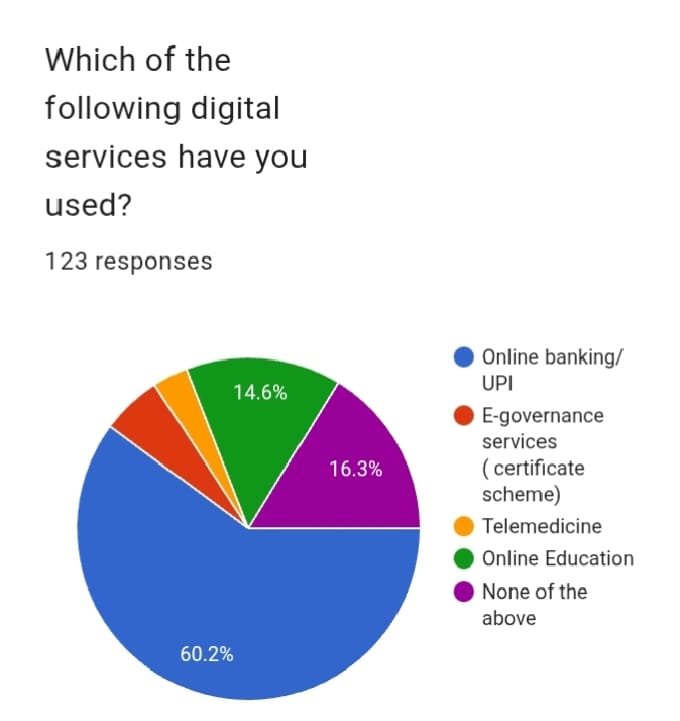
Table No. 1 presents the gender-wise use of digital services along with percentages. Online banking/UPI services are the most widely used, accounting for 60.17 percentage of the total respondents, with 23.58 percentage of the males and 36.59 percentage of the females. E-governance services are used by only 5.69 percentage, comprising 2.44 percentage of the males and 3.25 percentage of the females, while telemedicine services show very limited usage at 3.25 percentage, including 0.81percentage males and 2.44 percentage of the females. Online education is accessed by 14.63 percentage of the respondents, with 5.69 percentage of the males and 8.94 percentage of the females. Notably, 16.26 percentage of the respondents reported using none of the listed digital services, consisting of 7.32 percentage of the males and 8.94 percentage of the females. No usage was reported among the transgender category 0.00 percentage.
Table No: 2 Digitalization has reduced delays and corruption in service delivery
| Particulars | Male | Female | Transgender | Total |
|---|---|---|---|---|
| Strongly disagree | 8 (6.50) | 8 (6.50) | 0 (0.00) | 16 (13.00) |
| Disagree | 6 (4.88) | 13 (10.57) | 0 (0.00) | 19 (15.45) |
| Neutral | 21 (17.07) | 33 (26.83) | 0 (0.00) | 54 (43.90) |
| Agree | 13 (10.57) | 17 (13.82) | 0 (0.00) | 30 (24.39) |
| Strongly agree | 1 (0.81) | 3 (2.44) | 0 (0.00) | 4 (3.25) |
| Total | 49 (39.84) | 74 (60.16) | 0 (0.00) | 123 (100.00) |
Source: Primary data
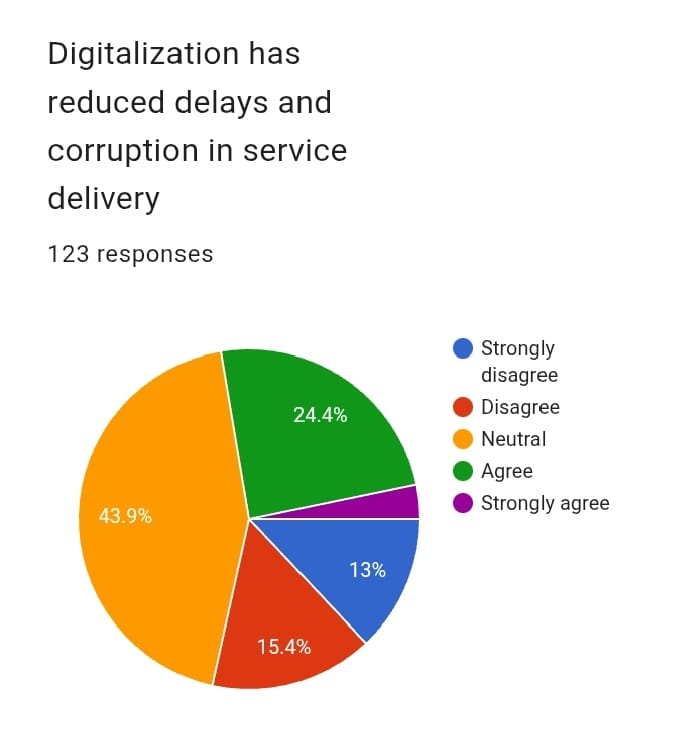
Table No. 2 depicts the respondents’ opinions on the statement that digitalization has reduced delays and corruption in service delivery, along with gender-wise percentages. A majority of respondents expressed a positive view, as 43.90 percentage remained neutral, comprising 17.07 percentage of the males and 26.83 percentage of the females, while 24.39 percentage agreed with the statement, including 10.57 percentage of the males and 13.82 percentage of the females. Further, 3.25 percentage of respondents strongly agreed, with 0.81 percentage of the males and 2.44 percentage of the females, indicating a smaller but notable strong approval. On the other hand, 15.45 percentage of the respondents disagreed, consisting of 4.88 percentage of the males and 10.57 percentage of females, and 13.00 percentage strongly disagreed, equally represented by 6.50 percentage of the males and 6.50 percentage of the females. No responses were recorded from the transgender category 0.00 percentage.
Table No: 3 Digital policies are implemented equally in all villages
| Particulars | Male | Female | Transgender | Total |
|---|---|---|---|---|
| Yes | 23 (18.70) | 23 (18.70) | 0 (0.00) | 46 (37.40) |
| No | 26 (21.14) | 51 (41.46) | 0 (0.00) | 77 (62.60) |
| Total | 49 (39.84) | 74 (60.16) | 0 (0.00) | 123 (100.00) |
Source: Primary data
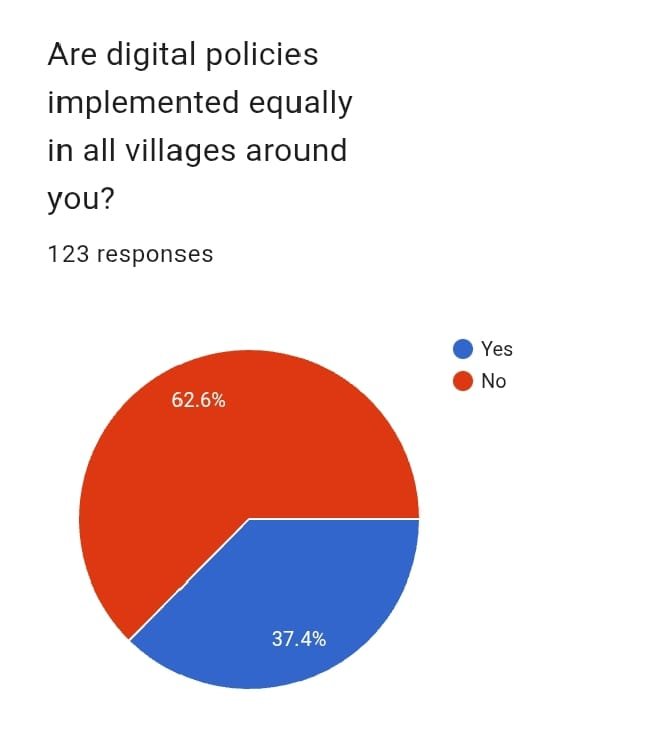
Table No. 3 presents the respondents’ opinions on whether digital policies are implemented equally in all villages, along with gender-wise percentages. The results show that a majority of respondents, 62.60 percentage, stated “No”, indicating that digital policies are not implemented equally across villages; this includes 21.14 percentage of the males and a significantly higher 41.46 percentage of the females. In contrast, 37.40 percentage of the respondents answered “Yes”, comprising an equal proportion of 18.70 percentage of the males and 18.70 percentage of the females, suggesting some level of perceived equality in implementation. No responses were recorded from the transgender category 0.00 percentage.
HYPOTHESIS TESTING
H1: Digitalization has reduced delays and corruption in services delivery.
From the empirical evidence, Table No: 2 shows that the majority of the respondents’ response is neutral (43.90) and also agreed (24.39) about the digitalization’s reduced delays and corruption in services delivery. Therefore, the hypothesis is accepted. It is null hypothesis (Ho).
H2: Digital policy is not implemented equally in all villages.
From the empirical evidence, Table No: 3 shows that the majority of the respondents (62.60) said that the Digital policy is not implemented equally in all villages. Therefore, the hypothesis is accepted. It is called as null hypothesis (Ho).
CONCLUSION
This research paper has discussed the importance of digital rural transformation in achieving inclusive growth and sustainable development in the country. For instance, the digital technology provides potential to decrease rural-urban inequalities in accessing the governance, education, healthcare services, and employment opportunities. In rural areas. The digital governance programs undertaken by the government is an significant aspect in promoting digital access in rural regions of India. However, the case study also explains that in order to ensure success in digital rural transformation, not only the creation of the policy is necessary, but also its implementation is also very important. There are problems that still affect digital initiatives in rural areas, including a lack of adequate digital infrastructure, a lack of internet connectivity, low digital literacy, and a lack of awareness. Thus, the disconnect still exists between the policies and realities on the ground.
SUGGESTIONS
1. Ensure uniform implementation of digital policies: regulatory frameworks should mandate equal implementation of digital policies across all rural regions to avoid disparities between villages and states.
2. Strengthen legal backing for digital rights: laws should clearly recognize access to the internet, digital services, and data protection as essential rights for rural citizens.
3. Improve coordination between Centre and states: a clear regulatory mechanism is needed to improve coordination between central, state, and local government for effective policy execution at the grassroots level.
4. Establish strong data protection and cyber security rules: rural digital users must be protected through strict regulation on data privacy, cyber security, and misuse of personal information.
5. Promote regulatory support for digital infrastructure: regulations should encourage private and public investment in rural digital infrastructure such as broadband connectivity, common service Centres, and digital platforms.
6. Create monitoring and accountability mechanisms: the regulatory framework should include regular monitoring, grievance redressal systems, and accountability measures to ensure transparency and reduce corruption in digital service delivery.
*****
Footnotes
1. Satish patel International Journal of Science and Research 13 (4), 2024
2. Saurabh Sharma, KK Jha, B Thangjam Research Journal of Agricultural Sciences 15 (1), 31-37, 2023
3. Neha Saini, Journal of Asia Business studies 19 (3), 606-634, 2025
4. Vinayak Raju Kage, Seminar Proceedings, 2024
5. Arjun Ghosh, World Medical and Health Policy, 2025
6. National Education Policy (NEP) 2020 Emphasizes digital education, e-learning, and teacher training.
7. National e-Governance Division (NeGD), India e-Governance Initiatives and Common Service Centre (CSC) Scheme Documents
8. Pragya prasun & Ors. V. Union of India & Ors.(2025) INSC 599
9. Faheema Shirin R.K. v. State of Kerala(2020) 1KHC 213
10. Anvar P.V. v. P.K. Basheer & Ors. (2014)10 SCC 473.