
INTRODUCTION
The technology consists of two significant terms. One is ‘Electronic,’ and the other is ‘Information Technology’. Information Technology is “any equipment or interconnected system or subsystem of equipment used in the automatic acquisition, storage, manipulation, management, movement, control, display, switching, interchange, transmission, or reception of data or information. Information technology includes computers, ancillary equipment, firmware, and services”. The other term, technology, “encompasses information technology but includes any equipment or interconnected system or subsystem of equipment used in the creation, conversion, or duplication of data or information.” (Burgstahler, 2003). Accessing technology allows today’s young people to maximize independence, productivity, and participation in academic programs, recreation, employment, and other activities. Technology is one of the key determiners of the community, and community members use technology as a medium to interact with others. Even culture plays an important role in today’s generation’s adoption of technology by youth (Ma & Agarwal, 2007; Junny et al. 2018; Godfred et al. 2020).
Individuals believe that new technology could change the view the appearance of telecommunications, e-commerce, digital transformation creating opportunities for smaller players. With the help of human and non-human objects are linked together with the help of wireless networks communicate and interact with each other. As a true statement, technological environment is composed of hardware, software, network technologies, databases, platform integration, and technical standards are emerge to interact with humans in a physical environment (Krotov, 2017). Technology partners invest fund in developing both software and hardware based on digital streams in real time environment (Krotov, 2017, Pigni, Piccoli & Watson, 2016). Other than this, a number of organizations like International Telecommunication (ITU), agency of the United Nations (UN), International Electro-technical Commission (IEC), International Organization for Standardization (ISO) and the Institute of Electrical and Electronic Engineers (IEEE) established technology standards in relation. Albayati, Kim and Rho, 2020 emphasized in their paper that security, Trust and Privacy are the three factors affected directly or indirectly motivate people to embrace technology.
Information and Communication Technology (ICT) has given new birth to various cybercrimes like attacks on ICT infrastructure, hacking, cracking, online fraud, child pornography, violation of intellectual property rights, and also other crimes like financial crimes, sale of illegal articles, web defacement, Email bombing, data diddling, DoS attacks, cyber terrorism, cyber warfare, salami attacks (Gunjan, Kumar, and Avadhanam, 2013). Kamruzzaman et al., (2016) mention in their paper that due to unawareness of cybercrimes and usage of technology, individuals are becoming victims of cybercrimes like hacking, internet online harassment, and various criminal activities. Many young individuals are unaware about cybercrimes, and today young consumers are facing various cybercrimes like cyberstalking, phishing, hacking, credit / debit card fraud, cyberbullying, internet threats, child pornography, virus spreading, and cyber espionage, respectively (Deora & Chudasama, 2021). The various factors of technology adoption are given by various researchers tabulated below:
Table. 1. Factors affecting Technology adoption
| S. No | Factors | Authors & Years |
|---|---|---|
| 1 | Privacy, Government Initiative, Convenience, Lower cost, Credibility of Financial Issuers, Law Enforcement | Gupta and Sareen, 2001 |
| 2 | Privacy – Infringements by Online Retailers, System Security – Third Party Fraudulent Behavior, Security – Fraudulent Behavior of Online Retails, Inconvenience of Online Shopping, No concerns | Miyazaki & Fernandez, 2001 |
| 3 | Shared Value, Communication, Opportunistic behavior, Trust, Relationship commitment | Mukherjee & Nath, 2003 |
| 4 | User Interface Quality, Product Information Quality, Service Information Quality, Security Perception, Site Awareness, Information Satisfaction, Relational Benefit, Purchase Behavior | Park and Kim, 2003 |
| 5 | Usefulness, Ease of Use, Compatibility, Privacy, Security, Normative Beliefs, Self Efficacy, Attitude, Intention | Vijayasarathy, 2004 |
| 6 | Customer support, Security, Ease of Use, Transactions and Payment, Information Content & Innovation, Culture | Brown & Buys, 2005 |
| 7 | Privacy concern, Security concern, Information Quality, Website Security Awareness, Importance of Website Security Awareness | Kim, Steinfield, and Lai, 2008 |
| 8 | Credibility, Benevolence, Satisfaction, Loyalty, Propensity of trust | Kantsperger & Kunz, 2010 |
| 9 | Information Management Capability, Performance Management Capability, Customer Management Capability, Process Management Capability, Customer Performance, Financial Performance, Human Resource Performance, Organizational Effectiveness | Mithas, Ramasubbu, and Sambamurthy, 2011 |
| 10 | Online privacy concerns, Perceived Vulnerability, Perceived ability to control, Internet literacy, Social awareness, Willingness to provide personal information, Willingness to participate in e-commerce, Willingness to use the Internet | Bandyopadhyay, 2011 |
| 11 | Privacy concerns, Consumer Privacy Empowerment, Trust and Gender | Midha, 2012 |
| 12 | Privacy Policy, Privacy concern, trust, willingness to provide information | Wu et al., 2012 |
| 13 | Anonymity, secrecy, Confidentiality, Perceived benefits of Information disclosure, Information sensitivity, Importance of Information Transitivity, Regulatory Expectations | Dinev et al., 2013 |
| 14 | Mobile Usefulness, Mobile Ease of Use, Mobile Perceived Compatibility, Mobile Perceived Trust, Mobile Perceived Security Risk, Mobile Perceived Financial Resources, Intention to Use | Ooi & Tan, 2016 |
| 15 | Digital leadership and Digital Empowerment, Data driven agility, Customer and partner engagement, Digital platform management, Business model innovation, IT architecture transformation, process digitalization and automation, Digital security and compliance | Legner et al., 2017 |
| 16 | System quality, Information quality, Virtual interactivity, Reward, Customer engagement, | Islam and Rahman,2017 |
| 17 | Perceived Price, Perceived Sacrifice, Perceived Benefit, Transaction Value, Utilitarian Value, Hedonic Value, Brand Value, Epistemic Value, Self Congruity | Dubey et al., 2020 |
| 18 | Perceived privacy risk, Perceived effectiveness of privacy policy, Information sensitivity, perceived mobile app security, perceived privacy awareness | Balapour, Nikkhah, Sabherwal, 2020 |
| 19 | Password management, Email use, Internet use, Social media use, Mobile devices, Information handling, Incident reporting, Data breaches, NDB, GDBR | Nield, Scanlan, and Roehrer, 2020 |
| 20 | Physical Experience, Integration of Offline and Online Information, Perceived Benefit, Cognitive Effort, Perceived Risk, Perceived Value, Perceived Usefulness, Perceived Ease of Use, Attitude, User Intention | Yang et al., 2020 |
| 21 | Resource allocation, High dimensional data processing, Efficiency, Cost saving, Security and Reliability, Distribution, Trust, Traceability, Profit improvement, Reliability and Security improvement, Labour cost reduction, Efficiency Enhancement, | Luo and Choi, 2021 |
| 22 | Online product price, product brand, product introduction, promotion content, promotion intensity, business popularity, business reputation, perceived product quality, offline product price, after sales service, delivery service | Wang et al., 2021 |
| 23 | Active Controls, Two-way communication, Synchronicity, Visibility, Personalization, Trust in streamers, Trust in products, Continuance intention | Zhang et al., 2022 |
| 24 | Attitude, Facilitating condition, easy skillful, Understanding, proficient, confident, and information quality, Severity and suffer, Perceived vulnerability, Efficacy response, social influence, and support, system quality, promised time | Sulistyaningrum, Pribadi, Sari, 2023 |
| 25 | Adopting planning errors, Risks related to changes in project budget, Miscalculations in the choice of machinery, equipment, its installation, Poor integration with existing technology, Risk of failing to complete the project on time, Delay in technology start-up after implementation, Unpreparedness of employees to use new IT technologies, Insufficient qualification of performers, Functional inconsistency, Risk of reduced information security, Risk of reduced productivity of information system, Innovation risks, Organization risks. | Belanova, 2023 |
| 26 | Benefit barriers, Economic barriers, Complexity barriers, Facilitating conditions barriers, Performance barriers, and Risk barriers. | Orbaiz & Urriza, 2024 |
Digital transformation comprises four dimensions namely technological integration, business process optimization, customer experience enhancement, and cultural and organizational change. Technological integration includes leaning on the advanced technologies like Artificial Intelligence, Internet of Things, Cloud Computing and Big Data respectively. Business Process Optimization includes operations and renovating processes to take an account on the power of the digital. Customer Experience Enhancement includes digitalized, experiences, and designing unbroken over touchpoints. Cultural and Organizational change includes motivating agility and innovation in businesses to adopt the digital mindset (Sadhukhan and Dev, 2025).
Data Governance according to (Sadhukhan and Dev, 2025), is the administration of data integrity, security, availability and compliance in an organization. Principles of data governance includes data minimization, accountability, transparency & compliance, risk management, security management, data quality & data integrity, privacy by design. Cross functional engagement, ongoing learning, and executive advocacy are the three pillars for a successful governance. Administrations and companies adopt advanced technologies like blockchain, Artificial Intelligence (AI), quantum computing, data governance and cyber laws to meet ethical, new security, and regulatory challenges that arise. Cyber law as mentioned earlier consists of Data Protection & Privacy, Intellectual Property Rights, Cybercrime prevention, Digital Evidence Forensics. Data Protection and privacy consist of CCPA and GDPR laws to protect personal data collection, processing, and storage of data. Cybercrime prevention consists of laws criminalize phishing, hacking, identity theft and ransomware. Intellectual Property Rights consists of safeguard digital products, patents and trademarks and copyrights. Digital Evidence & Forensics consists of legal standards to provide digital evidence used in cybercrime investigations (Sadhukhan and Dev, 2025).
CYBERCRIMES AND ATTACKS
Researchers defined cybercrime in different ways. For instance, Deora & Chudasama, (2021) defined cybercrime as a criminal activity in which computers or computer networks are used as a tool or target, or both tool and target. Cybercrimes according to Alqurashi et al., (2020); Tanwar et al. (2020); Batra et al., (2020) not only cracking and hacking but also other crimes like money laundering, cyber pornography, fraud, software, pirating, corporate espionage, unauthorized access to computer systems, data alteration, malware attacks like viruses, worms, trojan horse, cyberstalking, online gambling, juice jacking, ATM cloning, identity theft, financial theft, drug trafficking, botnet attack and brute force attack. Cybercrimes against woman are sextortion, cyberstalking, cyber hacking, cyberbullying, sexually abusive and pornographic content, and cybersex trafficking respectively (Das & Nagrath, 2022). Cybercriminals target especially women, children and senior citizens as they are not familiar with the technology, hesitate to report to the crime authorities due to social shame and relative wealth etc. Cybercrimes are classified based on 4 categories: Cybercrimes against individuals, Cybercrimes against property, Cybercrimes against society, cybercrimes against government.
Cybercrimes against individuals includes identity theft, Mobile network fraud, hacking, unauthorized access to some other computer system, spoofing, spreading worms, and viruses into other systems, unauthorized access to debit and credit cards, cyberbullying, exposure of obscene material through online etc. Cybercrimes against organization includes logic bombs, cyber terrorism, salami attacks, denial of service attacks, unauthorized access into organization systems, web jacking, Email bombings etc. cybercrimes against property includes computer forgery, hacking, inserting malicious programs like logic bombs, trojan horse, hardware and software sabotage time theft. Cybercrimes against society includes child pornography, e-abusing, e-threatening, hate speech etc. Cybercrimes against government are cyberwarfare, cyber terrorism respectively. (Bhatia & Shrivastava 2010; Jana & Mondal, 2012; Saini, Rao & Panda, 2012; Vineetha, 2012; Das & Nayak, 2013; Elnaim, 2013; Fernandes, 2013; Misra, 2013; Singh, Husain & Viswas, 2014; Thakare, Shivratriwar, & Sarda, 2015;Guha & Mukhopadhyay, 2015, Chadha & Kumar, 2016; Sanchi, 2016; Goel, 2016; Padmavathy, 2018; Sreehari et al., 2018; Katkuri, 2018; Hachim, 2019; Ashvarya, 2020; Sawaneh, 2020).
Women age between 18 to 24 are becoming victims of cybercrime. Interesting thing is, most of the females are homemakers and they have less awareness on cybercrimes. It should be ensure that individuals (women) should be aware that anyone can become victim of cybercrime in this digital world (Viraja & Purandare, 2020). Tanwar et al. (2020) mentioned about the main motive behind cybercrimes among young consumers. Illegal gain, followed by revenge, blackmail, sexual exploitation, an insult to the modesty of women, hate crimes against the community etc. In order to keep check to these cybercrimes the government authorities of India had introduced cyber law. India is not exempted from cyber law.
The jurisdictional challenges faced in cybercrime as mentioned by the researchers (Atrey, 2023) lack of international legal consensus, cross border nature, mutual legal assistance, cultural and legal differences, limited low enforcement resources and expertise jurisdictional conflicts. Various types of cybercrimes in India are identity theft, financial frauds, online fraud, social media crimes, data breaches, privacy violations, cyber attacks on critical infrastructure, Intellectual Property Theft, Cyber threats to Government and Emerging threats (Atrey, 2023).
CYBERLAW
Cyber law is also known as digital law or internet law which refers to the body of legal principles, governing activities, regulations conducted in cyberspace. Cyber law intersects with various traditional domains such as contract law, criminal law, constitutional law, and international law which are posed by digital realm. One of the primary functions of cyber law is to establish rules and regulations that govern online conduct. Cyber law covers wider issues like online defamation, intellectual property infringement, cybersecurity, data privacy, and cybercrime (Bahuguna, 2019; Karagiannopoulos et al., 2021; Saradhi & Yende, 2022; Gupta, Tripathi, and Singla, 2024; Kumar et al., 2024)
The Indian government has introduced cyber law to prevent people from cybercrimes. The cyber laws followed in Indian context are Information Technology Act, 2000 and Information Technology (Amend) Act, 2008 (Jain and Shrivastava, 2014; Sandeep Kumar, 2019; Hegde, 2021). Cyber law is not a single concept rather it a combination of contracts, intellectual property rights, protection, and privacy laws respectively (Jain & Gupta, 2020). The IT Act proposes the amendment of the Indian Penal Code, 1860, Indian Evidence Act, 1872, the Bankers Book Evidence Act, 1891, and the Reserve Bank of India Act, 1934. Moreover, the highlights of this act include Electronic Records and Digital Signatures, Regulation of Certifying Authorities, Issues of a license of Digital Signature Certificates, Duties of the subscribers, Cyber Regulations Appellate Tribunal (Jain & Shrivastava, 2014; Bharadwaj & Pandey, 2018). Other than Information Technology Act, 2000, Indian Penal Code are also added in the cyber law curriculum. For instance, Section 465 covers Email spoofing, Section 420 covers Cyber fraud, Section 384 covers web jacking, and section 465 covers forgery of online records and section 500 covers sending defamatory messages through email respectively (Chauhan, 2013; Batra et al., 2020; Khan & Gulati, 2023). Not only cyber laws covers cybercrimes, it also covers broad concepts like freedom of expression, privacy, internet usage respectively (Hegde, 2021). Even for law makers became daunting task various essential ingredients like privacy, authenticity, intellectual property rights, personal jurisdiction, online contracts, freedom to contract from conventional mode to e-mode. The various factors for the development of cyber law are shown below:
Table 2. Cyber Law factors from Literature Review
| S. No | Cyber law factors | Authors & year |
|---|---|---|
| 1 | Data Protection and Data Privacy statements, Security policy statements, Contractual terms and conditions, Security seals of approval, Use of up-to-date technology, Previous own experience in the off line world, Link to trusted companies | Centeno, 2002 |
| 2 | Misconfigured firewalls, Servers with no specific protection, poorly managed operating system and application patching, shaky account administration, Logs for the sake of logs | Hinde, 2003 |
| 3 | Internet fraud as societal problem, Internet fraud legislation, Training practices and resources to address internet fraud, internet fraud training, Departmental awareness on internet fraud, Internet fraud investigative resources, internal collaboration for investigation, Internet fraud awareness information, disseminate information to public regarding internet fraud, Complaints regarding Internet fraud, Sharing information in Internet | Burns, Whitworth, and Thompson, 2004 |
| 4 | Business continuity planning, system access control, system developments and maintenance, physical and environmental security, compliance, personal security, security organization, computer and network management, asset classifications and control, and security policy | Chang and Ho, 2006 |
| 5 | Keeping update of Computer security news, virus attacks, and software vulnerabilities, Importance of privacy, level of understanding cyber laws, cyber safety levels, Users privacy, Security responsibility on the internet, Media of Communication, Lack of Privacy and Security, Cybersecurity Ethics, User Education and better virus protection. | Peng & Ramaiah, 2007 |
| 6 | Frequency of Internet use, Visiting inappropriate websites, Risky internet behavior, Parental Communication, Parental Supervision, Parental Tracking, Adolescent Disclosure | Liau, Koo, and Ang 2008 |
| 7 | WASSs Awareness, Importance of WASSs, Privacy Concern on site, Security Concern on site, Perception of Information Quality | Kim, Steinfield and Lai, 2008 |
| 8 | Assurance, Quality of Information, Responsiveness, Web assistance, Empathy, Reliability | Santouridis, Trivellas and Reklitis, 2009 |
| 9 | Collection of Personal Data, Usage of Personal Data, Accuracy of Personal Data, Personal Data Withholding Duration, Personal Data Access and correction, Personal Data Security | Ho, Dehghantanha, and Shanmugam, 2010 |
| 10 | Digital Privacy Literacy, Technical familiarity, Awareness of institutional surveillance, Policy understanding, Information control skill, Social dimension, Technology dimension | Park, 2011 |
| 11 | Cyber laws, Cyber torts, Ambiguity in the definitions among cyber laws, Lack of awareness, Jurisdictional issues, Extra territorial application, Cyber savvy bench, Dynamic form of cybercrime, Hesitation to report offences | Dashora, 2011 |
| 12 | Lack of latest technology and Good Equipment, Lack of fund, Lack of training, Documentation and Procedures are not adequately defined, Lacking Forensic Support, No Defined Jurisdiction, Lack of Centralized Information and Sharing / coordination, Lack of storage data facilities | Verma, Hussain and Kushwah, 2012 |
| 13 | Perceived Advantage, Hacking and Fraud Risk, Performance Risk, Computer Self-Efficacy, Technology Complexity, Social Influence, Pricing Concern | Kesharwani and Bisht, 2012 |
| 14 | Perceived Benefits, Perceived Compatibility, Perceived Risks, Perceived Costs, IS and Computer Knowledge, Innovativeness | Ghobakhloo and Tang, 2013 |
| 15 | High Social Media Usage, High perceived control over information, High computer efficacy, Low perceived risk, High risk propensity | Saridakis et al., 2016 |
| 16 | Privacy self-efficacy, Awareness of information security threats, Password strength, Refusal to disclose sensitive information, Refusal to disclose non-sensitive information, Age gender Education privacy concerns. | Mamonov & Fich, 2018 |
| 17 | Technology Gadget Literacy, Utilization of Internet, Level of Awareness of cybercrime and cybersecurity, Knowledge on Legal Acts regarding cybercrime, Understanding causes and consequences of cybercrime, Education awareness on cybercrime | Mathias & Suma 2018 |
| 18 | Government Initiative, Social Media, Word of Mouth, Organizations, Legal Enforcement, Awareness on Cybercrimes, Perceived Usefulness, Perceived Ease of Use, Actual Technology usage, Prevention of cybercrimes in SCI(Smart Cities in India) | Chatterjee et al., 2018 |
| 19 | Perceived mobile phone security or privacy issues, Security awareness, Password behavior, Behavior in terms of device | Venter et al., 2019 |
| 20 | Concerns about online security, Victim of a cyber attack, Risky behaviour, online financial activities and e-commerce | Barrantes et al., 2019 |
| 21 | Awareness of Terms and Conditions, Amendment of Strict laws, Speedy trial for cybercrime, Dispute Resolution for cybercrimes prevention, Prefer More Tech savvy bench in India, Strengthening existing laws, Usage of full-service internet security suite, Usage of Security passwords, Biometric password, Usage of Antivirus | Navalagund & Venumadhava, 2020 |
| 22 | Consumer data protection behavior (Information, Permission), Data Privacy Regulation (Privacy Policy, Managerial practices enforcement), Firm responses (Privacy approach, Privacy process) | Quach et al., 2022 |
| 23 | Awareness on cybersecurity, Knowledge on cyber attacks, Education awareness, IT security training, Recognition of URL, Familiarity of cybersecurity | Zwilling et al., 2022 |
Data governance and Cyber law has huge impact on various sectors mentioned by Gon et al., (2025) like Financial Services (Banking & Fintech), Healthcare (Digital Health & Telemedicine), Digital Marketplace & E-Commerce, and IoT & Smart cities, Digital Platforms & Social Media respectively. Financial Services includes regulatory compliances, consumer data protection and cybersecurity threats. Healthcare (Telemedicine & Digital Health) includes data privacy regulations on digital health information of a patient, AI & Ethical concerns, and cybersecurity concerns. Digital Marketplace & E-Commerce includes consumer protection laws, cyber frauds & digital payments, cross border data transfer. Internet of Things (IoT) & Smart cities includes public surveillance & privacy, cybersecurity risks, and Data ownership & usage. Digital Platforms & social media includes misinformation & legal liability, Cyberbullying & harassment laws, user data monetization (Gon et al., 2025).
Though data governance is on its way still there are few challenges which are facing in today scenario. Various challenges in digital transformation with reference to data governance and cyber law includes data privacy & protection, regulatory compliance complexity, cross border data transfers, Ethical data use, Artificial Intelligence, user rights & digital sovereignty, jurisdictional issues, legal enforcement, IoT security risks, lack of awareness on skilled workforce. In order to overcome these challenges key components of data governance and cyber law are proposed and some of them are legal compliance and monitoring engine, cybersecurity infrastructure, Compliance Reporting & Analysis, Data governance framework, and Digital Forensics & Audit system.
Digital Identity according to Sule, Zennaro, and Thomas, (2021) is also a similar type of physical identity of an individual, but the essentials of an individual is stored digitally usually in digital system or computer. A unique digital identity requires various authentication processes by a combination of attributes like passwords, smartcards, tokens, biometrics, pins etc. A good Digital Identity system stand benefit and economic value to the country and protect individuals in the public against loss and harm or theft of data. Many government legislations has uplifted the digital identity ecosystem in their own way. For instance, Australian Digital Identity Ecosystem is based on the following attributes like optional, having central government identity provider, federated, uses facial verification service, representing economy solution as unique solution to the country. The benefits of Digital Identity Ecosystem includes reducing fraud, improving efficiency, reducing operating cost, reducing improved efficiency and administrative cost, and enhancing privacy and improved security. On the other hand, digital democracy often called as digital democracy or e-democracy is defined as a form of governance that grasp digital technologies to motivate individuals participation, accountability and transparency. The essential features of digital democracy consists increased citizen participation, improved accountability, cross border collaboration, enhanced transparency, and decentralized decision making. At the same time the challenges faced by digital democracy consists of digital inequality, online harassment and cyberbullying, privacy concerns, disinformation and fake news, lack of digital literacy, and security threats (Sahoo, 2024).
A. Cyber Law Across Globe
Countries across the globe are well-versed with cyber laws. Strong regulations across the countries are introduce to control and protect consumers data at national, state and global levels. For instance, Australian government introduced various cyber laws like Australian Privacy Act, General Data Protection Regulation Act to help consumers to protect their data (Quach et al., 2022). Other countries like Indonesia introduced the Electronic and Transaction law (ICT law) in the year 2008 (Friend, Grieve and Kavanagh, 2020). Ireland government introduced cyber laws like the “Criminal Justice (Theft and Fraud Offences) Act 2001”, “Criminal Damage Act 2017”, “Harmful Communications and Related Offences Bill 2017” which covers cybercrimes like harmful communication, harassment, publishes to online actions. Malaysian government introduced various cyber laws to prevent cybercrimes like “The Computer Crimes Act, 1997”, “The Digital Signature Act, 1997”, “The Communication and Multimedia Act, 1998”, “Consumer Protection Act, 1999”, “Banking and Financial Institutions Act, 1998”, “Telemedicine Act, 1997”, “Electronic Commerce Act, 2006”, “Communication and Multimedia Commission Act, 1998”, and “Personal Data Protection Act, 2010” (Sulaiman, 2000; Jehangir, Dominic & Naseebullah, 2011; Nurshuhaida et al. 2021). Japan introduced cyber laws in order to protect cyber attacks like Unauthorized Computer Access Laws, Telecommunication laws, Copyrights law and Child Pornography law (Natsui, 2003). United Kingdom and United States have strengthened their cyber laws in order to prevent cybercrimes against from consumers. United Kingdom includes cyber laws like “Telecommunication Act, 1984”, “Competition Act, 1998”, “Patent law, 1997”, “Unfair Contract Terms Act 1997”, “Supply of Goods and Services Act 1987”, “Consumer Protection Act 1987” and “Data Protection Act 1998” while United States contains cyber laws like “Compute Fraud and Abuse Act, 1986”, “Electronic Communication Privacy Act, 1986”, “Communication Decency Act, 1986”, “Communication Decency Act, 1996”, “Child Online Protection Act, 1998”, “Data Protection Act, 1998”, “Anti Squatting Consumer Protection Act, 1999”, and “Virginia Internet Policy Act” respectively (Zhang, 2014; Jain & Chaudhury, 2019). Even there is no exemption for South Korea in strengthening cyber laws along with countries. South Korea introduced cyber laws mainly “Personal Information Protection Act”, “Information and Communication Act”, “Electronic Financial Transaction Act”, and “Credit Information Act” (Nam & Lee, 2014). Australia has emerged cyber laws in different sectors at healthcare, Internet services, Cross borders information sharing, Taxation, and Banking & Finance respectively. Healthcare contains “Healthcare Identifiers Regulations Act, 2012”, “Health Records Act, 2001”; Internet Services consists of Telecommunication and listening “Device Amendment Act, 2015”, “Telecommunications Act 1997”, “Telecommunication (interception and access) Act, 1979”; Banking and Finance consists of Anti-Money laundering and Counter Terrorism Financing Act, Financial Transactions Reports Act; Taxation consists of “Taxation Administration Act 1953”, “Income Tax Assessment Act 1936”, “Data-Matching program (Assistance and Tax) Act 1990” respectively. Besides these, other acts like “Privacy Act 1988”, “Privacy and Personal Information Protection Act, 1988”, “Privacy and Data Protection Act 2014”, “Information Privacy Act 2009”, “Personal Information Protection Act, 2004”, “Information Privacy Act 2014” (Anwar, Gill & Beydoun, 2018).
Other than different countries have established their own cyber laws to an extent. The cyber laws of different countries are as follows – Canada (Criminal Code of 1985, Evidence Act 2010), Germany (Network Enforcement Act, 2017). Hungary (Criminal Code of Act 2012), Iceland (General Penal Code), Indonesia (Electronic Information and Transactions Act), Ireland (Criminal Justice (Theft and Fraud Offences) Act 2001, Criminal Damage Act, 1991), Jamaica (Cybercrimes Act 2010, Criminal Justice Act 2014), Kenya (Information and Communication Act, 1998, The Computer Misuse and Cybercrimes Act, 2018), Malawi (Electronic Transactions and Cybersecurity Act 2016), Mauritius (Computer Misuse and Cybercrime Act, 2003), Nepal (Electronic Transaction Act, 2008), Netherlands (Telecommunication Act, 2014, Criminal Code Act), New Zealand (Search and Surveillance Act 2012, Film, Videos, and Publications Classification Act 1993, Mutual Assistance in Criminal Matters Act 1992), Nigeria (Cybercrime Act 2015), Norway (Civil Penal Code 1902), Singapore (Cybersecurity Act, 2018), Switzerland (Criminal Code 1937 as amended in 2020), Thailand (Computer Crime Act 2007), Uganda (Computer Misuse Act, 2011), Vietnam (Law on Cyber Information Security, 2015, Law on Network Information Security, 2015), and Zambia (The Electronic Communication and Transactions Act 2009) (Khan et al., 2023).
B. Data Protection and Privacy Laws
Data Protection and Privacy laws are well developed in various countries. European countries like Albania, Andorra, Armenia, Azerbaijan, Bosnia, Croatia, Estonia, Finland, France, Germany, Greece, Hungary, Iceland, are all well equipped with data protection and privacy laws. For instance, Albania consists of Protection of Personal Data Act, 1999, Andorra consists of Law on the protection of personal data, 2003, Armenia has Law on Personal Data, 2002, Azerbaijan contains Data Processing and Data Protection Act, 1998, Belgium has protection laws like law on Privacy Protection 1992 which is related to the processing of Personal data amended again in 1998, Bosnia has Protection of Personal Data Act, 2001, Bulgaria has Protection of Personal Data Law, 2002 updated in 2007, Croatia has Personal Data Protection Act, 2003, Cyprus has Personal Data Law, 2001 updated in 2003, Czech Republic has Personal Data Protection Act 1992 updated in 2000, Denmark has Processing of Personal Data Act 1978 updated in 2000, Estonia has Data Protection Act 2003, Finland has Personal Data Act 1987 updated in 1999, France has law related to protection of individuals against the processing of personal data 1978 updated in 2004, Germany has Federal Data Protection Act 1977 updated in 2001, Hungary has Law on the protection of personal data etc 1992, Iceland has Protection and Processing of Personal data 1989 updated in 2000, Ireland has Data Protection Act 1988 updated in 2003, Italy has Protection of Personal Data 1996 updated in 2003, Latvia has Law on Protection of Personal Data of Natural Persons, 2000 updated in 2002, Lithuania has Legal Protection of Personal Data Act 1996 updated in 2003, Luxembourg has Data Protection Law 1979 updated in 2002, Malta has Data Protection Act 2001, Moldova has Personal Data Protection Act 2007, Montenegro has Personal Data Protection 2008 respectively (Greenleaf, 2012).
Other than European countries, countries across the globe had their own data protection and privacy laws. For instance, Argentina has Personal Data Protection Act 2000, Australia has Privacy Act 1988 updated in 2001, Bahamas has Data Protection Act 2003, Canada has cyber laws like Personal Information Protection and Electronic Documents Act 1983 but updated in 2002, Chile has Privacy law 1999, Colombia has Data Protection Law, 2008, Dubai has Data Protection law 2007, Israel has Privacy Protection Act 1981, Japan has Protection of Personal Information Act 2003, Malaysia has Personal Data Protection Act 2010, Mexico has Data Protection Act, 2004, Monaco has Personal Data Processing Act 1993 updated in 2001, Netherlands has Personal Data Protection Act 1988 updated in 2000, New Zealand has Privacy Act 1993, updated in 2010, Norway has Personal Data Act 1978 updated in 2000, Peru has Law on Protection of Personal Data Act 2011, Poland has Protection of Personal Data Act 1997 updated in 2004, Romania has Law on the protection of individuals with regard to the processing of personal data 2001 updated in 2005, Russia has Federal law regarding personal data 2006, Serbia has Personal Data Protection Act 2008, South Korea, Data Protection Act 2001, Taiwan Personal Data Protection Act 1997, United Kingdom has Data Protection Act 1998, United States has Privacy has Privacy Act of 1974, Uruguay has Law on the Protection of Personal Data 2008, and Vietnam has Law on Protection of Consumer Rights 2010 (Saleem, 2019; Lipinsky, Evdokimov, and Musatkina, 2019; Papathanasia et al., 2014; Zhang, 2014; Greenleaf, 2012; Ho, Dehghantanha, Shanmugam, 2010;).
Though countries have their own cyber legislations, law enforcement mechanisms, and personnel who understand cybercrime, and its respective cyber laws remains adequate (Schia, 2018). Weak institutions, limited capacity, and low resources are the main resources for lack of cyber law awareness (Tripathee, 2019). Lack of standardization & globalization, ethical issues, increasing global network, lack of adopting newly evolved technologies and its awareness are the few issues which are not covered in IT Act 2000. One more important thing is cyber laws are not covered certain issues like power of attorney, contract for sale, and conveyance of immovable property (Shruthi, Kumar & Ranjan, 2022). Misuse of power, maladministration, and mismanagement leads to challenges of cyberlaw enforcement (Jain & Gupta, 2020).
GOVERNMENT INITIATIVES
According to Marwan, Garduno & Bonfigli, (2022), cybercrime laws are enforced based on properness, transparency, accountability, participation, effectiveness, and human rights. These laws applied to other fields like cryptocurrency, e-commerce, financial technology and online media. Good governance plays a role between democracy and the rule of law in order to stipulate properness, participation, accountability, legal principles, effectiveness, and human rights (Marwan, Garduno & Bonfigli, 2022).
Also, government of any country should use the principles of properness, transparency, accountability, effectiveness, participation and human rights in order to strengthen cyber awareness (Poulpunitha, Manimekalai & Veeramani, 2020). The primary responsibility of a government is to maintain law and order, check & monitor crimes through policing efforts. Government also promotes the ethical motives and moral philosophies of cyber law through education and recognition (Patiki et al., 2003). As compared to developing nations, developed nations has more experience in dealing with cybercrimes, designing cyberlaws, policies and strategies. But, the practical implementation of laws for criminal acts committed in foreign jurisdictions, provision of e-evidence still ineffective among the countries. The process of crime prevention requires active support and cooperation of citizens, industries, institutions, and government alike (Dholam, 2016). Consumers especially youth with the help of law enforcement mechanisms can learn about data control, data security, and governance measures quickly. Also, various protection measures like firewalls, login credentials, encryption, intrusion detection and prevention systems, awareness need to be known by youth. Second thing, users need to know how to protect their electronic devices like laptops, computers, and smart phones about what protection tools need to be used (Bhatia et al., 2017; Srinivas, Das & Kumar, 2019; Quach et al., 2022). Moreover, developing a new cyber law and providing a threat free environment for any nation is a daunting task (Kolekar and Khanuja, 2017).
ROLE OF EDUCATION IN CYBER LAW MANAGEMENT
Education plays an important role in every human life. Today technological education has become so easy that every human being is adopting as fast as possible. Along with the technological education, cyber education became important and mandatory for every individual. Education concerns qualifications, public consultations, research and collaboration. Cyber Education and management strategies should be given top priority. Cyber topics like ethical hacking, good technology practices and good policy practices must be taught to the students in their educational curriculum (Friend et al., 2021; Girdhar, Saxena and Singhal, 2021). As in cyber law, cyber ethics is a part of societal security, which is again part of cybersecurity, cyber law courses are taught to undergraduate and post graduate students in Indian Universities. Similarly, in European universities cyber law courses are introduced in master’s degree programs. Other than cyber laws courses, cybercrimes, cyber ethics, intellectual property rights, social responsibility, professional responsibility, and global impacts (Cabaj et al., 2018). American universities cover various courses in cyber security like operating system security, security policy formation, vulnerability analysis, and system security evaluation in master degree programs.
Universities and colleges started creating awareness on cybercrimes and cyber law to students and parents through workshops and seminars (Poulpunitha, Manimekala, and Veeramani, 2020; Solyu et al., 2021). Youngsters need to trained on internet policies, cyber laws and regulations, and different types of data protection software’s in order to prevent from cyber attacks. All these will be achieved with the help of knowledge, proper awareness and training. Training should be given on protection measures, awareness on cybercrimes and cyber law (Rajan & Babu, 2020; Manju Bala, 2023). Important feature is that investigation agencies like law enforcement authorities like judicial officers, legal professionals have taken various steps in creating awareness on cybercrimes and cyber law. Proper awareness should be given at grassroots levels about cyber literacy and cyber acts and policies (Girdhar, Saxena and Singhal, 2021; Jatin Patil, 2021; Yuvraj & Evelin, 2018). The cyberlaw ecosystem framework is shown in the below framework.
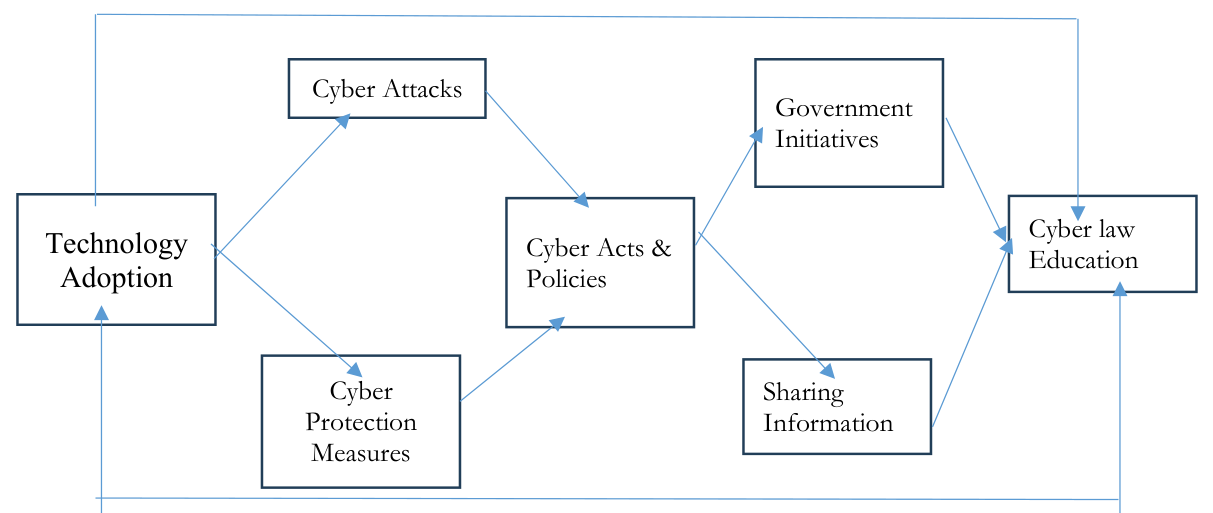
Fig.1 Cyber law Ecosystem Framework
Source: Authors Own
CONCLUSION
Cyber law also known as information technology law or internet law or digital law addresses a wide array of issues like use of digital technologies, online platforms, addressing cybercrimes and enhancing cybersecurity. Also, it regulates by establishing rules like digital signatures, online contracts, e-payment systems, consumer protection, intellectual property rights with reference to digital domain, copyright trademarks, trade secrets, patents also copyright infringement and piracy in cyberspace. System vulnerabilities, assessing risk, and lack of security assistance to our system are the main factors that allow the threat actors to attack our system or organization. In Indian Context, cyber law consists of two laws i.e. Information Technology Act 2000 and Indian Penal Code (IPC). Information Technology Act, 2000 got updated with more rules and regulations introduced as Information Technology (amend) Act, 2009. Countries like USA, UK, Canada, South Korea, Australia, Vietnam, Denmark, Hungary, Mexico are all versed with cyber law but none of the country has fully resolved the cybercrime issues. Adoption of new technologies, standardization & globalization, ethical issues are not addressed in the Information Technology Act, 2000 at present. Users need to be aware of cyber law, rules and regulations of cyberspace with the help of education and awareness. Cyber law recognizes legal frameworks for data privacy, data breach notification, consent requirements, individual personal rights are respected in an online environment. Furthermore, it also mandates cybersecurity standards, in order to protect critical infrastructure, sensitive information of people, and also digital assets from cyber threats. Governing online speech, legal frameworks, content moderation, and platform liability play an important role in shaping the digital public sphere nurturing a safe and inclusive online environment.