
INTRODUCTION
The skyline of Indian cities is rapidly transforming. From metro networks to gated communities, Indian urban spaces are witnessing a visible transition. But beneath this modern makeover lies a pressing issue gentrification and urban displacement. While cities become “world-class,” the urban poor are often pushed to the margins, both spatially and economically. With over 35% of India’s population now urban (Census 2011; expected to cross 40% by 2036), understanding how cities grow is vital especially for Sociology aspirants exploring themes under urbanization, inequality, and marginalization. This phenomenon holds immense significance in urban sociology and is increasingly relevant for aspirants seeking to understand contemporary socio-economic challenges in India.
The urban transition in India is one of the fastest growing across the globe. As cities like Delhi, Kolkata, Mumbai, Bengaluru, and Hyderabad are rapidly expanding at an unprecedented rates, in both spatially and demographically. This urban growth has resulted in placing a unwanted burden on urban land, housing systems, and infrastructure. As a result the solution to this was, the urban redevelopment has emerged as a dominant planning paradigm which focuses at addressing issues like aging infrastructure, informal housing, environmental degradation, and aspirations to transform Indian cities into global economic hubs. While the redevelopment have theoretically promised a modernization, improved living conditions, and an efficient use of land, it has also resulted in producing a significant set of socio-economic and legal consequences, particularly for marginalized and low-income people. A vital part of this transformation is state-led gentrification which simply means a process through which a government policies, planned decisions, and redevelopment schemes have systematically resulted in reshaping urban spaces in a ways that has displaced or disadvantage a vulnerable populations while benefiting a middle or upper class of people.
The gentrification which in the past traces its roots as an organic, market-led process in which the affluent residents move into working-class neighbourhoods, and has evolved significantly in the context of contemporary urban policy. As we have seen across India and global south, gentrification is increasingly state-engineered. The governments have also actively undertaken the large-scale redevelopment, incentivize private developers, relax zoning restrictions, and reconfigure urban spaces in order to suit the needs of the corporate sector, real estate investors, and middle-class residents. As such interventions have led to blur the line between public welfare and market driven transformation, raising a serious questions about legality, social justice, and the right to the city.
The researcher will try to examine the socio-economic and legal consequences of state-led gentrification in India’s urban redevelopment landscape. The aim is to unfold how the legal frameworks, planning instruments, and governance practices are not only facilitate redevelopment but also results in inequalities, displacement, and spatial exclusion. With the use of the theoretical insights, case studies and legislative analysis from various metropolitan cities like Bengaluru, Mumbai, and Delhi, it extends by evaluating the redevelopment-driven gentrification aligns or conflicts with constitutional guarantees, human rights principals, and the wider target of equitable urbanization.
GENTRIFICATION THEORY
The gentrification as a concept traces its origin in the 1960s and was coined by Sociologist Ruth Glass who described gentrification as the process where deteriorated urban neighbourhoods are renovated and upgraded, usually attracting affluent residents while displacing lower-income groups. In modern times this term gentrification has become a global urban trend including in metropolitan cities of India like Mumbai, Delhi, Bengaluru, and Kolkata. The classical version of this theory has emphasized the changes in a residential preferences, the patterns of cultural consumption for neighbourhood aestheticization and middle classes. However, the subsequent theorists such as Neil Smith have shifted its focus to structural economic forces. The famous theory propounded by him was rent-gap theory which base its arguments that gentrification happens when there is disparities which emerges between actual land value and potential land value under more profitable uses. This gap has led to motivate investors, developers, and governments to initiate urban restructuring. The smith has also articulated the idea of the “revanchist city”, where state power aligns with corporate interests in order to reclaim central urban spaces from the poor. In simple words the classical theory of gentrification describes the process where urban working-class neighbourhoods undergoes a class upgrading through the influx of middle-class residents, leading to rise in property values, renovated housing, and cultural shifts.
The classical concept of gentrification have involved renovations of individual into more mature neighbourhoods, evolving into a more broader restructuring with new builds. It raises concerns over displacement, through measurement varies, and boosts local economies via infrastructure but polarizes social hierarchies. The critics have challenged the neoclassical views of it as stressing capital’s role, inevitable. In the Global South, the scholars and intellectuals have noted that gentrification is seldom market-driven alone; it is deeply intertwined with state policy. The acquisitions, demolition drives, zoning reforms, infrastructure megaprojects led by government, and PPPs have become a central instruments of gentrification. This entire process has been characterized by a formal state intervention and regulatory restructuring rather than a spontaneous socio-economic change.
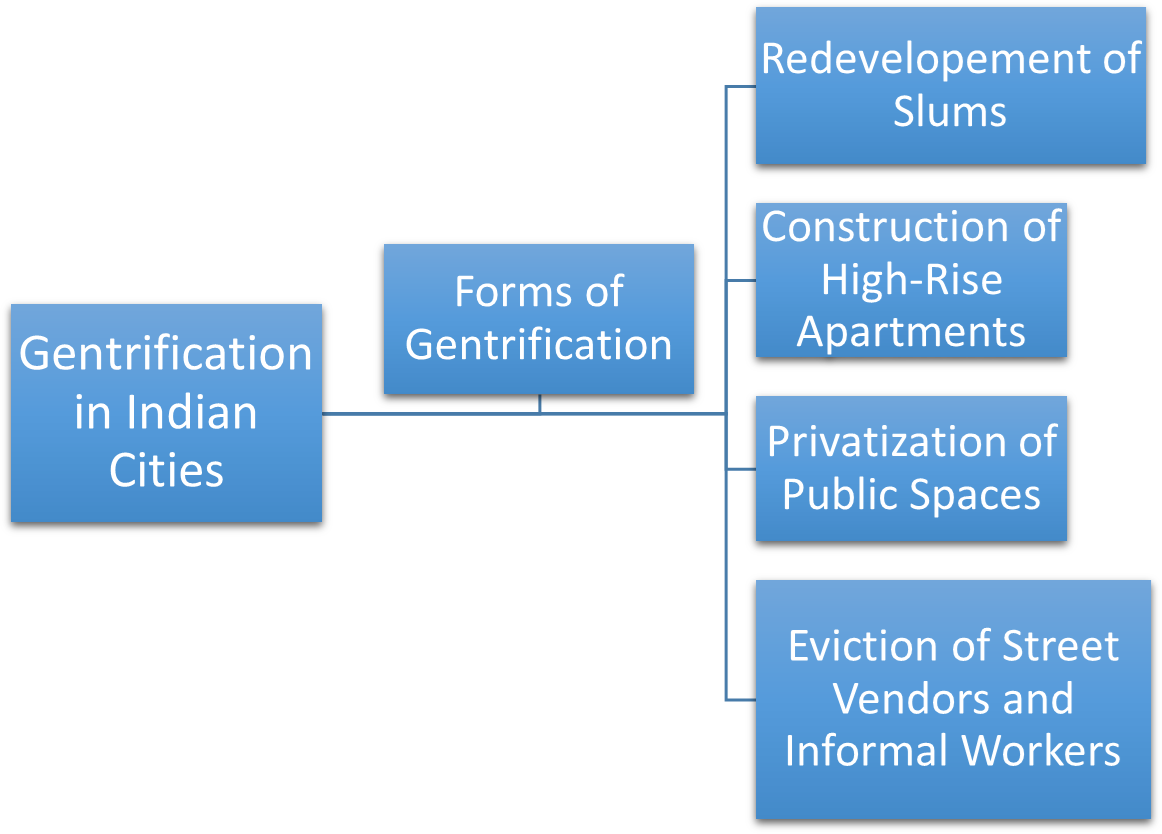
The state plays a dual role as under neoliberal urban governance, the state frequently plays a dual role i.e., it is both facilitator of market logics and the steward of public welfare. So, when the urban redevelopment becomes tied to municipal revenue generation, land-value capture, and city branding, the welfare role can be subordinated to market objectives. This has made a critical implications on low-income households who rely on proximate employment, informal economies, and social networks.
LEGAL AND POLICY ARCHITECTURE ENABLING REDEVELOPMENT
Constitutional Framework and Judicial Doctrine
The Indian legal framework is defined by making balance between the state’s power in order to acquire property for public good i.e., Urban Renewal and the Fundamental Rights of citizens.
1. The Right to Property and Eminent Domain
| Constitutional Provision | Doctrine/Principle | Relevance to Urban Renewal/Gentrification |
|---|---|---|
| Article 300A | Right to Property (Constitutional Right) | No person shall be deprived of their property save by authority of law. This replaced the earlier Fundamental Right to Property. It means the state must acquire property (land) for urban renewal only under a valid, statutory law (like the Land Acquisition Act of 1894 or the LARR Act, 2013). |
| Right to Fair Compensation and Transparency in Land Acquisition, Rehabilitation and Resettlement Act, 2013 | Eminent Domain (Power of State to acquire property for public purpose) | This Act governs how the State acquires land. It mandates “Fair Compensation” and emphasizes Rehabilitation and Resettlement (R&R). State-led gentrification projects that fail to provide adequate R&R or declare a private commercial purpose as a ‘public purpose” are highly vulnerable to legal challenge under this Act. |
| Seventh Schedule (State List) | Urban Planning and Development | Urban development, housing, and land are primarily State subjects. This means that the constitutional challenges and policy implementation will largely revolve around State-level laws, such as State Town and Country Planning Acts and Various Development Authority Acts (eg., MHADA, DDA). |
2. Fundamental Rights and Judicial Review
The judiciary mainly uses the following Fundamental Rights in order to scrutinize state action in urban renewal projects:
| Constitutional Provision | Judicial Doctrine/Interpretation | Impact on Gentrification/ Displacement |
|---|---|---|
| Article 21 | Right to Life and Personal Liberty (Includes Right to Housing/Shelter) | This is the most vital Article. Through landmark judgments like (Olga Telis, Challenging demolition in Shakur Basti), the Supreme Court has read the Right to Shelter as a constituent of the Right to Life. Eviction without an alternative (Right to Rehabilitation) or without a Procedure Established by Law that is fair, just, and reasonable, violates Article 21. |
| Article 14 | Right to Equality/Non-Arbitrariness | State action (such as selective slum clearance or discriminatory planning rules) must not be arbitrary, unreasonable, or discriminatory. The judiciary can strike down renewal projects if they are grossly disproportionate, target only the poor, or lack a rational nexus to a legitimate public goal. |
| Article 19(1)(e) & (g) | Right to Reside and Settle & Right to Livelihood | Displacement through gentrification/renewal often violates the slum dwellers right to carry on their trade or occupation, which is integrally linked to their location in the city. The courts often insist on protecting the livelihoods of displaced persons. |
As seen above the Constitution of India also does not explicitly guarantee a fundamental right to housing. But however, the judicial interpretation of Article 21 has widened the scope of right to life in order to include right to livelihood, shelter, and dignity. As in the case of Olga Tellis Vs. Bombay Municipal Corporation1, the Apex Court has recognized that any type of eviction of pavement dwellers affects their right to livelihood and must adhere to principles of fairness and reasonableness and the evictions cannot be effected arbitrarily; reasonable notice and procedural fairness are required. The Delhi High Court also gave its decision in Sudama Singh Vs. Government of NCT of Delhi2 deals with the issue of rehabilitation and eviction, i.e., highlighting the removal of jhuggis without ensuring relocation could violate Article 21 and related welfare obligations in the city context. On similar lines in the case of Ajay Maken Vs. Union of India in which the court has emphasized the need for a humane rehabilitation in slum evictions. Moreover in this case the court explicitly affirmed the “Right to the City” (through not a strict legal right, it is just a policy imperative). The clear direction was given by the court that any type of eviction/demolition must be preceded by a proper survey and meaningful consultation, and rehabilitation must be a coordinated joint effort. The high court widened the scope of slum dwellers as they are seen as contributors to the city and not merely mere illegal encroachers. But despite these decisions given by various courts the judicial outcome in eviction and redevelopment cases are mixed i.e., the courts in few circumstances prioritize planning objectives and thinks in favour of public interest but at the other hand it also emphasize procedural safeguards and the need for an adequate rehabilitation. This kind of difference in jurisprudence have created a legal uncertainty for vulnerable urban residents.
Central Urban Policies and Missions
Smart Cities Mission
It was launched in the way back in 2015, the mission is one of the crucial driver of state-led gentrification. As unlike previous missions or schemes which focuses on entire city, this mission only stress on Area-Based Development, redevelopment, and retrofitting. As this mission ensures to improve infrastructure and governance, but the critics have argued that it only focuses on some selective urban enclaves which ultimately results in exclusionary development and displacement of informal residents.3 As 80% of the SCM funds are typically spend on less that 5% of a city’s area i.e., the so called “Smart Enclave”. This has created “islands of excellence” where property values skyrocket, pricing out original low-income residents an informal traders.
The concept of “Rub-off Effect” comes into picture which simply means that “smart” neighbourhoods will catalyse development in surrounding areas. But in reality this has often resulted in a speculative real estate investment and the “beautification” of public places which generally excludes the poor people of urban areas.
Pradhan Mantri Awas Yojana – Urban(PMAY-U)
The PMAY-Urban scheme aims at achieving the goal of “Housing for All” through Credit-linked subsidies, affordable housing partnerships and in-situ slum redevelopment (ISSR) but it is also one of the major tool for state-led gentrification. However, this scheme heavily relies on participation of private sector, often prioritizing financially viable projects over the needs of the poorest households.4 In which the land is used as a resource under in-situ slum redevelopment. Which allows a private players and developers to build high-rise apartments for slum dwellers on a portion of the slum land, while the left over “freed-up” portion of land is used for residential or high-end commercial “sale components”. This idea of this scheme is borrowed from Mumbai’s Slum Rehabilitation Authority in which the model incentivizes the developers with more transferable development rights or floor space index. This ultimately results in generally verticalization of poverty into small, poorly maintained apartments, while the surrounding area is gentrified for the upper and middle group of people.
AMRUT (Atal Mission for Rejuvenation and Urban Transformation)
The AMRUT scheme focuses mainly on basic infrastructure like sewerage, water supply, and green spaces. The gentrification mechanism related to this scheme is that by simply improving “amenity value” like plazas, developing parks, and waterfronts, the state increases the market attractiveness of specific neighbourhoods. There are projects such as the Sabarmati Riverfront which is funded by both central and state funds is an classic example. They have replaced the informal settlements and “unproductive” riverbanks with the high-end recreational and commercial zones, effectively gentrifying the urban core.
PM-eBus Sewa & Transit-Oriented Development (TOD)
The recent policy launched by central government has heavily incentivize the Transit-Oriented Development (TOD) near all the BRTS corridors and Metro stations. The state has permits for a higher FSI and densification along the transit corridors. While it was originally meant to reduce traffic, it has triggered a so called “Transit-induced Gentrification”. The increased accessibility has made land located near transit hubs way too expensive for the poor people, leading to the displacement of informal shops and housing in favour of luxury apartments and the malls.
State-Level Redevelopment Laws and Regulations
The urban development is a state subject given under the Constitution of India. Consequently, redevelopment frameworks vary across states.
Maharashtra: Slum Rehabilitation Authority
The Slum Rehabilitation Authority also known as (SRA), which was enacted under the Maharashtra Slum Areas (Improvement, Clearance and Redevelopment) Act, 1971 is one of the crucial influential driver of redevelopment mechanisms in India. As under the SRA schemes, the developers provide a free rehabilitation housing to eligible slum dwellers in lieu for transferable development rights and additional floor space index. While the intention behind scheme is presented as a win-win situation, but in practicality it effectively monetizes slum land in prime locations, thus incentivizing gentrification.5
Delhi: Master Plans and Redevelopment Zones
The Delhi’s Master Plans also known as MPD 2021 and MPD 2041) promotes transit-oriented development, land pooling, and redevelopment of old residential and commercial areas. These envision densification of policies and mixed use development but often lack robust safeguards for informal residents.6
Karnataka: Urban Development Authorities
In the State of Bangalore, the redevelopment is majorly governed by Karnataka Urban Development Authorities Act and municipal regulations. The Redevelopment projects has frequently align with commercial and IT corridor expansion, marginalizing low-income settlements.
SOCIO-ECONOMIC IMPACTS OF STATE-LED REDEVELOPMENT: DISPLACEMENT, EXCLUSION, AND SPATIAL RESTRUCTURING
The socio-economic impacts of state-led redevelopment in India reveal a complex interplay of displacement, altered livelihoods, changing class geographies, and the market-driven commodification of urban land. While redevelopment policies are framed within the discourse of modernization, resilience, and equitable access to infrastructure, the lived realities of affected populations frequently contradict these projections. Gentrification manifests not merely as a physical transformation of the built environment but as a restructuring of social relations, community identities, and access to opportunity. The impacts are not evenly distributed; instead, they are profoundly classed, caste-mediated, and spatially stratified. Through examining patterns of displacement, housing insecurity, labor disruption, and cultural loss, this section demonstrates how redevelopment catalyzes socio-economic exclusion and reproduces urban inequality under the guise of progress.7
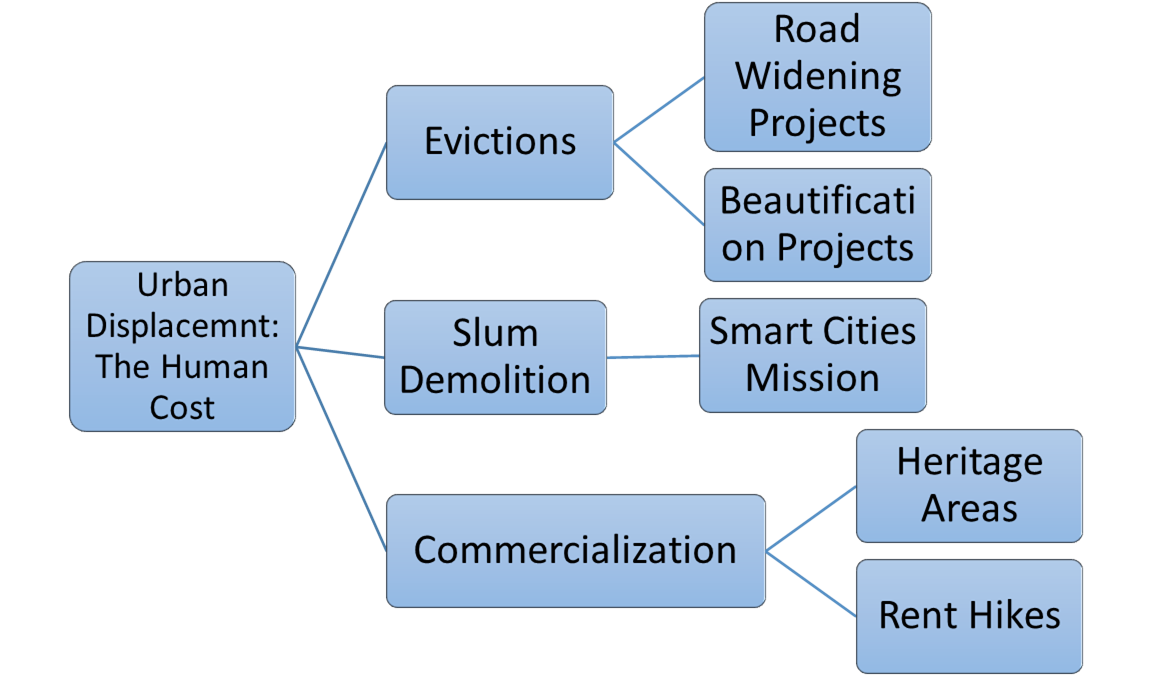
The most visible and immediate socio-economic consequence of redevelopment is displacement. In cities like Mumbai, Delhi, and Bengaluru, redevelopment-driven evictions displace thousands of slum dwellers, tenants, and informal occupants annually. This displacement is often categorized as “temporary,” yet in practice, resettlement timelines are unpredictable, and interim housing provisions frequently fail to materialize. Low-income households forced into peripheral resettlement colonies face substantial livelihood disruptions, as distance from employment hubs inflates commuting costs and reduces earning potential. Street vendors, domestic workers, construction laborers, and small entrepreneurs—whose livelihoods depend on proximity to densely populated neighbourhoods—are disproportionately impacted. For many families, the move to distant resettlement sites results in a permanent loss of income streams, compelling shifts into unstable informal labour or debt dependency. Thus, redevelopment-induced displacement produces cascading socio-economic vulnerabilities rather than merely spatial relocation.
Housing insecurity is another core dimension of the socio-economic impact of state-led gentrification. Redevelopment projects, particularly through frameworks like the SRA in Maharashtra or the Smart Cities Mission, often promise rehabilitation housing. Yet, the eligibility criteria for such housing frequently exclude tenants, recent migrants, sub-tenants, and individuals lacking documentary proof. Even for those deemed eligible, the quality and adequacy of allotted units raise concerns. Rehabilitation units are typically smaller, standardized, and lack flexibility for multi-generational families. Often built as high-rise apartments, these units impose new maintenance costs, electricity expenses, and service charges previously non-existent in informal settlements. The shift from self-constructed homes with flexible spatial arrangements to rigidly designed flats also disrupts home-based enterprises—tailoring, food preparation, small fabrication—undermining household income. As a result, redevelopment increases the financial burden on already precarious populations and transforms housing from a secure asset into a cost-intensive liability.
Moreover, redevelopment alters the socio-spatial fabric of neighbourhoods, contributing to the decline of community networks and social capital. Informal settlements are not merely clusters of homes; they are ecosystems of localized support, reciprocal labour exchange, childcare networks, caste and kinship-based solidarities, cultural institutions, and shared public spaces. When redevelopment displaces or fragments these networks, the loss extends far beyond physical shelter. For example, rehabilitation towers often limit communal interactions due to vertical segregation, restricted open spaces, and surveillance infrastructures. The erosion of such networks exacerbates vulnerability, as individuals lose access to informal credit, mutual aid, and neighborhood-based resource sharing. This intangible, yet deeply consequential loss of social capital underscores the fact that redevelopment disrupts not just living conditions but the social infrastructure that sustains marginalized communities.
Livelihood restructuring is another significant outcome of redevelopment. Many urban poor communities rely on dense urban environments to sustain economic activities that are micro-entrepreneurial and service-oriented. Redevelopment projects, particularly those that convert residential areas into commercial complexes or mixed-use townships catering to middle- and upper-income groups, shift the nature of local employment. Informal workspaces such as tailoring shops, cycle repair kiosks, and vegetable stalls are replaced by formal retail chains and commercial services that demand higher skill levels and formal qualifications. Consequently, displaced populations either lose access to their traditional livelihood base or are compelled to enter exploitative labor markets with lower wages and limited protections. Redevelopment, therefore, does not generate inclusive economic growth; instead, it restructures the labor landscape to favor formal and capital-intensive sectors, while marginalizing the informal economies that sustain the majority of urban poor households.
The cultural consequences of redevelopment are equally significant, though frequently under-acknowledged in policy narratives. Urban renewal projects often deploy aesthetic discourses—beautification, world-class infrastructure, and smart urbanism—that stigmatize informal settlements as eyesores or markers of backwardness. This cultural framing delegitimizes existing ways of living and renders low-income communities “undeserving” of central urban space. As redevelopment proceeds, traditional practices, religious festivals, local markets, and caste-specific occupations lose their spatial anchors. In neighbourhoods like Dharavi, Kathputli Colony, or the wadas of Pune, redevelopment threatens intangible heritage—craft traditions, community festivals, localized governance, and artistic labour—undermining collective identities. Thus, the cultural erasure embedded in redevelopment is not incidental but systemic, reinforcing socio-spatial exclusion by devaluing subaltern histories and aesthetics.
The financialization of urban space is another critical socio-economic dimension. Redevelopment has increasingly aligned with speculative real estate markets, with land becoming a commodity for investment rather than a social good. High-rise redevelopment in central areas inflates property values and rental prices, pricing out low-income families even in neighborhoods not directly undergoing redevelopment. As private developers leverage state-backed redevelopment policies to access premium urban land, gentrification radiates outward, creating ripple effects on rental markets, informal housing, and small businesses. Institutional investors, including real estate funds and corporate developers, further consolidate control over housing markets, making affordable housing scarce. This growing nexus between redevelopment and financial speculation intensifies socio-economic stratification and transforms urban cores into elite enclaves.
Gendered impacts of redevelopment further amplify social inequities. Women disproportionately bear the burden of relocation due to disruptions in caregiving networks, access to water, sanitation, healthcare, and neighborhood-based safety. Income-earning opportunities for women—often located within or near their homes—diminish following displacement. For many urban poor households, women’s earnings constitute vital supplementary income, and redevelopment’s disruption of informal labor spaces deepens gendered economic marginalization. Thus, redevelopment not only reproduces class inequalities but also reinforces patriarchal constraints.
In sum, the socio-economic consequences of state-led redevelopment are multifaceted and deeply entrenched. While urban renewal is presented as an instrument of modernization, it frequently induces displacement, generates livelihood loss, intensifies housing insecurity, disrupts social networks, and drives cultural erasure. Redevelopment reshapes urban economies, privileges market values, and restructures spatial hierarchies, thereby reinforcing socio-economic exclusion rather than alleviating it. Understanding these impacts is critical to assessing whether redevelopment truly serves public welfare or primarily facilitates gentrification and elite capture of urban space.
CASE STUDIES: MAJOR REDEVELOPMENT PROJECTS AND EVIDENCE OF GENTRIFICATION DYNAMICS
The dynamics of state-led gentrification become most visible when examined through concrete redevelopment projects in major Indian cities. These case studies demonstrate how legal frameworks, planning policies, and public-private partnerships translate into material socio-economic outcomes for affected communities. They reveal patterns of displacement, class reconfiguration, and land valorization that occur under the banner of modernization. By analysing redevelopment initiatives in Mumbai, Delhi, Bengaluru, and Ahmedabad, this section illustrates how distinct local planning regimes nonetheless reflect a shared logic of growth-centred urbanism that privileges capital accumulation over inclusive development.
Mumbai presents the most instructive case, as it has long been the epicentre of slum redevelopment and FSI-based incentives.8 The Dharavi Redevelopment Project (DRP), proposed in 2004 and revived in subsequent iterations, exemplifies how the state employs redevelopment frameworks to commodify informal settlements. Dharavi’s land value—enhanced by its strategic location near the Bandra-Kurla Complex—makes it one of the most valuable slum sites globally. The DRP proposes constructing high-rise rehabilitation housing for eligible slum dwellers while unlocking substantial saleable FSI for private developers. While framed as an opportunity to transform Dharavi into a “world-class” enclave, the project has been criticized for imposing homogenized, vertical housing typologies that are incompatible with the area’s dense micro-economies. For potters, leatherworkers, recyclers, and garment manufacturers, proximity within horizontal layouts is essential for production and trade. Vertical rehabilitation threatens to dismantle these economic systems. Furthermore, the eligibility cutoff date excludes a significant share of migrant workers who sustain Dharavi’s labor ecosystem. The DRP thus illustrates how redevelopment weaponizes planning regulations and land markets to restructure space in ways that marginalize vulnerable populations while valorizing land for capital-intensive uses.9
Another illustrative project is the redevelopment of Mumbai’s mill lands, particularly in Lower Parel and Worli.10 Once home to textile workers and working-class neighbourhoods, the area was transformed in the 1990s and 2000s through policies that allowed mill owners to convert industrial land for commercial use. While justified in the name of deindustrialization and urban renewal, the shift disproportionately benefited private developers and mill owners. Workers displaced by mill closures received limited compensation and no meaningful resettlement. The outcome was the proliferation of elite commercial spaces—malls, luxury apartments, entertainment complexes—while affordable housing remained negligible. The mill land redevelopment catalysed dramatic increases in land value and rents, displacing residual working-class populations. This case reveals how redevelopment, even when not explicitly framed as slum rehabilitation, can reproduce gentrification by transforming industrial working-class enclaves into elite consumption zones through selective state policy.
Delhi’s redevelopment of the Kathputli Colony offers another stark example. The colony, home to puppeteers, musicians, and artisans, was targeted for redevelopment under the JNNURM framework in collaboration with private developers. While authorities promised in-situ rehabilitation, the evacuation process involved the use of force, temporary camps, and delayed resettlement. Many residents were relocated to distant areas such as Narela, where livelihood opportunities are scarce. Cultural heritage—integral to Kathputli’s identity—was not meaningfully incorporated into redevelopment plans. The case exposes how state narratives of improved housing mask displacement, economic disruption, and cultural erasure. Moreover, the Delhi High Court’s limited interventions demonstrate the judiciary’s tendency to prioritize procedural compliance over substantive protection of vulnerable populations. This case underscores how legally sanctioned redevelopment can actively dismantle intangible cultural heritage and replace it with high-value real estate.11
Bengaluru’s Ejipura redevelopment project highlights the consequences of PPP models. Initially designed to provide Economically Weaker Section (EWS) housing, the project resulted in the demolition of existing low-income housing and the eviction of thousands. The private developer was granted substantial commercial development rights in exchange for constructing EWS units, yet delays, legal disputes, and cost overruns led to prolonged displacement. The eventual construction fell short of meeting original commitments. Residents experienced severe livelihood disruptions, particularly domestic workers and street vendors whose employment was bound to neighboring middle-class households and commercial centers. The Ejipura case therefore highlights the structural risks of PPP-based redevelopment, where profit incentives overshadow rehabilitation obligations.
Ahmedabad’s Sabarmati Riverfront project represents another variant of state-led gentrification. Although celebrated globally as a model of urban beautification, it involved the eviction of thousands of informal settlements located along the riverbank. Despite promises of resettlement, many households received inadequate or distant housing, disrupting employment tied to the riverbank—laundry work, fishing, and small-scale commerce. The project exemplifies how environmental and aesthetic narratives are strategically deployed to justify spatial clearance and class-based exclusion. By converting riverfront land into promenades, parks, and commercial spaces, the project reallocated central urban land for elite consumption while displacing marginalized groups to peripheral areas.
Across these case studies, several consistent themes emerge. First, redevelopment projects rarely guarantee in-situ rehabilitation; even when promised, execution is fragmented and exclusionary. Second, eligibility criteria, documentation requirements, and compensation mechanisms systematically marginalize migrant workers, tenants, and informal occupants. Third, state planning tools—including FSI bonuses, zoning changes, and PPP frameworks—facilitate private profit extraction while legitimizing displacement. Fourth, cultural and occupational economies are disregarded in redevelopment plans, treating land as a commodity rather than a social and economic resource. Finally, judicial responses often validate redevelopment objectives, intervening only to mitigate procedural discrepancies rather than contest substantive outcomes.
Collectively, these cases demonstrate that Indian redevelopment is not merely an administrative exercise in urban improvement. It is a spatial strategy rooted in legal authority, economic interests, and state-private alliances that restructure urban land markets and social geographies. By displacing low-income communities from high-value central areas and accommodating middle- and upper-class populations, redevelopment produces gentrification dynamics that are systemic rather than incidental.
EVALUATING THE LEGAL AND POLICY IMPLICATIONS: RETHINKING EQUITY, PARTICIPATION, AND GOVERNANCE IN REDEVELOPMENT
The patterns documented across redevelopment projects and legal frameworks raise critical questions regarding the normative goals of urban policy and the alignment of redevelopment with constitutional commitments to equity, social justice, and the right to housing. State-led gentrification is not simply an unintended side effect of poorly executed redevelopment; rather, it reflects a structural orientation in planning law toward capital-driven growth, revenue maximization, and private-sector participation. This section evaluates the legal and policy implications of such redevelopment practices, examining how procedural safeguards, participatory governance, and social welfare objectives are curtailed or reinterpreted within neoliberal redevelopment paradigms. It argues that without reconfiguring legal frameworks to prioritize socio-economic rights and genuine democratic participation, redevelopment will continue to exacerbate rather than alleviate spatial inequality.
A major legal implication concerns the expanding interpretation of “public purpose” within land acquisition and redevelopment law. Historically, the judiciary has used public purpose as a justification for displacing communities to further state objectives, often privileging economic development over social protection. Even under the ostensibly more progressive LARR Act, exemptions and diluted consent requirements permit acquisitions for PPPs and infrastructure projects that functionally serve private interests. The elasticity of public purpose effectively legitimizes the transfer of land and resources from low-income populations to elite beneficiaries. Without a more restrictive and rights-conscious interpretation—where public purpose encompasses social equity and adequate housing—redevelopment law will remain tilted toward dispossession masked as progress.
Participation is another crucial policy concern. Although planning laws and policies frequently invoke participatory decision-making, in practice, the mechanisms for consultation are largely symbolic, bureaucratic, or inaccessible to affected populations. Public hearings are often conducted in technical language, held in distant administrative offices, and structured in ways that discourage substantive engagement. Informal settlers and migrant communities—lacking documentation, legal literacy, or political representation—are especially disenfranchised from decision-making processes. The result is a technocratic model of planning where participation is procedural rather than transformative. Without institutional reforms that democratize planning through community representation, neighbourhood councils, and co-design processes participation will remain a checkbox rather than a meaningful safeguard against displacement.
Transparency and accountability, ostensibly strengthened under RERA and other statutes, reveal significant gaps in the context of redevelopment. RERA’s focus on consumer protection is oriented toward formal buyers rather than tenants or informal occupants. Rehabilitation timelines and grievance redressal mechanisms often lack enforceability, particularly when developers delay possession or alter plans. PPP agreements are frequently opaque, protected by commercial confidentiality, and inaccessible to the public. Municipal bodies and development authorities operate with substantial discretionary power in zoning amendments and FSI allocations, enabling selective and politically driven decision-making. Greater transparency in these domains—through mandatory disclosure of redevelopment agreements, impact assessments, and rehabilitation plans—is critical to ensuring accountability and public oversight.12
A further policy implication concerns the fragmentation of legal authority between municipal bodies, state agencies, housing authorities, and planning departments. Redevelopment governance is dispersed across multiple institutions—SRA, housing boards, urban development authorities, and municipal corporations—creating overlapping mandates and jurisdictional ambiguities. This fragmented governance structure leads to weak inter-agency coordination, delays, conflicting interpretations, and diluted accountability. More importantly, it enables government bodies to shift responsibility when rehabilitation commitments are not met. The absence of a unified institutional framework leaves affected communities navigating a labyrinth of authorities without clarity on rights or recourse. Addressing this institutional fragmentation is essential for equitable and efficient redevelopment.
Gentrification-driven redevelopment also challenges constitutional and human rights obligations. Although the Indian Constitution does not explicitly guarantee a right to housing, judicial interpretations of the right to life and dignity include adequate shelter. However, courts have been inconsistent in applying this principle, frequently balancing it against state claims of development necessity. International human rights standards including the ICESCR advocate for protection against forced evictions, adequate rehousing, and livelihood safeguards. Indian redevelopment policies, however, rarely align with these standards in practice. The lack of enforceable rights-based frameworks leaves vulnerable populations without substantive legal protection, allowing socio-economic rights to be overridden by growth agendas.
An additional concern is the state’s increasing reliance on PPPs and market-based instruments to deliver redevelopment. PPP models assume that private actors can efficiently provide housing and infrastructure, yet evidence shows that profit-driven logics often undermine rehabilitation commitments. FSIs, TDRs, and other incentive-based mechanisms prioritize developer profitability, and government revenues from premium charges incentivize municipal bodies to pursue redevelopment aggressively. This alignment of fiscal incentives with redevelopment intensifies pressures on low-income settlements and promotes urban renewal models geared toward commercial viability rather than social welfare. The penetration of market logic into housing policy calls for critical examination and recalibration.
Environmental implications also warrant policy attention. Redevelopment is often framed as an opportunity to build disaster-resilient, energy-efficient structures, yet actual outcomes sometimes contradict sustainability goals. High-rise rehabilitation housing increases carbon footprints, alters microclimates, and strains water and sanitation infrastructure. Green norms are frequently waived to expedite PPP projects. Informal settlements—though lacking formal services often exhibit low ecological footprints due to shared spaces and modest consumption. Redevelopment thus raises questions about what constitutes “sustainable” urbanization and whose environmental interests are prioritized.13
In conclusion, the legal and policy implications of state-led redevelopment point to systemic weaknesses in governance, rights protections, and distributive justice. Addressing these gaps requires reimagining redevelopment frameworks with binding safeguards, transparent governance, enforceable rehabilitation rights, and inclusive planning processes. Without such reforms, redevelopment will remain tethered to gentrification, reinforcing social inequalities while legitimizing displacement under the banner of modernization and growth. The path forward demands centring socio-economic justice, not merely urban aesthetics or capital accumulation, as the governing principle of redevelopment.
*****
Footnotes
1. (1985) 3 S.C.C. 545; 1986 A.I.R. 180. https://indiankanoon.org/doc/709776/
2. Sudama Singh Vs. Gov’t of NCT of Delhi, W.P.(C) 11616/2015 (Del. H.C. Mar. 18, 2019).
3. Ministry of Housing & Urban Affairs. Smart Cities Mission Statement & Guidelines (2015).
4. Ministry of Housing & Urban Affairs. PMAY-Urban Operational Guidelines (2015).
5. Maharashtra Slum Areas (Improvement, Clearance and Redevelopment) Act, 1971.
6. Delhi Development Authority, Master Plan for Delhi 2041 (Draft).
7. TriumphIAS (2025) Gentrification and urban displacement: Sociology optional coaching: Vikash Ranjan classes: Triumph IAS: UPSC sociology optional, TriumphIAS. Available at: https://triumphias.com/blog/gentrification-and-urban-displacement/ (Accessed: 07 February 2026).
8. Gentrification in mills of Mumbai, how policy failures impact urban development – RTF | rethinking the future. Available at: https://www.re-thinkingthefuture.com/architectural-community/a13709-gentrification-in-mills-of-mumbai-how-policy-failures-impact-urban-development/ (Accessed: 07 February 2026).
9. Land Housing and Gentrification in Mumbai, Available at Failure of Policies – Land, housing and gentrification in Mumbai, Accessed 26 Nov, 2025
10. Kamala Mills Fire and the Perilous Gentrification of Mumbai, Author : Dwiparna Chatterjee and D Parthasarthy, Date 26 April, 2018, Available at: Kamala Mills Fire and the Perilous Gentrification of Mumbai | Economic and Political Weekly, Accessed 26 Nov, 2025
11. ‘no man’s land’: Delhi’s urban villages face uncertain future | reuters. Available at: https://www.reuters.com/article/world/no-mans-land-delhis-urban-villages-face-uncertain-future-idUSKBN22N040/ (Accessed: 07 February 2026).
12. Foundation, O.R. (no date) Pathways to gentrification in India: The case of Patan, orfonline.org. Available at: https://www.orfonline.org/research/pathways-to-gentrification-in-india-the-case-of-patan (Accessed: 07 February 2026).
13. Rethinking gentrification in India: Displacement, dispossession and the spectre of development (six) – global gentrifications. Available at: https://www.cambridge.org/core/books/abs/global-gentrifications/rethinking-gentrification-in-india-displacement-dispossession-and-the-spectre-of-development/303B9F7C583F4AC412863 750B188576E (Accessed: 07 February 2026).