
INTRODUCTION
The entitlement of free speech constitutes the foundation of a democratic society, permitting individuals to articulate their views, challenge authority, and engage in public debate without the threat of retaliation. In India, this fundamental entitlement is granted under Article 19(1)(a) of the Constitution; however, it is also subject to reasonable restrictions as stated in Article 19(2). However, one of the most contentious issues is the law concerning sedition, which was initially enshrined under Section 124A of the Indian Penal Code, 1860. The notion of sedition, that rooted in colonial records, was initially implemented by the British to suppress nationalist opposition. For more than a century, it has served as a significant mechanism for oppressing dissenting voices that are viewed as challenges to state authority (Human Rights Watch, 2022).
Throughout the previous few years, the constitutional validity and extent of sedition have undergone heightened scrutiny again, particularly in light of India’s democratic development, judicial rulings, and commitments to international human rights standards. The discourse surrounding this issue intensified with the enactment of the Bharatiya Nyaya Sanhita, 2023 (BNS), which officially replaced the Indian Penal Code (Live Law, 2025). Although the BNS does not explicitly use the term “sedition”, it presents a redefined offence in Section 152, which pertains to acts that threaten the sovereignty, integrity, and unity of India. This transition prompts fundamental constitutional and interpretive inquiries, such as whether the absence of the term “sedition” signifies authentic reform or is it merely a semantic rebranding of the existing restrictive framework? (India Today, 2024).
The ambiguity arises when the principles of free expression are evaluated in relation to the necessities of national security (Verdictum News Desk, 2025). In Kedar Nath Singh case (1962)1, the Apex Court endeavoured to refine the interpretation of sedition, focusing specifically on actions that involve incitement to violence or disruption of public order. However, the provision has been extensively utilized repeatedly, targeting journalists, activists, and those expressing political dissent. Similarly, the BNS, instead of addressing these paradoxes, might persist in sustaining the same issues under a diverse label, thus revealing a constitutional quandary between maintaining national integrity and upholding democratic freedoms (BoomLive, 2025).
This research paper aims to rigorously analyse the transition from IPC to BNS concerning sedition, placing it within the larger context of free speech in India.
SEDITION AND FREE SPEECH
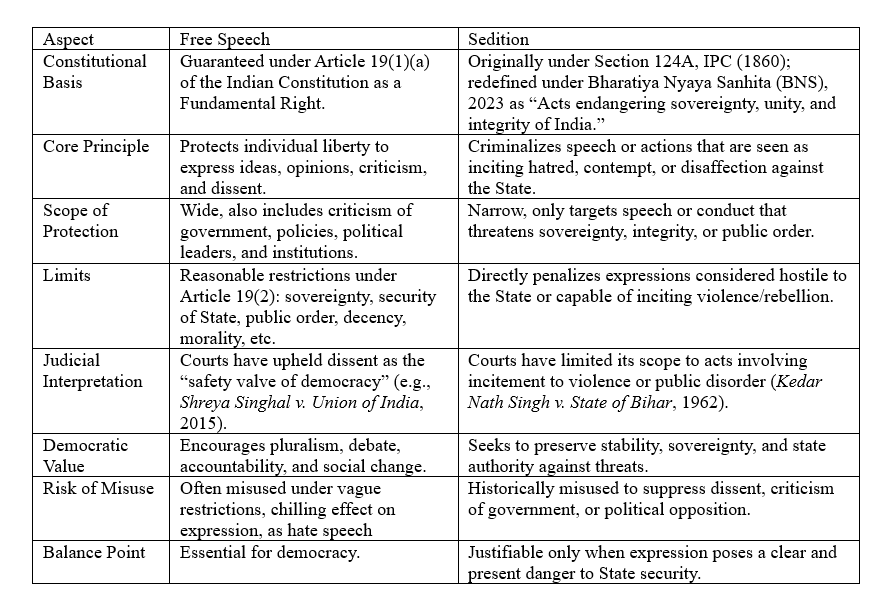
Free speech guaranteed under the Constitution of India is a fundamental right, whereas sedition is an offence under the Penal Code, having a penal provision. The “freedom of speech and expression” is the core of democracy to express individuals’ opinions, views, raise voices for wrong, etc., but never allows hatred speech, inciting speech, sedition to shield under it (Karnani, 2023). Sedition criminalizes “words, signs, or representations that bring or attempt to bring into hatred or contempt, or excite disaffection towards the Government or authority” (Indian Penal Code, 1860). The controversy arises only because of the ambiguity in the definition of free speech and sedition. The line that exists between words that embody the right to free speech and those that may be deemed offensive under sedition is a significant issue for examination. Table 1 below depicts the different aspects of free speech and sedition.
Table 1: Free Speech vs. Sedition
[Source: Compilation]
A. Origin and Historical Background of Sedition Law
The law regulating sedition in India has its origins in the colonial period, initially drafted as a mechanism to curb dissent and limit freedom of expression in opposition to the British Raj. The notion of sedition originated in the 17th century in England, where it was believed that governmental criticism was equivalent to endangering the stability of the State. The British enforced this concept in their colonies, including India, as a means of averting rebellion and putting down nationalist movements (EPW Engage, 2017). The concept of sedition first arose in 1837, by Thomas Babington Macaulay, under Section 113 in the Draft Indian Penal Code (IPC). Nonetheless, it was eliminated during the enactment of the IPC in 1860. Thereafter, in the year 1870, it was incorporated into the Indian Penal Code as Section 124A through an amendment put forth by Sir James Fitzjames Stephen. This initiative was primarily aimed at combating the accelerating prevalence of religious activities and various nationalist movements that posed a challenge to British authority (Parthasarathy, 2022).
Section 124A of the IPC articulates the concept of sedition, encompassing “any actions, words, or representations that incite or seek to incite hatred or contempt, or excites or attempts to excite disaffection towards the Government established by law in India”. The concept of “disaffection” entails a wide realm of sentiments, including enmity, disloyalty, and hostility. The extensive nature of the law enabled the British to employ it as a political instrument against those advocating for freedom and reform, such as Bal Gangadhar Tilak, Mahatma Gandhi, and Annie Besant, all of whom confronted charges under this provision for their critical speeches or writings directed at the British government (Narrain, 2011). Mahatma Gandhi, during his trial under Section 124A in 1922, notably referred to it as “the prince among the political sections of the IPC intended to curtail the liberty of the citizen”. The sedition law surfaced as an attribute of the colonial approach to limiting freedom of expression and suppressing political dissent (The Hindu Centre for Politics and Public Policy, 2022).
After India’s independence in 1947, the provision remained in the Indian Penal Code, along with the “right to freedom of speech and expression” in Article 19(1)(a) enshrined in the Constitution of India (1950). The ongoing conflict between this constitutional right and the colonial sedition law remains an issue of discussion within India’s democratic and legal frameworks (Table 2).
Table 2: Origin of Sedition Law
[Source: Compilation]
| Year | Event | Description |
|---|---|---|
| 1837 | Draft IPC by Macaulay | Sedition clause included as Section 113 of draft. |
| 1860 | IPC enacted | Sedition provision omitted. |
| 1870 | Section 124A inserted | Added by Sir James Stephen to suppress revolts. |
| 1897 & 1908 | Tilak Trials | Bal Gangadhar Tilak convicted for writings against British rule. |
| 1922 | Gandhi Trial | Gandhi charged for articles in Young India. |
| 1947 | Independence | Sedition retained in Indian law. |
| 1950–present | Constitutional debates | Ongoing judicial and political discussions about its validity. |
The Constitutional challenges that surfaced during the 1950s and 1960s continue to persist. The early years following independence were marked by intense dialogue regarding the compatibility of sedition laws with the right to free expression. Two significant Apex Court rulings in 1950, specifically Romesh Thappar case2 and Brij Bhushan case3, established a foundational precedent. The Court determined that “public order” did not constitute one of the reasonable restrictions under Article 19(2). Thus, any legislation that limits speech solely on the grounds of disrupting public order would be deemed unconstitutional. The implications of these rulings served to diminish the foundations upon which sedition prosecutions are based. The First Constitutional Amendment of 1951 introduced “public order” and “incitement to an offence” as legitimate justifications for the constraint of free speech as stipulated in Article 19(2) [The Constitution (First Amendment) Act, 1951]. This enabled Section 124A to persist constitutionally, though it now confronts severe appraisal.
The notable judicial decision regarding sedition was demonstrated in the case of Kedar Nath Singh v. State of Bihar (1962)4. The Supreme Court affirmed the constitutionality of Section 124A while significantly narrowing its application.
The Court determined that:
• Only actions demonstrating the “intention or tendency to incite violence or cause public disorder” can be classified as sedition.
• Simply criticizing the government, regardless of how harsh or disagreeable, does not qualify as sedition unless it is synthesized with incitement to violence or public disorder.
This ruling aligned the sedition statute with the constitutional guarantee of free expression, safeguarding the protection of peaceful dissent5.
Later decisions in the 1970s to 1990s developed the Scope and further solidified this understanding. In the case of Balwant Singh v. State of Punjab (1995)6, the Supreme Court rendered a verdict to acquit two individuals who had voiced pro-Khalistan slogans. The Court articulated that mere casual or isolated expressions, devoid of any intent to incite violence, do not meet the threshold for sedition. The ruling highlighted that simply harnessing slogans or expressing dissatisfaction does not warrant criminalization unless there is an apparent and substantial threat to public order.
During the Emergency ages from 1975 to 1977, sedition laws were time and again employed to suppress dissent among journalists, intellectuals, and opposition politicians, highlighting the risks of political exploitation even in the presence of judicial protections.
In contemporaneous discourse, the judiciary has persistently scrutinized the applicability of sedition within the framework of a democratic society. In the case of Vinod Dua v. Union of India (2021)7, the Supreme Court reiterated the precedent set in Kedar Nath Singh, noting that both journalists and citizens are shielded from prosecution for simply criticizing government actions, unless such speech incites violence or leads to public disorder. Public interest litigations have progressively scrutinized the constitutionality of the law. In 2022, the Supreme Court of India in S.G. Vombatkere v. Union of India (2022)8 mandated the suspension of all ongoing sedition trials and prosecutions pending the government’s thorough review of Section 124A. This consequence stands as a significant milestone, illustrating the judiciary’s recognition of the law’s colonial misapplication and its discordance with the principles of contemporary democracy.
The Law Commission of India, vide its 279th Report (2018), advocated for the retention of sedition laws with proper safeguards, contending that such provisions continue to achieve a critical role in countering anti-national and terrorist propaganda. Nonetheless, numerous legal experts and human rights advocates argue for its repeal, highlighting its recurrent exploitation against journalists, activists, and dissenters as a means to suppress political opposition.
The Bharatiya Nyaya Sanhita, 2023 (BNS) has replaced the IPC, and within this framework, the government has proposed a new provision (Section 152) that addresses “acts which may endanger the sovereignty, unity, and integrity of India”. This represents an effort to recalibrate the definition of sedition in accordance with modern democratic principles, although apprehensions regarding its expansive scope persist.
B. Meaning of Sedition
Sedition, according to English law, constitutes an offence characterized by overt acts, such as speech, conduct, or writing that provoke disaffection or rebellion towards the government. In Reg v. Alexander case (1868)9, Lord Fitzgerald, in his address to the jury, articulated a thorough definition of sedition, emphasizing its depiction as a crime against society, intricately linked to rebellion, and frequently serving as a precursor to it. He highlighted that sedition encompasses actions designed to disrupt the peace of the state and incite individuals to undermine the laws of the government.
In India, Section 124A of the Indian Penal Code, not only defines the term sedition but also provides the penal action for the offence in the provision, but the concrete definition is now absent in the newly enacted BNS. The provision under section 124A IPC criminalizes actions that either instigate or seek to instigate hatred or contempt, or that incite or attempt to incite disaffection towards the government. The significant ruling in a case Queen Empress v. Jogendra Chunder Bose, (1891)10, it is established that the mere expression of disaffection is inadequate; rather, such expression must possess the potential to subvert the authority of the government in order to be classified as sedition. The Supreme Court of India has determined that governmental criticism does not constitute sedition unless it incites violence or disrupts public order.
In a nutshell, sedition encompasses explicit actions that provoke disaffection or insurrection towards the governing authority. Although it is acceptable to criticise governmental actions, such discourse may transgress into the realm of sedition if it provokes violence or disrupts public order. This differentiation is essential in reconciling the right to free expression with the imperative of upholding public order.
CONSTITUTIONAL VALIDITY OF SEDITION LAW
After the enactment of the Constitution of India, the constitutional validity of Section 124A of the Indian Penal Code was initially challenged in the Tara Singh Gopichand case (1951)11. The East Punjab High Court concluded that the provision in question was inconsistent with Article 19(1)(a) of the Constitution, which ensures the right to freedom of speech and expression, and consequently declared it ultra vires. The Court articulated that sedition, as a remnant of colonialism intended to suppress political dissent, is incompatible with the principles of a democratic republic dedicated to liberty and the free exchange of expressions. This prompted considerable constitutional reflection, resulting in the First Constitutional Amendment Act, 1951, which introduced important alterations to Article 19(2) by incorporating the expressions “in the interests of” and “public order”. The modifications expanded the scope of reasonable restrictions on free expression, consequently bestowing a refreshed constitutional validity upon Section 124A in relation to public order and state security deliberations.
Nevertheless, the diversity among judicial convictions persisted to endure. In the Ram Nandan case (1959)12, the Allahabad High Court reaffirmed its stance on the unconstitutionality of Section 124A, asserting that it placed undue and unjustified limitations on the freedom of expression, despite the constitutional amendment. Nonetheless, this ambiguity was definitively resolved by the Hon’ble Supreme Court in Kedar Nath Singh case, which affirmed the constitutional validity of Section 124A while providing a parochial interpretation of its scope. The Hon’ble Court clarified that only expressions that provoke violence or instigate public disorder against the State are encompassed within the realm of sedition. It is pivotal to acknowledge the nuanced distinction between valid political critique and expressions of discontent, featuring that vigorous dissent, regardless of its intensity, is protected under Article 19(1)(a) provided it does not endanger the sovereignty or public order of the State. This ruling serves as the foundational legal principle delineating the acceptable boundaries of sedition law within the Indian legal framework.
SUPREME COURT ON SEDITION LAW- WHY IT IS IN NEWS?
The law of sedition in India has long been the primary focus of a constitutional paradox because it is formidable for a democracy to constitutionally safeguard political dissent while criminalizing expressions that are perceived as hostile to the state. The stance of the Supreme Court of India regarding the sedition law has undergone considerable transformation, reflecting the delicate equilibrium between national security and the right to freedom of expression as enshrined in the Constitution.
In Kedar Nath Singh case, the Hon’ble Supreme Court affirmed the constitutional validity of Section 124A of the Indian Penal Code (IPC) while narrowly interpreting its application to actions that incite violence or aim to provoke public disorder. The Court clarified that simply criticizing the government, regardless of the intensity of the language used, does not constitute sedition unless it incites violence or disrupts public order. This remarkable ruling has consistently served as the foundation for judicial interpretation regarding sedition in India. Afterwards, cases like Balwant Singh (1955)13 and Vinod Dua (2021)14 and free-speech jurisprudence in Shreya Singhal (2015)15 established a high criminality threshold i.e., “incitement” as distinct from “discussion” or “advocacy”.
In recent years, the Judiciary has articulated significant apprehension regarding the inappropriate application of the sedition provision to suppress dissent. In SG Vombatkere v. Union of India (2022)16, the Supreme Court suspended the operation of Section 124A, directing the government to refrain from registering new FIRs under this provision and to hold pending cases in abeyance until the Centre finalized its review of the law. The Court noted that the provision from the colonial era seemed to conflict with the principles of democracy and the constitutional values surrounding free speech.
Subsequently, the Bharatiya Nyaya Sanhita (BNS), 2023, which replaced the IPC, introduced Section 152, a revised version of the sedition law. Nonetheless, this new provision has yet again been subject to judicial scrutiny. In 2025, the Hon’ble Apex Court issued notice to the Union Government pertaining to petitions that contest the constitutionality of Section 152, asserting that it reintroduces sedition under broader and ambiguous terms, which could pose a threat to free speech. The compatibility of this re-enactment with Articles 14, 19(1)(a), and 21 of the Indian Constitution is currently being evaluated by the Judiciary.
Table 3 depicts the progression of sedition law in India from 1942 to 2025, highlighting the transition from initial colonial interpretations to the contemporary analysis by the Hon’ble Supreme Court regarding Section 152 of the Bharatiya Nyaya Sanhita. It furnishes a visual representation of the historic judicial milestones that have influenced the constitutional evolution of the sedition law.
Table 3: Case Analysis
[Source: Compilation]
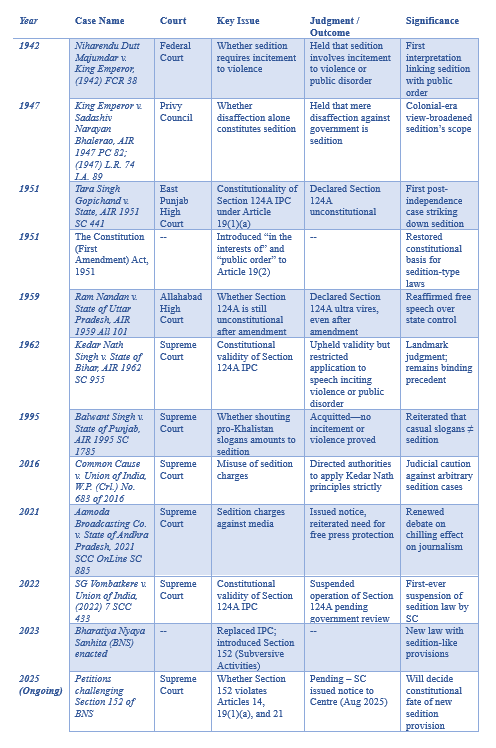
The Supreme Court currently finds itself at a pivotal moment, evaluating the equilibrium between state authority and the rights of citizens to express dissent, which may lead to a redefinition of sedition-related legislation within the context of India’s democratic structure.
RECOMMENDATIONS OF THE LAW COMMISSION
The 279th Report of the Law Commission of India, released in April 2023, recommended the retention of Section 124A of the IPC, which addresses the offence of sedition. This report comes a year after the Supreme Court ordered cessation of all proceedings and registration of fresh cases. The Commission highlighted the necessity of sedition laws in safeguarding national security and upholding the integrity of the state. The proposed amendments intend to elucidate that sedition pertains solely to expressions that possess the potential to incite violence or disrupt public order. Furthermore, the Commission proposed an enhancement of the penalty for sedition, raising it from three years to seven years of imprisonment, with the potential for life imprisonment as a last resort. To mitigate the potential for misuse, it proposed the implementation of procedural safeguards, which encompass a preliminary inquiry conducted by a police officer in the rank of Inspector or higher, prior to the filing of a First Information Report (FIR), as well as the necessity of obtaining prior approval from the Central Government (Yadav, 2023).
In addition to that, The Law Commission explained, the existence of anti-terror legislations like the Unlawful Activities Prevention Act, 1967, and the National Security Act, 1980, do not obviate the need for an offence of sedition. The Unlawful Activities Prevention Act is a special law. It deals with activities of a terrorist or subversive nature. The National Security Act is a law that deals with preventive detention. Special laws and anti-terror legislation dealing with national security seek to prevent and punish the commission of offences against the state. Whereas section 124A of IPC seeks to prevent the violent, illegal, and unconstitutional overthrow of a democratically elected government which is established by law.
The argument that the sedition law is a colonial rule has been vehemently criticized, and it has been opined that it is not a valid ground to repeal the existing law. Therefore, it has been expressed that the mere fact that a particular legal provision is colonial in its origin does not ipso facto validate the case for its repeal. Critics of the report contend that the proposed recommendations may perpetuate the misuse of sedition laws, thereby suppress dissent and curtail free speech. It is important to note that the expansive and ambiguous definitions of sedition could potentially violate the essential rights protected by the Constitution. The discourse persists as different parties evaluate the implications of the Law Commission’s recommendations concerning the equilibrium between national security and personal liberties (LiveLaw, 2023).
However, in December 2023, Parliament passed the Bharatiya Nyaya Sanhita, 2023 (BNS), omitting Section 124A IPC and introducing the same under Section 152 BNS to criminalize acts undermining India’s sovereignty, unity, and integrity, especially through electronic communication, which came into effect from 1st July, 2024. Despite the report suggesting the amendments in the sedition law, the new law was revised with more ambiguous terms.
COMPARATIVE ANALYSIS OF SEDITION LAW IN IPC AND BNS
Sedition was criminalized under Section 124A of the Indian Penal Code (IPC) as any act that provoked or sought to create hate, contempt, or disaffection against the Indian government. It was punishable by life imprisonment or three years and a fine.
The BNS, 2023 omitted the IPC and replaced it with a new legal framework. Instead of 124A IPC, Section 152 of the BNS was added under the heading “Acts endangering sovereignty, unity, and integrity of India.” The government indicated this modification was necessary to eliminate colonial terms while maintaining national integrity. Table 4 shows the key differences in Section 124A of IPC and Section 152 of BNS.
Table 4: Key Differences in Sedition Provisions in India’s Transition from Section 124A of IPC, 1860 to Section 152 of BNS, 2023
[Source: Compilation]
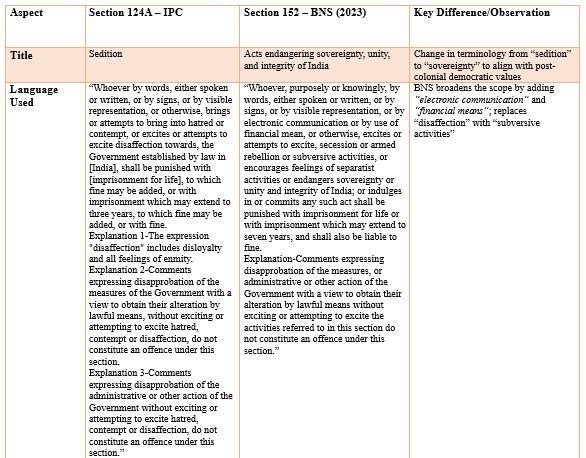
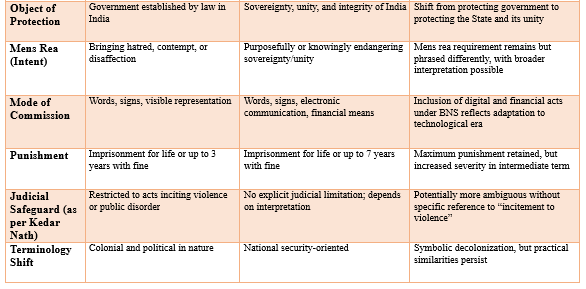
Section 124A of the Indian Penal Code, defined by its colonial origins, penalizes expressions of “disaffection towards the government”. In contrast, Section 152 of the BNS aims to contemporize this offence by eliminating colonial terminology and integrating concepts that are associated with the sovereignty, unity, and integrity of India. However, the essential goal remains the same i.e., to criminalize expressions perceived to be threats to national stability. The emergence of digital and financial means signifies a transition towards technological advancement; however, the vagueness surrounding phrases such as “subversive activities” and “endangers sovereignty” renders the provision open to wide interpretation and potential misuse, similar to the IPC’s “disaffection” clause. It is pertinent to mention here that there is also a provision for attachment of the property of the terrorist, as a terrorist commits any act in India or in any foreign territory with the intention to threaten the integrity, unity, and security of India, to browbeat the general public or a section thereof, or to disturb public order. Crimes like subversive activities, armed insurgency, separatism, and challenging the unity, sovereignty, and integrity of India have been defined in the BNS (Singh, 2025).
The formulation of the IPC provided judicial clarity after the landmark case of Kedar Nath Singh v. State of Bihar (1962), in which the Supreme Court confined the definition of sedition to acts of incitement that leads to violence or public disorder. The BNS version does not incorporate judicially defined constraints, which may lead to a concerning overlap between legitimate dissent and subversive actions.
INDIA VIS-À-VIS INTERNATIONAL PRACTICES ON SEDITION LAW
Based on a comparative outlook, the legislative sedition framework in India, evolving from Section 124A of the IPC to Section 152 of the Bharatiya Nyaya Sanhita (BNS), is noticeably more expansive than the contemporary democratic norms embraced by other countries. India justifies criminal liability for actions deemed “subversive” or that threaten the integrity, and sovereignty of the nation. In contrast, several nations have moved to repeal, restrict, or redefine sedition laws to align them with principles of free speech and human rights. The United Kingdom, through an Act (UK Coroners and Justice Act 2009), repealed the offence of sedition, recognizing its archaic nature and its inconsistency with the principles of democratic discourse. In 2010, Australia enacted the National Security Act (National Security Legislation Amendment Act, 2010), which eliminated the offence of sedition and introduced new offences related to “urging violence” against the government or community groups, specifically targeting conduct that involves direct incitement to violence. In a similar vein, New Zealand abolished its sedition laws in 2007 [The Crimes (Repeal of Seditious Offences) Amendment Act 2007], asserting that the existing statutes on incitement and rebellion adequately safeguarded national security while allowing for political discourse to remain unimpeded. In Canada, the concept of sedition is outlined within the Criminal Code, specifically in Sections 59–61. However, its application is strictly limited to actions that involve the use of force or violence directed at lawful authority, thereby excluding peaceful forms of criticism or dissent (Government of Canada, 1985). The United States criminalizes “seditious conspiracy”; however, the precedent established in Brandenburg case (1969)17, safeguards speech unless it is both intended and likely to incite imminent lawless action.
On an international level, ICCPR (International Covenant on Civil and Political Rights, 1966), especially Article 19(3), establishes a universal standard mandating that any limitations on expression must be legally grounded, essential, and proportionate to the aims of safeguarding national security or maintaining public order. The UN Human Rights Committee has consistently emphasized that sedition laws must not be employed to suppress dissent against government or political entities (United Nations Human Rights Committee, 2011). In contrast, India’s BNS employs ambiguous and broad terminology without clearly requiring a test of imminence or violent intent. This discrepancy places it in conflict with global democratic principles and human rights standards, highlighting the necessity for reform to ensure that domestic law is consistent with constitutional morality and international norms regarding free expression.
LACUNAE IN SEDITION PROVISION UNDER BHARATIYA NYAYA SANHITA, 2023 (BNS)
The researchers have identified certain notable gaps in BNS Concerning Sedition, such as:
i. The BNS employs ambiguous and excessively broad terminology, utilizing expressions like “subversive activities”, “endangering sovereignty”, and “unity and integrity of India” that lack precise statutory definitions. This ambiguity poses a risk of arbitrary interpretation, similar to the misapplication of Section 124A of the Indian Penal Code.
ii. The absence of a clear judicial limitation is notable. In contrast to the IPC version, which Kedar Nath Singh confined to actions that incite violence, Section 152 does not explicitly mandate incitement to violence or an intention to provoke public disorder, thereby expanding the scope for potential misuse.
iii. The incorporation of electronic communication and financial means within Section 152 broadens the scope of the offence to encompass online expressions and digital interactions. This development raises concerns about the potential criminalization of social media critiques or the financial support of dissenting movements, even in the absence of violent intent.
iv. The provision maintains life imprisonment as a potential penalty, which is disproportionate to the level of harm inflicted by non-violent speech, thereby not satisfying the proportionality criteria established under Article 19(2) and Article 21.
v. The ongoing threat to democratic dissent is evident in the evolution of terminology from colonial “disaffection” to nationalist “sovereignty”, yet the underlying spirit of suppression persists unchanged. In the absence of clear thresholds, even valid critiques of governmental policies may incur penal repercussions.
vi. The BNS provision lacks any mention of reasonable restrictions or constitutional limitations, thereby failing to align statutory interpretation with Articles 19(1)(a), 19(2), and 21 of the Constitution.
RECOMMENDATIONS
The transition from Section 124A of the Indian Penal Code (IPC) to Section 152 of the Bharatiya Nyaya Sanhita (BNS) signifies a redefinition of sedition law rather than a total transformation, resulting in a revised legislative framework. To ensure that the law is consistent with constitutional morality, democratic integrity, and international human rights standards, the following recommendations are proposed:
i. It is essential to define sedition strictly as actions that provoke immediate violence or armed insurrection against the State, in accordance with the principles established in Kedar Nath Singh v. State of Bihar (1962) and consistent with international norms.
ii. It is necessary to implement a legal standard that guarantees only speech that presents a genuine and immediate threat to public order or security is subject to punishment.
iii. It is crucial to conduct preliminary inquiry before the registration of FIRs related to sedition, in order to mitigate the risks of misuse and arbitrary detentions.
iv. It is vital to explicitly protect the rights to peaceful criticism, satire, and protest in order to clearly differentiate between dissenting opinions regarding government actions and activities deemed anti-national.
v. The punitive action system should be based on graded penalties that reflect the severity of the offence, in accordance with the principle of proportionality as outlined in Article 21.
vi. It is quintessence to ensure that the application of sedition laws to online speech is not excessively broad, thereby safeguarding the constitutional protection of digital expression.
vii. It is fundamental to implement educational and institutional training initiatives focused on the rights associated with free speech and the legal boundaries of sedition.
CONCLUSION
The sedition law introduced formally by the British to suppress the Indian freedom struggle in 1870 became controversial after it was allegedly misused mostly against activists, journalists, and social media influencers in the 21st century. The debate concerning sedition in India, tracing its roots from the colonial era under Section 124A of the IPC to its reformulation as Section 152 of the Bharatiya Nyaya Sanhita (BNS), highlights the persistent conflicts between the imperatives of national security and the principles of individual freedom. The intention to transition to BNS aimed at modernizing the criminal justice system; however, the continued existence of a provision similar to that of sedition indicates that the remnants of colonial influence continue to cast a shadow over India’s democratic structure. The Supreme Court’s evolving jurisprudence, from Tara Singh Gopichand to Kedar Nath Singh and SG Vombatkere, illustrates the judiciary’s ongoing struggle to achieve a constitutional equilibrium between the sovereignty of the State and the sovereignty of the individual’s conscience.
The reinterpretation under BNS, while linguistically modified, does not adequately address the constitutional uncertainty inherent in the law’s framework. The broadened terminology. “Subversive activities” and “exciting feelings of separatist tendencies”, retains a level of ambiguity, thereby perpetuating the potential for misuse that characterized the sedition provision during the IPC era. In a democratic society that values free expression as fundamental to its constitutional framework, the act of criminalizing dissent, criticism, or ideological differences fundamentally contradicts the essence of Articles 19(1)(a), 14, and 21 of the Indian Constitution.
Therefore, the evolution of sedition law in India should go beyond superficial textual amendments and instead focus on a fundamental philosophical change, recognizing loyalty not as mere compliance with authority, but as a commitment to constitutional morality. It is imperative to establish a legislative framework that prioritizes rights while maintaining public order, ensuring that democratic discourse is not suppressed. It is only through meticulously considered reform that India can overcome its colonial legal remnants and guarantee that, dissenting voices are upheld as the essence of democracy, rather than being treated as acts of disaffection deserving punishment all the time.
*****
Footnotes
1. Kedar Nath Singh v. State of Bihar, AIR 1962 SC 955 (India).
2. Romesh Thappar v. State of Madras, AIR 1950 SC 124 (India).
3. Brij Bhushan v. State of Delhi, AIR 1950 SC 129 (India).
4. Kedar Nath Singh v. State of Bihar, AIR 1962 SC 955 (India).
5. Ibid.
6. Balwant Singh v. State of Punjab, AIR 1995 SC 1785 (India).
7. Vinod Dua v. Union of India, 2021 SCC Online SC 414 (India).
8. SG Vombatkere v. Union of India, (2022) 7 SCC 433 (India).
9. Reg v. Alexander Martin Sullivan, (1868) 11 Cox’s Criminal Cases 44 (U.K.).
10. Queen Empress v. Jogendra Chunder Bose, (1892) ILR 19 Cal 35 (India).
11. Tara Singh Gopichand v. State, AIR 1951 SC 441 (India).
12. Ram Nandan v. State of Uttar Pradesh, AIR 1959 All 101 (India).
13. Balwant Singh v. State of Punjab, AIR 1995 SC 1785 (India).
14. Vinod Dua v. Union of India, 2021 SCC Online SC 414 (India).
15. Shreya Singhal v. Union of India, AIR 2015 SC 1523 (India).
16. SG Vombatkere v. Union of India, (2022) 7 SCC 433 (India).
17. Brandenburg v. Ohio, 395 U.S. 444 (1969) (U.S.).