
INTRODUCTION
Urban Company, founded in 2014 as UrbanClap, has fundamentally reshaped India’s unorganized home services sector. By connecting consumers with vetted, trained professionals for services ranging from beauty and wellness to home repairs and cleaning, the platform has become a benchmark for the gig economy in emerging markets. Its journey culminated in a successful Initial Public Offering (IPO) in September 2025, marking its transition into a publicly-listed corporation (Money control, 2025).
However, this transition has been accompanied by a significant strategic evolution. The company has expanded beyond its core service aggregation model into two distinct verticals: a direct-to-consumer (D2C) product line under the ‘Native’ brand, offering items like water purifiers and smart locks, and a foray into quick commerce with ‘InstaHelp’, an on-demand housekeeping service (Inc42, 2025). This diversification, coupled with the pressures of public market expectations, presents a complex managerial challenge.
This paper addresses the following research problem: How do classical management principles, specifically the fourteen tenets proposed by Henri Fayol, apply to a modern gig economy platform as it scales, diversifies, and navigates the pressures of public markets? While the original business model appeared to successfully institutionalize principles of order and stability for its service partners, the recent strategic pivots introduce new variables that may create tension with this foundational management philosophy.
The objectives of this study are threefold: first, to analyze the application of Fayol’s principles within Urban Company’s core operations and partner ecosystem; second, to evaluate how recent strategic shifts and financial performance impact this application; and third, to discuss the implications for management theory in the context of platform-based business models. The analysis is updated to February 2026, incorporating the latest financial results and strategic developments, including the Indian government’s recent policy initiatives concerning gig worker welfare (Multibagg.ai, 2026).
LITERATURE REVIEW
Henri Fayol’s (1949) General and Industrial Management laid the groundwork for administrative theory, proposing a universal set of management functions—planning, organizing, commanding, coordinating, and controlling—and fourteen principles to guide their execution. Principles such as Division of Work, Unity of Command, Scalar Chain, and Esprit de Corps have been cornerstones of organizational design for over a century. However, their relevance in the 21st-century digital economy, characterized by decentralized networks, algorithmic management, and flexible labor, is a subject of ongoing debate (Adler, 2012).
The rise of the gig economy and platform capitalism presents a direct challenge to Fayolian ideals. Platforms like Urban Company operate as intermediaries, managing a vast, distributed network of independent contractors rather than a traditional employee base. This model often leads to concerns about worker precarity, lack of social security, and the replacement of human managers with opaque algorithms (Vallas & Schor, 2020). Principles like Stability of Tenure of Personnel and Fair Remuneration are particularly contentious in this context, where high churn rates and commission-based pay are common.
Despite these challenges, some platforms have attempted to integrate classical principles to build trust and quality. Urban Company has publicly positioned itself as a platform focused on partner empowerment, investing heavily in training, providing standardized equipment, and creating a framework for career progression and stable earnings (Urban Company, 2024). This approach suggests a deliberate effort to apply principles of Order, Discipline, and Equity to an inherently fluid workforce. This study, therefore, situates Urban Company as a critical case for examining the enduring utility and modern adaptation of Fayol’s theories in a business environment he could not have foreseen.
METHODOLOGY
This research employs a longitudinal, qualitative case study approach to provide a deep, contextualized analysis of Urban Company’s management practices. The case study method is appropriate for exploring complex, real-world phenomena where the boundaries between the phenomenon and its context are not clearly evident (Yin, 2018).
The data for this study are drawn from two primary categories:
1. Foundational Qualitative Data: The analysis builds upon original research conducted for a prior study, which included informal interviews and conversations with 20 Urban Company service partners across various categories (e.g., beauty, repairs, cleaning). This data provides grassroots insights into how management principles are experienced at the operational level.
2. Secondary Longitudinal Data (FY2022-Q3 FY2026): To update and expand the analysis, this study incorporates an extensive review of publicly available secondary sources. These include:
Official company publications: Annual reports, quarterly financial results, shareholder letters, and investor presentations sourced from Urban Company’s Investor Relations portal (Urban Company, n.d.).
Regulatory filings related to its September 2025 IPO.
Reputable business and financial news analysis from outlets such as The Economic Times, Inc42, Money control, and Business Standard.
The analytical method is a thematic analysis. Data from all sources were systematically coded and mapped against each of Fayol’s fourteen principles. This process allowed for the identification of patterns, consistencies, and, most importantly, tensions in the application of these principles over time, particularly before and after the IPO and the launch of new business verticals. The integration of financial data and strategic announcements provides a macro-level context for the micro-level experiences reported by service partners.
ANALYSIS AND FINDINGS
The analysis is structured in two parts. First, we examine Urban Company’s corporate evolution and financial trajectory to establish the strategic context. Second, we analyze the application of Fayol’s principles in light of this evolution, integrating partner perspectives with corporate strategy.
A. Corporate Evolution and Financial Trajectory (2022-2026)
Urban Company’s recent history is a tale of strategic transformation. The period leading up to its 2025 IPO was marked by a disciplined drive towards profitability. As shown in Figure 1, the company systematically reduced its pre-tax losses from ₹514 crore in FY22 to ₹93 crore in FY24, while revenue more than doubled. This trajectory culminated in the company reporting its first-ever annual profit before tax of ₹28.6 crore in FY25, a critical milestone that bolstered its IPO narrative (Unlisted Zone, 2025).
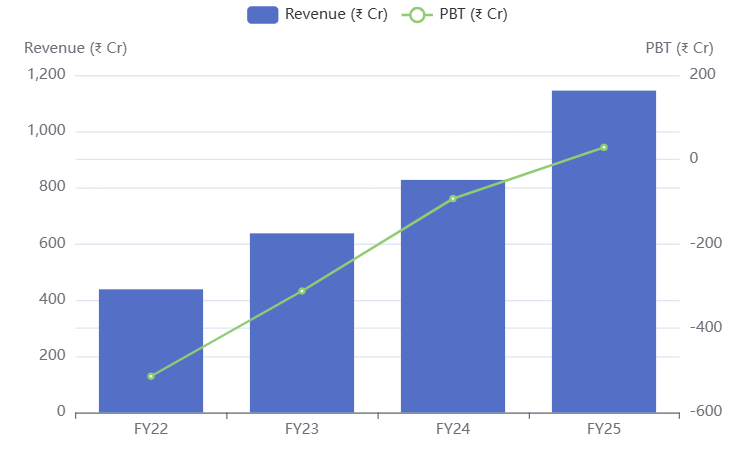
Figure 1: Urban Company Consolidated Revenue & Profit/Loss Before Tax (FY22-FY25).
Source: Compiled from Urban Company Investor Relations & media reports.
Post-IPO, the company’s strategy shifted from consolidation to aggressive expansion. This pivot is most evident in the financial results for FY26. After a profitable Q1, the company slipped back into losses in Q2 and Q3 FY26. As detailed in company statements, this reversal was not due to a decline in the core business but was a direct result of heavy, deliberate investments in new, high-growth verticals, particularly the quick-commerce service, InstaHelp (The Economic Times, 2026). Figure 2 illustrates the revenue contribution from these new segments, highlighting their growing importance to the company’s overall strategy.
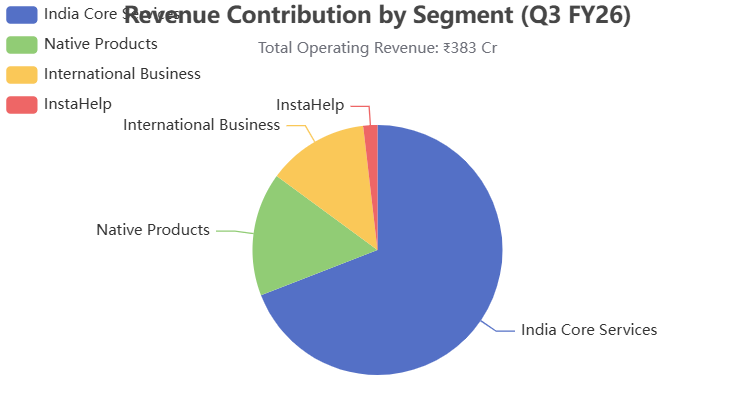
Figure 2: Urban Company Revenue Contribution by Segment (Q3 FY26).
Source: Compiled from Q3 FY26 investor presentation and media reports.
This strategic “burn-to-scale” approach, particularly for InstaHelp, which incurred an adjusted EBITDA loss of ₹61 crore in Q3 FY26 alone, places the company in a delicate balancing act between long-term growth ambitions and short-term public market expectations for profitability.
B. Application of Fayol’s Principles in a Shifting Landscape
The original study’s interviews with 20 service partners revealed a strong alignment between Urban Company’s operational model and several of Fayol’s principles. The updated analysis revisits these principles, integrating empirical data from the company’s recent evolution.
| Principle | Application in Core Services (Partner Perspective) | Impact of Recent Strategic Shifts & Tensions |
|---|---|---|
| 1. Division of Work | Highly applied. Partners specialize in narrow categories (e.g., “sofa cleaning,” “AC repair”), leading to expertise and efficiency. “I only handle sofa-cleaning orders. That helps me master one skill,” noted a partner. | Remains strong. This specialization, a core tenet of the tech-enabled model, is a key enabler of the platform’s scalability, which saw consolidated revenue grow from ₹438 crore in FY22 to ₹1,144.5 crore in FY25 (Unlisted Zone, 2025). |
| 2. Authority & Responsibility | Clear. Partners are responsible for service quality, reflected in customer ratings. The company holds authority over platform access and standards. | Tension arises. Algorithmic management can feel like authority without direct human responsibility, leading to partner frustration over deactivations or low visibility. |
| 3. Discipline | Strongly enforced through Standard Operating Procedures (SOPs), uniforms, mandatory use of the partner app, and a customer rating system. “If we miss uniform or safety gloves, we get a warning,” a partner shared. | Remains a core strength, crucial for maintaining brand trust. Discipline is essential for the high-volume, low-margin InstaHelp model to work. |
| 4. Unity of Command | Generally applied. Partners report issues to a single team lead or through a designated channel in the app. “If I have a problem, I message my team lead—only one person gives instructions.” | Largely intact at the operational level. However, corporate strategy now serves multiple masters: core services, products, and quick commerce, creating potential for conflicting internal priorities. |
| 5. Unity of Direction | The overarching goal of “customer satisfaction” provides a unified direction for all partners on a job. | Challenged post-IPO. The unified pre-IPO goal of achieving profitability, which culminated in the successful September 2025 listing, has now diversified into multiple strategic directions: service excellence, D2C product sales (e.g., Native RO purifiers), and quick-commerce speed (InstaHelp) (Inc42, 2025). |
| 6. Subordination of Individual Interest | Taught explicitly. “We are taught that one unhappy customer affects all professionals’ image.” The platform’s reputation is paramount. | Under pressure. High commissions (reported around 25%) and competition on the platform can lead partners to prioritize personal earnings, sometimes at odds with platform guidelines. |
| 7. Remuneration | Empirically demonstrated through transparent, app-based weekly payments. The company reports average net earnings of ₹33,469 per month for partners delivering over 30 services, substantiating the principle of fair pay (Urban Company, 2024). | A point of ongoing tension. While transparent and comparatively high, the level of commission required to fund the platform’s technology, marketing, and new ventures is a frequent source of partner protest. |
| 8. Centralization & Decentralization | A balanced model. Strategic decisions (pricing, policy) are centralized. Operational decisions (work slots, accepting jobs) are decentralized to partners. “Prices are fixed by UC, but we decide our working slots.” | This balance is critical. The 2025 decision to liquidate its Saudi Arabian subsidiary exemplifies a centralized strategic choice to reallocate capital, while operational flexibility remains decentralized (Inc42, 2025). |
| 9. Scalar Chain | A clear escalation path exists for partners, from app-based support to regional managers. “If issues go unsolved in chat, they escalate step by step.” | Maintained. Formal communication channels are crucial for managing a network of over 59,000 active partners and executing centralized strategic decisions like market exits (The Economic Times, 2026). |
| 10. Order | Material and social order are core strengths. Digital tools organize job allocation, and standardized kits ensure material order. This tech-enabled order is fundamental to the platform’s value proposition. | This remains the platform’s primary value proposition. The ability to bring order to a chaotic market is a direct driver of the revenue growth observed between FY22 and FY25. |
| 11. Equity | Highly rated by partners, especially regarding gender. “Female staff get equal ratings, pay, and training time.” The platform is seen as a meritocracy based on ratings. | A key strength. The recent Union Budget 2026 proposal to extend healthcare to gig workers further strengthens the social equity aspect of the platform, reducing risk for partners (Multibagg.ai, 2026). |
| 12. Stability of Tenure of Personnel | A stated goal. Partners with long tenure are celebrated. “I’ve stayed five years because regular training and income stability keep me loyal,” said a 5-year veteran. | A major point of tension. However, the high repeat customer share of 82% in FY25 (Unlisted Zone, 2025) indirectly suggests that a stable core of high-performing partners is delivering consistent quality, a positive outcome of tenure. |
| 13. Initiative | Encouraged through feedback channels. “We suggested eco-friendly products; UC adopted them in 2024,” a beautician shared. | While operational initiative is encouraged, strategic initiative is highly centralized, especially with the top-down push into new verticals like Native and InstaHelp. |
| 14. Esprit de Corps | Fostered through team-based recognition, WhatsApp groups, and welfare events. “When we hit five-star ratings, our whole team gets appreciated.” | Challenged by scale. Yet, the high average customer rating of 4.82/5.0 in FY23 (Report Junction, 2023) reflects a consistently positive service experience, an outcome often linked to a motivated and cohesive workforce. |
DISCUSSION
The analysis reveals that Urban Company’s success is built on a paradoxical foundation: the application of rigid, classical management principles to create a predictable and reliable service experience within the fluid, decentralized context of the gig economy. Principles of Discipline, Order, and Division of Work are not just theoretical constructs but are embedded in the platform’s technology and SOPs. This structured approach is what allows the company to transform informal labor into a professionalized service, building the customer trust that forms its competitive “moat.”
However, the company’s post-IPO journey highlights the inherent tensions in this model. The strategic imperative for growth has led to diversification into product sales (Native) and quick commerce (InstaHelp). These ventures, while promising new revenue streams, strain the classical management framework. The pursuit of multiple, and at times conflicting, objectives challenge the Unity of Direction. The heavy investment and resulting financial losses put pressure on the core business, potentially impacting partner commissions and straining the principle of Fair Remuneration.
Furthermore, the InstaHelp vertical, which relies on speed and high volume, may prioritize transactional efficiency over the deep skilling and relationship-building that characterized the core services, thereby testing the long-term commitment to Stability of Tenure. The company’s management is thus engaged in a high-stakes balancing act: maintaining the disciplined, quality-focused core that built the brand while funding risky, high-growth ventures to satisfy public market investors. The recent government initiative to provide a social safety net for gig workers is a significant external intervention that de-risks the platform model for partners and the company, potentially easing some of this internal tension.
The study’s limitations include its reliance on publicly reported data for the longitudinal analysis and the foundational nature of the partner interviews. Future research could involve new, in-depth interviews with partners and company management to specifically explore the perceived impacts of the post-IPO strategic shifts.
CONCLUSION
Urban Company’s evolution offers a powerful lesson in the contemporary application of management theory. It demonstrates that Fayol’s principles are not obsolete relics but can be potent tools for creating order, quality, and trust in the digital age. The company’s initial success was predicated on its ability to institutionalize discipline, specialization, and equity for a distributed workforce, professionalizing an entire sector and empowering thousands of individuals.
Yet, its current trajectory as a public company reveals the limits and tensions of this model. The need to pursue relentless growth forces a confrontation between the stable, orderly world envisioned by Fayol and the volatile, high-risk world of modern tech ventures. The company’s ability to navigate this conflict—to fund innovation without eroding the trust and stability of its core partner ecosystem—will determine its long-term success. Urban Company’s journey thus serves as a crucial, real-time case study for managers and scholars on how to balance the timeless principles of good management with the relentless demands of the platform economy.
Future research should continue to monitor this balance, focusing on partner satisfaction metrics, churn rates in different verticals, and the long-term profitability of the company’s diversified portfolio. Understanding how Urban Company resolves the tension between its foundational principles and its growth ambitions will provide invaluable insights into the future of work and management in the 21st century.