
INTRODUCTION
The sacred stories of the mythology and folklore, transcending time, carry ethical values, collective beliefs, and psychological truths that continue to shape human imagination. Mythology and folklore have always played a crucial role in shaping art and culture, as they address universal human questions such as desire, duty, fate, power, and morality.1 Artists across generations draw inspiration from these enduring narratives, reinterpreting mythological themes through their personal and cultural perspectives. Ganesh Pyne, one of the most enigmatic figures in the Indian art scene, contributed significantly to the reinterpretation of Indian mythology and folklore. As a child and adolescent, he read Bengali children’s magazines and encountered the art of Abanindranath Tagore a founding figure of the Bengal School of Art whose romantic and symbolist leanings would resonate with Pyne’s own inclinations.2 His interest in the line and abstraction of Paul Klee encouraged an economy of form and a belief in the expressive autonomy of signs and marks. He also drew upon the storytelling techniques of the early animations and the measured authority of the European cinema, shaping a visual language that remains narrative without becoming merely illustrative, and cinematic without turning theatrical.3
Objectives
• To study the mythology and folklore representation in paintings of Ganesh Pyne.
• To study the representation of dark imagery in the Ganesh Pyne’s painting.
Methodology
This study follows a qualitative and descriptive approach based on visual analysis of selected artworks by Ganesh Pyne. The research examines imagery, symbols, colour, and compositions to understand the representation of mythological and folkloric narratives. Secondary sources such as books, journals, interviews and exhibitions catalogues are consulted to support interpretation and contextual understanding.
BENGALI FOLKLORE
Folklore refers to the body of traditional beliefs, narratives, and practices transmitted primarily through oral traditions within a society. It encompasses a wide range of cultural expressions, including belief systems, oral literature and artistic practices such as performing and visual arts. Folklore often addresses themes such as heroism, supernatural, death and human vulnerability. Rather than following fixed literary or religious structures, folklore relies on symbolism and metaphor to convey meaning. With reference to the Bengali folklore, these features can be seen in terms of a rich tradition of spoken storytelling, folk songs, and visual media such as patachitra, as well as performative media such as jatra.4 In visual art, folkloric elements are expressed through mood, and symbolic imagery rather than direct narration, allowing artists to explore psychological tension, morality, and the darker aspects of human existence.
MYTHOLOGY
The word mythology is derived from two words, ‘myth’ and ‘logia’. The word myth refers to a traditional narrative passed down through generations, while logia denote study or systematic knowledge. Therefore, mythology is a field of study that examines traditional sacred narratives about the creation and end of the universe, gods, and humans, developed by societies through the blending of reality and imagination5. In the Indian context, mythology is richly represented through epics such as the Mahabharata and Ramayan, along with sacred texts like the Puranas.6 It provides cultural frameworks that shape ethical values and collective understanding across generations. In visual art, mythology results in a symbolic means of expression rather than a fixed narrative. Artists reinterpret mythological elements through imagery and form to express psychological and existential concerns, making mythology both a cultural inheritance and a creative medium.
DISCUSSION
Ganesh Pyne’s artworks represented the haunting and evocative works that delve into the depth of human psyche. He was a master of the tempera medium. Pyne’s art is characterized by a reflective and introspective quality, marked by meticulous detail, layered symbolism, and a sustained engagement with narratives drawn from Bengali folklore and mythology.7 His art is also deeply rooted in the cultural traditions of Bengal, drawing inspiration from its rich literary and artistic heritage.8 Alongside these influences, Pyne’s paintings also reveals elements of dark imagery, expressed through muted colours, shadowed spaces, and a restrained use of light. Rather than presenting over drama, this darkness emerges subtly, creating an atmosphere of silence, tension, and introspection that transforms familiar narratives into psychologically charged and contemplative visual experiences.
Saat Bhai Champa [Plate 1] by Ganesh Pyne draws upon the Bengali folklore in which Queen Rajalakshmi’s children are betrayed out of jealousy and transformed into bamboo and a champa flower to escape death, while the king remains unaware of his grave injustice. The tale revolves around concealment, deception, and the eventual revelation of truth. In the artwork, Pyne transforms this layered narrative into a single, psychologically charged image. Rather than narrating the full story, he focuses on the moment when the king reaches for the mysterious champa flower as it rises beyond his grasp, symbolizing truth and justice that cannot be suppressed. Executed in pen and ink with intricate cross-hatching, the surface is layered with darkness, producing depth and an atmosphere of emotional intensity. This dense tonal treatment contributes to dark imagery, creating an atmosphere of concealment, unease, and emotional intensity. Through this approach, the artwork reflects poetic surrealism, where folklore is transformed into an introspective space in which memory, imagination, and inner tension quietly converge.
Bir Bahadur [Plate 2], one of his tempera works created with the inspiration of the narratives his grandmother used to tell him. From his collective childhood stories and experiences, Pyne creates visual narratives of monkeys as prince. The monkey, Bir Bahadur whose name in Bengali suggests ‘master of all things’, is shown dressed like a courtier yet gently restrained by a rope. His story begins as the beloved pet of Emperor Akbar, adding quite a layer of irony and meaning to his presence. His eyes suggest his bondage is due to mischievous behaviour and his sitting gesture contrasts the calm and prince like charm. This imagery also resonates with traditional Akbar-Birbal stories, where wit and intelligence are tested through unusual situations, highlighting themes of perception and hidden truths.9 Monkeys appear repeatedly in the art of Ganesh Pyne, not merely as animals but as metaphors for the human psyche playful yet trapped, instinctive yet aware, dignified yet vulnerable.10 The overall colour palette creates a subdued, atmospheric mood that enhances this psychological depth. The monkey emerges not merely as a folkloric figure but as a metaphor for the human condition, caught between instinct and awareness, freedom and limitation. Through poetic surrealism, Pyne transforms a simple character into a symbolic and dreamlike presence shaped by memory and inner conflict [Plate 3], [Plate 4] and [Plate 5].
In addition to folklore, Pyne reinterprets Indian mythology through a psychological and introspective visual language.
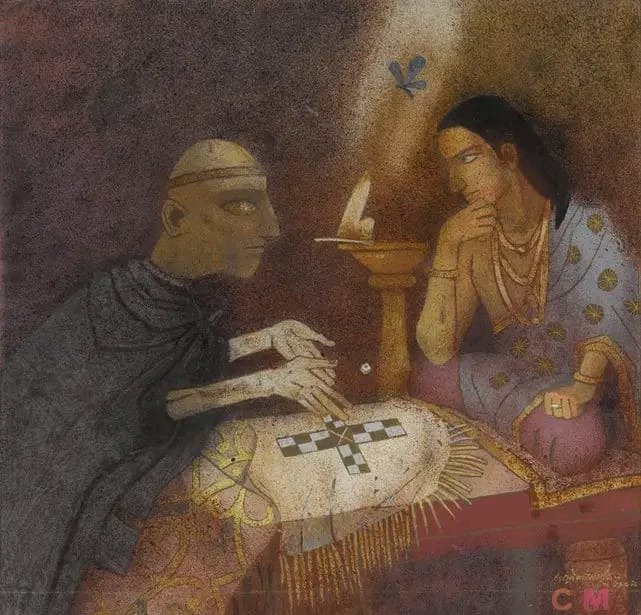
The White Hands [Plate 6] is a tempera on canvas painting, depicting a scene from the Mahabharat. It portrays Shakuni’s clever tricks against Yudhishthir during the game of dice. The painting feels serious and quite, creating a tense mood rather than showing dramatic action. Pyne uses soft and muted colours, mixing cool and warm tones to show the difference between Shakuni’s dishonest nature and Yudhishthir’s honest and truthful mind. The use of limited colours give the scene a heavy and contemplative look. In the background, a lighted diya is visible, which may symbolize truth, hope, or the awareness that still exists. A flying termite is also depicted, adding a feeling of discomfort and decay. These elements contribute to dark imagery, where muted tones, subtle decay, and quite tension evoke psychological unease and moral complexity. Such simple yet significant details help the painting convey its deeper emotional and moral message. Hence, the artwork reflects poetic surrealism, as it transforms a familiar mythological scene into a symbolic and introspective space where psychological tension, moral conflict, and subtle imagery evoke deeper meanings beyond direct representation.11
Abhimanyu [Plate 7] is considered one of the strongest works from his mature tempera phase, where he presents the young warrior from the Mahabharat in a moment of heroic readiness. Abhimanyu stands tall with a massive bow stretching almost the entire height of the canvas, a quiver full of arrows on his shoulder, and a dagger tied around his waist, indicating his readiness to face the battle ahead. The deep crimson red background of the painting symbolizes blood and foretells the tragic, as he knew how to enter the complicated Chakravyuh formation but not how to come out of it. Although he appears brave and powerful in his blue armour, there is also a sense of vulnerability in his expression and posture. A mysterious inner light softly illuminates his face, shoulders, and hands, without any visible source, which adds a spiritual and emotional depth to the figure. This use of intense colour, combined with the sense of inevitable fate and quite vulnerability, contributes to dark imagery, where visual elements evoke tragedy, tension, and psychological depth. Pyne’s mastery of the gouache technique, inspired by traditional miniature painting, creates a layered and textured surface, making the figure appear almost built from tiny particles. Through light, colour, and texture, Pyne beautifully combines heroism with the inevitability of pain and tragedy.11
CONCLUSION
Ganesh Pyne’s works display a reflective visual style that blends mythology, folklore, and psychological experience. He finds inspiration in texts like the Mahabharat and local stories. Pyne transforms familiar narratives into short, symbolic images that showcase inner conflict rather than straightforward storytelling.12 His limited colour palette, mainly soft blues, browns, and grays, creates a calm and thoughtful atmosphere. This enhances the feeling of silence, tension, tension, and introspection in his art.13 Simple yet meaningful elements act as symbols, letting each detail add to the emotional and moral depth of his work. These themes extend beyond visual art and connect to literary pieces like Red Oleanders (Raktakarabi) by Rabindranath Tagore, which critiques a mechanical and oppressive society. The character Nandini symbolizes resistance and renewal, reflecting the hope evident in Pyne’s imagery, where human sensitivity survives despite control and limitations. In the painting [Plate 8] inspired by this narrative, the composition appears structured and enclosed, reflecting the restrictive environment of the mining town. The dominant earthy and muted tones create a sense of heaviness and emotional suppression, while the placement of figures establishes a contrast between authority and vulnerability. The standing figures suggests control and power, whereas, the reclining body and the caring figures introduce fragility and compassion. This contrast, along with the subtle use of light, reinforces the tension between oppression and humanity, echoing the symbolic depth of Raktakarabi.14
Through his restrained use of muted tones, shadows, and symbolic detail, Ganesh Pyne also incorporate elements of dark imagery, intensifying the sense of psychological tension and introspection within his works.
Through poetic surrealism, Pyne reinterprets mythology and folklore, revealing strong reflections of psychological tension, moral complexity, and the ongoing search for meaning.
Plates
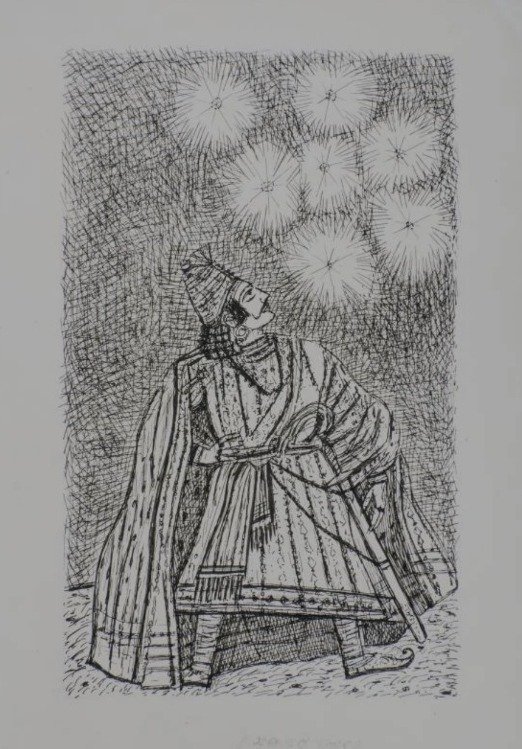
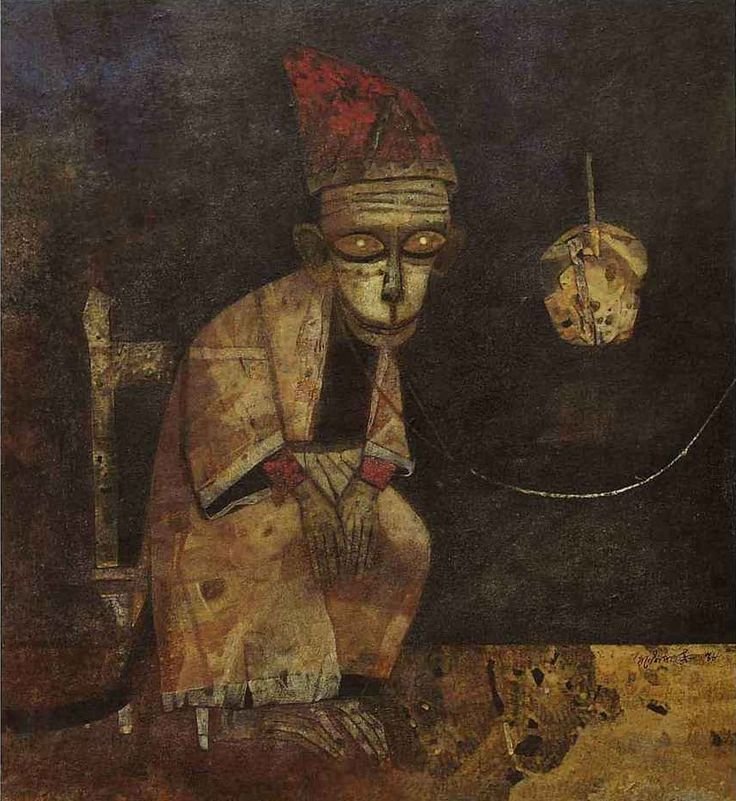 Plate 1 Plate 2
Source: www.akarprakar.com15 Source: www.christies.com16
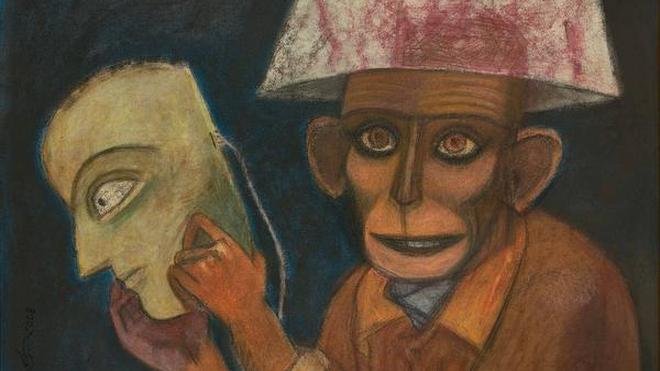
Plate 3
Source: www.thehindu.com 17
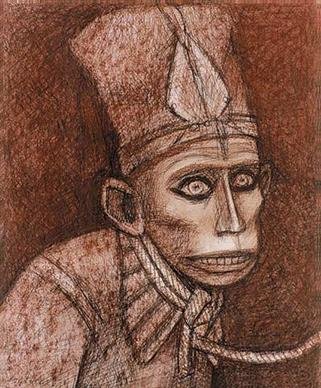
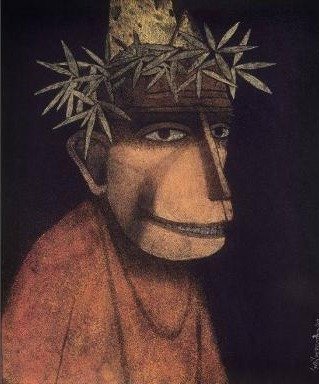
Plate 4 Plate 5
Source: www.readersdigest.in 18 Source: www.saffronart.com 19
Plates 6
Source: www.prinseps.com 20
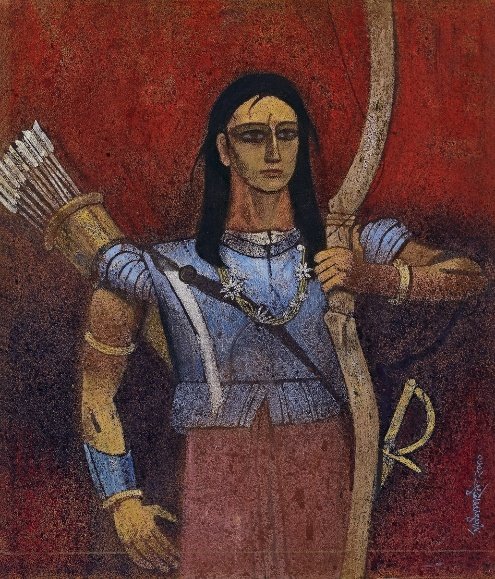
Plate 7
Source: www.tallengestore.com 21
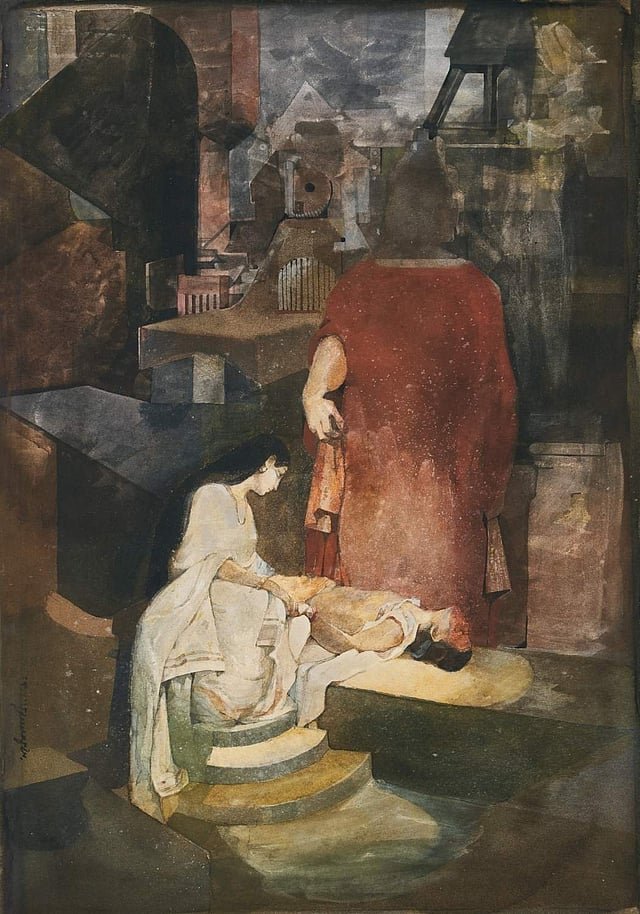
Plate 8
Source: www.indulgexpress.com 22