
INTRODUCTION
Land laws in Bangladesh regulate the ownership, transfer, and administration of land, thereby playing a crucial role in the country’s socio-economic development. The legal framework has evolved through colonial legacy and post-independence reforms. Despite the existence of extensive legal provisions, the land administration system continues to face significant challenges, including bureaucratic inefficiency, corruption, and lack of transparency. This study critically examines these issues from the perspective of citizens’ rights.
The objective of the article
1) To provide an overview of land laws and land administration in Bangladesh from the perspective of the rights of the citizen of Bangladesh.
2) To assess how these laws and administrative practices impact citizens’ rights to land ownership, access, and dispute resolution.
3) To examine the evolution and impact of different types of records of rights (RoR) and mutation process.
4) To pinpoint key challenges in the land administration system, including errors in Records of Rights (Khatiyan), barriers to accessing justice, that undermine citizens’ land rights etc.
5) To analyse the basic knowledge of the general people regarding their land rights.
Methodology
This study is based on both primary and secondary sources of data. Secondary data have been collected from books, journal articles, reports, and official sources, while relevant national legislation has been examined as primary material. In addition, empirical data were gathered through surveys and interviews. Both qualitative and quantitative approaches have been employed to analyze land laws, administrative practices, and public awareness.
RIGHTS OF THE CITIZEN IN LIGHT OF AS WELL AS IN RELATION WITH THE LAND LAWS OF BANGLADESH
The land laws of Bangladesh, rooted in a complex historical and legal framework, outline several rights for citizens concerning land ownership, use, transfer, and protection. These rights are primarily enshrined in the Constitution of Bangladesh, key legislation, and customary practices. Below is a concise overview of the rights of citizens under Bangladesh’s land laws, based on relevant legal provisions and their practical implications:
1. Constitutional rights to property:
• Article 42 of the Constitution: Every citizen has the right to acquire, hold, transfer, or dispose of property, subject to restrictions imposed by law. Property cannot be compulsorily acquired, nationalized, or requisitioned except by the authority of law and for a public purpose, with fair compensation provided. (Bangladesh, n.d.)
• Equal Protection: The Constitution (Articles 27 and 28) guarantees equality before the law and prohibits discrimination based on gender, religion, or other grounds, ensuring all citizens have equal access to property rights. However, practical disparities, especially for women and marginalized groups, persist. (Bangladesh, 2019)
2. Right to own and transfer land:
• Ownership limits: Under the State Acquisition and Tenancy Act, 1950, no private individual can own more than 20 acres of agricultural land, aiming to prevent land concentration and promote equitable distribution. (Wahid, 2024)
• Transfer of property: The Transfer of Property Act 1882 and The Registration Act, 1908 govern the legal procedures for transferring immovable property. All transfers (e.g., sales, leases, mortgages) must be registered with the Sub-Registry Office to be legally enforceable. Mutation of the transferor’s name in the latest Khatyan (land record) is mandatory. (Barrister Rahman and Barrister Mahbub, 2023)
3. Right to fair compensation in Land Acquisition:
The Acquisition and Requisition of Immovable Property Act, 1982 ensures that when the government acquires private land for public purposes (e.g., infrastructure, public institutions), affected citizens are entitled to compensation at market rates. Compensation may also cover standing crops, particularly for bargadars (sharecroppers), as determined by the Deputy Commissioner. (Islam, 2019)
4. Right to Khas land and Landless support:
The government is obligated to distribute khas land (government-owned land) to landless citizens, particularly peasants, under the State Acquisition and Tenancy Act, 1950 and the Land Reforms Act, 2023. Agricultural families with less than 25 bighas are exempt from land revenue, and landless persons may receive up to 3 acres of khas land for 99 years at no cost. (Hoque, 2021)
5. Rights of Indigenous and Marginalized Groups:
In the Chittagong Hill Tracts (CHT), customary laws govern land rights for indigenous groups, who represent about 1.5% of Bangladesh’s population. The Chittagong Hill Tracts Land Dispute Resolution Act, 2001 and the CHT Resolution Act, 1990 aim to protect these rights, though enforcement is weak due to conflicts with Bengali settlers. (Anon., n.d.)
6. Right to Dispute Resolution and Legal Recourse:
• Citizens can seek redress for land disputes through civil courts, the Land Reform Board or the Land Appeal Board. The Land Administration System allows Revenue Officers to handle disputes related to partition, possession, boundary demarcation, and deed authenticity. (Saleh, 2015)
• The Article 44 of the Constitution of Bangladesh guarantees the right to approach the High Court for enforcement of fundamental rights, including property rights. However, over 3.2 million land-related cases are pending, and the process is slow, costly, and inaccessible to many. (Saleh, 2015)
BANGLADESH’S LAND LAWS
According to the laws currently in effect in Bangladesh, land may be owned by an individual, a cooperative, or the government. Food security and land are closely related since land is essential to agricultural output. Thus, land interest security serves as a crucial basis for both social and economic advancement. Furthermore, protecting land rights is especially important for the safety of vulnerable groups, such as the impoverished, women, and indigenous people. In this manner, social and economic progress can be achieved by guaranteeing land rights. Despite the lengthy history of Bangladesh’s land laws, the following Acts and Ordinances, among others, are essentially relevant in this context:
1) The Land Survey Act 1875
2) The Bengal Tenancy Act 1885
3) The Transfer of Property Act 1882
4) The PDR Act 1913
5) The Survey and Settlement Manual 1935
6) The Non-agricultural Tenancy Act 1949
7) The State Acquisition and Tenancy Act 1950
8) The Land Development Tax Ordinance 1976
9) The Land Reforms Ordinance 1984 (Now the Land Reforms Act 2023)
10) The Immovable Property (Acquisition and Requisition) Ordinance 1982
(Now the Acquisition and Requisition of Immovable Property Act 2017)
11) The Land Reform Board Ordinance1989
12) The Land Appeal Board Ordinance1989
13) The Land Management Manual 1990
Bangladesh’s Statutory Recognition of Land Rights
Tenancies to be held under the state and other related problems are governed by the State Acquisition and Tenancy Act of 1950. The Bengal Tenancy Act of 1885 and the Bengal Permanent Settlement Regulations of 1793 made up the majority of Bengal’s agrarian law prior to its passage. ZAMINDAR landowners were required by the Permanent Settlement regulations to pay the government a certain percentage of their land earnings. They also had the right to collect rent from their subordinate tenants, who in turn had the right to establish subordinate interests. The landed nobility established by the Permanent Settlement rules of 1793 was expected to support the East India Company. The rights and obligations of tenants with regard to their superior landlords were established by the Bengal Tenancy Act of 1885 (Banglapedia, 2014). However, the SAT Act of 1950 for agricultural land and the NAT Act of 1949 for Nonagricultural Land currently govern the tenancy as well as the rights and obligations of the landowner. Currently, there is only one type of agricultural landowners, known as maliks, and the SAT Act’s regulations govern each landowner’s rights and obligations (Section 81 (1), The State Acquisition and Tenancy Act). However, none of these Malikis have any claim to any subsurface interests, including mining rights in their properties. (Shahidul Islam, 2015)
Land administration’s institutional framework
Bangladesh’s current land administration system is multi-layered (see Figure 1). The system is paper-based, and the majority of record upkeep is done by hand. There is redundancy and a lack of consistency because these records are maintained in separate offices. Several government agencies oversee Bangladesh’s land administration system concurrently. These government agencies are charged with managing land and property development, transferring land rights from one party to another through sales, leases, loans, gifts, and inheritance, collecting land revenue through sales, leases, and taxes, and settling disputes over land ownership and use.
Figure 1: Land administration and management structure in Bangladesh
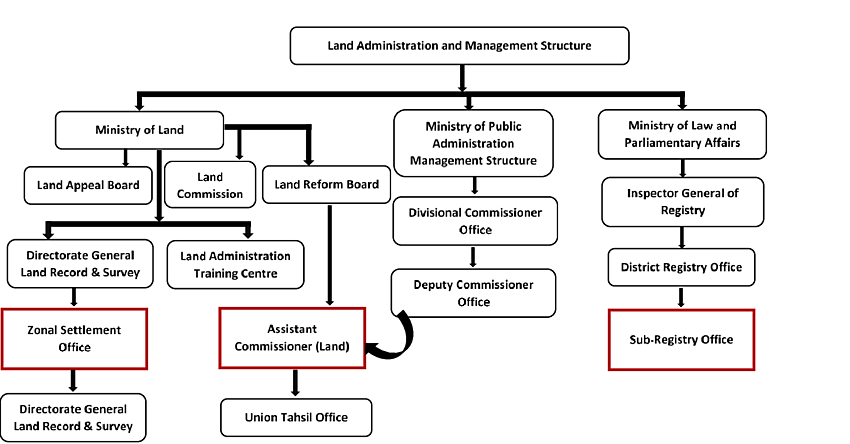
The Ministry of Land and the Ministry of Law, Justice, and Parliamentary Affairs (MoLJPA) are the two ministries that house the four main institutions that currently make up the nation’s land administration system. The Ministry of Land’s Directorate of Land Records and Surveys, Land Reform Board, Land Appeals Board, and Department of the Land Registration System (under the MoLJPA) are the four main organizations that oversee the land management system. The responsible authority for both the Ministry of Land (through the Land Reform Board) and the Ministry of Public Administration (through the Deputy Commissioner’s (DC’s) office) is the Assistant Commissioner (Land), who can be appointed by the Ministry of Public Administration, formerly the Ministry of Establishment. The Department of Roads and Railways, the Directorate of Housing and Settlement, the Fisheries Department, and the Ministry of Forests are additional government agencies that have a modest role in managing land.
In Bangladesh’s land administration and management system, there are four main stakeholders:
i. The Settlement Office: Usually, the Settlement Office is in charge of keeping the Record of Rights up to date. Additionally, this office is tasked with creating, printing, and disseminating the maps of each district’s mouzas and thanas, drawing boundaries between them, and training newly hired civil service cadres who work at the field level of various directorates and ministries, including the administration, land, and forest. Additionally, neighborhoods are surveyed every 30 years to determine land ownership.
ii. Assistant Commissioner (Land): With the exception of land surveys, the Assistant Commission of Land is authorized to authorize the transfer of land rights through mutation under the State Acquisition and Tenancy Act 1950. Starting with unions, the nation is divided administratively at several levels. A few unions constitute a sub-district, also known as a thana or upazilla20; a few thanas form a district; a few districts form a division; and eight divisions make up the entire nation. In general, the land administration adheres to this order. Land management is carried out by the Commissioner at the division level, the Deputy Commissioner at the district level, the Assistant Commissioner (Land) at the thana level, and the Tahsildar at the union level, according to a report released by the Local Government Engineering Department, United Nations Development Programme (UNDP), and UN-Habitat (Shafi, 2007). The executing authority of the Assistant Commission (Land), the Assistant Commissioner (Land), manages all upazilla land office operations through a well-organized administrative structure that includes several tiers of clerical staff. The duties of the Assistant Commissioner (Land) in relation to land include those of Circle Inspector, Revenue Circle Officer22, Upazilla Revenue21 Officer, Upazilla Settlement Officer, and Revenue Circle Inspector.
iii. Sub-Registry Office: Under the Registration Act of 1908, the Sub-Registry Office is tasked with registering lands and other properties and is run by the MoLJPA. At the upazilla24 level, the Sub-Registrar serves as both the Registry Office’s executive authority and the MoLJPA’s representative. A stamped deed stating the property valuation is used by the Sub-Registrar to record the land transfer. In Bangladesh, there are 503 Registry Offices, at least one in each upazilla, and 7,000 land transfers take place there annually on average. The National Board of income is not in charge of these offices, which generate BDT 14 billion (or US$ 165 million) in tax income annually, or 0.4% of all government tax revenue (Ministry of Finance, 2019).
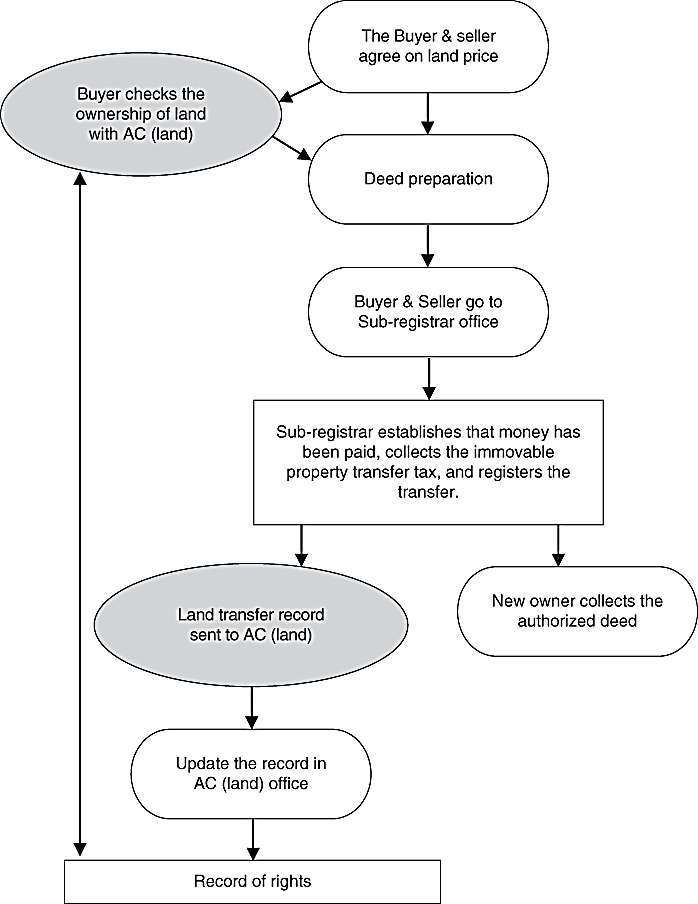
iv. Land Survey Tribunal: The Land Survey Tribunal and the Land Survey Appellate Tribunal are established by the State Acquisition and Tenancy Act of 1950. The impacted party files a lawsuit with the Land Survey Tribunal in the event of any difficulties, such as phony documents or phony mutations. The Government selects the judge of the Land Survey Tribunal from among the Joint District Judges after consulting with the Supreme Court. An appeal against a Land Survey Tribunal judgment may be filed with the Land Survey Appellate Tribunal, which is composed of a judge who currently serves or has served in the Supreme Court’s High Court division. The Ministry of Public Administration oversees the Upazilla administration, which is mostly in charge of maintaining the Record of Rights with respect to mutations. The Sub-Registry Office and the Assistant Commission (Land) office are directly related to the purchase of land or the transfer of rights. The aforementioned information is provided to any interested party that formally applies to the Sub-Registrar with questions regarding the land they plan to buy. In order to give information, the deeds are kept up to date by producing content that is arranged both alphabetically and by plot number. The buyer is responsible for arranging the creation of the deed after the two parties have, in theory, agreed on the property’s price. In order for the Sub-Registrar to establish the money transfer between the two parties and collect the immovable property tax, the two parties will then go to the Sub-Registry Office jointly. After registering the transfer, the Sub-Registrar sends the land transfer record to the Assistant Commission (Land) office, where the tahsilder reviews and amends it. The goal of this procedure is to update the Record of Rights, also referred to as Khatiyan locally. Additionally, purchasers can verify the legitimate owner of the land they plan to purchase by consulting the Assistant Commission (Land) office’s Record of Rights. However, this land transfer must be reported while the settlement office conducts the land survey. (Selim Raihan, 2020)
Figure 2 illustrates the land transfer procedure that would occur if the system worked properly:
CLASSIFICATION OF RECORDS OF RIGHTS (KHATIYAN) IN BANGLADESH
The Record of Rights is often referred to as Khatiyan in Bangladesh. It holds significant importance in verifying land affiliation, land possession as well as calculating land revenue tax. It is a Khatiyan which comes from the Persian word that translates as ‘ledger’ is prepared based on the surveys conducted by the Department of Land Record and Survey. Khatiyan is not a title deed. It is a record of rights concerning a property, such as the plot number, the owner’s name, and the tax to be paid. With this text, I aim to explicate various types of Khatiyan in the broader context of Bangladesh history and the jurisprudence for scholarly purposes.
1. Cadastral Survey (CS) Khatiyan:
Historical references: It was started in 1888-89 in Ramu Cox’s Bazar, and was completed in Rangpur & Dinajpur in 1940. CS Khataiyan was prepared under the Bengal Tenancy Act, 1885. It was the first systematic land survey in the region, aimed at creating a comprehensive registration of land ownership and the Occupation.
Purpose: Documentation of land details including plots, ownership and lease conditions for income collection and land management.
Characteristics:
• Register the names, plot details and leases of the landlords.
• Information on land classification, field and income obligations are included.
• Basic but less accurate due to the errors reported during the implementation are considered to lead to subsequent studies.
Legal significance: Historically it acts as a base line for an ownership, but often complements for subsequent studies due to impurities.
2. State Acquisition (SA) Khatyan:
Historical Reference: After abolishing the zamindarry machinery, it was prepared under the State Acquisition and Tenancy Act, 1950. The survey began during the 1950s to change the land figures after absorbing the hobby of American middlemen.
Objective: To indicate land ownership changes by recording the names of new owners and eliminating middlemen (landlords).
Features:
Register the roof of land possession according to the 1950 Act.
Information of the report in which the owner’s name, father’s name, plot number, land area and tax liabilities are named. • Array according to Mauja (minor land machinery) with plot numbers from Northwest to South -East.
3. Revisional Survey (RS) Khatiyan:
Historical Perspective: Conducted after about 50 years of CS survey from the 1920s to 1950s to correct the anomalies of CS Khatiyan.
Objective: To revise and modernize land records by correcting the errors relating to- (i) ownership, (ii) possession and (iii) other cultivable land for the purpose of production of agriculture.
Characteristics:
• Two pages, vertical format.
• On top of first page, it should have district, mouza, Khatiyan number.
• Refers to applicable laws (Article 105/106/108/1093 of each law) at the end of first page.
• Receives the data of the “possessor of north frontier” and segments owners in the Bengali alphabet.
Legal Significance: More reliable than CS Khatiyan, it is widely used in legal proceedings and property transactions to verify ownership and resolve disputes.
4. Bangladesh Survey (BS) Khatiyan:
Historical Context: Started in 1970 and ongoing, BS Khatiyan is the most authentic and complete survey so far.
Purpose: To update and digitize land records, to ensure accuracy in ownership, possession and tax assessment. Features: Includes tenancy rules, plot numbers (partial or full), owner’s name, father’s name, address, land class, nature, location, easement rights and land development tax details. Prepared mouza wise, Khatiyans are bound together in sets of 100. Accompanied by survey maps for each mouza, showing plot numbers.
Legal Importance: The most authentic Khatiyan used in current land transactions, mutation and dispute resolution. Helps in tax compliance and transparent property management.
5. Dhaka City Jorip (City Survey) Khatiyan:
Historical Context: Started in 1985 and ongoing, this survey is for urban land records, specially for Dhaka, managed by RAJUK and Land Record and Survey Department.
Purpose: To solve the complexities of urban land ownership, especially in high density and commercial areas.
Characteristics:
• Records ownership and plot information specific to urban area.
• Has data on land use, zoning and building code compliance.
• Used with BS Khatiyan for urban land management.
Legal Significance: Very important for urban property transaction, title verification and compliance with municipal rules, especially in Dhaka.
Standard Characteristics of Khatiyan
Composed of each Khatiyan contains the following:
• Mouza and Plot Information: Determines location by mouza and plot numbers.
• Titleholder Information: Includes titleholder’s names and addresses along with shares.
• Land Information: Includes the measurement, type, and nature of rights held over the land.
• Tax Information: State ensured payment of tax (land development tax) and how it was paid.
• Judicial Legalities: Framework tenancy regulations and rights of easement relevant to this khatiyan.
Filing: As reference, Khatiyans are stored in the Collectorate Record Room, Judge’s courts Record Room, and Tahsil/Rent Collectorate Office.
Mutation (Namjari): A legal action that changes such Khatiyan records when the owner is changed by selling, bequeathing, or gifting so that the legal title and taxes in question match the evidence.
LAND MUTATION (NAMJARI) SERVICES IN BANGLADESH
Mutation is the formal procedure of recording a new owner’s information with the appropriate governmental entities subsequent to a property transfer. In Bangladesh, this process is generally known as Namjari. Mutation is crucial for determining legal ownership in government data and occurs in two main phases:
1. Authority Mutation: Pertinent to leased properties, including flats or plots, when ownership records are amended by the appropriate authorities. The finalization of Authority Mutation occurs with the issuance of a Mutation Letter by the relevant authority in favor of the new owner or applicant.
2. Land Mutation (Tahshil Mutation): Executed at local land offices to revise ownership information in governmental land registries. Land mutation necessitates the procurement of many official documents, which may encompass:
• Mutation Proposal Sheet
• Duplicate Carbon Receipt (DCR)
• Land Tax Receipt
• Previous mutation records and Khatians
• Registered Sale Deed or Gift Deed
• National Identification (NID)
• Application in the prescribed format
• Copy of Authority Mutation
• Baya Deeds (Chain of ownership documents)
WHEN DOES THE CITIZEN NEED MUTATION?
1. After Purchasing Land
When land ownership is transferred through a sale deed, the new buyer must apply for a mutation to update the ownership details in the government records. This is necessary to establish the buyer’s legal rights over the property. Without mutation, the ownership transfer is incomplete, which can lead to legal complications in the future. Mutation after purchasing land ensures that the new owner’s name appears in the Record of Rights (Khatian), and it is mandatory for paying land taxes and other official purposes.
2. Inheritance of Property
In cases where land ownership is passed down through inheritance, such as after the death of the original owner, mutation is essential to transfer the ownership rights to the legal heirs. The heirs must submit legal documents such as the death certificate, inheritance certificate (Warishan Certificate), and the original title deed to prove their claim. This process ensures that the inherited property is officially recorded in the names of the rightful successors, enabling them to maintain ownership and pay taxes. Failing to mutate the land after inheritance can lead to disputes among family members or third parties.
3. Property Gifts (Heba)
When land or property is transferred as a gift (Heba) through a registered deed, the recipient of the gift must apply for mutation to update the ownership records. In Bangladesh, property gifted to a family member or other recipients requires proper documentation, including the registered Heba deed, proof of possession, and identity documents of both parties. Mutation following a gift deed ensures the new owner has a legally recognized title to the property. Without mutation, the gift transfer remains incomplete in government records, causing potential issues in the future.
4. Property Exchange
In cases where land ownership is transferred between parties through a property exchange, mutation is necessary to update the ownership records for both properties involved in the transaction. A property exchange usually occurs through a mutual agreement between the owners, documented by a registered exchange deed. Mutation ensures that both parties’ names are officially recorded against their new properties, thereby eliminating confusion or disputes over ownership.
5. Court Decree or Settlement
If land ownership changes as a result of a court judgment, decree, or legal settlement, mutation is required to update the official ownership records. This commonly happens in cases of property disputes, partition suits, or claims resolved in court. Once the court issues a decree or settlement, the rightful owner must apply for mutation by submitting the certified court order, along with other supporting documents. This step is vital to legalize and enforce the new ownership in government records. Failing to perform mutation in such cases may delay the implementation of the court order.
6. Land Development or Partition
When land is developed or partitioned, mutation is necessary to record the ownership details for each divided portion of the property. Landowners who subdivide their property among family members, partners, or for commercial purposes must apply for mutation to ensure that each new portion is accurately documented. Proper mutation ensures clarity regarding ownership of each section of land, preventing future disputes or overlaps in legal rights. (Anon., n.d.), (Anon., 2025)
Here is an in-depth look at the essential steps involved in the land mutation process in Bangladesh:
Step 1: Application Submission – The process starts with the applicant filing a mutation application at the relevant land office, along with supporting documents. This includes the registered sale deed, inheritance documents, sale agreements, and tax receipts. This application establishes a legal request for the mutation process.
Step 2: Verification of Documents & Background Check – Once submitted, the land office reviews the application and performs a background check on the property’s previous records, ensuring compliance and accuracy. This includes checking historical ownership, any court orders related to ownership, and the presence of any unresolved disputes or encumbrances.
Step 3: Field Inspection by Authorities – After document verification, officials conduct a physical inspection of the property to confirm its boundaries, current possession, and details like plot location. This field visit ensures the submitted documents align with the actual property characteristics.
Step 4: Record Updates & Data Entry – Once all verifications are complete, the land office updates the ownership records, aligning them with the new owner’s details. This includes correcting any previous inconsistencies and recording any mortgage or leasehold interests on the property.
Step 5: Issuance of Mutation Certificate – The mutation certificate, which serves as the final proof of updated ownership, is then issued. This certificate includes details on the property owner, boundaries, and tax liabilities and is a crucial document for maintaining legal ownership.
Step 6: Record Archiving for Future Reference – Updated mutation records are permanently stored for future reference, serving as a public record to confirm ownership, track transactions, and resolve potential disputes. (Anon., n.d.)
I have surveyed 50 numbers of general people with a view to getting the perception of the basic knowledge on land laws as well as land administration of Bangladesh they do have to know the real scenario. Accordingly I made a Google Form and collected the face to face interview data from those people. Let’s see how far the basic knowledge on land laws as well as land administration of Bangladesh and the rights on immovable property they know.
On the below chart the ages of the participants are shown:
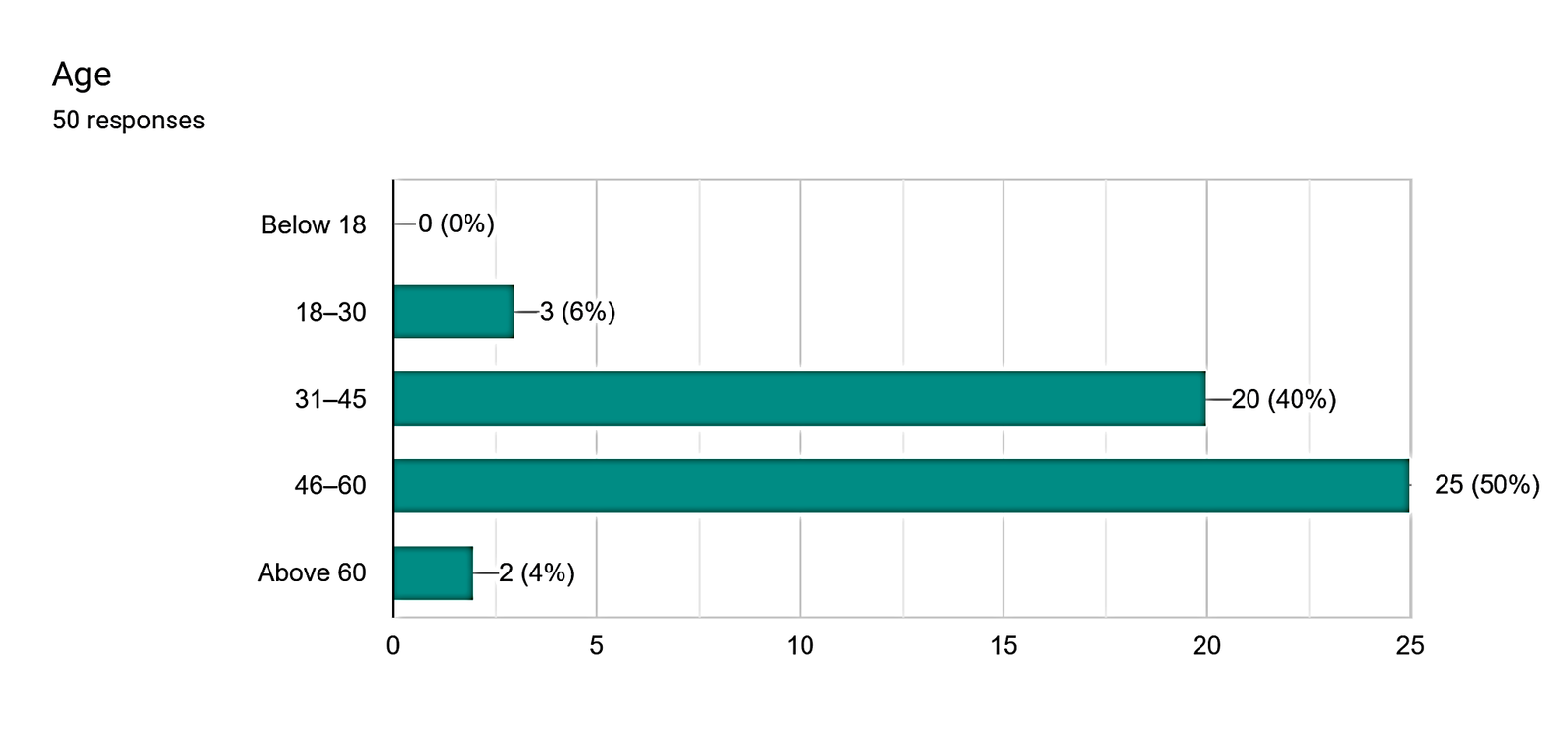
Here 3 participants (6%) were between 18 to 30 years of age, 20 participants (20%) were 31 to 45 ages, 25 participants (50%) were 46 to 60 years of ages and 2 participants (4%) were above 60 years of ages.
I. The participants were asked that do they have any idea which Article of Bangladesh Constitution guarantees own of property and the responses is shown below:
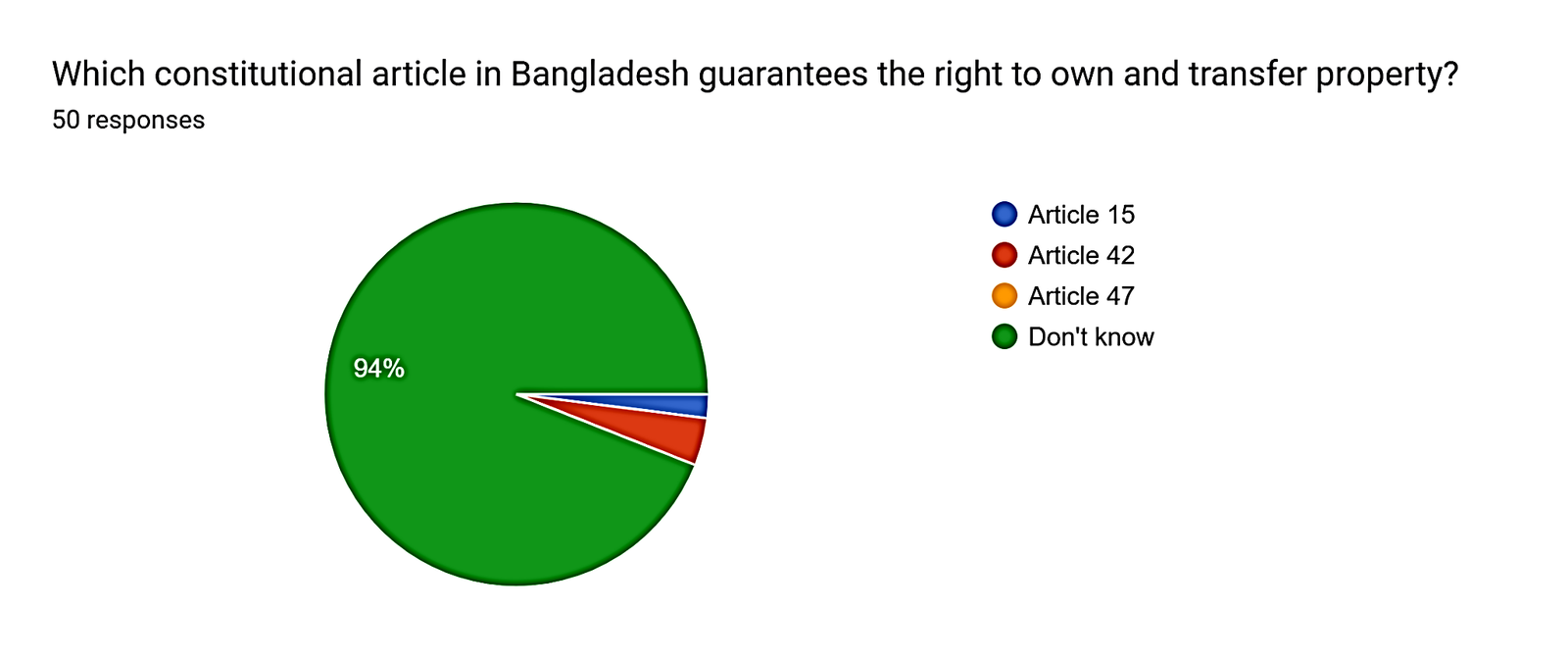
Here it is seen that 47 participants (94%) don’t know that, 1 participant (2%) answered Article 15 and 2 participants (4%) answered correctly that 42 Article.
II. The Participants were asked that have they heard the common enacted land laws of Bangladesh and the responses is shown below:
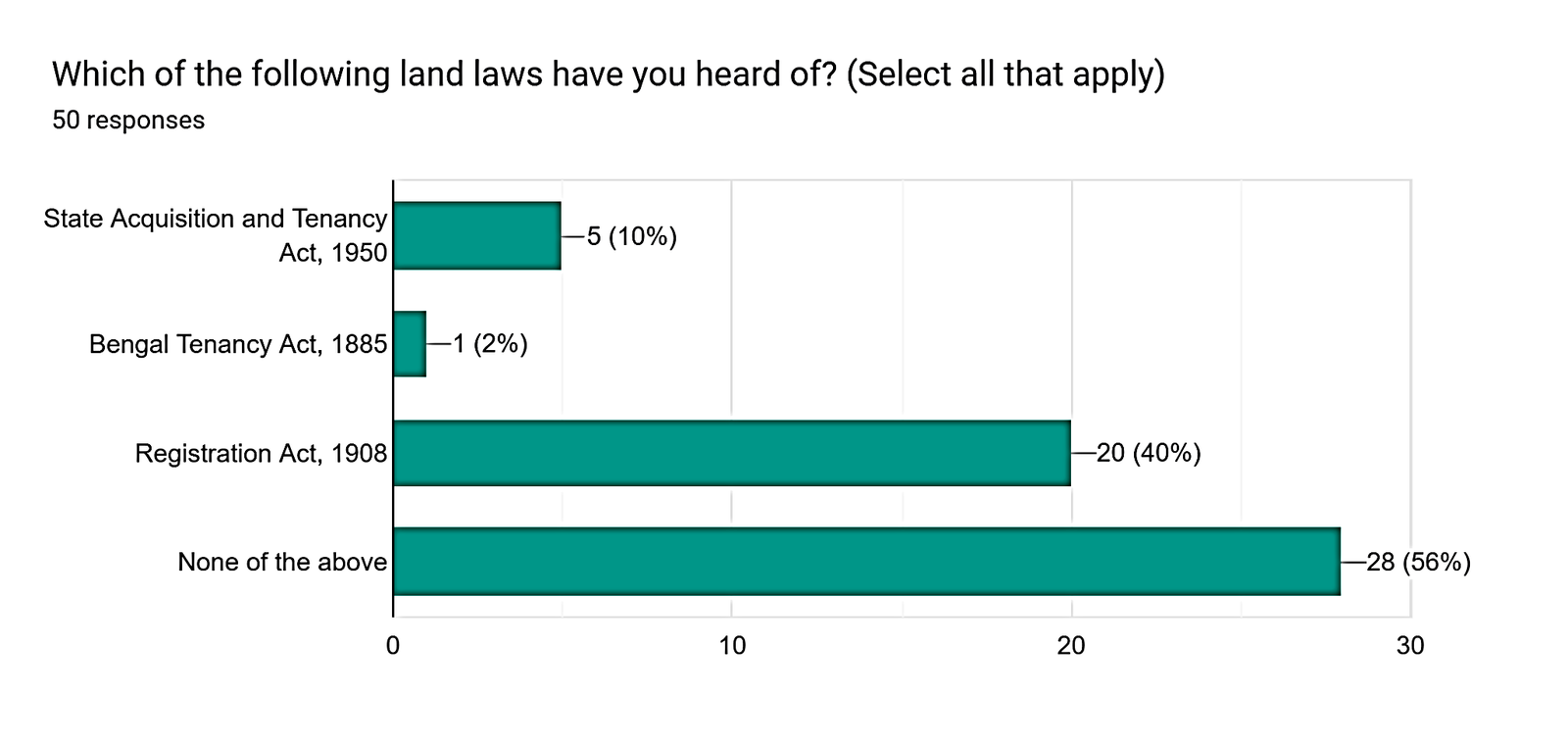
Here it is seen that 28 participants (56%) don’t even heard the above mentioned common land laws of Bangladesh, 20 participants (40%) knew about the Registration Act, 1908 due to land registration, 1 participant (2%) knew about the Bengal Tenancy Act, 1885 and 5 participants (10%) knew about the State Acquisition and Tenancy Act, 1950.
III. The participants were asked if government acquire their land what may the do and the responses are below:
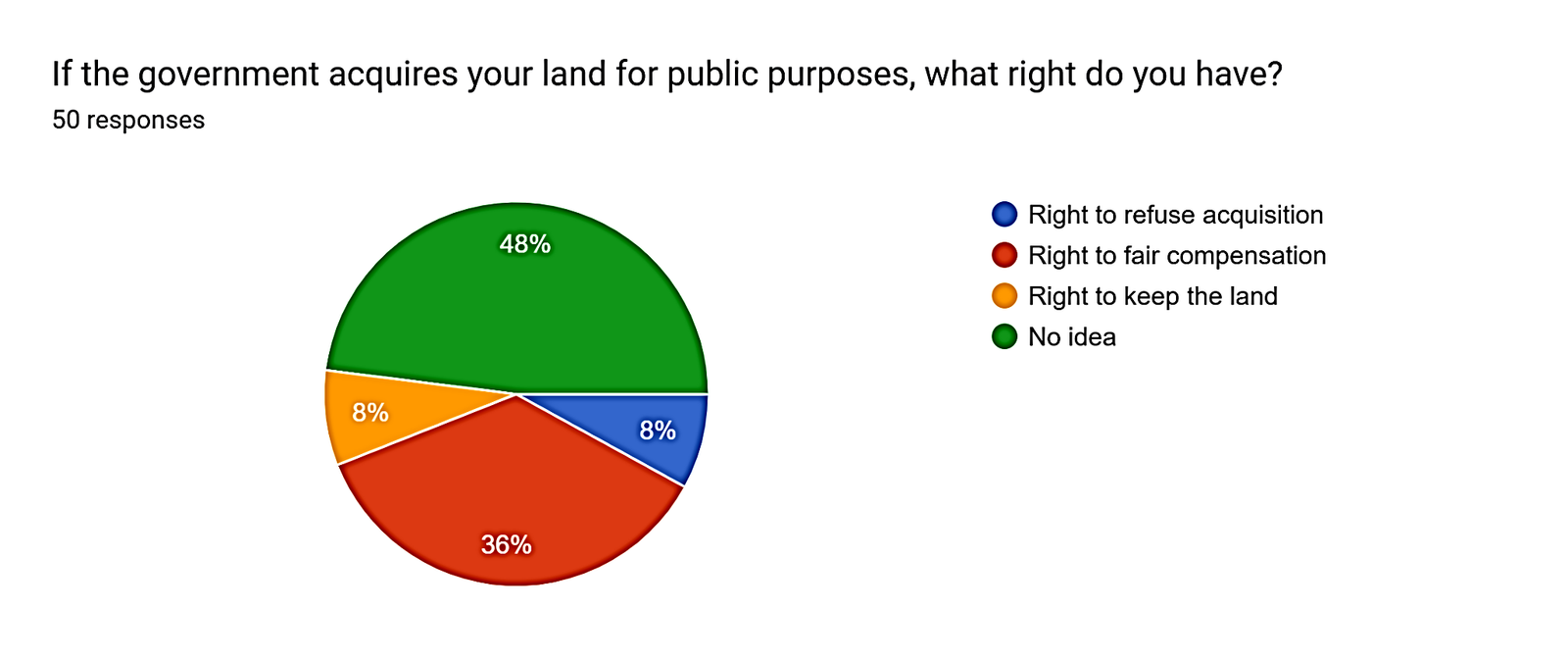
24 participants (48%) answered that they don’t have any idea, 18 participants (36%) correctly answered that “Right to fair compensation”, 4 participants (8%) answered “right to keep the land” and 4 participants (8%) answered “right to refuse acquisition’’ which were wrong.
IV. The participants were asked about different records of rights known as khaiyan which are so important to outline the person’s right to the land. In this regard the responses are given below:
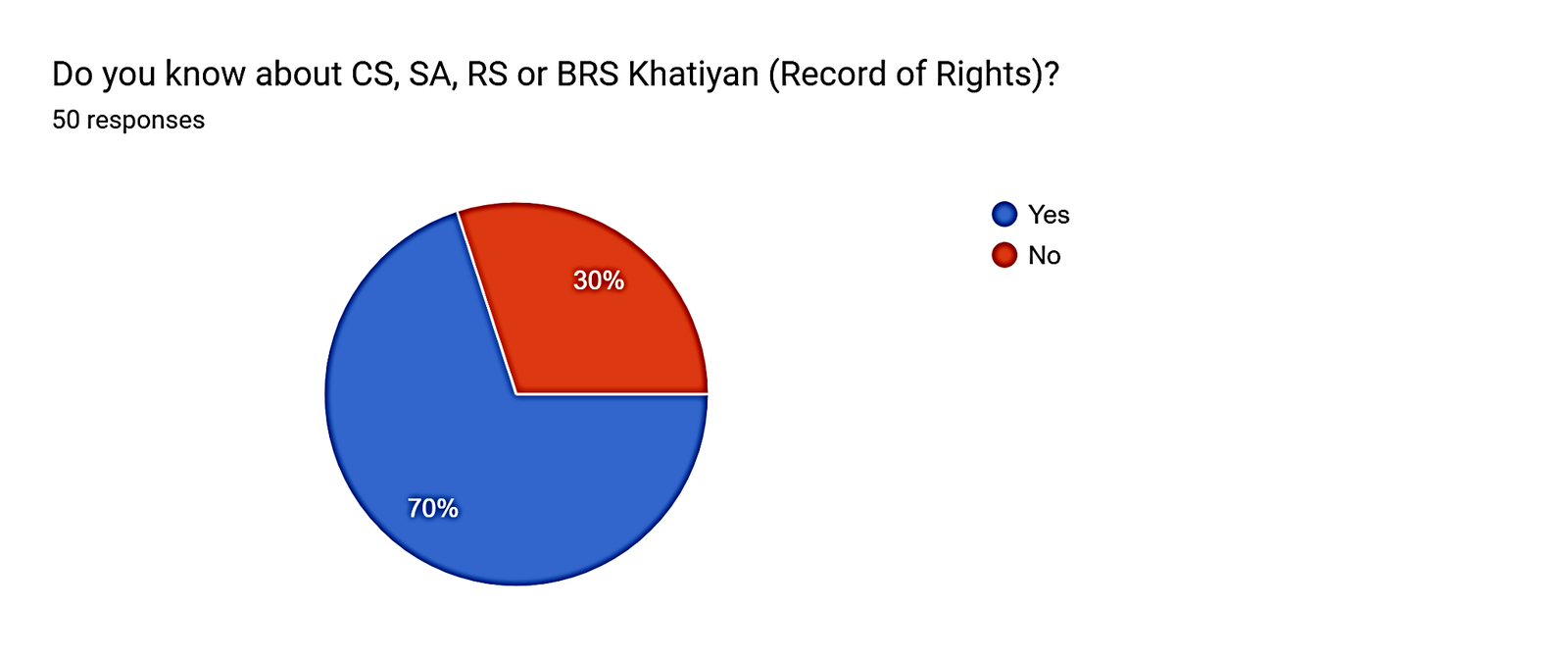
Here it is clearly seen that 35 participants (70%) knew about different records of rights (e.g. CS, SA, RS or BRS) and 15 participants (30%) don’t know about those but the interesting part of this section is that the 35 numbers of participants just have heard those names but what is CS, SA, RS or BRS or why these are needed they don’t know.
V. The participants were asked that whether they know about the records of rights’ importance in respect of ownership or possession and they responded below:
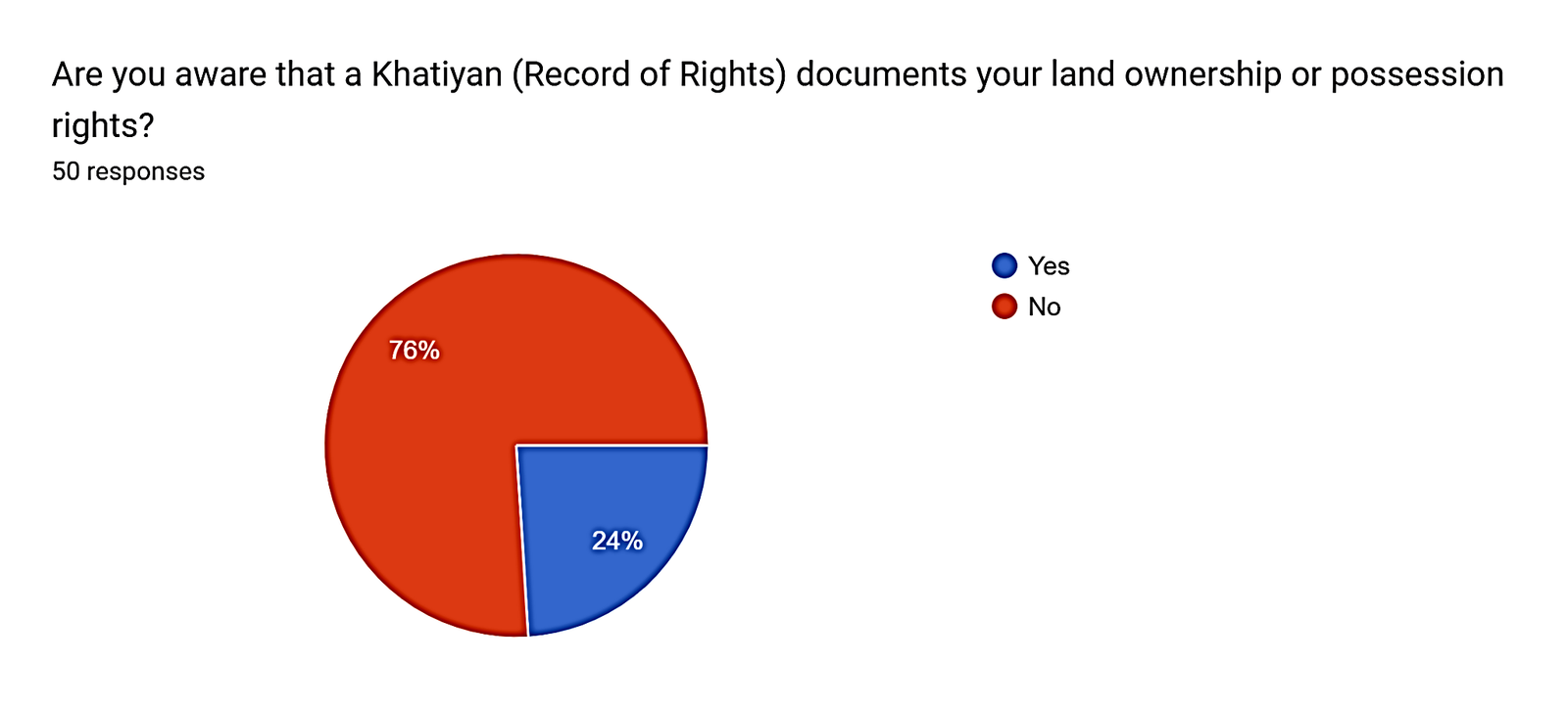
38 participants (78%) are not aware about the importance of those documents in respect of ownership or possession and 12 participants (24%) may have awareness about those.
VI. The participants were asked that whether they have basic knowledge between title deed and records of rights and they responded as such a way given below:
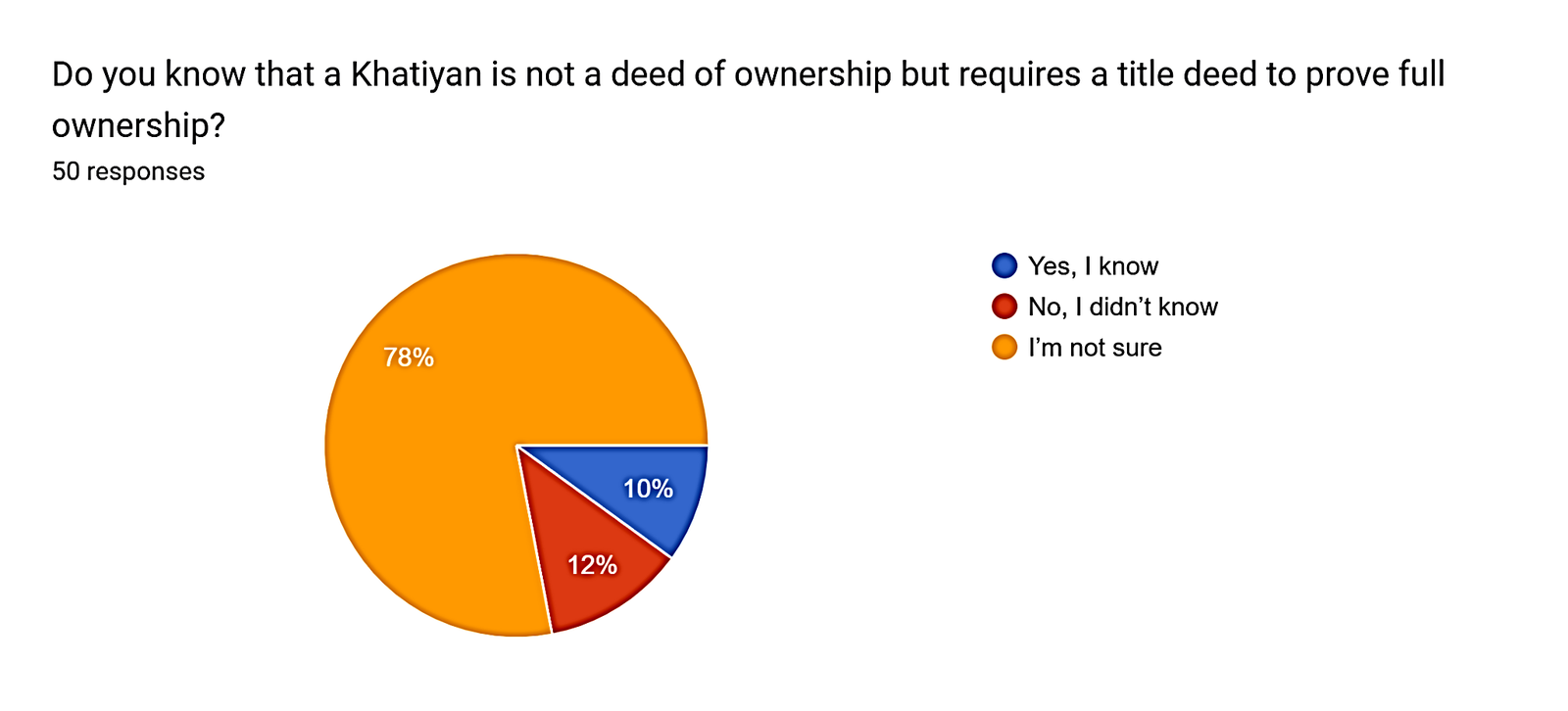
39 participants (78%) were not sure about that, 5 participants (10%) knew about that and 6 participants (12%) didn’t know about the matter.
VII. The participants were asked the importance of land development tax (LDT) to prevent the land related dispute and they responded below:
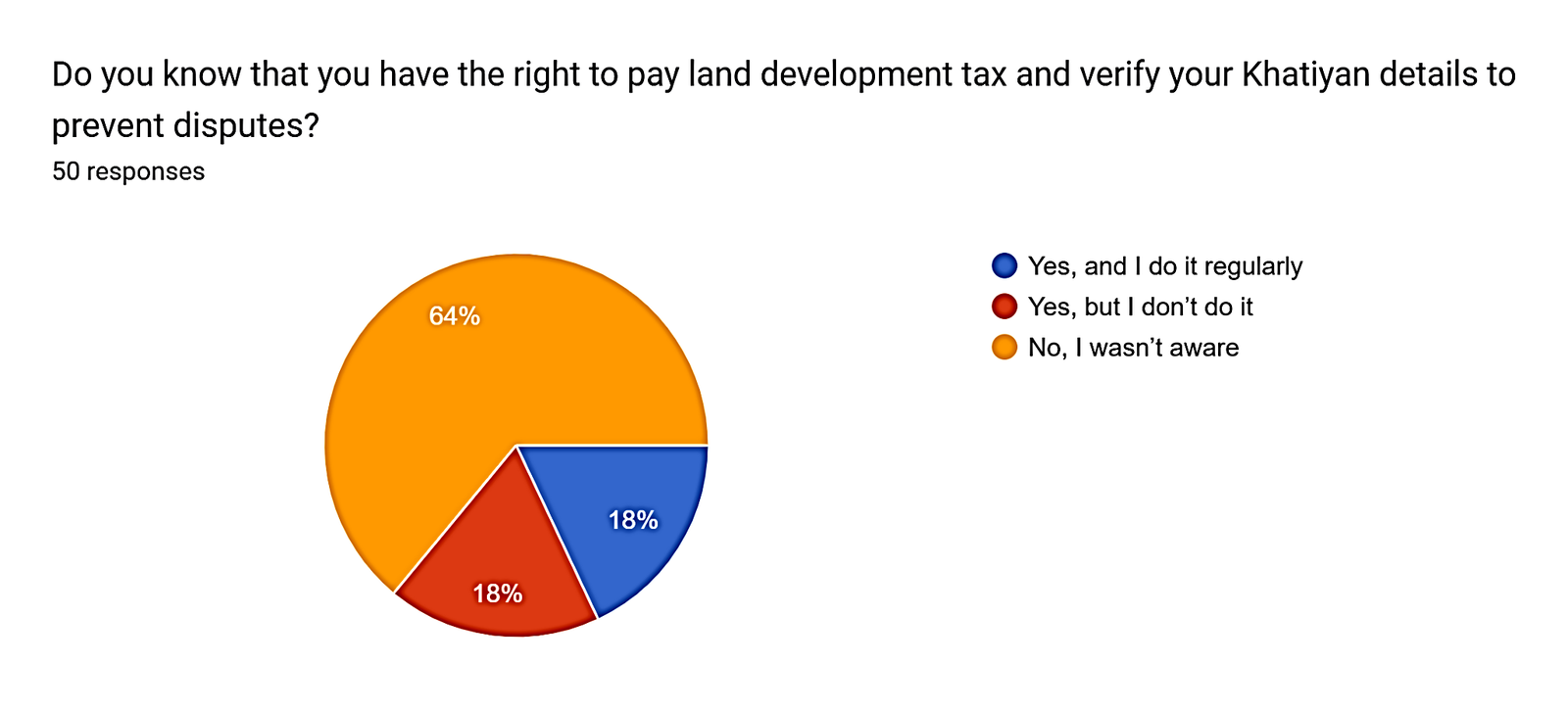
32 participants (64%) were not aware about the matter, 9 participants (18%) knew about the matter as well as comply with the same and 9 participants (18%) might have known about the matter but didn’t do that.
VIII. The participants were asked if there is any mistake or error in khatiyan then what to do and they responded below:
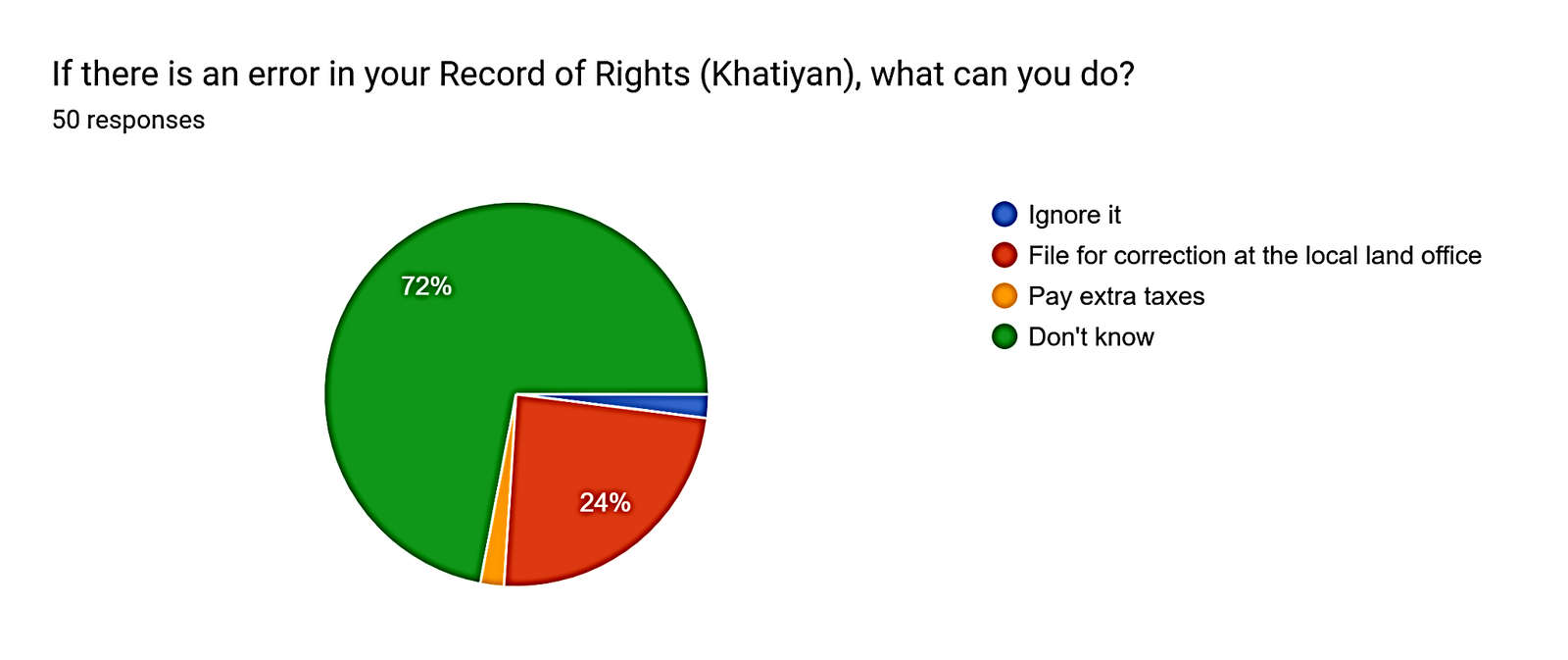
36 participants (72%) didn’t know the procedure for what to do, 12 numbers of participants knew what to do and 2 (1+1) participants (2%+2%) wrongly answered.
IX. The participants were asked the purpose of the Land Survey Tribunal of Bangladesh and the answered the question as below:
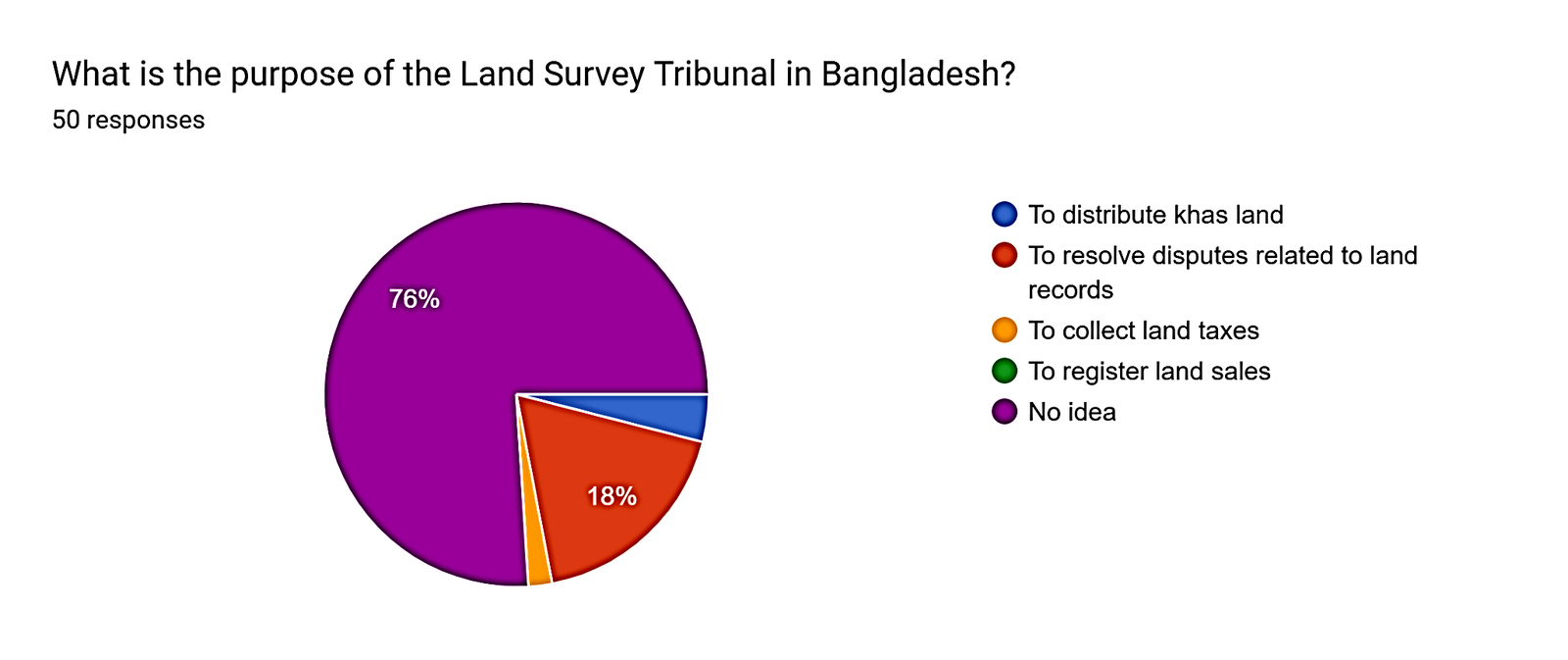
36 participants (72%) didn’t know the purpose of establishment of the Land Survey Tribunal of Bangladesh, 9 participants (18%) answered correctly and the rest of the participants (6%) answered wrongly even though they didn’t have any rational idea.
X. To resolve the land related problem the participants were asked that if they have any pecuniary jurisdiction of the Civil Courts of Bangladesh and they responded as below:
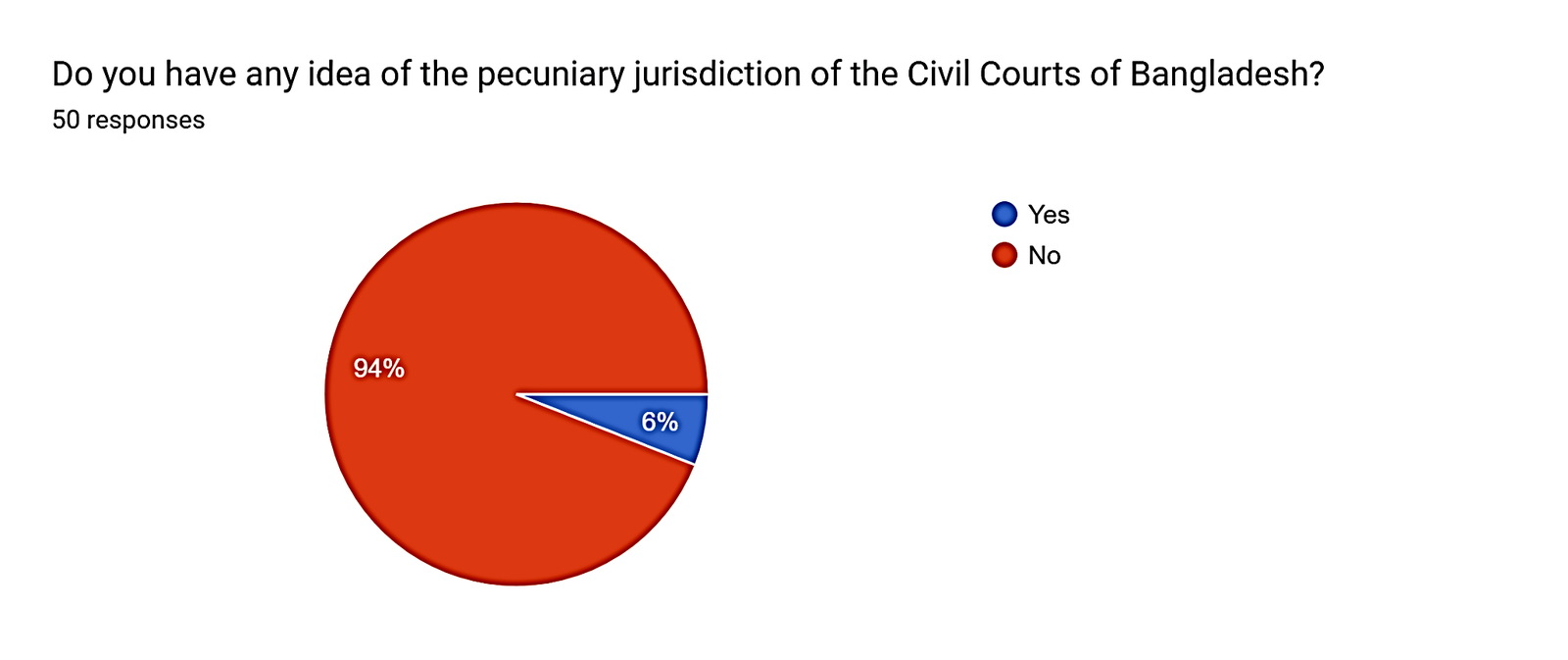
47 participants (94%) didn’t know the pecuniary jurisdiction of the Civil Courts of Bangladesh and 3 participants (6%) knew about those but not the all courts’ pecuniary jurisdiction.
XI. The participants were asked if their land right is violated then what he/she needed to do and they responded as below:
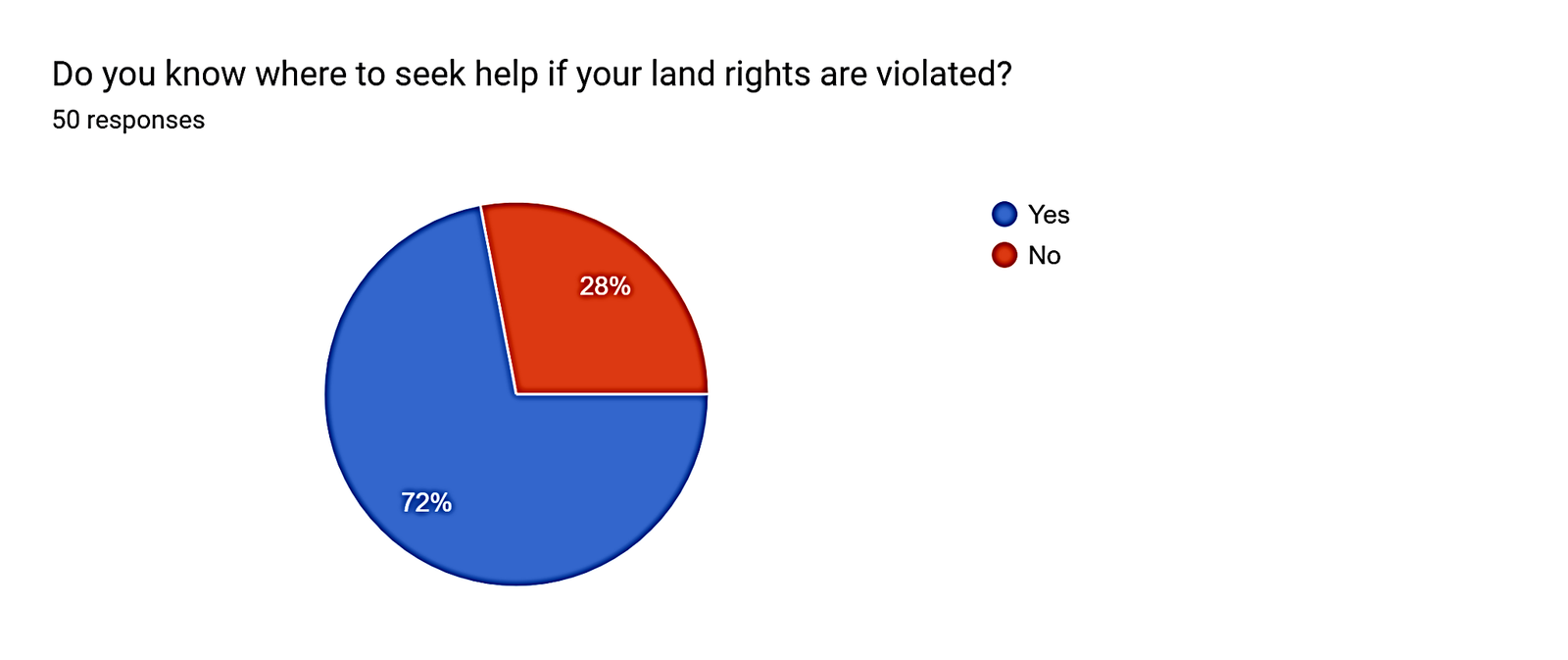
36 participants (72%) responded that they knew the procedure what to do but the interesting fact that maximum of them said that they would go to the local member/chairman to resolve the problem and the elective representative has the exclusive right to solve the problem and 14 participants (28%) didn’t know what to do.
XII. The participants were asked how do they think about the understanding of the land laws of Bangladesh and they answered as below:
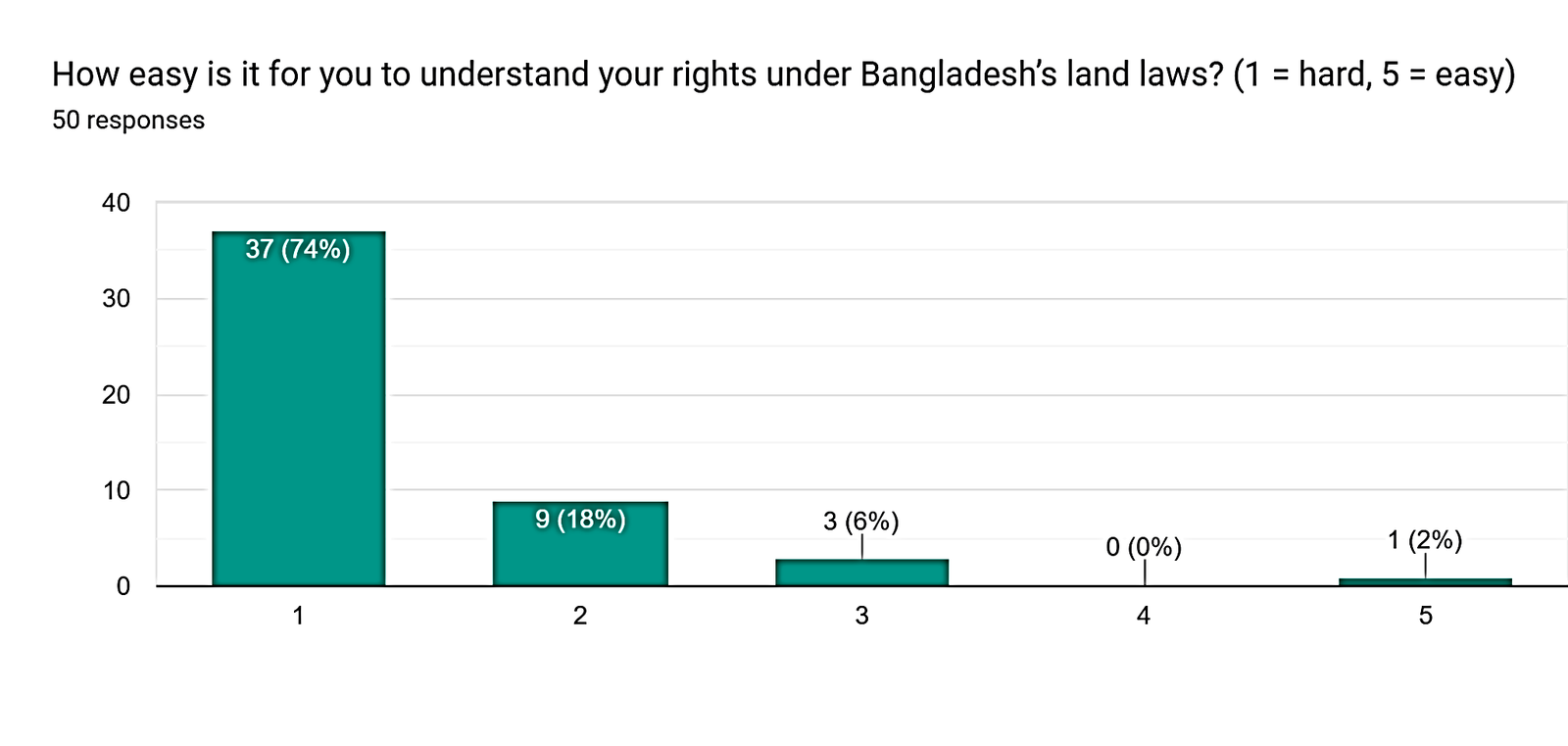
37 participants (74%) answered very hard and 1 participant (2%) answered that it’s easy.
XIII. Few reforms for understanding and development of the land laws as well as land administration of Bangladesh were given to choose and the participants chosen (one or more may be chosen) as below:
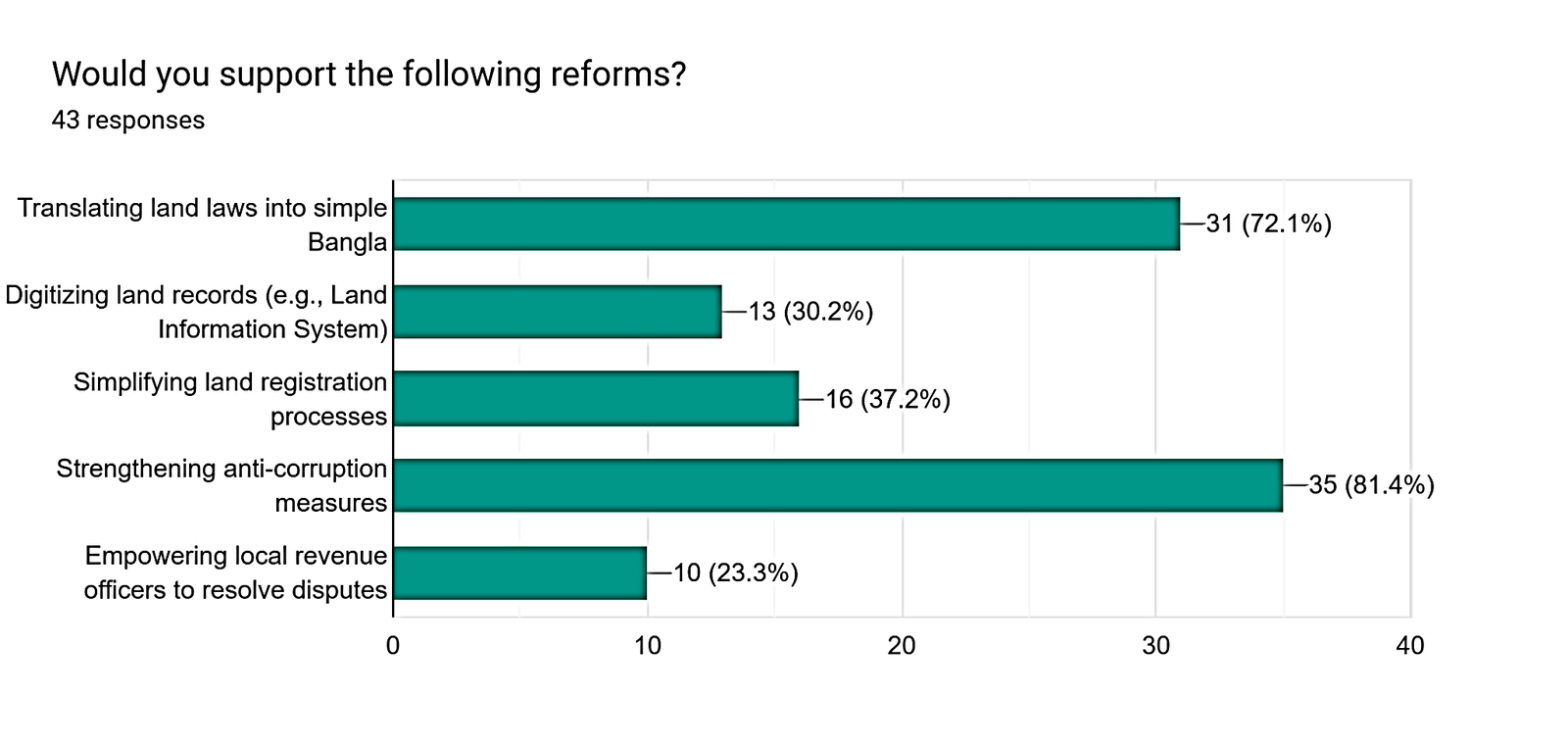
43 participants responded hare and it is seen that 31 (71.1%) participants agreed that if the land related laws are written in simple bangla language this surely be helpful, at the same side among the all participants, 13 participants (30.2%) opined that digital land records should be implemented, 16 participants (37.2%) propounded about simplify the land registration process, 35 participants (81.4%) strongly agreed that anti-corruption measures must be strengthened and 10 participants (23.3%) admitted that local authorities should be empowered to resolve the land related problems.
CONCLUSION
Land law and land administration in Bangladesh remain deeply rooted in historical evolution while continuously adapting to modern challenges. This study demonstrates that although a comprehensive legal framework exists, practical implementation gaps continue to undermine citizens’ rights. Strengthening transparency, digitization, and public awareness is essential to ensure effective land governance. A citizen-oriented land administration system is crucial for promoting justice, reducing disputes, and achieving sustainable development in Bangladesh.