
INTRODUCTION
Legal aid in the United Kingdom has evolved through several stages, reflecting the transformation of the state from a charity-based system to a welfare-oriented model and later to a cost-controlled framework, reflecting changing state priorities between social justice and fiscal discipline. The origin of the present LAS lies with the Rushcliffe Committee which reported in May 1945.
Legal aid has been in the forefront of social and legal transformation in Europe over the last few years. In France, a Statute of January, 1972 in force since September, 1972 (repealed the 19th Century LAS1 based on gratuitous services rendered by the Bar and repealed it with a more modern judicare approach). In May 1972, Sweden promulgated an extremely interesting public Legal Aid law, effective since July, 1973, which combines both the judicare and the salaried staff attorney models. Following a widespread “strike” of Legal Aid Lawyers, the Federal Republic of Germany enacted a law providing more adequate compensation by the State for legal services rendered to poor in October, 1972. In Austria, the Constitutional Court of Austria, in its landmark decision struck down the Legal Aid Legislation2 included in the Austrian Code of Civil Procedure, 1895, in so far as the services rendered by the private Legal Aid Attorneys were not adequately compensated by the State. In Italy, the Italian Senate in May, 1973, passed for the second time as entirely new Legal Aid set, which, if approved by the other Chamber, will at least repeal a scandalous Fascist Statute of 1923. England enacted the Legal Assistance and Advice Act in July, 19723 which greatly expands the reach of legal advice to the poor by allowing up to 25 pounds’ worth of consultation with private attorneys paid for by the State.
All these manifestations of the European Reform Movement share a common point of departure. There are millions of civil and criminal cases brought to the Courts each year in England, France, West Germany and Italy. At the same time, more than in other eras, the great complexities of the legal system have put justice beyond the reach of many.
EVOLUTION OF FLA IN THE UNITED KINGDOM
For many centuries throughout continental Europe and England, Legal Aid was given as a charitable, but not a legal obligation. The French, German, Italian, Spanish and other statutory schemes of the second half of the Nineteenth Century placed on private lawyers a legal duty to provide legal services gratuitously to the poor. However, these provisions did not work because, no compensation was paid. It provided poor justice for the poor. This semi-charitable Nineteenth Century approach reflected the prevailing laissez-faire philosophy of the time, with its desire to minimize State involvement in affirmative social and economic action. The past of legal aid in Western Europe was “charity”. The twentieth Century has brought fundamental departure from that past by acceptance of the idea of legal aid as a social service and the State’s duty to make justice accessible to all segments of society.
Departing from this common historical attitude, a new trend was initiated by Weimar Germany in 1919 and by Great Britain in 1949. Its roots in the United Kingdom trace back to medieval times, though early developments were limited and uneven.
A. During Thirteenth Century
During thirteenth Century, the notion of providing legal access to the poor was addressed in part by the Statute of Westminster 12754, which allowed individuals to proceed in forma pauperis (as a poor person) in certain civil cases5. However, this did not extend to legal representation. Legal assistance remained largely inaccessible to the common populace. The Statute of Westminster 1275 along with the Statute of Westminster 12856 and 12907, constitutes a major, early systematic effort at legal reform in England.
B. During Fifteenth Century
In 1495, under Henry VII8, a Statute allowed indigent persons to sue without paying Court fees and assigned them legal representation at no cost. This was a notable early recognition of the State’s role in justice for the poor. However, the implementation was inconsistent and widespread legal aid did not exist.
C. During Sixteenth and Seventeenth Centuries
During these Centuries ecclesiastical Courts occasionally intervened in legal matters, especially those related to family and morality. But these Courts were guided by Canon Law9 and not inclusive of all civil or criminal cases. Legal redress remained elusive for most citizens.
In criminal law, the situation was more dire. Until the Prisoners’ Counsel Act, 183610, individuals charged with felony offences were not entitled to legal representation11. Even after this, only limited representation was allowed in trials. For the most part, defendants had to speak for themselves in Court.
D. During Nineteenth Century
This Century saw greater public concern over poverty and injustice. The industrial revolution and rise of the working class brought awareness of social inequality. By the late 1800s, charities and organisations began providing minimal legal assistance. In civil cases, access remained fragmented. Solicitors were sometimes willing to act pro bono, but only in select circumstances.
The Poor Persons Procedure, established at the Royal Courts of Justice in the early twentieth Century, provided limited legal help in family and housing matters12. There was also the Poor Man’s Lawyers Movement, first established at the end of the nineteenth century at Mansfield House and Toynbee Hall, charitable settlements in East London, which provided pro bono help that stopped short of representation in Court. In 1926 one of its founders explicitly recognized the limitations of charity in providing access to justice, saying that it made the rule of law “an anaemic attenuated make believe which we flash in the eye of the poor as justice.” A little earlier a Committee chaired by Mr. Justice Finlay, responding to a witness who had used the analogy of health to argue for a “Legal Hospital System”, expressed the view that while it was the State’s interest for people to be healthy, it was not necessarily in its interest for them to be litigious.
E. During Twentieth Century
World War II marked a turning point in British welfare policy. During the war the Law Society had had to set up a Salaried Divorce Department because of the non-availability of pro bono lawyers, but it was not anxious to continue this service after the war, and in 1944 the Coalition Government set up the Rushcliffe Committee, chaired by Lord Rushcliffe, a former backbench Conservative MP, to advise it on the way forward. Post war aspirations toward equity and justice led to significant reform.
1. The Beveridge Report 1942
The Beveridge Report 194213 was a landmark United Kingdom plan for a comprehensive Welfare State led to the establishment of a system of social security and the National Health Service after the end of the World War II. The Report was presented by Sir William Beveridge, to the British Parliament in November 1942. It provided a summary of principles necessary to banish poverty and ‘Want’ from Britain. ‘Abolition of Want’ was the foremost ideals of the Report. Beveridge argued for social progression which required a coherent government policy. Social insurance fully developed may provide income security, it is an attack upon Want. But Want is one only of five giants (others are Disease, Ignorance, Squalor and Idleness) on the road of reconstruction and in some ways the easiest to attack.
Today, the ideas that were outlined in the Beveridge Report are still considered to provide the foundation of the modern Welfare State. Thus, the goal of the Report of 1942 is to create a comprehensive Welfare State for all citizens, funded by compulsory contributions.
2. The Rushcliffe Committee Report
When it came to delivery of the new service, the Rushcliffe Committee relied entirely on the existing private practice structure of the legal profession. In the main, the Committee simple rubber-stamped a plan but forward by the Law Society, the trade association and professional body representing solicitors.
CLA would be dispensed through solicitors and barristers in private practice who would be paid ‘reasonable remuneration’ on a case-by-case basis out of a legal aid fund provided by the government and administered by the Law Society. Legal Aid as implemented on the Rushcliffe Model, was not so much a public service as a private service paid for out of public funds. The proposals for Cr LA were similar except that most of the administration would be done by the Courts.
In only one major respect did the Rushcliffe Committee propose a new way to deliver legal services – the law society should employ solicitor to give legal advice to those who could not afford to pay for it. That, along with all its other recommendations, was incorporated in the 1949 Act but became the only one which was not brought into effect.
The Rushcliffe Committee, established in 1944, reviewed the legal aid system and published a Report in 1945 recommending a national, publicly funded service assessable to people of “small or moderate means14” and the post-war Labour Government accepted its recommendations, saying in a White Paper in 1948 that legislation would be introduced “to provide legal advice for those of slender means and resources, so that no one would be financially unable to prosecute a just and reasonable claim or defend a legal right; and to allow Counsel and Solicitors to be remunerated for their services.” However, legal aid was never one of the four pillars of the new Welfare State. The four pillars (Beveridge Era) are –
1. Health Care (NHS): universal, free healthcare (National Health Service Act, 1948).
2. Education: Comprehensive schooling and universal education for all (Education Act, 1944).
3. Social Security: Benefits for unemployment, sickness, disability and old age (National Insurance Act, 1948).
4. Housing: Provision of decent housing, though this often involved a mix of public and private provision, making it less “pillar-like” than others.
Prof. Peter Townsend has described the principle behind the Beveridge Reforms as that of ‘minimum rights for the many’. The way in which ‘the many’ were included in the LAS was explicitly stated in the long title of Legal Aid and Advice Act of 1949. It was ‘an Act to make legal aid and advice……. more readily available for persons of small and moderate means.’
With housing as a less stable component, access to legal advice and representation was sometimes identified as a crucial fourth pillar, ensuring access to justice for all citizens (Legal Aid and Advice Act, 1949).
3. Legal Aid and Advice Act, 1949 (LAAA 1949)
The result was the LAAA 1949 a landmark in legal history. The British experiment in government subsidized legal aid for England and Wales got under way on October 2, 1950, when much of the LAAA 1949 was given operative effect. It established a State-funded Legal Aid Scheme administered by the Law Society, making legal aid available for civil matters and some criminal proceedings15. Legal aid certificates were issued after means and merits testing. At the time, around eighty percent of the population was potentially eligible. The original plan envisaged the simultaneous implementation of all provisions of the Act, but economic difficulties caused postponement of a portion of the programme. This piecemeal execution was accomplished with relative facility because the Act itself is not self-executing and is only selected in form. The details of the programme were left for development by regulations of the Lord Chancellor and by a Scheme drafted by the Law Society and approved by him.16 The provisions presently in force are mainly those applicable to civil litigation. Part II of the Act of 1949, only a minor portion of which has been given effect, was intended to make a number of improvements in the system of legal aid in criminal proceedings.17
a. Eligibility For Legal Aid
Eligibility for legal aid depends on the applicants’ financial circumstances. There are separate income and capital limits to decide whether applicants qualify and, if so, whether they should make a financial contribution and how much that should be. In order to apply the limits, it is necessary to calculate ‘disposable’ income and capital which involves deducting certain expenses and fixed ‘allowances’ for Dependants. Therefore, the level of allowances as well as that of the limits themselves determine the proportion of the population which is eligible at any given time.
The poor have always been eligible for FLA. It is in relation to the other people contemplated by Rushcliffe and the Act of 1949, those of ‘moderate means’, that there has been considerable fluctuation and where the line may be said to lie between a scheme which is intended to form part of the Welfare State and one which is only for the deserving poor.
b. The Test of Reasonableness
The test of reasonableness is whether “a man of moderate means18 would embark on litigation relying upon his own means; whether, in effect, it would be ‘reasonable business’ to take action”. For example, aid would not be given where the applicant would usually be aided by some other organization or person, such as a trade association or trade union, or where the applicant wants to take an action with the aid of public funds which a person of moderate means would not as a rule take unless others helped to finance the proceedings. An application would probably also be denied where the action is of a trumpery nature, such as some trespass or assault in the case of a backyard quarrel, where the expenses entailed in securing judgment would be disproportionate to the benefit which would be reaped, or where litigation is already pending which will decide the issue with which the applicant is concerned; in such a case, however, legal aid may be granted limited, for instance, to the issue of the writ.
If a Local Committee rejects an application, the decision can be appealed to the Area Committee.19 In cases of urgency, emergency application can be approved by the Chairman, Vice-Chairman or Secretary of the Local Committee without reference to the Certifying Committee, as soon as practicable, the holder of an emergency certificate must supply the information required for an ordinary certificate.20 When an application has been granted, the chosen lawyer serves the client just as he would any other client, and funds are available for all usual expenses such as investigations and expert witnesses. The lawyer receives 90% of his usual fee for his services.
c. History and Summary of the Programme of LAAA 1949
The Labour Party Government was responsible for the introduction of the Legal Aid Bill into Parliament, but the measure was supported by the Conservative Party as well. In fact, it was during Churchill’s Wartime Coalition Government that the Rushcliffe Committee, whose recommendations21 the Act follows in almost every detail, was commissioned to review the system of legal aid for the poor.
Under the old system, the principal method of aid to civil litigants was the Poor Persons Procedure, available only to virtually poverty-stricken. For more than the literally “poor”, however, are benefitted by the new legislation – the substitution of the term “assisted person” for the old “poor person” being more than a mere euphemism. Today, probably three of every four persons are eligible for assistance in civil actions. In order to qualify, an applicant must have a “disposable income”22 of less than £ 420 ($ 1176) a year and a “disposable capital”23 of less than £ 500 ($ 1400), although as to the latter requirement the administrators are left some discretion. But the applicant who meets these tests does not necessarily obtain free assistance. He must contribute to the cost of prosecuting or defending his case in an amount proportionate to his means. The determination of financial eligibility and of the “maximum contribution” which may be required of an applicant is entirely the province of the non-legal National Assistance Board.24
The terms of the LAAA 1949 expressly exclude from its coverage certain types of litigation, such as defamation, breach of promise of marriage, loss of the services of a female in consequence of her rape or seduction and alienation of affections.25
The Law Society manages the scheme through twelve Area Committees and 112 Local Committees, of which all members are practicing lawyers. After an applicant’s “maximum contribution” has been determined, a Certifying Committee26 passes on the application and fixes the applicant’s “actual contribution” on the basis of the probable cost of the Court proceedings. In order to obtain assistance an applicant must demonstrate to the Certifying Committee the following two requirements27 –
• First, that he has reasonable grounds in law for taking or defending against the action, and
• Second, that is not unreasonable that he should receive aid in the particular circumstances of the case.
In urgent cases, an emergency certificate may be issued by the Chairman, Vice-Chairman or Secretary of the Local Committee without prior reference of the application to either the National Assistance Board or the Certifying Committee, provided that the issuer is satisfied that the applicant is likely to fulfil the financial and legal conditions under which an ordinary certificate would be granted.28 Except in certain matrimonial causes conducted by the Law Society’s Divorce Department, as assisted litigant may retain any practicing lawyer who has indicated his willingness to accept legal aid cases.29
d. Functioning of the LAAA, 1949
Legal aid has a long history in England as in the United States. No doubt some legal aid has been provided in criminal cases since time immemorial, and in the superior Courts there has existed for at least 150 years a system which allowed poor persons to sue or defend actions, in what has become the Supreme Court, in “forma pauperis”. Until recent years it has been relied very largely on the services of lawyers which were given to poor people without any charge or for only nominal fees. Lawyers have rendered such services in many parts of the World since early times and it has become a tradition of public service. However, there are many factors which have contributed to making a largely voluntary system out-worm and, indeed, impracticable in the twentieth century. Already, before the Second World War, the machinery for providing legal aid on a semi-voluntary basis was creaking and, by the end of the war, it had become apparent in England that a thorough inquiry was needed with a view to finding a more rational and workable system.
Following factors contributed to a pressing need for modern arrangements for legal aid –
The distribution of wealth, the complexities of modern life, the growing volume of legal provisions which affect the citizen, the growth of the population, the regrettable increase in the amount of crime and in the number of divorce cases in recent years.
These changes were also taking place at a time when people in England were turning their attention to the need to develop other social services. There was to more free education, and every man in the Country, regardless of his means, was to be eligible for free medical and hospital care.
It was in such conditions and with such ideas exciting the public interest that Lord Simon, when Lord Chancellor, established a Committee in 1944, as the war was drawing to a close, to consider this problem. The Committee was presided over by Lord Rushcliffe, an eminent retired statesman. The present system for providing legal aid in England in civil cases is based very largely on the recommendations of that distinguished Committee which, among other members, included two Judges of the High Court and the present Attorney General, Sir Reginald Manningham Buller. Again, though the system for providing legal aid in criminal cases depends on the Poor Prisoners’ Defence Act, 193030, it has developed as a result of recommendations of the Rushcliffe Committee.
In general, the LAAA, 1949 provides for the payment of part or all of the legal fees in either civil or criminal cases, according to the litigant’s ability to pay. In criminal cases, the decision to grant legal aid is made by the Court; in civil cases, the determination is by Volunteer Committees of Barristers and Solicitors. Payment is made by the Exchequer31, but the client is free to select his own solicitor and counsel, and the relationship between them is precisely the same in legal aid cases as it is in unaided cases.
e. Problems attributed to piecemeal introduction of the LAAA, 1949
The architects of the LAAA realistically appreciated that not everyone who finds himself in need of legal assistance is involved in actual or impending litigation. However, government economy has delayed the plan’s implementation, causing the postponement of the effective date of those provisions designed to extend the scheme beyond actual litigation. Among the more important of these is Sec. 7 of LAAA, 1949, which contemplates the Country-wide establishment of Legal Advice Centres at which solicitors will be employed to give oral advice, supplemented by a written note, when necessary, to anyone who “cannot afford to obtain it in the ordinary way”.32 Sec. 5 of LAAA, 1949, when operative, will offer “legal assistance in matters not involving litigation” to close the great gap between mere oral advice and aid rendered in connection with proceedings before a Court or Tribunal. Therefore, assistance under Sec. 5 of the Act of 1949 will be available only in situations where the question of proceeding in Court has not arisen, but where, if it did arise, the cause would be a proper subject to legal aid under the general provisions of the Act.33 However, the only persons eligible for assistance under Sec. 5 of the Act of 1949 are those whose income and capital are so minimal that they could not be required to make any contribution whatever toward the costs of proceedings instituted on their behalf.34
Experience has already shown that in loss of over-all effectiveness a high price has been paid for the economy of postponing the execution of Sec.s 5 and 7. The only agencies providing comparable services in England today are voluntary organisations which depend entirely upon charitable subscriptions for their support. In England these organisations have never been effective as their American counterparts and their financial plight is steadily growing worse. One such voluntary organisation in Landon, the Bentham Committee, has been closed for lack of support. Furthermore, they are badly understaffed, since many of their personnel have been absorbed into the administration of the Legal Aid and Advice Act.
In addition to the benefits which the operation of Sec.s 5 and 7 would bring to those in need of legal advice or assistance there would also result a number of economies in that part of the scheme now in effect. Many persons now being assisted in the prosecution or defence of Court proceedings might have avoided litigation altogether through the timely advice of a solicitor. Since disputants may now obtain legal assistance only in the Courts, the existing scheme may be said to actively encourage litigation. This defect is especially regrettable in matrimonial cases, where a legal advisor might recommend consultation with marriage guidance organisations. The staff of Local Committees would be relieved of the considerable burden of helping applicants to fill out application forms, a function originally intended for performance by Legal Advice Centres.35 The establishment of such Centres would also justify replacing with more efficient full-time personnel the part-time local secretaries who now serve sparsely populated areas.36 Considerations of this kind have prompted the Lord Chancellor’s Advisory Committee to recommend that Sec.s 5 and 7 be brought into force as soon as possible.37
Therefore, problem attributed to piecemeal introduction of the LAAA, 1949 may be summarised as follows –
(a) Not everyone who finds himself in need of legal assistance is involved in actual or impending litigation.
(b) Government economy has delayed the plan’s implementation causing the postponement of the effective date of those provisions designed to extend the scheme beyond actual litigation.
(c) There are also jurisdictional anomalies, because the benefits of the Legal Aid and Advice Act have not yet been extended to litigants in all Courts, certain indefensible anomalies have crept into the scheme.
4. Developments After LAAA 1949
By 1970, it covered matrimonial, housing, personal injury, and some welfare disputes. The Legal Aid Act, 1974 extended provisions and introduced legal advice and assistance schemes for summary matters38.
Throughout the 1980s, legal aid continued to grow but faced increasing security. Rising costs and administrative complexity prompted reforms. In 1988, the Legal Aid Board was formed to administer funding and control spending39. This marked a shift from professional self-regulation toward bureaucratic oversight.
By the late 1990s, the legal aid budget exceeded £1.5 billion, triggering further reform. the Access to Justice Act, 1999 abolished the Legal Aid Board and replaced it with the Legal Services Commission (LSC)40. It introduced new funding rules and established the Community Legal Service and Criminal Defence Service.
F. During Twenty-First Century
However, critics argued that access was becoming harder, not easier. Many Solicitors opted out due to reduced fees. In 2010, the Coalition Government proposed drastic cuts. These culminated in the Legal Aid, Sentencing and Punishment of Offenders Act, 2012 (LASPO)41. LASPO radically restructured legal aid in England and Wales. Entire areas of law, such as, immigration, housing (unless there was immediate risks), employment, dept (unless eviction or repossession), and welfare benefits, were removed from scope. Only cases involving domestic violence, risk to life or liberty, or children in care remained eligible. The result was a dramatic fall in legal aid cases. By 2014, applications had dropped by over forty percent and the number of legal aid providers fell significantly42. The Government argued this was necessary for fiscal sustainability. However, critics saw it as a denial of justice to the vulnerable.
The Bach Commission, in its 2017 Report “The Right to Justice”, condemned the post-LAPSO legal landscape43. It argued for a statutory right to justice and a new public defender service. The Commission recommended the reintroduction of early legal advice and an end to complex eligibility requirements.
Organisations such as LawWorks, Citizens Advice, and The Legal Aid Practitioners Group stepped into fill the void. The legal profession expanded its pro bono initiatives. However, the scale of unmet legal need remained vast.
In 2019, the Ministry of Justice began a LAPSO post-implementation review. It acknowledged the negative impact of reforms and pledged targeted adjustments44. In 2021, the Means Test Review proposed raising income thresholds and simplifying processes. For many areas of civil law, the implementation of the LASPO Act led to a reduction of workload. Areas affected include:
• Family – for private family law cases (such as contact or divorce), legal aid is now only available, if, there is evidence of domestic violence or child abuse and child abduction cases. Legal aid remains available for public family law cases (such as adoption).
• Tribunals – legal aid has been reduced for immigration work.
• Other non-family – legal aid has been removed (with some exceptions) or reduced for debt, employment, housing, welfare benefits, clinical negligence, education and personal injury.
The diagram below shows the stages of the Criminal Justice System and (in bold) where legal aid services may be involved.
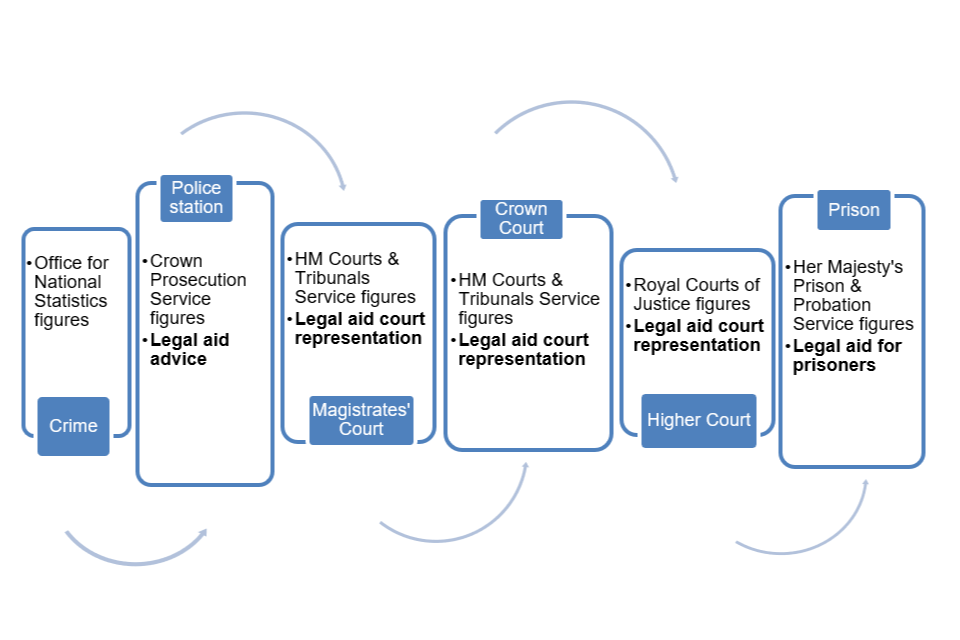
Figure 1: Stages of Criminal Justice System and where Legal aid services may be involved
FLA IN THE UNITED KINGDOM: A REFORM FROM A CHARITABLE MODEL TO A WELFARE-BASED RIGHT
Legal aid in the United Kingdom has evolved through several stages, reflecting the transformation of the state from a charity-based system to a welfare-oriented model and later to a cost-controlled framework, reflecting changing state priorities between social justice and fiscal discipline. The transformation or reform of FLA in the United Kingdom from a charity-based system to a welfare-oriented model can conveniently be divided into seven periods: Pre-194545; Rushcliffe Committee Report, 194546; Legal Aid and Advice Act, 194947; Expansion Phase (1950s–1970s)48; Access to Justice Act, 199949; Legal Aid, Sentencing and Punishment of Offenders Act, 2012 (LASPO) and Present Position.
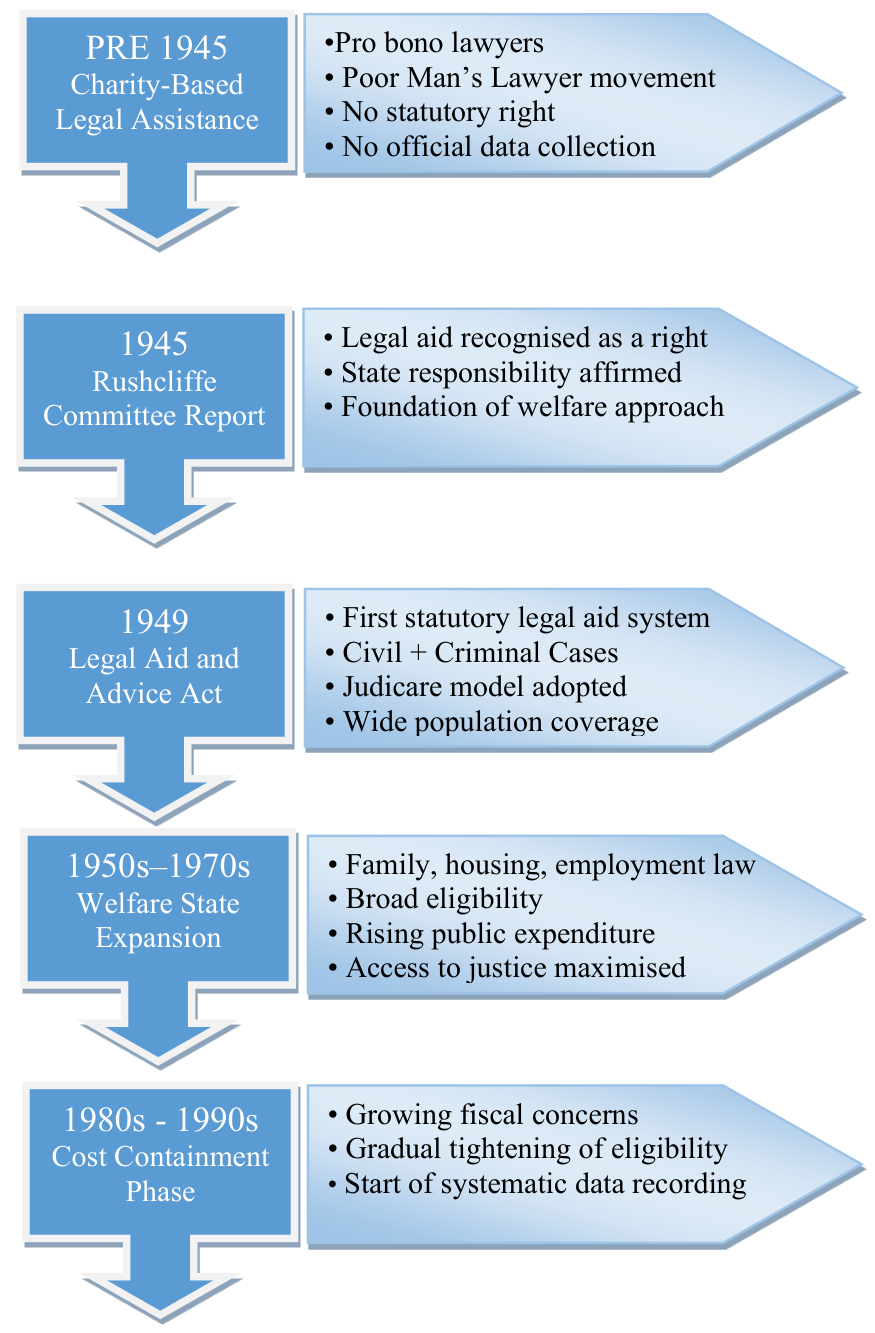
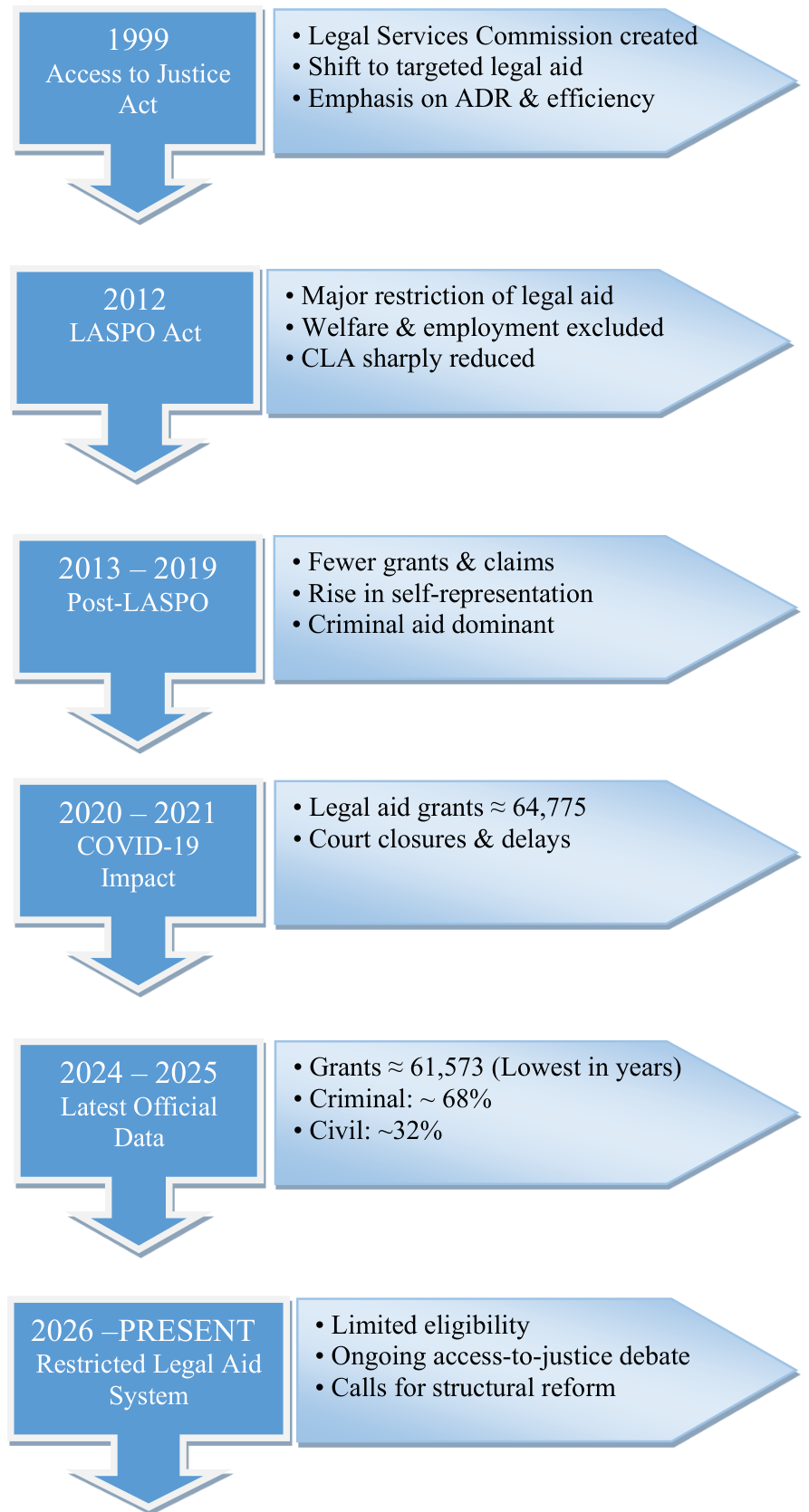
Figure 2: Flow Diagram of United Kingdom Legal Aid Evolution with Reforms and Data Trends (1945–2026)
A. Pre-1945: Charity and Voluntary Legal Aid
Before 1945, legal aid in the United Kingdom was largely unorganized and charitable in nature. Assistance was provided mainly through:
• Pro bono services by lawyers
• Charitable organizations
• The Poor Man’s Lawyer movement
There was no statutory obligation on the state to provide legal aid. As a result, access to justice depended on goodwill and varied greatly, leaving many poor litigants without effective legal representation.
B. Rushcliffe Committee Report, 1945
The Rushcliffe Committee Report (1945) marked a major turning point in the history of legal aid. The Committee recommended:
• A comprehensive, state-funded legal aid scheme
• Legal aid should be treated as a right of citizenship, not charity
This report laid the foundation for integrating legal aid into the emerging Welfare State.
C. Legal Aid and Advice Act, 1949
The Legal Aid and Advice Act, 1949 introduced the World, first Statutory Legal Aid System. Its key features included:
• Coverage of both civil and criminal cases.
• Adoption of the Judicare model, where private lawyers were paid by the State.
• Eligibility based on means test and merits test.
This Act institutionalized legal aid as a public service.
D. Expansion Phase (1950s–1970s)
During this period, the scope of legal aid expanded significantly. It came to include:
• Family law
• Housing disputes
• Employment and social welfare matters
Legal aid became an integral part of the United Kingdom’s Welfare System, though increasing costs began to concern the government.
E. Access to Justice Act, 1999
The Access to Justice Act, 1999 restructured the legal aid system by:
• Establishing the Legal Services Commission
• Emphasizing cost control, efficiency, and quality assurance
• Encouraging alternative dispute resolution (ADR) to reduce court burden
This marked a shift away from broad access towards managed legal aid.
F. Legal Aid, Sentencing and Punishment of Offenders Act, 2012 (LASPO)
The LASPO Act, 2012 significantly restricted legal aid by:
• Removing areas such as welfare benefits, employment law, and non-asylum immigration from its scope
• Introducing stricter eligibility criteria
The reforms were justified on grounds of austerity but were widely criticized for creating an access to justice crisis.
G. Present Position
Today, legal aid in the United Kingdom continues in a limited form. While Cr LA remains relatively protected, CLA is heavily restricted. There is ongoing debate about the need to restore access to justice, especially for vulnerable groups.
Table 1: Evolution of FLA in the United Kingdom and its Significance
| Period / Year | Development | Significance |
|---|---|---|
| Pre – 1945 | Charity and pro-bono legal aid | Legal aid treated as charity |
| 1945 | Rushcliffe Committee Report | Recommended State- funded legal aid |
| 1949 | Legal Aid and Advice Act | First Statutory Legal Aid System |
| 1950s – 1970s | Expansion of legal aid scope | Legal aid as part of Welfare-State |
| 1999 | Access to Justice Act | Cost-control and ADR focus |
| 2012 | LASPO Act | Major reduction in legal aid |
| Present | Limited Legal Aid System | Ongoing access to justice concerns |
1. Latest United Kingdom Legal Aid Data (Annual Figures)
A total of 61,573 legal aid applications were granted during the year 2024 to 2025.
Of these:
• 41,570 (68%) were Cr LA grants.
• 20,003 (32%) were CLA grants. These figures represent the number of cases in which legal aid was approved, not the number of lawyers or providers.
2. Trend Over Recent Years (2019–2025)
Table 2: Trends of Legal Aid over Recent Years (2019 – 2025)
| Year | Legal Aid Grants (Total) |
|---|---|
| 2019/20 | 74,298 |
| 2020/21 | 64,775 |
| 2023/24 | 63,881 |
| 2024/25 | 61,573 |
The number of legal aid grants in 2024/25 is the lowest total seen in recent years — down 17% compared with 2019/20.
CLA IN ENGLAND
The arrangements for providing legal aid in civil cases are somewhat more complicated. The system of legal aid in England derives its statutory force from the Legal Aid and Advice Act, 1949, as amended by the Legal Aid Act, 196050. Basically, the scheme is what the Rushcliffe Committee proposed. Although, the Lord Chancellor is the minister responsible to Parliament for the operation of the scheme, Parliament imposed on the Law Society the duty of administering the scheme and its finances and the Law Society undertook that duty willingly and has discharged it admirably. The Bar Council were parties to the arrangement and have played a most important part in the success of the scheme. Thus, the scheme is administered by the profession itself.
There is a Statutory Committee, known as the Legal Aid Committee, which is established under the Law Society’s umbrella, which has executive and advisory functions, and it is that Committee which controls the organisation throughout the Country. The Country is divided into twelve areas, in each of which is a Committee known as the Area Committee on which Barristers and Solicitors who have made their mark in their professions volunteer to serve. Each area is divided into certain number of sub-areas, in each of which a Local Committee is established and each Local Committee also consists of Barristers and Solicitors.
Anyone who wants to take legal aid must apply in the first place to the Local Committee. If the Committee rejects his application, he may appeal to the Area Committee, except where the application is rejected solely because he has been found outside the financial limits of the scheme or has been required to make a contribution which he thinks excessive.
The work of granting or refusing to grant legal aid in civil cases and the task of considering numerous other applications which may have to be made in the course of different types of proceedings – for the employment of more than one Counsel, for incurring unusual expenditure, for revoking a certificate for legal aid where events show that it is not justifiable and numerous other steps which may have to be taken, is thus entrusted to the profession itself, to Barristers and Solicitors who have been chosen to serve on these various Committees throughout the Country. The serviced that they give is important and often involves a lot of hard work and the expenditure of good deal of time. They are paid only a nominal fee and travelling expenses in attending meetings. The judges agree, and it is generally agreed, that they do an excellent job of work in deciding matters which to the individual and the taxpayer may be of great importance. If they withhold legal aid unjustifiably, the individual may be denied justice; but if they grant legal aid in a case which has no merits, the taxpayer will have an unnecessary burden added to what is already a very heavy burden indeed.
The LAAA of 1949, following a modern trend in Great Britain, provided for the establishment of an Advisory Committee with members chosen for their knowledge of the work of the Courts and social conditions. This Committee scrutinises the Law Society’s Annual Report on the operation of the legal aid scheme; its report and that of the Law Society are both presented to Parliament and in that way, it can be ensured that members of Parliament and the Country as a whole know what is going on and can be satisfied that an efficient legal aid service have been kept up to date.
In the 1950s and 60s, the legal aid system expanded to include more areas of law. There is much to be learned from Great Britain’s fifteen years of experience with a truly comprehensive legal aid system. The legal aid in civil matters which Britain extends to its poor includes representation by solicitors and, if necessary, barristers, in the preparation and hearing of a case in all Courts except the Magistrates’ Courts51 and the highest Appellate Court, the House of Lords. In addition, the coverage of the Scheme was extended in 1959 to include legal advice and again in 1960 to include legal aid to contest or support claims where eventual Court proceedings are improbable. Under the Act, lawyers, through the Law Society, rather than Government authorities administer the system. The reason behind this is the drafters sought to avoid possible conflicts of interest which might arise if Government agencies were called upon to aid suits against other agencies. In addition, they believed that a closer and more confidential lawyer-client relationship would exist if the attorney were not a State employee. The Lord Chancellor has general supervisory power but no authority over the detailed administration of the plan. As soon as any dispute or question arises, a poor client may get legal advice by simply contracting any lawyer who has placed his name on a legal aid list. Since, nearly all Barristers and firms of Solicitors participate, a poor client has substantially as much freedom of choice as any other client. Officials never choose lawyers for clients, nor is there any rotation system by which lawyers are assigned a case in turn. But lawyers may limit their participation to specified categories of legal service. If a lawyer, after conferring with the client, believes that advice alone is not sufficient, and that further legal action is necessary, he applies to a local certifying Committee. The facts of the case, then placed before a sub-committee of four practicing Solicitors and a Barrister who attend meetings in rotation. If the applicant is financially eligible, the certifying Committee must satisfy itself that he has a prima facie case in law on his own showing, and that it is reasonable under the particular circumstances of the particular case for the applicant to receive legal aid.52
CR LA IN ENGLAND
FLA in criminal Courts may be granted to the defense by the Courts themselves for trials as well as for appeals. That is solely within the discretion of the Court which satisfies itself that the accused needs legal aid and that he cannot afford to provide it for himself.
There is a provision in the LAAA of 1949 that where there is a doubt whether the means of the accused are sufficient to enable him to obtain legal aid or whether it is desirable in the interest of justice that he should have FLA, the doubt shall be resolved in favour of granting him FLA53 and that is so whether the accused intends to plead guilty or not guilty.
The system of providing FLA in England in criminal cases is extremely simple. It involves no elaborate machinery for determining the accused’s means nor would anything of the kind be practicable, since it is essential for decisions whether to grant or refuse legal aid for the defense, to be taken expeditiously. Of course, different Courts have exercised their discretion in different ways, thus, there are people who advocate the accused the right to have legal aid only in certain types of cases. Others would wish that Counsel should be made in all cases in which legal aid is now granted, even in the Magistrate’s Court, where there is not ow a right to counsel, except where it is a case of preliminary inquiry into a charge of murder. Others again tend not to give it when there is going to be a plea of guilty.
These differences in approach are, however, gradually disappearing and the tendency today is to grant legal aid in all cases, at all stages of the trial and of any appeal and whether or not there is a plea of guilty.
Cr LA Cases
For criminal cases specifically, historical case claim volumes from 2001–2025 show how many Cr LA cases were handled:
Table 3: Trends of Cr LA Cases Handled During 2019 – 2025
| Financial Year | Cr LA Claims (Total) |
|---|---|
| Apr 2001–Mar 2002 | 1,685,094 |
| Apr 2011–Mar 2012 | 1,332,269 |
| Apr 2018–Mar 2019 | 899,572 |
| Apr 2022–Mar 2023 | 848,749 |
| Apr 2024–Mar 2025 | 986,795 |
These figures reflect total claims handled (including duty solicitor and advice work), showing a long-term downward trend followed by a recent slight increase.
The diagram demonstrates that United Kingdom legal aid contraction is policy-driven rather than demand-driven, with the sharpest decline following LASPO 2012, despite continuing justice needs.
Here’s a simple visual representation (graph) of the trend in legal aid activity in the United Kingdom based on the most recent official data available — specifically the number of legal aid applications granted per year from 2019/20 to 2024/25 as reported by the Northern Ireland Statistics and Research Agency (NISRA) (which compiles United Kingdom legal aid grants data).
Trend of Legal Aid Applications Granted in United Kingdom (2019/20–2024/25)
The data below shows how the number of legal aid applications granted in UK each year has changed — reflecting policy changes, eligibility restrictions, and wider reforms (especially after LASPO 2012).
Table 4: Trend of Legal Aid Applications Granted in United Kingdom during
2019/20–2024/25
| Financial Year | Applications Granted | Notes |
|---|---|---|
| 2019/20 | 74,298 | Pre-pandemic baseline |
| 2020/21 | 64,775 | Drop due to COVID-19 impact |
| 2023/24 | 63,881 | Slight recovery but below 2019 levels |
| 2024/25 | 61,573 | Lowest total in last 6 years |
Source: Legal aid statistics England and Wales bulletin Apr to Jun 2024, Published 26 September 2024, Applies to England and Wales
The trend shows a downward movement in annual legal aid grants, indicating tighter eligibility, reduced applications, and system pressures over recent years.
Exceptional Case Funding (ECF)
The ECF scheme54 was introduced from April 1, 2013 as part of the LASPO Act 2012. If a case falls outside the scope of legal aid, funding may still be provided if the case is deemed ‘exceptional’. A case will be deemed as such if failure to provide legal aid would be, or would result in, a breach of the individual’s rights under the European Convention of Human Rights.
There is discretion to waive the means eligibility limits relating to inquests if, in all the circumstances, it would not be reasonable to expect the family to bear the full costs of legal assistance at the inquest. This will depend on factors such as the history of the case, the applicant’s assessed disposable income and capital and the estimated costs of providing representation.
Telephone Gateway55
The LASPO Act created a mandatory gateway through the ‘Community Legal Advice’ helpline for those seeking legal advice in relation to debt, special education needs and discrimination claims relating to a breach of the Equality Act 2010.
Legal Aid Transformation
The LASPO Act also required the LAA to implement a number of changes to the way legal aid is administered, through the Legal Aid Reform and Legal Aid Transformation programmes.
As a result, the following reforms were effective from 2 December 2013:
• Reform of fees in criminal Very High-Cost Cases (VHCCs). On 7 July 2014 temporary arrangements were put in place, under which self-employed barristers were instructed to represent defendants in a number of VHCCs.
• Changes to the scope of prison law for legal aid
• Changes to the rules for use of multiple advocates for Cr LA.
• Changes to experts’ fees for both civil and criminal law
• Removal of the uplift for permission and appeal work for immigration and asylum law
• Harmonising barrister fees – for civil (non-family) law
The following reforms were effective from 27 January 2014:
• Changes to the Crown Court means test for Cr LA.
• Removing legal aid for cases judged to have borderline prospects of success.
The following reform was effective from 20 March 2014:
• Interim fee cut for Cr LA work of 8.75% (excluding work remunerated under VHCC arrangements and the Advocate Graduated Fee Scheme)
The following reforms were effective from 22 April 2014:
• Changes to the remuneration of Judicial Review cases
• Changes to remuneration schemes to reflect the introduction of a Family Court
• Reduction of the fixed fee paid to providers in family cases covered by the Care Proceedings Graduated Fee Scheme (and the underlying hourly rates) by 10%
• Amendments to private family law children and finance evidence requirements
• A new legal requirement for applicants to attend a mediation information and assessment meeting (MIAM) before making an application to Court.56
Despite reforms, legal aid remains in crisis. Lawyers face low pay and heavy caseloads. Legal aid deserts, where no local providers are available, have emerged, particularly in rural areas57. The Law Society warned that without intervention, the system risks collapse.
The legal aid crisis in the United Kingdom reflects a wider tension between austerity and welfare. While originally a core component of post-war justice, legal aid has been increasingly framed as a burden. Access to justice, however, is a fundamental right.
The United Kingdom’s journey from charitable legal help to a structured welfare-based system, and then to austerity-induced retrenchment, highlights the vulnerability of justice when framed as a cost rather than a right. The story is still unfolding.
The British plan benefits not only paupers, but also those who are financially able to pay part of the cost of legal services. Each applicant must contribute to the cost of his action in proportion to his means; this sustainability reduces the amount of public funds necessary to carry out the Act. In fact, in over one-half of the cases the assisted party pays part of the costs. The amount of the applicant’s contribution is calculated from a formula58 based on the applicant’s “disposable income”59 and “disposable capital”.60 The Certifying Committee then sets the “actual contribution – estimated probable costs – as contrasted with the “maximum contribution”, the legal upper limit, derived for the means formula, that the assisted party can be required to pay. The Committee also decides how the contribution will be made – in a lumpsum, instalments, or a combination of the two. Where the actual contribution set is less than the “maximum contribution”, but the costs later exceed the “actual contribution” figure, the Area Committee may raise the contribution.61 And if the client’s financial circumstances change, the “maximum contribution” can be increased or decreased.62
CONCLUSION
The evolution of FLA in the United Kingdom is a story of gradual progress shaped by political, economic and moral pressures. Legal aid, as a concept, implies the provision of legal representation or advice at no cost or subsidized cost to individuals unable to afford it. The LAS was originally created on twin pillars. On one side was the wartime consensus on the need for a Welfare State and on the other side the preexisting economic and social organization of the legal profession. That structured lasted for thirty years. The past of legal aid in Western Europe was “charity” but, the Twentieth Century has brought fundamental departure from that past by acceptance of the idea of legal aid as a social service and the State’s duty to make justice accessible to all segments of society. Despite reforms, legal aid remains in crisis. Lawyers face low pay and heavy caseloads. Legal aid deserts, where no local providers are available, have emerged, particularly in rural areas63. The Law Society warned that without intervention, the system risks collapse. The legal aid crisis in the United Kingdom reflects a wider tension between austerity and welfare. While originally a core component of post-war justice, legal aid has been increasingly framed as a burden. Access to justice, however, is a fundamental right.
In order to transform the system, to make legal aid available to the poor, marginalized people, and for the welfare of the society, comparative analysis of the differences in law, history, economics and ideologies from society to society are of paramount importance. For instance, a highly motivated, salaried staff attorney system, might prove less successful in a legal tradition which, because of a more conservative and less creative type of judiciary, the lack of a doctrine of stare decisis and severe limitations imposed on class and public actions, would not provide ample room for test legislation. Therefore, the State should make it compulsory for all the Attorneys, Lawyers, Counsels to provide free legal advice and representation to people unable to afford it. Providing legal aid through the Attorneys should be conducted by a Government Panel and remuneration should be given to the Attorneys from Government Funds.
The United Kingdom’s journey from charitable legal help to a structured welfare-based system, and then to austerity-induced retrenchment, highlights the vulnerability of justice when framed as a cost rather than a right.
*****
Footnotes
1. Legal Aid Scheme.
2. W.e.f. from November 30, 1973.
3. In force since April, 1973.
4. Statute of Westminster 1275 or (Statute of Westminster I) was a landmark English Law issued at Edward I’s first general Parliament, codifying existing laws into 51 Chapters. The Statute aimed to improve legal administration, protect Church rights and maintain peace, specifically mandating free elections and establishing bail rules.
5. Statute of Westminster 1275, 3 Edw. I c.15.
6. Statute of Westminster 1285, 13 Edw. I St..1 or (Statute of Westminster II).
7. Statute of Westminster 1290 commonly known as Quia Emptores (1290) or often cited as Statute of Westminster III.
8. In 1495, King Henry VII strengthened his rule by establishing the Council Learned in Law and enforcing the Treason Act of 1595 (11 Hen.7).
9. Canon Law is the oldest continuously functioning legal system in Westen Europe. It is the internal, codified system of laws and legal principles created and enforced by ecclesiastical authorities (specifically in the Roman Catholic, Anglican and Orthodox Churches) to regulate their organisation, Government and the actions of their members.
10. This Act marked a significant shift towards the modern criminal justice system’s reliance on legal expertise and established the “right to counsel” in Common Law. The Act was officially repealed in the United Kingdom by the Statute Law (Repeals) Act, 1986.
11. Prisoners’ Counsel Act, 1836, 6 & 7 Will. IV c.114.
12. Royal Commission on Legal Services, “Report of the Rushcliffe Committee” (Cmd 6641), 1945.
13. Officially entitled Social Insurance and Allied Services (Cmd. 6404.)
14. Royal Commission on Legal Services, “Report of the Rushcliffe Committee” (Cmd 6641), 1945.
15. Legal Aid and Advice Act, 1949 (12, 13 & 14 Geo. 6. c. 51).
16. Legal Aid and Advice Act, 1949 (12, 13 & 14 Geo. 6. c. 51), Sections 8 and 12. This part of citation refers to the regnal years of King George VI during which the Parliamentary session took place (specially the 12th, 13th and 14th years of his reign, covering parts of 1948, 1948 and 1950). ‘c. 51’ indicates that it was the Chapter, i.e., Act Number 51, passed during that specific Parliamentary session
17. Legal Aid and Advice Act, 1949 (12, 13 & 14 Geo. 6. c. 51), Sections 18 – 24.
18. Moderate means signify sufficient to afford the costs of litigation but not in a position to waste money.
19. Legal Aid (General) Regulations, 1962, para. 10 (1).
20. Legal Aid (General) Regulations, 1962, para 11 (1), 11 (8), Greenwood v. Sketcher, (1951), 1 All E.R. 750 (G.A.).
21. Report of the Committee on Legal Aid and Legal Advice in England and Wales, CMD. No. 6641 (1945). CMD. No. refers to Command Paper Number 6641, published in 1945, which is the formal citation for the Report of the Committee on Legal Aid and Advice Act in England and Wales. Command Paper is a class of document presented to the Parliament of the United Kingdom, typically containing reports from Committees, Governments Policy proposals or Treaties. This specific document is widely known as Rushcliffe Report.
22. Legal Aid and Advice Act, 1949, Section 2 (1). Each of these expressions is a term of art. In the computation of “disposable income” certain allotments received as pensions and welfare benefits are disregarded, and deductions are allowed in part of such necessary expenses as maintenance of dependents, interests of loans, income tax and rent.
23. In computation of “disposable capital” items such as household effects, personal clothing, tools and equipment of trade and a part of the value of owner-occupied dwellings are disregarded and deductions are allowed for dependents, debts and contingent liabilities. See, Legal Aid and Advice Act, 1949, Second Schedule.
24. Legal Aid and Advice Act, 1949, Section 4 (6). This Organisation also acts as an instrument of the government in administering other welfare measures. Representatives of the Legal Profession expressed their preference for a plan under which the financial eligibility of applicants would be determined by a non-legal body such as the Board.
25. See, Legal Aid and Advice Act, 1949, First Schedule, Pt. II. These actions were said to have been excluded merely for the sake of practicability and expediency.
26. Certifying Committee is a subcommittee of the Local Committee.
27. Legal Aid and Advice Act, 1949, Section 1 (6). To satisfy the first requirement, only a prima facie case need be shown. Whereas, the second requirement is designed to give Local Committees broad discretion to refuse applications in actions which they consider trumpery, disproportionately costly or otherwise unmeritorious. When aid is denied by the Local Committee, the applicant may take an appeal to the appropriate Area Committee.
28. In practice, some Local Committees have referred applications to the Board for assessment before issuing emergency certificates. In such cases, however, the Board has usually proceeded the application in a matter of hours. As soon as practicable, the holder of an emergency certificate must furnish the Local Committee with the additional information required on application for an ordinary certificate, and unless a permanent certificate is issued within six Weeks or such longer period (not exceeding three months) as a Local Committee may allow, the emergency certificate is deemed revoked.
29. Legal Aid and Advice Act, 1949, Section 6 (4).
30. 20 & 21 Geo. 5. c. 32. It indicates that it was the 32nd Act passed during the session that spanned the 20th and 21st years of the reign of King George V. The Poor Prisoners’ Defence Act, 1930 was later repealed by the Criminal Justice Act, 1967.
31. A Royal or National Treasury. The account at the Bank of England in which is held the Consolidated Fund into which tax receipts and other public monies are paid.
32. Legal Aid and Advice Act, 1949, Section 7 (8) (a). Thus, the means test is much less formal than that applied to cases in litigation.
33. Legal Aid and Advice Act, 1949, Section 5 (1).
34. Legal Aid and Advice Act, 1949, Section 5 (5).
35. Legal Aid and Advice Act, 1949, Section 7 (2). Solicitors receive no remuneration from the Legal Aid Fund for work done in making out applications or, except in very limited circumstances, for any work that antedates the instance of civil aid certificates.
36. Comments by Advisory Committee (See, First Report, 34).
37. Comments by Advisory Committee (See, Second Report, 24).
38. Legal Aid Act, 1974, c.4.
39. Legal Aid Act, 1988, c.34.
40. Access to Justice Act, 1999, c.22.
41. Legal Aid, Sentencing and Punishment of Offenders Act, 2012, c.10.
42. House of Commons Justice Committee, “Impact of Changes to Civil Legal Aid under LAPSO”, 2015.
43. Bach Commission, The Right to Justice, Fabian Society, 2017.
44. Ministry of Justice, “Post Implementation Review of LASPO Part 1”, Feb.2019.
45. Pre 1945, legal aid in the United Kingdom was treated as charity.
46. It marked a major turning point in the history of legal aid and recommended State-funded Legal Aid.
47. It introduced the First Statutory Legal Aid System.
48. During these Periods Legal aid became an integral part of the United Kingdom’s Welfare System.
49. It restructured the Legal Aid System and focused on cost-control and ADR.
50. (8 & 9 Eliz. 2) 28. The Legal Aid Act, 1960 was passed by the Parliament during the 8th and 9th regnal years of Queen Elizabeth II. This Act increased the proportion of allowed fees paid to Counsel and Solicitors providing legal aid in certain Court proceedings from 85% to 90%.
51. Magistrates’ Courts deal mainly with criminal matters.
52. Legal Aid (General) Regulations, 1962, para. 5 (1).
53. Section 18, Legal Aid and Advice Act, 1949.
54. An ECF determination can generally only be granted if: the means criteria are met (this relates to the client’s financial eligibility), and the standard legal aid merits criteria are met (this relates to the likelihood of the client being successful), and the exceptional case criteria detailed above are met.
55. This means that the only way clients can obtain legal aid for these types of cases is by initially calling the helpline. Gateway call operators and specialist advisers will assess the specific needs of callers on a case-by-case basis and may refer them to a face-to-face advice service if they consider it necessary.
56. More recent changes: Changes have been made to mediation funding so that the first mediation session is paid for by the LAA for non-financially eligible parties where the other party is financially eligible for legal aid and the first mediation session after the MIAM takes place on or after 3 November 2014. A further fee cut for Cr LA work was introduced in July 2015 but subsequently suspended from April 2016. For cases with representation orders granted from April 2018 onwards, substantial changes have been introduced to the way advocates’ fees for Crown Court work under the Advocate Graduated Fee Scheme are calculated. On 8 January 2018 changes to evidence requirements in private family law disputes came into effect. There is now no longer a time limit on abuse evidence, which previously stood at 5 years. Additionally, the range of documents accepted as evidence of abuse was widened and now includes; Letters from local authorities or housing associations, letters from independent domestic violence advisors/advocates, expert reports produced for courts/tribunals and letters confirming client granted leave to remain in the United Kingdom. From October 2020 under the accelerated Cr LA review remuneration for the work undertaken at the magistrates’ court for the sending hearing was added to payment under crime lower.
57. The Law Society, “Legal Aid Deserts”, 2021.
58. See Section 3, Legal Aid and Advice Act, 1949 (12, 13 & 14 Geo. 6. c. 51) as amended in 1960, Legal Aid Act, 1960, 8 & 9 Eliz. 2, c. 28. The Act provides that an assisted person’s contribution may include an amount “not greater than one third the amount (if any) by which his disposable income exceeds two hundred and fifty pounds a year,” and “the amount (if any) by which his disposable capital exceeds one hundred and twenty-five pounds….” See also Legal Aid (General) Regulations, 1962, First Schedule, para. 10.
59. Net income after specified deductions for rent, food and taxes, adjusted for number of dependents. If disposable income exceeds £700 ($1970) the applicant is disqualified altogether.
60. Certain assets held for personal use and occupational necessity.
61. Legal Aid (General) Regulations, 1962, para. 5 (1).
62. Legal Aid (General) Regulations, 1962, para. 9 (1) (d).
63. The Law Society, “Legal Aid Deserts”, 2021.