
Discussing the Effects of Government Policies on the Electric Vehicles Industry
Consumer preferences in India have shifted towards sustainable products and towards firms that contribute to society (Poorani & Banumathi, 2025). This shift requires firms to move from traditional business models to sustainable ones, a change that may involve altering technologies, value chains, distribution methods, user practices or organisational culture (Hernández-Chea et al., 2021). During such transitions, however, various external and internal factors can influence sales volume and revenue generation. This study examines the impact of government policy and participation, treated as one such external factor, and specifically of the FAME and PM E-DRIVE schemes, on sales volume and revenue generation during business model transitions, using case studies of Tata Motors and Mahindra & Mahindra. The results show that while both companies saw growth in their EV sales between 2014 and 2025, Tata Motors saw a decline in EV sales in the years in which the schemes concluded, whereas the EV sales of Mahindra & Mahindra were inconsistent throughout. The study finds that although government policy plays an important role in shaping the EV industry in India, several other factors influence its direction, and that the government therefore needs to strive to implement stronger measures than those already in place.
Introduction
Awareness of the environmental challenges that arise from human activity is receiving greater attention now than ever before. Globally, government initiatives and regulations are pressing firms to adopt practices that have a positive impact on the ecosystem. The Government of India articulated the concerns of developing countries at the 26th session of the Conference of the Parties (COP26) to the United Nations Framework Convention on Climate Change (UNFCCC), held in Glasgow, United Kingdom, where it emphasised its commitment to climate action through the five nectar elements, the panchamrit (Press Information Bureau, 2022). Consumers increasingly prefer eco-friendly products, or products made by firms that consistently contribute to society and the environment (Poorani & Banumathi, 2025). This shift compels firms to move from traditional business models to sustainable ones. Such a transition may involve adopting greener technologies, implementing consumer-centric approaches, or integrating eco-friendly values and practices (Hernández-Chea et al., 2021).
However, the transition to a sustainable business model can bring significant challenges, including potential losses of market share, sales volume and, ultimately, revenue (Hu et al., 2022). Firms must therefore weigh the various external and internal factors that give rise to these threats to performance during such a transition.
This study analyses the cases of Tata Motors and Mahindra & Mahindra, which together account for a major part of the market share in the electric vehicle (EV) industry as well as in the internal combustion engine (ICE) vehicle industry in India. Both firms chose to change their traditional business model by manufacturing and supplying EVs alongside the ICE vehicles they had made and sold for decades. While the firms were undergoing this transition, certain external and internal factors were affecting their performance throughout. Of these factors, this study evaluates how government policies and participation, counted here as an external factor, affect the performance of the two firms, by analysing their annual reports and other archival sources.
In India, the major constraints on the mass adoption of EVs are that their prices remain very high compared with those of ICE vehicles, and that the country lacks the infrastructure needed to support mass EV adoption. This study evaluates how far the policies of the Government of India are working to mitigate these constraints, by reviewing how the sales of the two firms are affected by the implementation of those policies.
Need of the Study
Studies report that battery electric vehicles (BEVs) consistently outperform ICE and hybrid electric vehicles (HEVs) in terms of life-cycle greenhouse gas (GHG) emissions. Their advantages are best captured when analyses avoid unrealistic energy-consumption assumptions and reflect real-world performance. The research warns against delaying BEV adoption in anticipation of a cleaner grid, since ICE vehicles bought today will remain on the roads for 10–15 years, emitting consistently, while BEVs benefit from gradual improvements in the grid (Kumar, 2025). Consumers in India are at present showing a greater inclination towards eco-friendly or sustainable products than ever before (Bhardwaj et al., 2023). With time, therefore, firms need to bring innovation into their business models to keep pace with the preferences of their customers. Projections indicate that the Indian passenger vehicle market will reach US$54.84 billion by 2027, growing at a compound annual rate of more than 9 per cent (Lalita & Asthana, 2025). India is a developing country, and studies suggest that a sustainable transition can be costly for firms, especially for small and medium enterprises, which find it difficult to integrate sustainability-related activities while striving for profit (Hernández-Chea et al., 2021).
This study analyses two firms, Tata Motors and Mahindra & Mahindra, that account for a major part of the market share, and evaluates the impact of government policies on inducing EV sales and so on supporting the success of sustainable business models. The focus is mainly on government policy and participation because, for a developing country such as India, which lacks the infrastructure needed to give a boost to the EV market, the government has to step in (Pathak & Gangal, 2023). Consumers are not induced to buy EVs in India because of the high price of EVs and the absence of adequate infrastructure. They also face high interest and insurance rates on retail loans for EVs, low loan-to-value ratios and limited specialised finance options (Karmakar & Mukherjee, 2021). Firms cannot tackle these challenges on their own, and so they need government participation to overcome them. This study aims to understand the impact of the various government policies implemented to overcome these challenges and to create a market for EVs in India.
Study Area
This study evaluates the cases of Tata Motors and Mahindra & Mahindra in India. Both firms have been leaders in the automotive industry for decades, and both chose to change their traditional business model by manufacturing and supplying EVs alongside the ICE vehicles they had made for decades. The study evaluates the government policies and schemes in India that have influenced or affected the electric vehicle market, in the context of Tata Motors and Mahindra & Mahindra.
The government policies and schemes examined are as follows:
• PM E-DRIVE (2024–2026)
• FAME I (2015–2019)
• FAME II (2019–2024)
NITI Aayog anchors the EV policy roadmap for India, while the three schemes studied here are administered by the Ministry of Heavy Industries. These three schemes are examined in detail because they directly affect the firms' performance in the EV industry in the Indian market and are significant among the external factors considered.
Material and Methods
The material and methodology used in this study provide a systematic evaluation of EV sales for the two firms, Tata Motors and Mahindra & Mahindra, for each year from 2014 to 2025. The aim is to analyse how effective the three government schemes (FAME I, FAME II and PM E-DRIVE) have been in mitigating the constraints of inadequate infrastructure and high EV prices, and so in promoting the EV market in India.
This study employs both a qualitative and a quantitative approach. In the qualitative part, the policies for the EV industry, their implementation, goals, success and objectives have been analysed extensively. In addition, a case study research approach has been used to understand the key points of difference between the two firms.
To establish a theoretical foundation and identify existing research gaps, a systematic review of 30 peer-reviewed research papers was conducted. Papers were retrieved from sources such as Google Scholar, JSTOR and ScienceDirect, and from government websites. The keywords used were sustainable business model, case analyses of Tata Motors, Mahindra & Mahindra, EV industry in India, EV policies in India, PM E-DRIVE India, FAME I and FAME II.
Next, after identifying the problem, the study relied on archival research, using primary government and corporate documents to examine the performance of the three schemes. To study the firm-level impact, the annual reports and corporate presentations of Tata Motors and Mahindra & Mahindra were examined in order to track their EV-related growth and market share. Data on policy formulation, targets and implementation frameworks were drawn from NITI Aayog reports, including Unlocking a $200 Billion Opportunity: Electric Vehicles in India (2025) and the India Electric Mobility Index (2025), and the official e-AMRIT portal was used to track national-level incentives.
Data evaluation framework. Data were collected from the companies' annual reports and various archival sources, covering the period from before any of the three schemes was in effect up to the present. The data show the total EV sales of the two firms from 2014 to 2025, presented through line graph representations. In evaluating the data, other variables (inadequate EV infrastructure in India, and other external and internal factors) have been held constant. The percentage change in EV sales for both firms in each year was then evaluated, in order to establish the direction of sales for each firm in the light of the schemes. The result is interpreted through a line chart.
In the next step, data on the budget utilised under each scheme in each year were collected from the Open Government Data (OGD) Platform and entered into a spreadsheet along with each year's EV sales for Tata Motors and Mahindra & Mahindra individually. A simple linear regression model was then used to test and strengthen the conclusion. The results of the regression were analysed as the final step.
Results and Discussion
A. Policy Discussion
The Government of India has been actively promoting EVs, but this study finds that the major barriers to adoption are the higher purchase price of EVs and the limited availability of charging stations. To address these barriers, the Government of India has been actively implementing various policies and schemes. This study evaluates the effect of three of them (FAME I, FAME II and PM E-DRIVE) on the first of these barriers, in the context of two major EV firms, Tata Motors and Mahindra & Mahindra.
FAME I. The first phase of the Faster Adoption and Manufacturing of (Hybrid &) Electric Vehicles in India (FAME India) scheme was implemented from 1 April 2015 and concluded in March 2019. FAME I had a budget outlay of ₹895 crore, of which ₹43 crore was earmarked for the development of 520 charging stations (Kohli, 2024). The scheme aimed to encourage the swift adoption of electric and hybrid vehicles by providing upfront incentives for their purchase and by establishing crucial charging infrastructure. It offered monetary incentives to customers that helped reduce the purchase price of EVs and bridge the price differential between EVs and ICE vehicles (Suma & Daniel, 2025). Of the total allocation of ₹895 crore, ₹529 crore was utilised over the life of the scheme (Press Information Bureau, 2019).
FAME II. The second phase of the scheme was launched in April 2019 with an initial budget outlay of ₹10,000 crore, later increased to ₹11,500 crore, and it concluded on 31 March 2024 (Kohli, 2024). About 86 per cent of the total budget was allocated to demand incentives for EV consumers. Its primary objectives were to encourage the adoption of electric, hybrid and zero-emission vehicles, to promote indigenous technology for the development of EVs, to contribute to the country's aim of building a low-emission economy, and to reduce vehicular emissions (Chopra, 2025). Of the total allocation of ₹11,500 crore for 2019 to 2024, ₹7,941.97 crore was actually utilised (Government of India, 2022).
PM E-DRIVE. The PM Electric Drive Revolution in Innovative Vehicle Enhancement (PM E-DRIVE) scheme came into effect on 1 October 2024 and is to conclude on 31 March 2026. With greater emphasis on affordable and environmentally friendly public transport for the masses, the scheme applies mainly to e-2Ws and e-3Ws registered for commercial purposes. In addition to commercial use, privately owned and corporate-owned registered e-2Ws are also eligible under the scheme. To encourage advanced technologies, incentives are extended only to EVs fitted with an advanced battery. The total outlay supported by the Ministry of Heavy Industries is ₹10,900 crore (Ministry of Heavy Industries, 2024).
B. Case of Tata Motors
Studies report that Tata Motors complies with government policy in a timely and responsive manner in adopting the EV framework. Through heavy investment in research and development, partnership with Tata Power for EV charging infrastructure, and the establishment of dedicated EV platforms, Tata Motors has emerged as a pioneer in India's electric vehicle transition (Aithal, 2025).
C. Case of Mahindra & Mahindra
Mahindra & Mahindra, on the other hand, developed all its electric vehicle systems in-house after acquiring a majority stake in the Reva Electric Car Company in 2010, and has pushed EV technology to the next step to create better energy management, faster charging and advanced telematics. The company offers innovative electric vehicles and mobility solutions, technology licensing, and licensed manufacturing and distribution (Swami & Jaiswal, 2019).
D. Case Analysis of the Two Firms
Research reveals that both firms treat supply chain resilience, cost competitiveness and environmental sustainability as core pillars of their EV strategies. Challenges such as global semiconductor shortages, high battery import costs, regulatory uncertainty and the need for extensive supplier development persist and call for continuous innovation. Mahindra focuses on recycling, tracking emissions and building green logistics, while Tata Motors is dedicated to making batteries locally, forming global partnerships and creating a digital supply chain (Shandilya & Sharma, 2025). This brings out the major point of differentiation between the growth in EV sales of the two firms under the government schemes.
E. Data Evaluation
The graph below illustrates the total sales of EVs by the two firms, Tata Motors and Mahindra & Mahindra, from 2014 to 2025. The blue line shows Tata Motors and the purple line shows Mahindra & Mahindra. All the data used to depict this graph were collected from the companies' annual reports and archival sources. All other factors capable of influencing the EV sales of the two firms are assumed to be constant, giving primary focus to the three schemes (PM E-DRIVE, FAME I and FAME II) alone.
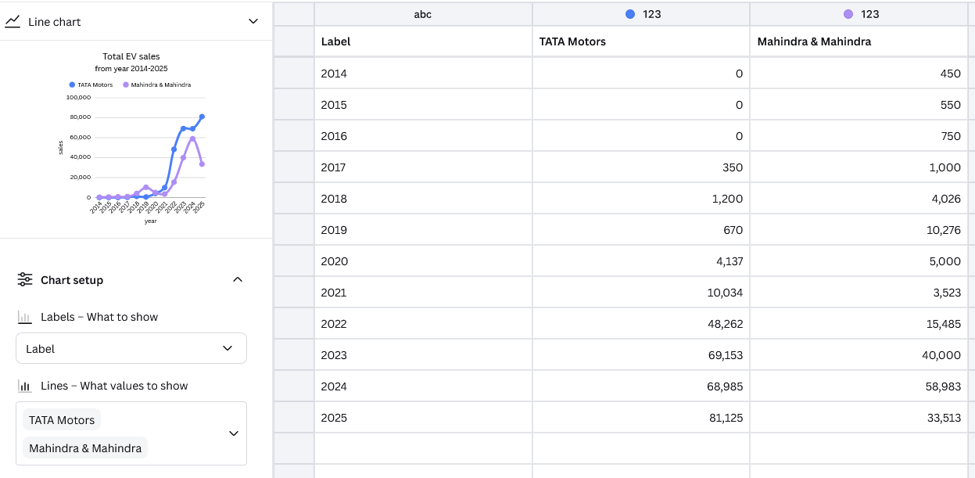
Note: This table represents the data of the two firms, Tata Motors and Mahindra & Mahindra, from 2014 to 2025. Each entry for the total sales of the two firms is an approximate value and may differ from the actual value by marginal units.
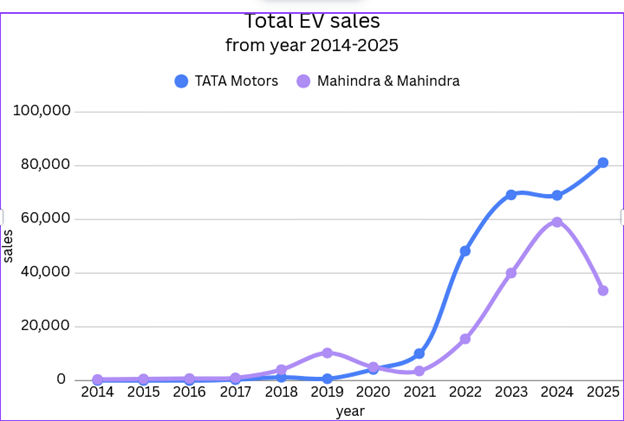
Note: This line chart is the representation of the data shown above for the two firms, Tata Motors and Mahindra & Mahindra, from 2014 to 2025.
In this chart, one can evidently see the following:
• Although Mahindra & Mahindra entered the EV industry before Tata Motors, by 2025 Tata Motors was the firm leading the EV industry.
• Both firms saw an increase in sales compared with 2014, when none of the three schemes chosen (FAME I, FAME II and PM E-DRIVE) was in force.
• Mahindra & Mahindra showed a downward-sloping trend in 2020, 2021 and 2025, whereas Tata Motors showed a downward-sloping trend in 2019 and 2024.
• For Tata Motors, the drop in EV sales could be attributed to the end of a scheme, since the firm faced a downward-sloping trend only in the years in which the schemes concluded.
• For Mahindra & Mahindra, the same cannot be concluded. The firm showed a very inconsistent rate of sales throughout the period from 2014 to 2025, although its EV sales had certainly increased compared with 2014.
This evaluation indicates that while Tata Motors appears to have benefited from all three schemes, the same cannot be said of Mahindra & Mahindra.
It also indicates that although government policies and schemes can help boost the EV industry in India, several other factors that influence a firm's share of the EV industry can outweigh the policies and schemes implemented to address the obstacles facing that industry.
The result suggests that while the three schemes (FAME I, FAME II and PM E-DRIVE) were effective enough to expand the EV market in India, they were not sufficiently funded and need to be implemented with stronger measures if the EV industry in India is to be supported on a larger scale. This can be seen from the total EV sales of the two firms from 2014 to 2025. While both firms saw an increase in total sales by 2025 compared with 2014, Tata Motors saw a decrease in its EV sales only when these schemes concluded, which suggests how significantly the schemes were supporting the EV industry in India. In the case of Mahindra & Mahindra, however, the evaluation shows inconsistent EV sales, which suggests insufficient funding of the schemes and less involvement in support of the EV industry in India. Here, the major difference between the sales growth of the two firms can be traced to the actions they took internally, since studies suggest that Tata Motors moved ahead in the EV industry through strategic collaboration, which differentiated it from its competitor Mahindra & Mahindra.
F. Stata Model Evaluation
Data on the budget utilised and the total EV sales of the two firms, Tata Motors and Mahindra & Mahindra, were collected individually for each year from 2014 to 2024. A relationship was then established between budget utilised and each firm separately, with the firm chosen as the dependent variable and budget utilised as the independent variable. The model chosen was a simple linear regression model.
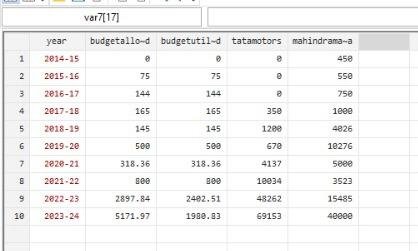
Note: This is the data for the budget utilised by all the policies and the total sales of EVs in each year for the two firms, collected from publicly available online government resources.
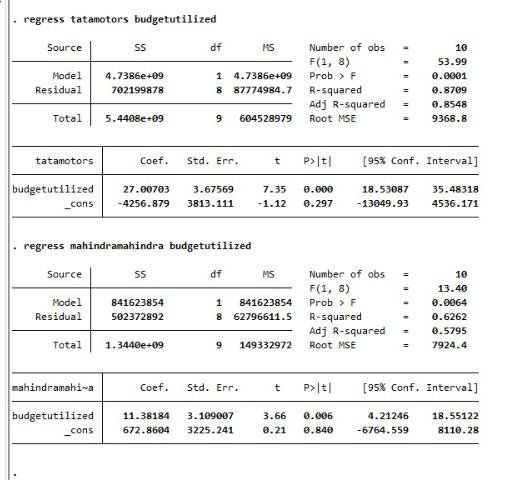
Note: This is the linear regression model, which used the firm as the dependent variable and budget utilisation as the independent variable.
i. Evaluation of the Model
A value of Prob > F below 0.05 indicates that the relationship established is real and not a matter of coincidence, which applies to both firms, as both have a Prob > F below 0.05.
R-squared is the explanatory power, indicating the percentage of the variation in the results explained by the independent variable. For Tata Motors, R-squared is 87 per cent, which means that 87 per cent of the year-on-year variation in the total sales of EVs for Tata Motors is explained by the budget utilisation of the policies. For Mahindra & Mahindra, R-squared is 62 per cent, which means that 62 per cent of the variation in the sales of its EVs is explained by the annual budget utilisation of the policies.
The coefficients state by how many units the performance metric of a firm is affected for every unit change in the budget utilisation of the policies. For Tata Motors, every unit change in the budget utilisation of the policies results in a 27 per cent change in the total sales of EVs for Tata Motors each year. For Mahindra & Mahindra, every unit change in budget utilisation brings about an 11 per cent change in the total sales of EVs each year.
This analysis of the model suggests that appropriate budget utilisation of the policies acts as a major decisive factor for Tata Motors, but that the same is not the case for Mahindra & Mahindra. It suggests that other external and internal factors can overpower the positive effects of government policy on the EV industry in India, given that the budget utilised is not adequate to overcome the limitations of inadequate infrastructure and the high price of EVs for consumers, which stand in the way of mass EV adoption in India.
Sustainability Perspective
The Government of India has emphasised its commitment to climate action through the five nectar elements announced at the Conference of the Parties (COP26). Studies report that BEVs consistently outperform ICE and hybrid electric vehicles in terms of life-cycle GHG emissions, and research has already warned against delaying BEV adoption in anticipation of a cleaner grid, since ICE vehicles bought today will remain on the roads for 10–15 years, emitting consistently (Kumar, 2025). This study shows that India has considerable scope for growth in the EV industry, which could bring about a large positive change in relation to climate change. Research suggests that the government sector must step in if EVs are to grow in India. The policies already implemented in India for EVs, however, are not funded adequately in relation to the needs of the industry. To support the EV industry further, several other major factors that influence a firm's growth need to be considered, since they too could influence the performance of a firm in the EV industry.
Conclusion
This study shows that government participation through policies and schemes can be found adequate to support the EV industry in India, as the evaluation shows that the industry has gained a much larger market share in recent years than it had in 2014. However, other major factors weaken the effectiveness of the government policies and schemes (FAME I, FAME II and PM E-DRIVE) in the electric vehicle industry and influence the sales volume and revenue generation of a firm.
The three schemes (PM E-DRIVE, FAME II and FAME I) worked well for both companies, as the rise in market share shows. The evaluation showed that the sales of Tata Motors dropped only in the years in which the schemes concluded, whereas Mahindra & Mahindra lost sales more frequently than Tata Motors, even though it had been the leader before any of the three schemes was introduced. This shows that while the three schemes proved adequate to increase overall sales in the subsequent years, they were not adequate to alter the problems that the EV industry faces in India, namely inadequate infrastructure and the high price of EVs.
The Stata analysis shows that several other factors overpower the direction of government policy in support of EVs where firms do not act individually through strategic collaboration. The budget utilised under the policies plays a vital role for the EV industry in India, as Stata shows a Prob > F value below 0.05 for both firms. The Government of India should therefore work next towards strengthening these policies and utilising the funds effectively, since the funds utilised so far remain low in relation to what the EV industry in India needs.
Limitations of the Study
This study is limited to the analysis of three government schemes only; further researchers can evaluate the broader impact of government policies and participation as an external factor in the EV industry. Another major limitation of this study is that the effect of the policies and schemes of the government was evaluated for two major firms only, which makes it too general a basis for a macro-level conclusion. Further, this study did not consider other factors that heavily affect the EV industry in India.
Acknowledgements
The author sincerely thanks Mr Prabhat Kumar, Decision Analyst Associate, ZS Associates, for help in the evaluation of data from archival sources.
Conflict of Interest Statement
The author declares no conflict of interest related to this research.
Ethics Statement
This study did not involve human participants, animal subjects or clinical experimentation.
Data Availability Statement
The data used in this study were collected from publicly available government reports, policy documents, research articles and secondary sources.
*****
- Aithal, P. S. (2025). Company analysis of Tata Motors Limited, India, with special reference to the electric vehicle (EV) segment. Poornaprajna International Journal of Teaching & Research Case Studies, 2(2), 146–191. https://doi.org/10.5281/zenodo.16976080
- Bhardwaj, M., Mishra, A., Rivera, K. M., & Julyanthry. (2023). Consumer perception towards eco-friendly products: A quantitative study. Journal of Informatics Education and Research, 3(2). https://doi.org/10.52783/jier.v3i2.79
- Chopra, P. (2025). Assessing the impact of the FAME-II policy on domestic electric vehicle manufacturing in India and its unintended economic consequences. IOSR Journal of Economics and Finance, 16(5), 49–53. https://www.iosrjournals.org/iosr-jef/papers/Vol16-Issue5/Ser-3/F1605034953.pdf
- Government of India, Ministry of Heavy Industries. (2022). Lok Sabha unstarred question no. 1177. https://sansad.in/getFile/loksabhaquestions/annex/182/AU1177_PAWMm0.pdf?source=pqals
- Hernández-Chea, R., Jain, A., Bocken, N. M. P., & Gurtoo, A. (2021). The business model in sustainability transitions: A conceptualization. Sustainability, 13(11), 5763. https://doi.org/10.3390/su13115763
- Hu, R., Wang, L., Zhang, W., & Bin, P. (2022). Founders' creativity, business model innovation, and business growth. Frontiers in Psychology, 13, 892716. https://doi.org/10.3389/fpsyg.2022.892716
- Karmakar, J., & Mukherjee, A. (2021). Electric vehicles in India: Policy implications, challenges, and cost savings. Indian Journal of Transport Management.
- Kohli, S. (2024, October). Charging infrastructure in India: Incentives under FAME II and considerations for PM E-DRIVE (Working Paper ID-239). International Council on Clean Transportation. https://theicct.org/wp-content/uploads/2024/10/ID-239-%E2%80%93-E-DRIVE-charging_final.pdf
- Kumar, V. (2025, June 6). Study reveals electric vehicles in India emit up to 38% less CO2 than petrol cars. Down To Earth. https://www.downtoearth.org.in/energy/study-reveals-electric-vehicles-in-india-emit-up-to-38-less-co-than-petrol-cars
- Lalita, & Asthana, S. (2025). Passenger car market and its leading automobile players in India (Tata Motors, Mahindra & Mahindra, and Maruti Suzuki). International Journal of Accounting and Economics Studies, 12(8), 408–416. https://doi.org/10.14419/qt3dan02
- Ministry of Heavy Industries. (2024). PM Electric Drive Revolution in Innovative Vehicle Enhancement (PM E-DRIVE) scheme. Government of India. https://pmedrive.heavyindustries.gov.in/
- Pathak, A., & Gangal, V. K. (2023). Advancements and challenges in electric vehicle adoption in India. Journal of Science & Technology, 4(4), 13–34. https://doi.org/10.55662/JST.2023.4402
- Poorani, G., & Banumathi, M. (2025). Deciphering sustainable product preferences: Insights from Indian consumer behavior. Nature Environment and Pollution Technology, 24(S1), 363–373. https://doi.org/10.46488/NEPT.2024.v24iS1.028
- Press Information Bureau. (2019, July 9). FAME India scheme. Government of India. https://www.pib.gov.in/PressReleasePage.aspx?PRID=1577880
- Press Information Bureau. (2022, February 3). India's stand at COP-26. Government of India. https://www.pib.gov.in/PressReleasePage.aspx?PRID=1795071
- Shandilya, S. S., & Sharma, S. K. (2025, October). Supply chain and logistics innovations in Mahindra & Mahindra and Tata Motors' EV segment. International Journal of Dynamic Educational Research Society, 6(3). https://www.researchgate.net/publication/396916649_Supply_Chain_and_Logistics_Innovations_in_Mahindra_Mahindra_and_Tata_Motors'_EV_Segment
- Suma, R., & Daniel, R. M. (2025). A study on FAME India (Faster Adoption and Manufacturing of Hybrid & Electric Vehicles in India): A big push towards PM's vision towards sustainable transportation and its impact on the stock market. Journal of Information Systems Engineering and Management, 10(42), 70–78. https://doi.org/10.52783/jisem.v10i42s.7855
- Swami, D., & Jaiswal, V. (2019, March). A step towards sustainable growth: Case study on Mahindra Electric Mobility. Review of Research, 8(6). https://oldror.lbp.world/UploadedData/10723.pdf