
AN ANALYSIS OF THE OBJECTIVES OF THE REVISED LABOUR LAW
The national legal system (from the Greek systema, meaning a unified whole composed of parts) reveals the interconnection of a state’s legal norms manifested through coordination, coherence, and functional interdependence as well as their distinctions, internal structure, organization, and essential characteristics. Legal space refers to the aggregate of legal phenomena and regulatory mechanisms operating within the territory of a particular state for the purpose of governing social relations. The foundation of the sphere of legal applicability is the national legal system.1 Within the national legal system, labour law like other branches of law has evolved through historical continuity and reform, progressively developing in its regulatory framework in response to the prevailing social order and socio-economic conditions of each period, and has thus reached its present level of refinement.
The proper formulation and legislative articulation of the objective of a law are of fundamental importance, as they “…express the substance of the law and reflect the means by which its implementation is ensured.”2 The proper definition and articulation of the regulatory objective is not merely a theoretical matter; it ensures that the substantive content of the law is appropriately determined and provides significant methodological guidance for the correct application of the law by the parties within its scope, both at the stage of its enactment and in its subsequent implementation.3 Furthermore, the nature and specific characteristics of labour relations regulated by the Labour Law constitute the principal factor in determining the appropriate legal method of regulation.4 Since such relations involve parties in an economically unequal position, the state, through legislation, seeks to establish a legally proportionate balance between them. Accordingly, the legally proportionate balance established by the Labour Law is reflected in the content of its specific provisions and regulatory mechanisms.5 In this regard, upon analyzing the objectives of the Labour Law adopted on 2 July 2021 and effective as of 1 January 2022, the Labour Law…
A. Purpose of this law6
| Objective (Labour Law) | To establish the principles and foundational norms governing labour relations | To define the fundamental rights and obligations of the parties participating in such relations | To ensure a proportionate balance between them7 | Civil Code (CC)8 |
|---|---|---|---|---|
| Placement of the Objective | “C” | “B” | “A” | (C1 + B1) |
| Method of Regulation | Imperative Dispositive | Imperative Dispositive | Imperative Dispositive | Imperative Dispositive |
| Total Number of Provisions | 929 provisions | 42 provisions | 1+19 provisions | – |
| Percentage of Provisions | 95.4% | 4.3% | 0.2% | – |
The interpretation of a statute does not encompass the law in its entirety; rather, it examines the meaning of specific textual provisions. The objective of interpretation is to achieve the purpose of a particular text within the framework of the legal system as a whole.10 If law, as an instrument of society, is inherently purposive, then each individual provision must also possess its own purpose within the system.
From this perspective, the 973 provisions of the revised Labour Law11 may be tabulated and classified in accordance with its stated objective and positioned according to the general method of regulation. Such an analytical approach allows the following construction. In order to implement “A” (to ensure a proportionate balance between the parties), “B” (to define the fundamental rights and obligations of the parties participating in such relations) and “C” (to establish the principles and foundational norms governing labour relations) are formulated as the normative means through which the stated objective is achieved.
Accordingly, the structure may be expressed as follows:
1. Objective of the Labour Law =A (A = B + C)12
2. A = (B + C) = (B1 + C1)13
3. Objective of the Labour Law = A + B + C14
In connection with the Civil Code represented here as (B1 + C1) and considering its systematic structure through its general parts, it becomes necessary to examine the manner in which civil law provisions operate within labour law relations.
| Part I | Part II | Part III | Part IV | Part V | Part VI |
|---|---|---|---|---|---|
| General Provisions | Obligations | Law of Contracts | Non-Contractual Obligations | Inheritance | Private International Law |
| CC Art. 369.3: Unless otherwise provided by law, the general provisions of this Code shall apply to employment contracts. | General grounds of obligations | CC Art. 369.1: A citizen may work on the basis of an employment contract concluded with another citizen or a legal entity. | CC Article 498 | No specific provision | No specific provision |
From this, it may be observed that the Civil Code is legislatively recognized as applicable to relations arising in connection with employment, thereby allowing it to regulate labour law relations in accordance with its general provisions. Given that the objective of a statute serves as a guiding framework for the legal relations within a particular branch of law, it becomes methodologically untenable to characterize activities that fall outside the stated objective without first determining their proper legal qualification.15 In the process of applying the law, attention is often directed toward clarifying and favoring what “exists” within the text, rather than what “ought to exist”; consequently, a distinction has already been established between the evaluative dimensions of theory and practice as operating within different conceptual spaces.16 Civil law becomes the “general law” insofar as, in determining the types and characteristics of proprietary rights and rights of claim exercised in the course of everyday life, it defines their distinctions through the content of the subjective rights vested in the aggrieved party and the preconditions required for the enforcement of infringed rights17 as noted by the scholars.
The Civil Code referred to as the general law and the norms of civil law are structured through a method that relies predominantly on abstraction and generalization. Accordingly, the Civil Code proceeds “from the general to the particular,” placing general norms in its initial part in order to avoid repetitive restatement of rules applicable to each specific legal relationship. In doing so, it employs a structural technique comparable to the bracket method used in mathematics, whereby general provisions are set out at the outset and subsequently apply across the specialized parts of the Code. This technique does not operate solely within the special sections of the Civil Code such as the law of obligations, property law, and inheritance law but extends to function as the foundational regulatory framework of private law as a whole18 аccordingly, based on the proposition that A = B + C, when examined from this perspective19 although, from a literal reading, the Civil Code appears to apply directly only to this specific provision, it may nevertheless be understood as applicable by rule to employment relations more broadly. In other words, when considering the operation of the Civil Code within the sphere of labour law, its applicability to employment relations is discernible through its general principles and the contractual nature of obligations. Conversely, from the perspective of the Labour Law, the application of the Civil Code appears to be limited to specific instances and, at times, marked by a degree of indeterminacy. This reflects the fact that the national legal system comprising branches of law, legal institutions, chapters, articles, and provisions functions as an interconnected and sequential structure. According to Ronald Dworkin, legislation forms a coherent whole, comparable to a chain novel in which each chapter is connected to the next, creating an integrated and unified narrative. Accordingly, legal interpretation entails situating a given norm within this systemic chain, clarifying its ambiguous meaning, and affirming its coherence within the unified structure. Even where the interrelation of a particular norm is uncertain or indeterminate, the judge interprets it in light of the underlying nature and substantive content of the legal system as a whole20 This may be understood as reflecting the essence of a systematic interpretation. In a market-based economy, among the various forms of labour relations that arise and operate within society, the Labour Law serves as the foundational statute regulating wage labour relations in their entirety, while governing only certain aspects of other types of labour relations, such as public service employment. 21 this indicates not only that the Labour Law constitutes the primary statute regulating employment relations in Mongolia, but also clarifies the scope of its application. Some scholars have classified labour law within the framework of “mixed law.”22 Within the framework of the constituent elements of the national legal system, substantive law may be classified as private law, public law, or mixed law23 has so classified it.24 Furthermore, within the structure of the Romano-Germanic civil law tradition, substantive law is classified into private law, public law, and mixed law (including labour law). Labour law is regarded as belonging to the category of mixed law, insofar as it encompasses relations that are intertwined with private law relations.25
Furthermore,26 …Such viewpoints cannot be dismissed. In other words, the issue under consideration should be approached in accordance with the theoretical principles of legal families, and labour law should be regarded as constituting mixed law. Going forward, it is important to examine more broadly the place and function of mixed law within the legal system.27 The researcher concurs with this view. Private law, in turn, is internally structured into a general28 and is divided into special29 branches of private law. Within this classification, labour law is included as a special branch of private law. The principal criterion for categorizing a field as a special branch of private law lies in its connection to a distinct professional or social sector, possessing its own specific characteristics and structural complexity, thereby necessitating specialized regulation. The relationship between civil law and the special branches of private law is characterized by the distinction between general and special regulation. Civil law applies to particular areas of social relations governed by private law in instances where no specific rules are established within the relevant special branch.30 The fundamental criteria (grounds) for dividing law into branches must also be taken into account. Three principal approaches are generally identified in classifying the legal system: (a) primary and derivative (natural law and positive law); (b) public and private law; (c) the most widely accepted traditional criterion for dividing law into branches classification according to the subject matter of regulation and the method of legal regulation. In this context, the characterization of labour law as “mixed law” may be understood from the fact that employment relations, as regulated by the relevant legislation, exist systemically within both private and public law.31 The substance of the relevant relations determines their legal form; conversely, it would be methodologically unsound to determine the substance solely on the basis of form. Furthermore, if the objective of the Labour Law of Mongolia is examined through the tripartite model of the mixed theory of labour law,
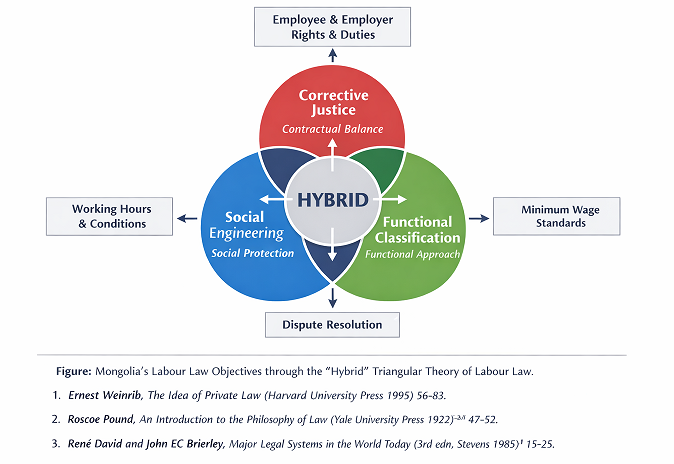
The classical model of private law, legal autonomy, and the theory of corrective justice32 From this perspective, the contract is defined as the fundamental form of legal relations between autonomous subjects. In contemporary private law philosophy, the theory of corrective justice further elaborates this autonomy-based model. According to Ernest J. Weinrib, private law relations possess a bilateral structure of justice between the parties, in which duties and liabilities are characterized by a reciprocal and correlational balance.33 Under this theory, contract law is not conceived as an instrument of social policy, but rather as an institution aimed at restoring the juridical equilibrium between the parties. The philosophical foundation of corrective justice is found in Aristotle’s Nicomachean Ethics, where justice is distinguished into distributive and corrective forms, and corrective justice is defined as the principle of rectifying a loss arising between two parties through an arithmetic equalization.34
This bilateral and equalizing character has evolved in contemporary private law philosophy into the normative logic underlying contract law. Accordingly, within the framework of the classical model of private law, an employment contract may be understood as a type of ordinary civil law contract. However, given the existence of real imbalances of power within labour relations, this theory cannot be applied without modification, and it may therefore be argued that labour law has been required to incorporate elements of social protection into its regulatory structure.
Furthermore, it has been defined as “an engineering activity aimed at regulating social interests with minimal conflict and maximum efficiency.”35 In his theory, society encompasses multiple categories of interests individual, public, and social interests which may potentially come into conflict with one another. Law, in this view, functions as a mechanism for appropriately “engineering” and balancing these competing interests. Roscoe Pound referred to this approach as social engineering.36
Roscoe Pound’s theory is directly connected to the development of labour law. Within labour relations, multiple interests intersect: the economic dominance of the employer, the relative vulnerability of the employee, and the broader requirement of social stability. According to Pound’s logical formulation, labour law does not merely mechanistically enforce the consequences of free market contracts; rather, it operates as an institutional form of social engineering designed to protect social interests and to balance them through structured legal mechanisms. Accordingly, labour law cannot be confined within the corrective justice model; instead, it develops as a mixed system incorporating distributive and social protection functions, thereby serving as an instrument of social policy. René David, in classifying legal systems, argued that they should be categorized not by formal characteristics but by the functions they perform within society. In his theory of comparative law, legal systems evolve in connection with historical, cultural, and social conditions, and the classification of branches is determined less by rigid logical structures than by social purposes. A single branch of law may therefore combine multiple regulatory methods. David’s functional approach thus requires that branches of law be understood not in “pure” doctrinal isolation, but in light of their concrete social functions.37
From this, at the theoretical level, labour law cannot be understood merely as a branch of private law grounded in the formal logic of contract; rather, it is characterized as a multidimensional institutional system oriented toward social protection and regulatory objectives. According to Ernest J. Weinrib’s theory of corrective justice, the employment contract creates a bilateral legal relationship structured around the restoration of juridical balance between the parties. In contrast, Roscoe Pound’s approach of social engineering conceives law as limiting free market contracting in order to protect social interests at an institutional level. René David’s functional method, in turn, allows branches of law to be classified not by rigid doctrinal formalism, but by the social purposes and functions they perform. Accordingly, the Labour Law of Mongolia may be theoretically characterized as a mixed normative system one grounded in autonomy, yet constrained by social protection, and functionally situated in an intermediate position between private and public law.38
In the case of Mongolia, the position of labour law within the constituent structure of the national legal system may be defined and examined through the following three models,
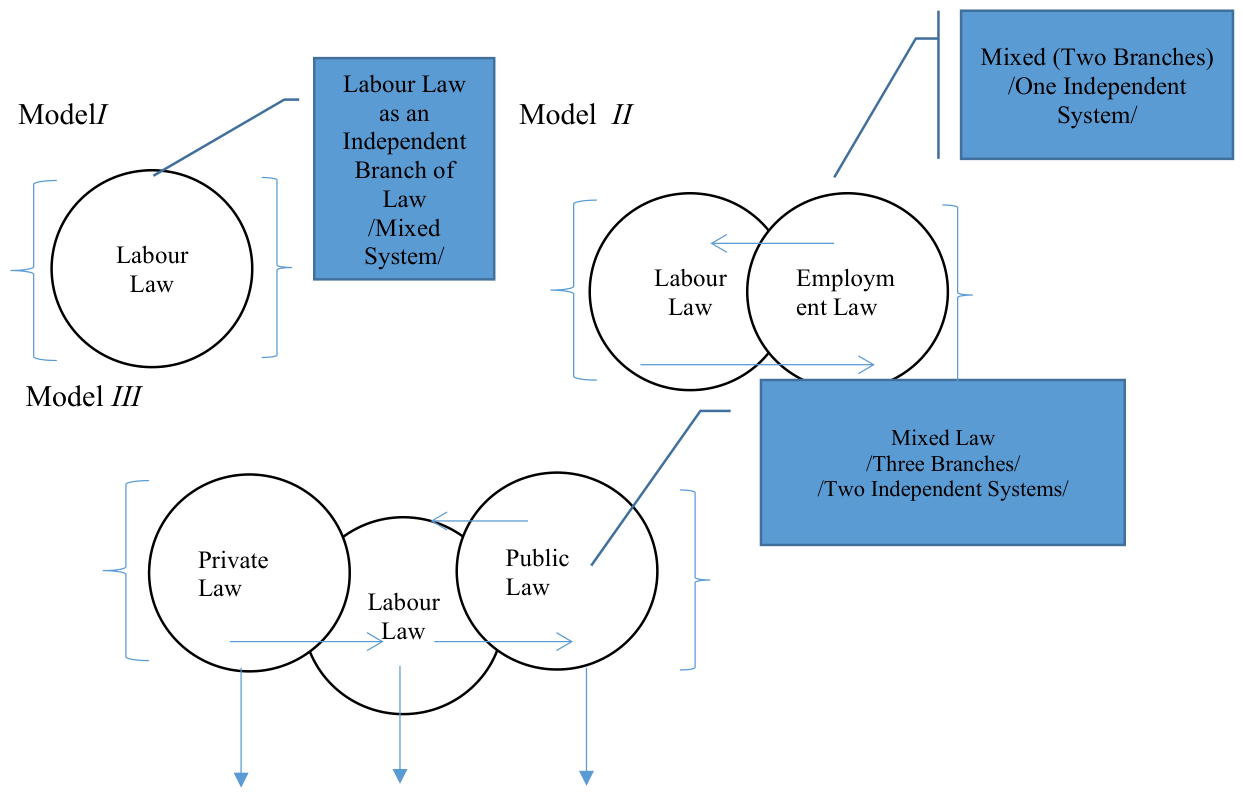
Civil Law abour Law39 Law on Civil Service 40
Professor Alon Harel of Hebrew University of Jerusalem, in addressing the distinction between public and private law, examines41 is determined by reference to the parties participating in the legal relationship and the substantive nature of that relationship.
Public law is founded upon relationships of authority and subordination, thereby producing unilateral regulation, whereas private law, grounded in the primacy of individual autonomy and freedom, emphasizes dispositive norms, which operate only insofar as the parties have not agreed otherwise.42 From this, labour law may be characterized as a relatively autonomous form of “mixed law,” functionally connected to two independent legal systems. The “Scope of Application” sections of both the Labour Law and the Law on Civil Service expressly define the applicability of related legislation. This legislative clarification not only provides a degree of certainty in the application of labour legislation, but also reinforces the systematic position of labour law within the broader legal43may be understood as establishing the possibility of applying labour legislation in accordance with the prescribed legal framework.
CERTAIN ISSUES CONCERNING THE APPLICATION OF LEGISLATION (LABOUR LAW)
“…in adopting a new perspective and approach toward the legal system, it is appropriate to rely upon the doctrine of public and private law.”44 This reflects the fact that, within the national legal system, labour law exists in a “mixed” form, being related to both public and private law; accordingly, further examination of the application of labour legislation from this perspective grounded in legal tradition, philosophy, theory, and legal reasoning cannot be denied as possessing both theoretical and practical significance in establishing coherent and unified application.
With respect to the theory and methodology of applying legislation, it is appropriate to note that scholars have advanced various approaches. In particular, the coexistence of general normative provisions and specific detailed norms within a statute, the interrelationship of their regulatory structures, and their interaction with other legislation often create complexity in the practical application of the law.45 Accordingly, in resolving specific disputes, the interpretation of law creates the conditions for its uniform understanding and application an issue that must likewise be considered in the application of labour legislation. A significant portion of the laws currently in force, particularly their core provisions, are related to private law and civil law, regulating proprietary and non-proprietary relations arising between parties in a position of formal equality. The substantive meaning of these laws, which function as regulators of social relations, may necessitate interpretation due to ambiguities in wording, potential dual meanings, excessive generality, or the interaction between broadly framed statutes and more detailed regulatory acts. Through such interpretation, the foundation for correct application is established. Since this process emerges in the course of applying the law, application and interpretation are interconnected concepts. The interpretation of law is thus linked to the necessity of application and, at the same time, is grounded in established concepts, doctrinal understandings, and what may be termed the “customary” logic of legal theory; accordingly, the act of interpreting constitutes legal interpretation in the proper sense.46 Moreover, norms developed at a high level of abstraction and generalization specifically, those systematized through theoretical concepts and formulated at a certain degree of abstraction are often not directly applicable to the resolution of concrete disputes; this constitutes a common characteristic of norms within the continental legal system47 accordingly, interpretation is regarded as essential in the application of law, and Friedrich Carl von Savigny48 maintained that the distinctive nature of interpretation becomes comprehensible only when it is analyzed through its constituent elements. Furthermore, with respect to this issue, scholars and researchers have49 although statutes are enacted by Parliament, they are applied by judges. At first glance, it may appear that judges merely need to rely on the statutory provisions and render a decision accordingly. In reality, however, the matter is far more complex. While the legislator may draft each word of a statute with great precision and care, courts frequently encounter uncertainty as to how the law should be applied to a particular case. Such indeterminacy arises for various reasons50, Furthermore, interpretation must be conducted in accordance with the purpose and objectives of the law. In doing so, due regard must be given to the distinctive and general characteristics of the legal system. Since private law, in protecting individual interests, places particular emphasis on maintaining a balanced relationship between them, statutory interpretation may appropriately be guided by this consideration.51
In Mongolia, although the objective of the Labour Law the foundational statute regulating employment relations may be formulated as (A = B + C), the components (B + C), in accordance with the above model, are expressed through the rights and obligations of the parties (employer and employee) and are articulated in norms that proceed from the general to the specific52 must be structured in conformity with the relevant legislation in order for (A) that is, the objective of the Labour Law to be fulfilled. In particular, the rights and obligations of the employer and the employee,

In other words, the non-overlapping and specific character of the parties’ rights and obligations is manifested through the internal labour regulations applicable within the respective organization, including those mandated by the Labour Law as well as those not expressly prescribed but adopted within its framework.
With regard to the theory and methodology of interpreting and applying the law,53 First, with respect to the theoretical issues of legal interpretation, it is argued that the macro- and micro-level political policies underlying the norm to be applied constitute the primary foundation for interpreting the law. (a) Law is the product of social consensus; therefore, it must not be interpreted in a manner contrary to generally accepted values. (b) Interpretation must be grounded in the hierarchy of legal sources, determining meaning and content in accordance with their place within that hierarchy (cf. Constitution, Article 3). (c) Due regard to the characteristics of the relevant legal family is likewise considered a guiding principle in interpreting and applying legal norms. Second, regarding the methods of interpreting legal norms, not every norm is accompanied by an explicit theory or principle of interpretation. In such cases, recourse is made to other interpretative methods, among which linguistic (textual) interpretation is regarded as the most commonly employed. From this, it becomes evident that the application of law is inseparably linked to the theory and methodology of interpretation. In light of the specific characteristics of labour law relations, correctly interpreting and conveying the essential content and underlying rationale of the foundational norm the objective of the Labour Law is of both theoretical and practical significance. Moreover, social relations are multifaceted and complex, akin to a puzzle; it is neither feasible to tailor legislation to every conceivable circumstance nor to regulate all matters exhaustively by statute. The Anglo-American legal tradition acknowledges this reality and fills such normative gaps through the institution of Common Law comprising precedent, custom, and general legal principles. Furthermore, because the legislator cannot reduce every social phenomenon and relationship into discrete normative provisions, various legislative techniques are employed such as the use of composite terminology, general clauses, categorization, reference, and analogy to broaden the regulatory capacity and scope of the law. It is through interpretation, grounded in established methods and doctrine, that the law-applying authority elucidates these techniques in concrete cases. Since law is not a flawless instrument, the purpose of legal interpretation also lies in mitigating its imperfections and ensuring its coherent and just application.54
In order to realize the objectives and strategic goals of a particular organization, the rights and obligations of the employer and the employee must be reflected in relevant norms in a manner that proceeds from general principles to specific rules; this process is inseparably connected with the organization’s policies and human resource management practices.
In practice, it is common for the rights and obligations set forth in the Labour Law to be merely reproduced in internal labour regulations (for example, internal rules of procedure) and in employment contracts, or for standardized employment contracts with identical content and structure to be concluded with all employees of an organization. In other words, the Labour Law establishes the foundational norms governing work-related activities, whereas internal labour regulations allow organizations greater legal latitude to formulate and implement rules tailored to their specific activities, operational scope, and institutional characteristics. Furthermore, employment contracts and job descriptions concluded between the parties should derive from the organization’s mission and long-term objectives. When their structure and content are clearly defined, each employee’s duties can be formulated with relative precision and without overlap, thereby enhancing productivity for the employer while enabling employees to assume defined responsibilities and accountability. Beyond the detailed specification of rights and obligations, it is also appropriate for organizations, through internal labour regulations, to clarify processes related to work performance and to regulate labour and social protection matters in a manner that effectively safeguards employees’ rights and legitimate interests. Such regulatory refinement creates the conditions necessary for ensuring a proportionate balance between the parties. It should be recognized that such balance cannot be fully achieved solely through the general formulations contained in the Labour Law. In this regard, some scholars have observed that “the law is not applied exclusively by courts; it is also applied by other state bodies, officials, and private persons when making decisions.” At the same time, the use of legal norms by participants in legal relations constitutes the exercise of their subjective rights; the fulfillment of obligations imposed by legislation represents compliance with and execution of legal norms; and refraining from conduct prohibited by law constitutes observance of the law55 has likewise provided a definition concerning the subject responsible for applying the law.
Scholars approach the application of legislation and the subjects of law application in both broad and narrow senses.
CONCLUSION AND RECOMMENDATIONS
1. Defining labour law as a “mixed legal system” does not concern the overall classification of the national legal order, but rather relates to the regulatory methodology of the particular branch.
2. Mongolian labour law combines, at a structural level, the contract-based logic of private law with the protective imperative intervention characteristic of public law; thus, it cannot be regarded as purely private or purely public law, but rather as possessing a mixed regulatory character. In other words, from the perspective of the national legal system, an analysis of the objective of the Labour Law supports the view that labour law may appropriately be characterized as a relatively autonomous form of “mixed law” functionally connected to two independent systems.
3. Imperative norms operate to restrict contractual freedom in order to secure substantive balance between the parties.
4. The application of labour legislation reflects a protective orientation that goes beyond formal equality.
5. The characterization of labour law as “mixed law” is evidenced not only by the fact that employment relations regulated by relevant legislation exist within both private and public law, but also by the regulatory structure of the Labour Law itself, which expresses a mixed regulatory approach. In this context, it is the substance of the legal relationship that determines its form, rather than the form determining its substance.
6. Clarifying the structure of the labour law system has theoretical, methodological, and practical significance for examining the application of labour legislation from a comparative perspective and for developing a coherent analytical model.
7. From the standpoint of a “mixed law” system, further research into the application of labour legislation should address constitutional concepts and formulations, legal traditions, legal families, and legal systems, as well as issues of legal philosophy, doctrinal theory, legal reasoning, interpretative techniques, and the role of the subjects applying the law.
8. A comprehensive analysis of relevant judicial decisions rendered under the Labour Law in practice would constitute an important component in examining the application of labour legislation from a theoretical standpoint.
*****
Footnotes
1. Ch. Nyamsuren, General Theory of Law, Ulaanbaatar, 2017, p. 249.
2. D. Bayarsaikhan, Theory of Law, Ulaanbaatar, 2018, p. 43.
3. B. Urantsetseg, “The Need to Renew the Labour Law and Its Fundamental Amendments,” Rule of Law Journal (2021), p. 11.
4. B. Urantsetseg, “Norms Established and Applicable within Enterprises and Organizations (Internal Regulations) and Judicial Practice in Their Application in the Resolution of Labour Disputes,” Judicial Authority No. 4 (2017), p. 46.
5. ibid.,
6. Labour Law (2022), Article 1.1: “The purpose of this Law is to establish the principles and foundational norms of labour relations, to define the fundamental rights and obligations of the parties participating in such relations, and to ensure a proportionate balance between them,” available at www.legalinfo.mn, pursuant to which the relevant provisions of the Law have been tabulated and arranged according to the method of regulation.
7. B. Urantsetseg, “Norms Established and Applicable within Enterprises and Organizations (Internal Regulations) and Judicial Practice in Their Application in the Resolution of Labour Disputes,” Judicial Authority No. 4 (2017), p. 46.
8. Civil Code (2002), Articles 369.1-369.3: “A citizen may work on the basis of an employment contract concluded with another citizen or a legal entity. The conditions and procedures for concluding an employment contract shall be determined by law. Unless otherwise provided by law, the general provisions of this Code shall apply to employment contracts.” In connection with Parts I–VI of the Civil Code, the relevant provisions include references by frequency of occurrence to: work and services (14 instances; Part II – 3, Part III – 9, Part IV – 2); labour (42); employment contract (11); salary (10); remuneration (5); employer (5); employee (3); object of ownership (48); tangible property (4); things (41); property (302); damage (41); harm (187); and termination of contract (37). These terms are codified throughout the legislation in the above-mentioned frequencies.
9. /Labour Law (2022), Article 43.3: “The employer shall support the work life balance of employees by regulating working and rest time, applying flexible working arrangements, and shall implement child-friendly and child protection policies by incorporating such measures into collective agreements and internal labour regulations.”
10. A. Barak, Purposive Interpretation of Law (Continuation), trans. T. Naranbat, Ulaanbaatar, Judicial Authority, 2017, p. 73.
11. Labour Law (2022), comprising 13 Chapters and 166 Articles.
12. This formulation constitutes the objective of the Labour Law.
13. This formulation may reflect the combined framework of the Labour Law and the Civil Code.
14. From the researcher’s perspective, this formulation does not constitute the objective of the Labour Law.
15. J. Naranpurev, “An Analysis of the Objective of Law,” in Contemporary Issues in Comparative Law Theory and Practice(Proceedings of the International Academic Conference), Ulaanbaatar, 2007, p. 35.
16. Ibid
17. Ibid., p. 28.
18. Ibid., p. 30.
19. Labour Law (2022): the term “services” appears 8 times; “labour” 706 times; “employment” 107 times; “employment contract” 134 times; “salary” 147 times; “remuneration” 118 times; “object of ownership” once; “tangible property” 6 times; “things” 0 times; “property” 12 times; “damage” 10 times; “harm” 2 times; and “termination of contract” 4 times, as codified in the Law. Furthermore, Article 71.2 of the Labour Law provides: “A ‘assistant herder’ shall mean a person who resides with a principal herder and, under his or her direction and supervision, performs herding and other livestock-related work on the basis of mutual agreement for remuneration. Relations arising from independently herding another’s livestock for payment shall be regulated by the Civil Code.” From a literal interpretation, the Civil Code appears to apply directly only to this specific category of relations.
20. N. Lündendorj, “Theory and Methodology of Interpreting and Applying Law,” Judicial Authority Journal, No. 1 (2015), p. 7.
21. B. Urantsetseg, “The Need to Renew the Labour Law and Its Fundamental Amendments,” Rule of Law Journal, 2021, p. 24.
22. Christopher Osakwe, Comparative Law, Ulaanbaatar, 2005, p. 41. (Other theoretical scholars have likewise classified it as belonging to mixed law.)
23. Christopher Osakwe, Comparative Law, Ulaanbaatar, 2005, p. 24 (labour law is classified as belonging to mixed law).
24. Ibid., p. 23.
25. G. Amarjargalan, Defining the Structure of Rights and Obligations in Private Law from the Perspective of Comparative Law, doctoral dissertation, Shihihutug University, 2021.
26. Doctor B. Urantsetseg, Ts. Sarantuyaa, and T. Sengedörj, among others, have regarded labour law as an independent branch of law (Legal Terminology Dictionary, 2003; Theory and History of Mongolian State and Law, 2006), whereas certain civil law scholars tend to consider it an institute of civil law, arguing that the matter is regulated pursuant to Chapter 33, specifically Article 369, of the Civil Code (cited indirectly).
27. L. Baasan, “Certain Prioritized Issues in the Regulation of Labour Relations in Mongolia,” in Contemporary Issues in Comparative Law Theory and Practice (Proceedings of the International Academic Conference), Ulaanbaatar, 2007, p. 56.
28. Ts. Davkharbayar & D. Yanjinkhorloo, Theory and Methodology of Interpreting and Applying Civil Law Norms in Commercial (Trade) Relations (training manual), Ulaanbaatar, 2020, p. 25: “Civil law belongs to the general part of private law and regulates the most important and common relations between private individuals through the Civil Code and its derivative statutes, such as the Law on Family, the Law on the Legal Status of Homeowners’ Associations and Common Ownership in Apartment Buildings, laws regulating consumer credit, and other related legislation.”
29. Special branches of private law include commercial law (not yet enacted in Mongolia), company law, securities law, competition law, legal protection of entrepreneurs, copyright law, private insurance law, and labour law, among others.
30. Ts. Davkharbayar & D. Yanjinkhorloo, Theory and Methodology of Interpreting and Applying Civil Law Norms in Commercial (Trade) Relations (training manual), 2020, p. 26.
31. Ibid., p. 253.
32. Karl von Savigny, System des heutigen römischen Rechts, vol. I (Veit, 1840), pp. 331-345.
33. Ernest J. Weinrib, The Idea of Private Law (Harvard University Press, 1995), pp. 56-83.
34. Aristotle, Nicomachean Ethics, Book V, trans. W. D. Ross (Oxford University Press, 2009), 1131a-1132b.
35. Roscoe Pound, An Introduction to the Philosophy of Law (Yale University Press, 1922), pp. 47-52.
36. Roscoe Pound, “The Scope and Purpose of Sociological Jurisprudence” (1911) 24 Harvard Law Review 591, 609-611.
37. René David and John E. C. Brierley, Major Legal Systems in the World Today: An Introduction to the Comparative Study of Law (3rd edn, Stevens & Sons, 1985), pp. 15-25.
38. Ernest Weinrib, The Idea of Private Law (Harvard University Press 1995) 56–83; Roscoe Pound, An Introduction to the Philosophy of Law (Yale University Press 1922) 47-52; René David and John EC Brierley, Major Legal Systems in the World Today (3rd edn, Stevens 1985) 15-25.
39. Labour Law (2022), Article 3.4: “Labour relations of civil servants that are not specifically regulated by the Law on Civil Service and other relevant legislation shall be governed by this Law.”
40. Law on Civil Service (2017), Article 4.3: “The legal status of a civil servant holding a service position shall be determined by the Labour Law, this Law, and other relevant legislative acts.” Article 4.4: “Other matters relating to the labour relations of civil servants that are not regulated by this Law shall be governed by the Labour Law and other applicable legislation.” Article 41.3: “Other issues relating to the labour relations of civil servants that are not regulated by this Law shall be regulated in detail by the Labour Law.”
41. Alon Harel.Public and Private law. The Oxford handbook of Criminal Law. Ed Markus D.Dubber and Tatjana Hornle. 2014. p.1042
42. B. Buyankhishig, Introduction to Civil Law, Ulaanbaatar, 2012, p. 39.
43. Yo. Bolormaa, “Labour Legislation and Certain Issues of the Right to Work,” Rule of Law, No. 4 (2018), p. 89.
44. B. Chimid, “The Correlation and Characteristics of Certain Concepts Concerning Subjects of Public Law,” in Concept of the Constitution-1, 2004, p. 314.
45. Ts. Davkharbayar & D. Yanjinkhorloo, Theory and Methodology of Interpreting and Applying Civil Law Norms in Commercial (Trade) Relations (training manual), Ulaanbaatar, 2020, p. 10.
46. Klaus Adomeit, Theory of Law, 2017, p. 11 (cited indirectly).
47. B. Amarsanaa, Comparative Law, 2014, p. 88.
48. Klaus Adomeit, referring to Friedrich Carl von Savigny’s System des heutigen römischen Rechts (1840), provides a detailed discussion on interpretation in Theory of Law, 2017, p. 59 (cited indirectly).
49. O. Amarkhüü, Theory of Law, Ulaanbaatar, 2018, p. 249 (“The application of law is not an act carried out at someone’s discretion, but a complex process conducted in accordance with procedures and forms defined by law and other legal acts.”); D. Bayarsaikhan, Theory of Law, Ulaanbaatar, 2010, p. 246 (“A legal process directed toward clearly determining and establishing the provisions and principles of legal norms by an authorized subject empowered by law such as a judge or official.”); D. Lündeejantsan, Legislative Activity and Legal Technique, Ulaanbaatar, 2016, p. 148 (“The application of law constitutes one of the key issues of legal theory. As a distinct form within the process of implementing law, it involves the creation of a legal fact namely, an act directed at the establishment, modification, or termination of a legal relationship followed by its evaluation and analysis, the selection of applicable legal norms, and the issuance of an act applying the law.”); S. Narangerel, Encyclopedic Dictionary of Law, Ulaanbaatar, 2008, p. 534 (“The practice of applying law refers to the generally recognized legally significant conduct of courts or other law-enforcement bodies formed in the course of interpreting legal norms or eliminating their gaps and ambiguities.”); P. Bayanbaatar & B. Ganpürev, “Theoretical Foundations of Law Application and the Obsolescence of Legal Positivism” (“The application of law is an activity directed toward rendering a legal decision in order to resolve a specific legal issue, guided by the provisions and principles of legal norms conferred by law.”); A. K. Romanov, The Law and Legal System of Great Britain, trans. Ch. Davaadash, Ulaanbaatar, pp. 252-254 (In Russian legal scholarship, the application of law is understood as the interpretation of law, whereas within the British legal system the term ‘application of law’ is interpreted in relation to the subject exercising the function of applying the law).
50. A. K. Romanov, The Law and Legal System of Great Britain, trans. Ch. Davaadash, Ulaanbaatar, 2016, pp. 252-254.
51. Ibid., p. 37.
52. Labour Law (2022), Article 2.3: “Acts establishing labour law norms shall apply in the following order of hierarchy, except as provided in Article 2.5 of this Law: 2.3.1. this Law; 2.3.2. other laws of Mongolia; 2.3.3. administrative normative acts; 2.3.4. sectoral and inter-sectoral collective agreements; 2.3.5. collective agreements; 2.3.6. employment contracts; 2.3.7. internal labour regulations of enterprises and organizations. Article 2.4: Collective agreements, collective bargaining agreements, employment contracts, and internal labour regulations that are consistent with labour legislation shall be binding upon the relevant parties. Article 2.5: In the event of a conflict between acts establishing labour law norms as referred to in Article 2.3 of this Law, the provision granting more favourable conditions to the employee shall apply.”
53. N. Lündendorj, “Theory and Methodology of Interpreting and Applying Law,” Judicial Authority, 2015, p. 17.
54. Ibid.
55. D. Lündeejantsan, Legislative Activity and Legal Technique, Ulaanbaatar, 2016, p. 148.