
INTRODUCTION
A constitution is a “set of laws and rules setting up the machinery of the government of a state and which defines and determines the relations between the different institutions and areas of Government, the executive, the legislature and the judiciary, the central, the regional and the local governments.”1 According to the words of Jefferson, one of the makers of the Constitution of United States had stated: “Some men look at constitutions with sanctimonious reverence and deem them like the art of the covenant too sacred to be touched. They ascribe to the men of the preceding age a wisdom more than human and suppose what they did to be beyond amendment laws and institutions must go hand in hand with the progress of human mind as new discoveries are made, new truths discovered and manners and opinions change with the change of circumstances, institutions must advance also and keep pace with the times.” There are three types of constitutional amendments can be done based on the category of constitutional provisions that is by the method of simple majority, special majority and the special majority with the ratification of the states.
WHICH ARTICLES CAN BE AMENDED
Since the commencement of the Constitution in 1950 as many as 92 constitutional amendments have been affected under article 368 alone. This has been done in exercise of the parliament’s constituent powers where any provisions in the constitution of India can be amended where the supreme court has made it clear that “Article 368 does not enable parliament to alter the basic structure or framework of the constitution.”2 and also specifies the basic structure. “The Fundamental Rights form the part of basic structure of the Constitution and therefore, they may be abridged by constitutional amendment but they cannot be abrogated or destroyed.”3 The 130th constitutional Amendment bill of India primarily involves amendment to articles 75, 164, 239AA of the Indian Constitution where the major question is whether the amendment can lead to the violation of the basic structure.
HISTORICAL CONTEXT
When the Constitution was framed, “it’s architects could not have imagined that in the future, there would be political figures who would refuse on moral grounds before being arrested. In recent years, an astonishing situation has arisen in the country where Chief Ministers or Ministers have unethically run the government from jail without resigning”.4 The amendment of the bill where Prime Minister, Chief Ministers, and other Ministers who are arrested and kept in custody for more than thirty days continuously was being taken into consideration as several elected leaders continued in office even after being under serious criminal charges. The purpose of this bill is to “elevate the declining standards of morality in public life and bring integrity to politics where in the recent years an astonishing situation has arisen in the country where Chief Ministers or Ministers have unethically run the government from jail without resigning.”5
The reason behind the amendment is to maintain the integrity and moral standards in government where the government in the ruling argues that the character and conduct of the minister is the most essential where it undermines the public trust and also states that the elected representatives hold the trust of the people where they need to be honest, accountable.
ASSESSING THE CRIMINAL PROFILES OF POLITICAL CANDIDATES IN RECENT ELECTIONS
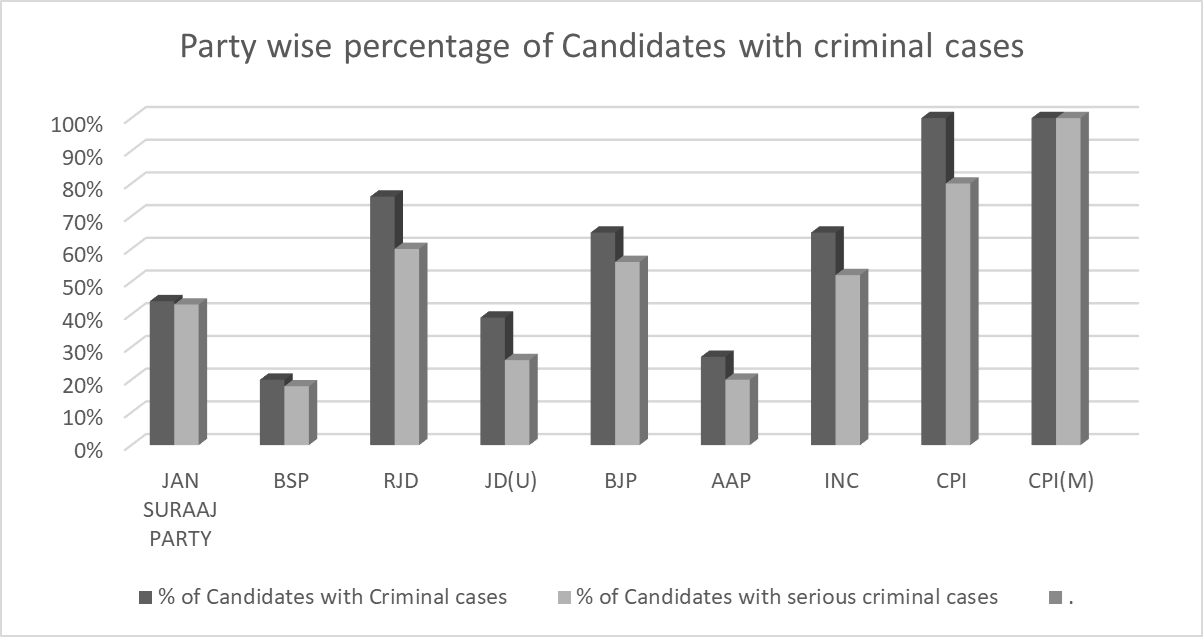
• The information related to the Candidates of the Recent Assembly Election being Conducted which the total candidates of 121 constituencies in the Phase I where a total of 1303 candidates were being analysed out of them 432 candidates have declared criminal cases against themselves which is of a total of 32% of the criminal cases.
• Where the criminal cases which includes the serious Criminal cases of 354 have been declared serious criminal cases against themselves which makes a total of 27% of the cases.
• The cases related to murder and the attempt to murder together constitute to 119 candidates under section 103(1) and section 109 of BNS.6
The information which was being collected just after the Centre introduced three bills that sought the removal of Prime Minister, Chief Minister and other ministers i.e.130th Amendment bill which “Nearly 47 percent of ministers in the country have declared criminal cases against themselves, including serious charges such as murder, Kidnapping, and crimes against women.7
EXISTING LEGAL FRAMEWORK
The drafting committee at its meetings decided to add a new Article to the Constitution in 1948 regarding the qualification to be possessed by persons to be chosen to fill a seat in Parliament but there was no corresponding provision for the existing members of the Parliament. Any legislators who are being disqualified for the conviction for offences with the imprisonment of two or more years.8 where it also includes that there must be a disqualification for the period of six years after the term of the Conviction. Where according to the current law where the person is treated as innocent until the conviction is being done where mere arrest does not lead to the removal from the position.
In the hon’ble Supreme Court Justice Dipak Misra concluded that “while interpreting Art.75(1),9 definitely a disqualification cannot be added but it can always be legitimately expected, regard being had to the role of Minister in the Council of Ministers and keeping in view the oath he takes”.10Any sitting member of the Parliament of State Legislature has the privilege of the disqualification for the period of three months to file an appeal after the conviction11 which was being struck down as unconstitutional by the Supreme Court.12
THE 130TH AMENDMENT BILL: REDEFINING ACCOUNTABILITY FOR MINISTERS
The Amendment bill was being introduced to the Lok Sabha with the two other bills concerning the Union Territories where the bill seeks for the removal of the Ministers which was being introduced on August 20, 2025 and was being referred to the Joint Parliamentary committee which had a huge backlash. Where the bill inserts the clause states “Any Minister for a period of thirty consecutive days during holding the office is being detained in custody on the allegation of committing a crime which the punishment of imprisonment is five years or more, shall be removed from office”.13
The removal of the Minister is being done with the procedure includes that in the Union Level the Prime Minister must advice the President regarding the conviction for the term of more than 30 days then the Union Minister is being removed wherein failure to advice may lead to automatic cessation of office and the removal of ministers in the State is done by the advice must be given by the Chief Minister to the Governor of the state failure to do so than the State Minister shall cease to hold the office after the 30th Day of detention which the procedure is applicable to the Ministers of Delhi Government on the advice of Delhi Chief Minister.
The ministers who are being removed from the office shall be reappointed upon release where any specific time barred limit has not been placed for the reappointment. The bill extends to the Union territories of Puducherry and Jammu & Kashmir in the same applicability.
CRITICISM OF THE BILL
Due to the introduction of the New Bill leads to disqualification of the Ministers based on the detention of the minister irrespective of the Minister is guilty or innocent where bill leads against the concept of “Innocent until proven Guilty” which is the part of fundamental rights14 which leads to the violation of the basic structure doctrine. The Supreme Court held “that a person cannot be held guilty unless proven reasonable doubt which mean that unless the prosecution succeeds in rebutting the contentions presented by the accused with reliable evidences he cannot be held guilty”.15 Where removal of Minister merely based on the Detention leads to the punishment without proven guilty.
The concept of ‘Rule of Law’ has been derived from the French phrase ‘le principle de legalite’ where in the 13th CE Henry de Bracton stated “The king is not supreme. He is subjected to almighty and the law. The king is subjected to the law because it is due to the law only that he is made a king” where disqualify a minister if they are in custody for more than 30 days is of the confliction of the Rule of law of the principle of ‘custody is not conviction’.
The removal would be made by the advice of the Prime Minister/Chief Minister on the 31st Day which can facilitate the misuse of power by the detentions to force ouster of opposition ministers which acts as a major weapon to politically target rivals.
The Amendment challenges the foundational constitutional value of Separation of Powers which erodes the basic structure by shift of power from the judiciary by allowing for the removal of minister based on the executive powers rather than the judicial procedure.
The hon’ble Supreme court “restricts that the automatic arrests for offenses punishable by up to seven years also mandates careful justification and assurance against arbitrary detention”16 where the amendment leads to the arbitrary detention invites conflict to the precedent.
CONCLUSION
The Constitution (130th Amendment) Bill, 2025 was being introduced with the intent to decriminalize the Indian Politics which restores public confidence in political institutions. The bill seeks for the removal of the ministers merely based on the detention which smashes the constitutional safeguards such as the rule of Law, Separation of powers. The bill leads to the centralization of powers and the higher chances of the misuse of powers. The aim of decriminalization must be achieved through without compromise in the democratic integrity.
*****
Footnotes
1. MV PYLEE, Constitutional amendments in India 3 (5th edn., 2017)
2. Kesavananda Bharati Sripadagavalvaru v. State of Kerala, AIR 1973 SC 1461
3. Ibid
4. Ministry of Home Affairs, https://www.pib.gov.in/PressReleasePage.aspx?PRID=2158593 (Feb 3,2026)
5. ibid
6. Association for Democratic Reforms, “Analysis of Criminal background, Financial, Gender and other details of Candidates, 11 (Oct, 2025)
7. Aryan Rai, “Nearly 47 percent of India’s ministers face criminal charges: Report”, India Today, 5th September 2025, available at https://www.indiatoday.in/india/story/india-adr-report-criminal-charges-congress-bjp-rjd-sp-india-bloc-constitution-2782020-2025-09-05 (feb 2,2025)
8. Representation of People Act, 1951, s.8
9. The Constitution of India, 1950
10. Vol 9, DURGA DAS BASU, Commentary on the Constitution of India 7643 (S.S. Subramani, 8th edn. 2025)
11. Supra Note 12, s.8(4)
12. Lily Thomas v. Union of India, AIR 2000 SC 1650
13. The Constitution (One Hundred and Thirtieth Amendment) Bill, 2025, art.75(5A)
14. The Constitution of India,1950 arts. 14, 21
15. Kali Ram v. State of Himachal Pradesh, AIR 1973 SC 2773
16. Arnesh Kumar v. State of Bihar & anr. AIR 2014 SC 2756