

Introduction
Acid violence is a unique crime within the criminal justice system, as it is not only intended to cause harm to the victim, but to change their body, appearance and social life, for good. In India the social connotation of the crime is overwhelmingly gendered, as many of the attacks are a result of rejected marriage proposals, marital conflicts, family conflicts and other attempts at asserting control over women’s autonomy.1 The injury goes beyond burn and disfigurement. It often wreaks devastation on livelihood, disrupts education, extends treatment cycles on families and leaves behind stigma beyond the criminal justice process. Any legal study that considers the acts of acid attacks as a series of single acts of violence is inadequate in capturing the social and institutional implications of these attacks over time.
The overall language of the victim justice approach helps clarify why punishment is not enough to answer this form of violence. The victim as evidence and questions of repair, dignity and voice have always been central issues in modern victimology, in which the criminal process tends to deprioritise and ignore the suffering harmed.2 In the cases of acid attacks, such concern is particularly relevant with respect to the need to secure conviction of the offender, as well as the need for the victim to undergo surgery, counselling, financial reconstruction and accessibility to the public and to restore their normal civic life. An effective legal system does not merely rehabilitate; too often it rehabilitates only a little.
Since the Laxmi v. Union of India3 case, similar litigation has expanded the reach of the Constitution to the regulation of the sale of acid and to provisions for free medical treatment and compensation. This Article analyses Laxmi v. Union of India within the framework of the Bharatiya Nyaya Sanhita, 2023, the Bharatiya Nagarik Suraksha Sanhita, 2023, and disability law, and within the scope of recent Indian case law and data published by the Government of India. It is argued that Indian legislation has advanced enormously in recognising acid attack victims, and that India now recognises the acid attack survivor in much clearer terms. However, ‘victim’ justice is still framed too narrowly, treating compensation as a one-off payment rather than as part of the continuum of the right to rehabilitation and reintegration.
Constitutional and Statutory Foundations of Survivor Justice
The legal structure pertaining to acid attack victims must be interpreted through constitutional guarantees, penal law, procedural law, legislation governing disabilities, and standards established through court rulings. Interpretation of these sources, together, indicates the journey from the recognition of an offence to addressing the needs and rights of victims, which surpasses the idea of justice.4
A. Constitutional Dignity and Equality
Acid attack cases raise issues related to equality, non-discrimination, dignity, and access to justice at the level of the Constitution. In Parivartan Kendra v. Union of India,5 the Supreme Court viewed compensation in such cases as related to the survivor’s dignity and not as a case of ex gratia payment. This has a significant doctrinal impact, as it situates the survivor’s dignity within the provisions of Articles 14, 15, and 21 of the Constitution of India. In that context, it is the responsibility of the State to provide for the survivor; the survivor should not be left to the mercy of private charity after suffering public violence.
B. Specific Penal and Procedural Protection
The content of the provisions in the law also matters. The Bharatiya Nyaya Sanhita, 2023, for instance, has a separate provision for the criminalisation of causing grievous hurt by the use of acid and of the administration of acid with the necessary mens rea. Such provisions are necessary, as acid violence was hitherto classified under the general provisions of the law for the causing of hurt.6 Doing so lost the uniqueness of the crime both in a symbolic and in a practical sense. This is a specific crime, and this specificity also helps to bring the sentencing and compensation in line with a crime that is designed to inflict violence and terror on a person by way of permanent disfigurement.
The Bharatiya Nagarik Suraksha Sanhita, 2023 creates new links between criminal and restorative laws. Victims of specified crimes, including acid attacks, are guaranteed compensation and, in all public and private sector hospitals, first aid and medical treatment at no charge. This represents a shift in the criminal justice paradigm, as it ensures that survivors will receive medical aid without relying on their ability to finance it, negotiate through bureaucracies, or find government resources.7 Therefore, in this framework, compensation and medical aid are the victims’ rights and legal obligations, not optional charity.
C. Disability Recognition and Victimology
The Rights of Persons with Disabilities Act, 2016 offers even more comprehensive legislation, as it includes victims of acid attacks within the formal definition of persons with disabilities. This inclusion is much more than a formal categorisation.8 It brings acid attack survivors within a range of other rehabilitative rights, including entitlement to employment and supportive services. Sadly, the potential of this inclusion is yet to be realised, as the mediating entities such as hospitals, welfare, and compensation remain segregated from disability support services and institutions. While the law provides a continuum of services from trauma injury to permanent disability, these systems and services readily ignore the law.
Understanding survivors solely through the context of court processes can be reductive. Victim and victim-policy research identifies the importance of legal recognition. This can only be achieved when institutions incorporate the rebuilding of survivors’ lives after the crime as a core component of justice, and not as a separate concern; most insights drawn from victimology theory and policy begin from a more humane place.9 In the case of acid attacks, sustaining conviction while failing to provide survivors with a range of support services, such as therapeutic treatment, financial assistance, and transitional housing, recognises the survivor in law but fails to restore.
Compensation as an Incomplete Guarantee
Although survivors of acid attacks must contend with it as their most visible legal recourse, the reality is that compensation is deeply misunderstood. Many people assume that it is the survivor’s main remedy and the end of their legal rights. It is more accurate to say that compensation is only the beginning of a survivor’s journey through an extended system of medical, social, and financial support.10
A. The Minimum Compensation Floor
The establishment of a minimum compensation threshold through judicial initiatives has advantages. As per the amended victim compensation framework under the National Legal Services Authority, survivors of acid attacks are to be paid a minimum compensation of Rs 3,00,000, with a portion of the compensation being paid in advance to guarantee timely medical treatment as well as subsistence. This provision represented a significant improvement from the arbitrary settlement of compensation claims by the State.11 It also acknowledged a major conceptual advancement in law by declaring that the injury caused by acid attacks is of such a serious nature that it justifies a compensation threshold, below which compensation should not be determined, even where the local administration may be reluctant to do so.
B. Why the Compensation Floor Remains Inadequate
However, a minimum threshold of this nature cannot be equated with adequate compensation. Both comparative and Indian studies on acid violence show that, for survivors, multiple surgical interventions for reconstruction, prolonged courses of medication, recurrent expenditure on transportation, as well as the provision of assistive care, diet, and relocation for safety and treatment, may be necessary. A single, one-time payment is inadequate to cover all these recurring costs, lost income, lost educational opportunities, and reduced future earning capacity.12 The legal inadequacy of the current model lies in its assumption that a one-time compensation award can cure a catastrophic injury.
Administrative design exacerbates this problem. The National Commission for Women identified chronic problems of delays, burdens of documentation, unpredictability surrounding the assessment of disability, and varying levels of understanding of the schemes among survivors and local authorities. These issues are significant because the payment of compensation is of greatest value when it is made early enough to prevent debt, a break in treatment, or a break from employment, which cause permanent and unrectifiable exclusion from the labour force.13 A payment made late may fulfil the legal requirement but fail the purpose of victim justice. In this regard, the question of promptness is not merely a technical issue. Rather, it goes to the very essence of compensation, considering that belated assistance is almost always provided in the aftermath of the most critical period of recovery, when the opportunity has already become very limited.
Narrow monetary models fall short in explaining trauma. Research on survivors of acid attacks shows that they deal with persistent anxiety, shame over an altered self, and withdrawal from society, which cannot be accounted for by the cost of surgeries or loss of income. Yet the law on compensation continues to give preference to losses that are visible and quantifiable.14 Consequently, there is a mismatch between the lived experiences of survivors of acid attacks and the defined categories of harm and the value the system places on harm. A more consistent theory would consider the possibility of compensation in phases that are not fixed. In other words, there would be the potential for continual compensation whenever prolonged medical, psychological, or occupational loss is evidenced.
C. The Limits of Threshold-Based Assessment
The value system currently in place reduces complex human injuries to simplistic, crude thresholds. In most administrative practices, the assumption is that injuries are considered severe only if a survivor can be classified as disabled at a certain percentage or within a certain category. This approach cannot be applied to acid attacks, which are often marked by a low percentage of burns, visible scarring on the face, severe psychological trauma, and work and educational exclusion. Rather, the more pertinent question is the extent to which the law has considered the lifelong agonies of impairment, social exclusion, and the need for social support.15
Rehabilitation and Reintegration as Legal Entitlements
Of all the victim justice components for acid attacks, rehabilitation and reintegration are the least developed and most critical. Once the offence is perceived as an ongoing attack on the victim’s integrity, personality, and social standing, the limitations of the punishment-plus-compensation model become starkly evident.16
A. Medical and Psychological Rehabilitation
Medical rehabilitation extends long after the initial emergency admission. Survivors often require a sequence of surgeries, along with respiratory, ophthalmic, and skin-graft management, as well as long-term control of pain and long-term engagement with rehabilitation. Therefore, the initial treatment is only a small part of the obligation to survivors and is not an adequate solution. Survivor experience of rehabilitation shows that the impact of acid violence includes the survivor’s reliance on expensive, ambiguous, and uncertain treatments.17 Rehabilitation cannot only provide the first response; it must also guarantee the continuity of care.
The principles of psychological rehabilitation and the psychological responses of acid attack survivors after rehabilitation are equally important. Survivor narratives reveal altered body image, depression, distrust, and isolation. Most survivors experience these symptoms in varying degrees after an acid attack, especially where the perpetrator belonged to their intimate or local social relationships.18 Mental health support is the most weakly institutionalised component of the legal response. Survivors are compelled to depend on family or civil society support, even where the injury was caused by the perpetrator’s criminal actions. Counselling is treated as optional, showing a fundamental misunderstanding of the effects of the offence. Survivors of acid attacks need the restoration of confidence, autonomy, and the ability to enter public spaces as much as the restoration of skin.
B. Social and Economic Reintegration
Reintegration is also an economic and social process. Education, employment, housing, and mobility, as well as the protection and realisation of these rights, are crucial for recovery, especially after gender-based violence. Research on violence against women in India shows that structural inequality after violence accumulates and results in the survivor’s loss of the means of survival, as well as the loss of the means of post-violence recovery, such as family and public support. Acid attack survivors experience the structural violence of the labour and social world acutely because of skin disfigurement.19 A law that only covers the cost of treatment leaves survivors legally visible yet materially marginalised, positioning them outside the legal framework of the right to live with dignity, including employability and independent living.
C. Legal Aid and Institutional Coordination
The necessity of both legal aid and coordination between institutions is evident. The National Legal Services Authority has established a legal framework to provide assistance to victims of acid attacks. The framework recognises that survivors of acid attacks require more than legal aid to secure compensation.20 Survivors require legal aid to obtain their medical records and to access other benefits and services. In particular, the framework recognises survivors’ needs for aid in securing counselling and access to other services. Survivors should not have to endure the pain of bureaucratic fragmentation. They should not have to deal with police services, hospitals, and legal aid services located in completely disparate sections. The design should be that services are integrated and responsive to the needs of the survivor.
The recent trend of the Supreme Court in Shaheen Malik v. Union of India21 speaks to the fact that even the most basic level of compliance should not be taken for granted. In that case, the Court ordered that the Union, the States and the Union Territories, hospitals, and various legal services be provided with the means to fulfil their obligations to provide compensation and treatment. In addition, the Court ordered that provisions of disability law be taken into account for victims of acid attacks. The need for such a level of supervision is striking. It illustrates that the problem is no longer the absence of legal provisions; the problem is the absence of coordinated implementation of these provisions. Where the institutions under the obligation to give effect to the provisions do not do so without judicial oversight, reintegration, if it happens, is a legal right that is unreliable.
Judicial Development and Corrective Intervention
Judicial decisions have been crucial in modernising the laws pertaining to acid attack survivors, given their ability to transform fragmented statutory components into a coherent ideology of justice for victims. Concurrently, recent case law demonstrates that courts are still approached to correct basic procedural mistakes that, to begin with, should not have occurred.22
A. Supreme Court Foundations
The Supreme Court’s jurisprudence established two foundational propositions. First, acid attacks demand a legal response calibrated to their uniquely disfiguring and disabling character. Second, survivor support is not confined to sentencing but includes compensation, treatment, and regulatory intervention. Those themes are visible across the leading decisions and were sharpened when the Court in State of Himachal Pradesh v. Vijay Kumar alias Pappu23 rejected leniency in sentencing and stressed the uncivilised nature of acid violence. The judgment matters not only for punishment but for its recognition that even injuries described numerically as limited can involve devastating and irreversible harm.
A second aspect of the problem is the relationship between judicial benchmarks and compensation systems. In Nipun Saxena v. Union of India,24 the Supreme Court endorsed the national compensation scheme as a starting point and thus restricted the ability of the States and Union Territories to provide lesser support to victims through their own weaker laws. This is important because it recognises that in a federal system, with a large degree of system-wide inconsistency, legislative support for victims’ compensation schemes deserves to be a mandatory national standard. However, it is important to recognise that a minimum, centralised framework, as is the case here, helps reduce arbitrariness but may not be sufficient to foster adequacy, responsiveness, and timely delivery.
B. Recent High Court Corrections
The latest decisions of the High Courts exemplify that, even after the introduction of a minimum standard, the subordinate organs of the State continue to misinterpret the rules. The Delhi High Court, in Rachna Paul v. Government of National Capital Territory of Delhi,25 overturned the refusal to classify the survivor within the acid attack compensation category solely because her injuries were assessed, in a purely administrative fashion, to be below 50 per cent, as though only a disability of 50 per cent or more would qualify. This decision is useful, for it refuses to allow what is essentially a mechanical system of percentage scoring to replace sound legal reasoning. It demonstrates that the subordinate system’s refusal to provide a survivor of disfigurement, to the point of permanent impairment, with acid attack victim compensation should not turn on the fragmented bureaucratic system of assessment, but on the nature of the offence committed and the subsequent impairment caused.
The decision in Surya Sankar Barik v. State of West Bengal26 also plays an important role in the development of the victim-centric justice system in India. The Court opined that statutory minimums act as a floor, not a ceiling, and stated that over time compensation for acid attacks can, and should, be increased. The Court also noted that the provision is gender neutral. This is a significant correction. While the sociological assumption of a female survivor is often correct, it creates an incomplete legal position. A rights-based scheme needs to address the gendered nature of the crime and, in doing so, provide male survivors the same level of recognition and support.
C. The Question of Inclusive Entitlement
With that gender-neutral stance in mind, the Court’s position is quite broad in scope. The most recent insights in the medico-legal study of male victims argue that male victims of acid attacks highlight the blind spots in policy formulation and design concerning compensation and support, which, in most cases, work within a women-only framework. Acknowledging male survivors of acid attacks does not extinguish the predominant sociological and legal position of acid attacks.27 The challenge in the legal framework is to retain the argument that acid attacks are predominantly acts of control against women, while also giving the relevant State and support systems the necessary range to be fully inclusive of all victims.
Empirical Patterns and Implementation Deficits
While official data does not explain implementation failures, it does show the magnitude and enduring nature of the problem. This data also shows the nature of the problem that the legislation must address. The latest parliamentary materials show the following with a fair degree of certainty: steady reporting, increasing pendency, and concentrated incidence in only a handful of States.28
A. National Reporting Trends
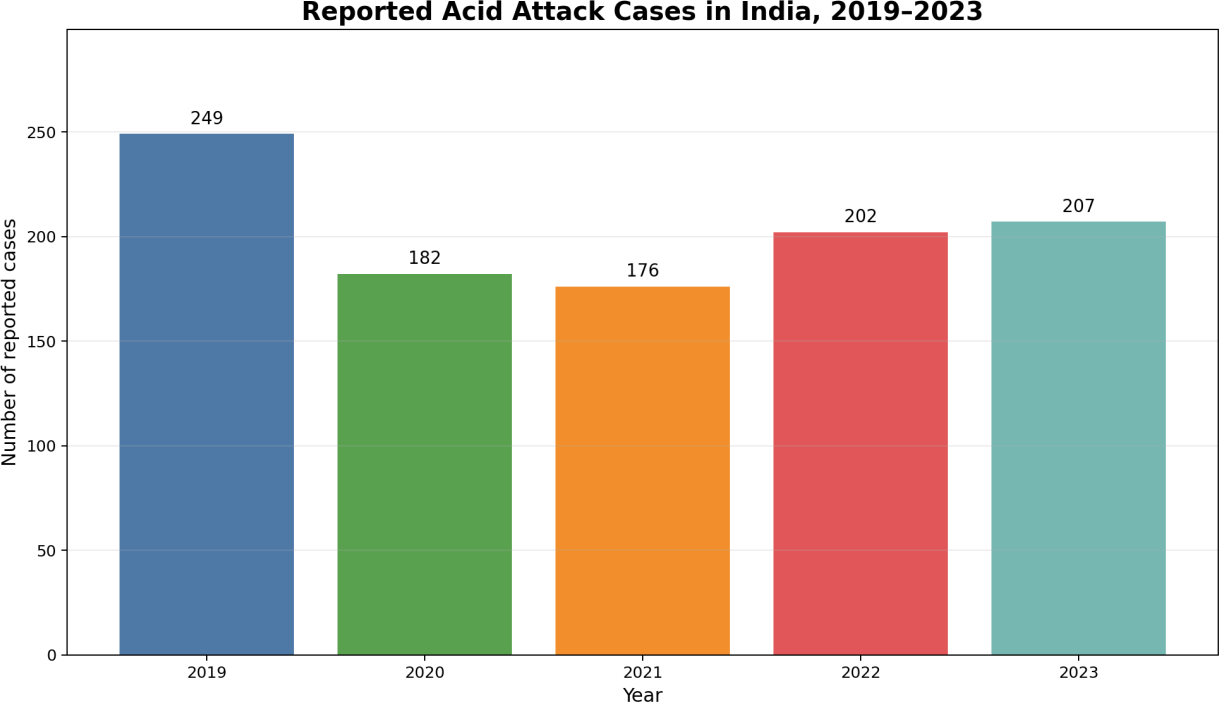
Figure 1 illustrates the cases of acid attacks in India during the years 2019 to 2023. The notable pattern is that, after the pandemic caused a drop in reported cases, the reported cases remained above 200 for both 2022 and 2023. This shows that acid violence does not exist only in exceptional and rare cases. More important than the change in year-to-year numbers is the persistence of the cases. A legal system that assumes acid attacks are so infrequent that they do not warrant a dedicated infrastructure is mistaken. Such a system would not account for the demand for various services, such as survivor compensation and emergency and long-term care, which is still made across various regions of the country.
Figure
Figure 1: Reported acid attack cases in India, 2019–2023.
Figure note: The official series lists 249 documented cases in 2019, 182 in 2020, 176 in 2021, 202 in 2022, and 207 in 2023. The pattern is suitable for comparison over the years and appropriate for visual analysis of consistency, as opposed to isolated spikes.
B. Pendency and Delay
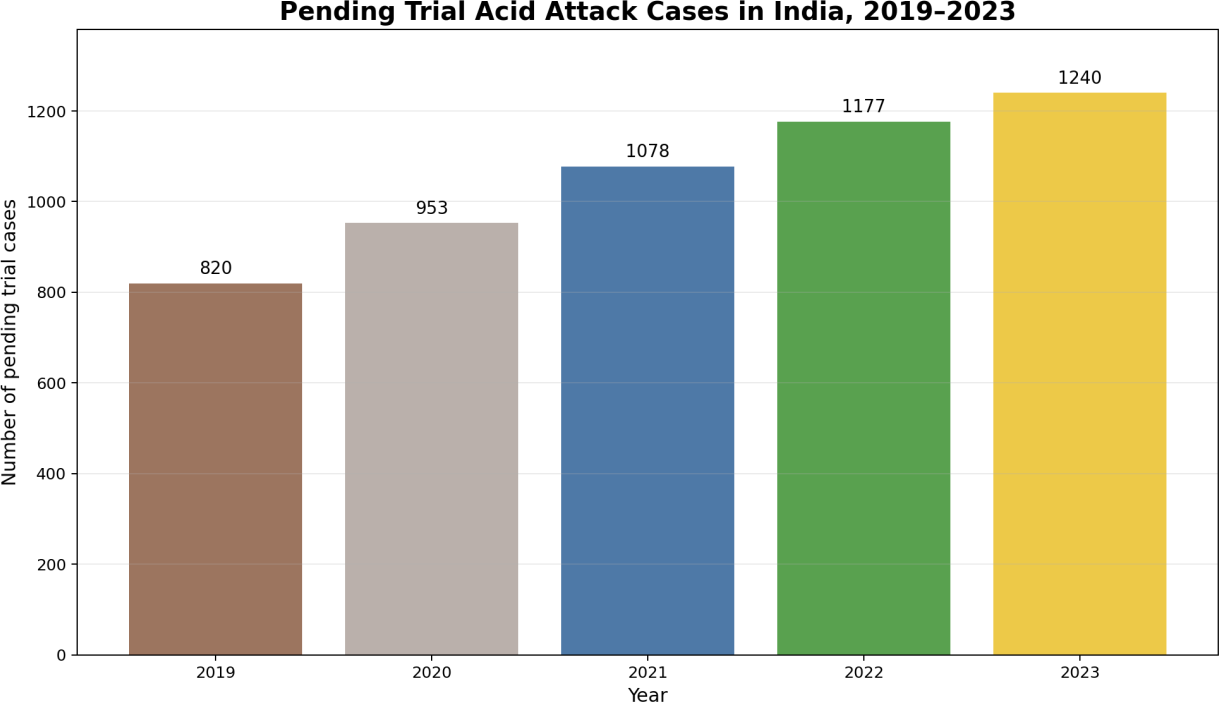
Figure 2 shows pending trial numbers for the same years and displays an increase from 820 cases in 2019 to 1,240 cases in 2023. That increase is relevant for victim justice, because delay is not neutral in acid attack case law.29 Pending trials increase the uncertainty of evidence, delay closure, and usually coincide with delay in financial compensation, repeated visits to hospital, and economic dependence. As pending cases increase, along with the new cases reported, the legal system treats survivors’ pending and new cases as secondary. Therefore, the delay is not neutral; it becomes part of the victim’s active harm, and not just an irrelevant delay in the system.
Figure
Figure 2: Pending trial acid attack cases in India, 2019–2023.
Figure note: Pending trial numbers rose from 820 in 2019 to 953 in 2020, increasing to 1,078 in 2021, 1,177 in 2022, and 1,240 in 2023. This figure illustrates the growth of the backlog and the importance of timely adjudication in the protection of survivors.
C. Regional Concentration and Survivor Vulnerability
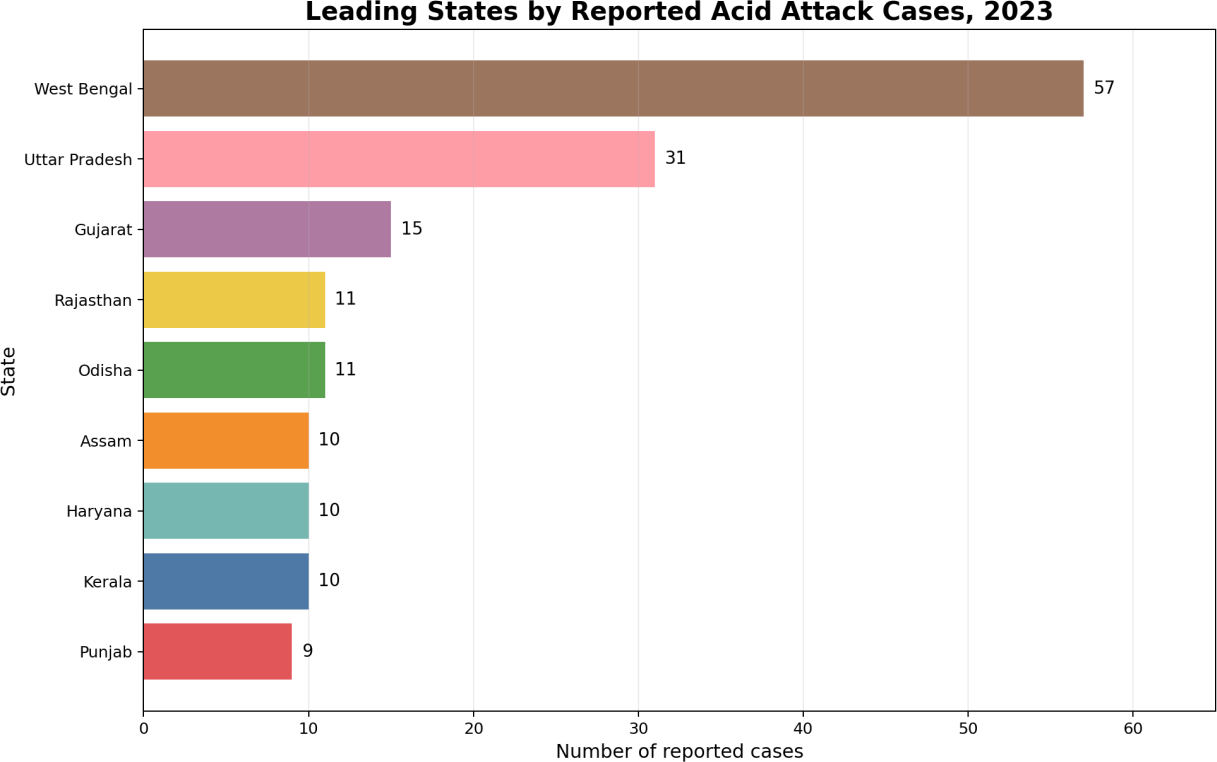
Figure 3 illustrates the highest-reporting States for acid attack cases. The concentration of cases in States such as West Bengal and Uttar Pradesh can be seen in both recent parliamentary replies and earlier ministry data. This indicates that certain regions carry case burdens that are not incidental.30 Case numbers here have two meanings. First, the distribution of services to survivors cannot be equal across all States, as some will need more services and more advanced infrastructure than others. Second, the case concentration should prompt the administration to evaluate the regulation of acid sales, offer hospital readiness and legal aid, and focus more on awareness of survivor services in the high-case regions.
Figure
Figure 3: Leading States by reported acid attack cases, 2023.
Figure note: According to the official statistics for 2023, West Bengal reported 57 total cases, Uttar Pradesh 31, and Gujarat 15. Rajasthan and Odisha reported 11 cases each, while Assam, Haryana, and Kerala each reported 10 cases. The data illustrates a regional distribution of reported cases.
The passage from victim to survivor in modern scholarship is determined by the length of the medical delay, the public aid gap, and the social burden of stigma and enforced social dependency. This description bolsters the legal theory that compensation is a prerequisite of rehabilitation. Where there is persistent backlog data alongside a lack of qualitative research on the situation after the attack, an inadequate legal response becomes unacceptable.31 The law must be assessed not only by the number of convictions but also by the survivors’ ability to recreate the fabric of day-to-day life.
Differential vulnerability is another important issue that deserves more recognition. Research shows that attacks involving acid and minors can make the integration process even more difficult by disrupting schooling, identity development, and family stability. This is important because the current discourse on compensation tends to focus on adult claimants who need medical treatment and income replacement.32 However, survivors are often minors, students, or people who do not participate in the formal labour market. Therefore, a more comprehensive victim justice approach needs to factor in the survivor’s age, gender, and social status when considering compensation, counselling, educational assistance, and guardianship-sensitive frameworks.
Towards a Rights-Based Model of Victim Justice
Victim justice that operates within a rights-based approach does not forgo compensation. Instead, it places compensation within a wider range of enforceable responsibilities. The main issue concerns whether, within the Indian legal system, acid attack survivors will continue to be viewed as claimants of episodic relief, or whether, in future, they will be viewed as holders of persistent claims on the State.33
A. Reframing Compensation
Victim justice theory supports the post-crime restoration approach because it considers restoration and accountability as intertwined. From the lens of victims and restorative justice, James Dignan articulates how the legal system must address the needs that arise from the offence, and that accountability cannot be presumed to be the fulfilment of the social contract. When Dignan’s perspective is applied to acid attacks, it becomes clear that if the State recognises an acid attack as a social wrong, it must also address the social damage.34 Thus, treatment, rehabilitation, and financial compensation are correlated responsibilities of the State and are not to be treated as the State’s options.
The victimology of India offers a different perspective on the place of victims in the formal justice system. Victims of acid attacks are in a position of being on the margins of the justice system. Early scholars of victimology in India were critical of a justice system that criminalised the acid attack offence and underscored its legal significance, yet practically denied victims justice.35 Survivors of acid attacks continue to face a justice system that keeps the survivors’ needs, both at the moment of the offence and at the most critical legal moment of after-care, at the periphery and with the least capacity.
B. Institutional Consequences
Such a framework would contain four structural components. First, compensation should occur on a recurring basis where ongoing medical or vocational loss can be shown. Second, certification of disability should give an automatic right to relevant welfare programmes. Third, legal aid covering the hospital, compensation, and disability processes should be provided to each survivor and should be case-managed. Fourth, the data systems should reflect not only the recorded crimes, but also the provision of compensation, the continuity of treatment, and the outcome of reintegration. These changes would not amount to the creation of an entirely new system of laws. Instead, they would give effect to the principles of statutes and case law that are evident but remain insufficiently bound to administrative practice.36
The aim should be repair, not charity. According to restorative justice, the response to serious harm should do more than express condemnation of the act. Instead, the response should allow the victim to restore his or her social status and to re-engage with society.37 This approach has particular relevance to the case of acid attacks, which are a permanent and excruciatingly painful act of altering the victim’s body for the purpose of public humiliation. In order to have a justice system that is restorative and dignified, we should equip acid attack survivors with the resources they need to regain their right to the social spheres of education, employment, and the freedom to exist. The transition from providing aid to a survivor to the restoration of that survivor is the promise of victim justice.
Conclusion
The contemporary laws on survivors of acid attacks have advanced from settings that were crude and primitive. The current laws are incomplete, with implementation fragmented, slow, and dependent on one-off monetary compensation. The difficulty here is not so much whether victim justice is important, but rather transforming this idea into some form of institutional architecture that survivors can use.38
The Indian legal system, as explored here, includes most of the necessary components for the creation of a serious survivor-centred system. Acid violence is specifically defined in the Bharatiya Nyaya Sanhita, 2023; the Bharatiya Nagarik Suraksha Sanhita, 2023 links the criminal process to compensation with free treatment; disability law broadens the scope of support; and the courts have repeatedly stated that acid violence survivors must not be abandoned. Over this period, significant progress has been made, given that the offence previously lacked institutional visibility and doctrinal specificity.39
Compensation appears to be seen more as a form of delivery. The provision of a minimum payment may give some form of relief. However, it is insufficient to provide the many forms of compensatory treatment. Reconstructive care, psychosocial stability, and social reintegration are all examples of the compensatory treatment that a minimum payment will not begin to cover. Recent corrections by the courts of under-compensation, along with the Supreme Court’s continued oversight, point to the fact that the greatest deficiencies lie in implementation and not in the establishment of a norm. The promise of victim justice, therefore, lies in the unfinished distance between the law and the lived experience of recovery.40
A more appropriate model would integrate compensation, rehabilitation, and reintegration as rights, each triggered by the same criminal act. Such a shift in the law would reflect the actual structure of acid violence, which rips apart the body, social identity, and community of the victim. If Indian law is to honour the dignity of acid attack survivors, it must move beyond episodic relief and organise sustained repair. Only then will the transition from victim to survivor become a legal accomplishment rather than a social burden placed primarily on the victims’ own will.41
Suggestions
Addressing the challenges faced by acid attack survivors requires comprehensive reforms bridging various domains, such as criminal law, disability law, public health, legal support, and welfare services, to offer a complementary approach to recovery from the initial medical crisis to long-term social reintegration.
• Create staged compensation awards: Compensation should be distributed in stages, corresponding to the completion of required medical procedures, the provision of reconstructive surgeries, and losses pertaining to education and livelihood, not through a one-time disbursement. Schemes of States and Union Territories should clearly empower revisions where subsequent surgeries, further disability progression, or documented income loss is sustained.
• Mandate automatic disability linkage: Once acid attack survivors receive certification under the Rights of Persons with Disabilities Act, 2016, linked welfare benefits and social security schemes should automatically become accessible. This means survivors would no longer have to continually demonstrate the same injury to different entities.
• Institutionalise hospital case management: All designated hospitals treating acid attack survivors should have a case manager. The case manager would sustain treatment, maintain records, create referrals, and liaise with legal services. This would ensure that survivors do not lose compensation or welfare benefits due to incomplete or dispersed medical records.
• Guarantee trauma-informed counselling: Counselling should be considered an automatic legal right from the very first stage of treatment, rather than an optional service provided by civil society. Governments should appoint trained counsellors and should ensure that counselling continues after discharge, particularly where the survivor is likely to be confronted by hostile family members or where public stigma is likely to be directed at the survivor.
• Build livelihood restoration programmes: Every compensation programme should include a specific path to the smooth continuation of education, vocational training, placement counselling, and support for starting an individual business. Survivors need to regain their income, independence, and the ability to engage confidently in the community before true reintegration can take place.
• Develop high-incidence State action plans: Targeted programmes for acid sale regulation, survivor support, police training, and specialised legal assistance are recommended for regions with endemic acid attack cases. While uniform national standards are required, region-specific intensity is imperative for areas with high concentrations.
• Track outcome-based data: Official reports must go beyond documented cases and convictions to include the disbursement of compensation, completion of medical treatment, certification of disability, and reintegration. Improved data would allow the judiciary and legislators to appraise the extent to which legal recovery rights are achieved and the sustainability of recovery.
• Strengthen District Legal Services Authorities: District Legal Services Authorities must create survivor-centric monitoring registers and track each survivor through the stages of treatment, compensation, and disability, and provide final reintegration assistance. Legal aid should be a continuous support service, not a one-time offering.
• Clarify gender-inclusive implementation: Policy documents need to clearly stipulate that all acid attack survivors will have access to compensation and rehabilitation programmes. This should be done while maintaining an understanding of the gendered nature of these offences, in order to retain feminist perspectives and avoid leaving male survivors and child survivors in administrative gaps.
• Create judicial compliance dashboards: High Courts should work with State Legal Services Authorities to create public, reportable dashboards to monitor compliance with directions on compensation and treatment. In the absence of a monitoring system, survivors are forced to take recourse to court to realise and enforce their legal rights. The introduction of monitoring systems will reduce the legal demand on survivors.
*****
Footnotes
1. Shivani Goswami and Rakesh Kumar Handa, The Peril of Acid Attacks in India and Susceptibility of Women, 3 Journal of Victimology and Victim Justice 72 (2020).
2. Matthew Hall, Victims of Crime: Policy and Practice in Criminal Justice 67 (Routledge, London, 1st edn., 2012).
3. Laxmi v. Union of India, (2014) 4 SCC 427.
4. Law Commission of India, 226th Report on the Inclusion of Acid Attacks as Specific Offences in the Indian Penal Code and a Law for Compensation for Victims of Crime 3 (July 2009).
5. Parivartan Kendra v. Union of India, (2016) 3 SCC 571.
6. The Bharatiya Nyaya Sanhita, 2023 (Act 45 of 2023), s. 124.
7. The Bharatiya Nagarik Suraksha Sanhita, 2023 (Act 46 of 2023), ss. 396, 397.
8. The Rights of Persons with Disabilities Act, 2016 (Act 49 of 2016), s. 2(zc) and Schedule.
9. Sandra Walklate, Handbook of Victims and Victimology 120 (Routledge, London, 1st edn., 2007).
10. Supra note 4, at 196.
11. National Legal Services Authority, Compensation Scheme for Women Victims/Survivors of Sexual Assault/Other Crimes 11 (2018).
12. Sital Kalantry, Jocelyn Getgen Kestenbaum et al., Combating Acid Violence in Bangladesh, India, and Cambodia 43 (2011).
13. National Commission for Women, Acid Attack Survivors 18 (2025).
14. Shalini Mittal, Tushar Singh et al., Exploring the Trauma of Acid Attack Victims: A Qualitative Enquiry, 88 Women’s Studies International Forum 102507 (2021).
15. National Commission for Women, Acid Attack Survivors 24 (2025).
16. Supra note 12, at 220.
17. Mohammad Sabzi Khoshnami, Elham Mohammadi et al., Conceptual Model of Acid Attacks Based on Survivor’s Experiences: Lessons from a Qualitative Exploration, 43 Burns 608 (2017).
18. Pratishtha Singh, Vikash Ranjan Keshri et al., Stigma, Disfigurement and Resilience Among Acid Attack Survivors: A Qualitative Body Mapping Study in Noida, India, 4 BMJ Public Health 1 (2026).
19. N. Prabha Unnithan, Mahesh K. Nalla, Violence Against Women in India: Honour Killings, Legacy of Acidity and Sexual Exploitation 91 (Routledge, London, 1st edn., 2018).
20. National Legal Services Authority, NALSA (Legal Services to Victims of Acid Attacks) Scheme 4 (2016).
21. Shaheen Malik v. Union of India, W.P.(C) No. 1112 of 2025, orders dated 9 March 2026 and 4 May 2026 (Supreme Court of India).
22. Supra note 4, at 249.
23. State of Himachal Pradesh v. Vijay Kumar alias Pappu, (2019) 5 SCC 373.
24. Nipun Saxena v. Union of India, (2019) 2 SCC 703.
25. Rachna Paul v. Government of National Capital Territory of Delhi, W.P.(C) No. 2804 of 2019, judgment dated 6 November 2024 (Delhi High Court).
26. Surya Sankar Barik v. State of West Bengal, WPA 12725 of 2023, judgment dated 20 December 2023 (Calcutta High Court).
27. Navpreet Kaur and Roger W. Byard, Issues and Problems Involving Acid Attacks Against Male Victims in India, 63 Medicine, Science and the Law 218 (2023).
28. Government of India, Support Mechanisms for Acid Attack Survivors (Ministry of Women and Child Development, February 2026).
29. National Crime Records Bureau, Crime in India 2023 (Ministry of Home Affairs, 2024).
30. Government of India, Cases of Acid Attacks in the Country (Ministry of Home Affairs, March 2022).
31. Rashida Salmani, Geeta Mishra et al., Acid Attacks in India and the Role of Stakeholders: A Journey from Victim to Survivor, 28 Vision 251 (2024).
32. Navpreet Kaur and Roger W. Byard, Characteristics of Acid Attacks Involving Children in India, 64 Medicine, Science and the Law 91 (2024).
33. Supra note 2, at 218.
34. James Dignan, Understanding Victims and Restorative Justice 84 (Open University Press, Maidenhead, 1st edn., 2005).
35. Vasu Nair Rajan, Victimology in India: An Introductory Study 55 (Allied Publishers, New Delhi, 1st edn., 1981).
36. Supra note 20, at 65.
37. Howard Zehr, The Little Book of Restorative Justice 34 (Good Books, New York, 2nd edn., 2015).
38. National Commission for Women, Acid Attack Survivors 32 (2025).
39. Supra note 6.
40. Supra note 11, at 245.
41. Supra note 12, at 90.